
Rust Boat Building Guide (2026): How to Build a Boat, All Recipes, Materials & Pro Tips
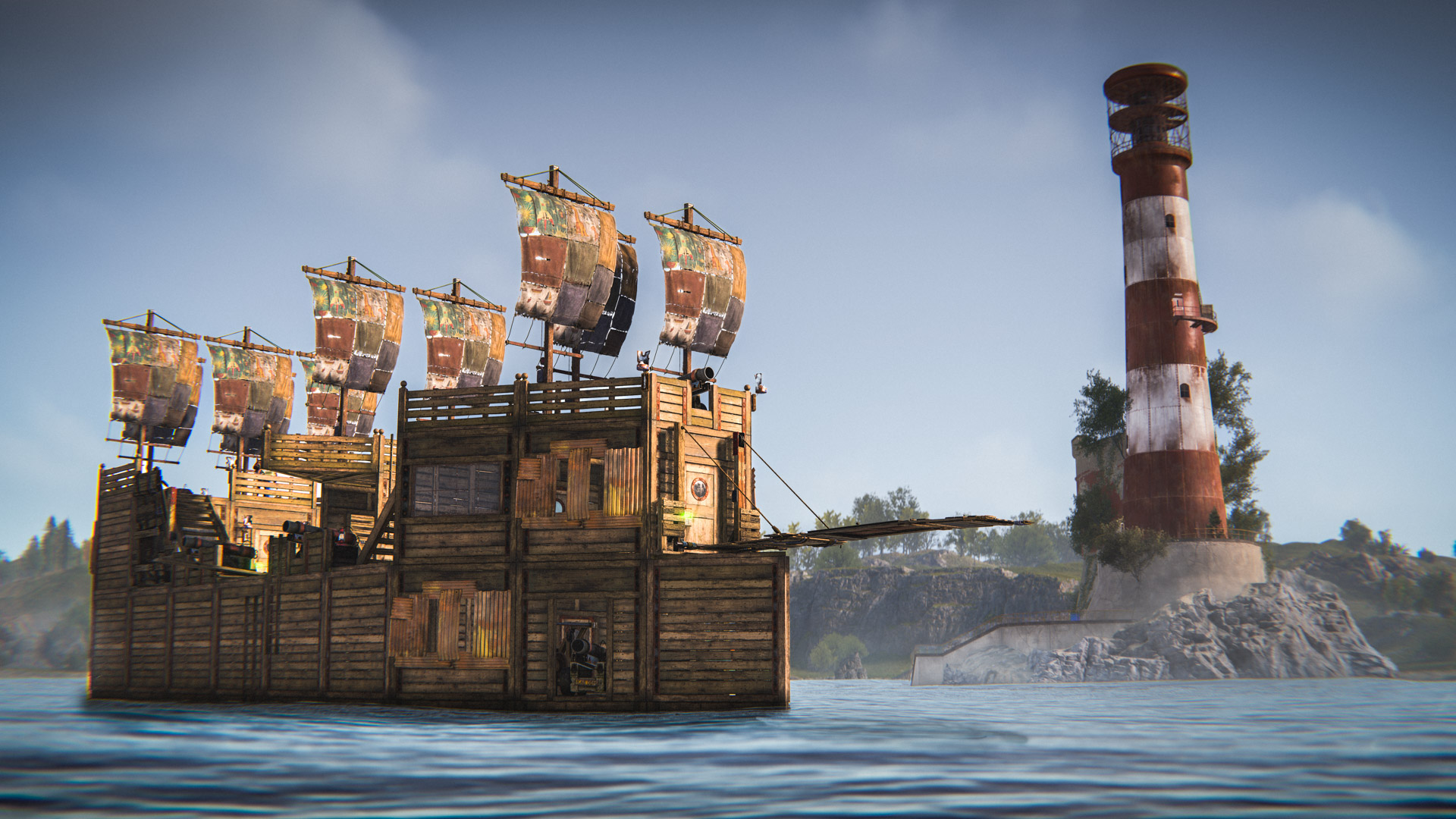
From driftwood to dreadnought — the Naval Update lets you build this. (Image: Facepunch Studios)
TL;DR: Deploy a Boat Building Station in deep water, use a Boat Building Plan (20 wood) to place hulls and walls, add sails (free, 2,500 power) or engines (fuel-hungry, 10,000 power), lock your steering wheel, and keep your power-to-mass ratio above 1.0 — or your ship won’t move an inch.
Ever since the Naval Update dropped in February 2026, Rust’s oceans have stopped being empty space between monuments and become territory worth fighting over. Player-made boats let you build anything from a one-person fishing skiff to a cannon-bristling war galleon — and unlike a land base, your loot moves with you.
This guide covers everything you need to build your first boat in Rust: every crafting recipe, how the power-to-mass speed system actually works, how boat health and decay differ from land bases, and the mistakes that sink new shipwrights on day one.
What Is Boat Building in Rust?
The player-made boat building system arrived with the Naval Update as a mobile, fully customizable alternative to the Tugboat. Instead of claiming a pre-made vessel, you deploy a Boat Building Station in deep water and construct your ship piece by piece using a Boat Building Plan — hulls, floors, walls, sails, engines, and weapons, all snapped together on a floating construction grid.
The result is something between a base and a vehicle. You can deploy furnaces, workbenches, beds, storage boxes, and even traps on board, then pull anchor and relocate your entire operation overnight. For solo players, that means a home that raiders can’t map. For groups, it means floating fortresses and genuine naval PvP.
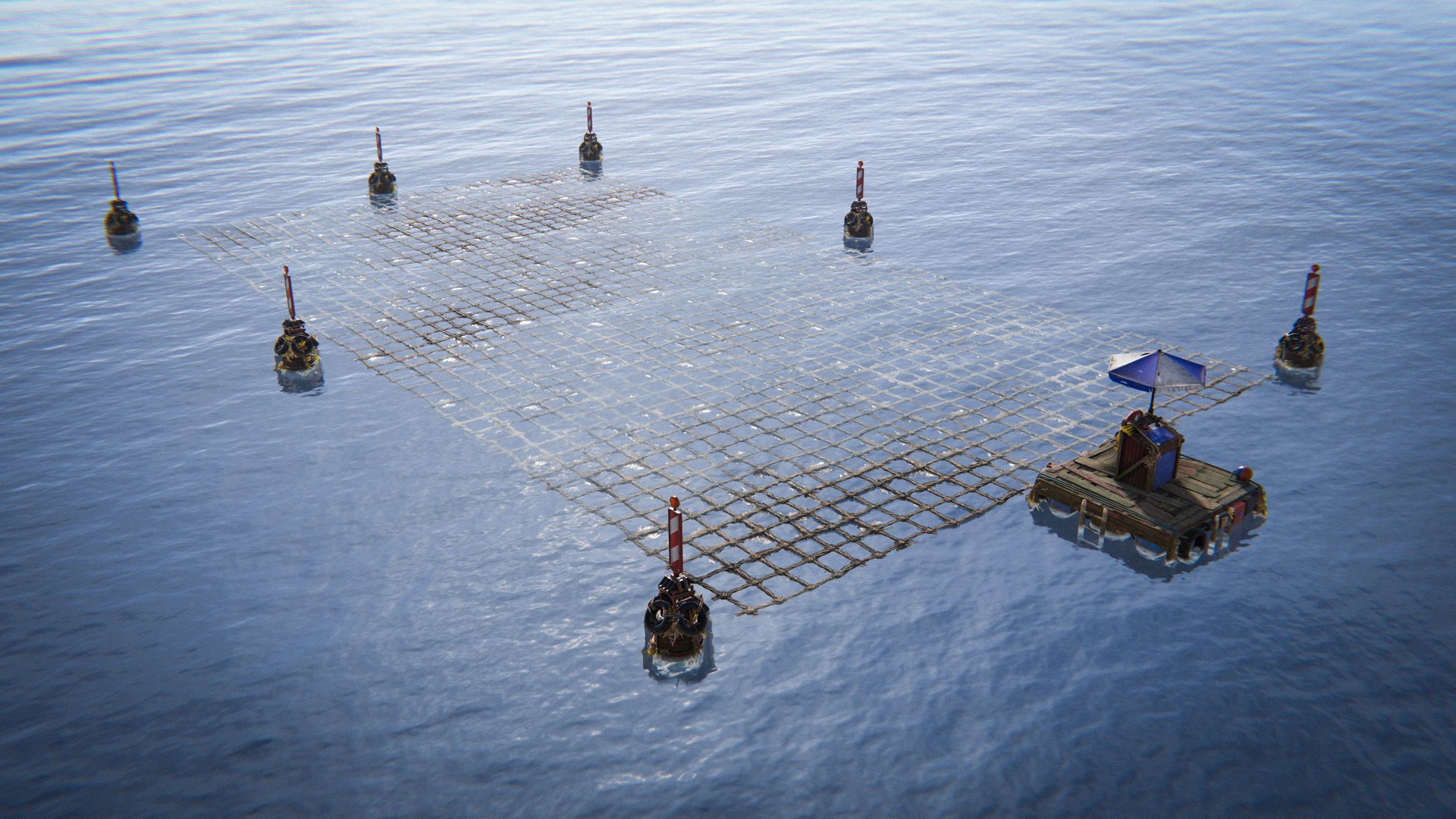
The Boat Building Station’s blue grid marks a valid deep-water build zone. (Image: Facepunch Studios)
Rust Boat Building Rules and Limits
Before you burn a stack of wood, know the hard limits the game enforces:
| Rule | Limit |
|---|---|
| Maximum footprint | 5×10 squares |
| Maximum height | 2 decks (plus a low third-height wall) |
| Maximum pieces | 180 placeable blocks |
| Building materials | Wood or sheet metal only |
| Steering wheels | 1 per boat |
| Engines | Bottom deck only |
| Water depth | Deep water required — no shallow-water cheese |
Two other rules shape every design decision:
- Boats share one health pool. Unlike a land base, damage isn’t tracked per wall. Your ship’s total durability is the sum of all its parts, and when it hits zero, the whole thing goes down.
- Speed is power divided by mass. Every piece you add makes the boat heavier. Every sail or engine adds thrust. Get the ratio wrong and your dreadnought becomes a very expensive buoy.
We’ll cover both systems in detail below.
How to Build a Boat in Rust: Step by Step
Step 1: Craft the Boat Building Plan
The Boat Building Plan is your construction tool — think of it as the hammer of the seas.
- Recipe: 20x Wood at a Workbench Level 1
- How to use: Equip it and hold Right-Click inside the Boat Building Station’s zone to open the build menu
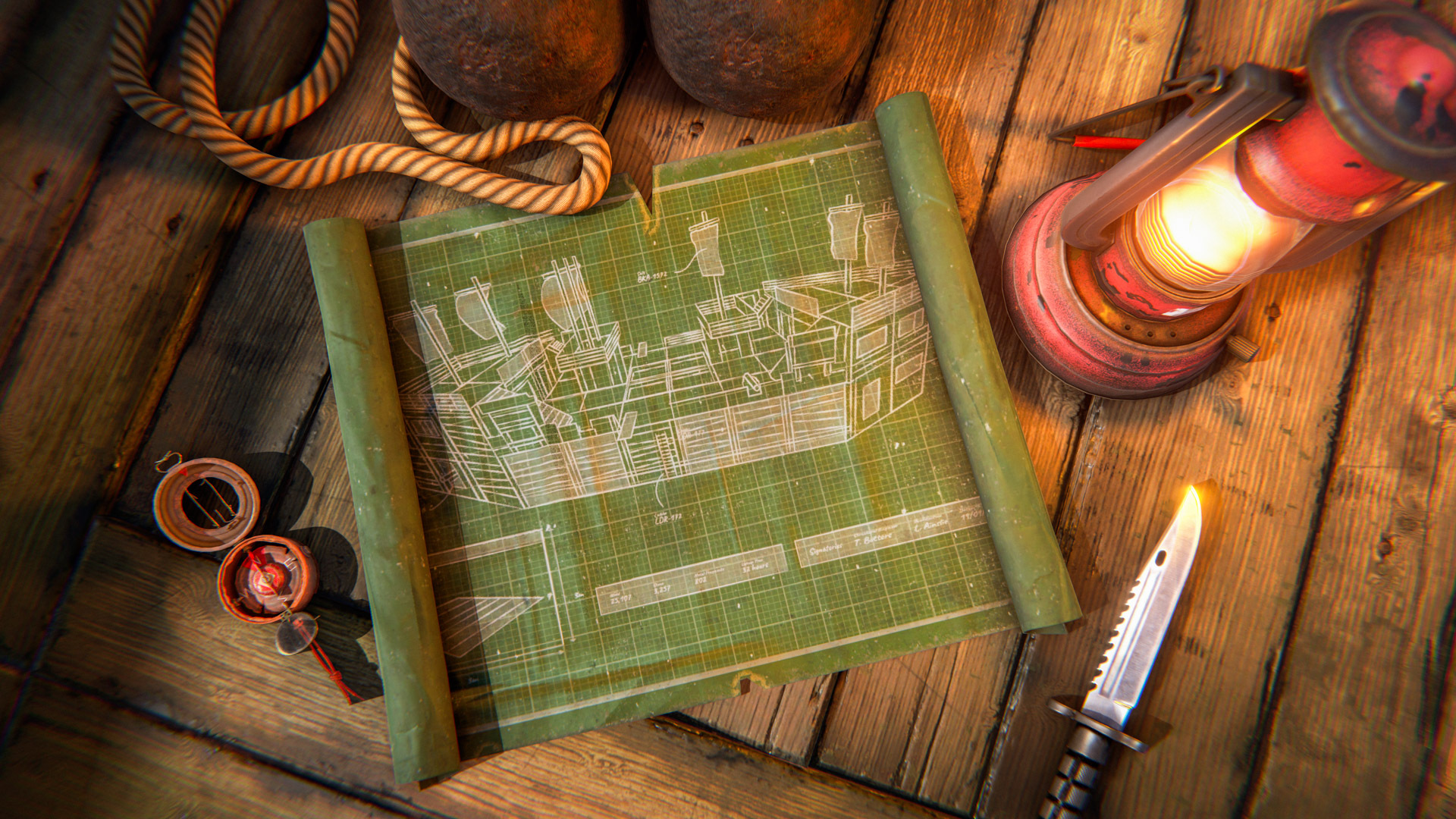
The Boat Building Plan — 20 wood buys you the keys to the ocean. (Image: Facepunch Studios)
It’s cheap enough that losing one is meaningless, so craft a spare.
Step 2: Deploy the Boat Building Station
The Boat Building Station is the anchor point (literally) for the entire process.
- Recipe: 200x Wood + 1x Tarp at a Workbench Level 1
- Placement: Deep water only. The station checks the distance between the seafloor and the surface — if it projects a blue hue and a construction grid, you’re in a valid spot. If not, pick up and redeploy further out.
The station also doubles as your dry dock. Sail a finished boat back inside its boundary and redeploy the station to enter edit mode, which suspends the vessel so you can add, remove, or rearrange pieces. While editing, the hammer’s demolish option works on a 10-minute timer, just like a fresh land base.
One warning: the station’s “Clear Building Area” function deletes the entire project with no refunds. It’s one click away from erasing hours of work, so treat it like a self-destruct button.
Step 3: Place Hulls, Floors, and Walls
Hulls are your foundations. Everything else builds on top of them, and each piece has a wood cost, a Low Grade Fuel cost, a health value, and — critically — a mass value:
| Piece | Health | Mass | Cost |
|---|---|---|---|
| Square Hull | 75 | 100 | 300 Wood + 15 Low Grade |
| Triangle Hull | 25 | 50 | 150 Wood + 8 Low Grade |
| Floor | 50 | 100 | 150 Wood + 8 Low Grade |
| Floor Triangle | 25 | 50 | 75 Wood + 4 Low Grade |
| Wall | 50 | 100 | 300 Wood + 15 Low Grade |
| Doorway | 50 | 100 | 210 Wood + 11 Low Grade |
| Window | 50 | 100 | 210 Wood + 11 Low Grade |
| Low Wall | 25 | 50 | 150 Wood + 8 Low Grade |
| Low Cannon Wall | 25 | 50 | 150 Wood + 8 Low Grade |
| Boat Stairs | 50 | 50 | 300 Wood |
Notice that Low Grade Fuel is a construction material here, not just engine food. Budget for it before you start — running dry mid-build with a half-finished hull is a classic first-timer mistake.
Step 4: Add Propulsion — Sails vs. Engines
You have two propulsion options, and the best boats use both.
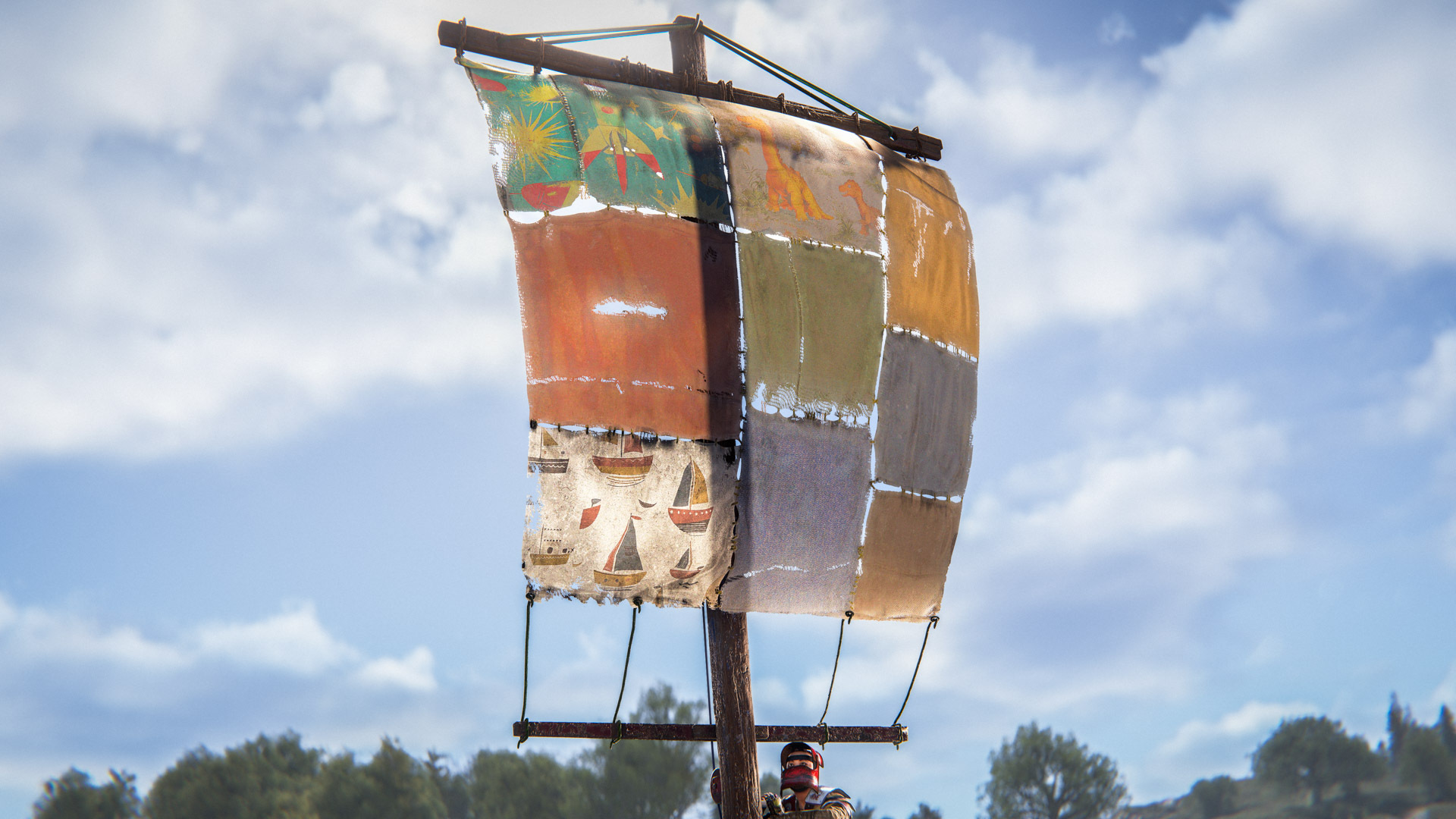
Sails: slow, scrappy, and gloriously free of fuel costs. (Image: Facepunch Studios)
Sail
- Recipe: 150x Wood + 1x Tarp at a Workbench Level 1
- Power output: 2,500 per sail
- Fuel cost: None — sails are free, forever
- Placement: Must face the direction of travel, and can’t sit too close to another sail
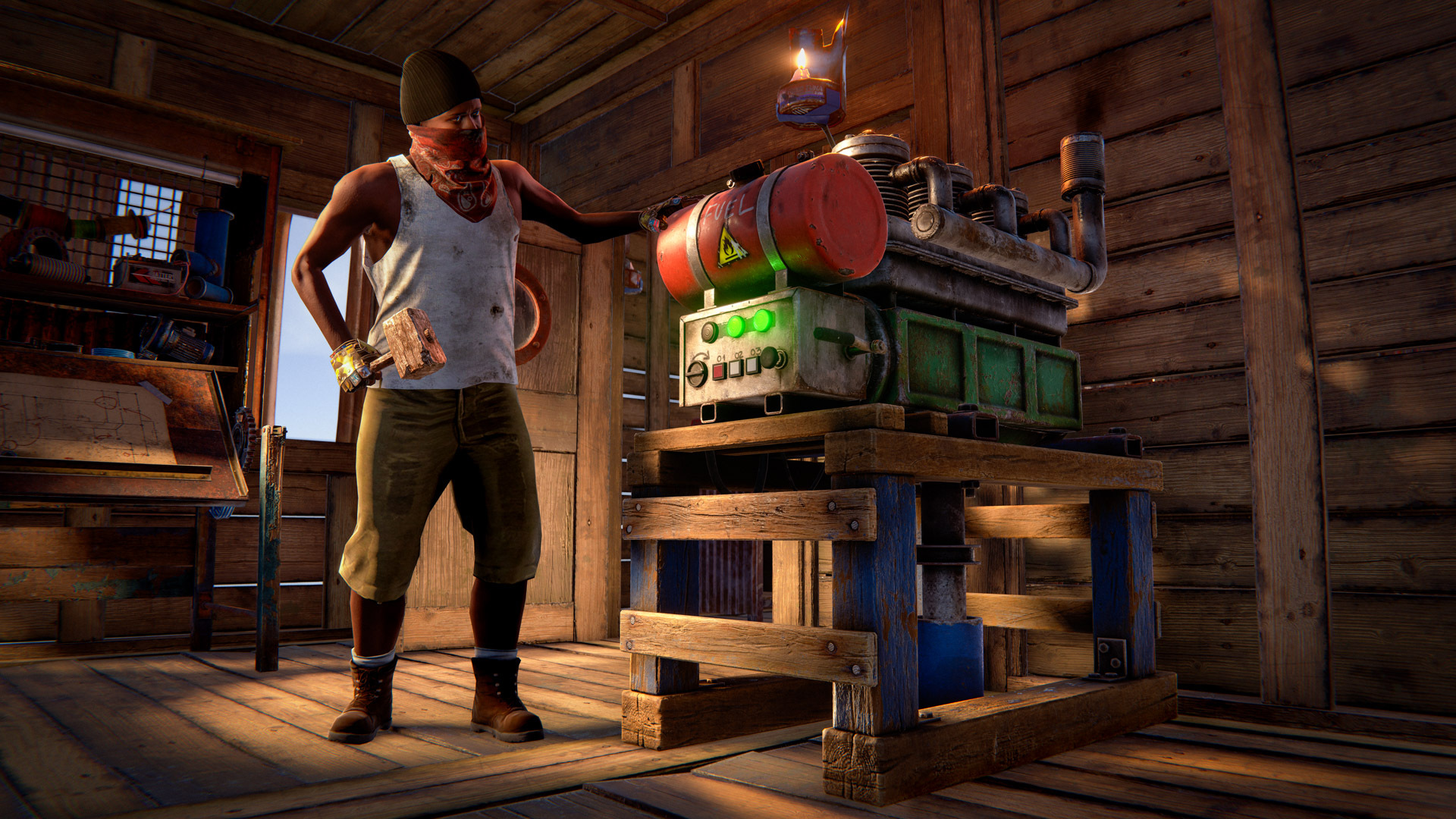
The Small Boat Engine: four times a sail’s power, and thirsty to match. (Image: Facepunch Studios)
Small Boat Engine
- Recipe: 50x Low Grade Fuel + 5x High Quality Metal + 2x Gear at a Workbench Level 2
- Power output: 10,000 per engine
- Fuel cost: Runs on Low Grade Fuel
- Placement: Bottom deck only. Each engine toggles individually with E, and engines support reverse — sails don’t.
The smart setup is a hybrid: cruise on sails to save fuel, then fire up the engines when you need to run a blockade or chase down a target. One engine is worth four sails in raw power, but four sails never ask for fuel again.
Step 5: Mount the Steering Wheel
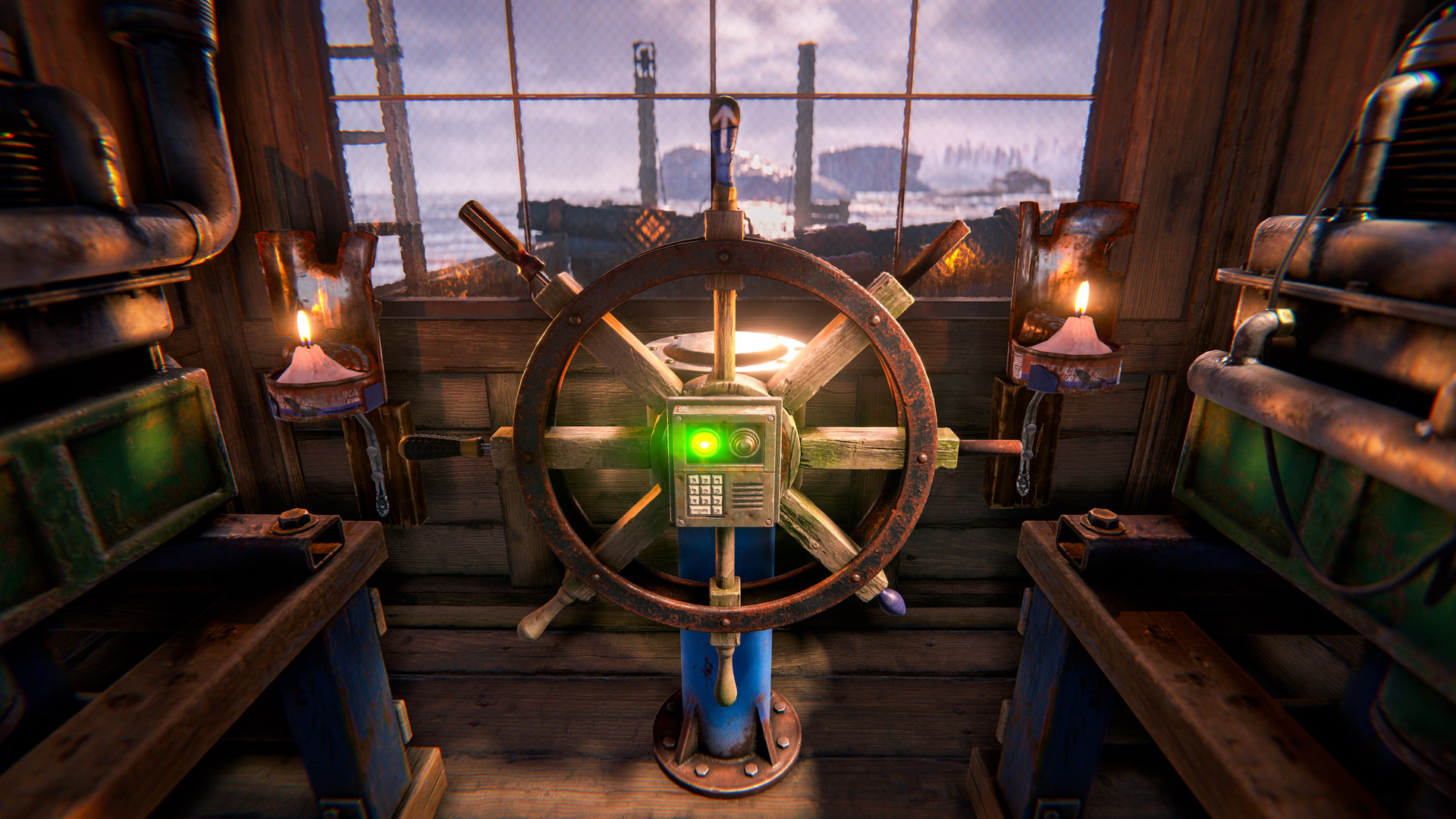
One wheel per boat — and whoever holds the code holds the ship. (Image: Facepunch Studios)
- Recipe: 100x Wood at a Workbench Level 1
- Limit: One per boat
The Steering Wheel is more than a control surface — it’s your boat’s authorization system. Boats don’t use tool cupboards; instead, you place a code lock on the wheel, and that lock controls who can pilot the vessel. Lock it the second you place it. An unlocked wheel is an open invitation for someone to sail off with your entire base.
Controls: Press E to mount, hold A to bear left, hold S to bear right, Spacebar to dismount. The arrow on the wheel shows your current heading.
Step 6: Fit Your Accessories and Set Sail
With propulsion and steering in place, your boat is seaworthy. Load your storage, drop in a bed for a respawn point, and pull away from the station. Congratulations — you’re officially a menace to maritime traffic.
Rust Boat Accessories: Cannons, Anchors, Planks & Ramps
These are optional, but “optional” in Rust usually means “the difference between winning and sinking.”
Cannon
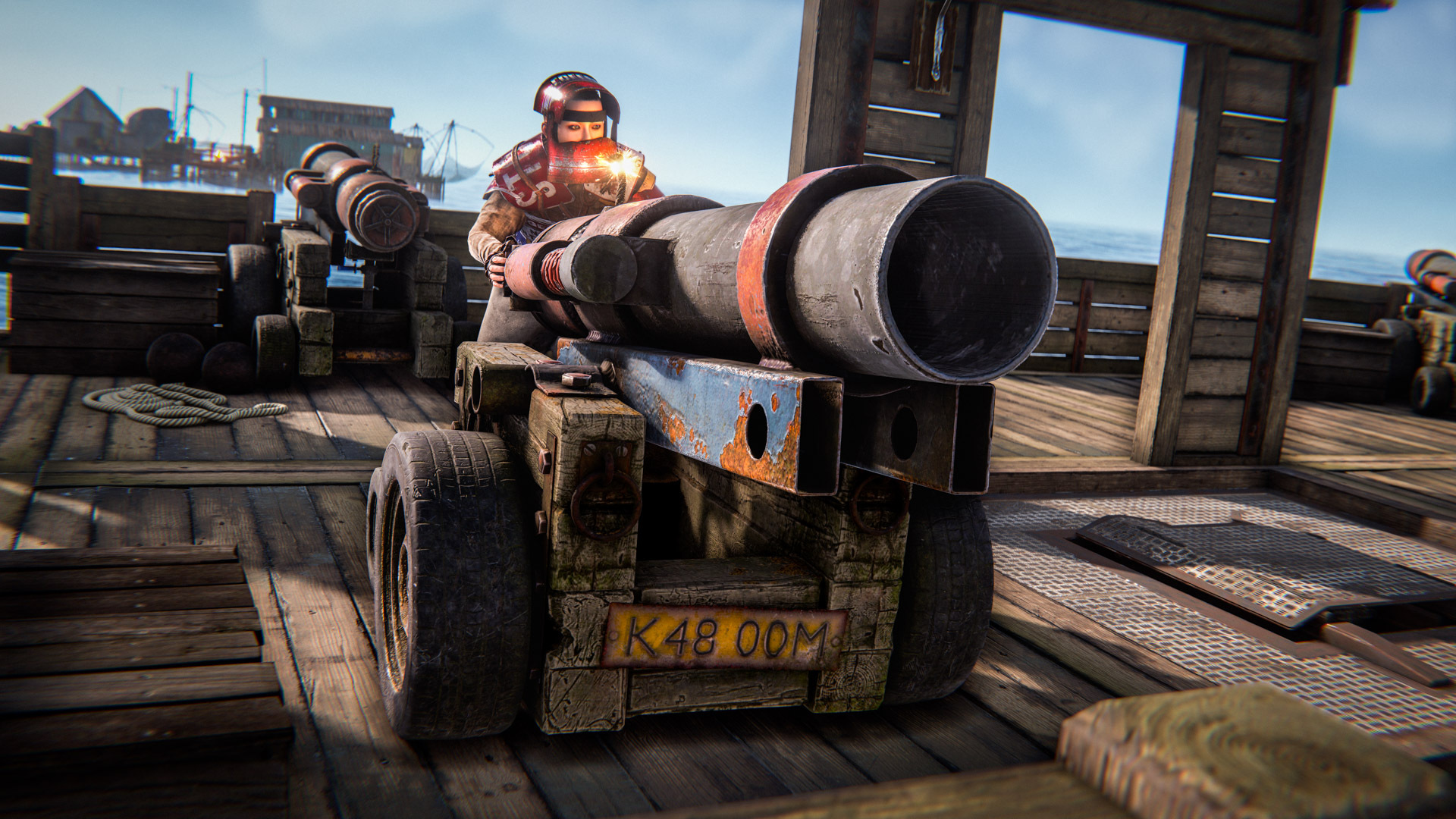
Questionable accuracy, unquestionable damage. (Image: Facepunch Studios)
- Recipe: 100x Wood + 200x Metal Fragments at a Workbench Level 1
- Controls: W/A/S/D to aim, R to prime, Left-Click to fire
Mounted on your boat’s sides, the cannon fires cannonballs with questionable accuracy and unquestionable damage. Fair warning: a badly angled cannon can damage your own ship, and with a shared health pool, friendly fire hurts twice.
Anchor
- Recipe: 250x Wood at a Workbench Level 1
Drops from the side of the vessel and kills all drift. Essential for parking overnight — an unanchored boat wanders, and a wandering boat finds rocks.
Plank
- Recipe: 100x Wood at a Workbench Level 1
A crude, non-retractable boarding platform. Facepunch’s patch notes suggested it’s also useful for “settling minor disagreements” with clanmates. Walk wisely.
Small Ramp
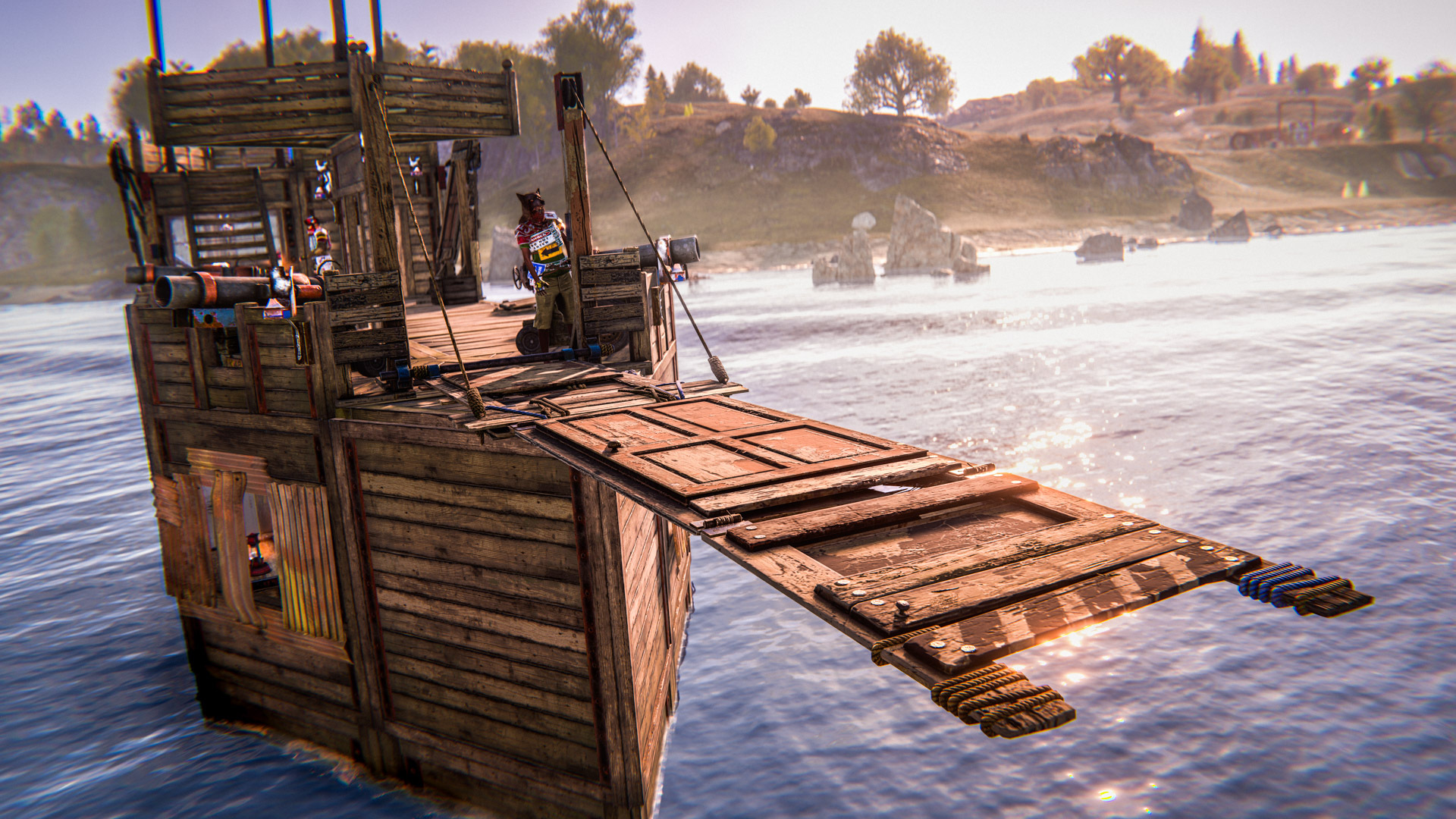
The Small Ramp unfolds for boarding actions — theirs or yours. (Image: Facepunch Studios)
- Recipe: 250x Wood + 2x Rope at a Workbench Level 1
The Plank’s bigger sibling: longer, and retractable with E. This is your boarding tool for hostile vessels — pull alongside, drop the ramp, and storm the deck.
How Boat Speed Works: The Power-to-Mass Ratio
This is the system that separates good shipwrights from floating-brick owners. Your boat’s speed comes from a simple formula:
Total Power ÷ Total Mass = Speed Ratio
- Below 1.0 — your boat doesn’t move at all
- At 1.0 — you’re at the baseline, effectively stationary
- Above 1.0 — you move, and higher is faster (capped at a maximum velocity of 15)
Worked example: a small boat with two sails generates 5,000 power. If its hulls, floors, and walls total 4,100 mass, the ratio is 5,000 ÷ 4,100 = 1.22 — a slow but functional cruiser. Swap one sail for a Small Boat Engine and you’re at 12,500 power for a ratio of 3.05, nearly three times the thrust per unit of weight.
The takeaway: every wall you add is a tax on your speed. Use triangle pieces (half the mass) where you can, skip decorative walls, and add propulsion as your boat grows. A big boat isn’t slow because it’s big — it’s slow because its builder forgot to scale power with mass.
Boat Health, Repair, and Decay
One Health Pool to Rule Them All
Your boat’s durability is the sum of every piece on it. A boat with 750 total health takes ten 75-damage torpedo hits before it sinks — regardless of where those torpedoes land. There’s no “soft side” to exploit and no weak wall to hide: melee damage is equal on all surfaces. More pieces means more total health, but remember the speed tax above.
Repairs
Repair with a standard hammer, consuming Wood and Low Grade Fuel per swing. Keep both stocked in an on-board box — patching mid-fight is often the difference between limping home and feeding the fish.
Decay
Boats decay on a forgiving but real timer:
- Decay starts after 24 hours (1,440 minutes) without player interaction
- Once started, the boat fully breaks down over the next 12 hours (720 minutes)
Touch your boat at least once a day and it lives forever. Deployables made of anything other than wood decay at their normal standard rates, so metal boxes and electrical items need the usual upkeep attention.
7 Pro Tips for Your First Boat
- ⚓ Lock the steering wheel immediately. It’s the boat’s only authorization — an open wheel means anyone can sail away with everything you own.
- ⛽ Stockpile Low Grade Fuel before building. It’s consumed by construction itself, not just engines. A medium build eats hundreds.
- 📐 Go triangle-heavy. Triangle hulls and floors cost half the mass of squares, keeping your power-to-mass ratio healthy.
- ⛵ Mix sails and engines. Sails for free cruising, engines for combat speed and reverse. Pure-sail boats can’t back up; pure-engine boats die when the fuel does.
- 🌊 Anchor every time you park. Drift is real, and shorelines are unkind to wooden hulls.
- 💥 Never touch “Clear Building Area” casually. It wipes the whole project with zero refunds.
- 🛶 Start small. A 2×3 sail skiff teaches you the mechanics for under 2,000 wood. Build the galleon after you’ve sunk your first starter boat — and you will sink it.
Rust Boat Building FAQ
Can a solo player build and operate a boat in Rust?
Yes. A small sail boat with one steering wheel and a couple of sails is entirely solo-friendly. Larger warships with multiple cannons realistically need a crew — one pilot plus gunners.
What workbench level do I need?
Almost everything (plans, station, sails, steering wheel, cannon, anchor) is Workbench Level 1. Only the Small Boat Engine requires Workbench Level 2.
Can boats be raided?
Absolutely. Boats share a single health pool, so attackers don’t need to pick a weak wall — cannons, torpedoes, and even sustained melee will eventually sink you. Mobility is your real defense.
Do boats replace the Tugboat?
Yes, for now. The Naval Update switched off tugboat spawns at Harbor, since the Tugboat was the test bed for player-made boats, and Facepunch said it may return later. Player-made boats are more customizable and scale from dinghy to warship.
Can I put electricity on my boat?
Yes, since the Shipshape update in March 2026. Solar panels, batteries, switches, alarms and storage monitors all work on player-made boats; auto turrets, SAM sites, windmills, CCTV cameras, seismic sensors, hanging lights, door controllers and hoppers are still blocked. Standard deployables — workbenches, furnaces, storage, beds, and even flame turrets and shotgun traps — all work too.
Final Thoughts
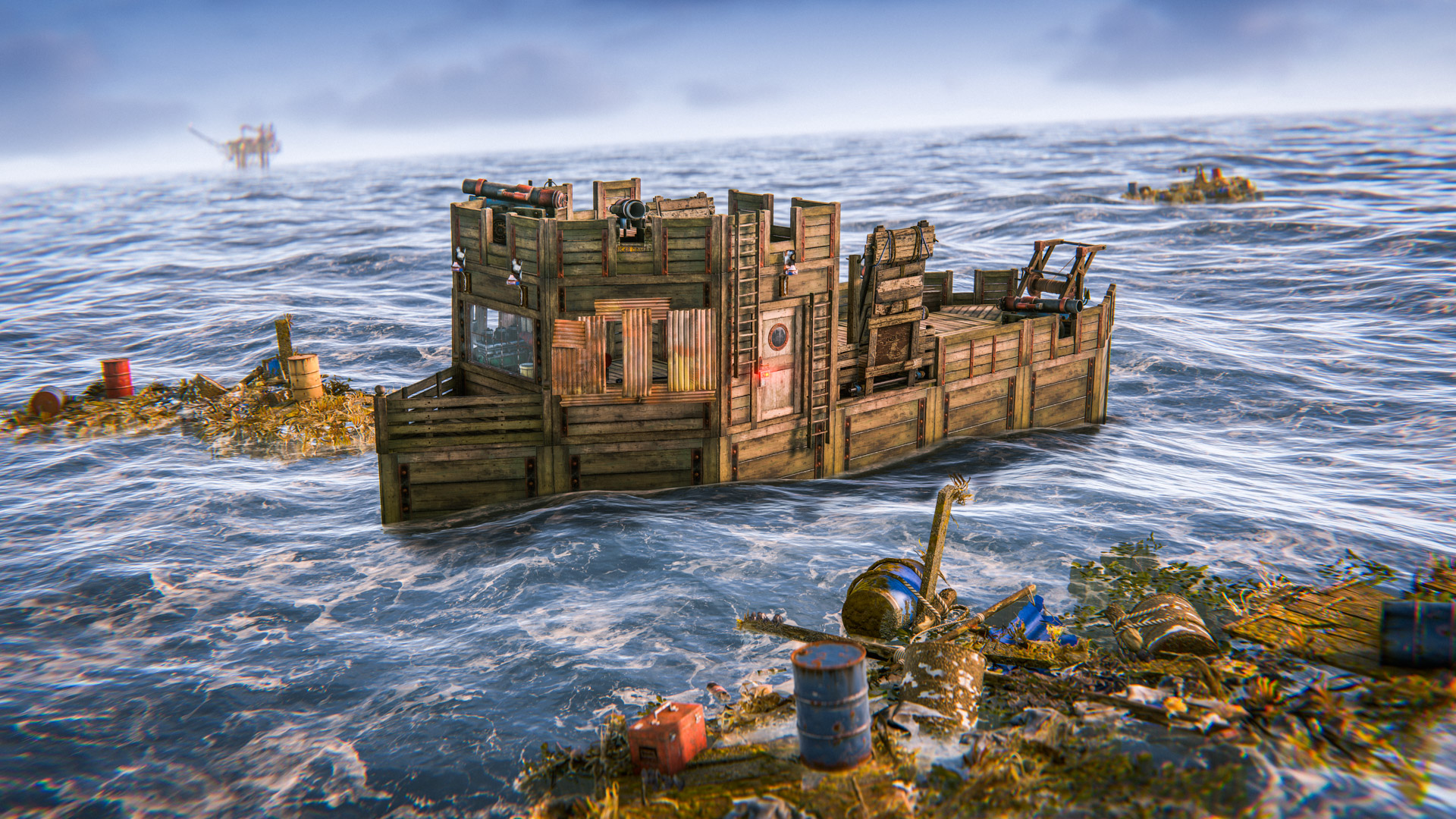
Your first boat won’t look like this. Your third one might. (Image: Facepunch Studios)
Boat building is the biggest shake-up to Rust’s map control in years. The formula for success is simple to say and hard to master: keep mass low, keep power high, lock your wheel, and touch your boat once a day. Start with a cheap sail skiff, learn how the ocean plays, and work your way up to a ship worth flying colors from.
Now get to the dock — the ocean isn’t going to conquer itself.
All screenshots courtesy of Facepunch Studios, from the official Naval Update announcement.