
The tech tree is how you learn blueprints in Rust without ever finding the item. Every workbench has one: a web of item nodes that you unlock with scrap, one connected step at a time, until the gun, door or explosive you want is yours for the rest of the wipe. It is the guaranteed route, and since the big price cut in late 2025 it is a lot cheaper than most older guides say.
This Rust tech tree guide covers how the tree works, what every node costs, the full scrap total for each workbench tier, the real path cost to the items everyone wants (AK, C4, bolt, rockets, SAR, garage door), when to use the tech tree instead of the research table, how the new workbench upgrades change it, and the best order to unlock things on a fresh wipe.
- How It Works
- Node Prices
- Tier Totals
- Path Costs
- Tech Tree vs Research
- Workbench Upgrades
- What to Unlock First
- Tips
- FAQ
How the Rust Tech Tree Works
The tech tree is built into every workbench. Open the workbench, switch to its tech tree, and you see a map of item nodes branching out from the workbench itself. Each node is one blueprint.
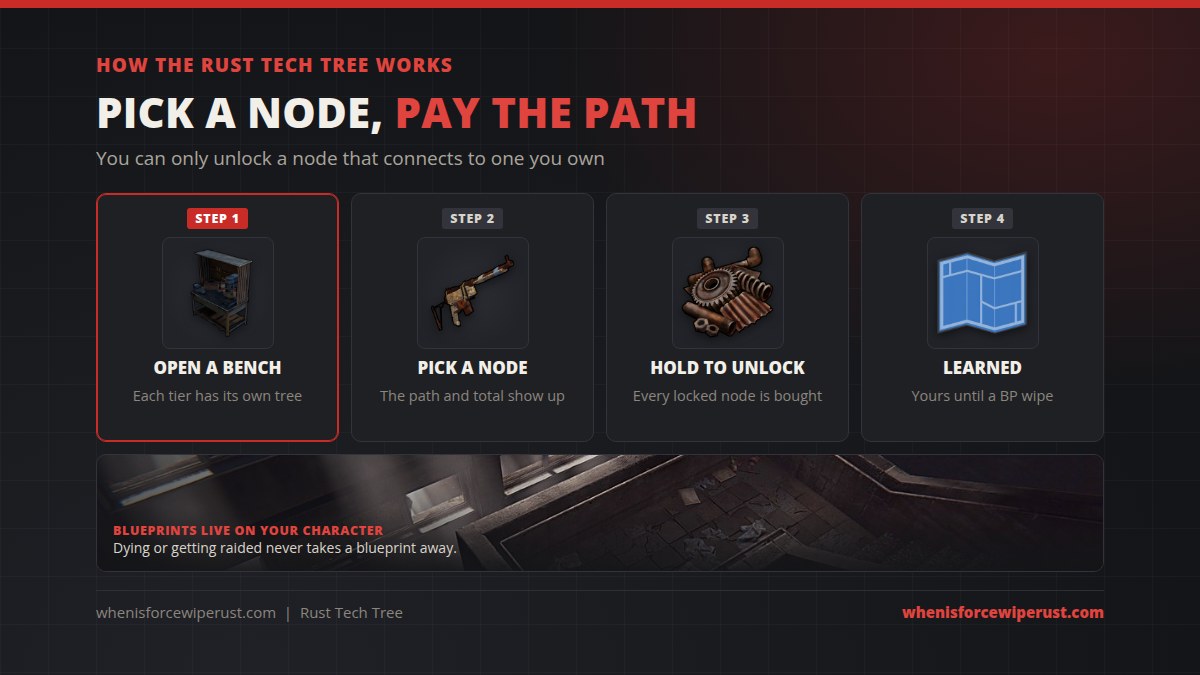
- Stand at a workbench. Workbench Level 1 shows the tier 1 tree, Level 2 the tier 2 tree, Level 3 the tier 3 tree.
- Pick the node you want. Since the 2026 tech tree update, selecting any node previews the whole path to it and shows the total scrap.
- Unlock the path. Hold to unlock, and every locked node on the way is bought in order. You still pay for each one.
- Craft it. The blueprint is learned straight away. Craft it at a workbench of the item’s tier or higher.
The one rule that drives every cost: you can only unlock a node that connects to one you already own. That is why the target item’s own price is never the real price. You also pay for every node standing between the workbench and your target.
Tech Tree Node Prices
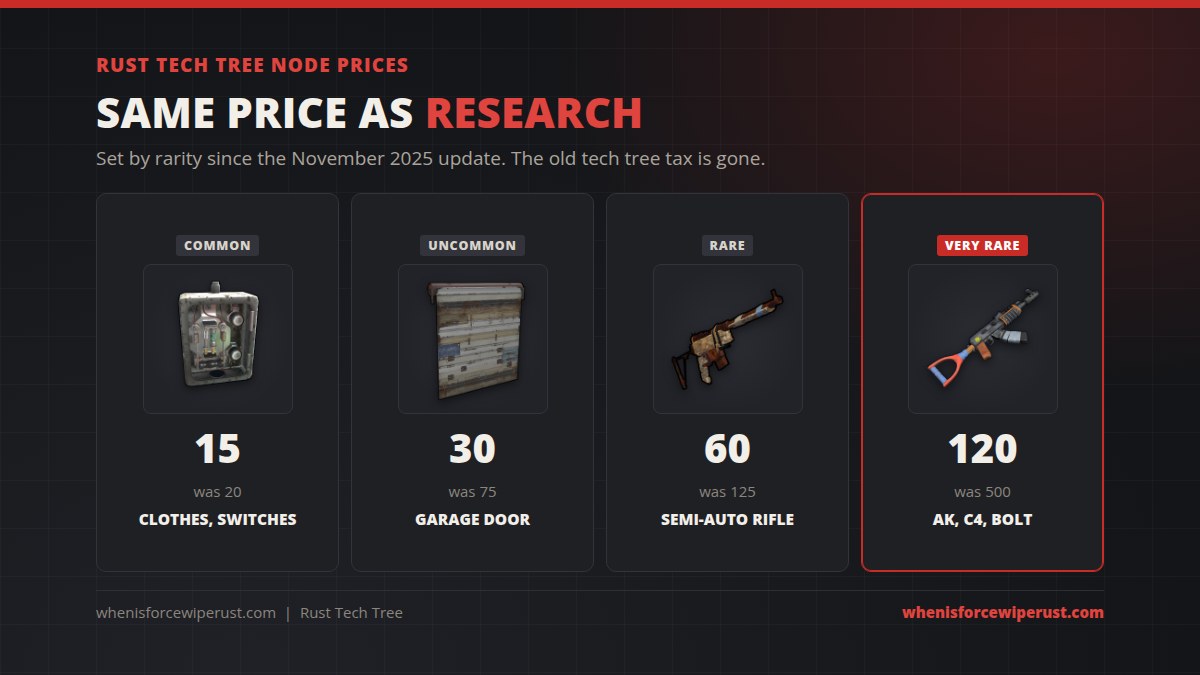
Every node has a price set by the item’s rarity. Facepunch’s Pivot or Die update in November 2025 cut these prices hard and removed the old tech tree tax, so a node now costs exactly what researching the same item costs.
| Rarity | Node price now | Before Nov 2025 | Examples |
|---|---|---|---|
| Common | 15 scrap | 20 | Basic clothing, water barrel, switches |
| Uncommon | 30 scrap | 75 | Garage door, revolver, mixing table |
| Rare | 60 scrap | 125 | Semi-auto rifle, satchel charge, large furnace, Thompson |
| Very rare | 120 scrap | 500 | AK, C4, bolt action rifle, auto turret, metal facemask |
Before the update, tier 1 and tier 2 nodes also carried a surcharge on top of the research price. That tax is gone, so any guide still quoting 500 scrap for an AK or C4 node is out of date. Scrap was also removed from the workbench recipes themselves, so all of your scrap now goes into blueprints.
Tech Tree Cost by Workbench Tier
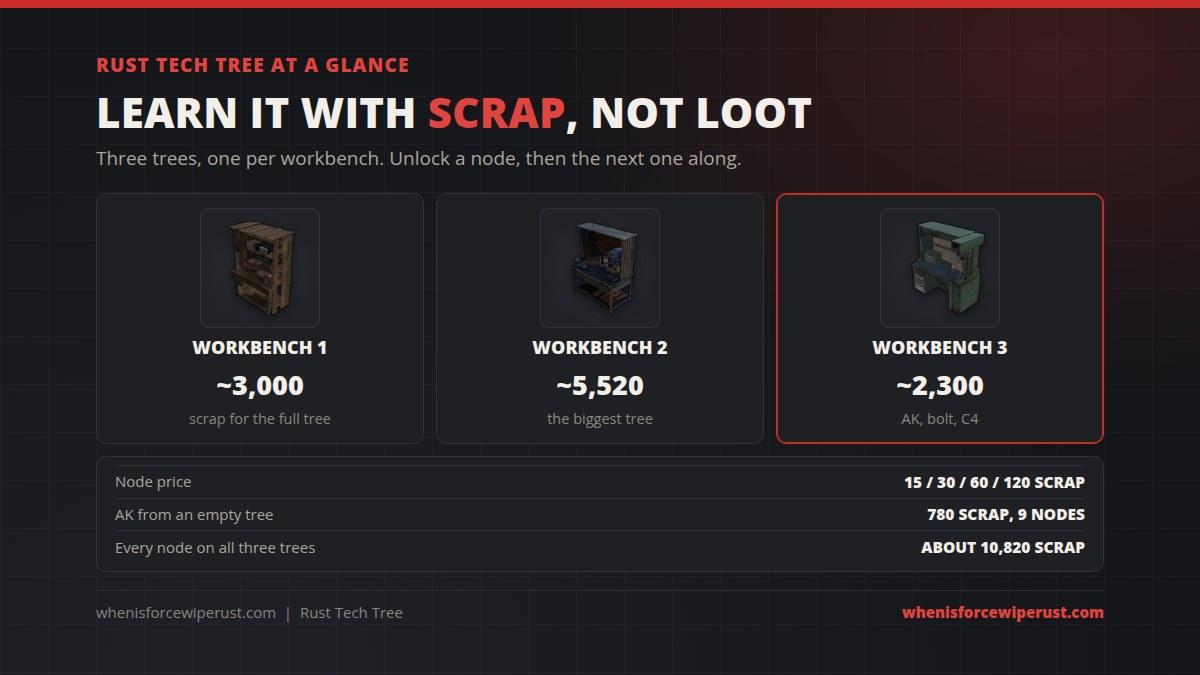
Each tier has its own tree with its own total. Nobody should clear a full tree, but the totals show where your scrap goes.

| Tree | Nodes (approx.) | Full tree | Bench recipe | Highlights |
|---|---|---|---|---|
| Workbench Level 1 | about 125 | about 3,000 scrap | 500 wood, 100 metal fragments | Satchel charge, revolver, double barrel, high external wooden walls, electrical basics |
| Workbench Level 2 | about 133 | about 5,520 scrap | 500 metal fragments, 20 HQM, 5 Basic Blueprint Fragments | Semi-auto rifle, Thompson, garage door, auto turret, large furnace, rocket launcher |
| Workbench Level 3 | about 27 | about 2,300 scrap | 1,000 metal fragments, 100 HQM, 5 Advanced Blueprint Fragments | AK, bolt action rifle, C4, MP5, metal facemask and chest plate, armored doors |
| All three | about 285 | about 10,820 scrap |
Node counts shift a little with each monthly update as Facepunch adds items, so treat them as close, not exact. The bench recipes matter more than they look: you cannot even see the tier 2 or tier 3 tree until you build that bench, and those need blueprint fragments from monument loot rooms.
Tech Tree Path Costs for Popular Items
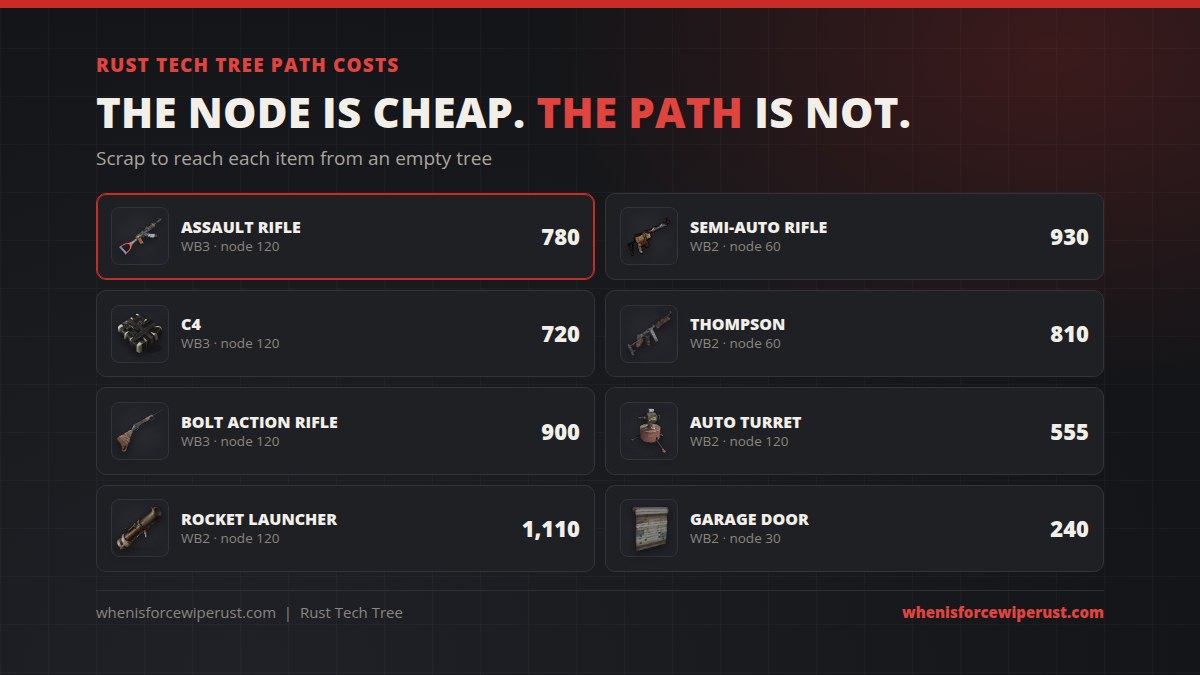
This is the number that actually empties your scrap box: the cost to reach an item from an untouched tree, with every node on the way included.
| Item | Tree | Node / research | Full path from empty tree |
|---|---|---|---|
| Garage Door | Workbench 2 | 30 scrap | 240 scrap |
| Large Furnace | Workbench 2 | 60 scrap | 390 scrap |
| Satchel Charge | Workbench 1 | 60 scrap | 510 scrap |
| Metal Facemask | Workbench 3 | 120 scrap | 540 scrap |
| Auto Turret | Workbench 2 | 120 scrap | 555 scrap |
| Timed Explosive Charge (C4) | Workbench 3 | 120 scrap | 720 scrap |
| Assault Rifle (AK) | Workbench 3 | 120 scrap | 780 scrap (9 nodes) |
| Thompson | Workbench 2 | 60 scrap | 810 scrap |
| Bolt Action Rifle | Workbench 3 | 120 scrap | 900 scrap |
| Semi-Automatic Rifle | Workbench 2 | 60 scrap | 930 scrap |
| Rocket Launcher | Workbench 2 | 120 scrap | 1,110 scrap |
Paths share nodes. Anything you already own on the way is not charged again, so a second target on the same branch costs less than its listed path. That is why groups pick one main target per tier and plan the next one around the nodes they already bought.
Tech Tree vs Research Table
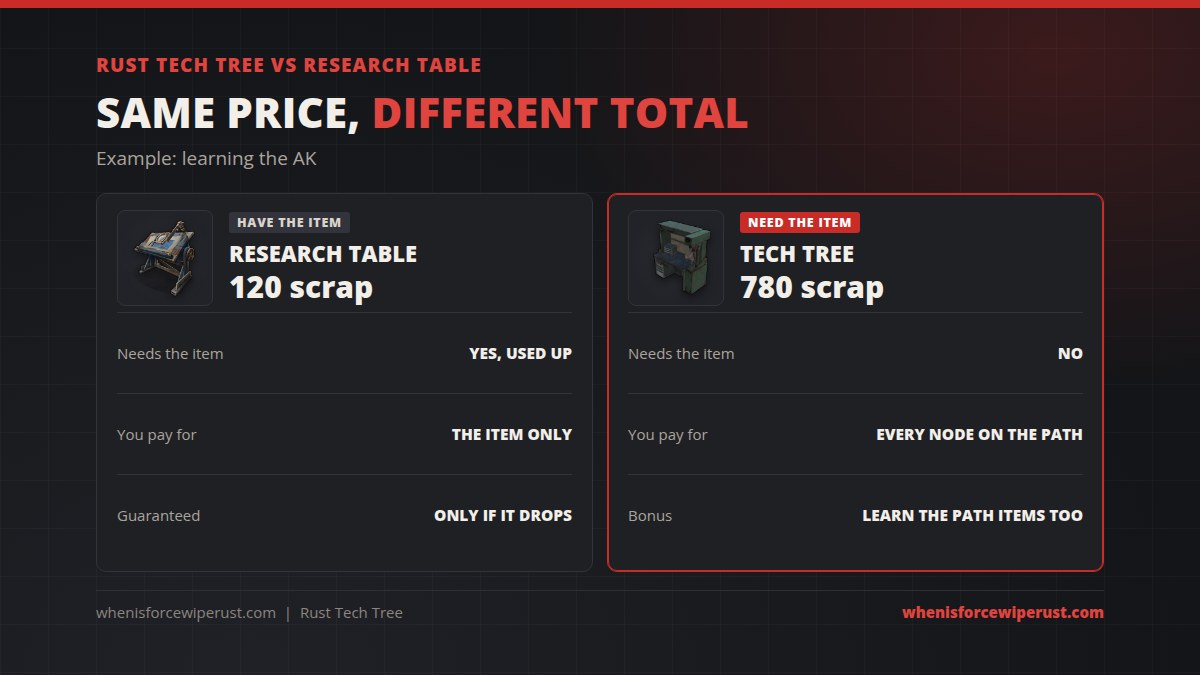
Since the November 2025 update both routes charge the same price for the item itself. The difference is what else you pay for.
| Research Table | Tech Tree | |
|---|---|---|
| Needs the item | Yes, and it is used up | No |
| Price | The item’s own price only | Every locked node on the path |
| AK example | 120 scrap | 780 scrap from an empty tree |
| Guaranteed | Only if you find the item | Always |
| Bonus | None | You also learn every item on the path |
The rule of thumb: research what you loot, tech tree what you need. If an AK drops from a crate, put it in a research table and save 660 scrap. If you have been farming for two days and still have no rifle, the tech tree is the way to stop gambling on drops.
Workbench Upgrades That Change the Tech Tree
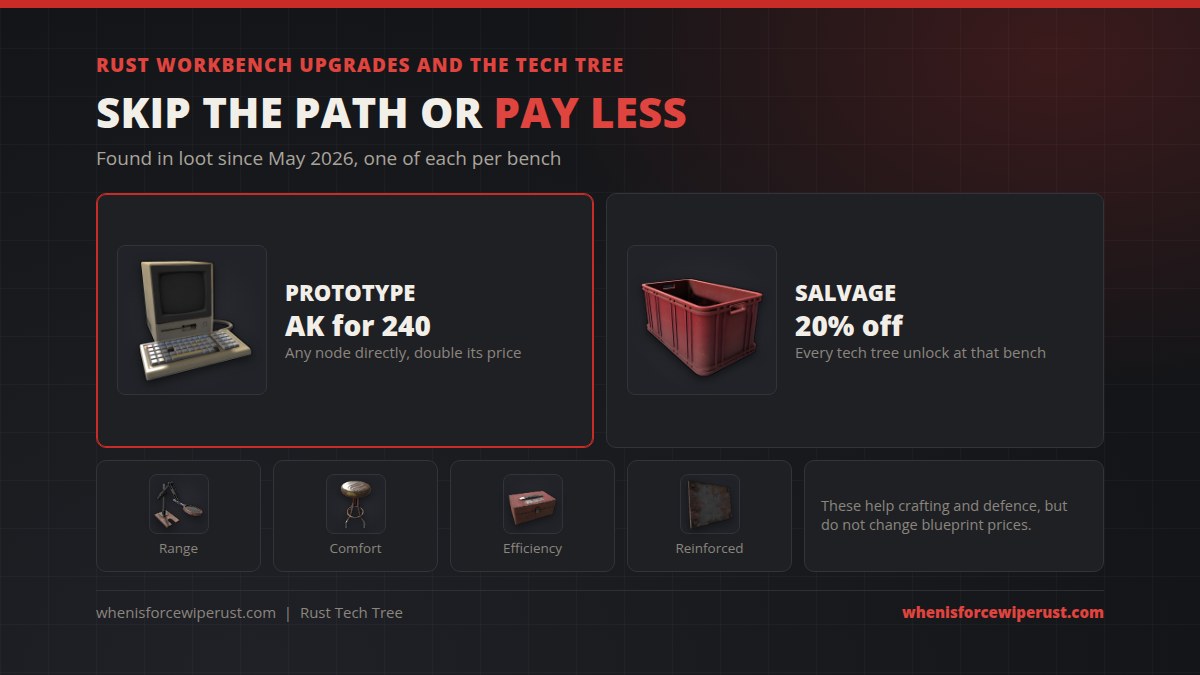
The May 2026 update added workbench upgrades: items you find in loot and install on a workbench. Each bench takes one of each kind. Two of them change how the tech tree works.
| Upgrade | What it does | AK example |
|---|---|---|
| Prototype | Unlock any node on that bench’s tree directly, without the path, for double the item’s price | 240 scrap instead of 780 |
| Salvage | All tech tree unlocks at that bench cost 20% less | 624 scrap for the full path |
Prototype is the bigger deal. For a single deep item such as the AK, bolt or C4, paying double for the node is still far cheaper than the path. Salvage pays off when you plan to unlock a lot, for example a whole branch for a group. The other upgrades, such as Range, Comfort, Efficiency and Reinforced, help crafting and defence but do not touch blueprint prices.
What to Unlock First on the Tech Tree
A good tech tree plan is a short list of targets per tier, not a shopping spree. This is the order most solos and small groups follow on a fresh wipe.
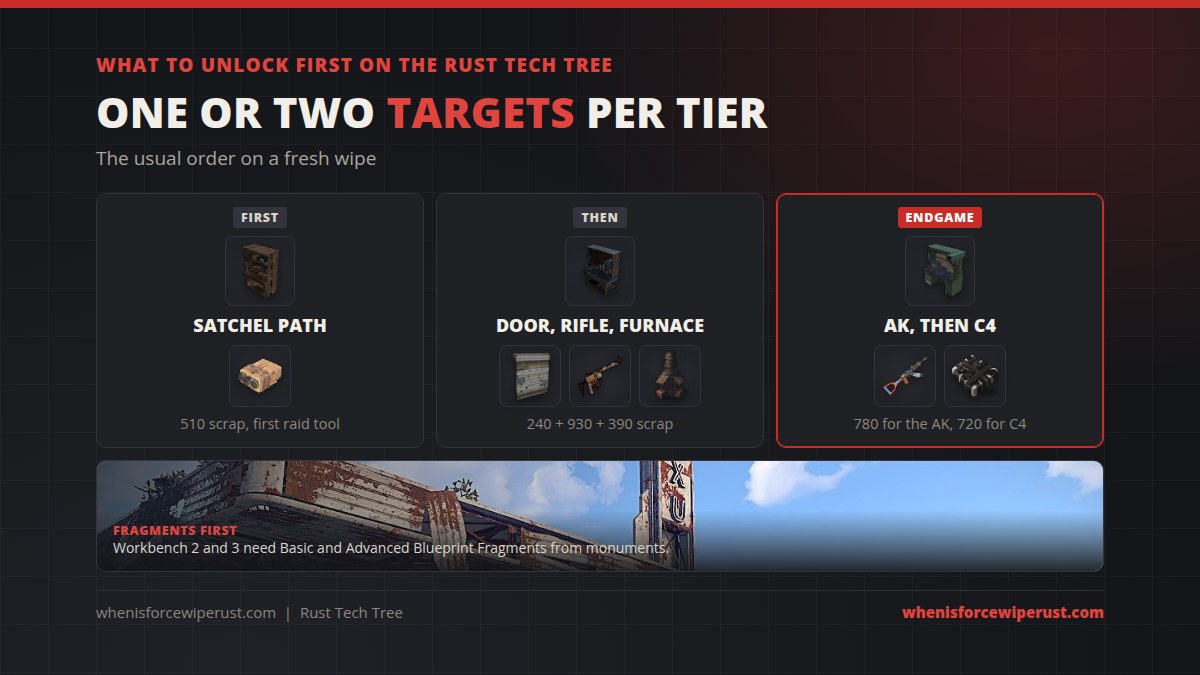
- Workbench 1: the path to the satchel charge (510 scrap) gives you a first raid tool and picks up useful early items on the way. Get a revolver or double barrel if you have nothing to fight with.
- Workbench 2: the garage door (240 scrap) for the cheapest strong door, then a semi-auto rifle or Thompson as your main gun, and a large furnace once you farm a lot of ore.
- Workbench 3: one endgame gun (AK 780 or bolt 900), then C4 (720 from empty, less for any nodes you already own). Grab metal facemask and chest plate if your group fights a lot.
Raiding next? Our Rust raid calculator shows how many C4, rockets or satchels each wall and door takes, so you know whether the C4 path is worth it this wipe.
Rust Tech Tree Tips
- Check the path, not the node. Select the target first and read the total. If it is huge, look for the item in loot before you commit.
- Never tech tree what you already hold. If the item is in your box, the research table costs only its own price.
- Split trees in a group. One player takes the tier 2 rifle path, another the door and furnace path, and everyone crafts for the group.
- Use a Prototype upgrade for deep items. It turns a 780 scrap AK into 240.
- Do not dump scrap the night before a wipe. Blueprints reset on a blueprint wipe, so late in the wipe spend on things that help right now.
- Get your fragments early. The tier 2 and 3 trees stay hidden until you build the bench, and that needs Basic or Advanced Blueprint Fragments, not scrap.
Rust Tech Tree FAQ
How much scrap is the whole tech tree in Rust?
About 10,820 scrap for all three trees: roughly 3,000 at Workbench 1, 5,520 at Workbench 2 and 2,300 at Workbench 3. Almost nobody clears a full tree.
How much does the AK cost on the tech tree?
The AK node is 120 scrap, but reaching it from an empty Workbench 3 tree costs 780 scrap across 9 nodes. Researching a looted AK at a research table costs only 120 scrap.
How much does C4 cost on the tech tree?
The Timed Explosive Charge node is 120 scrap, and the full path from an empty Workbench 3 tree is about 720 scrap. Nodes you already own on the way are not charged again.
Is the tech tree or the research table cheaper?
The research table, whenever you have the item. Both now charge the same price for the item itself, but the tech tree also makes you pay for every locked node on the path to it.
What are tech tree node prices in Rust?
15 scrap for common items, 30 for uncommon, 60 for rare and 120 for very rare. These are the same as research table prices since the November 2025 update.
Can you skip the path on the tech tree?
Yes, with a Prototype workbench upgrade installed. It lets you unlock any node on that tree directly for double the item’s price, so the AK costs 240 scrap instead of 780.
Do tech tree blueprints wipe?
They are normal blueprints, so they last until the server does a blueprint wipe. Dying or being raided never removes them.
Why can’t I see the Workbench 2 or 3 tech tree?
You need to build that workbench first. Workbench 2 needs 5 Basic Blueprint Fragments and Workbench 3 needs 5 Advanced Blueprint Fragments, along with metal fragments and high quality metal.
Sources and Further Reading
- Facepunch, Pivot or Die update notes (price cut, tech tree tax removed)
- Facepunch, Meta Shift update notes (blueprint fragments)
- Rustafied, Tech tree improvements (path unlock)
- Rustafied, Workbench upgrades arrive
- Rustly, tech tree node and path costs
- More on blueprints and fragments: Rust blueprints guide