
Sooner or later every Rust player picks up a heavy black barrel labelled Diesel Fuel, checks the description, and wonders what on earth it is actually for. You cannot craft it, you cannot burn it in your furnace, and it will not go in your minicopter. So why does everyone fight over it? Because Diesel Fuel Rust is the key that starts the biggest resource machines in the game, and one full tank of it can hand you tens of thousands of stone, metal or sulfur.
This guide covers everything about diesel: what the item is, the three machines it powers, exactly how much you get per diesel, where diesel fuel spawns on the map, why you cannot make it at home, and how it is completely different from low grade fuel. Every number here is checked against the in-game item data, not guessed, so you can plan a farm around it with confidence.
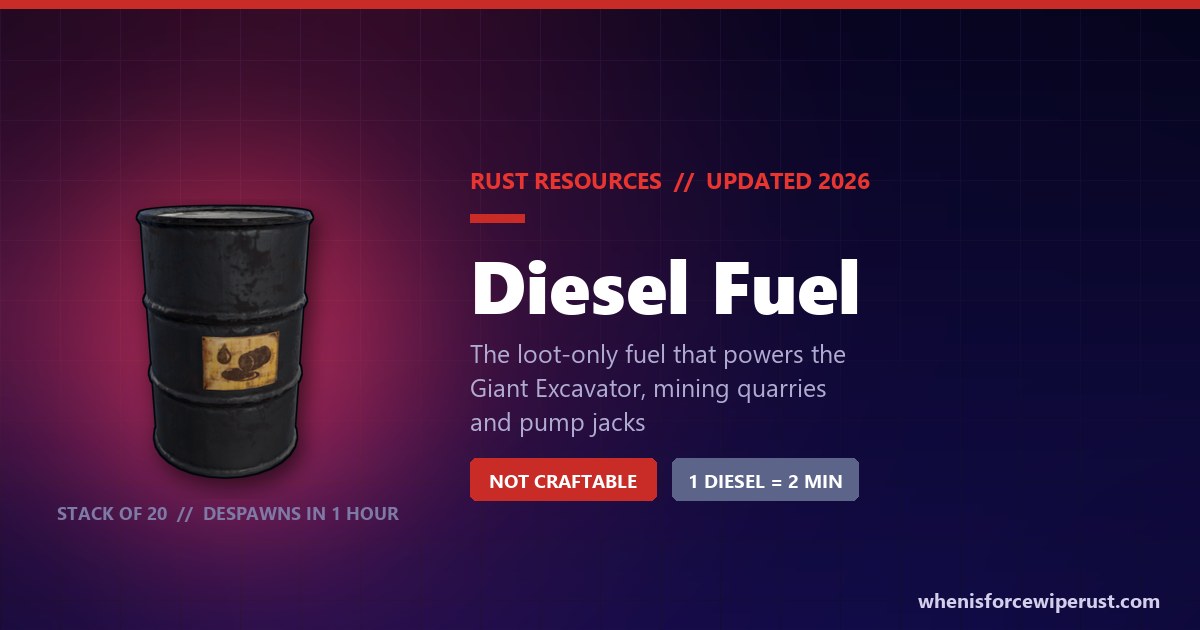
diesel_barrel) is a loot-only item that powers three machines in Rust: the Giant Excavator, mining quarries and pump jacks. It is not craftable and not recyclable, stacks to 20 and despawns in one hour. One diesel runs a machine for about 2 minutes. At the Giant Excavator, a single diesel digs out 10,000 stone, 5,000 metal fragments, 2,000 sulfur ore or 100 HQM ore, and the tank holds a full stack of 20 for roughly 40 minutes of mining. You get diesel by looting monuments like the oil rigs, Power Plant, Water Treatment and the Dome, or by trading around 300 low grade fuel for one at the Outpost. It is a different fuel from low grade, so do not mix them up.
- What is Diesel Fuel
- What it powers
- Can you make it
- Where to get it
- How much per diesel
- Diesel vs low grade
- Is it worth it
- FAQ
What is Diesel Fuel in Rust?
Diesel Fuel is a resource item that exists for one reason: to power heavy mining machinery. The in-game description says it plainly, calling it “suitable fuel to power quarries and the giant excavator.” It is not a weapon, not a building part and not a component, it is simply the fuel these machines burn to run. You will recognise it as a chunky black barrel with a yellow oil label on the front.
The important thing to understand up front is that diesel is a pure loot item. It has the shortname diesel_barrel, it stacks up to 20 in a single slot, and a dropped barrel despawns after one hour. You cannot craft it, you cannot recycle it, and there is no blueprint for it anywhere in the tech tree. Every diesel barrel in the game is either picked up off a monument or bought from a vendor, which is exactly why controlling a diesel supply matters so much on a busy wipe.
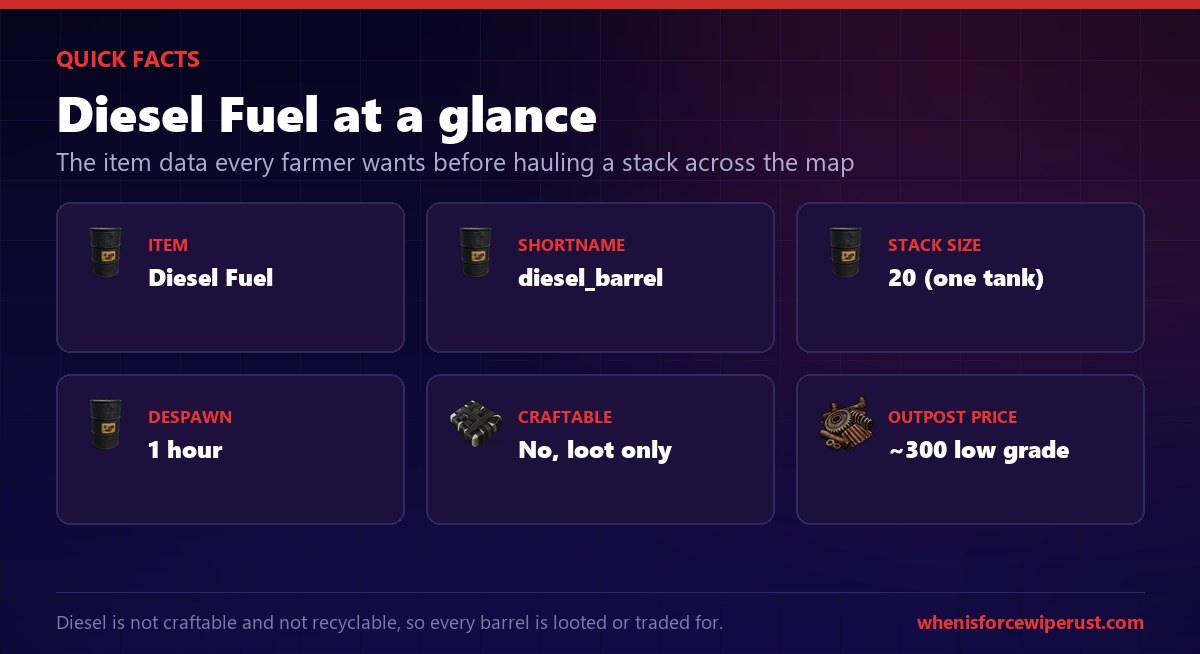
Because a full stack of diesel is exactly 20, and the Giant Excavator tank also holds exactly 20, one stack of diesel is the natural unit players think in. Grab a stack, run the excavator until it is empty, and you have had a full 40 minute mining session. Everything about diesel, from where it spawns to how you carry it, revolves around that stack of 20.
What is Diesel Fuel used for in Rust?
Diesel Fuel powers exactly three machines, and nothing else. It does not fuel vehicles, tools, lights or furnaces. If you are staring at a barrel wondering what to do with diesel fuel, the answer is always one of these three:
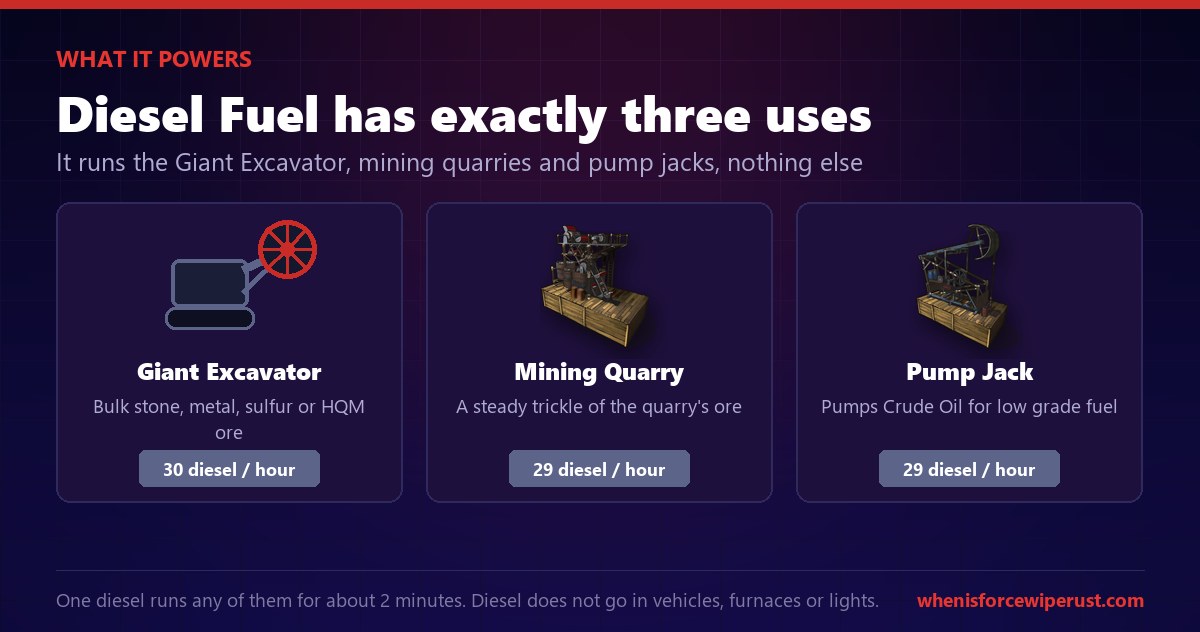
- The Giant Excavator. This is the big one. Pour diesel into the engine room, hit the startup panel, and pick a resource in the control room. The excavator mines bulk stone, metal fragments, sulfur ore or high quality metal ore for you, burning about 30 diesel per hour.
- Mining quarries. The static Sulfur, HQM and Stone quarries you find on the map run on diesel too. Drop diesel in the fuel hopper, flip the switch, and the quarry churns out its resource type as a steady trickle, using around 29 diesel per hour.
- Pump jacks. A pump jack pulls Crude Oil out of the ground, which you then refine into low grade fuel. Same fuel, same roughly 29 diesel per hour, different output.
The Giant Excavator is by far the most popular use because it is the highest volume resource source in Rust. The quarries and pump jacks are slower and more situational, but they run on the exact same diesel, so any barrel you find is useful no matter which machine you take it to. A pump jack in particular is worth knowing about if you want to feed a small oil refinery without hunting red barrels for crude.
Can you make Diesel Fuel in Rust?
No. You cannot craft or make Diesel Fuel in Rust. There is no recipe, no workbench option and no tech tree node for it. You cannot turn low grade fuel into diesel, you cannot brew it from crude oil, and there is no hidden crafting trick that guides sometimes claim. Diesel is a loot item, full stop.
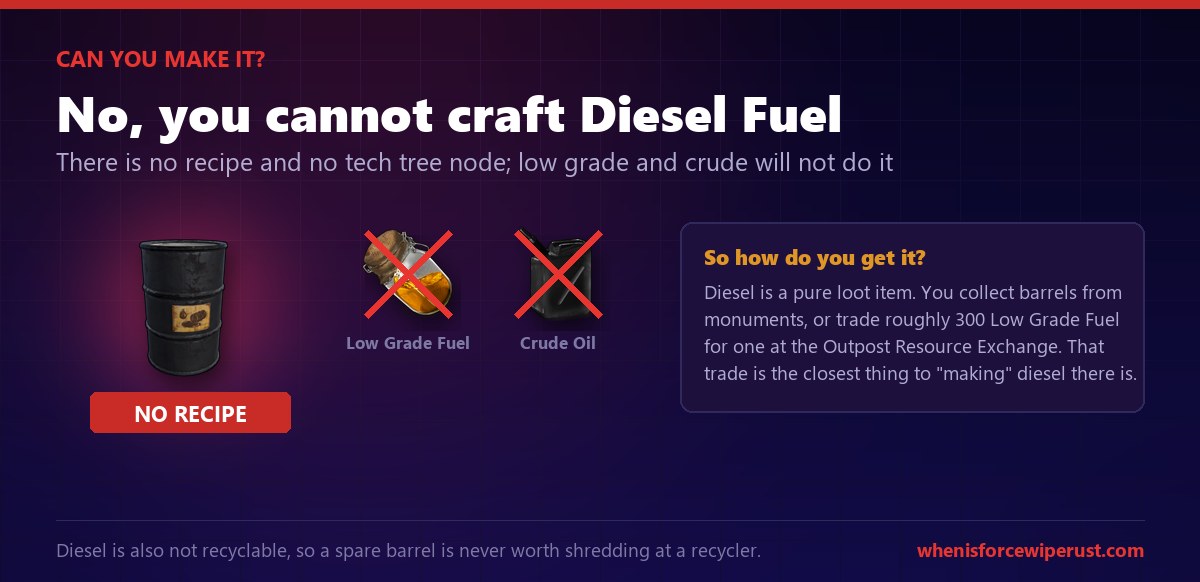
This trips up a lot of newer players because most fuels and resources in Rust can be crafted or processed somehow. Low grade fuel is refined from crude, gunpowder is mixed from sulfur and charcoal, and so on. Diesel breaks that pattern. The closest thing to “making” diesel is the Outpost Resource Exchange, where you can trade roughly 300 low grade fuel for a single diesel barrel. It is a trade, not a craft, but if you are swimming in low grade it is a reliable way to top up.
Diesel is also not recyclable, so there is no point ever putting a spare barrel in a recycler. If you have diesel you do not need, either save it for the next excavator run or hand it to a teammate. It will never break down into other components.
Where to get Diesel Fuel in Rust
Since you cannot craft diesel, knowing where to find diesel fuel is the whole game. Diesel spawns as a fixed collectable at a set of mid to high tier monuments. You simply walk up to the barrel and hold your use key to collect one diesel per spawn point. The monuments with the most diesel are the powered and industrial ones.
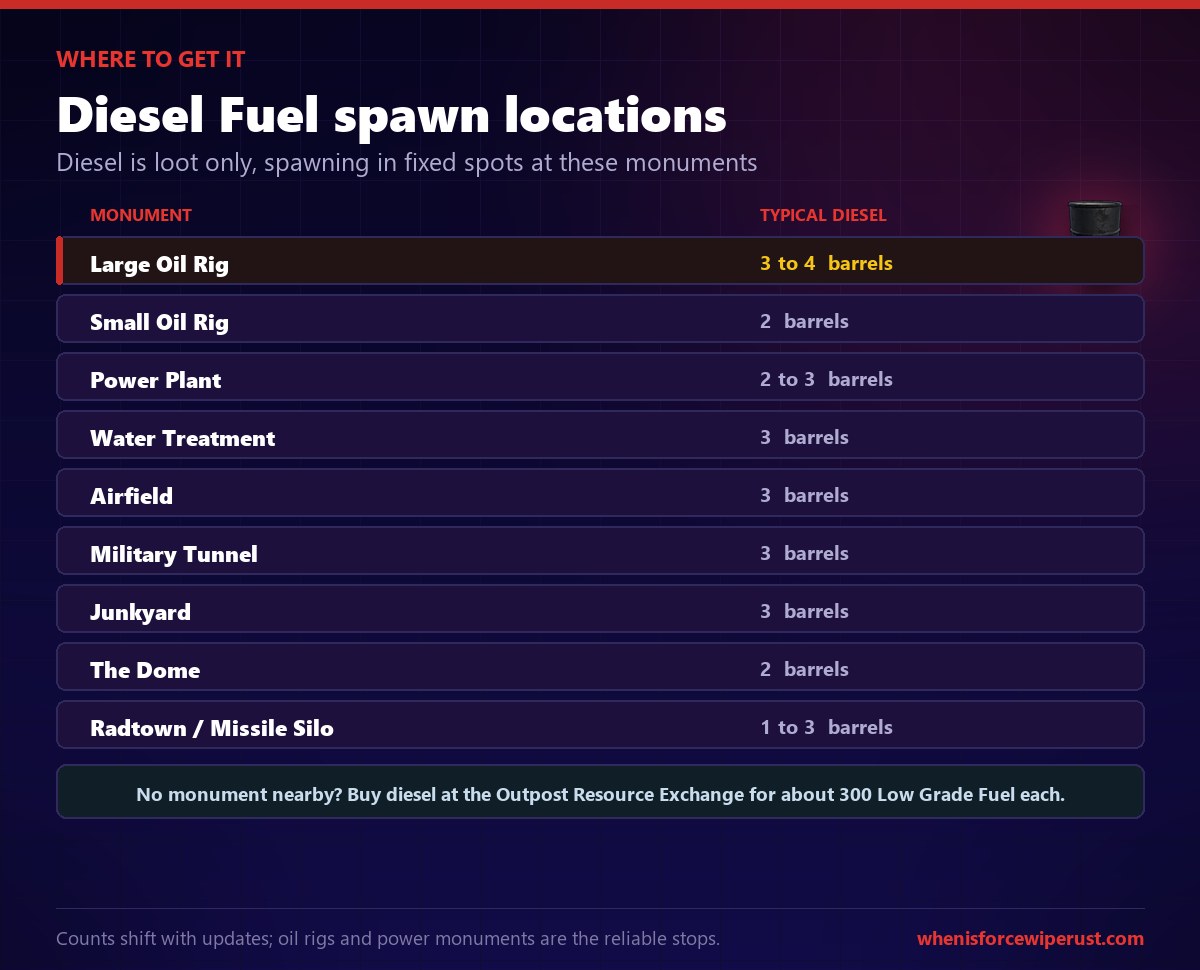
| Monument | Typical diesel | Notes |
|---|---|---|
| Large Oil Rig | 3 to 4 | The most diesel in one place, but heavily contested |
| Small Oil Rig | 2 | Easier to hold solo than the large rig |
| Power Plant | 2 to 3 | No safe zone, watch for other players |
| Water Treatment | 3 | Big open monument, bring meds for radiation |
| Airfield | 3 | Central and busy on most maps |
| Military Tunnel | 3 | Elite scientists guard it, high risk |
| Junkyard | 3 | Reliable and often overlooked |
| The Dome | 2 | Quick in and out once you can climb it |
| Radtown / Missile Silo | 1 to 3 | Smaller and red-card spawns respectively |
Exact counts drift a little with each Rust update, so treat these as reliable ballparks rather than fixed numbers. The pattern holds though: the oil rigs and the power monuments are the places to run if diesel is what you are after. A single loop of Water Treatment, Power Plant and the Dome can easily net you a full stack.
How much do you get per diesel? (Rates)
This is the number everyone actually searches for. At the Giant Excavator, each diesel runs a two minute cycle and produces a fixed amount of whichever resource you selected in the control room. The rates below are the confirmed Giant Excavator output per diesel, and they are the same on PC and console.
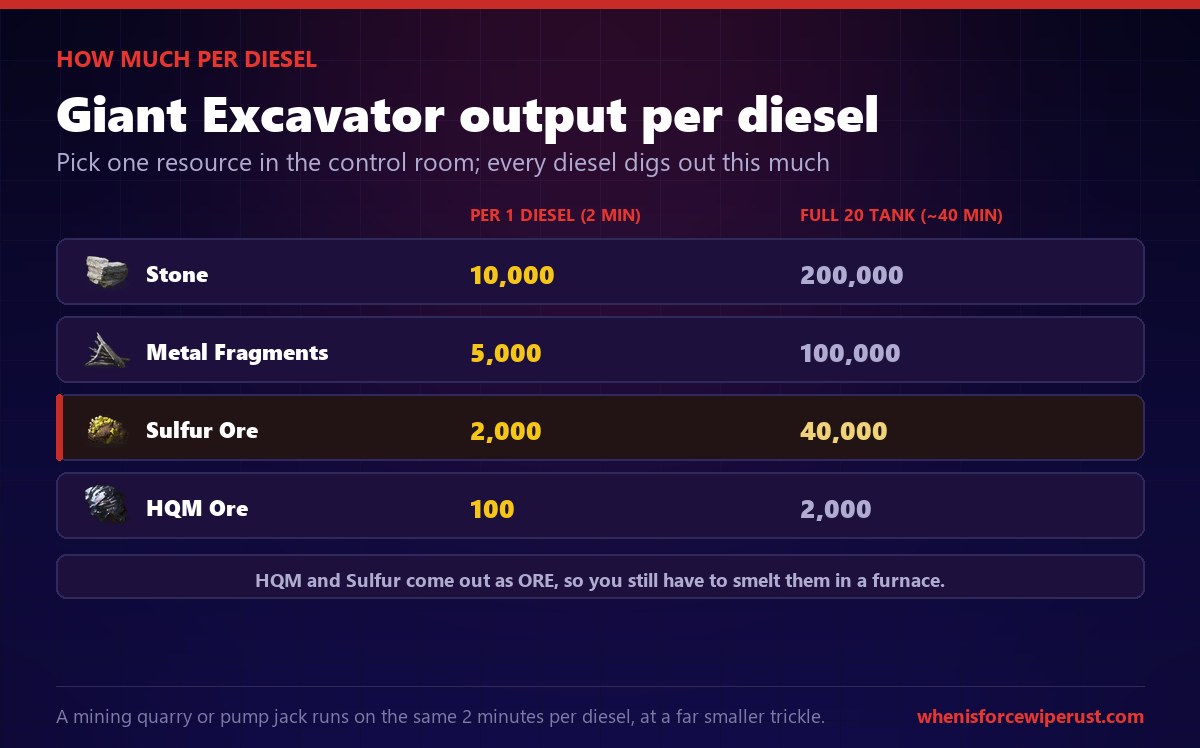
| Resource | Per 1 diesel (2 min) | Full tank (20 diesel) | Note |
|---|---|---|---|
| Stone | 10,000 | 200,000 | Ready to use, no smelting |
| Metal Fragments | 5,000 | 100,000 | Ready to use, no smelting |
| Sulfur Ore | 2,000 | 40,000 | Smelt into sulfur for explosives |
| HQM Ore | 100 | 2,000 | Smelt into high quality metal |
Two things stand out. First, stone and metal fragments come out ready to use, but HQM and sulfur come out as ore, so you still have to smelt them in a furnace before they are useful. Second, look at the scale: a full tank of stone is 200,000, which is more than most bases will ever need, while a full tank of sulfur ore is 40,000, which is the reason raiders farm the excavator before hitting a base.
Mining quarries and pump jacks run on the same two minutes per diesel, but their output is a much smaller trickle set by the machine rather than a big controllable haul. A sulfur quarry will slowly produce sulfur ore for each diesel you feed it, but nowhere near the excavator’s 2,000 per diesel. If raw volume is the goal, the excavator wins every time, which is why “how much sulfur per diesel” almost always means the excavator’s 2,000.
Diesel Fuel vs Low Grade Fuel: do not mix them up
The single most common diesel mistake is confusing it with Low Grade Fuel. They are two completely different items that do completely different jobs, and knowing which is which saves you a wasted trip across the map.
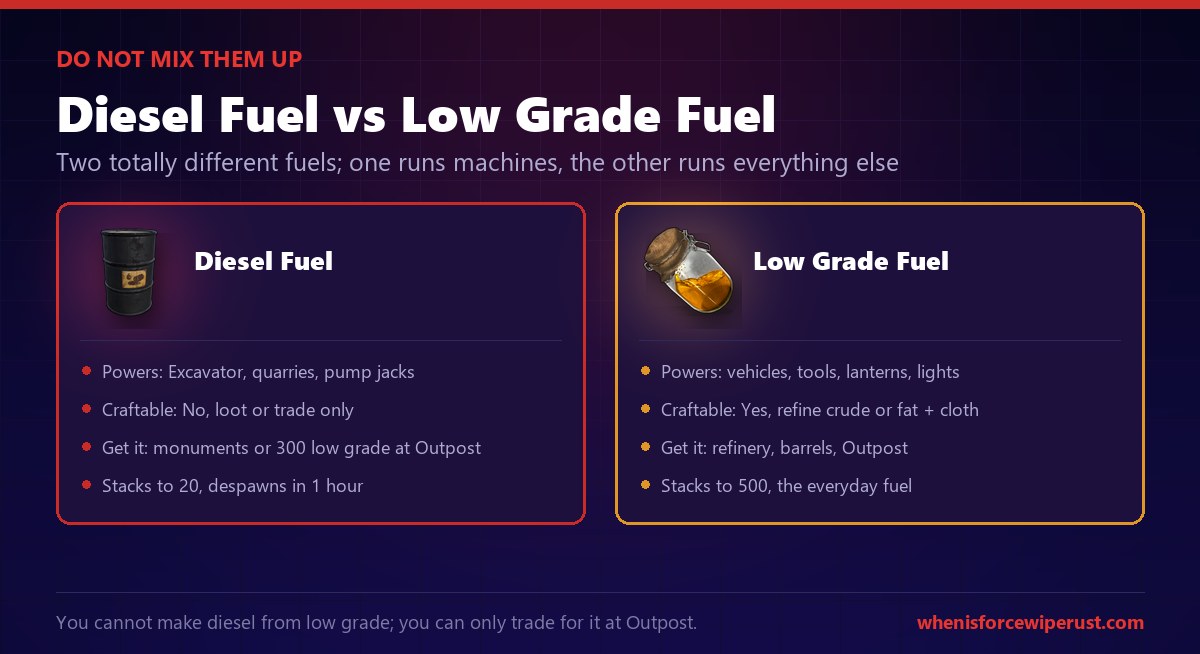
| Diesel Fuel | Low Grade Fuel | |
|---|---|---|
| Powers | Excavator, quarries, pump jacks | Vehicles, tools, lanterns, lights, flame weapons |
| Craftable? | No, loot or trade only | Yes, refine crude oil or animal fat and cloth |
| Where | Monuments, or 300 low grade at Outpost | Refinery, red barrels, Outpost |
| Stack size | 20 | 500 |
So your minicopter, boat, chainsaw and lanterns all run on low grade fuel, which you can make yourself. The excavator and quarries run on diesel, which you cannot. The one place they connect is the Outpost, where you can trade about 300 low grade for one diesel, effectively converting the fuel you can make into the fuel you cannot.
Is Diesel Fuel worth farming in Rust?
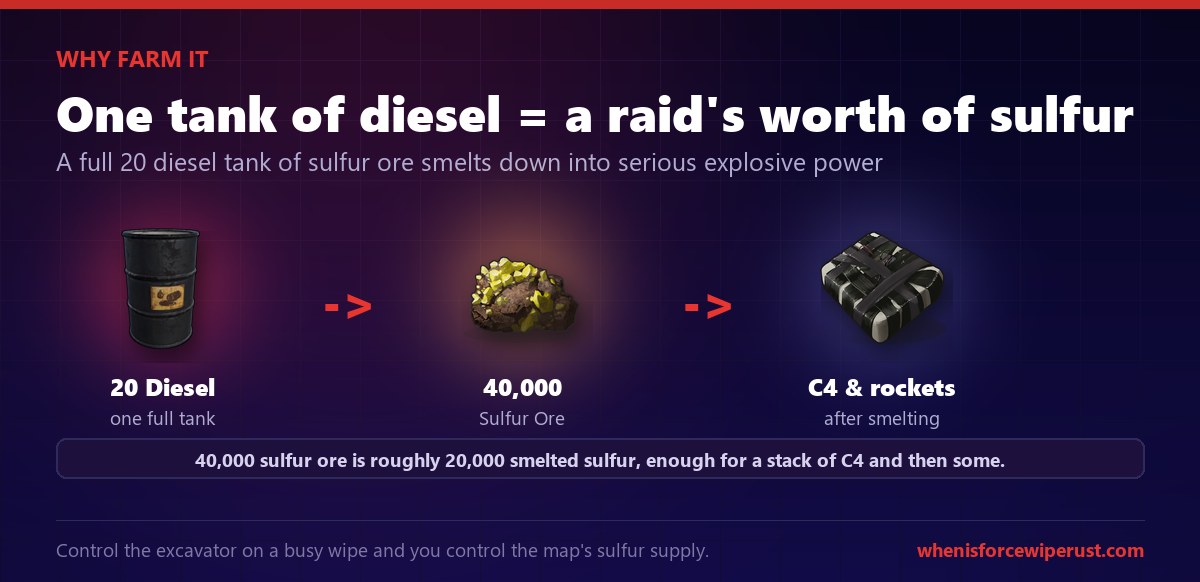
For any group planning a raid, diesel is absolutely worth farming, because it converts directly into explosive power. A full 20 diesel tank of sulfur ore at the excavator is 40,000 sulfur ore, which smelts down to around 20,000 sulfur. That is enough to build a serious stack of C4 and rockets with plenty left over.
The catch is that diesel is a magnet for other players. Starting the excavator broadcasts on a radio frequency and makes noise, so running the pit on a busy server is a fight as much as a farm. Diesel is worth it when you can defend the machine long enough to spend a full tank, and much less worth it if you are going to get third partied two minutes in. Price your target with the raid calculator first, then farm exactly the diesel you need to hit that sulfur number.
- Bank a full stack before you start. A machine only earns while it runs, so carry all 20 diesel in before you flip the switch rather than trickling it in.
- Pick the right resource. Sulfur ore for raiding, HQM ore for building high tier, stone and metal only if you genuinely need bulk. Do not waste a tank on stone you will never use.
- Bring smelting capacity. 40,000 sulfur ore and 2,000 HQM ore are useless until smelted, so have furnaces ready when you get home.
- Do not confuse it with low grade. Diesel only ever goes in the excavator, quarries and pump jacks. Everything else takes low grade.
- Trade for it if you are rich in low grade. A refinery run plus the Outpost exchange can fill a tank without touching a single monument.
Farming diesel before the wipe? Every barrel of diesel and stack of sulfur in your base is gone on the force wipe. Check exactly when it lands so you can time your excavator runs and start fresh with a plan.
Check the wipe countdownRust Diesel Fuel FAQ
What is Diesel Fuel used for in Rust?
Can you make or craft Diesel Fuel in Rust?
Where do you get Diesel Fuel in Rust?
How much sulfur do you get per diesel in Rust?
How long does one Diesel Fuel last in Rust?
How much stone, metal and HQM do you get per diesel?
How much low grade fuel is a diesel at Outpost?
Is Diesel Fuel the same as Low Grade Fuel?
Can you recycle Diesel Fuel in Rust?
Do mining quarries use Diesel Fuel in Rust?
How many diesel does the Giant Excavator tank hold?
Does Diesel Fuel spawn on console Rust?
Does Diesel Fuel remove rust?
Is Diesel Fuel worth farming in Rust?
Sources
- Facepunch Rust Wiki, Diesel Fuel (diesel_barrel), for the item data: shortname, item ID, stack size of 20, one hour despawn, not craftable, not recyclable, and the description confirming it powers quarries and the giant excavator.
- Corrosion Hour, Diesel Fuel in RUST, for the three uses, the two minutes per diesel run time, the airdrop terminal mechanic and the 300 low grade Outpost price.
- RustClash Rust Wiki, Diesel Fuel, for the fuel consumption rates (Mining Quarry 29, Pump Jack 29, Giant Excavator 30 per hour) and spawn locations.
- RustHelp, Diesel Fuel (collectable), for the per-monument diesel spawn counts.
- whenisforcewiperust.com Giant Excavator guide and raid calculator, for the excavator output rates and the sulfur to explosives cross-check.