
The Giant Excavator Pit is the closest thing Rust has to a money printer. There is no keycard puzzle and no wall of heavy scientists. You clear a handful of guards, pour Diesel Fuel into an engine, pick a resource, and a machine the size of a monument digs out bulk sulfur, metal, stone or high quality metal for you. One full tank can hand you tens of thousands of resources, which is why controlling the excavator on a busy wipe is basically controlling the map.
This Giant Excavator Rust guide covers all of it: what the monument is, how to run the excavator step by step, exactly how much you get per diesel and per full tank, where to find diesel fuel (and why you cannot craft it), the scientists and radiation, the RF 4777 tell that quietly rats you out to every raider nearby, and whether the whole thing is even worth your time. Every number here is checked against current in-game data, not a six-year-old launch video.
- What it is
- Quick facts
- How to use it
- Rates per diesel
- Diesel fuel
- Scientists & radiation
- Loot & recycler
- Is it worth it
- FAQ
What is the Giant Excavator Pit in Rust?
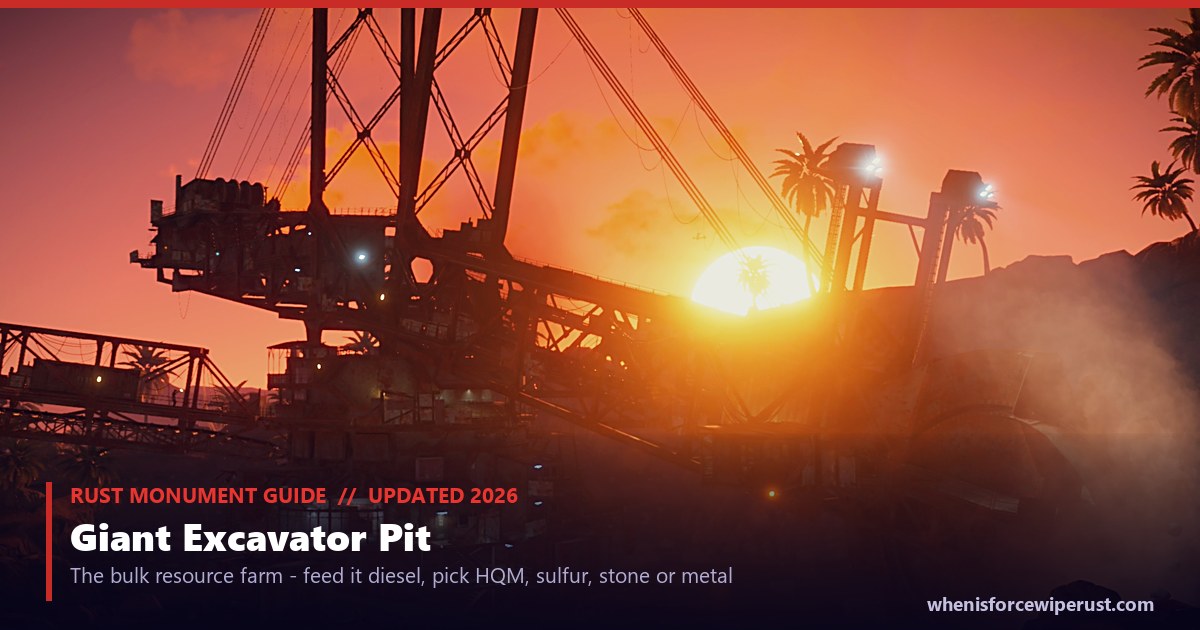
The Giant Excavator Pit, sometimes called the Giant Excavator or the Large Excavator, is a huge Rust monument in the desert biome built around a working bucket-wheel excavator. Facepunch added it in the Excavator Update on 1 August 2019, and unlike almost every other high-value monument, it is not about a puzzle or a loot room. It is a machine. You supply the fuel, you flip the switches, and it mines raw resources on an industrial scale.
That makes the excavator a different kind of target from the card monuments. There is no green, blue or red keycard involved, no electric fuse, and no timed door sequence. The barrier to entry is simpler and, in some ways, harder to hold: you need diesel, you need to clear the scientists, and you need to survive long enough out in the open desert to actually collect what it digs up. Get all three and the excavator out-produces every other resource source in the game by a wide margin.
Giant Excavator quick facts
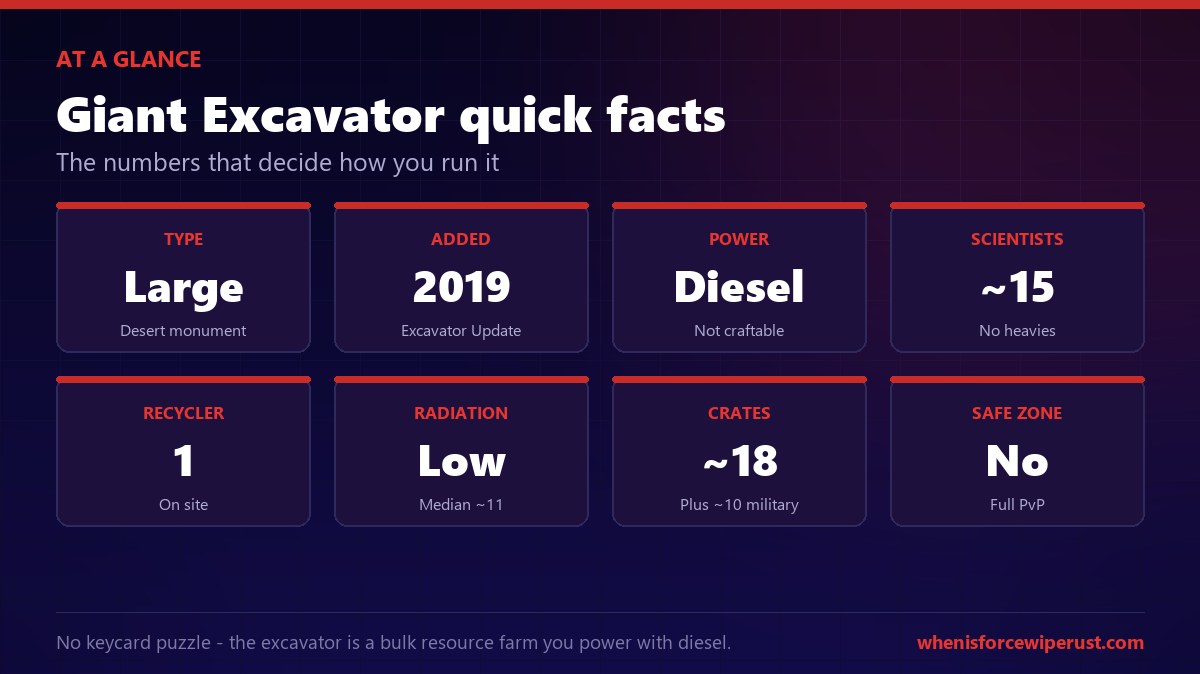
Here is the full stat line for the monument, pulled from current in-game data rather than an old wiki snapshot.
| Stat | Value |
|---|---|
| Monument type | Large, desert biome |
| Added | 1 August 2019 (Excavator Update) |
| Keycard puzzle | None (fuel and operate) |
| Powered by | Diesel Fuel (not craftable) |
| Fuel tank capacity | 20 diesel (one full stack) |
| Run time | ~2 minutes per diesel, ~40 minutes per tank |
| Resources | HQM, Sulfur, Stone or Metal Fragments |
| Scientists | Around a dozen (no heavies) |
| Radiation | Mild (median around 11) |
| Recyclers | 1 on site |
| Crates | Around 18, including up to ~10 military |
| Safe zone | No, full PvP |
| No-build area | 152,053 m² |
| Special tell | Engine broadcasts on RF 4777 |
| Patrol Heli can crash here | Yes |
Two numbers stand out. First, the fuel tank holds exactly 20 diesel, which is one full stack, so a single stack of diesel is one uninterrupted 40 minute run. Second, there is no card and no fuse, which means anyone who can find fuel and win a fight can run the excavator. That low barrier is the whole appeal, and also the whole problem, because everyone else on the server knows it too.
How to use the Giant Excavator
Running the excavator is a five step loop, and the order matters because the machine sits out in the open where anyone can push you. Here is how to use the Giant Excavator in Rust from arrival to loot.
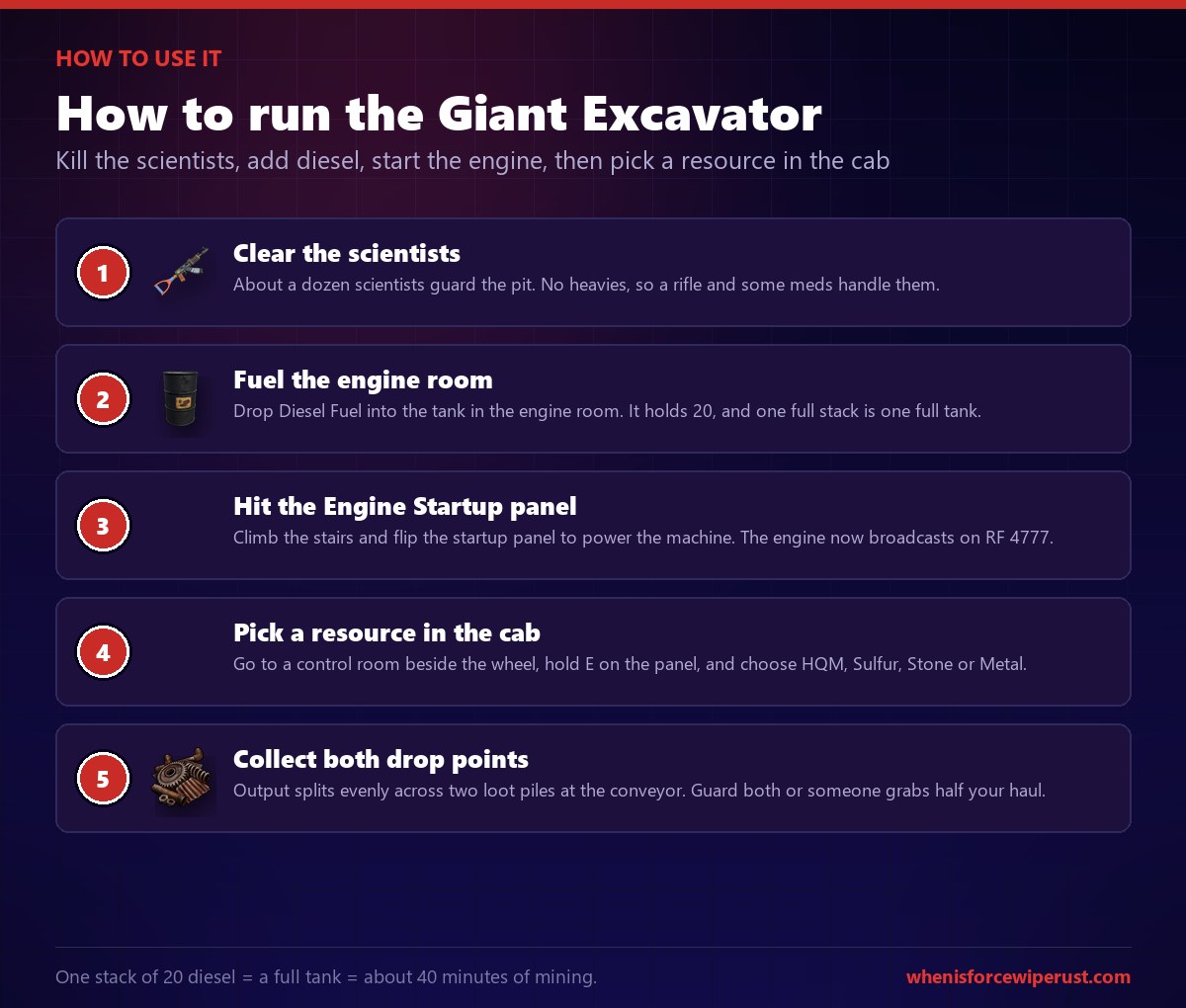
- Clear the scientists. Around a dozen scientists patrol the pit and the catwalks. They are regular scientists, not the heavies you meet at Oil Rig, so a decent rifle, some armour and a few syringes clear them without much trouble.
- Fuel the engine room. Head into the engine room and drop your Diesel Fuel into the large fuel storage tank. It holds a maximum of 20, and because diesel stacks to 20, one full stack fills the tank completely.
- Hit the Engine Startup panel. Climb the stairs and interact with the Engine Startup panel to power the machine. This is the moment the engine begins broadcasting on RF 4777, so the clock on other players noticing you starts now.
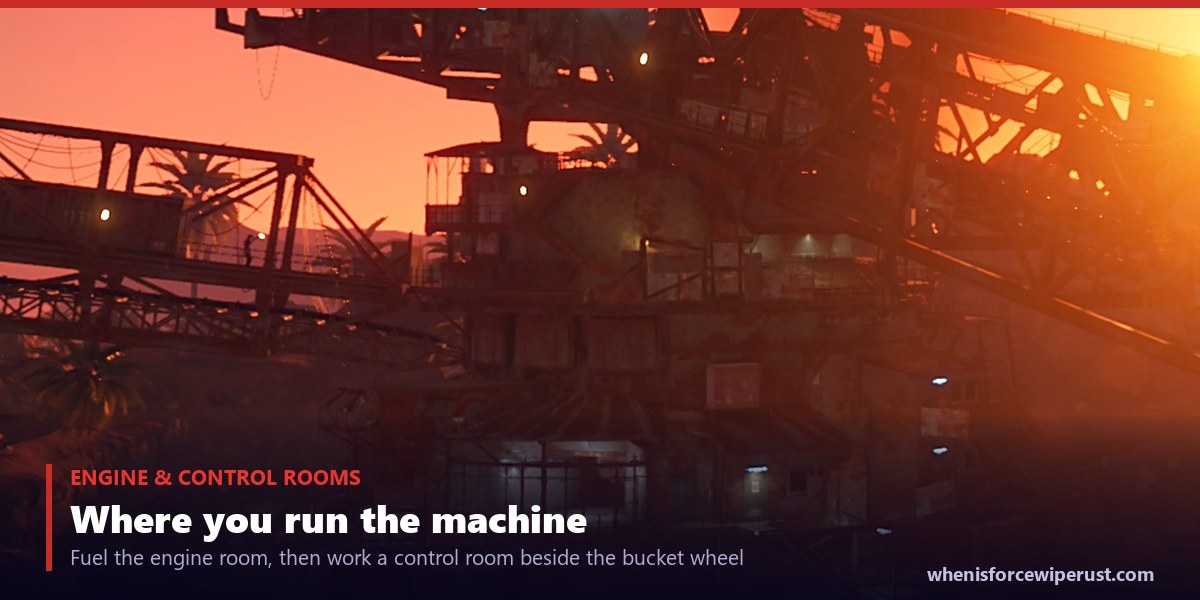
- Pick a resource in a control room. Walk the catwalk to one of the two control rooms beside the bucket wheel. Hold E on the control panel to open the selection wheel and choose HQM, Sulfur, Stone or Metal Fragments. The arm swings to the matching pile and starts digging.
- Collect both drop points. The mined resources are deposited in equal amounts at two separate drop points at the end of the conveyor. Bring friends and cover both, because a solo player physically cannot watch both piles at once, and thieves know it.
Giant Excavator Rust rates: what one diesel gets you
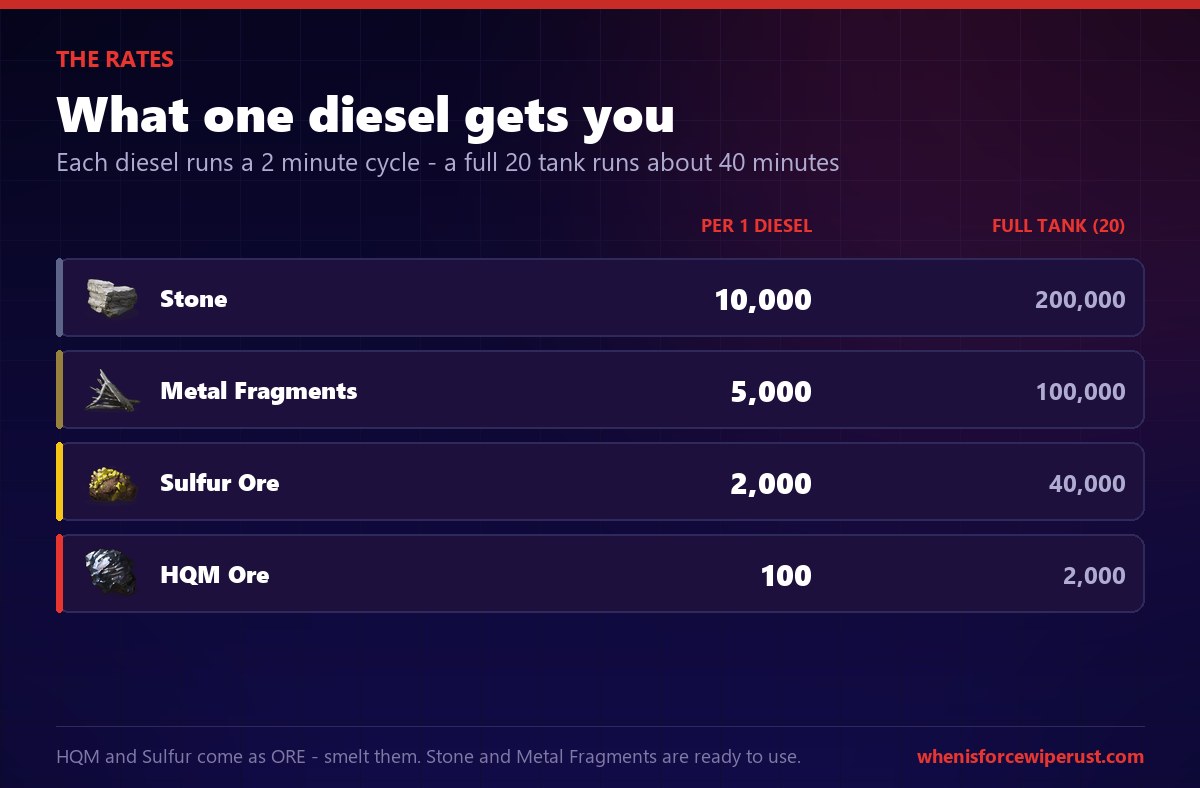
This is the part everyone actually searches for. The excavator burns one diesel per 2 minute cycle and produces a fixed amount of your chosen resource each cycle. Pick the resource in the control room, and every diesel in the tank turns into the same haul until you run dry or switch. Here are the confirmed Giant Excavator rates.
| Resource | Per 1 diesel (2 min) | Full tank (20 diesel) | Note |
|---|---|---|---|
| Stone | 10,000 | 200,000 | Ready to use |
| Metal Fragments | 5,000 | 100,000 | Ready to use |
| Sulfur Ore | 2,000 | 40,000 | Smelt into sulfur for explosives |
| HQM Ore | 100 | 2,000 | Smelt into High Quality Metal |
A few things to know before you pick. HQM and Sulfur come out as ore, so you still have to smelt them in a furnace, while Stone and Metal Fragments are ready to use straight away. For most players the answer to “what should I mine?” is sulfur, because 40,000 sulfur ore a tank smelts into enough sulfur to fund a serious raid. If your base is hungry for build resources instead, stone and metal come out so fast that a single tank tops up a whole clan.
To turn that sulfur into an actual raid, feed it into the Rust raid calculator and work backwards. A full tank of sulfur is a stack of C4 and rockets, which is exactly why controlling the excavator so often decides who wins the back half of a wipe.
Diesel Fuel: where to get it and why you can’t craft it
The excavator is only as good as your diesel supply, and diesel is the real bottleneck. Diesel Fuel is not craftable. There is no recipe, no tech tree node and no way to make it from low grade at home. It is a pure loot item that stacks to 20 and despawns in an hour, and its only jobs in Rust are powering the Giant Excavator, the mining quarries and pump jacks. If you are sitting on diesel and wondering what to do with it, the excavator is the answer.
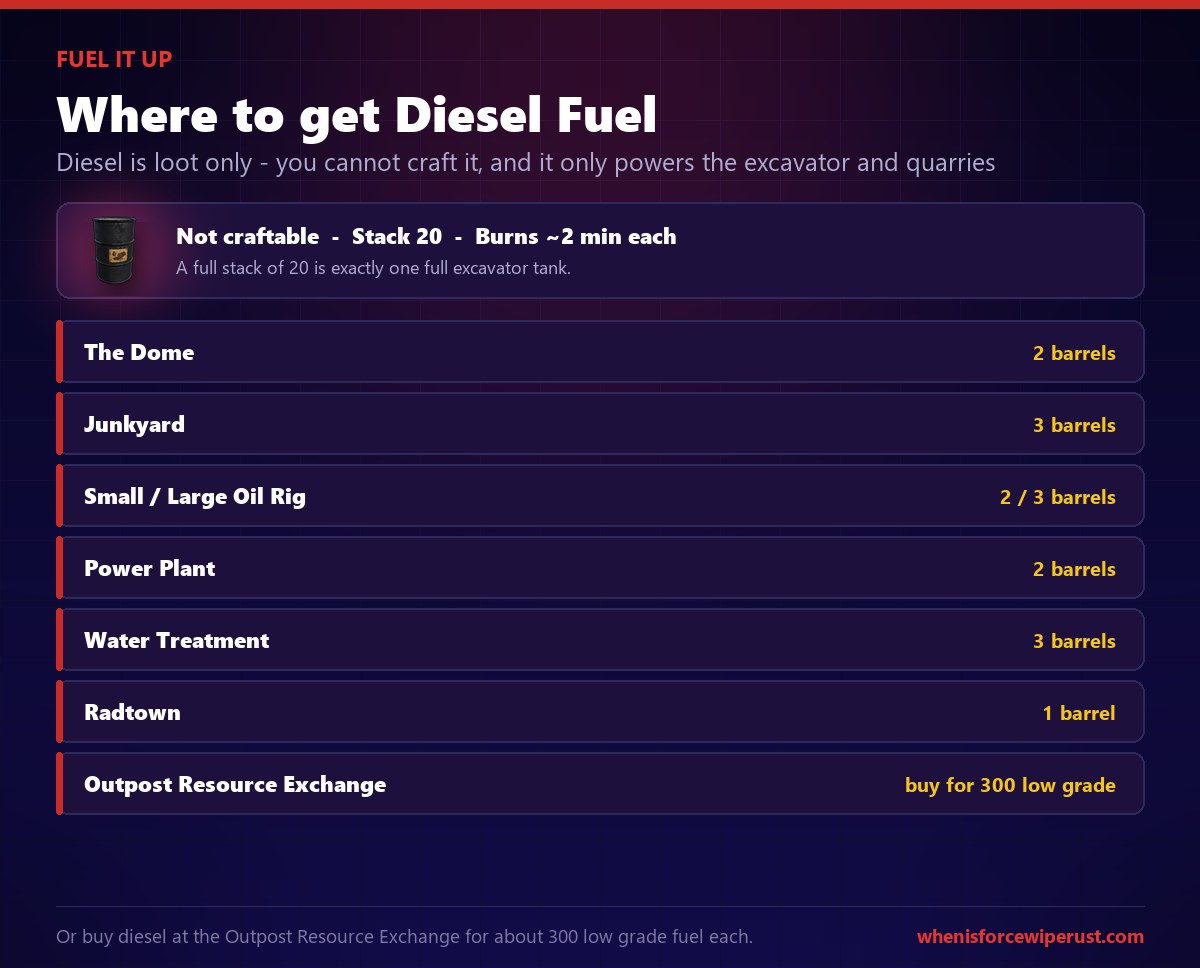
Because you cannot make it, you gather it. Diesel spawns in fixed amounts at a handful of monuments, and there is one vendor exchange if you would rather pay for it.
| Source | Diesel | Notes |
|---|---|---|
| The Dome | 2 barrels | Up top, quick grab if you can climb it |
| Junkyard | 3 barrels | Reliable, close to the desert excavator |
| Small / Large Oil Rig | 2 / 3 barrels | On top of the crate and card runs |
| Power Plant | 2 barrels | Around the monument |
| Water Treatment | 3 barrels | Around the monument |
| Radtown | 1 barrel | Occasional single spawn |
| Outpost Resource Exchange | Buy | Around 300 low grade fuel per diesel |
The vendor route matters more than it looks. If you are drowning in low grade fuel from a refinery run but short on diesel, the Outpost Resource Exchange will trade you diesel for roughly 300 low grade each. Prices in Rust drift with the dynamic vendor system, so treat 300 as a ballpark rather than a fixed rate, but it is a genuine way to top up a tank without touching a single monument. Note that diesel is a completely different fuel from the low grade your minicopter and tools burn, so do not confuse the two.
Scientists, radiation and the RF 4777 tell
The excavator is one of the easier monuments to clear on paper, but it has a few quirks that catch people out. The real danger is rarely the PvE.

Scientists. Around a dozen scientists guard the monument, spread across the pit floor and the catwalks. They are standard scientists rather than heavy scientists, so they go down to normal rifles and shotguns. It is a much softer fight than Oil Rig or Launch Site, and a competent solo can clear it, but the numbers mean you should bring enough ammo and meds to win several small fights rather than one.
Radiation. Radiation at the excavator is mild by modern standards, with a median reading around 11, and it is nowhere near as punishing as older 2019 guides make out. A Hazmat Suit makes the whole monument a non-issue, but if you would rather fight in combat armour, a road-sign kit plus a few anti-rad pills is enough to hold the pit while you work. Do not over-invest in rad gear here; spend the budget on meds and ammo instead.
Loot, the recycler and what else is on site
The mined resources are the reason you come, but the monument has ordinary loot too. There are around 18 crates scattered across the pit and buildings, including up to roughly 10 military crates, plus food boxes and a few cave-style crates down in the dig. There are no elite crates and no hackable crate, because the excavator is a resource monument, not a card run.
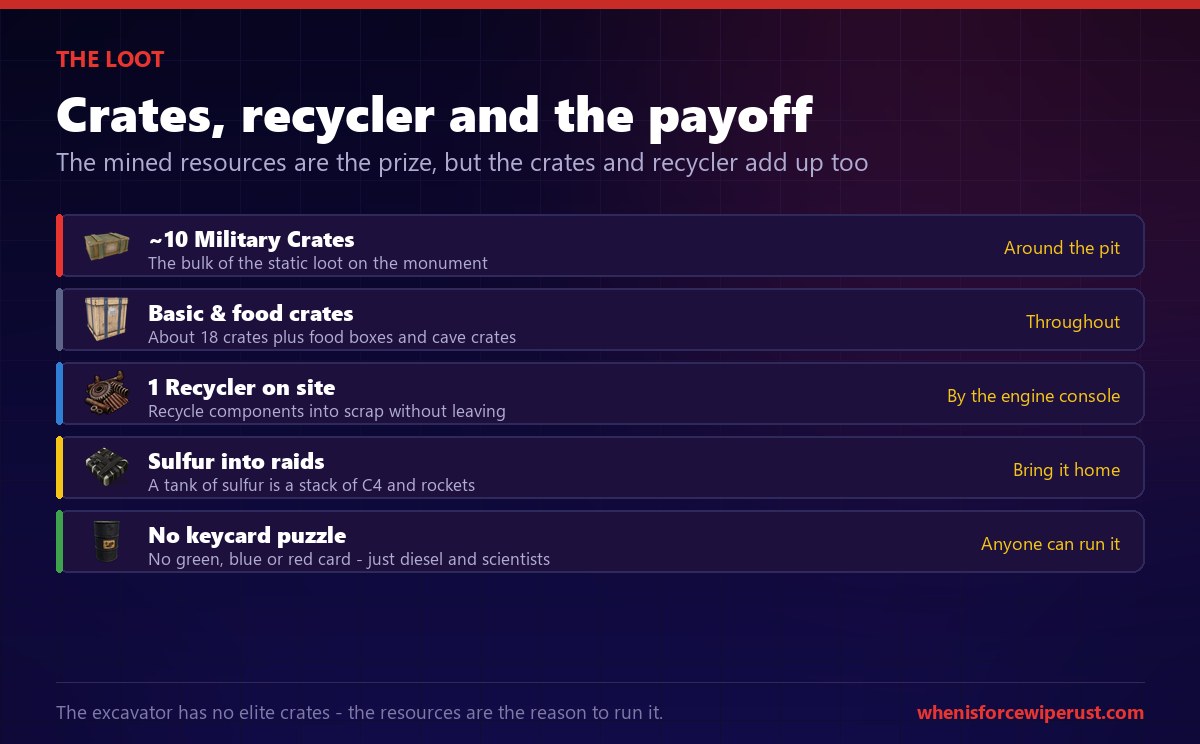
The genuinely useful extra is the recycler. There is one on site, near the engine startup console, which means you can smash the crates, recycle the components straight into scrap on the spot, and leave lighter without a detour to a safe zone. While a tank is running, popping the crates and recycling as you go is a tidy way to spend the 40 minutes. The monument also has an underground tunnel entrance, so you can slip in and out through the rail network if the surface is hot.
One feature almost nobody uses is the airdrop terminal next to the generator. If you feed it diesel, it charges toward 100%, and a full charge (which costs around 5 diesel) lets you call in an airdrop right onto the monument. It is a niche trick, but if you already have a stack of diesel and you control the pit, spending five of them to summon an airdrop is a cheap way to squeeze extra loot out of a run you are already defending.
Stockpiling before a wipe? All those resources, blueprints and stashes only matter until the monthly force wipe resets the map. Time your big excavator run for the days before, not after, so the sulfur actually gets used.
Check the wipe countdownIs the Giant Excavator worth using?
Ask the question honestly, because plenty of players do: is the Giant Excavator actually worth running? The answer depends entirely on whether you can hold it. As a raw resource source it is unmatched. Nothing else in Rust hands you 40,000 sulfur ore or 200,000 stone in 40 minutes from one input. For a clan that can post lookouts and defend both drop points, it is the single best farm in the game and a straight shortcut to a raiding stockpile.
For a solo or a duo it is a harder sell. The RF 4777 broadcast, the open desert sightlines and the two-pile collection problem all work against small groups, and it is very common to lose half a tank to a third party who heard the engine. Compared with a quiet Train Yard loop or a mining quarry you can tuck away, the excavator trades safety for raw output. Run it when you have the numbers and the map presence to defend it, use the haul to fund your explosives and your push on the red-card monuments, and skip it on the nights you are playing alone and quiet.
Giant Excavator FAQ
How do you use the Giant Excavator in Rust?
How much do you get from the Giant Excavator per diesel?
How much sulfur do you get per diesel at the Giant Excavator?
How long does one diesel last in the Giant Excavator?
Where do you get Diesel Fuel in Rust?
Can you craft Diesel Fuel in Rust?
Can you get stone from the Giant Excavator?
How many scientists are at the Giant Excavator?
Do you need a Hazmat Suit for the Giant Excavator?
Is there a recycler at the Giant Excavator?
Can you call an airdrop at the Giant Excavator?
What is RF 4777 at the Giant Excavator?
Is the Giant Excavator a safe zone?
Is the Giant Excavator on console Rust?
Does the Giant Excavator have camera codes?
What map size do you need for the Giant Excavator to spawn?
Giant Excavator or a mining quarry, which is better?
Is the Giant Excavator worth using?
Sources
- Facepunch, Excavator Update, for the release date, how the machine works, the two drop points and the RF 4777 broadcast.
- Facepunch Wiki, Diesel Fuel, for the item data: not craftable, stack size 20, one hour despawn, and its use in the excavator and quarries.
- RustHelp, Giant Excavator Pit monument page, for the scientist count, radiation, recycler, crate counts and no-build area.
- RustClash, Giant Excavator and Diesel Fuel pages, for the resource rates and diesel spawn locations.
- Rustafied, Giant Excavator Pit added, for the launch history and early monument details.
- whenisforcewiperust.com monuments guide, raid calculator and oil refinery guide for the cross-referenced game data.