
If you have ever watched a farmer clear a mining spot in half the time and walk away with a truck load of metal, there is a good chance they had a tea running. Ore Tea in Rust is the single best buff for gathering, a cheap berry brew that makes every metal, sulfur and stone node pay out more while it is active. It is one of the most underrated items in the game, and most players either never touch it or never make the good version.
This guide covers the whole thing: what Ore Tea does, the exact yield bonus for Basic, Advanced and Pure, how to brew it from berries at a Mixing Table, how much a Pure Ore Tea really costs, whether it works on stone, and how to stack it with a pie and a jackhammer for the fastest farming in Rust. Every number here is checked against the in-game item data, not guessed.
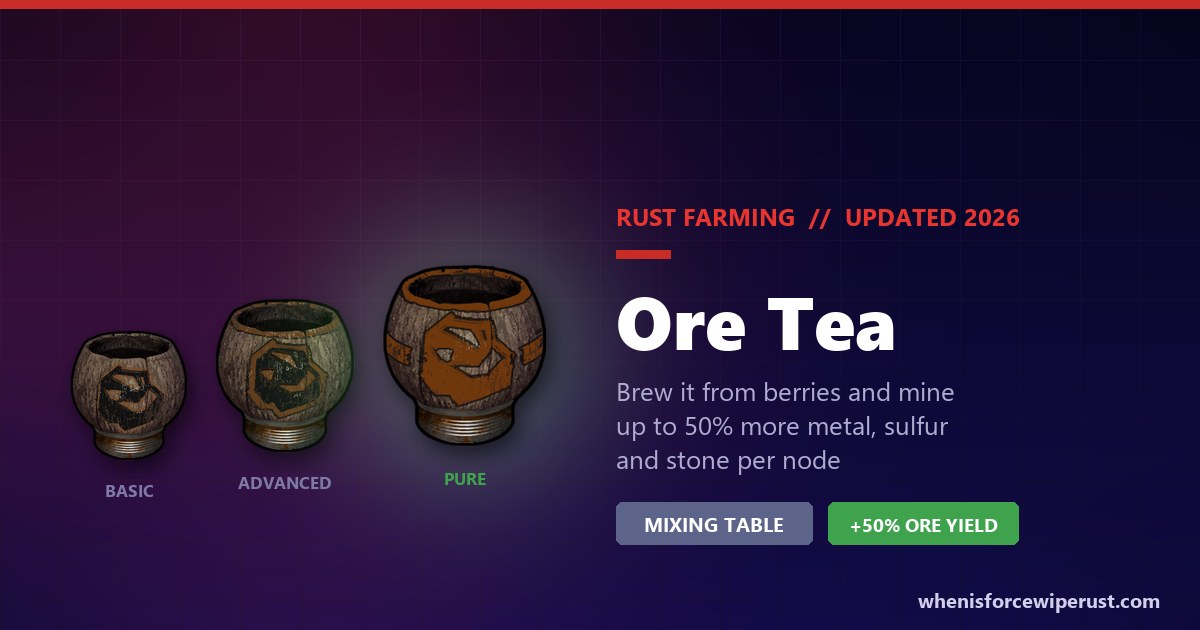
oretea) is a buff you brew at a Mixing Table that temporarily increases the ore you gather from nodes. There are three tiers: Basic (+20%), Advanced (+35%) and Pure (+50%), and every tier lasts 30 minutes and gives +30 hydration. You make a Basic from 2 Yellow Berries and 2 Blue Berries, then combine four of each tier to climb to the next. It works on metal, sulfur and stone nodes, including the bonus High Quality Metal you get finishing a metal node. If you farm ore, you should always have one running.
- What is Ore Tea
- Tiers and bonuses
- How to make it
- Pure Ore Tea
- What it boosts
- The Mixing Table
- Farming the berries
- Stack for max yield
- Is it worth it
- FAQ
What is Ore Tea in Rust?
Ore Tea is a consumable buff, one of the many teas you brew at a Mixing Table from berries. Its whole job is to increase the amount of ore you pull out of nodes. When the buff is active, every swing on a metal, sulfur or stone node gives you more resources than normal, right up until the node is gone. The in-game description says it plainly: it “temporarily increases your yield from harvesting ores.”
Teas are Rust’s answer to potions. You do not equip them, you drink them, and the effect ticks down on a timer in the corner of your screen. Ore Tea specifically is a gathering tea, in the same family as Wood Tea and Scrap Tea. Where those boost wood from trees and scrap from barrels, Ore Tea boosts the metal, sulfur and stone you mine. For anyone who spends time farming to fund a base or a raid, it is the most valuable tea in the game.
The beauty of Ore Tea is how cheap the payoff is. Berries grow for free, a Mixing Table is one of the first deployables you can afford, and a single tea can pay for itself many times over in one farming trip. The only real cost is the time spent building a small berry farm, and once that is running you can keep a whole team stocked with tea for the entire wipe.
Ore Tea tiers: Basic, Advanced and Pure
There are three tiers of Ore Tea, and the only thing that changes between them is the size of the bonus. Every tier lasts the same 30 minutes and restores the same +30 hydration. So the higher tier you drink, the more ore per node you get for the exact same amount of time.
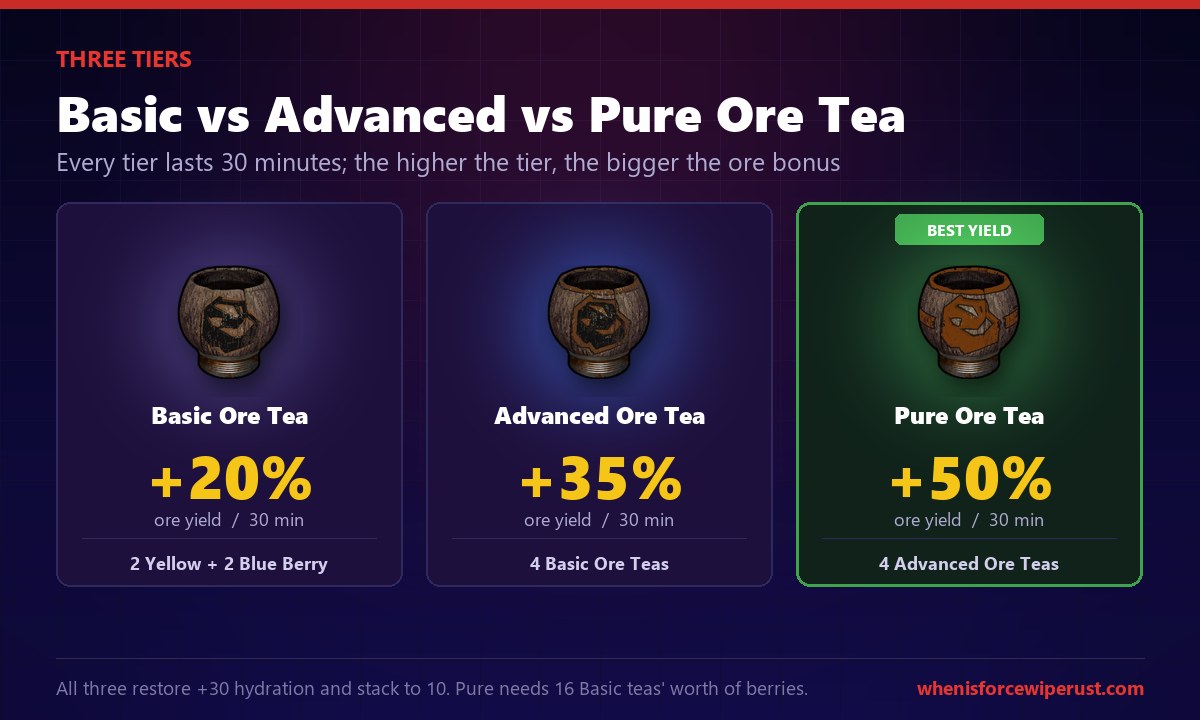
| Tier | Ore yield | Duration | Made from | Shortname |
|---|---|---|---|---|
| Basic Ore Tea | +20% | 30 minutes | 2 Yellow + 2 Blue Berry | oretea |
| Advanced Ore Tea | +35% | 30 minutes | 4 Basic Ore Teas | oretea.advanced |
| Pure Ore Tea | +50% | 30 minutes | 4 Advanced Ore Teas | oretea.pure |
Because the timer never changes, there is no reason to sip a weaker tea to “save” the good ones for later in terms of duration. A Pure Ore Tea is simply +50% for 30 minutes, and a Basic is +20% for the same 30 minutes. The trade is purely how many berries you are willing to spend for a bigger bonus, which is why serious farmers brew Pure and casual players get plenty of value from Basic.
How to make Ore Tea in Rust
Making Ore Tea is simple once you have a Mixing Table. The recipe for a Basic Ore Tea is 2 Yellow Berries and 2 Blue Berries. Drop them into the Mixing Table, and after a five second mix you get one Basic Ore Tea. That is the whole recipe, and the order you place the berries in does not matter.
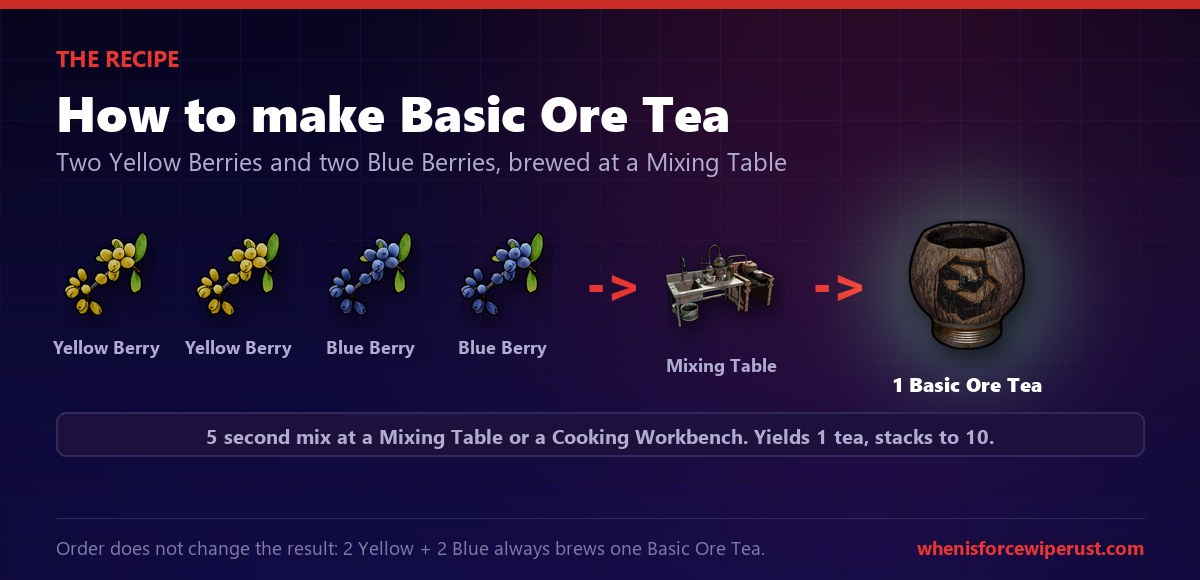
- Get a Mixing Table. Craft one for 200 Metal Fragments and 100 Stone at a Workbench Level 1, or buy one for around 175 scrap at Bandit Camp. A Cooking Workbench works too.
- Gather Yellow and Blue Berries. Pick them from bushes around the map, or grow your own in planters. You need two of each per Basic tea.
- Mix a Basic Ore Tea. Put 2 Yellow and 2 Blue Berries in the table and wait five seconds. Out comes one Basic Ore Tea.
- Combine up if you want more. Four Basic teas mix into one Advanced, and four Advanced mix into one Pure. Same table, same five second mix each time.
The Mixing Table is the gate here, not the berries. Once you have the table up and a small berry supply, you can brew Ore Tea endlessly for the cost of a bit of farming. Berries also grow back on their own once planted, so a tea farm is close to free to run after the initial setup.
Pure Ore Tea: the farmer’s favourite
Pure Ore Tea is the top tier and the one dedicated farmers live on. It gives the biggest bonus at +50% ore yield for 30 minutes, which means for every two nodes you would normally clear, Pure Ore Tea gets you the ore of three. Over a long farming session that is an enormous amount of extra metal, sulfur and stone for zero extra swings.
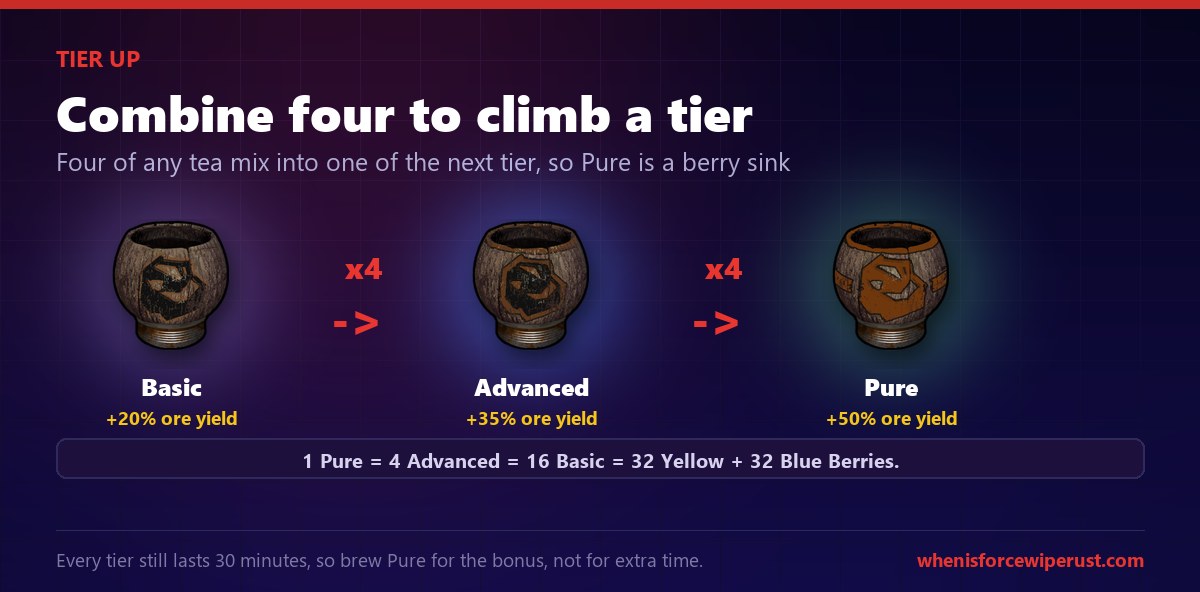
The catch is the cost. Because you build every tier from four of the tier below, a Pure Ore Tea is not cheap in berries:
| To make | You need | Berry total |
|---|---|---|
| 1 Basic Ore Tea | 2 Yellow + 2 Blue | 4 berries |
| 1 Advanced Ore Tea | 4 Basic teas | 16 berries (8 Yellow + 8 Blue) |
| 1 Pure Ore Tea | 4 Advanced teas | 64 berries (32 Yellow + 32 Blue) |
So one Pure Ore Tea costs 32 Yellow Berries and 32 Blue Berries, the same as 16 Basic teas’ worth of berries. That sounds like a lot, but a couple of well tended planters produce berries faster than you will drink tea, and the +50% bonus more than pays back the harvest. If you only ever make one tier of Ore Tea, most farmers would tell you to skip straight to Pure and just grow the berries to feed it.
What does Ore Tea boost? (Yes, including stone)
Ore Tea increases your yield from the three ore nodes in Rust: metal, sulfur and stone. A very common question is whether it works on stone, and the answer is yes. Stone nodes count as ore nodes for the buff, so Ore Tea boosts the stone you mine right alongside the metal and sulfur.

Here is what more yield means on each node type:
- Metal nodes give more Metal Ore, which you smelt into Metal Fragments. Ore Tea also boosts the chunk of High Quality Metal Ore you get on the finishing hit, which is the part farmers care about most since HQM is always in short supply.
- Sulfur nodes give more Sulfur Ore, the base of gunpowder and every explosive. More sulfur per node means cheaper explosives when it is time to raid.
- Stone nodes give more Stone for walls, foundations and upkeep. Stone is the cheapest resource, but a big base eats a lot of it, so the boost still adds up.
The buff lifts the ore itself, so it does not matter whether you are hitting nodes with a rock, a pickaxe or a jackhammer. The tool changes how fast the node comes apart, but Ore Tea changes how much you get out of it, and the two work together.
The Mixing Table: where every tea is born
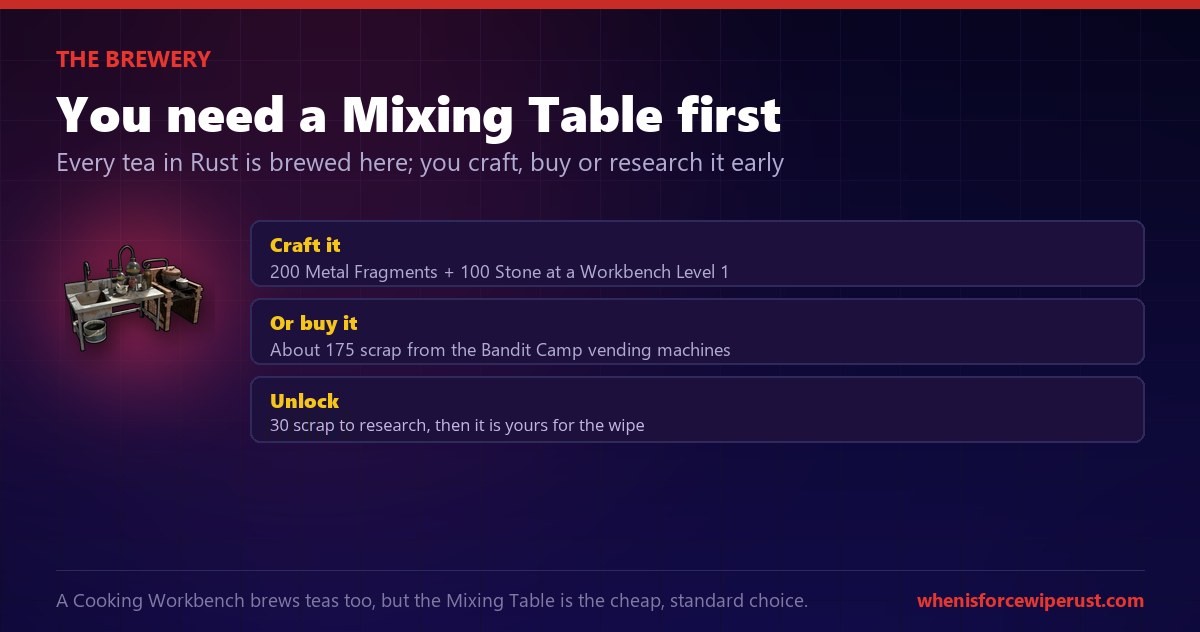
You cannot brew a single tea without a Mixing Table, so it is the first thing to sort out. It is a cheap early deployable and well worth rushing if you plan to farm seriously.
| How | Cost | Notes |
|---|---|---|
| Craft it | 200 Metal Fragments + 100 Stone | At a Workbench Level 1, roughly 30 seconds |
| Buy it | About 175 scrap | From the Bandit Camp vending machines |
| Research it | Around 30 scrap | Unlock the blueprint at a research table |
Once the table is placed, brewing is instant and free apart from the berries. A Cooking Workbench can brew teas as well, but it is a later, pricier deployable, so the Mixing Table is the standard choice for anyone who just wants tea. Scrap prices at Bandit Camp drift with the game’s dynamic pricing, so treat the 175 figure as a ballpark rather than a fixed sticker.
Farming the berries for endless tea
Ore Tea runs entirely on Yellow and Blue Berries. You can pick them wild from bushes scattered around the map, and each bush you harvest also drops a seed. Plant those seeds in a planter box and you have the start of a self sustaining tea farm.
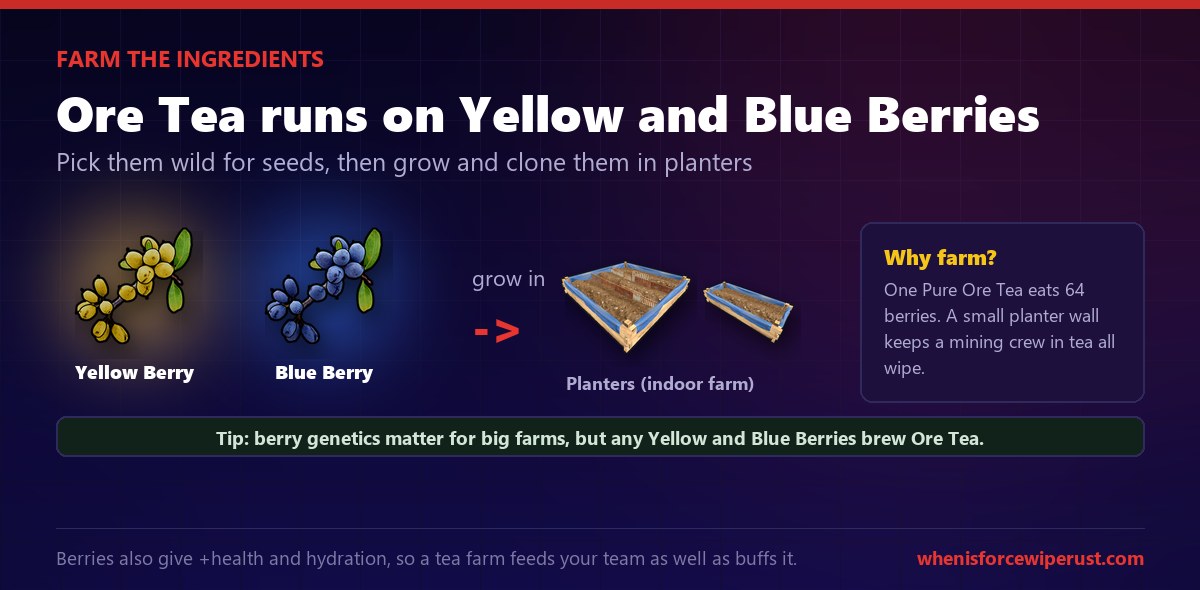
There are five berry types in Rust (white, yellow, red, green and blue), but Ore Tea only needs the yellow and blue ones. A small indoor farm of a few planters, with a light and some water, produces far more berries than a solo drinker will ever get through. Once berries are growing you can also clone the best plants to expand the farm quickly.
Stack Ore Tea for the highest yield in Rust
Ore Tea is strong on its own, but the reason it defines the farming meta is that it stacks with other buffs. The gathering bonus from a food like a Bear Pie is a separate multiplier, so it piles on top of your tea rather than overwriting it. Add a Jackhammer to tear through nodes at top speed and you have the fastest ore farming setup in the game.

The way to think about it is that each piece solves a different problem. Ore Tea raises how much ore the node contains for you, a Bear Pie raises your gather rate on top of that, and a Jackhammer raises how fast you can physically mine it out. Run all three at once and a farming trip that used to take an hour drops to a fraction of the time with a far bigger haul. Even just a Pure Ore Tea and a jackhammer is a massive upgrade over swinging a bare pickaxe.
Farming hard before the wipe? Every berry, tea, and stack of ore in your base is wiped on the force wipe. Check exactly when it lands so you can time your grind and start the new wipe with a plan.
Check the wipe countdownIs Ore Tea worth it?
For anyone who farms, Ore Tea is one of the highest value items in Rust, full stop. The ingredients are practically free once you have a berry farm, the buff lasts a useful 30 minutes, and even the Basic +20% pays for itself in a single node run. If you spend any real time mining, not drinking Ore Tea is leaving a large amount of ore on the table every trip.
Where it matters less is if you barely farm. If you get most of your resources from raiding, recycling and monument runs, a gathering tea does not do much for you, and you might prefer a Scrap Tea for barrels instead. But the moment your plan involves a pickaxe and a node field, Ore Tea belongs in your loadout.
- Always have one running while farming. A tea only ticks while you drink it, so pop one before you start hitting nodes, not after.
- Match the tier to the trip. A quick top-up run is fine on Basic. A dedicated multi-hour ore grind deserves Pure.
- Brew in bulk. Teas stack to 10, so make a full stack when your berries are ready and you are set for hours of farming.
- Share with the team. Hand teas out before a group farm. Everyone mining under +50% turns a base build into a short job.
- Do not forget the timer. Re-drink every 30 minutes. It is easy to grind past the buff running out and not notice your yields dropped.
- Feed the sulfur into a plan. More sulfur per node means cheaper raids, so price your targets with the raid calculator and farm to that number.
Rust Ore Tea FAQ
What does Ore Tea do in Rust?
How do you make Ore Tea in Rust?
What berries do you need for Ore Tea?
How long does Ore Tea last in Rust?
What does Pure Ore Tea do?
How many berries does a Pure Ore Tea cost?
Does Ore Tea work on stone?
Does Ore Tea increase High Quality Metal?
Are teas worth it in Rust?
What is the difference between Basic, Advanced and Pure Ore Tea?
Can you stack Ore Tea with other buffs?
Where do you get a Mixing Table in Rust?
Is Ore Tea better than Scrap Tea?
Do teas wipe in Rust?
Sources
- Facepunch Rust Wiki, Ore Tea (oretea) item pages, for the shortnames, +20% / +35% / +50% yield bonuses, 30 minute durations, hydration, stack sizes and berry recipes.
- RustClash Rust Wiki, Basic Ore Tea and Pure Ore Tea, for the per-tier yield, duration and item data.
- Rustafied, Mixing Tables in Rust, for the Mixing Table cost, how tea tiers combine, and the ore tea recipe and bonuses.
- whenisforcewiperust.com scrap guide, Bandit Camp guide and raid calculator, for scrap, vendor and sulfur cross-checks.