
If Rust has a currency, it is scrap. It is the grey pile of bent metal and bolts that you spend to research blueprints, climb the tech tree, buy keycards, and roll out of the vehicle vendor in a shiny minicopter. On a fresh wipe, the player with the most scrap is usually the player with the most guns, and that is not a coincidence.
This guide covers everything about Rust scrap: what it is, the fastest ways to get scrap, exactly which components give the most scrap when you recycle them, how much scrap the crates and monuments hand out, what scrap is actually used for, what it costs to buy the big toys, and how Scrap Tea can multiply your barrel haul. Every number here is checked against the in-game item data, not guessed.
scrap) is Rust’s core currency and research material. You cannot craft it, you gather it, mostly by recycling components at a recycler and by looting crates. The single best common component to recycle is the Rifle Body at 30 scrap, followed by Tech Trash at 24 and the weapon bodies at 18. Straight-up scrap comes from crates (basic 3, elite 25, locked crate 140 plus) and from running monuments, Cargo Ship, Bradley and dive spots. You spend scrap at a Research Table and the tech tree to learn blueprints, and at vendors for keycards, turrets and vehicles. Scrap Tea boosts the scrap you pull from barrels by up to 350%. Force wipe resets your blueprints, so scrap matters most in the first days of a wipe.- What is scrap
- Scrap facts
- How to get scrap
- Best to recycle
- Scrap from crates
- What scrap does
- What scrap buys
- Scrap Tea
- Farm scrap fast
- FAQ
What is scrap in Rust?
Scrap is a resource item that doubles as the game’s universal currency. The in-game description sums it up: “Scrap can be used in a Research table and Workbench to unlock and research items. Often used as a currency throughout the world.” In other words, scrap is what you spend to learn how to build things, and it is what NPC vendors take in exchange for gear you cannot craft yet.
The important thing to understand is that you never craft scrap. There is no recipe for it. You get it two ways: you loot it directly from crates and barrels, or you feed looted components into a recycler and it spits scrap back out. That makes scrap the payoff at the end of almost every loot run in Rust, which is why “how do I get more scrap” is one of the most common questions new players ask.
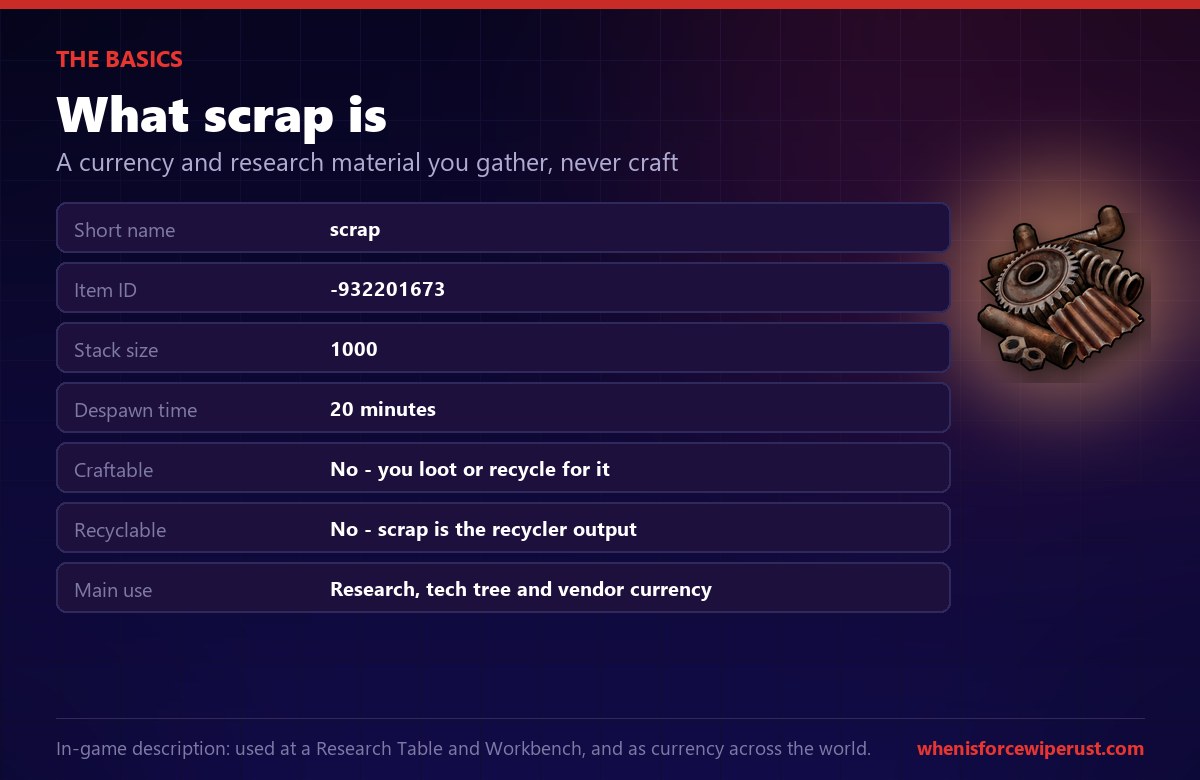
Scrap stacks to a huge 1000 per slot, so even a rich player only needs a slot or two to carry a wipe’s worth of it. It has no quality, no variants, and no decay in a box, which makes it the perfect thing to hoard. The only catch is that a loose stack on the ground despawns in 20 minutes, so pick up your scrap before it vanishes.
Rust scrap facts and stats
Here is the full stat line for scrap, pulled straight from the in-game item data.
| Stat | Value |
|---|---|
| Shortname | scrap |
| Item ID | -932201673 |
| Stack size | 1000 |
| Despawn time | 20 minutes on the ground |
| Craftable | No, there is no recipe for scrap |
| Recyclable | No, scrap is what the recycler outputs |
| Main uses | Research Table, tech tree, and vendor currency |
| Best source | Recycling components, especially weapon bodies |
The two lines people miss are the last ones on the “craftable” and “recyclable” rows. Because scrap is both un-craftable and un-recyclable, it is a pure sink-and-source resource: it flows in from loot and recycling, and it flows out into research and purchases. Nothing you do turns other materials into scrap in a crafting menu, which is exactly why recycling is so central to the whole economy.
How to get scrap in Rust
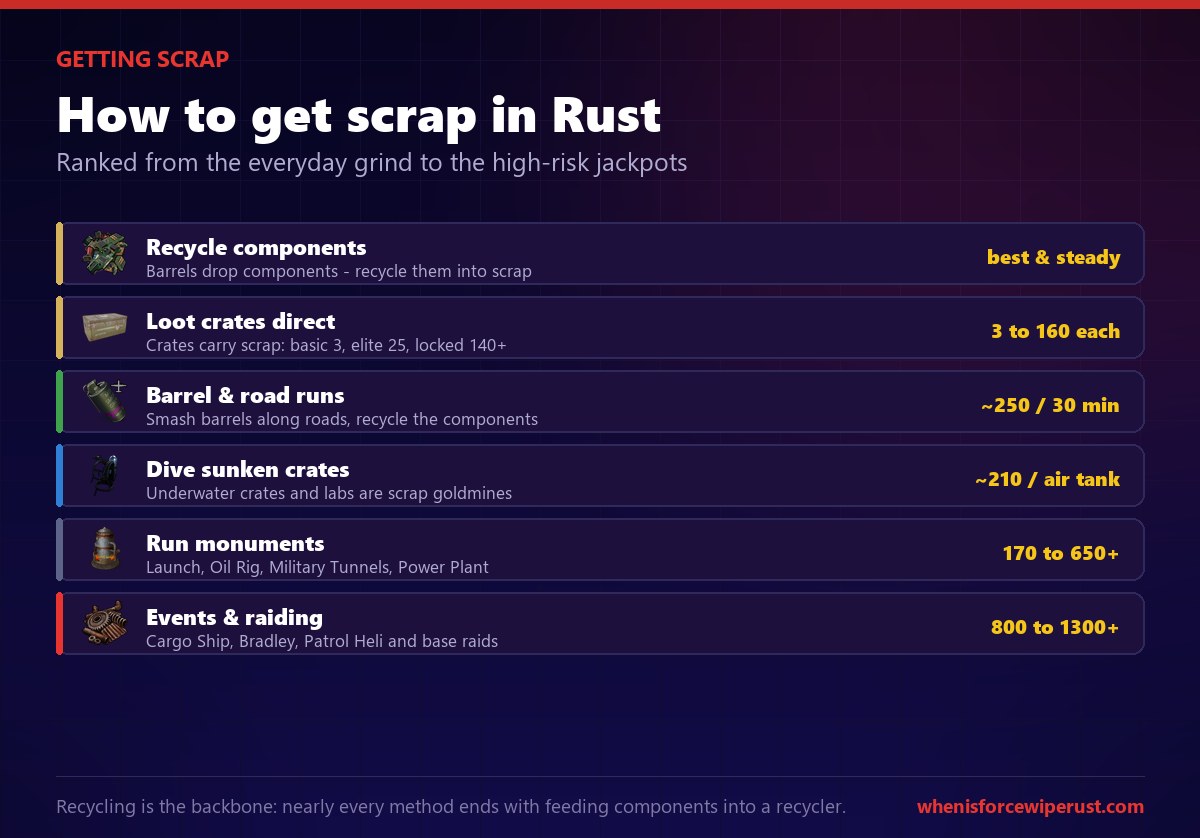
There are a lot of ways to earn scrap, and the right one depends on how much gear you are willing to risk. Below is the honest ranking, from the safe everyday grind up to the high-risk jackpots. Almost all of them share one final step: recycle the components you find.
| Method | Rough yield | Notes |
|---|---|---|
| Recycle components | Best and steady | Barrels and crates drop components, recycle them into scrap |
| Loot crates directly | 3 to 160 each | Many crates carry scrap on their own, no recycling needed |
| Barrel and road runs | ~250 per 30 min | Smash barrels along roads, then recycle the haul |
| Dive sunken crates | ~210 per air tank | Underwater crates and labs are scrap goldmines |
| Run monuments | 170 to 650 plus | Launch Site, the Oil Rigs, Military Tunnels, Power Plant |
| Events and raiding | 800 to 1300 plus | Cargo Ship, Bradley, Patrol Heli and base raids |
Recycling is the backbone of scrap. When you break a red barrel or open a crate, most of what you find is not scrap itself, it is components: rifle bodies, gears, sheet metal, road signs, springs, tech trash and so on. On their own those are just clutter. Drop them in a recycler and they turn into scrap plus a little high quality metal. That is the loop that funds your entire wipe, so learn where the recyclers are and never walk past a full inventory of components.
For pure looting, the road-and-barrel run is the classic safe method: grab a rock or an early weapon, run the roads smashing every barrel and green crate, and recycle the components at the nearest safe zone. A relaxed 30-minute loop nets a few hundred scrap with almost no risk. When you have gear to spare, monuments and events pay far more, but they announce your presence and invite PvP. Diving is the quiet middle option: a single air tank of sunken crates off the coast is worth around 210 scrap and rarely gets contested.
Best components to recycle for scrap
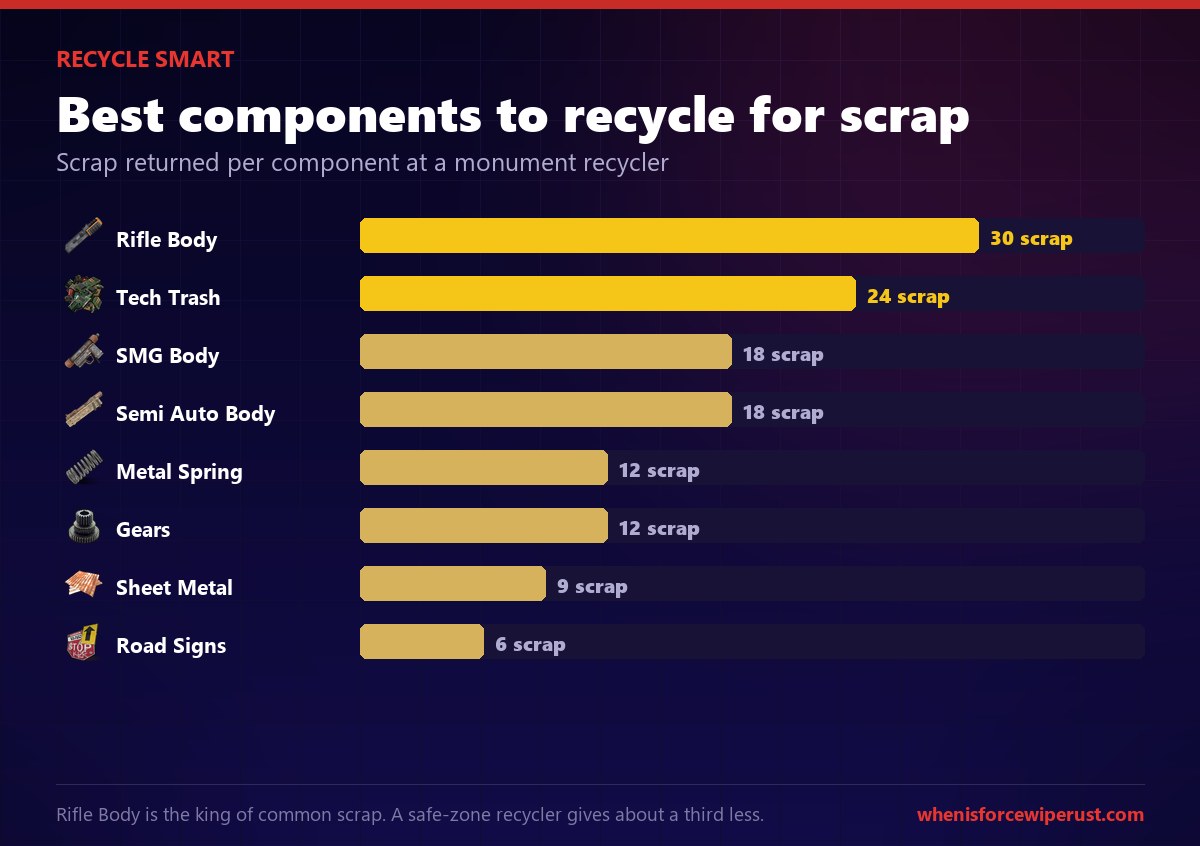
This is the question that decides how fast you get rich: what gives the most scrap when you recycle it? Not all components are equal. A rifle body is worth five road signs. If your inventory is full and you have to drop something, this chart tells you what to keep and what to leave behind.
| Component | Scrap (powered green recycler, 60%) | Scrap (safe zone recycler) |
|---|---|---|
| Rifle Body | 30 | 20 |
| Tech Trash | 24 | 16 |
| SMG Body | 18 | 12 |
| Semi Automatic Body | 18 | 12 |
| Metal Spring | 12 | 8 |
| Gears | 12 | 8 |
| Sheet Metal | 9 | 6 |
| Road Signs | 6 | 4 |
The clear winner is the Rifle Body at 30 scrap from a powered green recycler (25 while the Power Plant is offline, about 37 at the red Power Plant recycler), and it also throws in one or two high quality metal on top. Tech Trash is close behind at 24 scrap and is worth grabbing every single time, since it also feeds the recipes for C4 and other high-tier gear. After that, the weapon bodies (SMG and Semi Automatic) at 18 scrap each are the next best thing barrels commonly drop.
One more habit worth building: recycle, do not sell, your best components. Some players hand rifle bodies to vendors for a few scrap. Recycling them yourself gives you both the scrap and the high quality metal, which is almost always the better deal.
Scrap you loot without recycling
Plenty of containers hand you scrap directly, no recycler required. Knowing which crates are worth the walk (and the risk) helps you plan a run. Here is what the common sources drop.
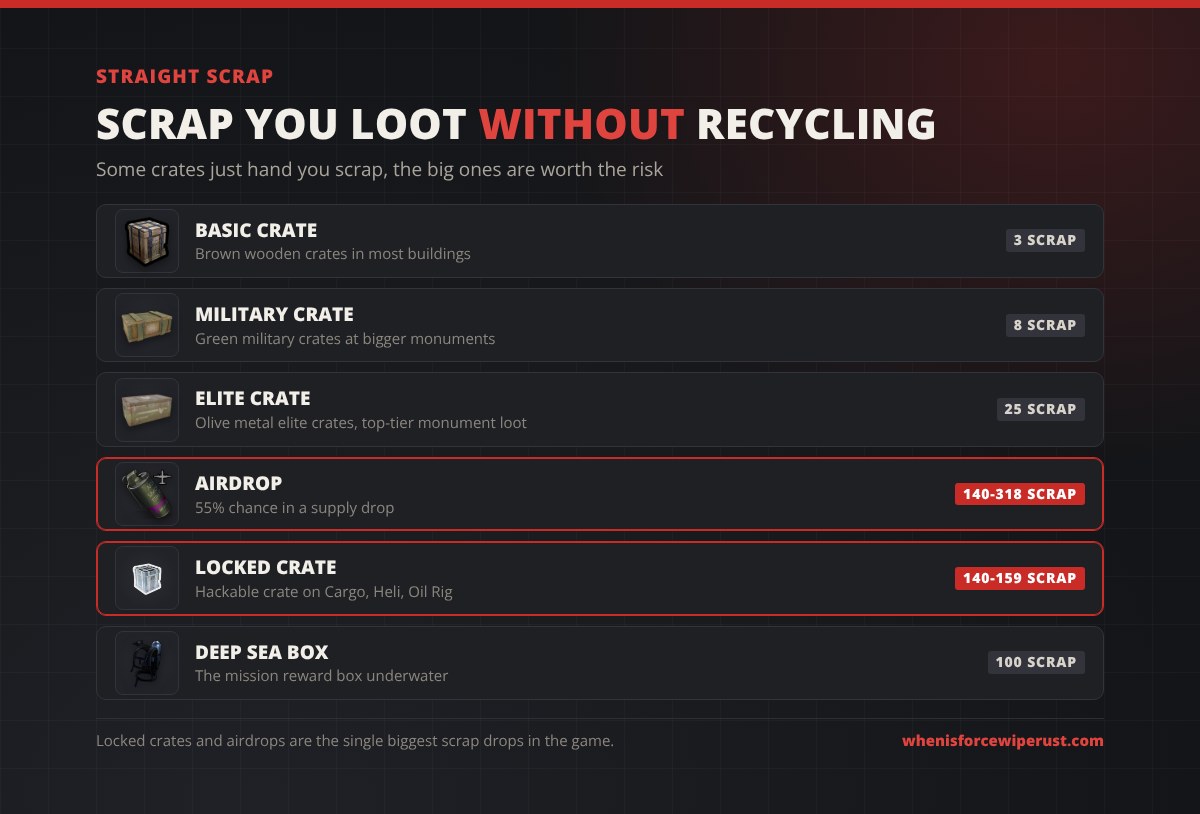
| Source | Scrap | Where |
|---|---|---|
| Basic Crate | 3 | Brown wooden crates in most buildings |
| Military Crate | 8 | Green crates at bigger monuments |
| Elite Crate | 25 | Olive metal crates, top-tier monument loot |
| Loot barrels | 2 plus components | The real value is the components inside |
| Locked (hackable) Crate | 140 to 159 | Cargo Ship, Chinook, both Oil Rigs |
| Airdrop | 140 to 318 | Roughly a 55% chance in a supply drop |
| Deep Sea mission box | 100 | The treasure box from the Vagabond’s Beep in the Deep mission, see our Rust missions guide |
| Scientists and NPCs | 8 to 33 | Dropped on kill at guarded monuments |
The takeaway is that locked crates and airdrops are the single biggest scrap drops in Rust. A locked crate takes a fixed hack time to open and can hand you 140 or more scrap along with high-tier gear, which is why events like Cargo Ship, the Bradley APC and the Patrol Helicopter are so lucrative. The trade-off is that every one of those is loud and contested, so bring gear you are willing to lose.
What is scrap used for in Rust?
Scrap is only worth farming because of what it unlocks. There are two big buckets: learning blueprints, and buying things from vendors. Get both working and scrap turns straight into firepower.
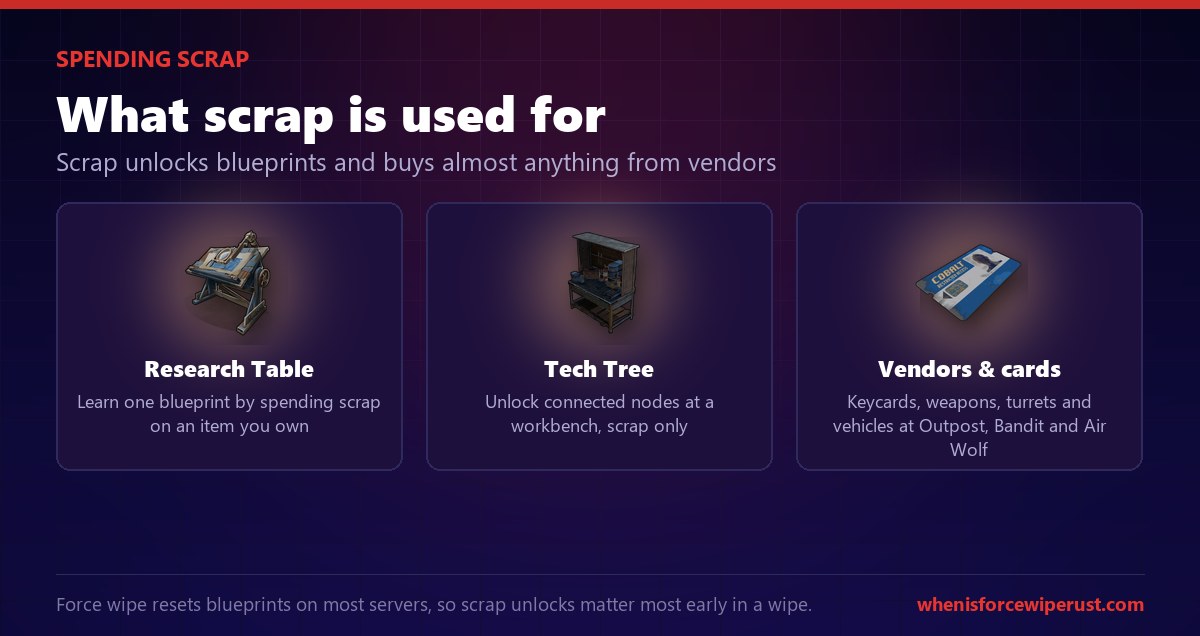
1. The Research Table. Put an item you own on a Research Table along with some scrap, and you permanently learn its blueprint so you can craft it forever. This is the cheap, targeted way to unlock a specific item you already looted, like a semi-automatic rifle or a piece of armor. Costs range from a few dozen scrap for basics up to several hundred for high-tier gear.
2. The tech tree. At each workbench you can spend scrap to unlock nodes in a branching tree, working outward from cheap items to expensive ones. It costs scrap only, no looted item required, which makes it the route for things you have not found yet. Unlocking an entire tech tree runs into the thousands of scrap, so most players cherry-pick the nodes they need. Our Rust blueprints guide breaks down both routes and the exact costs.
3. Vendors. Scrap is hard currency at the safe-zone shops. At Outpost you can buy weapons, defensive deployables and a blue keycard. At Bandit Camp you buy a green keycard, gamble on the wheel, and step over to the Air Wolf vendor for aircraft. The Fishing Village boat shop sells watercraft. All of it is priced in scrap.
How much scrap things cost
Wondering how much scrap you need for a boat, a mini, or a submarine? Here are the headline prices players search for most. Keep in mind Rust now uses dynamic vendor pricing, so these are base prices that drift up and down with supply and demand rather than fixed numbers.
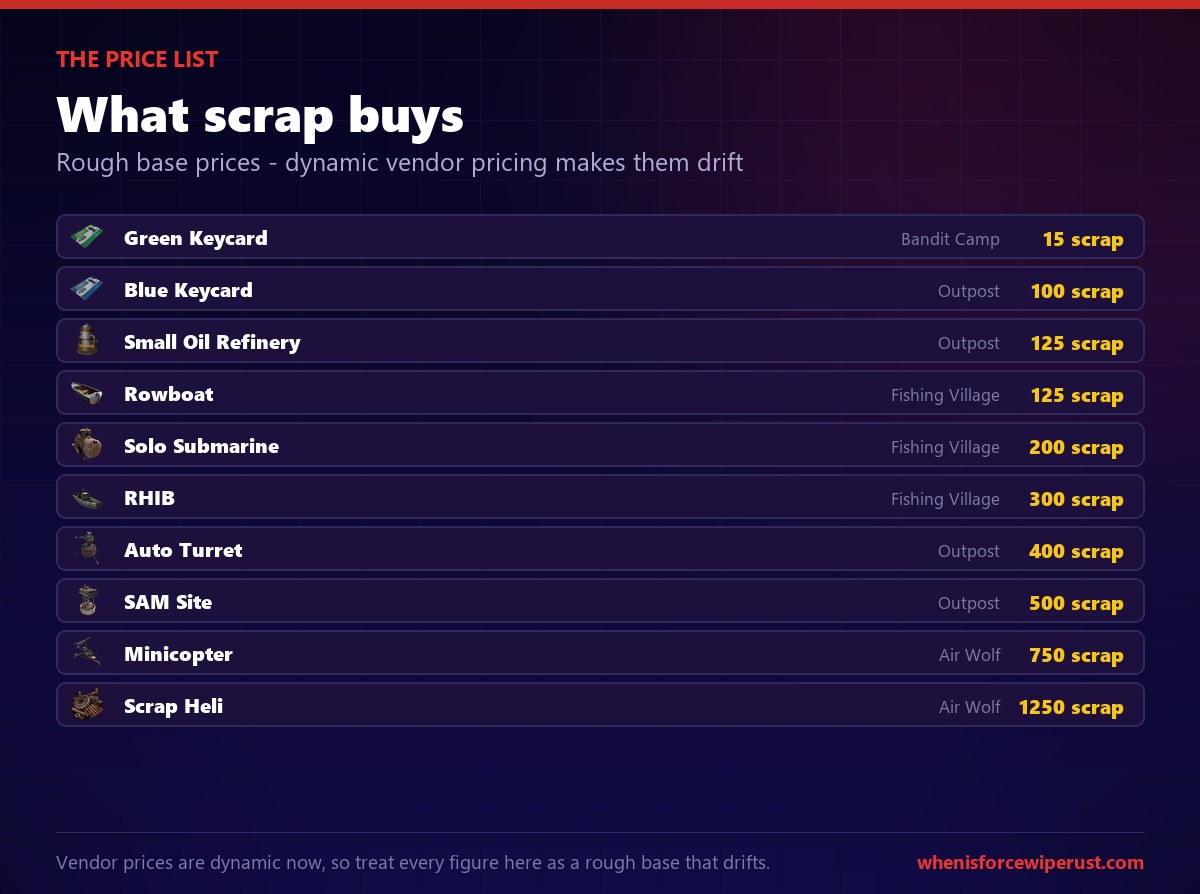
| Item | Rough scrap cost | Vendor |
|---|---|---|
| Green Keycard | 15 | Bandit Camp |
| Blue Keycard | 100 | Outpost |
| Small Oil Refinery | 125 | Outpost |
| Rowboat | 125 | Fishing Village |
| Solo Submarine | 200 | Fishing Village |
| RHIB | 300 | Fishing Village |
| Auto Turret | 400 | Outpost |
| SAM Site | 500 | Outpost |
| Minicopter | 750 | Air Wolf (Bandit Camp) |
| Scrap Transport Heli | 1250 | Air Wolf (Bandit Camp) |
So a boat is one good loot run, a minicopter is a serious afternoon of farming, and the Scrap Transport Helicopter is the big-ticket buy at around 1250 scrap. Note that the “scrap heli” people search for is a vehicle (the Scrap Transport Helicopter), not to be confused with the scrap resource itself, they just share a name. On top of these, don’t forget research and the tech tree quietly eat scrap the whole wipe, which is why it never feels like you have enough.
Scrap Tea: boost your barrel haul
Here is a trick a lot of players never touch: Scrap Tea. Teas in Rust are buffs you brew at a Mixing Table (or a Cooking Workbench), and Scrap Tea temporarily boosts the amount of scrap you pull from barrels. Barrels give a small amount of scrap on their own, and tea multiplies that, which stacks up fast over a long road run.
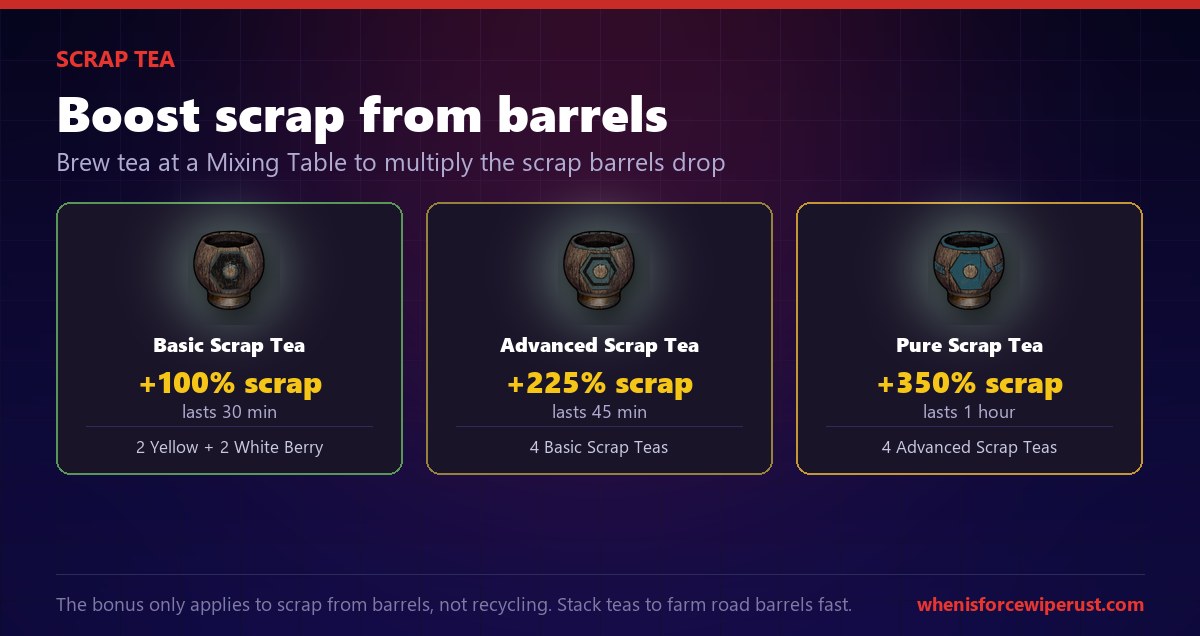
| Tea | Scrap bonus | Duration | How to make it |
|---|---|---|---|
| Basic Scrap Tea | +100% | 30 minutes | 2 Yellow Berries + 2 White Berries |
| Advanced Scrap Tea | +225% | 45 minutes | 4 Basic Scrap Teas |
| Pure Scrap Tea | +350% | 1 hour | 4 Advanced Scrap Teas |
You start by growing or looting Yellow and White Berries, then brew Basic Scrap Tea from two of each at a Mixing Table. Combine four Basic teas into one Advanced Scrap Tea, and four Advanced teas into one Pure Scrap Tea. That means a single Pure Scrap Tea costs 16 Basic teas’ worth of berries, but it more than quadruples the scrap you get from barrels for a full hour, and each tea also gives +30 hydration.
The fastest way to farm scrap
Put it all together and there is a clear “best” routine for a solo or small group early in a wipe. It is safe, repeatable, and it scales as you gear up.
- Drink a Scrap Tea and run the roads. Grab a two-handed melee weapon, drink a Basic (or better) Scrap Tea, and smash every barrel and green crate along a road loop. The tea multiplies the barrel scrap while you collect components.
- Recycle everything at a monument. Haul your components to a monument recycler for the best yield, ideally once the Power Plant is powered, not the safe zone one if you can help it. Rifle bodies, tech trash and weapon bodies are your big earners.
- Buy the cards, then run the puzzles. Spend a little scrap on a green and blue keycard and clear the monument puzzle rooms, which are stuffed with more components and scrap.
- Graduate to events and dives. Once you have gear, dive sunken crates for quiet scrap, then contest Cargo Ship, Bradley and the Patrol Heli for the huge locked-crate payouts.
- Recycle, always recycle. The number one mistake is leaving components on the ground. If it recycles into scrap, it is money. Carry it home.
For a breakdown of which monuments pay the most and what puzzles they hide, see our Rust monuments guide. And if you want the raw recycle numbers for every component, the recycler guide has the full chart.
Hoarding scrap before the wipe? On most servers the monthly force wipe resets your blueprints, so all that scrap you spent researching is gone and the race starts over. Check exactly when the next force wipe lands so you can time your scrap run.
Check the wipe countdownRust scrap FAQ
What item in Rust gives the most scrap?
What does scrap do in Rust?
Can you craft scrap in Rust?
What is the fastest way to get scrap in Rust?
What gives the most scrap when recycling in Rust?
Where is the best place to farm scrap in Rust?
How much scrap for a boat in Rust?
How much scrap for a minicopter in Rust?
How much scrap does it take to research everything in Rust?
What is Scrap Tea in Rust?
How do you make Scrap Tea in Rust?
Does Scrap Tea work on recycling?
How much scrap does a keycard cost in Rust?
Does scrap wipe in Rust?
Is a scrap heli the same as scrap in Rust?
Sources
- Facepunch Rust Wiki, Scrap (scrap) item page, for the shortname, item ID, stack size, despawn time, description and craft/recycle status.
- Facepunch Rust Wiki item pages for Rifle Body, SMG Body, Semi Automatic Body, Metal Spring, Gears, Sheet Metal and Road Signs, for the exact recycler scrap outputs.
- Facepunch Rust Wiki, Scrap Tea item pages, for the +100% / +225% / +350% bonuses, durations and berry recipes.
- Corrosion Hour, The Ultimate RUST Scrap Guide, for the ways to farm scrap and per-method yields.
- RustHelp, Scrap, for the loot-source scrap amounts and vendor uses.
- whenisforcewiperust.com recycler guide, blueprints guide and monuments guide, for the recycling, research and monument cross-references.