
Every base in Rust starts as a pile of grey rock with orange streaks in it. That rock is metal ore, and it is the raw material behind nearly every door, wall, gun and tool you will craft this wipe. You can’t build with it directly, though. Metal ore has to be mined, hauled home and cooked before it turns into anything useful.
This metal ore Rust guide covers the whole chain: how much ore every tool pulls from a node, every source of metal ore beyond swinging a pickaxe, where the best nodes spawn, how fast each furnace smelts it, and how many nodes you actually need for the things you want to build. If you want the finished product, our metal fragments guide covers what the ore turns into and every way to spend it.
- What It Is
- How to Get It
- Yield per Tool
- Where to Find It
- Smelting
- Ore vs Frags vs HQM
- How Much You Need
- Farming Tips
- Metal Ore & Wipes
- FAQ
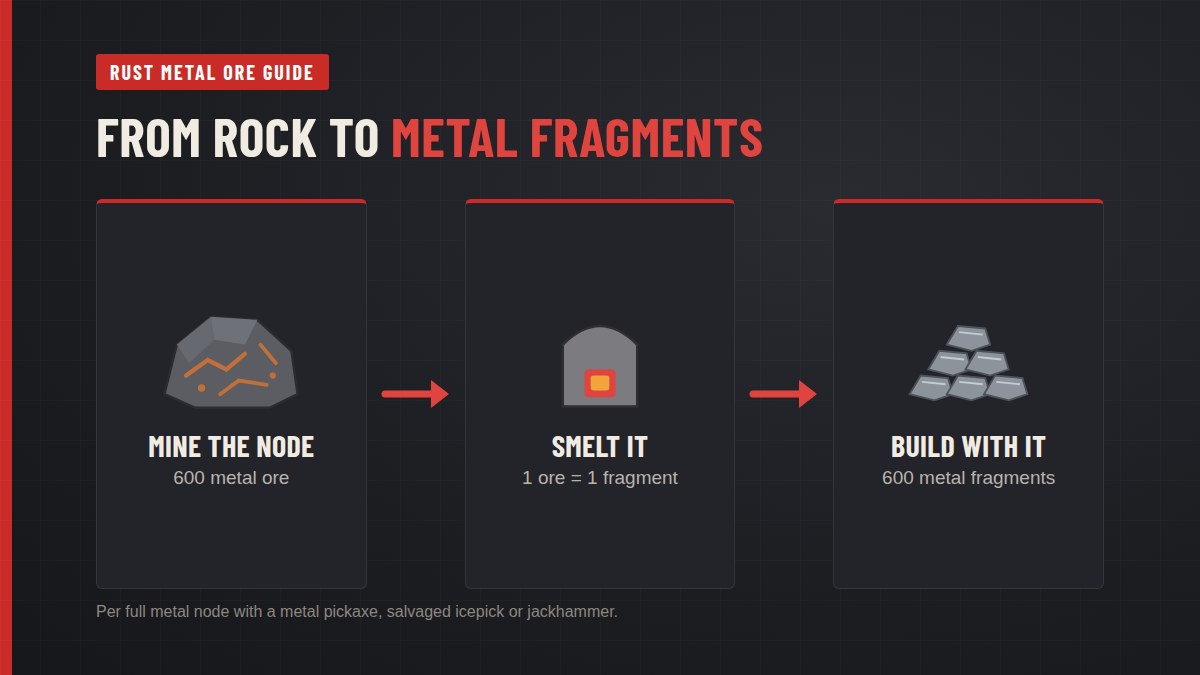
What Is Metal Ore in Rust?
Metal ore is the raw, unrefined form of metal in Rust. It is the most common ore in the game and the one you will gather most often after stone and wood. On its own it does nothing. There is no recipe that takes metal ore as an ingredient. Its only job is to go into a furnace and come out as metal fragments, which are used in hundreds of recipes.
That makes metal ore a pure farming resource. You measure it in nodes, not in items. When players talk about “going metal”, they mean running a loop of metal nodes, filling the inventory with ore, and heading home to smelt.
| Detail | Value |
|---|---|
| Item name | Metal Ore |
| Shortname | metal.ore |
| Stack size | 1,000 |
| Smelts into | Metal Fragments, 1 to 1 |
| Main source | Metal ore nodes |
| Craftable | No |
| Used in recipes | None, it must be smelted first |
How to Get Metal Ore in Rust
Mining nodes is where almost all of your metal ore will come from, but there are a few other sources worth knowing, especially early in a wipe when you have no good tools yet.
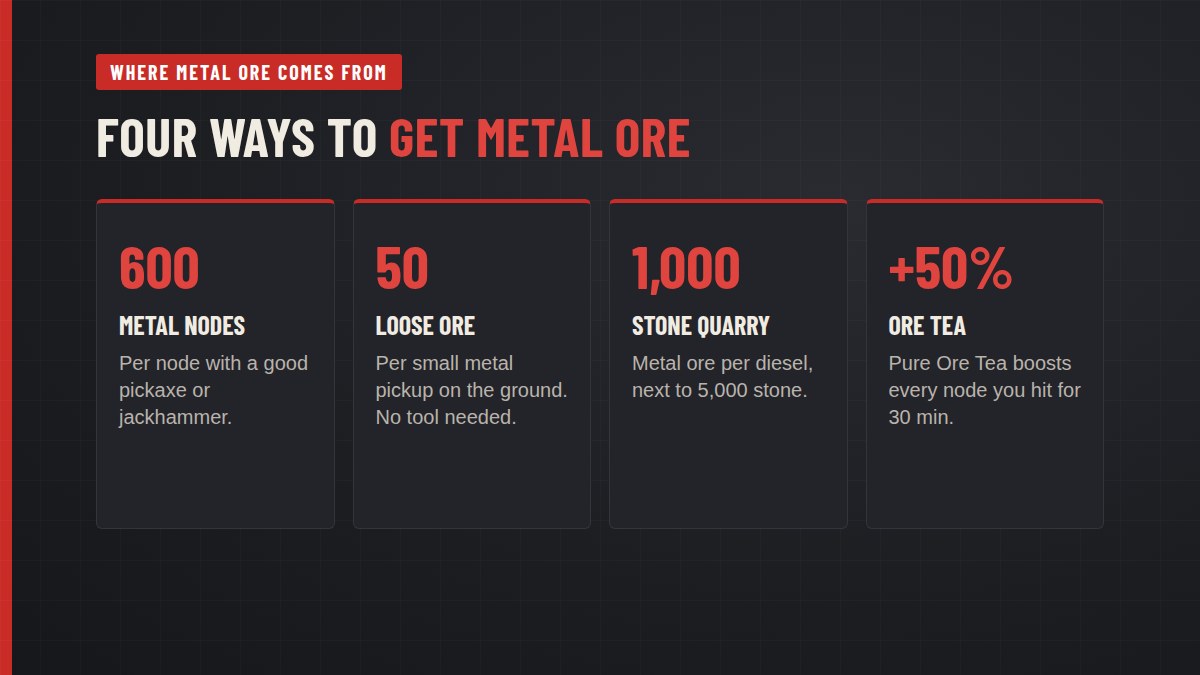
- Metal ore nodes. The main source. Hit the node with a pickaxe or jackhammer until it breaks. A full node gives 600 ore with a proper tool.
- Loose metal pickups. Small metal rocks lie on the ground near cliffs and rock formations. Press the use key on one to collect 50 metal ore with no tool. They are great for the first ten minutes of a wipe.
- The Stone Quarry. The roadside Stone Quarry pays 1,000 metal ore plus 5,000 stone for every diesel you burn. A full stack of 20 diesel is 20,000 ore in roughly 42 minutes.
- Ore Tea. Not a source by itself, but it multiplies every node you hit. More on that in the tips below.
How Much Metal Ore Does a Node Give?
A metal node has a fixed amount of ore inside it. Your tool decides how much of that you actually walk away with and how long it takes. With any proper metal tool you get the full 600 metal ore, and the node drops 2 high quality metal ore on the final hit.
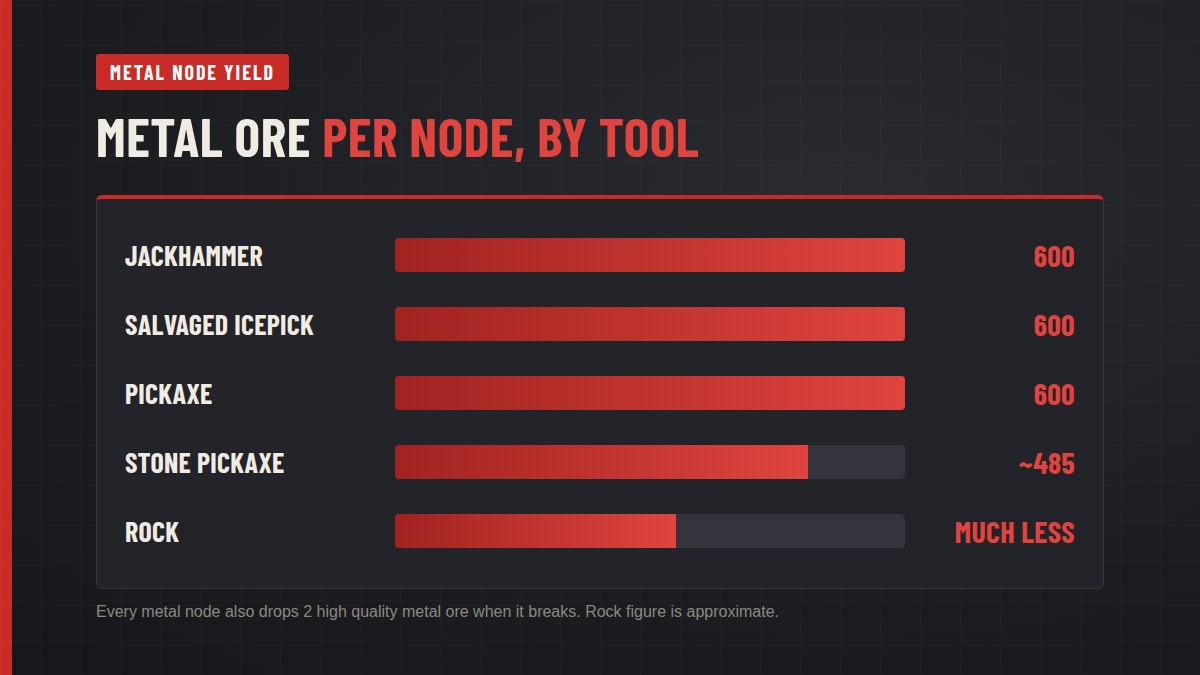
| Tool | Metal ore per node | Notes |
|---|---|---|
| Jackhammer | 600 | Fastest by far, a node in seconds |
| Salvaged Icepick | 600 | Best craftable pick for ore |
| Pickaxe | 600 | The standard farming tool |
| Stone Pickaxe | ~485 | Fine for the first hour |
| Rock | Much less | Emergency only, wastes the node |
Two things raise what you get per swing. The first is the weak spot: a glowing marker that appears on the node as you hit it. Landing a hit on it gives a bigger chunk of ore, and chaining hits on the marker grows the bonus further. It doesn’t add ore to the node, it just gets it out faster. The second is Ore Tea, which does raise the total.
| Ore Tea | Ore bonus | Ore per node |
|---|---|---|
| None | 0% | 600 |
| Basic Ore Tea | +20% | 720 |
| Advanced Ore Tea | +35% | 810 |
| Pure Ore Tea | +50% | 900 |
Figures assume a full-yield tool. The tea lasts 30 minutes, so drink it right before a farm loop, not while you are still crafting at home.
Where to Find Metal Ore Nodes
Metal nodes spawn on rock. You will find them around cliffs, mountains, canyons and boulder fields, and hardly ever in the middle of open grass. Every biome has them, but some are much better for a metal run.
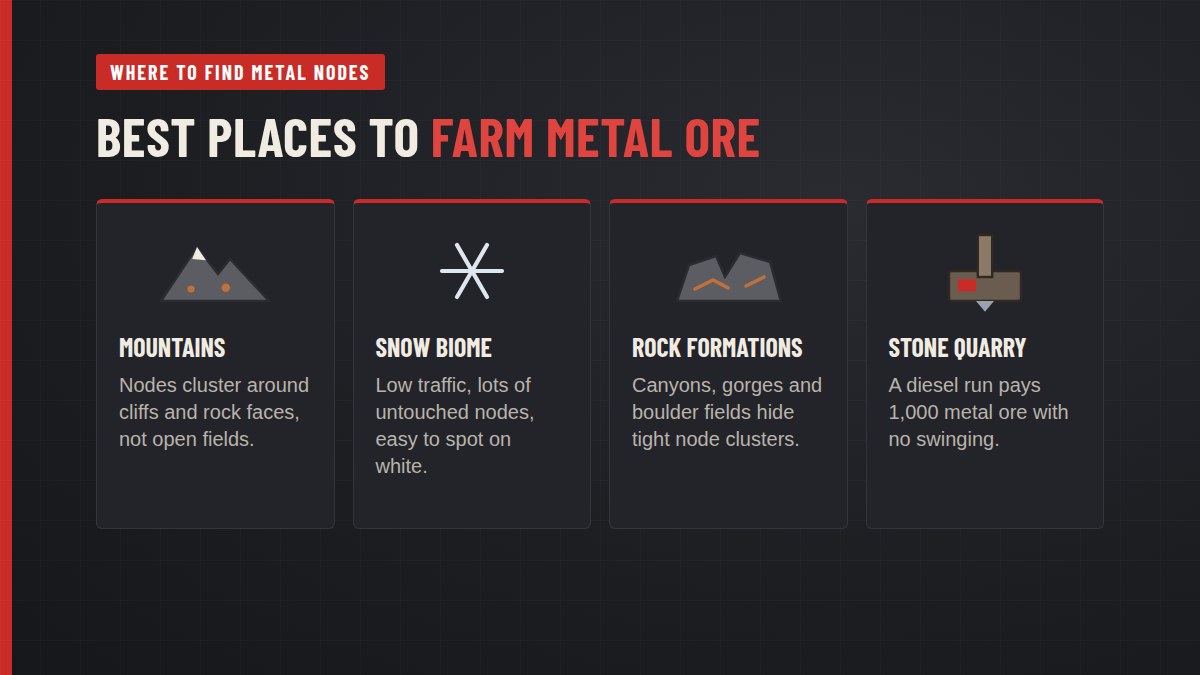
- Mountains and cliffs. The densest node clusters on most maps. Run along the base of a mountain range and you will hit node after node.
- The snow biome. Fewer players go there because of the cold, so nodes stay untouched. The grey rocks also stand out against the snow, which makes them quick to spot. Bring warm clothing.
- Canyons and boulder fields. Tight rocky areas often hold three or four nodes within a few metres of each other.
- The Stone Quarry. If you have diesel, it is metal ore with no swinging and one of the least contested spots on the map.
Metal nodes look like the stone ones, but darker, with orange-brown streaks through the rock. Sulfur nodes have yellow streaks. Once you know the colours, you can pick metal out from a distance and skip the rest.
How to Smelt Metal Ore
Put metal ore into any furnace with fuel, light it, and it turns into metal fragments. The ratio never changes: 1 metal ore always makes 1 metal fragment. The only difference between furnaces is speed and fuel. Our Rust furnace guide has the full breakdown.
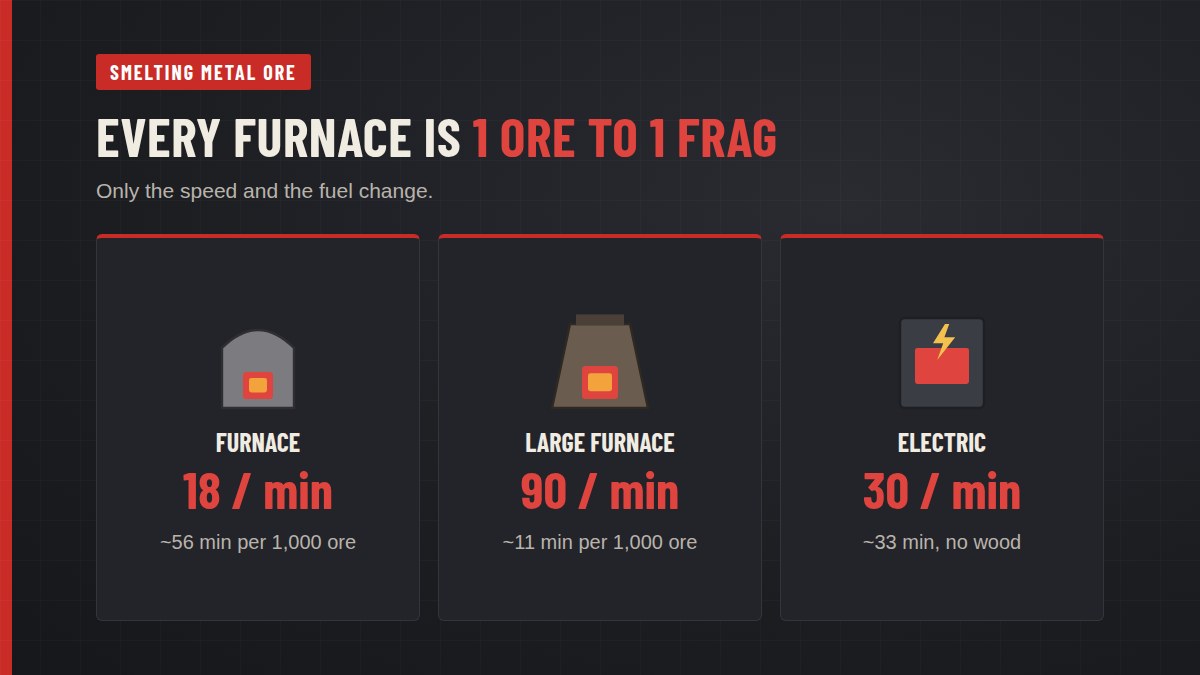
| Furnace | Metal ore per minute | Time for 1,000 ore | Fuel |
|---|---|---|---|
| Furnace | 18 | ~56 min | About 1,670 wood per 1,000 ore |
| Large Furnace | 90 | ~11 min | About 330 wood per 1,000 ore |
| Electric Furnace | 30 | ~33 min | 3 power, no wood, no charcoal |
- Place a furnace. The standard one costs 200 stone, 100 wood and 50 low grade fuel.
- Put wood in the fuel slot and metal ore in the input slots.
- Turn it on. Fragments appear in the output slots, and burnt wood leaves charcoal behind.
- Split big loads across several furnaces so they all cook at once.
Metal Ore vs Metal Fragments vs HQM Ore
New players mix these three up all the time. They are different items, and recipes never swap one for another.

| Item | What it is | Where it comes from | Used for |
|---|---|---|---|
| Metal Ore | Raw ore | Metal nodes, pickups, Stone Quarry | Smelting only |
| Metal Fragments | Smelted metal | Smelting metal ore, recycling, Excavator | Walls, doors, guns, ammo, tools |
| HQM Ore | Rare raw ore | HQM nodes, 2 per metal node, HQM Quarry | Smelts into high quality metal |
How Much Metal Ore Do You Need?
Because ore smelts 1 to 1, the easy way to plan a farm run is in nodes. One full node is 600 ore, which is 600 fragments. Here is what the common early builds cost in nodes.

| Build | Metal fragments | Metal nodes |
|---|---|---|
| Code Lock | 100 | About 1/6 |
| Sheet Metal Door | 150 | About 1/4 |
| Sheet metal wall upgrade | 200 | About 1/3 |
| Garage Door | 300 plus gears | 1/2 |
| Workbench Level 2 | 500 plus HQM and Basic Blueprint Fragments | About 1 |
| Workbench Level 3 | 1,000 plus HQM and Advanced Blueprint Fragments | About 2 |
A small starter base with a sheet metal door, a code lock and a few sheet metal walls needs two or three nodes. A proper 2×2 with a garage door on the loot room and a Level 2 workbench needs closer to ten. Plan one big metal run of 10 to 15 nodes after your first stone base is up, and you are set for the first day.
Metal Ore Farming Tips
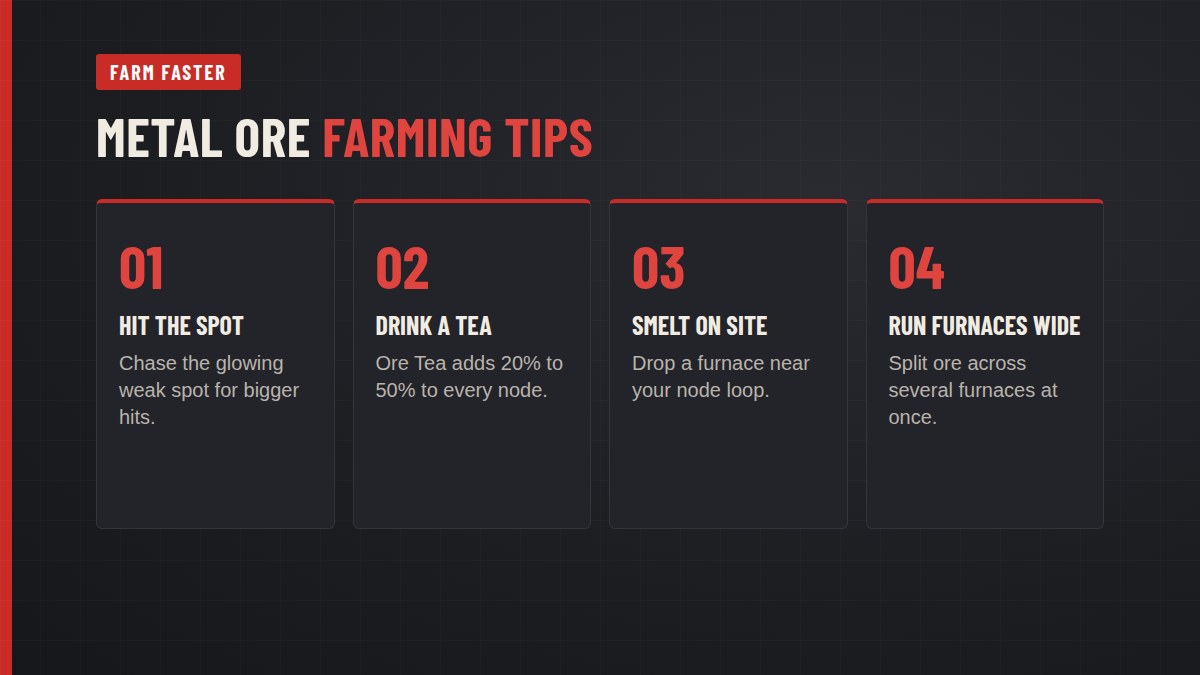
- Always chase the weak spot. Hitting the glowing marker gets the ore out much faster and keeps you exposed for less time.
- Drink Ore Tea before you leave. A Pure Ore Tea turns a 600 node into 900. Make them at a Mixing Table from yellow and blue berries.
- Smelt close to the nodes. A cheap furnace near a good node cluster saves you from running a full inventory across the map.
- Run furnaces in parallel. Five standard furnaces cooking together clear ore far faster than one furnace loaded to the top.
- Bring wood as well as ore. You will need fuel as well as ore. Smelting 1,000 ore in a standard furnace eats about 1,670 wood.
- Keep the charcoal. Every wood furnace leaves charcoal, which you need for gunpowder. A big metal smelt quietly sets up your raid supplies.
Metal Ore and the Wipe Cycle
Nothing you farm survives a force wipe. Your ore, your fragments and every furnace full of half-cooked metal is gone the moment the map resets. The first hour of a new wipe is a race to grab loose metal pickups, craft a stone pickaxe, and get the first furnace burning before anyone else locks down the good node areas.
The players who win that race are the ones who are online when the server comes back up. Check when your next wipe lands so you can be ready with a farm route in mind.
Be first to the nodes. See exactly when the next Rust force wipe goes live.
Force wipe countdownMetal Ore Rust FAQ
How do you get metal ore in Rust?
Mine metal ore nodes, the grey rocks with orange-brown streaks, with a pickaxe or jackhammer. You can also pick up small loose metal rocks for 50 ore each, or run the Stone Quarry, which gives 1,000 metal ore per diesel.
How much metal ore does a node give in Rust?
A full metal node gives 600 metal ore with a pickaxe, salvaged icepick or jackhammer, plus 2 high quality metal ore on the last hit. A stone pickaxe gets around 485. Ore Tea raises it to as much as 900.
How do you turn metal ore into metal fragments?
Put the ore into any furnace with wood and turn it on. Each metal ore becomes one metal fragment. A standard furnace smelts 18 a minute, a Large Furnace 90 a minute, and an Electric Furnace 30 a minute.
What does a metal node look like in Rust?
It looks like a stone node but darker, with orange-brown streaks running through the rock. Sulfur nodes have yellow streaks, and plain stone nodes have no coloured streaks.
Where is the best place to farm metal ore?
Mountains, cliffs and the snow biome. Nodes spawn on rock, so the base of a mountain range gives the densest loop. The snow biome sees fewer players, so its nodes are often untouched.
What is the stack size of metal ore in Rust?
Metal ore stacks to 1,000 per inventory slot.
Is metal ore the same as high quality metal ore?
No. Metal ore smelts into metal fragments. High quality metal ore is a separate, rarer ore that smelts into high quality metal. Every metal node drops 2 HQM ore, and HQM nodes and the HQM Quarry give much more.
Does Ore Tea work on metal nodes?
Yes. Ore Tea boosts metal, stone and sulfur nodes for 30 minutes. Basic adds 20%, Advanced adds 35%, and Pure adds 50%.
Sources and Further Reading
- Metal ore item and node data: Facepunch Rust Wiki, Metal Ore
- Node spawns and weak spot mechanics: Facepunch Rust Wiki, Ore Nodes
- Gather yields by tool: Rustly, Rust Gather Rates
- Ore Tea bonuses: Rust Wiki, Ore Tea
- Stone Quarry output: whenisforcewiperust.com, Stone Quarry Rust
- What the ore becomes: whenisforcewiperust.com, Metal Fragments Rust