
Every base in Rust lives or dies on one decision: how much of it you upgrade to sheet metal. It is the tier where a base stops looking like a suggestion and starts looking like a bad idea to raid, and it is the cheapest big jump in survivability the building system gives you.
Sheet metal is the third material grade you can build, sitting above stone and below armored. It doubles a block’s health to 1,000 HP, it takes zero fire damage, it needs no workbench and no blueprint, and it quietly costs you less in daily upkeep than the stone it replaces. That is a lot of upside for 200 metal fragments a wall.
This is the full guide to the whole tier: what sheet metal is, how to upgrade to it, what every piece costs, how it compares to the tiers around it, why fire and melee bounce off it, and where on your base the fragments actually belong. Where the deep raid maths lives on a dedicated page, we point you to it.
- What it is
- Stats
- How to upgrade
- What it costs
- Every piece
- All five tiers
- Vs stone and armored
- Fire, melee, soft side
- How to raid it
- Upkeep and decay
- Where to use it
- The component item
- Mistakes
- FAQ
What is sheet metal in Rust?
Sheet metal is a building grade, not an item you place. Every building piece in Rust starts life as twig, and you upgrade it up a ladder of material grades: twig, wood, stone, sheet metal, then armored. Sheet metal is the fourth rung and the third one you actually pay materials to reach.
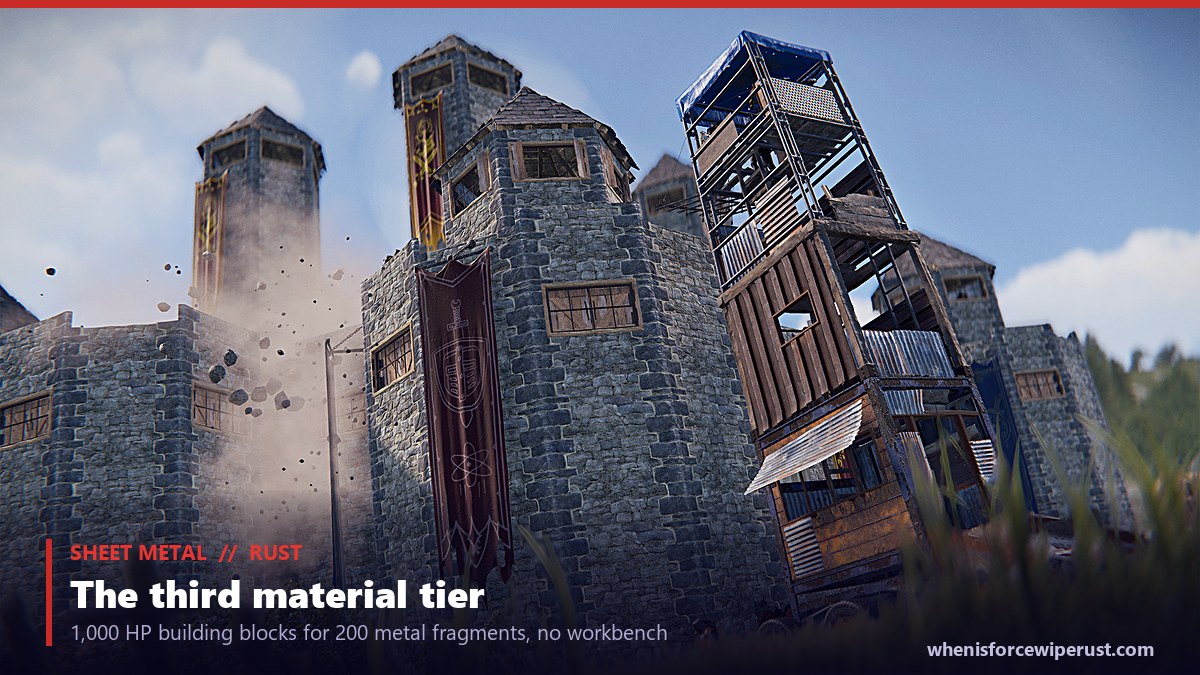
In game the grade is called Sheet Metal, which is why the same thing gets written as “metal tier”, “metal walls” and “sheet metal” depending on who is talking. It is unmistakable to look at: rusted, corrugated panels of slightly different shades riveted in overlapping sheets over a support frame.
Three facts define the whole tier, and they are the reason it is the most important upgrade decision in the game:
- 1,000 HP per block. Exactly double a stone block, exactly half an armored one. That doubling is what moves a raider from “two C4 and I am in” to “four C4 and there is still honeycomb”.
- No workbench, no blueprint. Building grades are not researched. If you have a hammer, the fragments and building privilege, you can build sheet metal on day one.
- It does not burn. Sheet metal takes zero fire damage and enormous melee resistance, which kills two entire categories of cheap raiding stone was still exposed to.
Sheet metal stats
| Stat | Value | Notes |
|---|---|---|
| Grade name | Sheet Metal | Tier 4 of 5, above stone, below armored. |
| Health (full block) | 1,000 HP | Wall, floor, foundation, frame, roof. |
| Upgrade cost (wall) | 200 Metal Fragments | Cut-out pieces cost a little less. |
| Workbench needed | None | Hammer, materials and building privilege only. |
| Fire damage | Zero | Immune to flame turrets, molotovs, incendiary ammo. |
| Melee (pickaxe, hard side) | 345 hits | Offline melee raiding is effectively dead. |
| Upkeep | 20 to 66 fragments / 24 h | Scales with total base size. |
| Decay | 8 hours | Full health to destroyed, no tool cupboard. |
| C4 to break a wall | 4 | 275 damage each. |
| Soft side | Yes, melee and bullets only | Explosives hit both faces identically. |
How to upgrade to sheet metal
Upgrading is one interaction. There is no crafting step, no bench, and no unlock. You place a piece, you point a hammer at it, and you pick the grade.
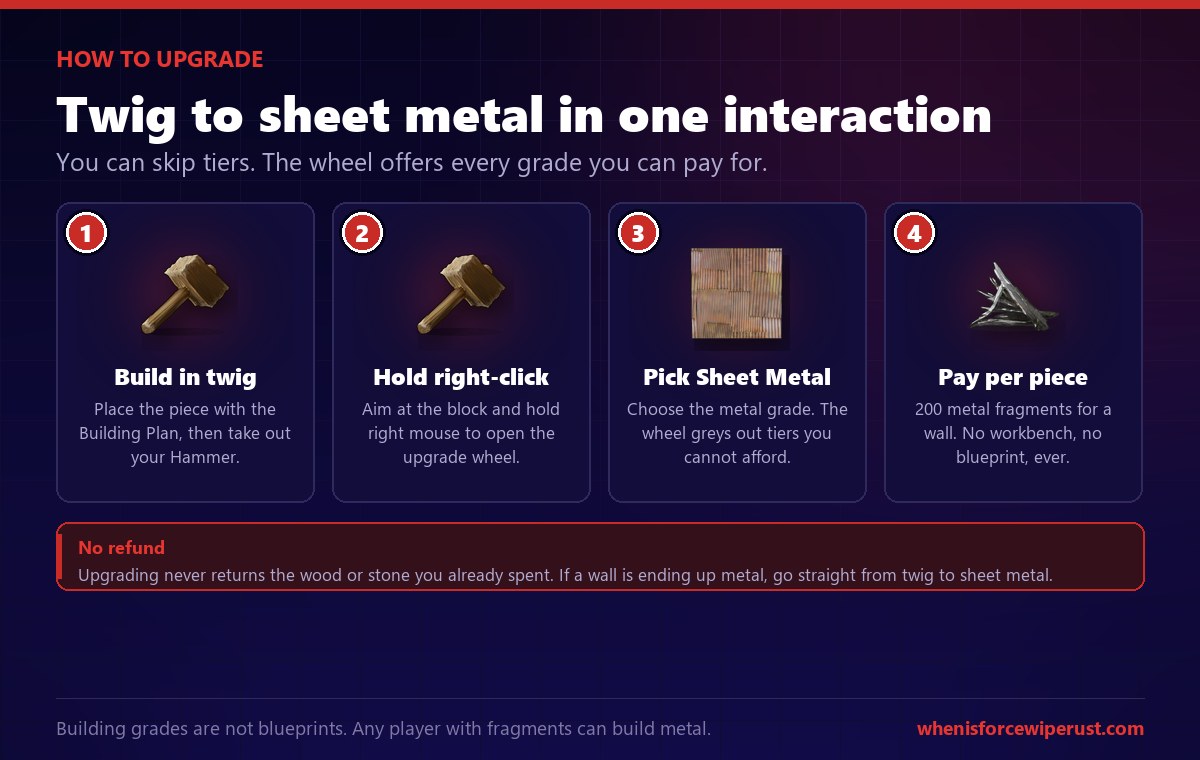
- Place the piece. Use the Building Plan to snap a wall, floor or foundation into a twig frame.
- Equip the Hammer and aim at the block you want to upgrade.
- Hold right-click. The upgrade wheel opens, offering every grade you can currently pay for. Grades you cannot afford are greyed out.
- Pick Sheet Metal. The fragments come straight out of your inventory and the block upgrades instantly.
You do not have to walk up the tiers one at a time. The wheel lets you jump twig straight to sheet metal in a single click and a single payment. Most experienced players throw up the whole shell in twig, then upgrade only the pieces that matter directly to their final grade.
What sheet metal costs to build
Two hundred metal fragments for a wall. That is roughly a stack and a bit of metal ore through a furnace, and a single decent metal node plus a loop of barrels covers several walls. Metal ore is also denser to carry than the stone a stone wall wants.
Where do the fragments come from? Smelt metal ore in any furnace, recycle components at a recycler (road signs, gears and the Sheet Metal component all pay out fragments), or run a quarry. For a metal base you want a steady fragment income, not a one-off pile, because upkeep is charged in fragments too the moment you go metal.
Every sheet metal piece, health and cost
Almost every full sheet metal block is 1,000 HP. What changes is the price: floors, wall frames, low walls and roofs cost 100 fragments, and pieces with a hole in them cost slightly less than a wall.
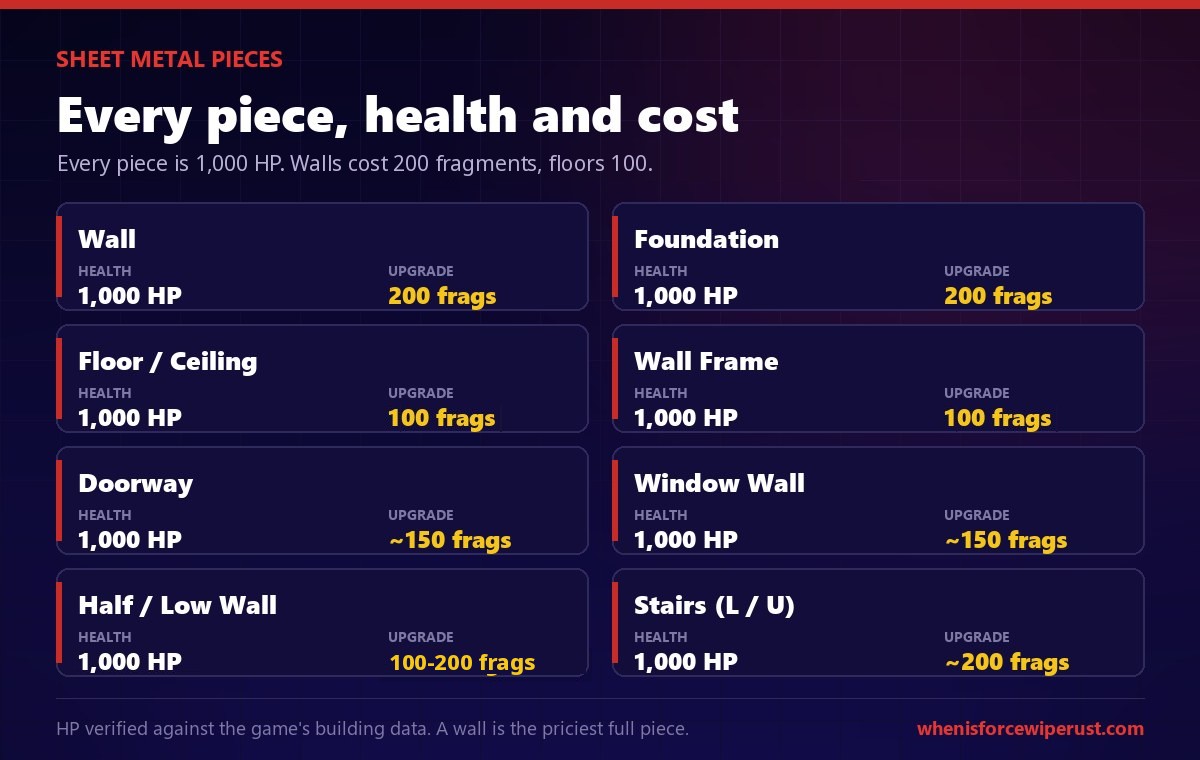
| Piece | Health | Upgrade cost |
|---|---|---|
| Wall | 1,000 HP | 200 Metal Fragments |
| Foundation | 1,000 HP | 200 Metal Fragments |
| Floor / Ceiling | 1,000 HP | 100 Metal Fragments |
| Wall Frame | 1,000 HP | 100 Metal Fragments |
| Doorway | 1,000 HP | Slightly less (cut-out) |
| Window Wall | 1,000 HP | Slightly less (cut-out) |
| Half / Low Wall | 1,000 HP | 200 / 100 Metal Fragments |
| Stairs (L / U) | 1,000 HP | Around a wall |
The practical takeaway is that a full sheet metal base is cheaper than “200 times the number of pieces” makes it sound, because floors, frames, low walls, doorways and windows all sit below the wall price. It is the wall that sets the ceiling.
The five building tiers compared
Here is where sheet metal sits against every other grade. Health, upgrade cost, and the C4 bill for a wall of each.
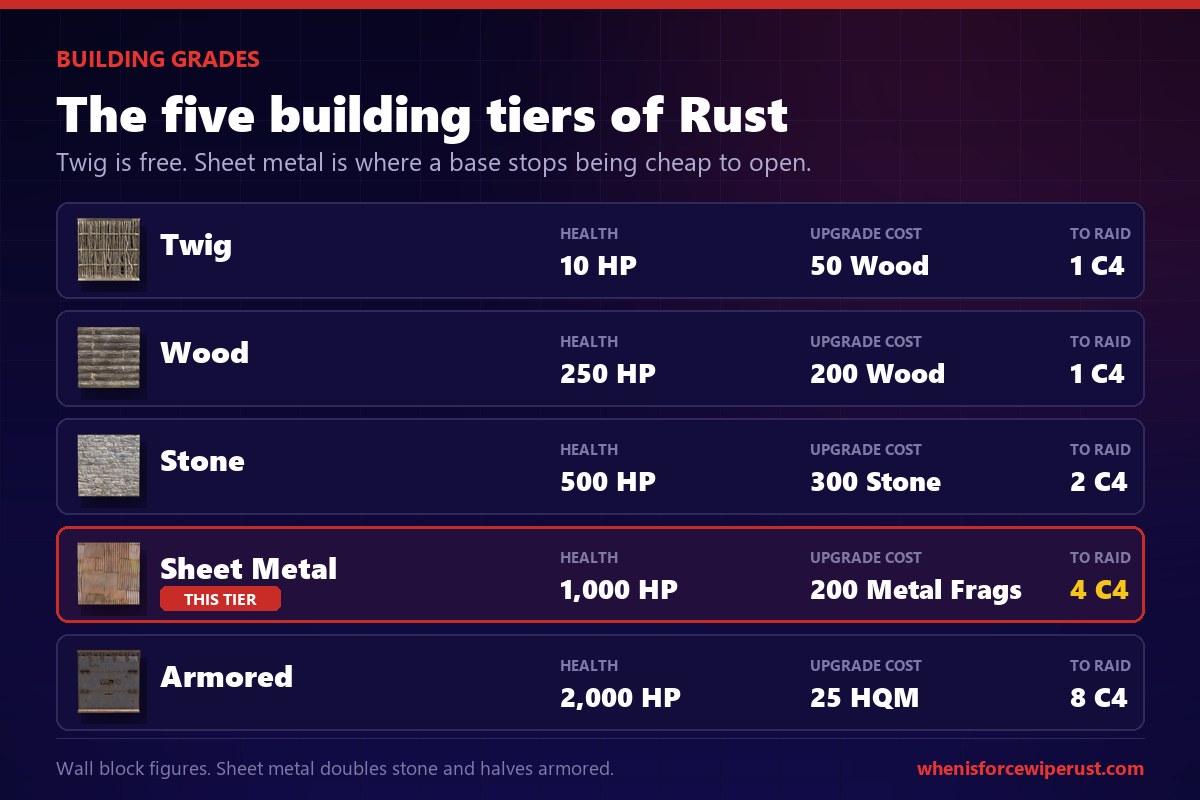
| Grade | Health | Upgrade cost | C4 (wall) | Decay |
|---|---|---|---|---|
| Twig | 10 | Free build state | 1 | 1 hour |
| Wood | 250 | 200 Wood | 1 | 3 hours |
| Stone | 500 | 300 Stone | 2 | 5 hours |
| Sheet Metal | 1,000 | 200 Metal Frags | 4 | 8 hours |
| Armored | 2,000 | 25 HQM | 8 | 12 hours |
The jump that matters most is stone to metal. Not for the raw health alone, but because it doubles the entry price and turns off fire and melee at the same time. A stone base is two C4 and a molotov story. A metal base is four C4 and nothing else, and that difference is what makes raiders scroll past.
Sheet metal vs stone vs armored
Stone is cheap and free-ish to farm. Armored is the hardest wall in the game. Sheet metal sits between them, and for most players most of the time it is the correct answer.
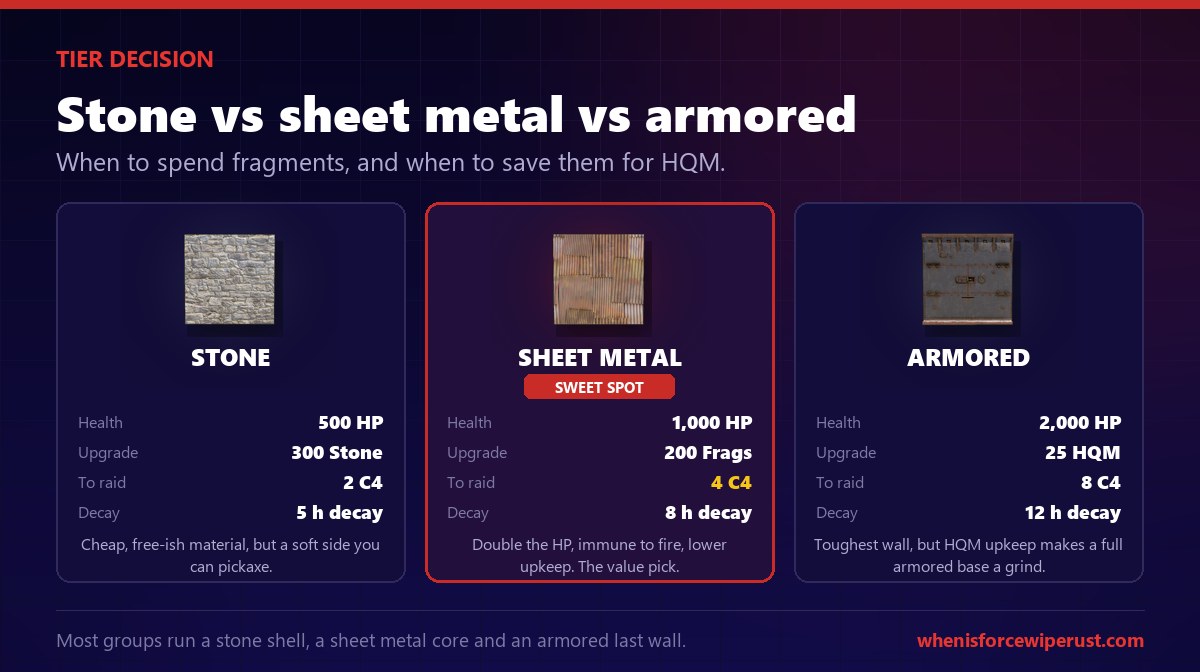
Stone keeps a soft side you can pickaxe through in about 90 hits, and it burns to nothing under a flamethrower. It is what your outer honeycomb should be, because honeycomb only exists to be chewed.
Sheet metal doubles the health, kills fire and melee raiding, and, as the upkeep section shows, actually costs fewer daily units than stone. The only real price is that fragments have competing uses and stone does not.
Armored doubles health again to 2,000 for 25 high quality metal, which is excellent per wall. The catch is that HQM is the hardest resource to farm at volume and armored upkeep is billed in HQM too. Almost nobody runs a full armored base. They run a sheet metal base with an armored core, the same way they run a armored door in a sheet metal wall.
Fire, melee and the soft side
This is the property that separates the metal tier from everything below it. Wood burns. Stone has a soft side you can mine. Sheet metal shrugs off both.
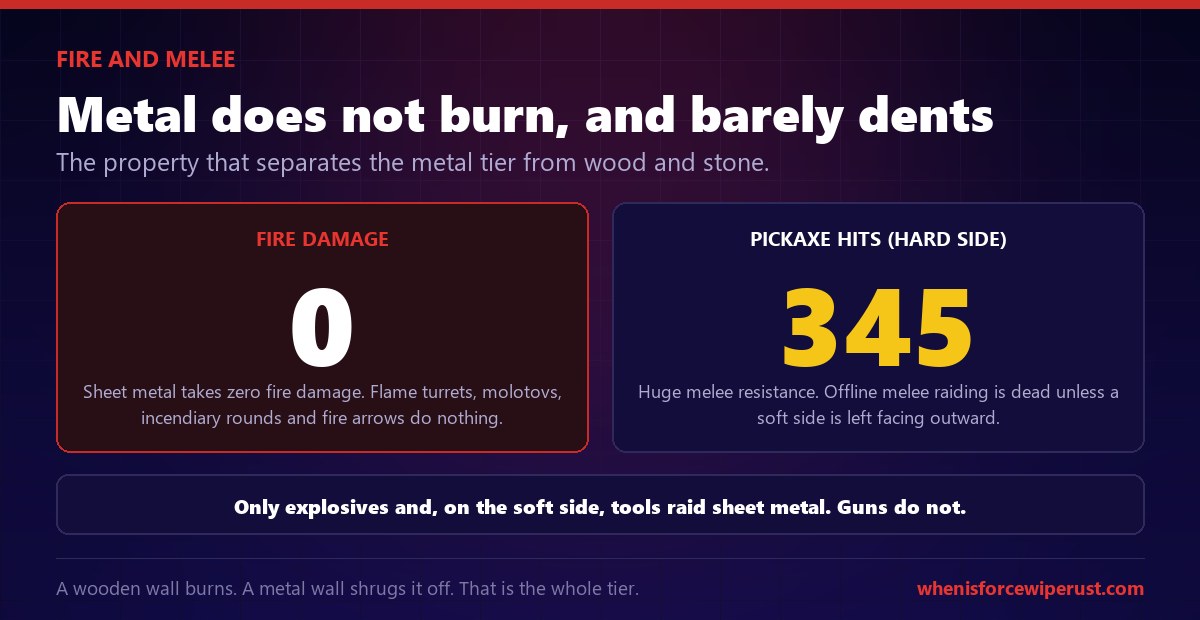
Fire does nothing. A sheet metal wall takes zero damage from flame turrets, molotovs, incendiary rockets, incendiary ammo and fire arrows. Every one of those tools that opens a wooden door for pennies is dead weight against metal.
Melee is a rounding error. A pickaxe needs 345 hits on the hard side of a metal wall, and a jackhammer still needs hundreds. That effectively ends offline melee raiding as a threat, with one exception below.
Bullets do not raid it. A standard 5.56 round does about 0.0025 damage to the hard side of a metal wall. You would need hundreds of thousands. Only explosive 5.56 counts, and even that is a raid tool, not gunfire.
How to raid sheet metal
Because fire, melee and gunfire are off the table, raiding sheet metal means one thing: explosives. The exact counts depend on the piece, and we keep the deep maths on the dedicated pages so it stays current.
| Target | C4 | Cheapest realistic route |
|---|---|---|
| Sheet metal wall | 4 | 3 C4 + 70 explosive 5.56 (8,350 sulfur) |
| Sheet metal floor / foundation | 4 | Same as a wall, 1,000 HP |
| Sheet metal door | 1 | 4 satchels, often cheaper than a wall |
| Garage door | 2 | The stronger door option in a metal wall |
The headline for a wall is four C4, but the cheapest carryable route is three C4 plus about 70 rounds of explosive ammo for 8,350 sulfur, which beats four straight C4 by 450 sulfur per wall. The full breakdown, including rockets, satchels, beancans and siege weapons, lives in the metal wall guide and the Rust explosives overview.
Sheet metal upkeep and decay
This is the section that changes minds. Sheet metal is not just tougher than stone, it is cheaper to keep.
| Grade | Upkeep per 24 h | Decay time | Health |
|---|---|---|---|
| Wood | 20 to 66 Wood | 3 hours | 250 |
| Stone | 30 to 99 Stone | 5 hours | 500 |
| Sheet Metal | 20 to 66 Metal Fragments | 8 hours | 1,000 |
| Armored | 3 to 8 HQM | 12 hours | 2,000 |
A stone wall bills up to 99 stone a day. A metal wall bills up to 66 fragments. You get double the health for a third fewer upkeep units. The only reason to hold off is that early on your stone is genuinely free while your fragments have a queue of other uses.
Decay runs 5 hours to 8 hours. If your tool cupboard runs dry while you sleep, a stone base has five hours of life left and a metal base has eight. Those three hours are often the difference between logging in to a base and logging in to a foundation. The full upkeep and decay mechanic is covered in the tool cupboard guide.
Where sheet metal actually belongs
Having the fragments is not the same as knowing where to spend them. The most common building mistake in Rust is metalling the outside first.
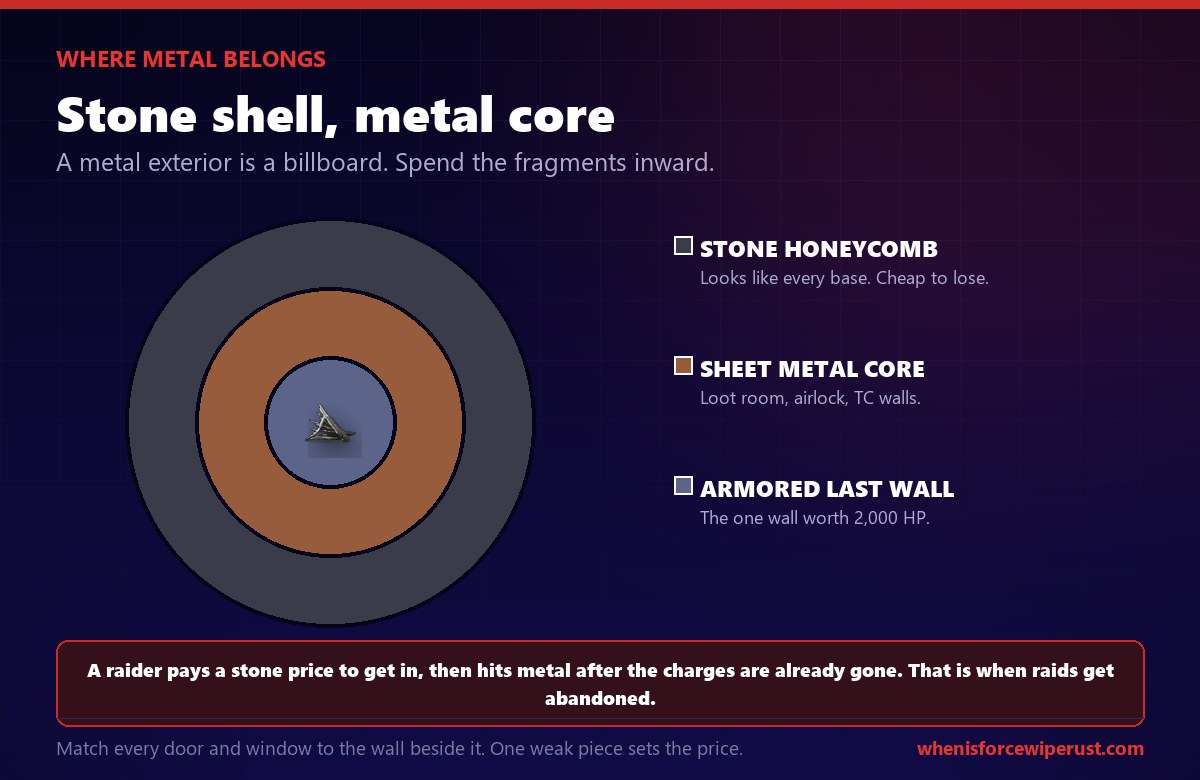
A metal exterior is a billboard. Everyone on the server can read it from a hill. It says two things at once: someone in here has fragments to spare, and this base is worth more than the two C4 a stone base would cost. Plenty of raids happen purely because a base looked expensive.
- Stone shell. Keep the outer walls and honeycomb in stone. It looks like every other base on the map, and honeycomb only exists to be broken.
- Metal core. Upgrade the loot room, the airlock and the walls immediately around your tool cupboard to sheet metal. That is where the C4 bill needs to bite.
- Armored the last layer. If you have the HQM, the single wall between the raider and the boxes is the one worth 2,000 health.
The effect is that a raider pays a stone price to get in, then discovers the expensive part starts after they have committed their charges. That is when raids get abandoned halfway.
Building for the next wipe? Do not sink fragments into a base you are about to lose. Check exactly how long you have left before the next force wipe.
Force wipe countdownThe Sheet Metal component item (not the tier)
Search “sheet metal” in Rust and you get two different things. One is the building grade this whole guide is about. The other is a loot component literally named Sheet Metal, and they are not the same.
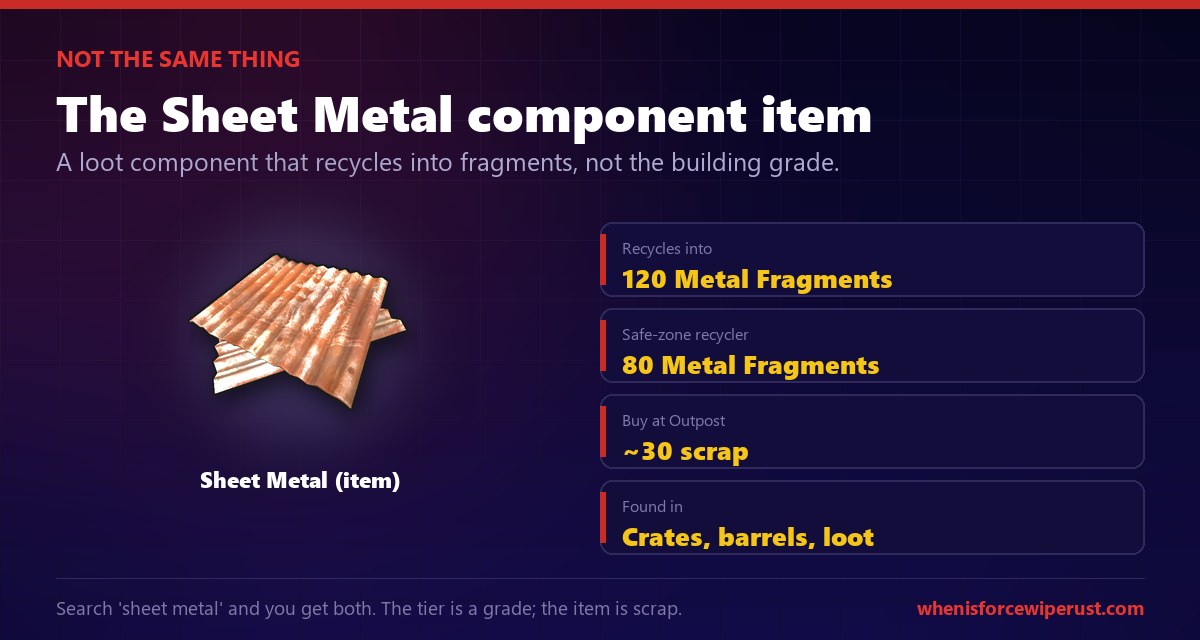
The Sheet Metal component is a stack of corrugated panels you find in crates and barrels. You never place it. What you do with it is recycle it: one Sheet Metal item gives 120 metal fragments at a normal recycler, or 80 at a safe zone recycler, plus a little scrap. It is also sold at Outpost for around 30 scrap.
So the two are linked in a neat loop: the component recycles into the fragments you spend on the grade. If a guide tells you to “craft sheet metal to build a wall”, it has confused the two. You build the grade with fragments, and the component is just one of the ways to get those fragments.
Five sheet metal mistakes that cost people bases
- Metalling the shell instead of the core. You paid extra to advertise your loot room. Stone outside, metal inside.
- Walking up the tiers. Wood then stone then metal wastes 200 wood and 300 stone you never get back. Go twig to sheet metal in one hop for anything you know is ending up metal.
- A cheap insert in a metal frame. A wooden door or plain window in a 1,000 HP wall means the wall is decoration. Raiders price the cheapest route.
- Soft side facing out. It does nothing against C4, but it turns a 345 hit wall into a 35 hit pickaxe job. Check exterior struts before you log off.
- Forgetting upkeep is in fragments now. The cupboard needs metal fragments the moment you go metal. A stocked-with-stone cupboard on a metal base is a base on a timer.
Sheet metal Rust FAQ
What is sheet metal in Rust?
How much HP does sheet metal have in Rust?
How do you get sheet metal in Rust?
How much does sheet metal cost to build in Rust?
Does sheet metal need a workbench in Rust?
Is sheet metal fireproof in Rust?
How many C4 for sheet metal in Rust?
Is sheet metal better than stone in Rust?
How long does sheet metal take to decay in Rust?
Which side of a sheet metal wall is the soft side?
Is the Sheet Metal item the same as the building grade?
Can you upgrade straight from twig to sheet metal?
Is there a high external sheet metal wall in Rust?
Final thoughts
Sheet metal is the tier where a Rust base becomes a real problem to raid. Two hundred fragments a block for double the health, immunity to fire, near-immunity to melee, three extra hours of decay protection and a lower daily upkeep count is the best trade in the whole building system, and almost every player who gets wiped early got wiped in stone.
Spend the fragments inward, keep the struts pointing indoors, match every door and window to the wall beside it, and stock the cupboard with fragments before it runs dry. Then check the countdown, because none of it matters if the wipe lands on Thursday.
Sources and further reading
- Sheet metal wall health, upgrade cost, 8 hour decay and the 20 to 66 fragment upkeep range: RustHelp, Metal Wall
- Comparison figures for the wood, stone and armored grades: RustHelp, Stone Wall and RustHelp, Armored Wall
- Building grades, per tier upgrade costs, the hammer upgrade wheel, building privilege and the rule that the rougher textured face belongs outward: Rustafied, Building: What you need to know
- The upgrade wheel, the rotation window after placement and the soft side described as the face with support palings crossing it: Corrosion Hour, How to Build in RUST
- Confirmation that all explosives deal equal damage to the hard side and the soft side of structures: Rustafied, Raiding in Rust
- The building upkeep system and the original per tier decay table it shipped with: Facepunch, Devblog 189
- The Sheet Metal component recycle output and vending price: Facepunch Wiki, Rust items