
Metal fragments are the quiet backbone of every base in Rust. They are the grey stacks you burn through by the thousand, the metal that turns your first twig hut into something with a real door, and the resource you will farm on every single wipe for as long as you play. If wood gets you started and scrap gets you unlocks, metal fragments are what actually build the base you defend.
This is the complete guide to metal fragments in Rust: what they are, every way to get them, how smelting metal ore actually works, which items recycle back into fragments, and the huge list of things you spend them on. We will also clear up the single most common beginner mix-up, metal fragments versus high quality metal, so you never waste a node farming the wrong thing. If you just want the essentials, they are right below.
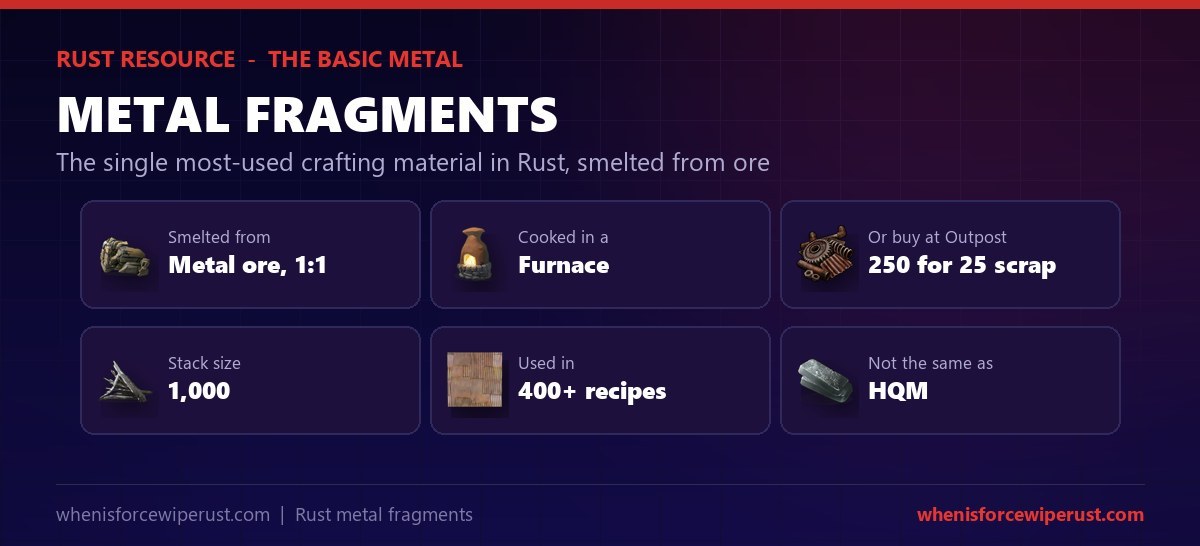
Metal fragments are made by smelting metal ore in a furnace at a flat 1 to 1 ratio, so 600 ore becomes 600 fragments. Mine metal nodes for the ore, then cook it in any furnace. You can also recycle metal loot, loot barrels and crates, run a quarry, or buy 250 fragments for 25 scrap at Outpost. They stack to 1,000, feed over 400 recipes from walls to ammo, and are not the same as high quality metal, which needs its own rarer ore.
- What they are
- How to get them
- Mining ore
- Smelting
- Recycling for frags
- What they build
- Fragments vs HQM
- Farming tips
- Fragments and the wipe
- FAQ
What are metal fragments in Rust?
Metal fragments are the standard mid-tier crafting material in Rust, sitting a step above wood and stone and a step below high quality metal. The in-game description says it plainly: “Smelted from Metal Ore, used in lots of different crafting recipes.” That second half is the important part. Metal fragments are an ingredient in more than 400 items, which is why they are the resource you never stop needing.
You cannot craft metal fragments directly, and you cannot research or repair them. There is really only one native way they come into existence, which is smelting metal ore in a furnace. Everything else, from recycling to looting to buying at a vendor, is just a shortcut that hands you fragments someone or something already made. They stack to 1,000 per slot, so a single stack is a serious amount of building material.
| Detail | Value |
|---|---|
| Made by | Smelting metal ore in a furnace, 1 to 1 |
| Stack size | 1,000 |
| Despawn time | 20 minutes on the ground |
| Craftable | No, only smelted or looted |
| Recyclable | No, fragments are already the base material |
| Used in | Over 400 crafting recipes |
| Item shortname | metal.fragments |
If you have played any survival game, think of metal fragments as your workhorse metal currency. You will not agonise over spending them the way you do with scrap or explosives. Instead you farm a big pile early, keep the furnaces running, and spend freely on doors, walls, guns and ammo.
How to get metal fragments
There are five practical ways to get metal fragments, and most players use several of them at once. Mining is the foundation, but the other four are what keep your stockpile from ever running dry.
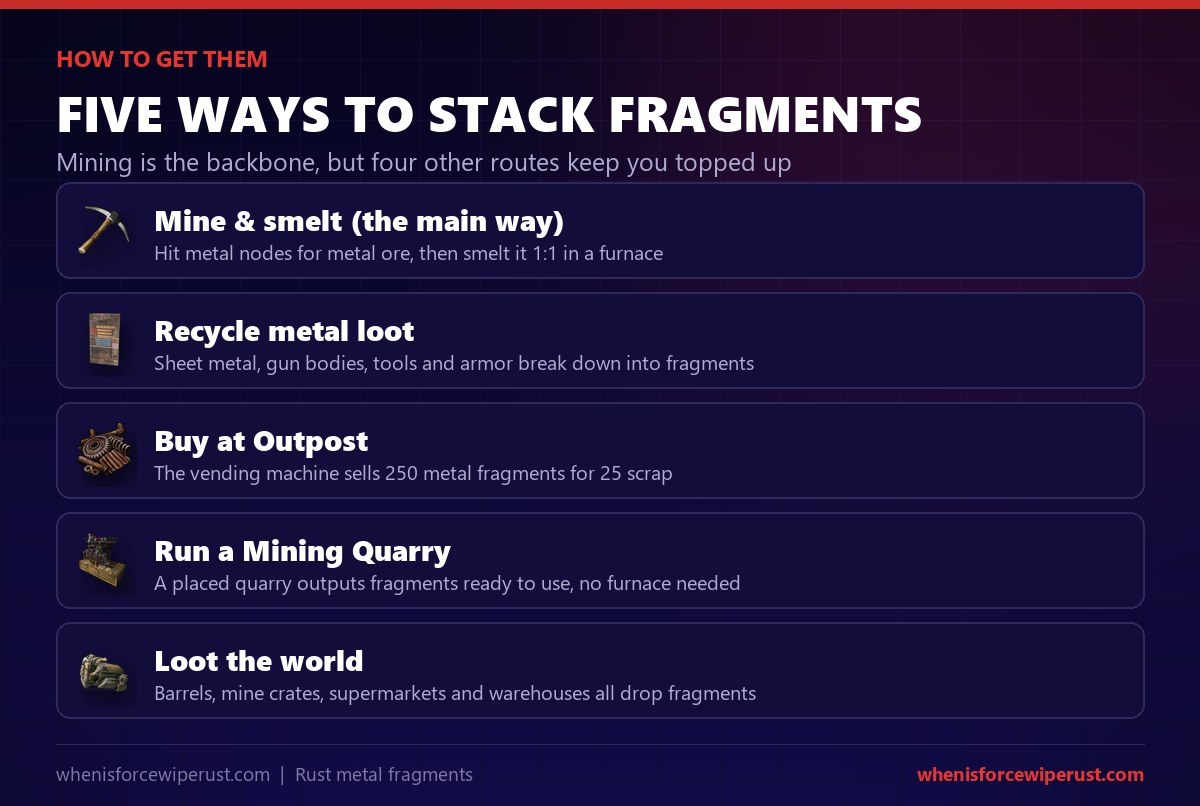
- Mine and smelt. The main event. Hit metal nodes with a pickaxe or jackhammer to gather metal ore, then smelt that ore into fragments in a furnace. Safe, reliable, and scales with how many furnaces you run.
- Recycle metal loot. Sheet metal, spare weapon parts, tools and armor all break down into fragments in a recycler. Great for turning junk loot into building material.
- Buy at Outpost. The vending machines at safe zones sell 250 metal fragments for 25 scrap, a clean 10 fragments per scrap if you have spare scrap and no time to farm.
- Run a quarry. A placed Mining Quarry or the map’s Giant Excavator outputs metal fragments directly, no smelting step required. Fuel it and let it grind.
- Loot the world. Barrels, mine crates, supermarkets and warehouses all drop fragments. Never enough to live on, but it adds up while you are out roaming.
Early in a wipe, scrap is precious for blueprints. Later, once your tech tree is done, spare scrap has few homes. That is the moment the Outpost trade shines: dump leftover scrap into metal fragments at 250 per 25 and skip a farm run entirely.
Mining metal ore
Since smelting is the core method, it starts with metal ore, and metal ore comes from metal nodes, the darker rocks scattered across the map with visible metallic veins. You hit them with a gathering tool, and the higher tier your tool, the more ore you pull before the node is exhausted.
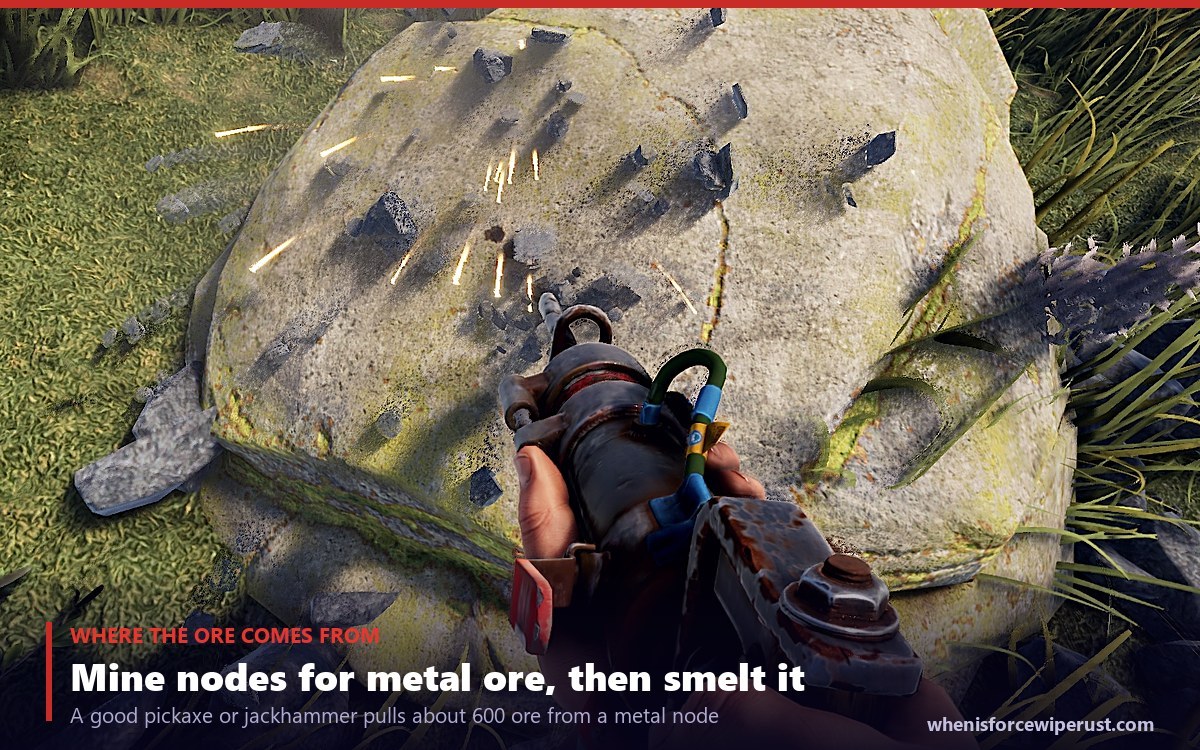
Tool choice matters a lot for how fast you farm. A metal pickaxe, salvaged pickaxe or jackhammer all pull the full 600 metal ore from a node, and the jackhammer does it in a second or two flat. Weaker tools give you less: a stone pickaxe gathers around 485 ore, and a rock or hatchet leaves a lot in the ground.
| Tool | Metal ore per node | Notes |
|---|---|---|
| Jackhammer | ~600 | Fastest by far, a node in seconds |
| Metal Pickaxe | ~600 | The standard farming pick |
| Salvaged Pickaxe | ~600 | Full yield, very durable |
| Stone Pickaxe | ~485 | Fine for the first hour of a wipe |
| Rock / hatchet | Under 400 | Emergency only, wastes the node |
Aim for the sweet spot on the node, the bright glowing marker that appears when you start hitting it. Landing hits on that spot gathers ore far faster. For a full breakdown of the best gathering tool and how it compares to a pickaxe on nodes and even vehicle wrecks, see our jackhammer guide.
Smelting metal ore into fragments
Once you have a backpack full of metal ore, you need to cook it. Ore does nothing on its own; it has to be smelted in a furnace to become usable metal fragments. The good news is the conversion is dead simple: one metal ore always becomes exactly one metal fragment, in every furnace. What changes between furnaces is the speed and how much fuel they burn.
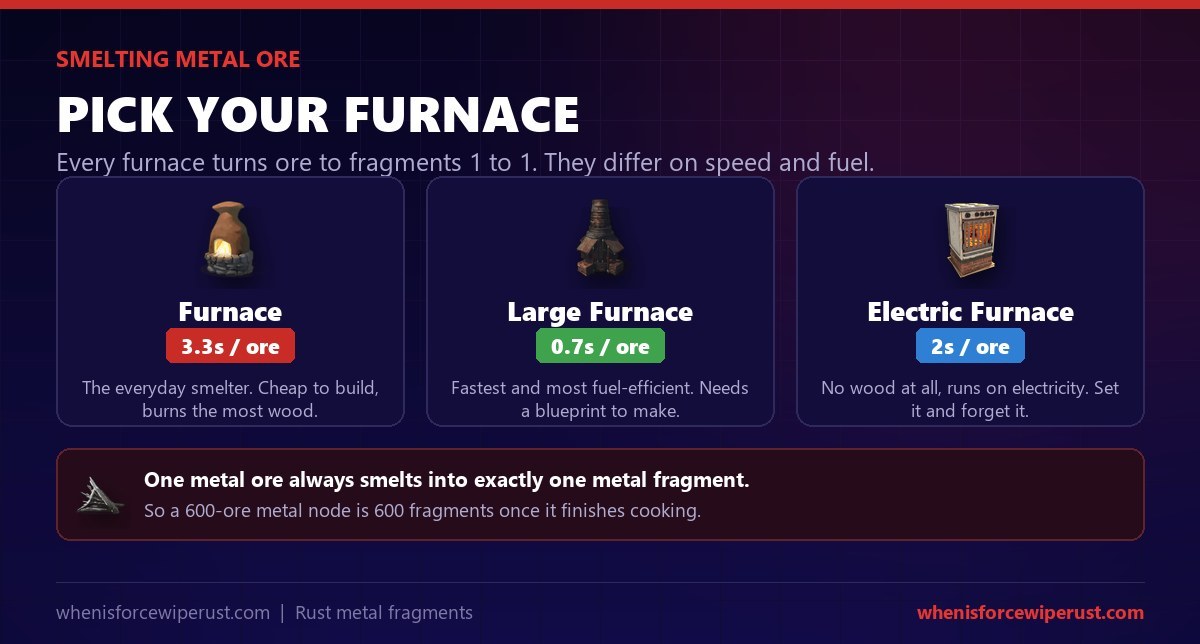
| Furnace | Time per ore | Wood per ore | Best for |
|---|---|---|---|
| Furnace | 3.3 sec | 0.3 | Your first smelter, cheap to build |
| Large Furnace | 0.7 sec | 0.1 | Bulk smelting, fastest and most efficient |
| Electric Furnace | 2 sec | None | Automated bases, runs on power |
For your first base, a standard furnace is perfect. It costs 200 stone, 100 wood and 50 low grade fuel and gets you smelting immediately. The catch is that small furnaces burn wood fast, so most players graduate to the large furnace for serious farming: it is quicker per ore and sips far less fuel, though you need to unlock its blueprint first. The electric furnace is the endgame pick for automated setups, trading wood for a power draw.
The classic trick: farm a big load of ore, split it across several small furnaces at once, load them with wood, and go do something else. Come back in fifteen minutes to hundreds of fragments. Five furnaces cooking together will comfortably clear a thousand fragments an hour while you raid or build.
Recycling metal loot into fragments
The recycler is the second-biggest source of metal fragments, and it is one a lot of new players sleep on. Almost any metal item you loot but do not need can be fed into a recycler to reclaim a chunk of the fragments it was made from. Since a recycler returns a share of an item’s crafting cost, the items worth the most fragments are the ones that were expensive in metal to begin with.
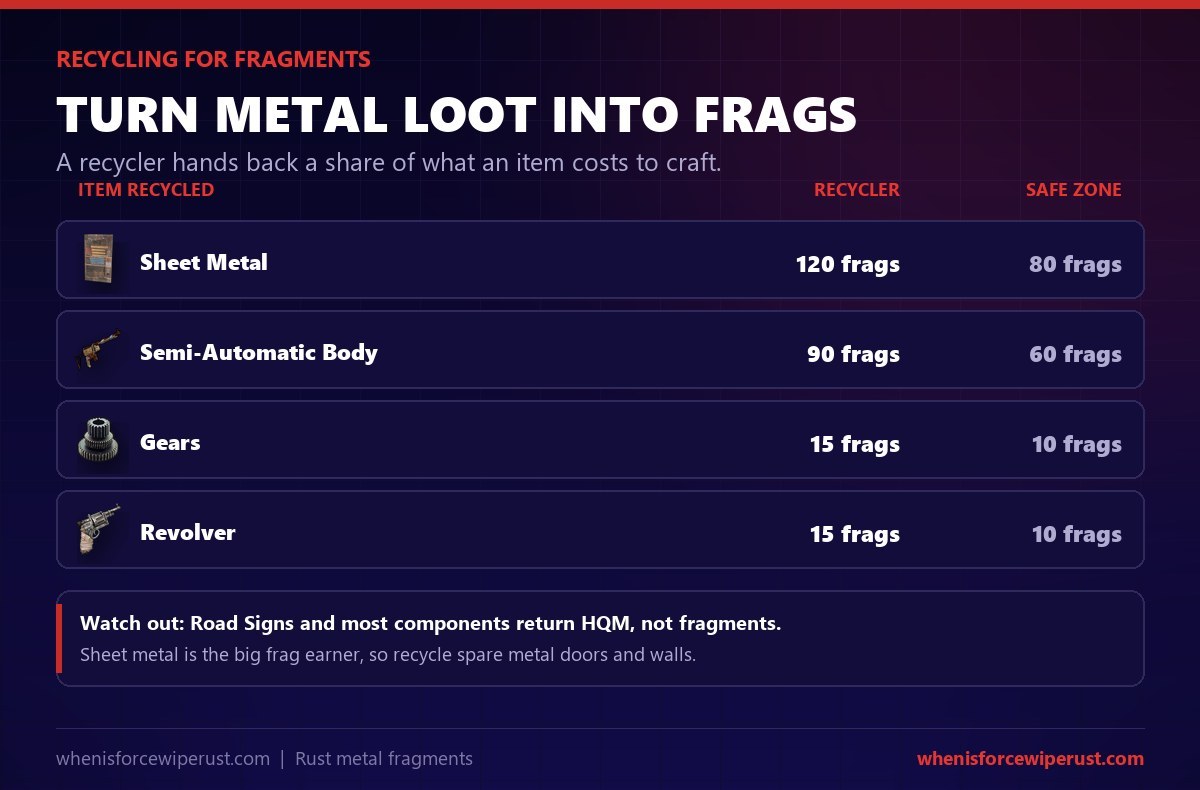
| Item recycled | Regular recycler | Safe zone recycler |
|---|---|---|
| Sheet Metal | 120 fragments | 80 fragments |
| Semi-Automatic Body | 90 fragments | 60 fragments |
| Gears | 15 fragments | 10 fragments |
| Revolver | 15 fragments | 10 fragments |
Sheet metal is the standout. A single sheet metal returns 120 fragments at a normal recycler, so recycling a spare sheet metal door or wall you tore down is a tidy refund. Metal weapon bodies and salvaged tools give solid returns too.
A common trap: Road Signs and many components recycle into high quality metal, not fragments. Roadsigns hand back HQM and scrap, gears mostly return HQM with a few fragments, and so on. If you specifically need fragments, check what an item breaks into before you feed the recycler, or you will end up with a pile of HQM instead.
What metal fragments are used for
This is why you never stop farming them. Metal fragments appear in more than 400 recipes, spanning base building, weapons, tools, ammo and electrics. You will not remember every recipe, but it helps to know the big categories your fragments feed.
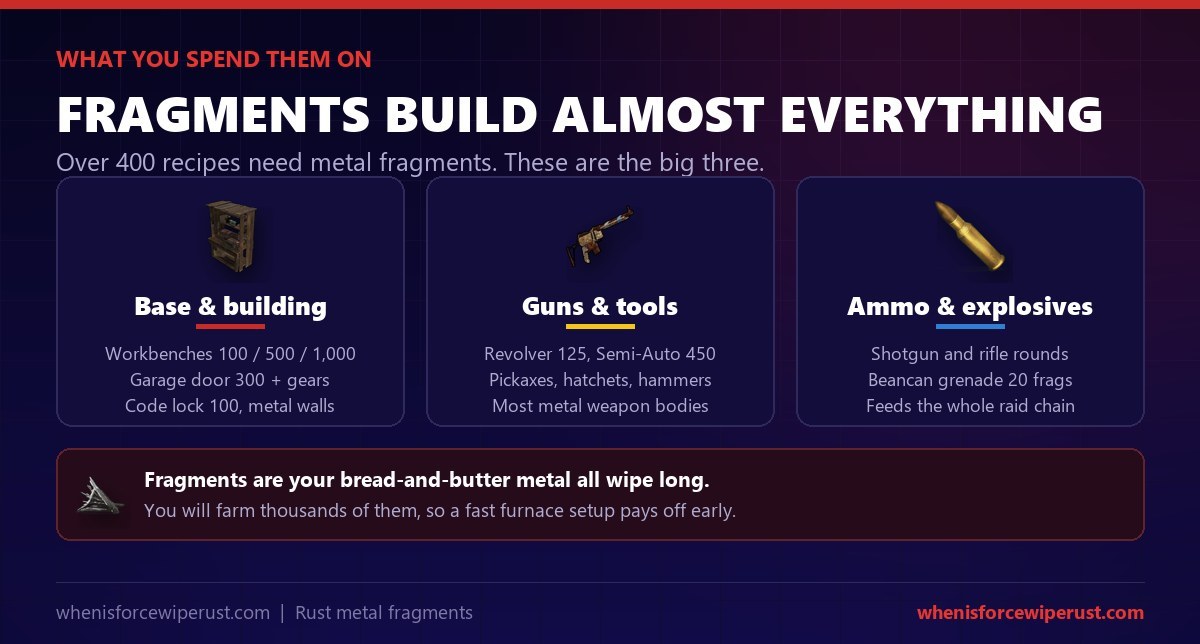
| Category | Examples and rough costs |
|---|---|
| Base building | Workbenches (100 / 500 / 1,000), garage door 300 + gears, code lock 100, metal walls |
| Weapons | Revolver 125, Semi-Automatic Rifle 450, Eoka 30, most metal gun bodies |
| Tools | Pickaxes, hatchets, hammers and the salvaged upgrades |
| Ammo & explosives | Shotgun shells, rifle rounds, satchel parts, beancan grenades (20 each) |
| Deployables | Furnaces, lights, storage, and dozens of workshop items |
The takeaway is that metal fragments are your everyday spend, not a resource to hoard. The garage door on your loot room, the code lock on your front door, the metal walls around your core, and every gun you craft to defend it all come out of the same grey pile. Farm big, spend freely, and keep the furnaces lit.
Metal fragments vs high quality metal
Here is the mix-up that trips up almost every new player. Rust has two refined metals, and they are not interchangeable. Metal fragments are the common one; high quality metal, usually shortened to HQM, is the rare premium one. A recipe that calls for HQM will never accept fragments, and vice versa.
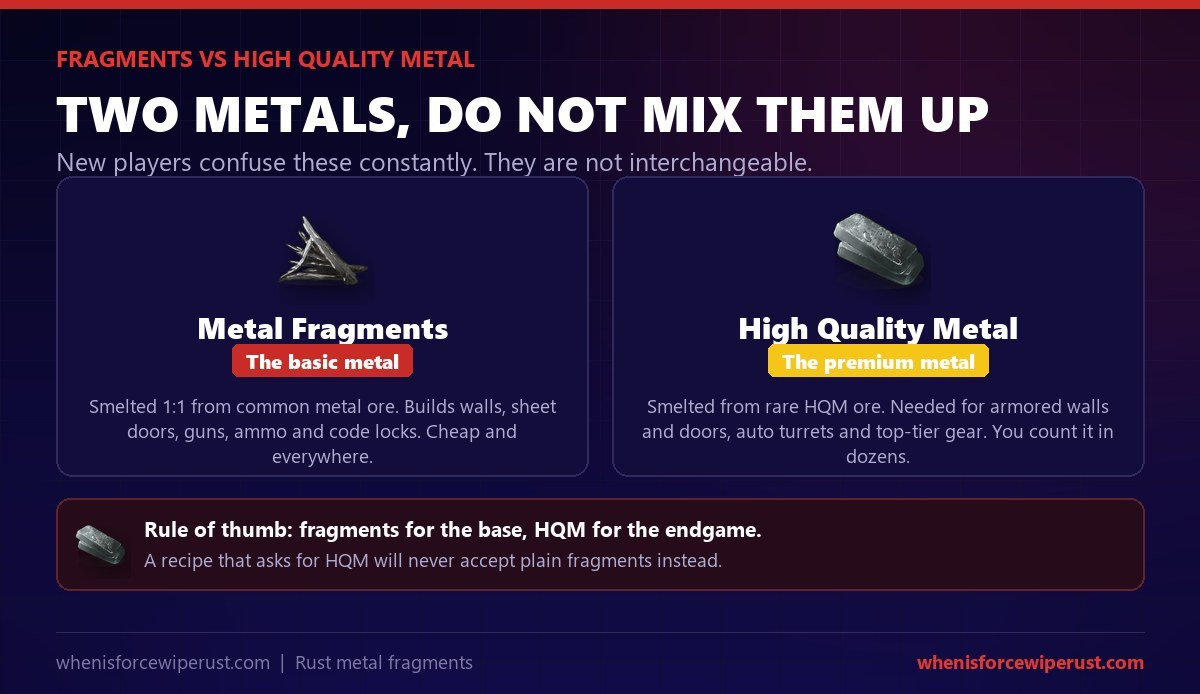
The difference comes down to the ore. Metal fragments smelt from plain metal ore, which is everywhere. High quality metal smelts from high quality metal ore, which is far rarer, comes in tiny amounts from the corner of some metal nodes, and now also spawns as its own dedicated node. Because HQM is scarce, it is reserved for the strongest gear in the game: armored doors, armored walls, auto turrets and high-tier weapons.
Metal fragments build the base you live in day to day; high quality metal builds the base that survives a real raid. You will farm fragments by the thousand and count HQM in the dozens. If you are chasing HQM specifically, read our HQM node guide and the HQM quarry guide, since the fastest routes to it are different from farming plain metal.
Metal fragment farming tips
Farming metal is not hard, but a few habits turn a slow grind into a fast one. These are the tricks experienced players use to keep fragments flowing without wasting time.
- Drink Ore Tea before a farm run. An Ore Tea temporarily boosts how much ore you gather from every node, so a single tea across a big farm loop pays for itself many times over in extra fragments.
- Always hit the sweet spot. When you start swinging at a node, a glowing marker appears. Landing your hits on that spot gathers far more ore per swing, so aim for it rather than spamming the whole rock.
- Batch your smelting. Do not smelt one furnace at a time. Line up several furnaces, fill them all, and cook in parallel while you build, raid or loot. Idle smelting is free fragments.
- Let a quarry work while you sleep. A Mining Quarry or the Giant Excavator produces fragments passively as long as it has fuel, so it is doing the boring part of the grind while you are offline or off doing something else.
- Keep a furnace near your farm. Do not haul heavy ore across the map. Ore stacks to 1,000 like fragments, but a small smelting outpost near a good node cluster saves you a lot of walking.
Every furnace burning wood also produces charcoal as a by-product, and charcoal is what you need for gunpowder and the whole raiding chain. So a big smelting session for fragments quietly stocks you up for explosives at the same time.
Metal fragments and the wipe cycle
Like everything you build, your metal stockpile is gone the moment the server force wipes. A force wipe clears the map, your furnaces, your walls and every fragment in your boxes, and you start the metal grind again from zero. That makes the first hours of a wipe a flat-out race to farm ore, get furnaces running, and turn that first pile of fragments into a lockable, walled base before the roaming crowd finds you.
The players who come out of a wipe ahead are the ones already smelting while everyone else is still gathering wood. Knowing exactly when your server force wipes lets you be online and ready, pickaxe in hand, the moment the fresh map goes live.
Do not miss the fresh map. Line up your farm run with the countdown and hit the ground mining ore from minute one.
Check the force wipe countdownMetal and the September 2026 update
Metal fragments themselves have not changed, they are a core resource that has been in Rust since the start. But the September 2026 Breach and Clear update did change the metal economy around them in one big way: it added dedicated high quality metal nodes out in the world, most commonly in the jungle. That gives solos a fresh, faster route to the HQM they need for armored gear, without relying on scraping tiny amounts off regular metal nodes.
So while your fragment farm looks the same as it always has, the metal picture around it is worth a fresh look. If you are gearing up for armored walls and turrets this wipe, the new HQM nodes are the headline change to know about.
Metal fragments FAQ
How do you get metal fragments in Rust?
The main way is to mine metal ore from metal nodes with a pickaxe or jackhammer, then smelt that ore into fragments in a furnace at a 1 to 1 ratio. You can also recycle metal loot like sheet metal in a recycler, loot barrels and crates, run a mining quarry, or buy 250 fragments for 25 scrap at an Outpost vending machine.
How do you make metal fragments from metal ore?
Put metal ore into any furnace with fuel and it smelts into metal fragments, one fragment per ore. A standard furnace takes about 3.3 seconds per ore, a large furnace 0.7 seconds and uses the least wood, and an electric furnace 2 seconds with no wood at all. So a metal node worth 600 ore becomes 600 fragments once it finishes cooking.
How much metal ore does a node give in Rust?
A metal node gives roughly 600 metal ore when mined with a metal pickaxe, salvaged pickaxe or jackhammer. A stone pickaxe pulls around 485, and weaker tools like a rock leave a lot of the node unmined. Since ore smelts 1 to 1, a full node is about 600 fragments.
Can you buy metal fragments in Rust?
Yes. The vending machines at the Outpost safe zone sell 250 metal fragments for 25 scrap, which works out to 10 fragments per scrap. It is a handy way to spend leftover scrap late in a wipe when your blueprints are already unlocked and you would rather not farm.
What is the difference between metal fragments and high quality metal?
Metal fragments are the common metal, smelted from ordinary metal ore, and are used for walls, doors, guns and ammo. High quality metal, or HQM, is the rare premium metal, smelted from high quality metal ore, and is used for armored doors, armored walls, auto turrets and top-tier gear. They are not interchangeable, so a recipe that needs HQM will never accept plain fragments.
What recycles into metal fragments?
Sheet metal is the best, giving 120 fragments at a normal recycler. Metal weapon bodies like the semi-automatic body give around 90, and many salvaged tools and metal weapons return fragments too. Be careful though: road signs and a lot of components recycle into high quality metal rather than fragments, so check before you recycle if fragments are what you need.
What is the fastest way to farm metal fragments?
Mine metal nodes with a jackhammer for the fastest ore gathering, then smelt the ore across several furnaces at once, ideally large furnaces since they are quickest and most fuel efficient. Running five furnaces in parallel while you do other things will clear well over a thousand fragments an hour. A mining quarry or the Giant Excavator can also produce fragments hands-free.
How many recipes use metal fragments?
Metal fragments are an ingredient in over 400 crafting recipes, which is why they are the most-used material in the game. They go into base building like workbenches, garage doors, code locks and metal walls, into weapons and tools, and into ammunition and explosives. You will spend them constantly all wipe long.
What is the stack size of metal fragments?
Metal fragments stack to 1,000 per inventory slot. If they are dropped on the ground rather than stored, a stack despawns after 20 minutes, so keep them in a box or your inventory rather than leaving them out.
Do barrels give metal fragments in Rust?
Barrels and crates can drop small amounts of metal fragments along with scrap and components, and monuments like supermarkets and warehouses have containers that do too. It is never enough to be your main source, but it adds up passively while you are out roaming and looting.
Can you craft metal fragments directly?
No. Metal fragments cannot be crafted from other materials. They only come from smelting metal ore in a furnace, or from recycling, looting or buying items that already contain them. Metal ore is the raw form, and the furnace is what turns it into usable fragments.
The bottom line
Metal fragments are the resource that quietly runs your whole Rust wipe. Mine metal ore from nodes, smelt it 1 to 1 in a furnace, and top up with recycling, quarries, looting and the odd Outpost buy. Spend the pile freely on doors, walls, locks, guns and ammo, keep it well clear of your high quality metal, and never let all your furnaces sit cold when you have ore to burn.
Get a fast furnace setup going early and metal stops being a bottleneck for the rest of the wipe. The one thing you cannot farm ahead of time is the wipe itself, so make sure you are online and ready to mine the moment the fresh map drops.
Start the wipe already mining. Know exactly when the next force wipe hits so your furnaces are lit before anyone else has walls.
See the force wipe countdownSources
- Facepunch Wiki, Metal Fragments for the description, stack size of 1,000, 20 minute despawn, item shortname, and the fact it is smelted from metal ore and used in hundreds of recipes.
- Facepunch Wiki, Metal Ore for the 1 to 1 smelting ratio and the per-furnace smelting times and wood costs.
- Corrosion Hour, How to Get Metal Fragments in RUST for the per-tool node yields, the Outpost vending price, and the range of farming methods.
- Facepunch Wiki, Sheet Metal for the 120 and 80 fragment recycle yields at regular and safe zone recyclers.
- Facepunch, Breach and Clear devblog (3 September 2026) for the new high quality metal nodes added around the metal economy.