
The electric furnace is the smelter you graduate to once your base has power. Instead of burning wood like a normal furnace, it runs on a trickle of electricity, which means it can smelt ore all night while you are asleep, on a raid, or halfway across the map. No wood runs, no low grade fuel, no babysitting. Wire it up once and it just works.
It is not a straight upgrade, though. The electric furnace smelts a little slower than the standard stone furnace per second is not the whole story, it makes zero charcoal, and it costs metal fragments and high quality metal instead of cheap stone. So the real question is not whether it is better, it is whether it fits your base. This guide answers that, and it goes deep on the part every other page skips: exactly how much power it needs and how to wire it.
Below you will find the exact craft cost, all three ways to get one, the true power draw in rW, a full solar and battery wiring walkthrough, how to run a whole wall of furnaces off one battery, the smelting rates versus wood furnaces, and how the August 2026 Power Trip update fits in. Every number is checked against the Facepunch wiki, RustHelp, RustClash and Corrosion Hour. For the standard and Large furnaces, see our full Rust furnace guide.
- What It Is
- Stats & Facts
- How to Get One
- How Much Power
- How to Wire It
- Running Many
- Smelt Speed
- The Charcoal Catch
- Boats & Niche Uses
- Power Trip Update
- Is It Worth It
- Pro Tips
- FAQ
What Is the Electric Furnace in Rust?
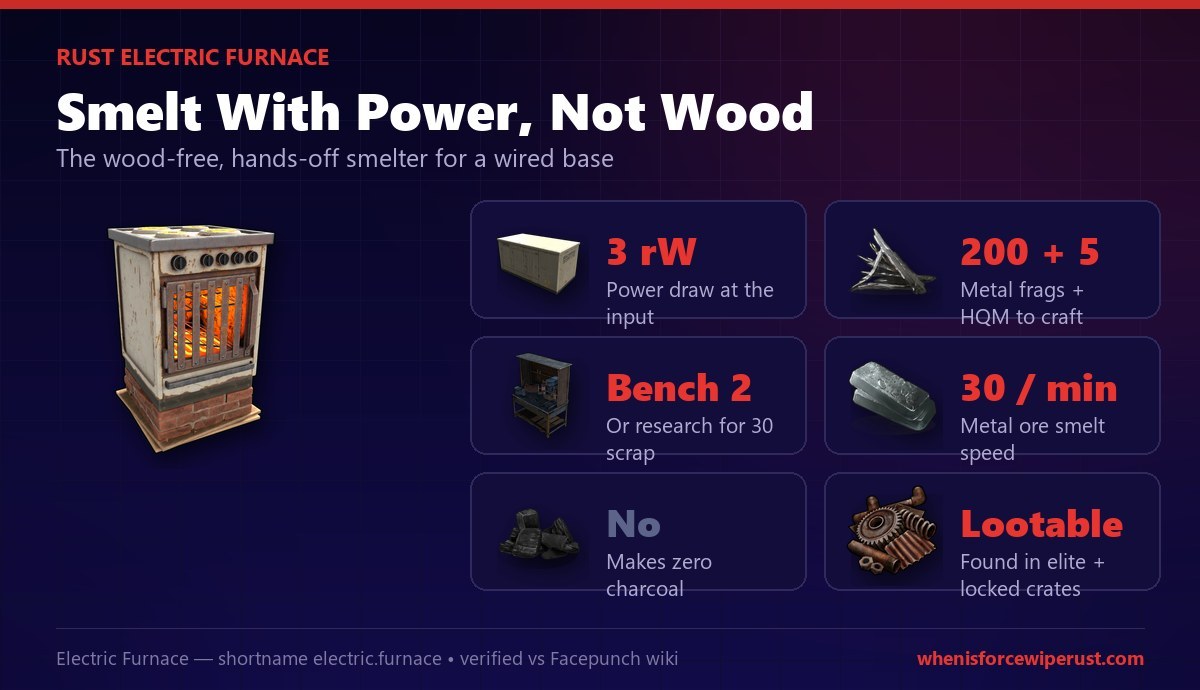
The electric furnace is a deployable smelter that turns mined ore into usable materials using electricity instead of wood. Facepunch describes it simply as “an electrical version of a furnace that uses electricity instead of a fuel source.” Drop metal ore, sulfur ore or high quality metal ore inside, feed it 3 power, and it converts the ore the same way a normal furnace does, just without ever asking for a log.
That single change, swapping wood for power, is what makes it worth building. A standard furnace stops the second it runs out of wood, so if you are away for an hour your smelt stalls. An electric furnace hooked to a battery keeps going as long as it has charge, which turns smelting into a passive background task. You load it, walk away, and come back to a stack of fragments. On a wired main base it basically automates your metal economy.
Like every furnace, the electric furnace cannot be picked back up once you place it. If you want to move it you have to destroy it and craft a new one, so plan your furnace room before you commit. It also gives off light while smelting, so seal it inside walls rather than leaving it glowing on an open foundation where it advertises your base at night.
Electric Furnace Stats and Facts
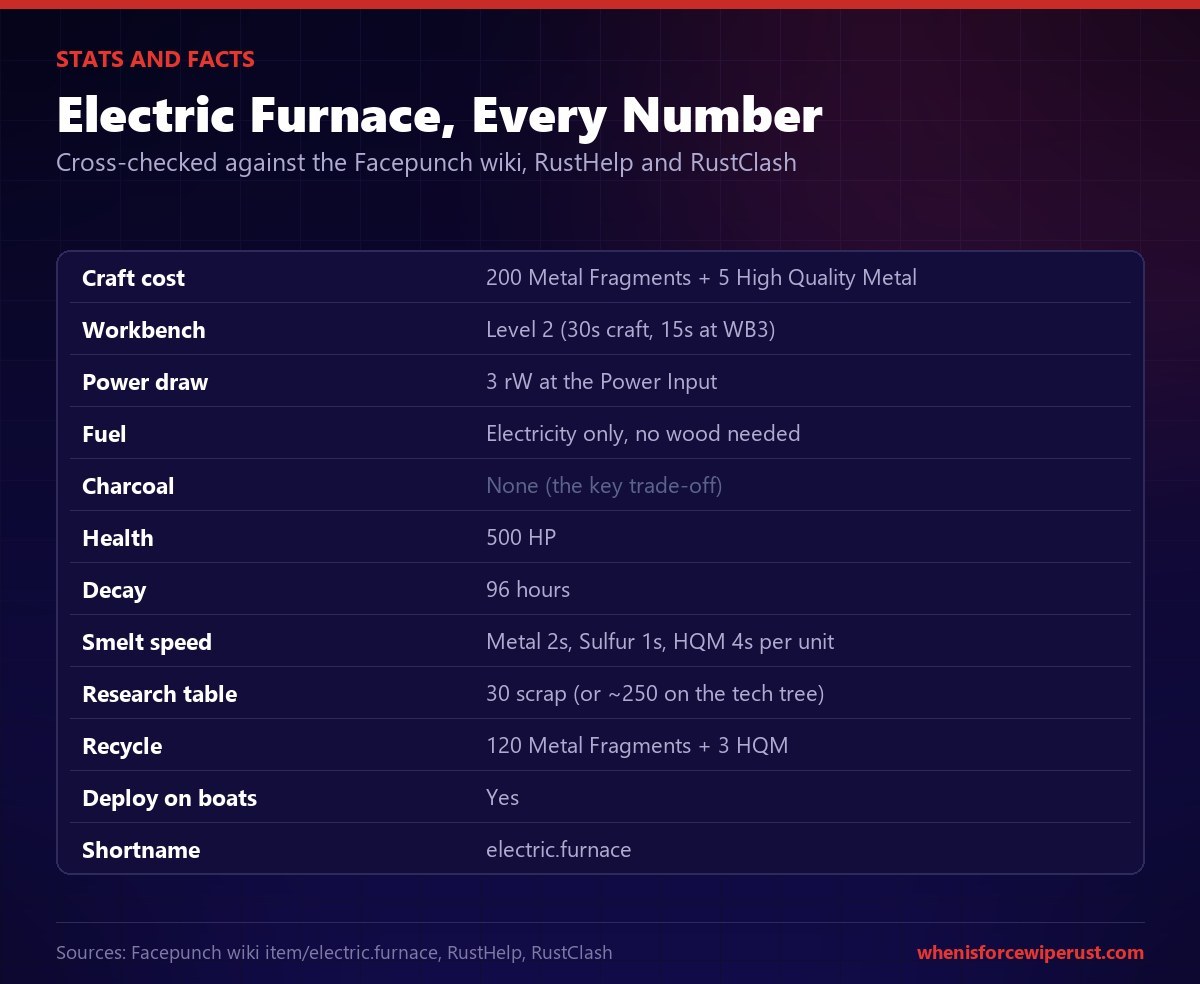
Here is the electric furnace in one table, pulled from the Facepunch wiki and cross checked against RustHelp and RustClash.
| Stat | Value |
|---|---|
| Craft cost | 200 Metal Fragments, 5 High Quality Metal |
| Workbench | Level 2 (30s craft, 15s at Workbench 3) |
| Power draw | 3 rW at the Power Input |
| Fuel | Electricity only, no wood or low grade |
| Charcoal | None, this is the trade-off |
| Health | 500 HP |
| Decay | 96 hours |
| Smelt speed | Metal 2s, Sulfur 1s, HQM 4s per unit |
| Research table | 30 scrap (or about 250 on the tech tree) |
| Recycle | 120 Metal Fragments, 3 HQM |
| Deploy on boats | Yes |
| Pick up | No, must destroy to move |
| Shortname | electric.furnace |
The number that matters most is 3 rW. That is a tiny draw, the same as a single light or a handful of small components, which is why powering a wall of electric furnaces is far easier than most players expect. The recycle return is also worth knowing: if you ever tear one down you get 120 fragments and 3 HQM back, which is 60% of what you paid.
How to Get an Electric Furnace in Rust
There are three routes to your first electric furnace: craft it, unlock it cheaply, or get lucky and loot one. Most players research it and craft it, but looting one early can save you a real chunk of high quality metal.
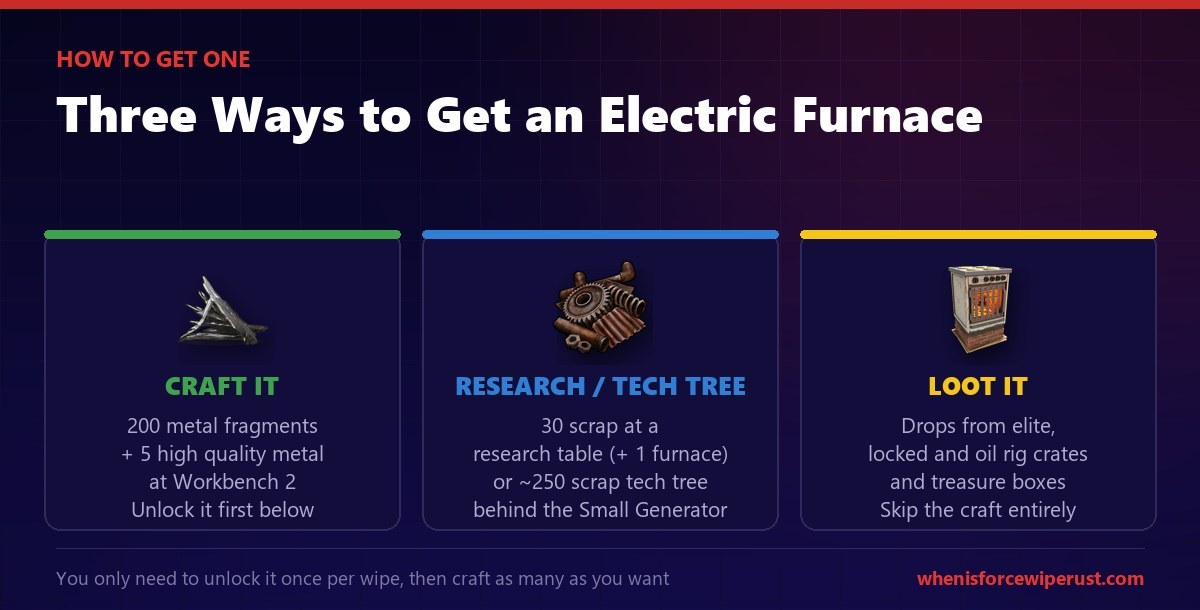
- Craft it. Once the blueprint is unlocked, build it at a Workbench 2 for 200 metal fragments and 5 high quality metal. It takes 30 seconds by hand, or 15 at a Workbench 3.
- Research or tech tree it. The cheapest unlock is a research table for 30 scrap (plus a spare electric furnace to research). On the tech tree it costs roughly 250 scrap and sits behind the Small Generator node, so you often unlock a power source and the furnace in the same trip.
- Loot it. Electric furnaces drop from elite crates, locked crates, oil rig crates and treasure boxes. It is not a common roll, but if one shows up before you have the HQM to craft it, you have skipped the most expensive part of the recipe.
How Much Power Does an Electric Furnace Use?
This is the most searched question about the electric furnace, and the answer is refreshingly simple: 3 rW. That is it. Wire 3 power into the Power Input slot and it runs. The figure is confirmed on the Facepunch wiki, Corrosion Hour and RustClash, so ignore any guide that quotes a bigger number, they are almost always confusing it with the smelt rate or a different appliance.
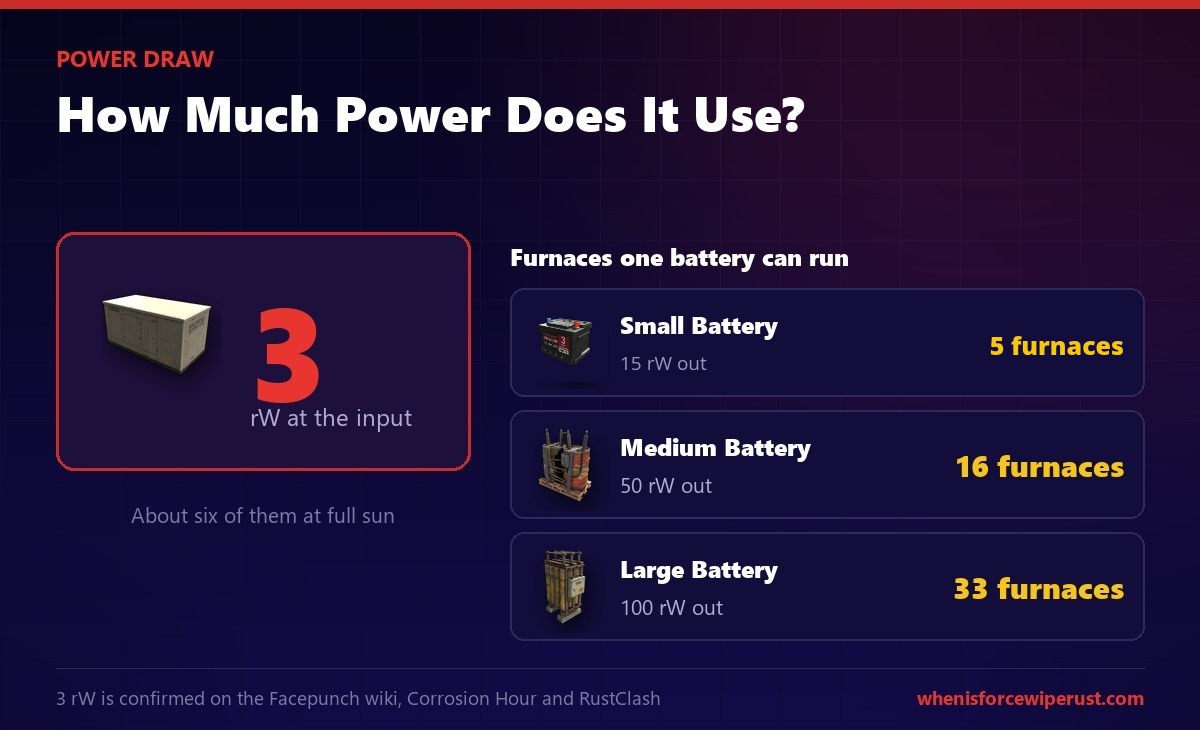
Because the draw is so low, a single power source stretches a long way. A Solar Panel peaks at 20 rW in full sun, which is enough to run about six furnaces at midday on its own. The trick is that solar output drops as the sun moves and falls to zero at night, so you almost always want a battery in the middle to store charge and keep smelting after dark.
Batteries output a steady rate whenever they hold charge, and that output is what caps your furnace count. Divide the battery output by 3 and you have your answer:
| Power source | Output | Electric furnaces it runs |
|---|---|---|
| Small Battery | 15 rW | 5 furnaces |
| Medium Battery | 50 rW | 16 furnaces |
| Large Battery | 100 rW | 33 furnaces |
| One Solar Panel | Up to 20 rW | ~6 at full sun |
So a single medium battery can quietly run an entire smelting room. The only thing that limits you is generating enough power to keep that battery topped up, which is where the wiring comes in.
How to Wire an Electric Furnace: The Full Solar Setup
This is the part that scares new players off electricity, and it should not. A basic solar setup for an electric furnace is five components in a line, and once you understand the order it takes about a minute to build. Here is the chain from the sun to the furnace.
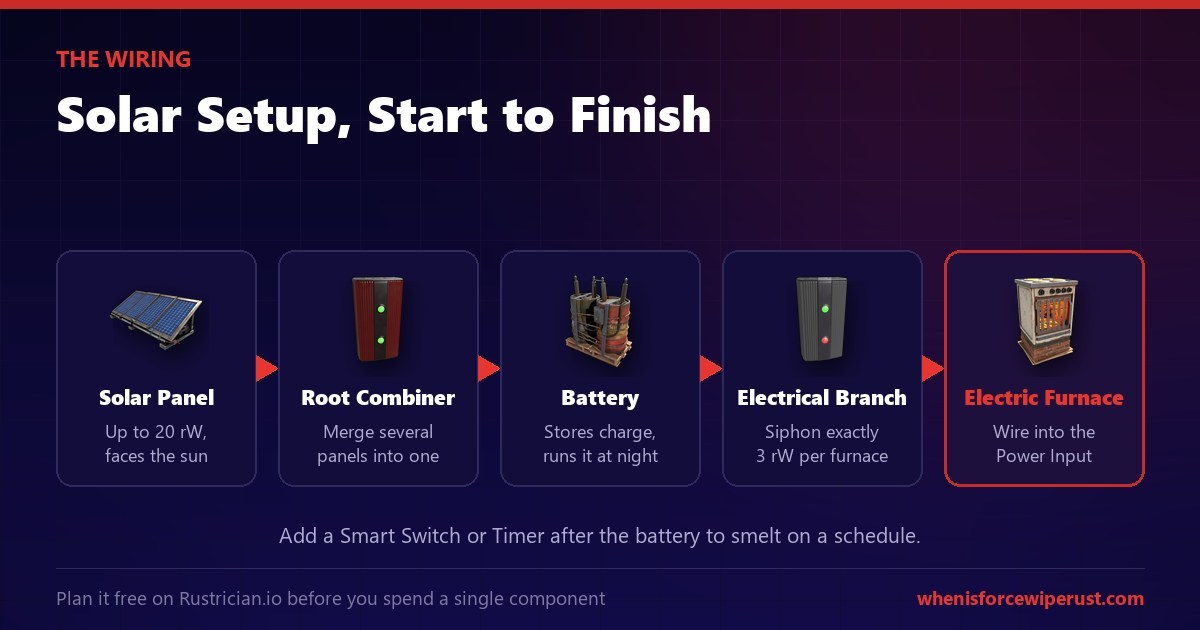
- Solar Panels. Place them on your roof facing the sky. Each one puts out up to 20 rW in full sun. One panel is enough for a couple of furnaces, but for a proper room you will want two or three.
- Root Combiner. If you use more than one panel, run each panel into a Root Combiner. It merges several inputs into one clean output, so you are not trying to wire five panels into a single battery slot.
- Battery. Feed that combined output into the Power In of a rechargeable battery. The battery charges while the sun is up and discharges from its Power Out at night, so your furnaces never stop when it gets dark. Batteries are roughly 80% efficient, so expect a little loss on the way in.
- Electrical Branch. From the battery’s Power Out, run into an Electrical Branch set to 3. A branch siphons off exactly the amount you set and passes the rest down the line, which lets you feed one furnace 3 power and send the remainder to the next branch. This is far more efficient than a Splitter, which just divides power into three equal parts whether you need it or not.
- Electric Furnace. Wire the branch output into the furnace’s Power Input. It lights up, starts smelting whatever ore is inside, and keeps going as long as power flows.
Running a Whole Wall of Electric Furnaces
One furnace is nice. A row of them is what actually changes your wipe. Because each furnace only sips 3 power, scaling up is about two things: generating enough to keep a battery charged, and chaining the furnaces so each gets its 3 rW.
To feed many furnaces, daisy chain Electrical Branches. Set each branch to 3, wire its main output into the next branch, and hang one furnace off each branch’s side output. Ten furnaces is ten branches in a line pulling 30 total power off a medium battery, which still has plenty to spare. Avoid long chains of Splitters, since every split wastes power you did not need to give away.
For hands off control, add a Smart Switch or a Timer right after the battery. A timer lets you smelt on a schedule, and a smart switch lets you flick the whole room on and off from a Computer Station or pair it with other automation. Combine that with a big ore stockpile and your base smelts metal around the clock with zero input from you, which is the whole point of going electric. The same power skills carry straight over to auto turrets and lights.
Electric Furnace Smelting Speed vs Wood Furnaces
Here is a myth worth killing: the electric furnace is not slow. It smelts one metal fragment every 2 seconds, which works out to 30 a minute. A standard furnace takes 3.3 seconds per fragment, or 18 a minute, so a single electric furnace is actually faster than a single stone furnace by five to three.
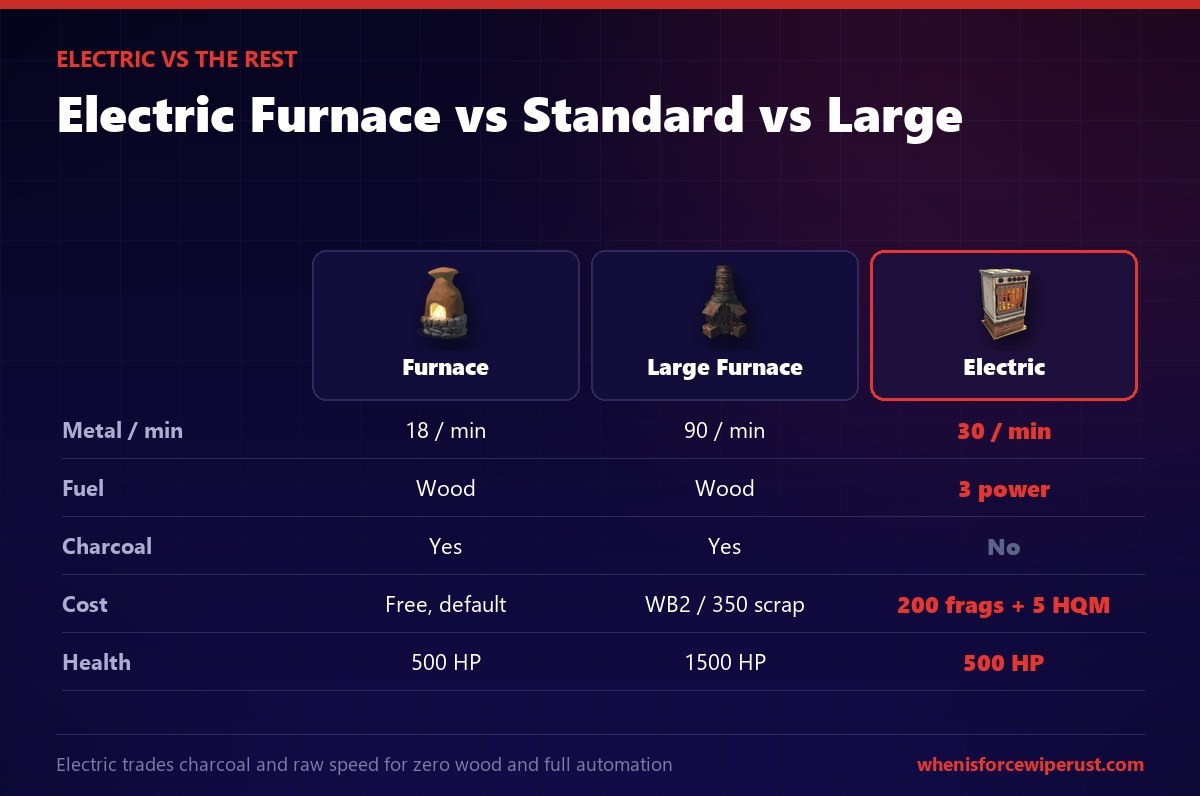
| Ore → Product | Furnace | Large Furnace | Electric Furnace |
|---|---|---|---|
| Metal Ore → Fragments | 18 / min | 90 / min | 30 / min |
| Sulfur Ore → Sulfur | 36 / min | 180 / min | 60 / min |
| HQM Ore → HQM | 9 / min | 45 / min | 15 / min |
The Large Furnace still wins on raw throughput because it runs five ore slots at once, so it clears thousands of ore far faster than a single electric furnace. But it burns a mountain of wood and has to sit exposed on terrain. The electric furnace’s edge is not top speed, it is that it runs unattended and never needs a wood run. Line up a few of them and you match a Large furnace’s output while keeping everything sealed inside your base.
The No Charcoal Problem
Every upside has a catch, and the electric furnace’s catch is a big one for raiders: it makes no charcoal. Wood furnaces produce charcoal as a byproduct of burning logs, and charcoal is what you turn into gunpowder, which feeds every explosive in the game. An electric furnace burns no wood, so it produces none.
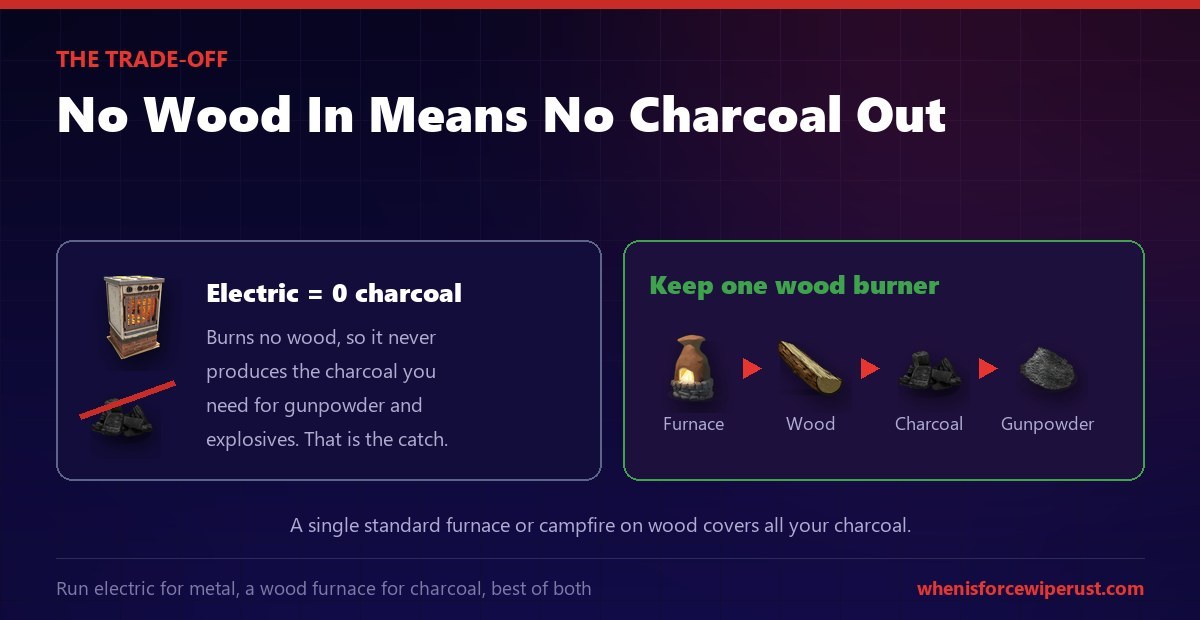
The fix is easy: do not go fully electric. Keep at least one standard furnace or a campfire burning wood on the side, and you cover all the charcoal you need for C4 and rockets. Most efficient bases run a hybrid setup, electric furnaces smelting metal and sulfur around the clock, and a wood burner ticking away for charcoal. You get the automation without giving up your explosives supply.
Electric Furnaces on Boats and Other Niche Uses
One overlooked perk: the electric furnace can be deployed on boats. Because it needs no fuel to haul around, a furnace bolted to a player-built boat lets you smelt while you travel or run a mobile base, as long as you have a battery on board to power it. Standard furnaces work on boats too, but the electric version means you are not carrying stacks of wood on the water.
It is also the smelter of choice for raid bases and forward camps. A tiny 1×1 with a solar panel, a small battery and one electric furnace can process ore on site without a single wood run, which keeps you off the roads. And on a solo base where you are often logged off, an electric furnace on a timer quietly turns your ore into gear while you sleep, so you log back in richer than you left.
The Electric Furnace and the Power Trip Update
The Power Trip update from August 2026 was the biggest electricity shake up in years, but it is important to be honest about what it changed. Power Trip overhauled monument power grids, adding climbable powerlines, roadside power poles with multiple outputs, water pressure mechanics and the new satellite crash event. It did not change how your base electric furnace works.
Your electric furnace still draws the same 3 rW and still runs off your own solar panels, batteries or a Small Generator exactly as it did before. What the update really did was double down on electricity across the map, which makes learning this wiring even more valuable, since the same skills now unlock more at monuments like the Power Plant. If a guide tells you Power Trip buffed or nerfed the base electric furnace, it is wrong, the change was to the monument grid, not the appliance.
Is the Electric Furnace Worth It in Rust?
The honest answer is that it depends entirely on your base and your stage of the wipe. It is a fantastic quality of life upgrade once you are set up, and a total waste of HQM if you are not.

Build the electric furnace when you have solar panels or a Small Generator running, when you are settling into a main base for the wipe, when you want hands off AFK smelting, or when you are smelting on a boat or a forward raid base. In all of those cases the no wood convenience is genuinely worth the fragments and HQM.
Skip it when it is the first day and you have no power source, when you mainly need charcoal for boom, when you are a nomad rebuilding every night, or before you have the HQM and tech trash to spare. In the early game a free stone furnace does the job perfectly well, and your HQM is better spent on armor and guns. Think of the electric furnace as a mid to late wipe comfort upgrade, not a rush priority.
Every electric furnace, battery and solar panel wipes on the force wipe. Know exactly when to rebuild your power grid.
Check the wipe countdownPro Tips for Electric Furnaces
- Run a hybrid. Electric furnaces for metal and sulfur, one wood furnace or campfire for charcoal. Best of both worlds.
- Use branches, not splitters. An Electrical Branch set to 3 feeds one furnace and passes the rest on. Splitters waste power you did not need to spend.
- Always add a battery. Solar dies at night. A battery in the middle keeps your furnaces smelting until sunrise.
- Put it on a timer. A Timer or Smart Switch after the battery lets your whole furnace room smelt on a schedule with zero babysitting.
- Simulate on Rustrician.io. Design and test the circuit for free before you burn real HQM into components.
- Seal the room. Furnaces glow while smelting. Wall them in so they do not light up your base for roaming players at night.
- Loot before you craft. If a crate hands you an electric furnace, use it and save yourself the 5 HQM.
- Mind placement. You cannot pick a furnace back up, so decide where your smelting room lives before you place the first one.
Electric Furnace Rust FAQ
How much power does an electric furnace use in Rust?
An electric furnace uses exactly 3 rW of power at its Power Input. That figure is confirmed on the Facepunch wiki, Corrosion Hour and RustClash. It is a very small draw, which is why a single battery can run many furnaces at once.
How do you power an electric furnace in Rust?
Wire 3 rW into the furnace’s Power Input from any electricity source. The most common setup is solar panels feeding a battery, then an electrical branch set to 3 running into the furnace. A Small Generator or a monument power hookup works too. The battery matters because it keeps the furnace running at night when solar output drops to zero.
How many solar panels do you need for an electric furnace?
One Solar Panel is enough for a single electric furnace, since a panel peaks at 20 rW and the furnace only needs 3. In practice you want a battery in the circuit so the furnace keeps smelting after dark, and two or three panels if you plan to run several furnaces off one battery.
Does the electric furnace make charcoal in Rust?
No. The electric furnace burns no wood, so it produces no charcoal at all. Charcoal only comes from burning wood in a wood oven such as a standard or Large Furnace, a campfire or a Small Oil Refinery. If you need charcoal for gunpowder and explosives, keep at least one wood burner running alongside your electric furnaces.
How do you get an electric furnace in Rust?
Craft it at a Workbench 2 for 200 metal fragments and 5 high quality metal, after unlocking it. You can unlock it with a research table for 30 scrap or on the tech tree for about 250 scrap behind the Small Generator. Electric furnaces also drop from elite crates, locked crates, oil rig crates and treasure boxes.
Is the electric furnace worth it in Rust?
It is worth it once your base has a power source and you want hands off, automated smelting, especially on a solo or a wired main base. It is not worth it early wipe before you have power or HQM to spare, and it is a poor choice if you mainly need charcoal, since it makes none. Most players build one in the mid to late wipe.
How fast does an electric furnace smelt?
It smelts one metal fragment every 2 seconds, which is 30 per minute, plus sulfur every 1 second and high quality metal every 4 seconds. That makes a single electric furnace faster than a single standard furnace, which takes 3.3 seconds per fragment. A Large Furnace still out produces it overall because it runs five ore slots at once.
How many electric furnaces can one battery run?
Divide the battery’s output by 3. A Small Battery at 15 rW runs 5 furnaces, a Medium Battery at 50 rW runs 16, and a Large Battery at 100 rW runs 33. The real limit is generating enough power to keep the battery charged, not the battery output itself.
Can you pick up an electric furnace in Rust?
No. Like every furnace, once you place an electric furnace you cannot pick it back up. To move it you have to destroy it and craft a new one, so plan your furnace room placement before you deploy the first one. It does recycle into 120 metal fragments and 3 HQM if you tear it down.
Can you put an electric furnace on a boat in Rust?
Yes, on player-built boats, which can run electricity since the Shipshape update in March 2026. The Tugboat never allowed electrical items. You will need a battery on the boat to power it. Because it needs no wood, it is a clean way to smelt ore on a mobile or water base without hauling fuel around.
Where do you get the electric furnace blueprint?
Unlock the blueprint with a research table for 30 scrap, or buy the node on the tech tree for roughly 250 scrap. The tech tree node sits behind the Small Generator, so unlocking a power source and the furnace often happens on the same path. You can also just loot a pre made electric furnace from crates.
Electric furnace vs Large Furnace, which is better?
They are built for different jobs. The Large Furnace smelts far more ore per minute because it runs five slots at once, so it wins for bulk metal and it also makes charcoal, but it burns huge amounts of wood and must sit exposed on terrain. The electric furnace is slower per unit but runs unattended on power, makes no charcoal, and can be sealed safely inside your base. Clans doing bulk metal lean Large, wired solo and main bases lean electric.
Does the electric furnace use fuel in Rust?
Not in the traditional sense. It uses no wood and no low grade fuel, only electricity. Its only running cost is 3 rW of power, which you supply from solar panels, a battery, a Small Generator or a monument grid. That is exactly why it can smelt unattended without you feeding it wood.
How much HQM does an electric furnace cost?
Each electric furnace costs 5 high quality metal plus 200 metal fragments to craft at Workbench 2. The HQM is the expensive part when you want several, so smelt HQM ore ahead of time or farm it at the HQM quarry before you commit to a full electric furnace room.
Final Thoughts
The electric furnace is one of the best quality of life upgrades in Rust once your base is wired. Three power, no wood, and a smelt speed that beats a standard furnace, all running hands off while you do literally anything else. Learn the five component solar chain, keep one wood burner around for charcoal, and your metal economy runs itself for the rest of the wipe. For the standard and Large furnaces, and the full charcoal and smelting breakdown, see our complete Rust furnace guide. Then keep an eye on the force wipe countdown, because every panel, battery and furnace resets when it hits.
Sources
- Facepunch Wiki, Electric Furnace (power draw, craft cost, smelt times, recycle)
- Facepunch Wiki, Solar Panel (20 rW output, craft cost)
- Facepunch Wiki, Furnace (standard furnace comparison)
- Facepunch, Power Trip Update (August 2026 electricity changes)
- Corrosion Hour, Smelting and Refining Guide (smelt rates, charcoal)