
Rust gambling sites are third-party websites where players bet Rust skins, crypto or cash on games like case opening, coinflip, jackpot and roulette. They are not run by Facepunch or Valve. You log in with Steam, deposit skins, get the site’s own coins, play, and then try to withdraw skins or crypto at the end.
This guide covers how these sites actually work, the games they run, what “provably fair” really proves, the risks players report most, where the law stands in 2026, and how to judge a site before you put anything in. If you want skins without the gamble, our guide on where to buy Rust skins compares real prices across 16 markets.
- What They Are
- How They Work
- Games
- Provably Fair
- Known Sites
- Risks
- Scams
- Is It Legal
- Checklist
- In-Game Gambling
- FAQ
What Are Rust Gambling Sites?
Rust has had tradable skins since Facepunch added the skin system in 2015. Because every tradable skin sits in your Steam inventory and has a market price, skins work like a currency between players. Rust gambling sites are built on top of that. They accept skins as deposits, value them at roughly market price, and let you bet that value on casino-style games.
The biggest sites are Rust-themed. They copy the game’s look, name their currency after Rust items like scrap, and name their games after things like crates and beancan grenades. Many also take CS2 and Dota 2 skins, crypto and cards, so they are really general skin casinos with a Rust skin on top.
None of them are official. Facepunch makes Rust and Valve runs Steam, and neither runs, licenses or protects any gambling site. When a site says “Rust” in its name, that is branding, not a partnership.
How Rust Gambling Sites Work
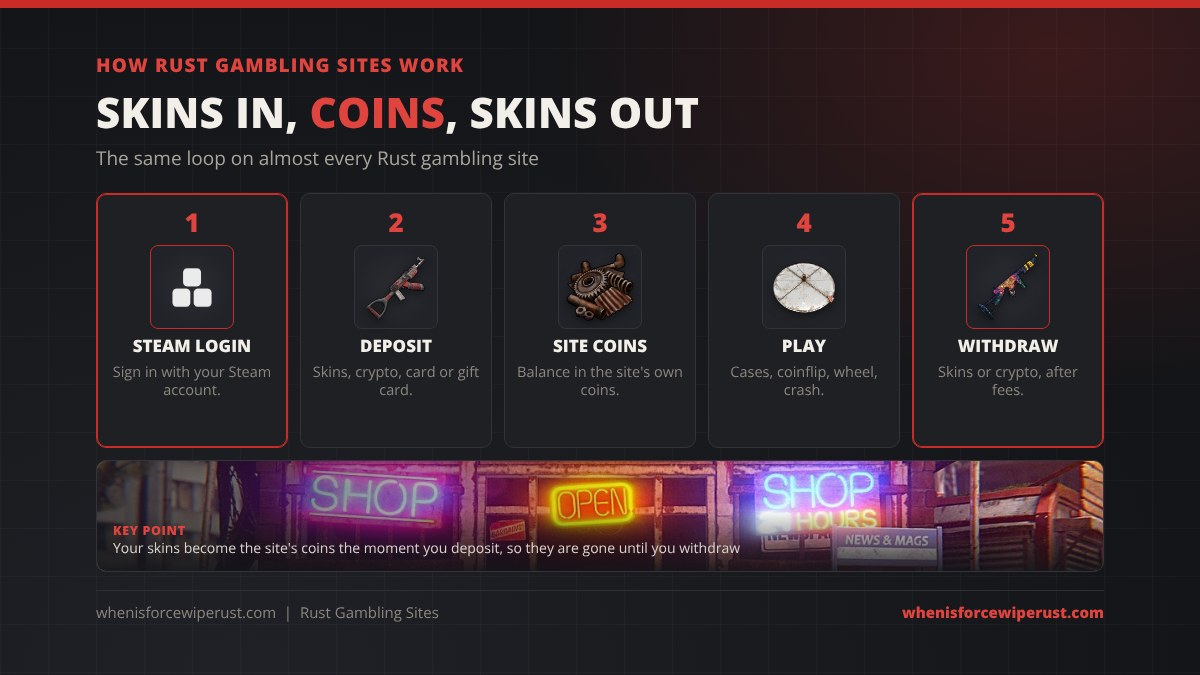
Almost every Rust gambling site follows the same five steps:
- Log in with Steam. Sites use the “Sign in through Steam” button so they can see your inventory and send trade offers. Signing in this way never gives the site your password.
- Deposit. You send skins to the site’s trade bot, or pay with crypto, a card or a gift card. Many sites give a bonus on cash and crypto deposits, which pushes you toward paying money rather than skins.
- Get site coins. Your deposit becomes a balance in the site’s own currency, such as scrap, gems or coins. The exchange rate is set by the site, and it is often below the Steam Market price for skins you send in.
- Play. You bet that balance on the site’s games, against the house or other players.
- Withdraw. You swap coins back into skins from the site’s shop or into crypto. This is where the rules bite: withdrawal fees, daily limits, wager requirements and ID checks all live here.
The key point is step 3. Once you deposit, your skins belong to the site and you hold a number in its database. If the site closes, freezes your account or refuses a withdrawal, there is no Steam trade to reverse and nobody at Valve to complain to.
Games on Rust Gambling Sites
| Game | How it works | Who you play against |
|---|---|---|
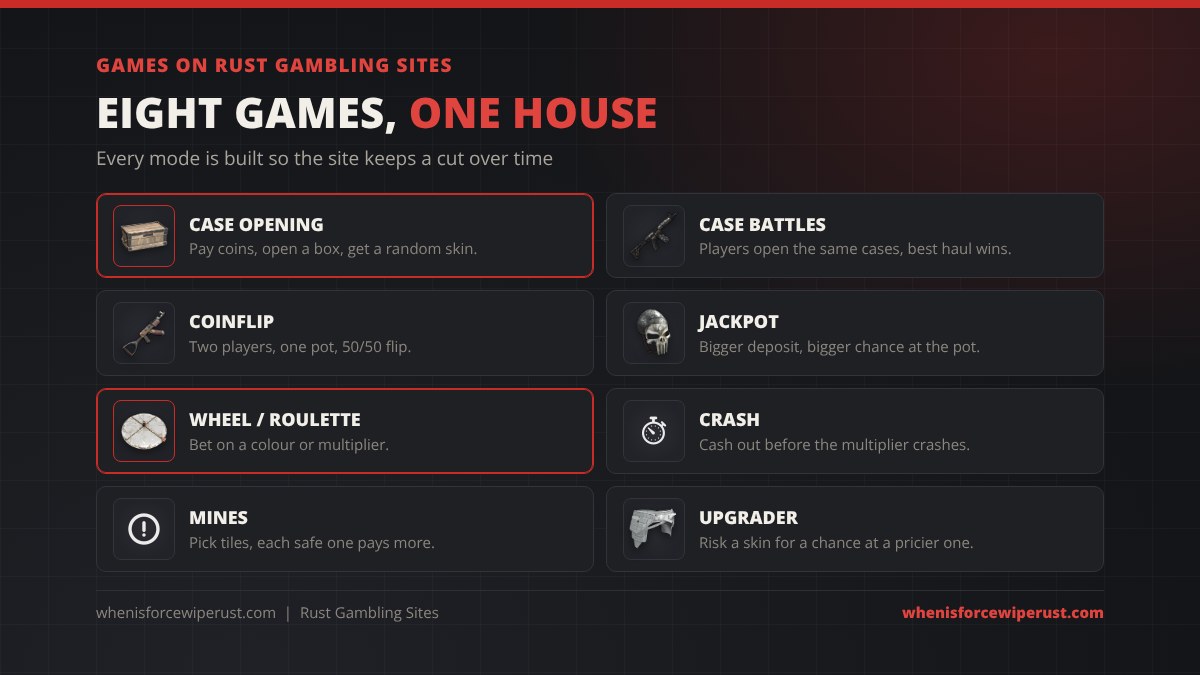
| Case opening | Pay a set price, open a case, get one random skin from its list | The house |
| Case battles | Two to four players open the same cases, highest total value takes everything | Other players, site takes a cut |
| Coinflip | Two players put in matching value, one wins the pot | Another player, site takes a cut |
| Jackpot | Everyone adds skins to a pot, your chance equals your share of it | Other players, site takes a cut |
| Wheel / roulette | Bet on a colour or multiplier, the wheel picks one | The house |
| Crash | A multiplier climbs until it crashes, cash out before it does | The house |
| Mines | Pick tiles on a grid, each safe tile raises the payout, a mine loses it all | The house |
| Upgrader | Risk a skin for a lower chance at a more expensive one | The house |
Every game is set up so the site keeps a slice. In house games the payouts are a little lower than the true odds (the house edge). In player-versus-player games like coinflip and jackpot the site takes a fee from every pot. Over enough bets, the average player always ends up with less than they put in.
What Does “Provably Fair” Mean?
Almost every Rust gambling site advertises itself as provably fair. It is a real system, but it proves less than most players think.
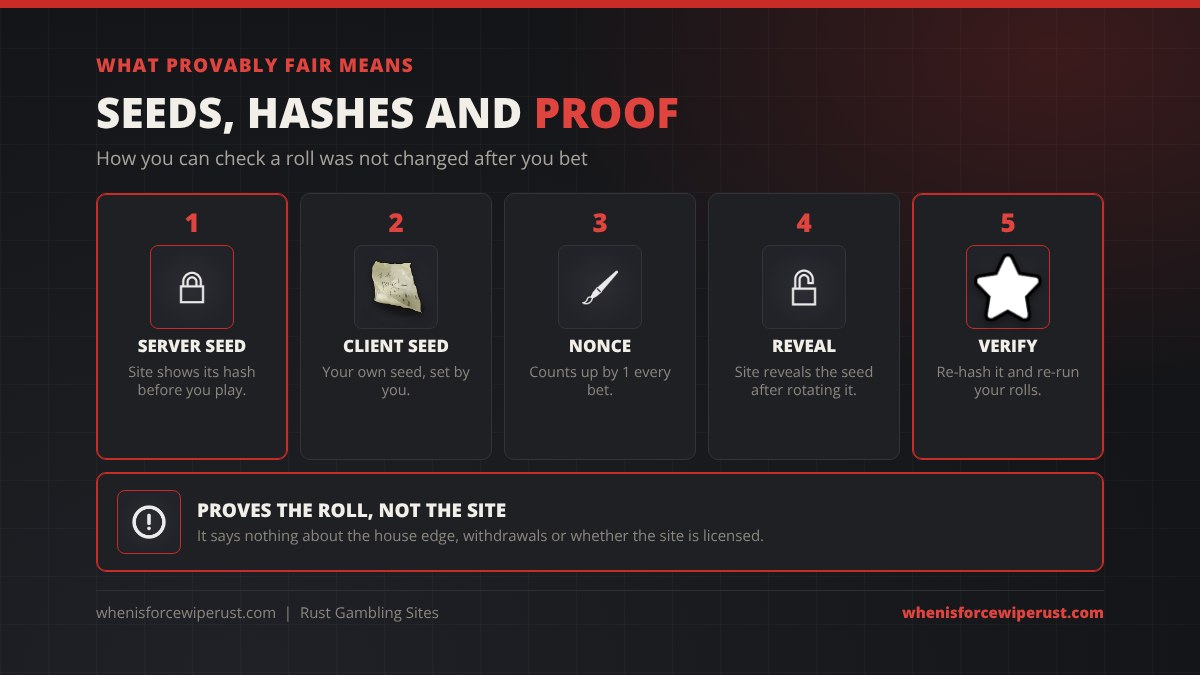
- Server seed: the site picks a secret random value and shows you only its hash (usually SHA-256) before you bet. The hash locks the seed in, so the site can’t swap it later without you noticing.
- Client seed: your own value, set by your browser or typed in by you, so the site can’t know the result in advance either.
- Nonce: a counter that goes up by one with every bet on the same seed pair.
- Reveal and verify: when you rotate seeds, the site shows the old server seed. You hash it, check it matches the hash you saw earlier, and re-run your bets to see the same results.
Some sites, like Bandit.camp, say they use public blockchain data (EOS) as part of the seed instead. Either way, a passing check only proves that a roll wasn’t changed after you bet. It does not tell you the house edge, whether the site pays out, whether it can lock your balance, or whether it is licensed anywhere.
Well-Known Rust Gambling Sites
These are the names Rust players run into most. This is not a recommendation, and we have no paid deal with any of them. The details come from each site’s own pages, independent reviews and public player reviews, so check the current terms on the site itself before you do anything.
| Site | Known for | Currency | Deposits | Withdrawals | Licence |
|---|---|---|---|---|---|
| Bandit.camp | The best-known Rust-themed site: cases, case battles, wheel, mines, dice | Scrap | Rust, CS2 and Dota 2 skins, crypto, cards, gift cards | Rust skins from the site shop or crypto, with fees and daily limits | Company registered in Cyprus, no traditional gambling licence per reviewers |
| RustClash | One of the first Rust-only skin gambling sites, launched in 2021 | Site gems | Skins and crypto | Skins or crypto | Calls itself a social casino |
Newer sites such as RustMagic pop up all the time, so use the checklist below on any site that isn’t in this table. Player reviews for the big names are split. Some players report fast cash-outs. Others report withdrawals that never arrived, accounts frozen during ID checks, or bonus terms that forced them to bet a deposit before they could take it out. Every operator denies rigging and points to its provably fair page. Read the newest reviews, not just the score.
Risks of Rust Gambling Sites
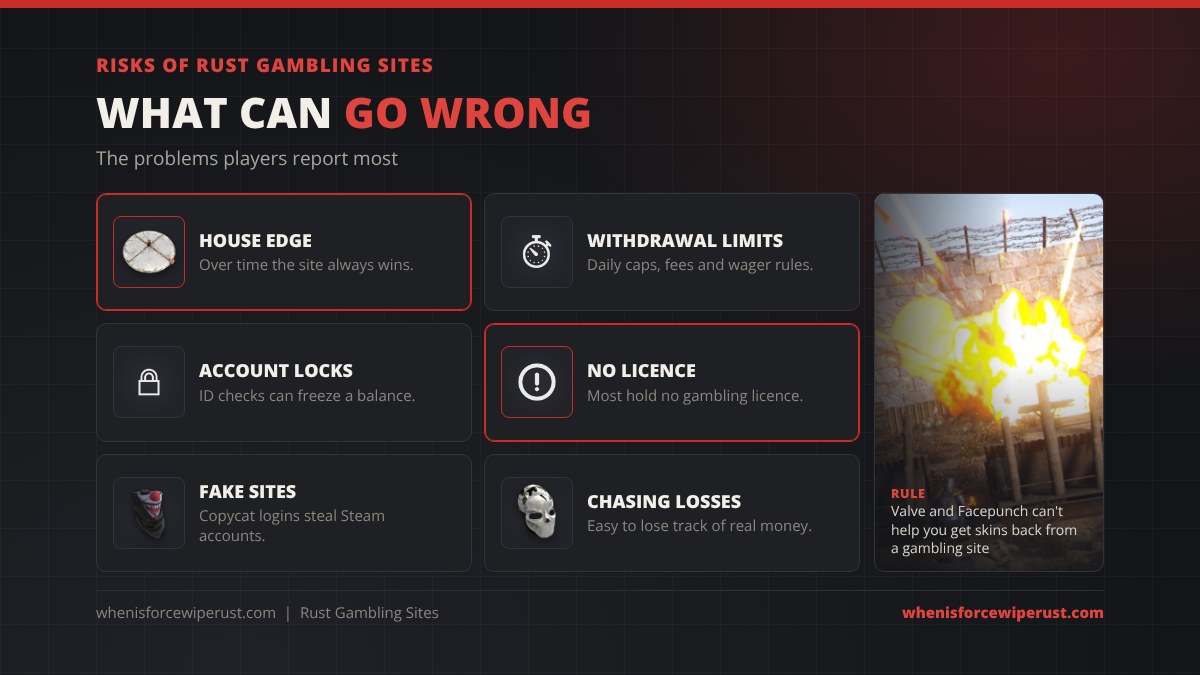
- You lose on average. The house edge and pot fees mean the longer you play, the closer you get to the site’s built-in cut. Big wins on stream are the exception that gets clipped.
- Getting money out is harder than putting it in. Withdrawal fees, daily limits, minimum withdrawals and “wager your deposit first” rules are common. Bandit.camp’s own support has said item withdrawals carry a fee of about 9% to 12%, depending on the item.
- Balances can be frozen. Many sites ask for ID only when you try to withdraw a large amount. If they reject your documents or decide you broke a rule, the balance stays locked.
- No licence, no regulator. Most Rust gambling sites aren’t licensed by a major gambling regulator. If a site refuses to pay, you usually have no ombudsman or regulator to complain to.
- No help from Steam. Valve and Facepunch don’t support gambling sites, and Steam Support can only deal with trades and purchases made on Steam.
- It’s built to keep you playing. Fast rounds, bonuses, rakeback and free cases are designed to feel like a game, not like spending money. If you’re chasing losses or betting more than you planned, stop.
- Sponsored streamers. Many streamers who play on these sites are sponsored or get a cut. In 2017 the US FTC took action against the owners of CSGO Lotto, two YouTubers who promoted the site without disclosing that they owned it.
Common Rust Gambling Scams
Gambling is also the most common bait for Steam account theft in the Rust community:
- Fake login pages. A friend or “streamer” sends you a link to a gambling site with free cases. The Steam login pop-up is fake and steals your account. Only sign in on steamcommunity.com, and check the address bar of any pop-up.
- API key scams. Scam sites ask you to create a Steam Web API key. With it they can cancel and fake your trade offers. No real site needs it.
- Fake trade bots. A bot with the same name and picture as the site’s bot sends a trade offer. Always start the trade from the site and match the bot’s details.
- “Promo code” and giveaway DMs. Messages promising free balance or a rare skin from a site you’ve never used are almost always phishing.
Our Rust skins guide covers how to keep your inventory safe, and the Rust inventory value checker shows what your skins are actually worth before anyone offers you a “deal”.
Is Rust Skin Gambling Legal?

It depends on where you live, and the trend is toward more rules, not fewer. Skins can be sold for real money, so most regulators treat betting them as gambling.
- 2016, Valve’s crackdown. After a lawsuit and pressure from the Washington State Gambling Commission, Valve said using Steam’s login and trading systems to run a gambling business breaks its API terms and user agreement. It sent cease-and-desist letters to at least 23 skin gambling sites and later shut down Steam accounts used by sites that ignored them. Many sites closed, and many others moved offshore.
- 2017, UK prosecution. The UK Gambling Commission prosecuted the owners of FutGalaxy, a site where players bet FIFA coins. They pleaded guilty to offences including providing facilities for gambling and were ordered to pay over £250,000 in fines and costs between them. The court heard a 12-year-old had used the site.
- 2017, FTC case. The US Federal Trade Commission’s first case against individual social media influencers was against the owners of CSGO Lotto, who promoted the site in videos without saying they owned it.
- 2026, New York v Valve. In February 2026 New York’s Attorney General sued Valve, arguing that paid random item drops in Counter-Strike 2, Dota 2 and Team Fortress 2 are illegal gambling because the items can be resold. Valve filed a motion to dismiss in May 2026. Rust has no paid loot boxes, but the case shows regulators now look at the whole skin economy.
In practice, almost every Rust gambling site is 18+ only in its own terms, blocks some countries, and is based outside the countries it takes players from. If gambling is illegal where you live, using an offshore site doesn’t make it legal, and it means you have no protection if something goes wrong.
How to Judge a Rust Gambling Site
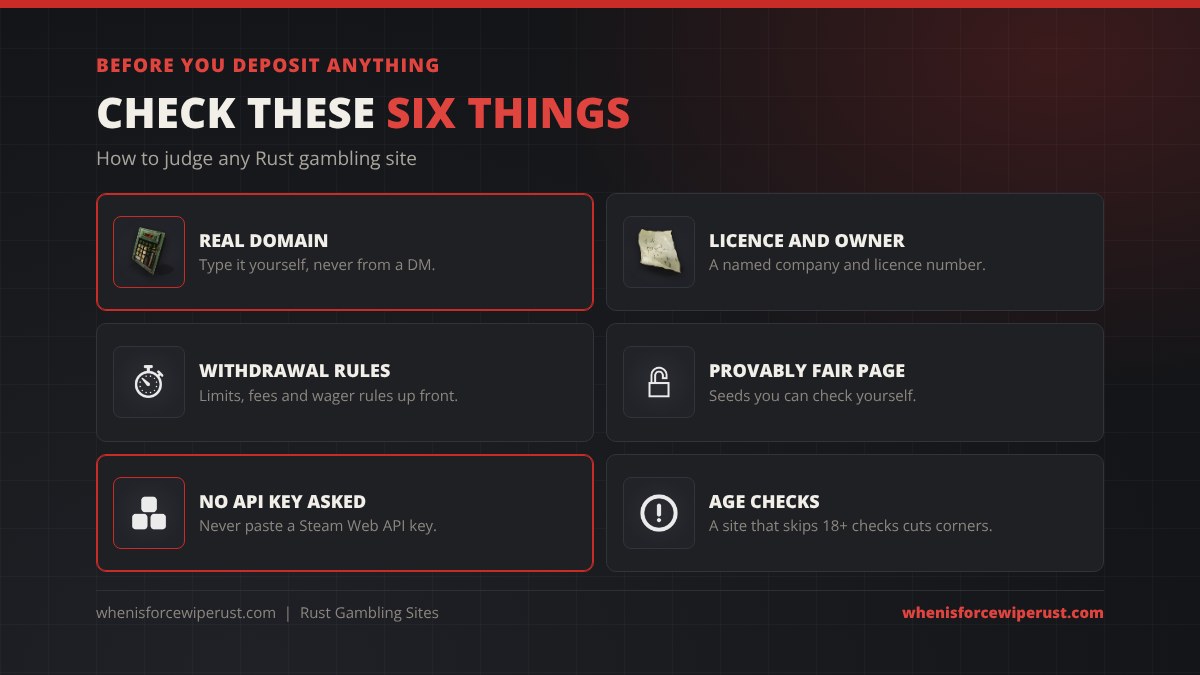
| Check | Good sign | Red flag |
|---|---|---|
| Domain | You typed it yourself and it matches the site’s official socials | Came from a DM, a misspelled name or a “free case” link |
| Owner and licence | Named company, address and licence number in the footer | No company name, or a licence number that doesn’t check out |
| Withdrawals | Fees, limits and wager rules written in the terms | Rules you only find out about when you try to cash out |
| Provably fair | A page where you can see and change your seeds and check old rolls | Only the words “provably fair” with nothing to check |
| Steam access | Sign in through Steam and trade offers you start from the site | Asks for a Steam Web API key, your password or a QR scan |
| Age checks | 18+ in the terms and ID checks that apply to everyone | No age question at all |
Gambling Inside Rust (No Real Money)
If you just like the thrill, Rust has its own gambling games that only use scrap you farm in game. Lose everything and the worst case is a recycling run, not your Steam inventory.
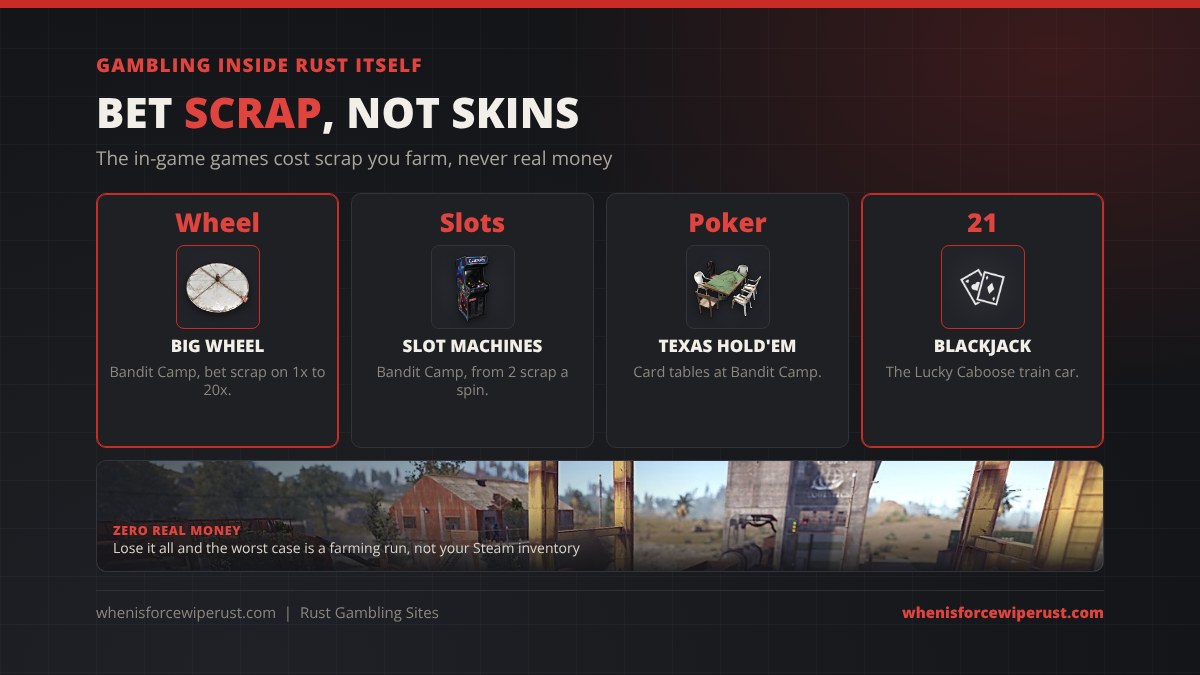
- Big Wheel: the 25-segment wheel at Bandit Camp, with bets on 1x, 3x, 5x, 10x and 20x. Our Bandit Camp guide has the real odds for each bet.
- Slot machines: also at Bandit Camp, added in 2021, starting at 2 scrap a spin with a multiplier for bigger bets.
- Texas Hold’em: card tables at Bandit Camp since April 2021.
- Blackjack: added in November 2022 in the Lucky Caboose train car, which also has slots and a poker table, and in a static caboose at Outpost since December 2022. Our Rust blackjack and casino games guide has the rules and odds.
Rust Gambling Sites FAQ
Are Rust gambling sites legit?
Some big Rust gambling sites have paid out to players for years, but none are run by Facepunch or Valve and most hold no traditional gambling licence. Player reviews are split between fast cash-outs and frozen balances, so “legit” mostly means “has paid out before”, not “protected”.
How do Rust gambling sites work?
You sign in with Steam, deposit skins, crypto or cash, and get a balance in the site’s own coins. You bet those coins on games like cases, coinflip, jackpot, wheel and crash, then withdraw skins or crypto, usually after fees and limits.
What does provably fair mean on Rust gambling sites?
The site shows a hash of a secret server seed before you bet and reveals the seed afterwards. Combined with your client seed and a nonce, you can re-create each roll to check it wasn’t changed after you bet. It does not prove the odds are good, that the site pays out, or that it is licensed.
Is Rust skin gambling legal?
It depends on where you live. Skins have real-money value, so many countries and US states treat skin betting as gambling, and it is always 18+ only. Valve banned using Steam’s systems for gambling sites in 2016, the UK has prosecuted unlicensed skin and virtual-currency gambling, and New York sued Valve in 2026 over its loot boxes.
Does Facepunch allow Rust gambling sites?
No. Facepunch has no partnership with any gambling site, and Valve’s Steam terms don’t allow its login and trading systems to be used to run a gambling business. Gambling sites operate on their own, and neither company can help if you lose skins on one.
Can you get banned on Steam for gambling Rust skins?
Valve has targeted the trade bot accounts that gambling sites use rather than ordinary players. The bigger risk to your account is phishing: fake gambling sites that steal your Steam login or ask for a Web API key.
Can you gamble in Rust without real money?
Yes. Bandit Camp has the Big Wheel, slot machines and Texas Hold’em poker tables, and blackjack is in the Lucky Caboose train car and the static caboose at Outpost. They all use scrap you collect in game, not real money.
Why do Rust streamers play on gambling sites?
Many are sponsored or get a share of what their viewers lose, and some sites give promoters free balance. Always look for a sponsorship disclosure, and remember that stream wins are picked for the clip.
Sources and Further Reading
- Valve’s 2016 cease-and-desist action: GeekWire
- UK FutGalaxy prosecution: Cornerstone Barristers
- CSGO Lotto case: US Federal Trade Commission
- New York v Valve (2026): GeekWire
- Rust card tables and blackjack: Rustafied
- Back to the main tracker: When is force wipe in Rust