
Open the Rust server browser and you will see thousands of servers with tags like 2x, 10x, PvE, vanilla, modded, battlefield, build, roleplay and noob friendly. They are all the same game, but they play like completely different games. A 10x battlefield server has you in a gunfight thirty seconds after you spawn. A vanilla monthly server makes you farm for days before you can craft an AK. Rust PvE servers turn off player damage altogether.
This guide explains every Rust server type in plain words: what each tag means, how the server is set up behind the scenes, who it suits, and how to pick the right one. When you know what you want, filter for it in our live Rust server browser, which has filters for every type below, and check the Rust force wipe countdown so you join on a fresh map.
- All Server Types
- Vanilla
- Modded
- 2x, 5x, 10x
- PvE Servers
- Battlefield and Aim
- Build and Creative
- Roleplay
- Softcore, Hardcore, Premium
- Noob Friendly
- Team Limits and Wipes
- Which to Pick
- FAQ
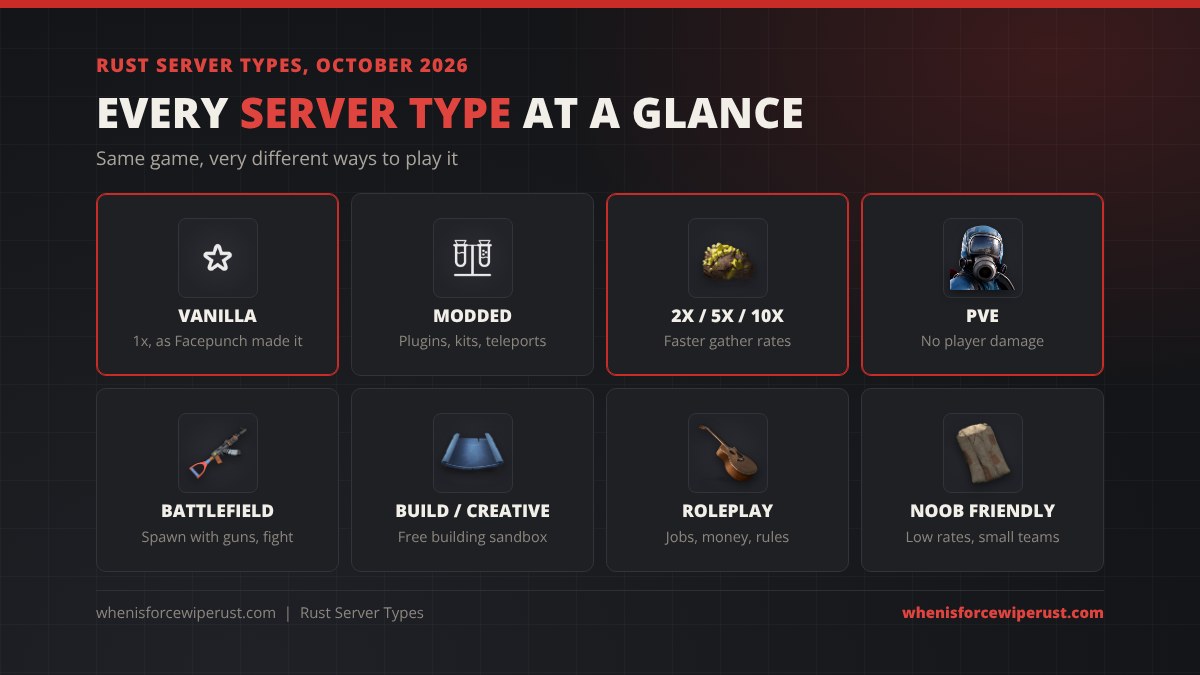
Every Rust Server Type at a Glance
Server owners describe their servers with tags. Some come straight from Facepunch’s official tag list (vanilla, modded, PvE, roleplay, creative, build server, combat training, battlefield, minigame, battle royale, softcore, hardcore, weekly, biweekly, monthly), and the in-game browser lets you filter by them (the full list with values is in our Rust server tags guide). Others, like 2x, 10x, solo/duo or noob friendly, are written into the server name. Here is what each one means.
| Type | What it means | Best for |
|---|---|---|
| Official | Run by Facepunch. Pure vanilla, no plugins, no admins changing settings. | Playing Rust exactly as designed |
| Community vanilla | Run by a community group with vanilla rates and rules, often with a team limit and active admins. | Vanilla play with better moderation |
| Modded | Runs plugins through Oxide or Carbon: kits, teleports, shops, events, faster rates. | Faster, shorter sessions |
| 2x / 3x / 5x | Gather (and often craft) multiplied by 2, 3 or 5. | Less grind, still a real progression |
| 10x and up | Huge gather rates, usually with kits and instant crafting. Fights start on day one. | PvP straight away |
| PvE | Player damage and raiding are off. You fight NPCs, heli, Bradley and events. | Building, farming, learning the map |
| Battlefield / aim train | Spawn with gear in an arena or small map. No farming at all. | Warming up and practising PvP |
| Build / creative | Free building, no costs or cooldowns, often with admin tools for everyone. | Designing and test-raiding bases |
| Roleplay | Jobs, money, police and story rules on top of Rust. | Social play and characters |
| Softcore | Facepunch’s easier mode: 2x gather, raids only 6 to 9 PM server time, and you keep half your loot on death. | New and casual players |
| Hardcore | Facepunch’s harder mode: fog of war map, no position without a compass, guns can’t be crafted. | Veterans who want it raw |
| Noob friendly | A label: usually low rates, small team limits, low decay, raid protection or starter kits. | Your first wipes |
Vanilla Servers: Official and Community
A vanilla server runs Rust with no gameplay plugins: 1x gather, normal crafting times, normal stack sizes, the full tech tree grind. There are two kinds.
- Official servers are run by Facepunch and named like “[US East] Facepunch 1”. They are always vanilla, have no team limit, and wipe on the monthly force wipe (some wipe more often). There are no admins to report players to beyond the in-game F7 report.
- Community vanilla servers (Rustoria, Rusty Moose, Rustafied and many more; see their wipe schedules and live stats) keep vanilla rates but add their own rules: solo, duo, trio or quad limits, weekly or biweekly map wipes, active admins and their own anti-cheat on top of Easy Anti-Cheat. Many also run small quality-of-life plugins such as a wipe countdown or a vote rewards system, which is fine as long as gather and crafting stay vanilla.
Vanilla is where the “real” Rust experience is, and it’s what most streamers play. It’s also the hardest place to learn: large clans, cheaters on some servers, and roof campers at every monument. If you want to see how busy a vanilla server gets before you commit, look it up on BattleMetrics and check its 30 day player graph.
Modded Servers
A modded server runs a framework, Oxide (uMod) or Carbon, and loads plugins on top of the normal game. Players don’t download anything: you join with the normal game and the server does the work. Facepunch requires servers that change gameplay to list as modded, so you will find them in the Modded tab of the in-game browser rather than Community.
Common modded features:
- Higher rates: 2x, 3x, 5x, 10x, 100x or even 1000x gather.
- Kits: a starter kit of tools, clothes and food, sometimes weapons on higher rate servers.
- Teleports:
/home,/tprto teammates and/townto Outpost. - Bigger stacks and furnace splitters, so smelting and looting take less time.
- Shops and economy: in-game currency, server shops and vote rewards.
- Events: Raidable Bases, convoy, airdrop and arena events.
Our Rust server mods guide covers the frameworks and the plugins almost every modded server runs, and the how to host a Rust server guide shows how to make your own.
2x, 5x and 10x Rust Servers: What the Numbers Mean

The number in a server name like “2x” or “10x” is the gather rate: how many resources you get for every hit on a tree or node, every pickup and every barrel, compared to vanilla. On a 2x server one swing that gives 10 wood in vanilla gives 20. Most rate servers also speed up crafting and smelting, and many raise stack sizes so a 10x haul fits in your inventory. Vanilla Rust has no rate setting, so every rate above 1x is a plugin such as Gather Manager.
| Rate | How it plays | Typical wipe |
|---|---|---|
| 1x (vanilla) | Full grind. Days to get to rifles and HQM walls. Raids cost real farming. | Weekly, biweekly or monthly |
| 2x | The most popular modded rate. Half the farming, but progression still feels earned. | Weekly or biweekly |
| 3x / 5x | Tier 3 gear in the first evening. Bases go up fast, raids happen early. | Weekly |
| 10x | Almost instant gear, often with kits. Constant PvP and raiding from the first hour. | Weekly or twice a week |
| 100x / 1000x | Loot is meaningless, everything is about fighting. Closer to a battlefield server. | Very often, sometimes daily |
Higher rates also change raiding. On vanilla, one raid can cost a whole day of sulfur farming, so people pick targets carefully. On 10x everyone has rockets by the first evening. If you want to see what a craft costs at any rate, our crafting calculator shows the vanilla cost, which you can divide by the server’s rate for a rough farming time.
Rust PvE Servers Explained

Rust PvE servers are servers where players can’t hurt each other or raid each other’s bases. You still farm, build, craft, run monuments and fight scientists, the Patrol Helicopter, Bradley and animals, but nobody can shoot you in the back for your sulfur. Rust has no PvE option in its main menu. Every PvE server is a community server that the owner has set up this way, and every official Facepunch server is PvP.
Owners make a server PvE in one of two ways:
- The built-in
server.pvesetting. One line, and it also adds the PvE tag in the browser. It is blunt: damage you do to other players is reflected back at you rather than finely controlled, and it doesn’t handle every case. - The TruePVE plugin (Oxide or Carbon). This is what most PvE communities use, because the owner decides exactly what can damage what: players, bases, vehicles, traps and turrets, NPCs. Bases are protected from other players by default.
To give players something to fight, most PvE servers add NPC content: Raidable Bases (NPC-defended bases full of loot that spawn around the map by difficulty), convoys, armed NPC events and custom monuments. Some are “PvE with PvP zones”, where fighting is only allowed inside marked areas like Oil Rig or an arena.
| Rust PvE server | What to check before you join |
|---|---|
| Rates | Most PvE servers run 2x to 5x, because there are no raids to make the grind feel worth it. |
| Loot rules | Can other players loot your kills, your airdrops or your crates? Many PvE servers lock loot to whoever earned it. |
| Base protection | Are bases fully protected, or can they decay? Upkeep still applies on most servers. |
| PvP zones | Some monuments or events may be PvP. Read the rules so you don’t walk in unprepared. |
| Wipe | PvE servers often wipe less (biweekly or monthly) so bases last longer. |
PvE is a great way to learn monuments, keycard puzzles, electricity and building without losing everything to a raid. Filter PvE in our Rust server browser to see every PvE server online right now.
Battlefield, Aim Train and Combat Training Servers
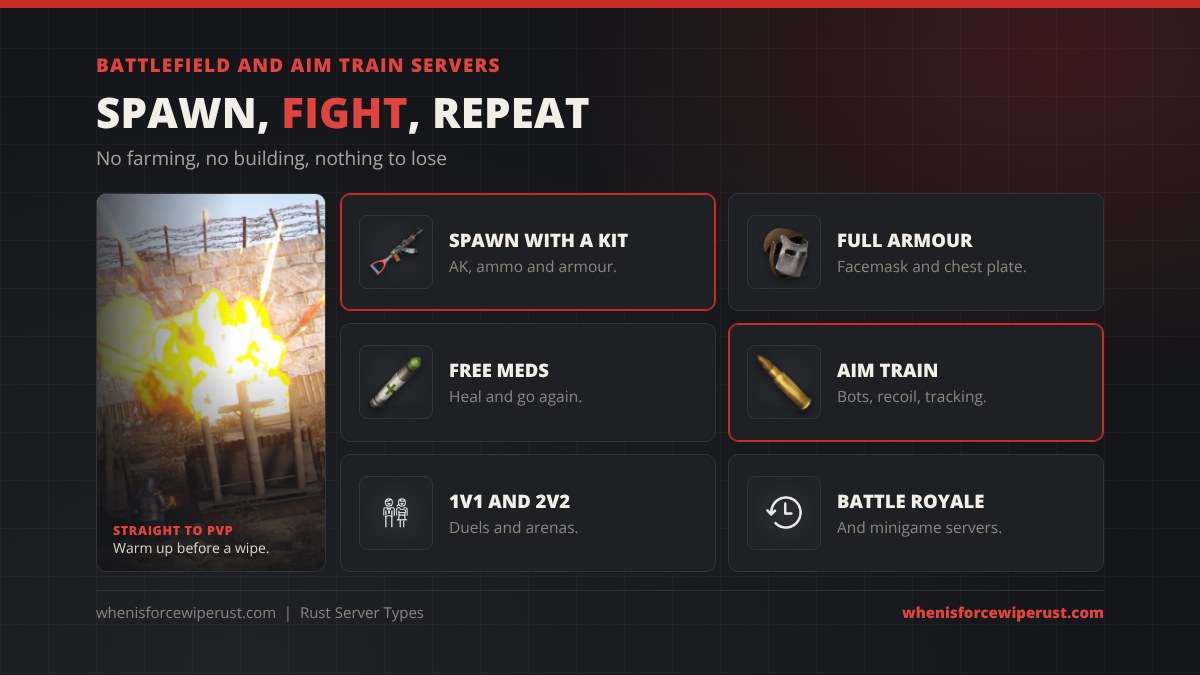
Battlefield servers give you a loadout when you spawn (often an AK, a metal facemask and chest plate, meds and ammo) and drop you onto a small map or arena to fight. There is no farming, no building and no progress to lose. Aim train and combat training servers are similar but built for practice: bots that strafe, recoil practice, deathmatch arenas, 1v1 and 2v2 duels and tracking drills. Some are listed as minigame or battle royale servers instead.
Players use them to warm up before a wipe or to get better at gunfights without losing a whole kit. Our Rust aim training guide covers how to practise on these servers and the settings that help, and the best Rust settings and console commands page helps you get more FPS before you join.
Build and Creative Servers

Build servers (tag builds) and creative servers (tag creative) are sandboxes. Building costs nothing, there are no cooldowns, and you can usually spawn items or use admin tools. Facepunch added a built-in creative mode for server owners, with settings like creative.freebuild (blocks cost nothing), creative.freeplacement (skip placement checks), creative.freerepair and creative.allusers to turn it on for everyone.
Players use build servers to:
- Design and practise a base design before wipe, so the first night goes up fast.
- Test raid costs with real C4, rockets and satchels, then compare with our raid calculator.
- Learn electricity and industrial setups without farming components.
Want to plan a base without joining a server at all? Use our free Rust base builder.
Roleplay Servers
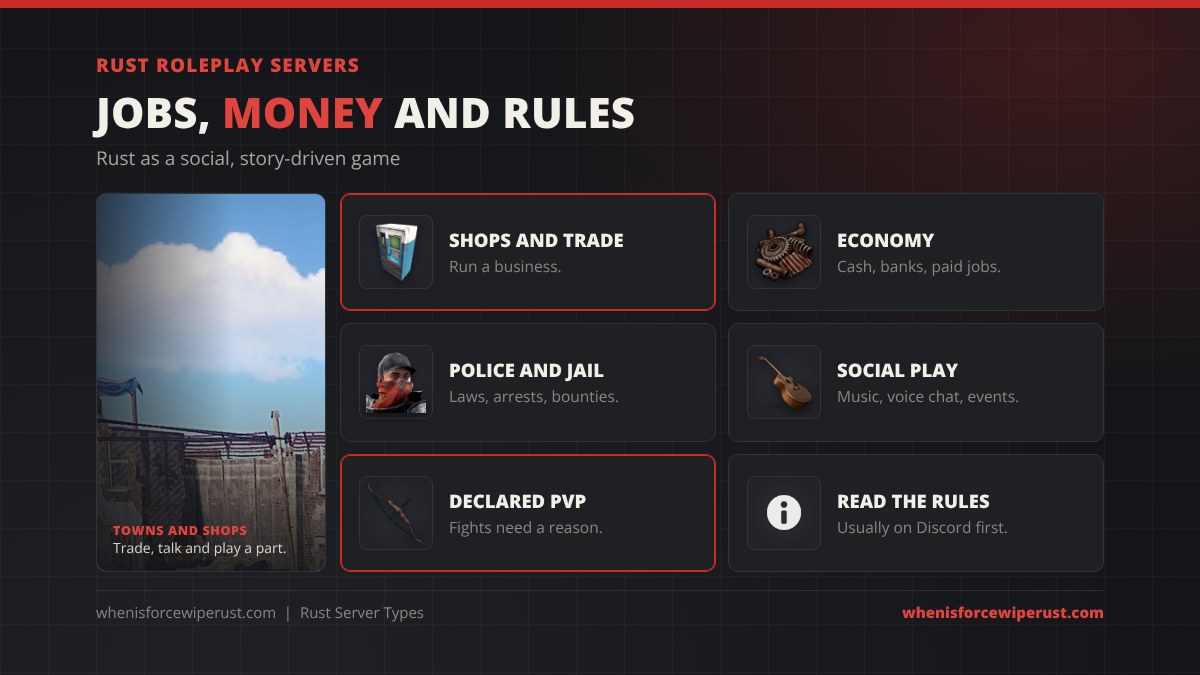
Roleplay (RP) servers turn Rust into a social, story-driven game. Players take a role, such as shop owner, farmer, medic, police officer or bandit, and act it out. Most RP servers use plugins for an economy (cash, banks, property, paid jobs), police and jail systems, and rules about when fighting is allowed, such as having to declare war on someone before you can attack them. Some go further, with GTA-style city maps and custom vehicles.
Every RP server has its own rule set and you will usually need to read the rules or join their Discord first. Breaking character or killing without a reason (RDM) can get you kicked. If you like the social side of Rust, such as trading at vending machines, playing instruments and talking on voice chat, RP is worth a try.
Softcore, Hardcore and Premium Servers
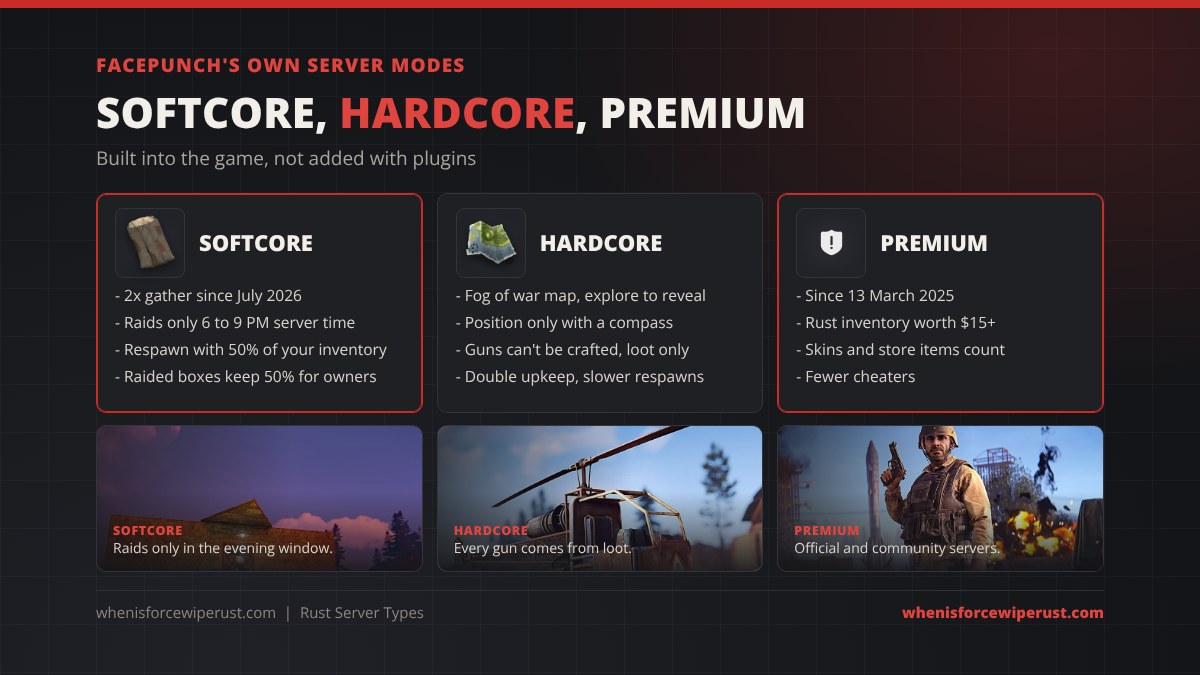
These three are built into the game by Facepunch rather than made with plugins.
Softcore is Facepunch’s easier game mode. Since the Soft Refresh update in April 2025, if you die outside a building privilege area you respawn with half of your inventory automatically (half of every stack). When raiders destroy a box, furnace, locker, workbench or tool cupboard in your base, it drops 50% of its contents and keeps the other 50% for the owners. A destroyed tool cupboard keeps building authorization for 48 hours so you can rebuild, and a destroyed sleeping bag lets you respawn on it one last time. Door upkeep is also raised to discourage huge bases.
The Common Ground update on 2 July 2026 made Softcore much friendlier again. Softcore servers now have raid windows: by default raiding only works from 6 PM to 9 PM server local time. Outside the window, explosive and projectile damage to building parts and doors is blocked, though twig, deployables, high external walls and melee damage still count, and a new base is only protected an hour after its tool cupboard goes down. Softcore also got a 2x gather rate on trees, ore, corpses and pickups. That makes it the closest thing to an official noob friendly server.
Hardcore is the opposite. It first launched in September 2022 with no map, compass or teams, and Facepunch brought it back, reworked, in the Harder Core update on 7 August 2025. Now the map starts covered in fog of war and only fills in as you explore on foot, your position only shows if you carry a compass, and guns can’t be crafted or researched (only the Eoka), so every gun comes from loot. Ammo costs 5x more to craft, NPCs drop half as much ammo, base upkeep is doubled, and respawn timers are longer (15 minutes on a sleeping bag, 10 on a bed). Server owners turn it on with the hardcore game mode.
For every softcore and hardcore rule in detail, including what raid window protection does and doesn’t cover, plus a live list of softcore and hardcore servers, read our Rust softcore vs hardcore guide.
Premium servers launched on 13 March 2025 as Facepunch’s experiment against cheaters. To join, your Rust Steam inventory has to be worth at least $15 (skins and store items count). Facepunch runs official premium servers, and community servers can turn the same check on. Read more about how cheating is handled in our Rust cheats and anti-cheat guide, and see where to get skins in where to buy Rust skins.
Noob Friendly Rust Servers: What It Really Means
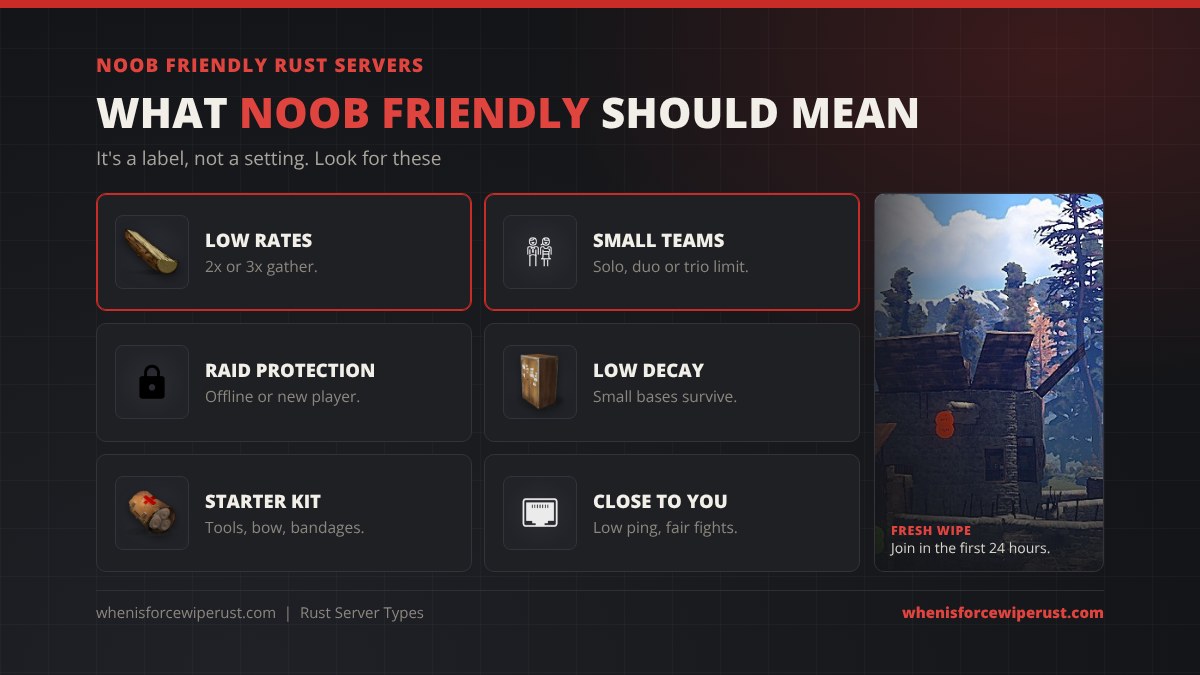
“Noob friendly“, “beginner friendly” and “new player friendly” are not Facepunch tags or settings. They are words owners put in the server name or description, and they can mean anything. The servers that actually are good for new players usually have most of these:
- Low rates: 2x or 3x. Fast enough that you don’t burn out, slow enough to learn what things cost.
- Small team limits: solo, duo or trio, so a 12-man clan can’t roll everyone.
- Raid protection: protection while you are offline, or for new players’ first hours.
- Low decay and cheaper upkeep, so a small base survives while you sleep.
- A starter kit: stone tools, a bow, bandages and clothes.
- Active admins and a clear rule against griefing new players.
- A server near you: high ping makes every fight harder.
New to the game? Our Rust beginners guide walks you through your first wipe, from what to craft first to building a stone starter base.
Before you join, check the server’s player graph on BattleMetrics. A noob friendly server with 300 players on wipe day and 20 on day three is not much use. Our server list can show you only servers that wiped in the last 24 hours, so everyone starts on the same footing.
Team Limits and Wipe Schedules
Two more labels sit on top of every server type.
Team limits: “solo”, “duo”, “trio” and “quad” servers cap how many players can be on a team. “No limit” means clans. Official servers have no group limit rule (the in-game team still holds 8 by default, see our Rust team limit and clans guide), so big groups usually win. A solo/duo server is the closest thing to a fair fight for small groups.
Wipe schedule: the weekly, biweekly and monthly tags tell you how often the map resets. Every PC server, official or community, also has to wipe on the monthly force wipe on the first Thursday of the month, when Facepunch ships the update. Short wipes suit casual players, long wipes suit groups that want to build up. To catch a server the day it resets, use our just wiped Rust servers list. Console is different, see the Rust console wipe schedule.
Which Rust Server Type Should You Pick?
| If you… | Pick |
|---|---|
| Are brand new to Rust | PvE, Softcore, or a 2x noob friendly solo/duo server |
| Want the real Rust experience | Official or community vanilla, weekly or monthly |
| Have a few hours a week | 2x or 3x weekly with a team limit |
| Want fights now | 10x, or a battlefield server |
| Want to get better at PvP | Aim train or combat training |
| Love building | PvE or a build/creative server |
| Hate losing everything | Softcore or PvE |
| Want to play with a big group | Vanilla, no team limit, monthly |
| Like the social side | Roleplay |
Want to run your own server of any of these types? Compare hosts in our Rust server hosting guide and look up commands in the Rust admin commands list.
Server names are full of shorthand like 2x, vanilla, BP wipe and pop. Our Rust slang and jargon glossary decodes all of it.
Rust Server Types FAQ
What does 2x mean on a Rust server?
2x means the server doubles the gather rate: every hit on a tree, rock or node and every pickup gives twice the vanilla amount. Many 2x servers also speed up crafting and smelting. It is the most popular modded rate because it halves the grind without making gear meaningless.
Are there official Rust PvE servers?
No. Every official Facepunch server is PvP. Rust PvE servers are community servers that turn off player damage with the server.pve setting or, more often, the TruePVE plugin. Filter PvE in a server browser to find them.
What is the difference between vanilla and modded Rust servers?
Vanilla servers run the game as Facepunch made it, with 1x rates and no gameplay plugins. Modded servers run Oxide or Carbon with plugins that add things like higher gather rates, kits, teleports, shops and events. Modded servers are listed in the Modded tab of the in-game browser.
What is a battlefield server in Rust?
A battlefield server spawns you with weapons, armour and meds on a small map or arena so you can fight straight away. There is no farming or building. They are used to warm up and practise PvP.
What is a build server in Rust?
A build server is a sandbox with free building, usually using Rust’s creative mode settings or admin tools. Players use it to design bases, test raid costs and practise electricity without farming.
What is softcore in Rust?
Softcore is Facepunch’s easier game mode. Since July 2026 it has 2x gather and raid windows, so bases can only be properly raided from 6 PM to 9 PM server time. If you die outside a building privilege area you respawn with half of your inventory, and when raiders destroy storage in your base, half of its contents stay protected for the owners.
What is hardcore mode in Rust?
Hardcore is Facepunch’s harder game mode. Since the Harder Core update in August 2025 the map starts hidden and fills in as you explore, your position only shows with a compass, guns can’t be crafted or researched so they only come from loot, upkeep is doubled and respawn timers are longer.
What is the best Rust server type for beginners?
A PvE server, a Softcore server, or a 2x noob friendly server with a solo, duo or trio limit, low decay and raid protection. Pick one in your region that wiped recently so you start at the same time as everyone else.
Do modded Rust servers wipe on force wipe?
Yes. Every PC server, modded or vanilla, has to wipe the map on the monthly force wipe on the first Thursday of the month because the update changes the server files. Many modded servers also wipe weekly or biweekly in between.