
The Rust rocket is the loudest sentence in the game. It is the item that turns a farming wipe into a raiding wipe, the thing every zerg is quietly stockpiling while you are still running satchels, and the single most expensive piece of ammunition a solo player will ever craft. One rocket costs 1,400 sulfur. A sheet metal wall costs eight of them.
That number is why so many rockets get wasted. Players farm for two days, craft a stack of three, then fire them at the wrong wall from the wrong angle and walk home with nothing. This guide covers the real crafting cost including the gun powder chain, how many rockets every wall and door actually takes, all four rocket types, and the honest answer to whether a rocket is even the right tool for the job.
- What It Is
- Crafting Cost
- Getting the Blueprint
- The Launcher
- Raid Chart
- Rocket vs C4
- All Rocket Types
- Bradley & Turrets
- How to Fire One
- Myths & Mistakes
- Pro Tips
- FAQ
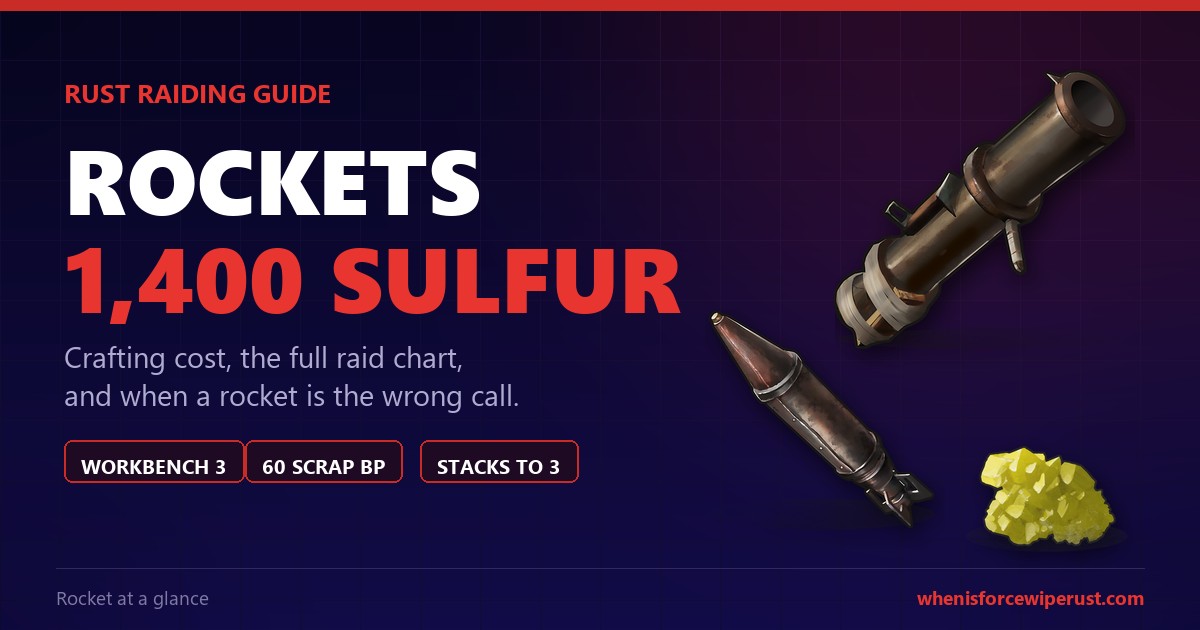
What Is a Rocket in Rust?
A rocket is ammunition for the Rocket Launcher. In the game’s own words it is a short to medium range self propelled, unguided rocket that deals large splash damage on impact. Unguided is the important word. You point, you fire, and gravity gets a vote.
Mechanically it is the mid tier of Rust’s serious raiding explosives. Satchels are cheap and unreliable, C4 is expensive and has to be placed by hand on the wall you want gone, and the rocket sits in between: it costs less sulfur than C4, and unlike C4 you can fire it from thirty metres away without ever touching the building.
That range is the entire point. Every other explosive in Rust requires you to walk up to a base, stand still next to it, and hope nobody is watching through a window. A rocket lets you do damage from a rooftop, from a hillside, or from behind a rock. You are paying a sulfur premium for the privilege of not being in the open.
A rocket stacks to three, so a full inventory slot holds 4,200 sulfur worth of explosive. Dropped on the ground it despawns after roughly an hour.
Rust Rocket Crafting Cost
The recipe on the crafting screen is short. The actual bill is not, because two of the three ingredients are themselves crafted from other crafted things.
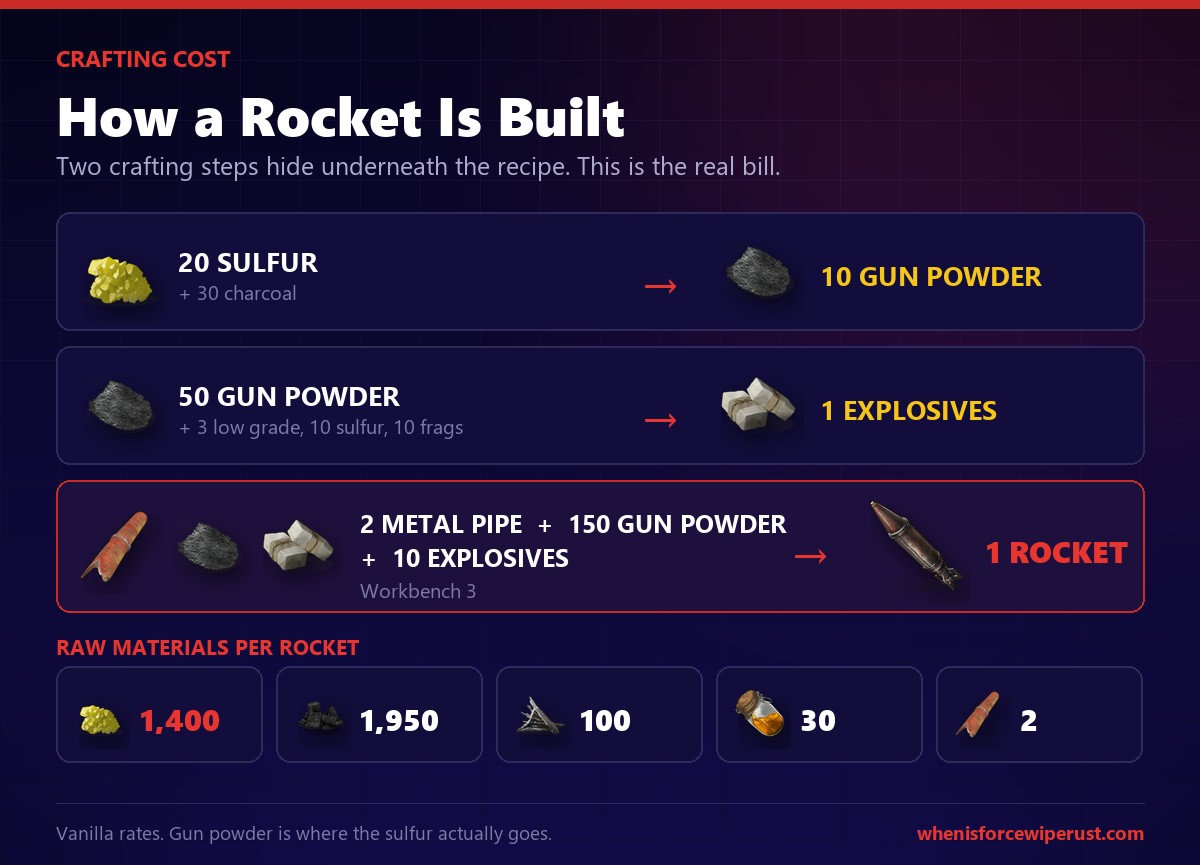
The recipe: 2 Metal Pipe, 150 Gun Powder and 10 Explosives, at a Workbench Level 3.
Those 10 Explosives each need 50 Gun Powder of their own, which means a single rocket burns through 650 Gun Powder in total. At 20 sulfur and 30 charcoal per 10 gun powder, that is where almost the whole cost lives.
| Raw Material | Per Rocket | Where It Comes From |
|---|---|---|
| Sulfur The bottleneck | 1,400 | Sulfur nodes, mining quarries, sulfur ore in barrels |
| Charcoal | 1,950 | Burning wood in a furnace or campfire |
| Metal Fragments | 100 | Smelted metal ore |
| Low Grade Fuel | 30 | Crude oil, animal fat, cloth |
| Metal Pipe | 2 | Loot component, or 2 HQM plus 20 scrap each at a Workbench 3 |
Charcoal is the quiet second cost. 1,950 charcoal per rocket means a lot of wood going through furnaces, and a group planning a ten rocket raid needs close to 20,000 charcoal alongside 14,000 sulfur. Large furnaces and a decent wood stockpile are not optional at that scale.
How to Get the Rocket Blueprint
Rockets are not a default recipe. You need the blueprint before the Workbench 3 will let you craft one, and there are two routes.
Research table. Put one rocket in a research table with 60 scrap and you own the blueprint for the wipe. This is by far the cheaper route, and it is why finding a single rocket in a locked crate is worth more than the rocket itself. Sixty scrap is nothing. Getting that first rocket to feed the table is the hard part.
Tech tree. Unlocking rockets through the Workbench 3 tech tree costs roughly 780 scrap in total once you count the nodes leading up to it, and the path runs through Timed Explosive Charge. It is expensive, but it is guaranteed, and it does not require you to first find a rocket.
Rockets themselves appear in Helicopter crates, hackable Locked Crates, Oil Rig locked crates and Ghost Ship crates. The drop rate is low, so treat any loose rocket you find as blueprint material rather than something to fire.
How to Get a Rocket Launcher in Rust
A rocket with nothing to fire it from is 1,400 wasted sulfur. The Rocket Launcher is a separate item with a separate blueprint. Our Rust rocket launcher guide covers its loot chances, recycle yield and skins in full.
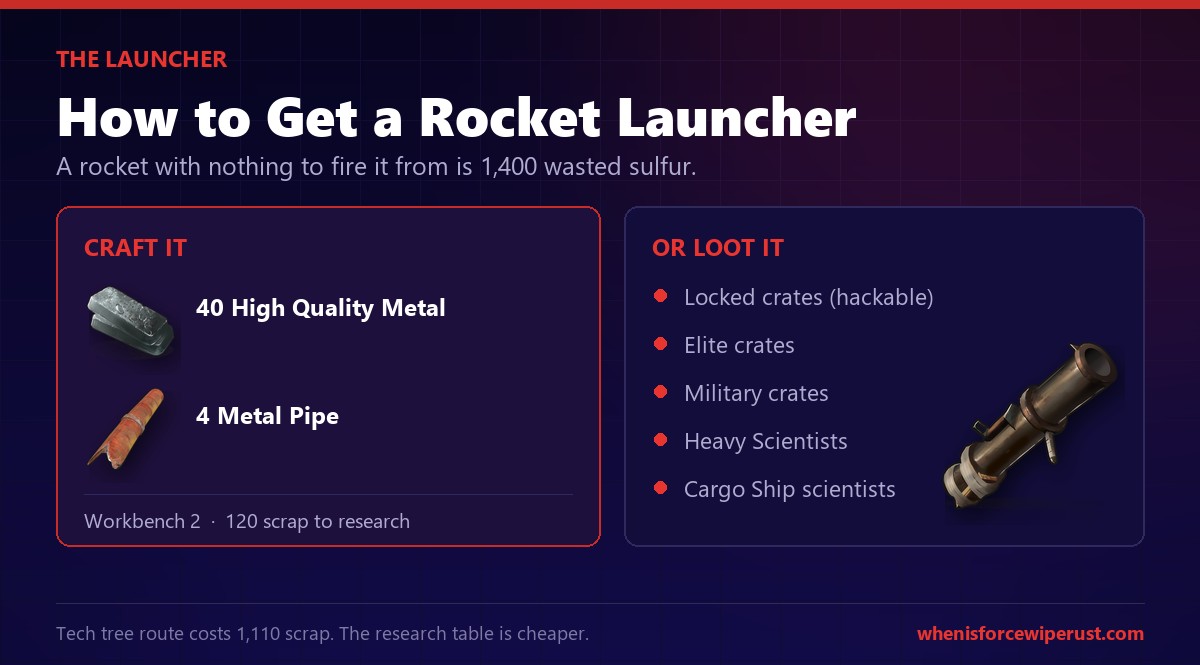
Crafting it takes 40 High Quality Metal and 4 Metal Pipe at a Workbench Level 2. The blueprint costs 120 scrap at a research table, or about 1,110 scrap through the tech tree. The research table is the obvious pick if you can find a launcher to feed it.
Looting it is realistic. Rocket Launchers turn up in hackable locked crates, elite crates and military crates, and they drop from Heavy Scientists and Cargo Ship scientists. If you are already running red keycard monuments for elite crates, you will see one eventually.
The launcher has durability and it does wear out, so keep a repair bench in mind if you are planning a long raiding wipe. It is also a heavy, obvious item to carry: anyone who kills you with a launcher in your hands has just been handed the most valuable thing you own.
How Many Rockets for Each Structure
This is the table people actually come for. All values are vanilla, hard side, against undamaged structures with no repairs mid raid.
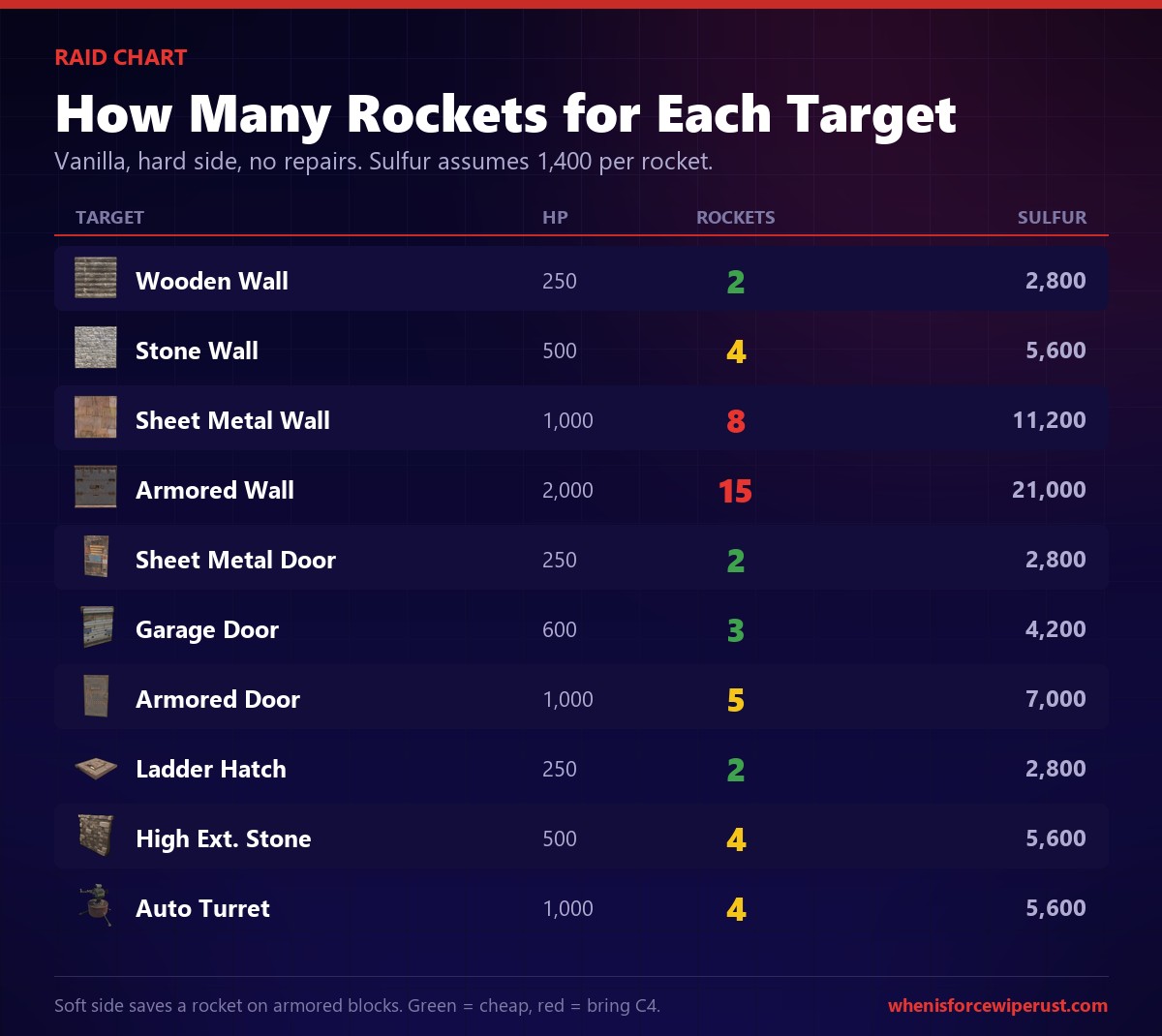
| Target | HP | Rockets | Sulfur Cost |
|---|---|---|---|
| Wooden Wall | 250 | 2 | 2,800 |
| Stone Wall | 500 | 4 | 5,600 |
| Sheet Metal Wall | 1,000 | 8 | 11,200 |
| Armored Wall | 2,000 | 15 | 21,000 |
| Wooden Door | 200 | 1 | 1,400 |
| Sheet Metal Door | 250 | 2 | 2,800 |
| Garage Door Best value | 600 | 3 | 4,200 |
| Armored Door | 1,000 | 5 | 7,000 |
| High External Wooden Wall | 500 | 3 | 4,200 |
| High External Stone Wall | 500 | 4 | 5,600 |
| Ladder Hatch | 250 | 2 | 2,800 |
| Metal Window Bars | 500 | 4 | 5,600 |
| Tool Cupboard | 100 | 1 | 1,400 |
| Auto Turret | 1,000 | 4 | 5,600 |
Two things jump out of that table. The first is that an armored wall at 15 rockets is 21,000 sulfur, which is not a raid, it is a project. If you hit armored on the outside of a base, the correct move is usually to look for a different entry point rather than to keep firing.
The second is that the soft side matters even for explosives on armored blocks. An armored door takes 5 rockets from the hard side but only 4 from the soft side, which is a 1,400 sulfur difference for standing in the right place. Learn to read which face you are looking at before you fire. Our stone wall guide covers how to tell the sides apart on each tier.
Rocket vs C4 vs Satchel: What Is Actually Cheaper
Here is the part most rocket guides skip, because it makes rockets look bad. In raw sulfur, a rocket is almost never the cheapest way to break something.
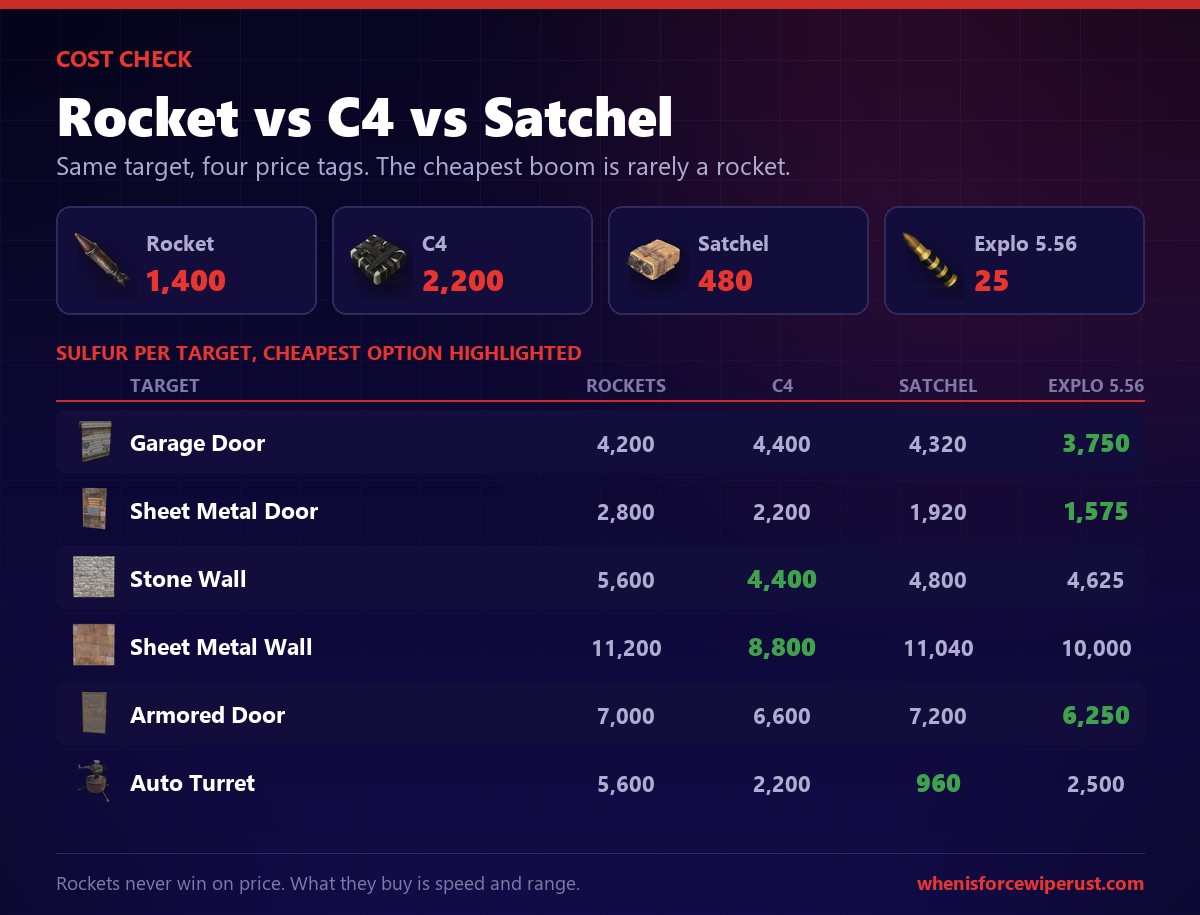
The per unit prices tell you why. A rocket is 1,400 sulfur, C4 is 2,200, a satchel is 480 and a single explosive 5.56 round is 25. Because C4 does so much more damage per charge, it usually wins on walls even at the higher unit price, and explosive ammo wins on almost everything if you have the patience for it.
| Target | Rockets | C4 | Satchels | Explo 5.56 |
|---|---|---|---|---|
| Sheet Metal Door | 2 (2,800) | 1 (2,200) | 4 (1,920) | 63 (1,575) |
| Garage Door | 3 (4,200) | 2 (4,400) | 9 (4,320) | 150 (3,750) |
| Armored Door | 5 (7,000) | 3 (6,600) | 15 (7,200) | 250 (6,250) |
| Stone Wall | 4 (5,600) | 2 (4,400) | 10 (4,800) | 185 (4,625) |
| Sheet Metal Wall | 8 (11,200) | 4 (8,800) | 23 (11,040) | 400 (10,000) |
| Auto Turret | 4 (5,600) | 1 (2,200) | 2 (960) | 100 (2,500) |
So why does anyone use rockets at all? Three reasons, and none of them are on that table.
Speed. A rocket does its damage the instant you pull the trigger. C4 has to be walked up to the wall, placed, and armed, and satchels have a fuse that can be shot or simply fail. In a contested raid where the owners are online and coming home, five seconds of exposure versus thirty is worth more than a few thousand sulfur.
Range. You can fire rockets from outside turret range, from a neighbouring rooftop, or from behind cover. Every other explosive requires you to physically touch the base.
Splash. A rocket damages everything near the impact point, up to about four building blocks at once. Fire into the seam where two walls and a floor meet and you are spreading damage across all three. C4 damages what you stuck it to.
Every Rocket Type in Rust
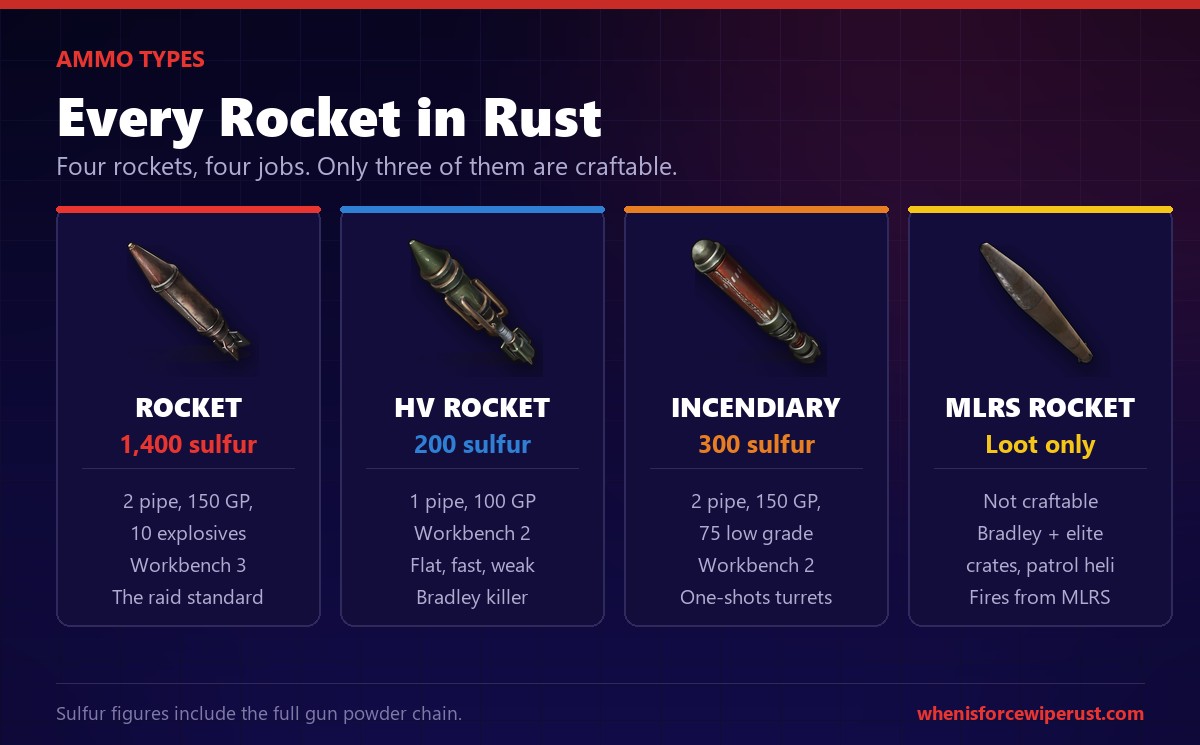
There are four. Three you can craft, one you can only loot, and they are not interchangeable.
Rocket
The standard. 2 Metal Pipe, 150 Gun Powder, 10 Explosives at Workbench 3, for 1,400 sulfur. It is the only rocket type with enough raw damage to be worth firing at a wall, and everything in the raid chart above assumes this one. If someone says “rockets” without qualifying it, this is what they mean.
High Velocity Rocket
1 Metal Pipe and 100 Gun Powder at a Workbench 2, for 200 sulfur. Seven times cheaper than a standard rocket, and it flies faster and much flatter, which makes it far easier to land at range.
The catch is damage. HV rockets do meaningfully less than standard rockets, so using them on building blocks is a false economy. Where they shine is anything with a flat health pool and no explosive resistance: vehicles, the Bradley APC, scientists, and players who thought a rooftop was cover. Think of the HV rocket as a sniper round, not a raiding tool. The full numbers for every target are in our HV rocket guide.
Incendiary Rocket
2 Metal Pipe, 150 Gun Powder and 75 Low Grade Fuel at a Workbench 2, for 300 sulfur. It does almost no impact damage and instead coats the area in fire.
This is the most underrated item in the entire rocket family, for one reason: a single incendiary rocket destroys an auto turret. Four standard rockets on the same turret cost 5,600 sulfur. The incendiary costs 300. If a base has turrets on the outside, incendiaries are how you strip them before the real raid starts. They are also genuinely nasty against wooden structures and against anyone hiding in a room you can shoot into.
MLRS Rocket
Not craftable at any workbench. MLRS rockets only come from loot, mainly Bradley APC crates, with occasional single drops from elite crates and the Patrol Helicopter. They are ammunition for the MLRS truck parked at the Abandoned Military Base in the desert biome.
To fire it you load between 1 and 12 MLRS rockets plus one MLRS Aiming Module, which is consumed by the barrage and only comes from locked crates. You mark a target on the map, the truck fires a salvo at it, and the MLRS then locks itself down for about 20 minutes. Maximum range is roughly 20 grid squares, so it cannot hit the entire map from one spot.
Rockets Against Bradley and Auto Turrets
Two targets deserve their own section because the obvious answer is the expensive one.
The Bradley APC has 1,000 HP. Killing it with standard rockets takes about 11 of them, which is 15,400 sulfur for a monument boss. Killing it with 7 HV rockets costs 1,400 sulfur, the price of a single standard rocket. HV rockets are the correct answer to Bradley and it is not close. Three C4 also works at 6,600 sulfur and is much faster to apply if you can get close safely.
One detail that catches people out: Bradley heals back to full if it goes about five minutes without taking damage. Half killing it and coming back later does not work. Commit or do not start.
Auto turrets have 1,000 HP and no explosive resistance worth worrying about. One incendiary rocket at 300 sulfur kills one. Four standard rockets at 5,600 sulfur also kills one. There is no version of this where the standard rocket is the right choice, and yet it is what most players reach for because it is what is in the launcher.
How to Actually Fire a Rocket
Rockets are unguided and affected by gravity, which surprises players used to hitscan weapons.
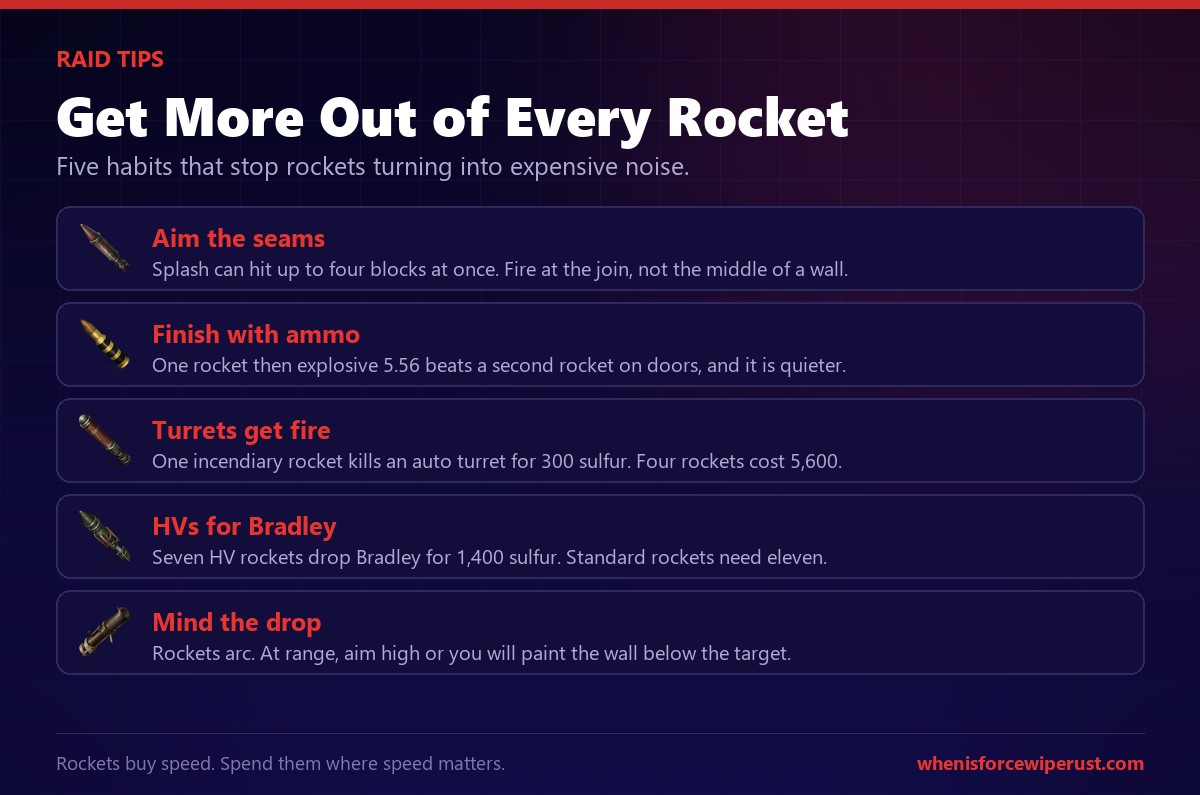
- Get close if you can. Rocket drop is negligible inside about fifteen metres and severe past thirty. Most missed rockets are missed because the shooter was being careful about their own safety and paid for it in sulfur.
- Aim at seams, not centres. Splash reaches roughly four building blocks. A rocket into the corner where two walls meet a floor spreads damage across all of them. A rocket into the middle of one wall damages one wall.
- Aim high at range. The rocket arcs. If you put the crosshair exactly on a distant door you will hit the wall underneath it.
- Check your line. Rockets detonate on the first thing they touch. Tree branches, window bars, your own teammate’s head. Step out properly before firing.
- Reload before you need to. The launcher holds one rocket and the reload is slow. Never walk around a corner on an empty tube.
There is also a well known hybrid that saves real sulfur on doors. Fire one rocket, then finish with explosive 5.56. Two rockets on a sheet metal door is 2,800 sulfur. One rocket plus roughly 30 explosive rounds to finish the job lands nearer 2,200, and the rifle is far quieter than a second rocket. On a sheet metal door specifically this is close to the optimal play if you already own an assault rifle.
Rocket Myths and Common Mistakes
Myth: rockets are the cheapest raiding explosive. They are not, and it is not close. Explosive ammo, satchels and C4 all beat rockets on sulfur for most targets. Rockets buy speed and range, not savings.
Myth: HV rockets are a cheaper way to raid. They are cheaper per rocket and worse per sulfur against building blocks. Use them on Bradley, vehicles and people. Do not use them on walls.
Myth: you can craft MLRS rockets. You cannot. There is no recipe at any workbench. They are loot only, and so is the aiming module they need.
Mistake: firing your first rocket instead of researching it. Sixty scrap converts one found rocket into unlimited rockets for the rest of the wipe. Firing it converts it into one hole.
Mistake: rocketing walls when doors exist. Doors cost far fewer rockets per unit of progress. Follow the doorways.
Mistake: not scouting the tool cupboard first. A tool cupboard has 100 HP and dies to one rocket. If you can get eyes on where it sits before you start, you can often end a raid in three shots instead of eight.
Mistake: raiding without spare rockets. Bringing exactly eight rockets for a sheet metal wall assumes nothing goes wrong. One misfire into a tree and you are standing outside a half broken base with an empty launcher, which is the worst position in Rust.
Stockpiling sulfur for a rocket raid? Every rocket you have not fired turns to dust when the map resets. Check the live force wipe countdown before you commit a wipe’s worth of farming.
Force Wipe CountdownPro Tips for Rocket Raids
- Strip turrets with incendiaries first. 300 sulfur per turret instead of 5,600. Do this before anyone knows you are there and the rest of the raid gets much calmer.
- Carry the launcher, split the rockets. Rockets stack to three. Spread them across the team so one death does not end the raid, and keep the launcher on whoever is least likely to push.
- Rocket the roof, not the door. Many bases stack their strongest walls at ground level and leave weaker blocks up top. A ladder and two rockets into a roof often beats eight into a front wall.
- Never fire the last rocket blind. If you are one rocket from opening a wall, confirm the wall is actually the last layer. Honeycomb exists specifically to eat that shot.
- Time it around the wipe. Nobody has 14,000 sulfur on day one and everyone has armored walls by day ten. The rocket sweet spot is the middle of a wipe, when bases are worth raiding and still made of sheet metal.
- Farm charcoal in advance. Sulfur gets all the attention, but 1,950 charcoal per rocket means your furnaces need to be running long before your raid night.
- Bring a repair bench plan. Launchers wear down. On a long raiding wipe, budget for repairs or a second launcher.
Rust Rocket FAQ
How much sulfur is a rocket in Rust?
What is the rocket recipe in Rust?
How many rockets for a sheet metal wall?
How many rockets for a stone wall?
How many rockets for a garage door?
How many rockets for an armored door?
How do you get the rocket blueprint in Rust?
How do you get a rocket launcher in Rust?
How many HV rockets for Bradley?
How many rockets for an auto turret?
Are rockets or C4 better in Rust?
Can you craft MLRS rockets in Rust?
Do rockets stack in Rust?
Do rockets carry over a wipe?
Final Thoughts
The rocket is the most misunderstood item in Rust because its cost and its purpose point in different directions. On paper it is a bad deal: 1,400 sulfur to do less damage than a C4 that costs 2,200. In practice it is the only explosive that lets you damage a base without standing next to it, and on a server full of people who would very much like to catch you standing next to a base, that is worth paying for.
Farm the sulfur, research the blueprint the first chance you get, strip the turrets with incendiaries, follow the doorways instead of the walls, and keep a spare rocket for the shot that goes wrong. Do that and rockets stop being the thing you save forever and start being the thing that ends wipes.
Sources
- Crafting recipes, blueprint and tech tree costs, stack sizes: RustHelp, Rocket, Rocket Launcher, High Velocity Rocket and Incendiary Rocket
- Raw material breakdown per rocket: GameRant, How To Craft Every Type Of Rocket Ammo
- Raid costs, soft side values and explosive comparisons: Rustly Raid Calculator and Rustly, Bradley APC Raid Cost
- Splash damage behaviour and building grade rocket counts: Facepunch Rust Wiki, Rocket
- Rocket and launcher loot sources: BisectHosting, Rust Rocket Farming Guide
- MLRS location, range, capacity and cooldown: Corrosion Hour, RUST MLRS Guide
- The game itself: Facepunch Studios