
The Rust furnace is the first real workbench of your wipe. Ore you mine is useless until you cook it, and the furnace is what turns raw metal ore into metal fragments, sulfur ore into sulfur, and high quality metal ore into the HQM that armour, guns and end game builds run on. Every base has at least one, and the good ones have a wall of them.
There are three furnaces to choose from, and picking the right one saves you a mountain of wood and time. The standard furnace is free and known by default, the Large Furnace smelts 5,000 ore in a single load, and the Electric Furnace ditches wood entirely and runs on power. They all smelt the same ores, but the cost, the speed and the fuel are wildly different.
This guide covers all three: exact craft costs, how to get each one, the smelting rates per minute, the charcoal and wood math that decides how efficient you are, how much power the electric furnace needs and how to wire it, and how the August 2026 Power Trip update fits in. Every number here is checked against the Facepunch wiki, RustHelp, RustClash and Corrosion Hour, not guessed.
- What It Is
- Furnace Stats
- The Three Types
- How to Get One
- Smelting Rates
- Wood & Charcoal
- Large Furnace
- Electric Furnace
- Power & Wiring
- Power Trip Update
- Which Is Best
- Skins
- Pro Tips
- FAQ
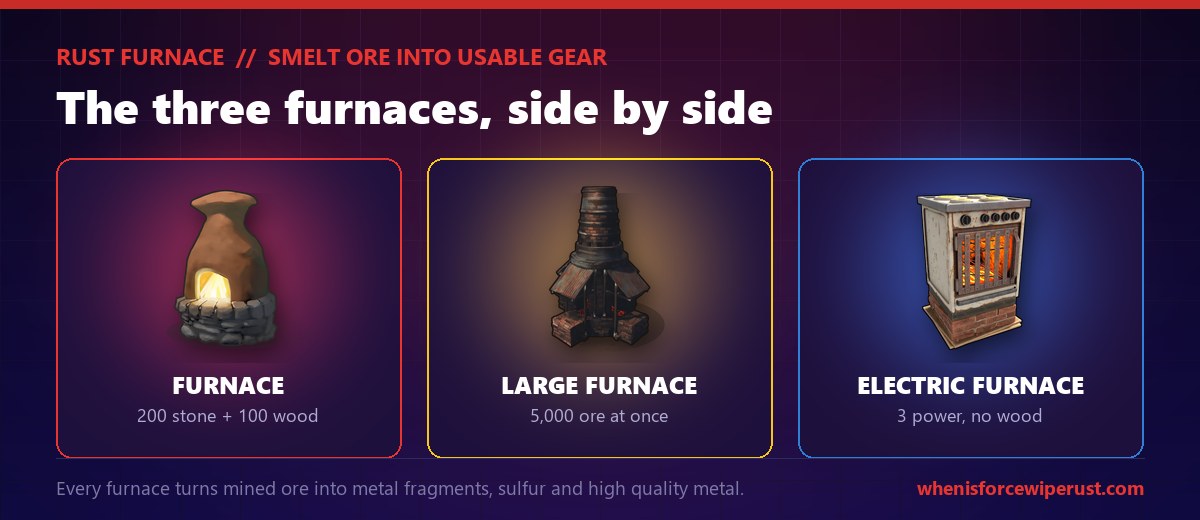
What Is a Furnace in Rust?
A furnace is a deployable that smelts mined ore into usable materials. You drop ore into it, add wood as fuel (or power, for the electric version), and it slowly converts the ore. Metal ore becomes metal fragments, sulfur ore becomes sulfur, and high quality metal ore becomes high quality metal. Without a furnace, every rock you break is dead weight, so it is one of the very first things you build on a fresh spawn.
The standard furnace is known by default, which means you can craft it the moment you have the materials, no research and no workbench required. That makes it the backbone of early game progression: mine nodes, smelt the ore, and turn it into the fragments you need for tools, walls and your first workbench. As you tech up you unlock the Large Furnace for bulk smelting and the Electric Furnace for automation, but the humble stone furnace never really leaves your base.
One thing to know before you place any of them: a furnace cannot be picked back up once deployed. If you want to move it, you have to destroy it and craft a new one, so think about placement before you commit. Put your furnaces somewhere sealed and defensible, because a smelting furnace glows and gives off light that can reveal a base at night.
Rust Furnace Stats and Facts
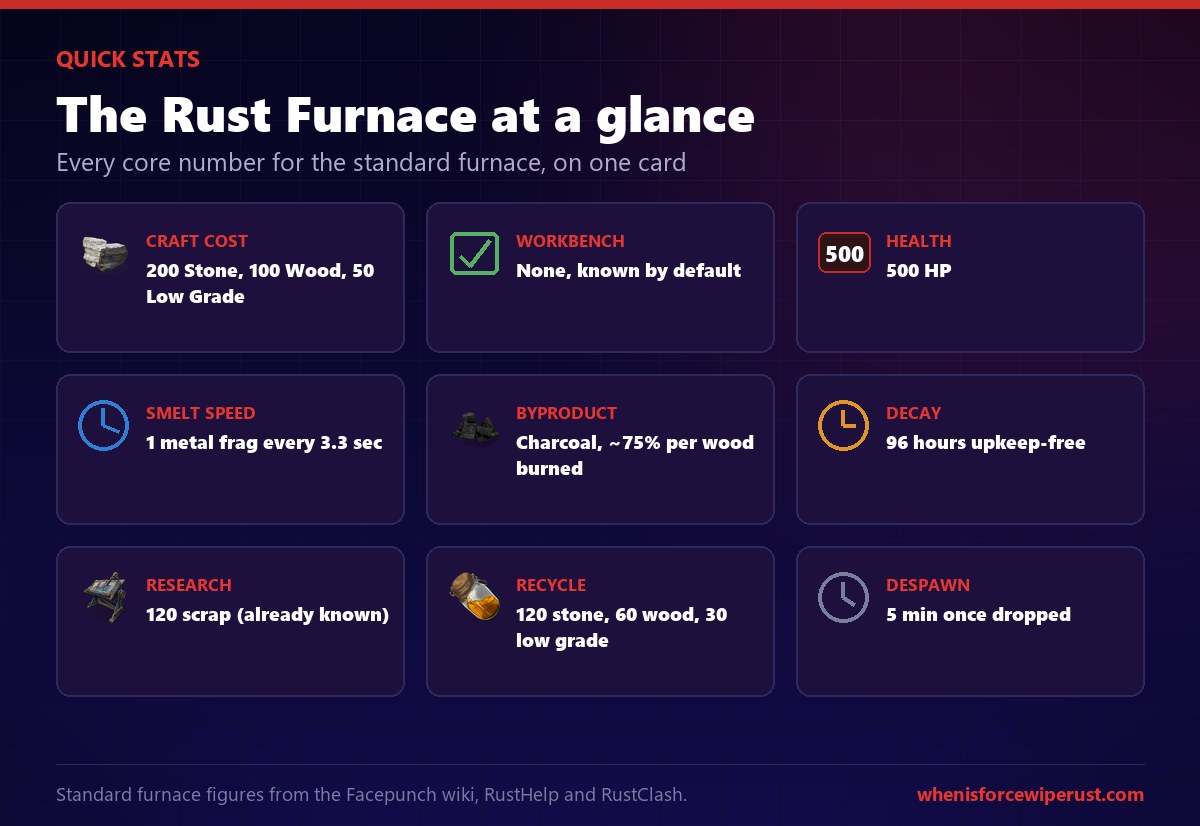
Here is the standard furnace in one table, pulled from the Facepunch wiki and cross checked against RustHelp and RustClash.
| Stat | Value |
|---|---|
| Craft cost | 200 Stone, 100 Wood, 50 Low Grade Fuel |
| Workbench | None, known by default |
| Craft time | 30s by hand, 7s at Workbench 2+ |
| Health | 500 HP |
| Decay | 96 hours (indoors, upkeep free) |
| Smelt speed | 1 metal fragment every 3.3 seconds |
| Charcoal | About 75% chance per wood burned |
| Research table | 120 scrap (irrelevant, already known) |
| Recycle | 120 Stone, 60 Wood, 30 Low Grade Fuel |
| Pick up | No, must destroy to move |
| Shortname | furnace |
Two numbers matter most here. The furnace is known by default, so nobody ever needs to research it, and it recycles for exactly 60% of its cost, which is worth knowing if you ever want the stone and low grade back. Everything else is about how fast and how efficiently it turns ore into gear, which is where the type you pick starts to matter.
The Three Types of Furnace
Rust has three furnaces, and they are not simply small, medium and large. Each one trades something. The standard furnace is free but wood hungry, the large furnace is efficient but a pain to protect, and the electric furnace is hands off but makes no charcoal. Here is the quick comparison.
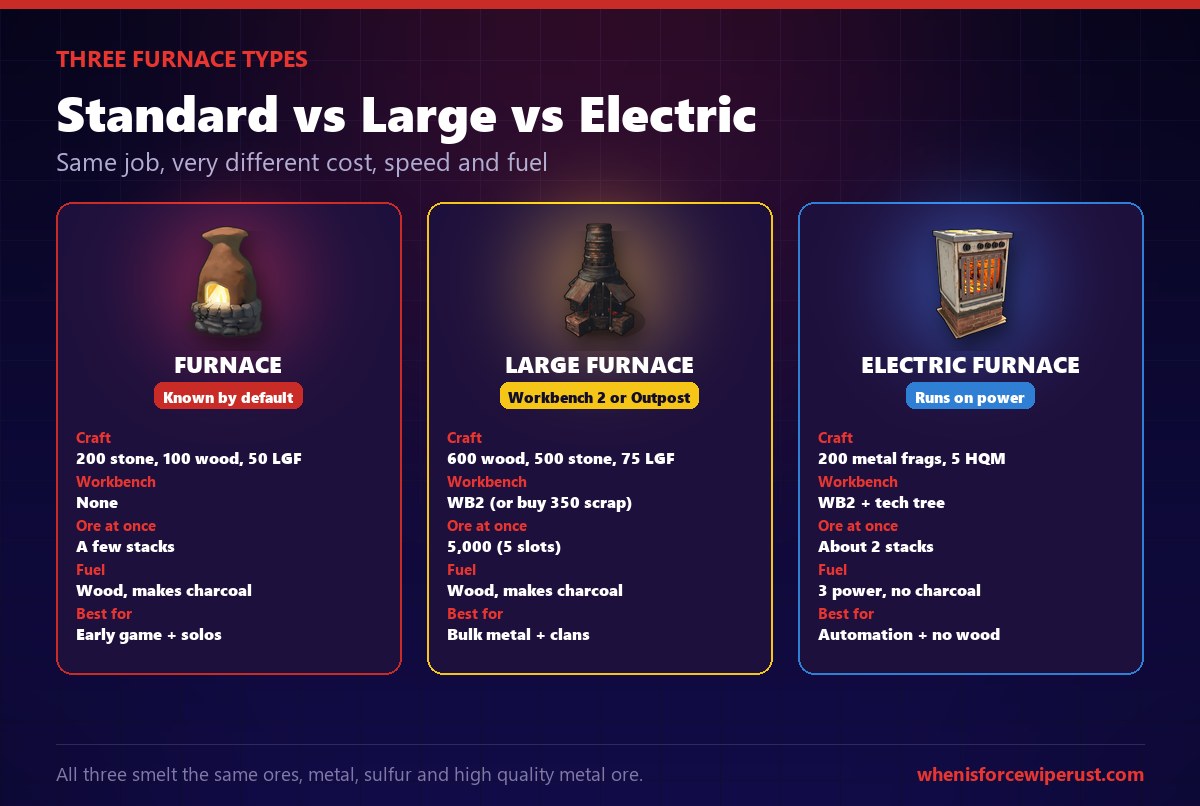
| Furnace | Craft | Capacity | Fuel | Charcoal |
|---|---|---|---|---|
| Furnace | 200 stone, 100 wood, 50 LGF | A few stacks | Wood | Yes |
| Large Furnace | 600 wood, 500 stone, 75 LGF (WB2) | 5,000 ore (5 slots) | Wood | Yes |
| Electric Furnace | 200 metal frags, 5 HQM (WB2) | About 2 stacks | 3 power | No |
The short version: the standard furnace is your default workhorse and your charcoal source. The large furnace is the bulk metal machine for when you are melting thousands of ore at a time. The electric furnace is the automation option that never needs wood, which is perfect for a wired base, as long as you have another source of charcoal. We break each one down in its own section below.
How to Get a Furnace in Rust
Getting your first furnace is the easy part. Getting the big ones takes a little tech or a trip to Outpost. Here is how you get each one.
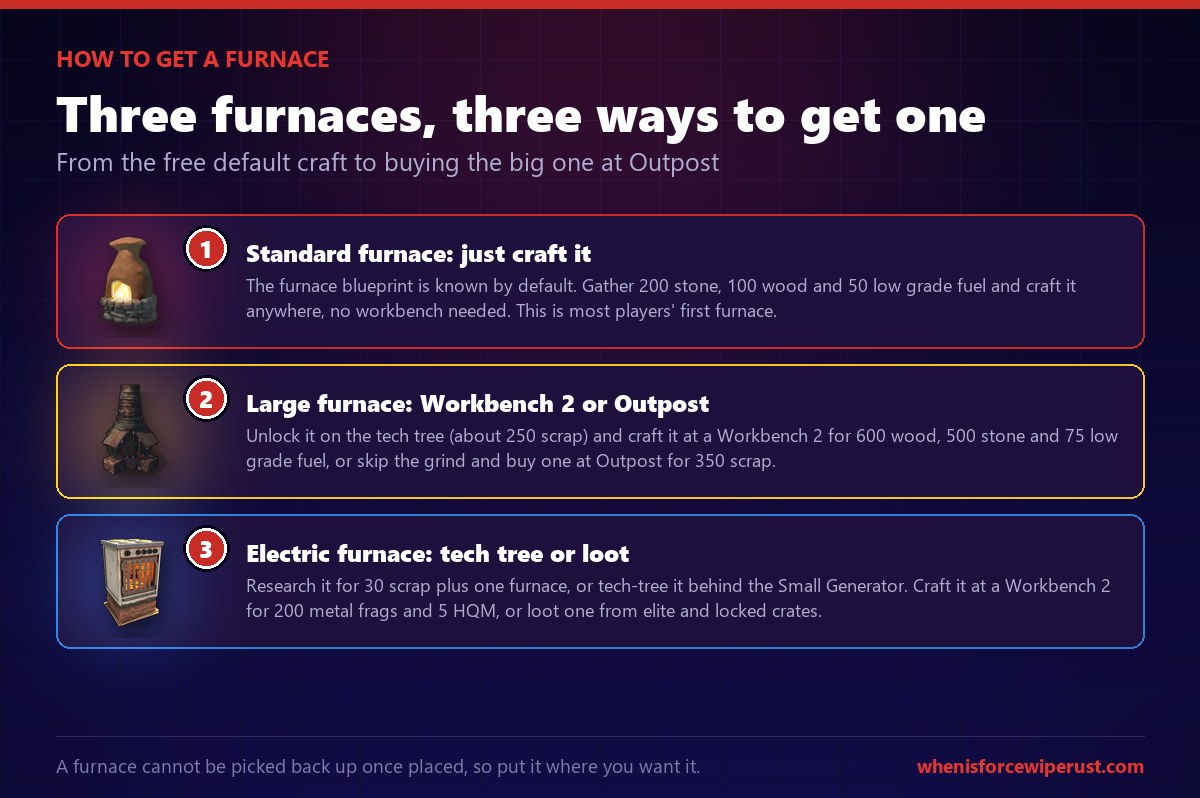
- Standard furnace, just craft it. The blueprint is known by default. Gather 200 stone, 100 wood and 50 low grade fuel, open your crafting menu, and make it anywhere. No workbench needed. This is almost every player’s first furnace.
- Large furnace, Workbench 2 or Outpost. Unlock it on the tech tree (about 390 scrap for the full path) or research it for 60 scrap, then craft it at a Workbench 2 for 600 wood, 500 stone and 75 low grade fuel. Short on time? Buy a finished one at Outpost for 350 scrap.
- Electric furnace, tech tree or loot. Research it for 30 scrap plus a furnace, or unlock it on the tech tree behind the Small Generator. Craft it at a Workbench 2 for 200 metal fragments and 5 HQM. You can also loot one from elite and locked crates if you get lucky.
Smelting Rates: How Fast Each Furnace Smelts
This is the number most guides skip, and it is the one that actually decides how long you stand around waiting. Every furnace smelts each ore at a fixed rate. The large furnace looks five times faster only because it runs five ore slots at once, so its per minute output is the total across all slots.
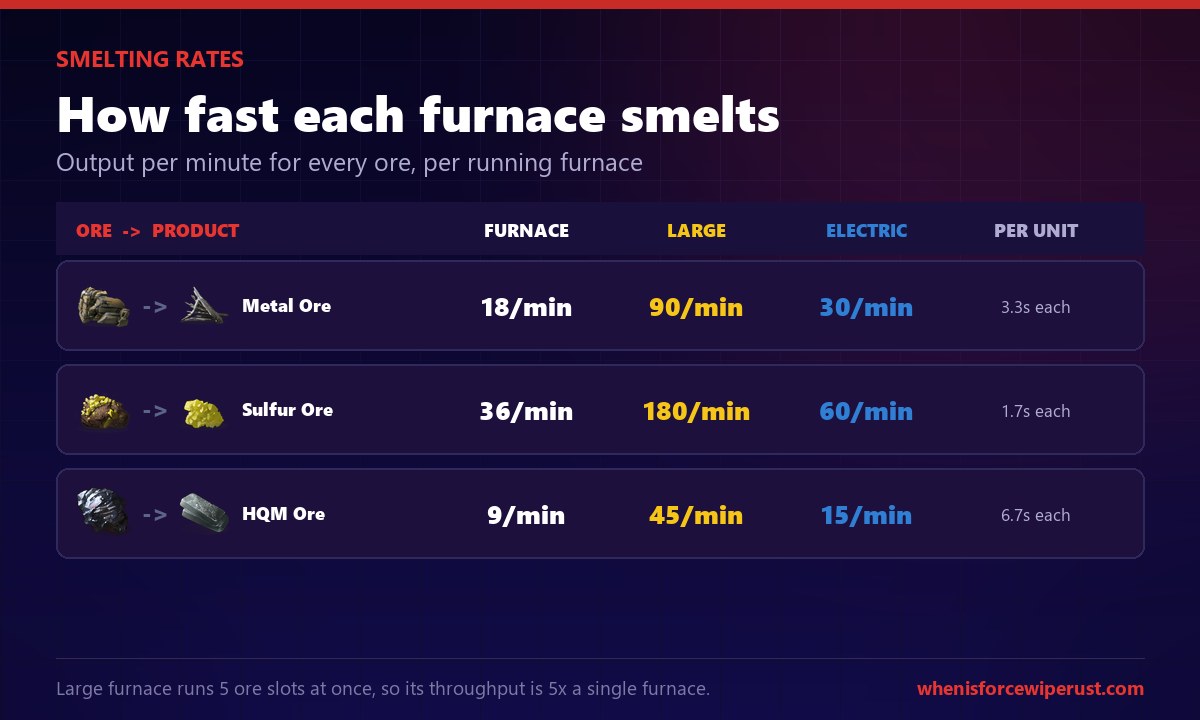
| Ore → Product | Furnace | Large Furnace | Electric Furnace |
|---|---|---|---|
| Metal Ore → Fragments | 18 / min | 90 / min | 30 / min |
| Sulfur Ore → Sulfur | 36 / min | 180 / min | 60 / min |
| HQM Ore → HQM | 9 / min | 45 / min | 15 / min |
| Time per unit (metal) | 3.3 sec | 3.3 sec per slot | 2.0 sec |
Notice that sulfur smelts twice as fast as metal, and HQM is the slowest by far. That is why players who are raiding stockpile sulfur ore and melt it in bulk, and why HQM always feels like it takes forever. If you are gathering ore quickly with a jackhammer or an ore tea boost, a single standard furnace will fall behind fast, which is the moment to build more furnaces or step up to a large one.
Wood, Charcoal and Why Your Furnace Is a Charcoal Factory
Burning wood does two jobs. It smelts your ore, and it drops charcoal as a byproduct. Charcoal is the bulk ingredient in gunpowder, and gunpowder is the base of every explosive in the game, so your furnace is quietly one of the most important raiding tools you own.
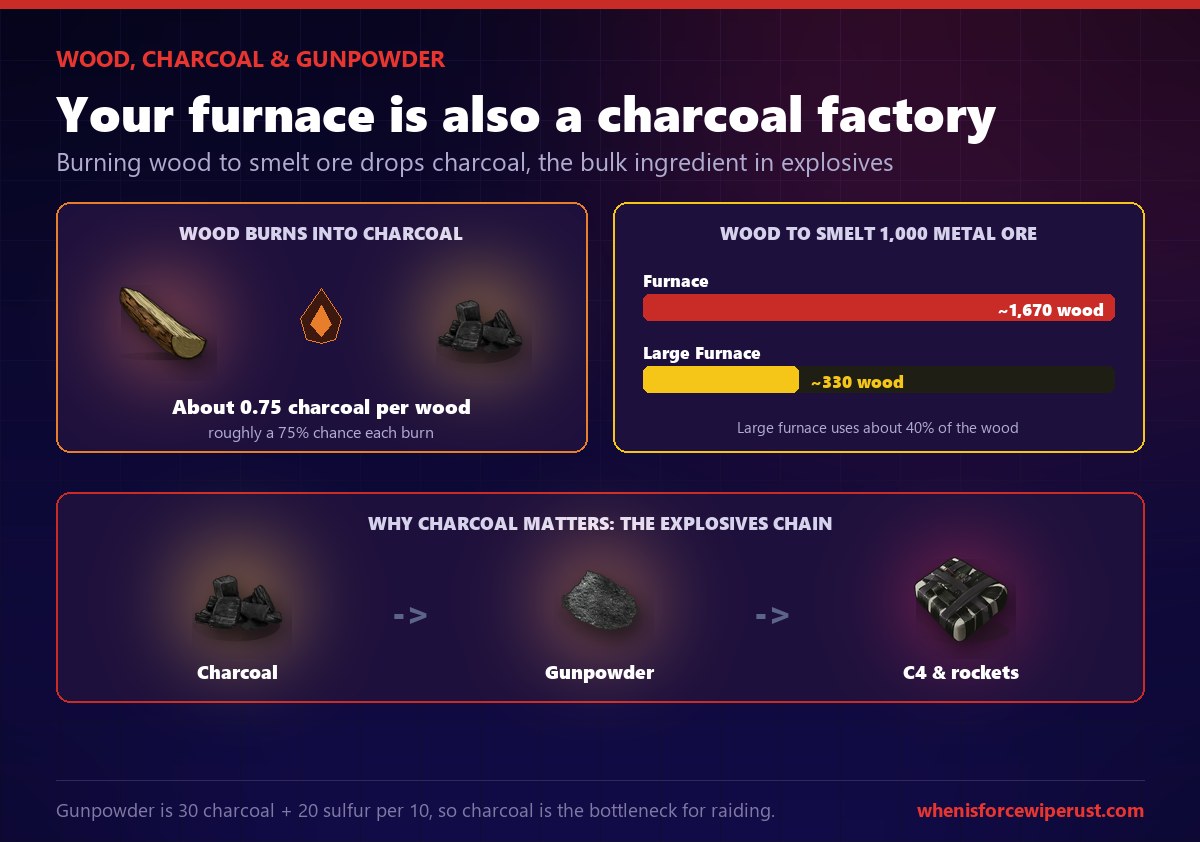
Every piece of wood you burn has roughly a 75% chance to leave a charcoal behind, so figure on about 0.75 charcoal per wood. That means you almost never need to farm charcoal on purpose. If you are smelting ore, you are already stacking charcoal at the same time. If you specifically want a pile of it, the fastest way is to fill a furnace (or several) with nothing but wood and let it burn, or use a large furnace since it chews through the most wood.
Wood efficiency is where the large furnace pulls ahead. Because five ore slots share one fire, it wastes far less wood per bar. Smelting 1,000 metal ore costs about 1,670 wood in a standard furnace, but only around 330 wood in a large furnace, roughly 40% of the wood for the same result. Over a wipe that is thousands of trees saved.
Once you have charcoal, the chain is simple: charcoal plus sulfur makes gunpowder (30 charcoal and 20 sulfur per 10 gunpowder), and gunpowder makes everything from ammo to C4 and rockets. If you want to know exactly how much of each you need for a raid, our raid cost calculator does the math for you.
The Large Furnace: Bulk Smelting for Clans
The Large Furnace is the upgrade you build when a single furnace can no longer keep up. It has five ore slots that smelt at the same per unit speed as a standard furnace, so its throughput is roughly five times higher, and it is far more wood efficient because that one central fire heats every slot. For the full breakdown, see our dedicated Large Furnace Rust guide.
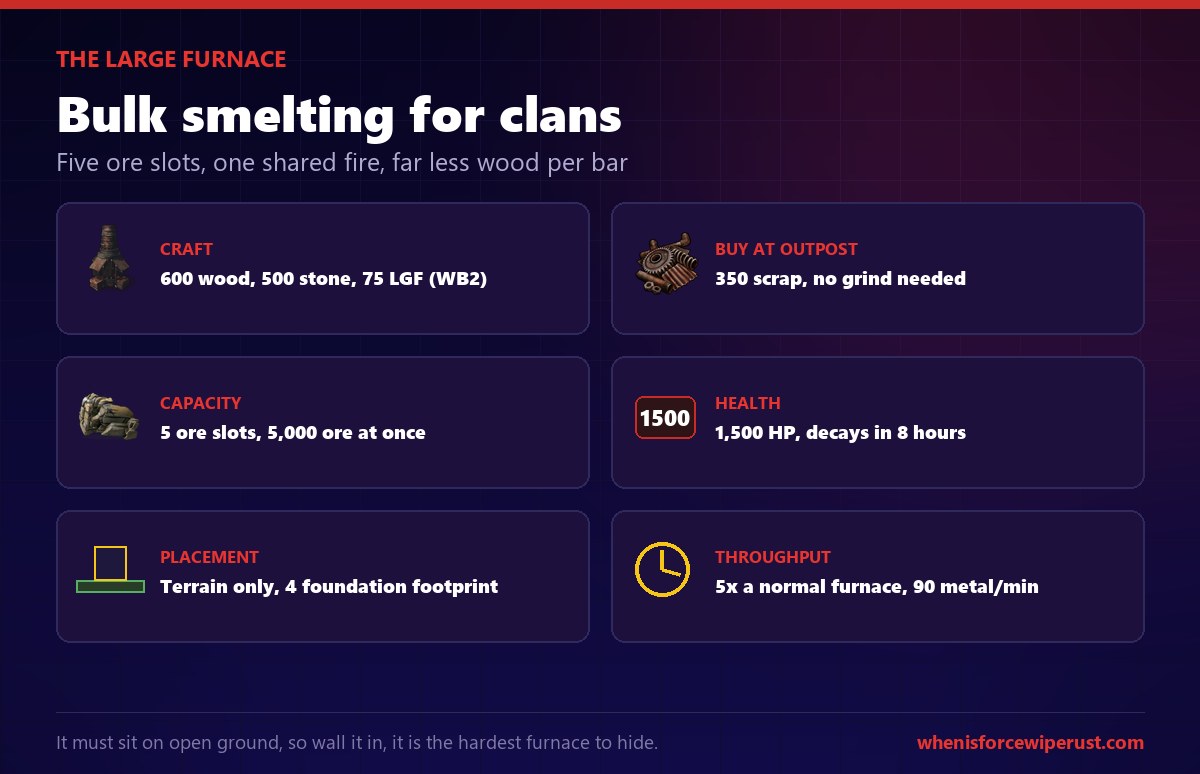
It holds 5,000 ore at once across five input slots, plus two stacks of wood (up to 2,000) for fuel, and five output slots that fill with your finished product and charcoal. At 1,500 HP it is tougher than a standard furnace too. The catch is placement: the large furnace must sit on open terrain, it cannot go on foundations or floors, and it takes up a four foundation footprint. That makes it the hardest furnace to hide, so smart bases wall it into a dedicated smelting room built around it.
If you do not want to grind the tech tree, you can buy a finished large furnace at Outpost for 350 scrap. That is often the fastest route on a fresh wipe when you have scrap from monument runs but have not unlocked the blueprint yet. Recycle it later for 360 wood, 300 stone and 45 low grade if you ever want the materials back.
The Electric Furnace: Smelt With Power, Not Wood
The Electric Furnace is the modern option, and it changes how a main base smelts. Instead of wood, it runs on electricity, drawing a tiny 3 power from your grid. That means no more hauling wood, no fire to feed, and it smelts about 5 to 3 faster than a standard furnace. The trade off is real though: it produces no charcoal at all.
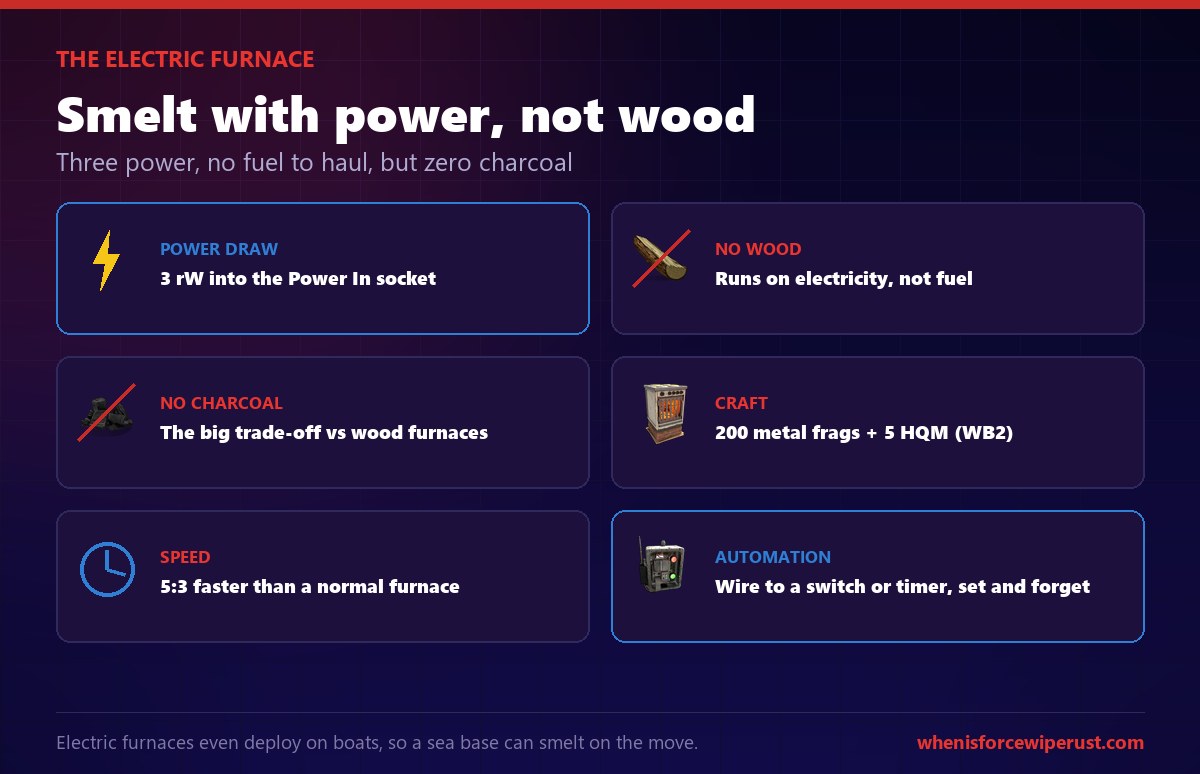
You craft it at a Workbench 2 for 200 metal fragments and 5 HQM, and it has 500 HP like the standard furnace. Because it is a wired deployable, you can hook it up to a switch or a timer and automate your smelting completely, turning it on and off without touching it. It even deploys on boats, so a sea base can smelt on the move.
The no charcoal drawback is the whole reason wood furnaces do not disappear. If you go all electric, you cut off your charcoal supply and therefore your gunpowder, so most bases run a mix: electric furnaces for the metal and sulfur you smelt constantly, plus a couple of standard furnaces burning wood whenever you need to top up charcoal for a raid.
How Much Power Does an Electric Furnace Use, and How to Wire It
The most searched electric furnace question is simple to answer: an electric furnace uses 3 power (3 rW). That is tiny, which is what makes it so appealing. A basic solar setup can run several at once during the day.
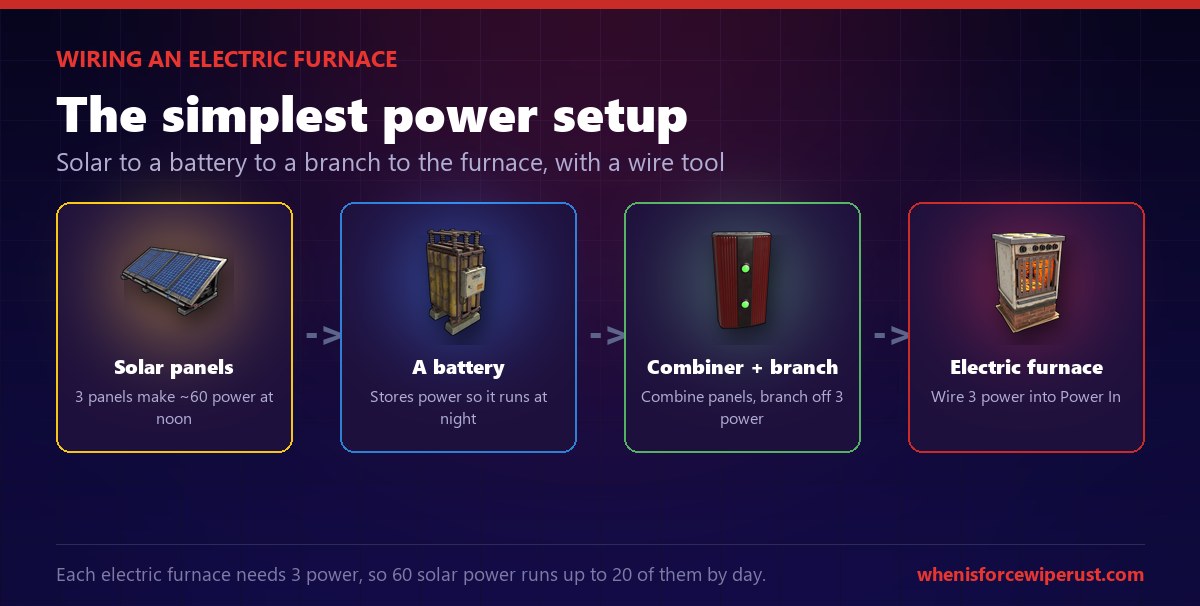
The simplest reliable setup is three large solar panels, a rechargeable battery, a root combiner, an electrical branch and a wire tool. Three panels make about 60 power at midday, which is enough to run up to 20 electric furnaces at once while the sun is up. Solar drops to zero at night, so you run it through a battery that charges by day and keeps your furnace smelting after dark.
- Place your solar panels on a roof, angled at the sky, and run their outputs into a root combiner to merge them into one line.
- Feed that line into a battery (medium or large) so it stores power for the night.
- Run the battery’s output to an electrical branch and set the branch to pass 3 power down the branch line.
- Wire that 3 power into the furnace’s Power In socket with the wire tool. Add a smart switch or timer in the line if you want to automate it.
Electric Furnaces and the August 2026 Power Trip Update
The big update of the moment is Power Trip, which landed on 6 August 2026 as the August force wipe. It is worth clearing up what it did and did not change for furnaces, because the two topics get tangled together.
Power Trip did not change how the electric furnace works. It still draws 3 power, still makes no charcoal, and still wires up exactly the same way in your base. What the update did do is make electricity a much bigger deal across the whole map. It rebuilt the Power Plant into a server wide power grid fed by Heavy Fuses, added climbable powerlines with roadside transformers, and gated new monument perks and even a satellite crash event behind how much power the plant is running.
So if you came here after the update wondering whether your electric furnace setup needs changing, it does not. Your base electricity still comes from your own solar panels, batteries and generators, exactly as before. The Power Trip changes are about monument power, not your smelting room. If you want the full breakdown of the new grid, Heavy Fuses and the four power phases, that is all in our dedicated Power Plant guide.
Which Furnace Is Best in Rust?
There is no single best furnace. The right one depends on where you are in the wipe and what you are smelting. Here is the honest breakdown.
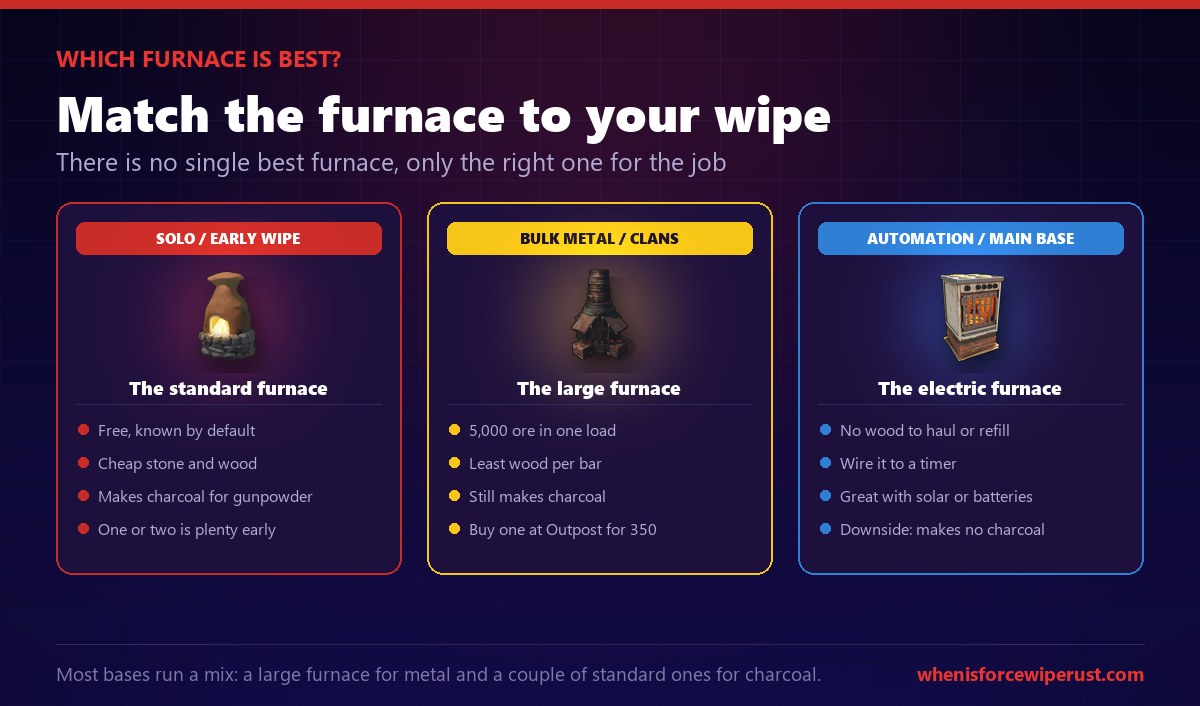
- Solo or early wipe: the standard furnace wins. It is free, known by default, cheap to build, and it makes the charcoal you need for gunpowder. One or two is plenty until you tech up.
- Bulk metal or a clan: the large furnace wins. 5,000 ore per load and the least wood per bar make it the efficient choice when you are melting thousands of ore, and you can buy one at Outpost to skip the grind.
- Automation or a main base: the electric furnace wins. No wood to haul, wire it to a timer and forget it, ideal with a solar and battery setup. Just keep a wood furnace around for charcoal.
In practice, a well built base runs all three: a couple of standard furnaces for charcoal, a large furnace for bulk metal ore, and a bank of electric furnaces wired to solar for constant hands off smelting. You do not have to pick one and stick with it.
Built a whole furnace wall this wipe? Every furnace, all your smelted metal and your entire base reset on the force wipe. Check the countdown before you sink hours into a smelting setup.
Force Wipe CountdownRust Furnace Skins
The furnace has a handful of workshop skins that change how it looks, and that is all they do. Furnace skins are purely cosmetic, so they do not smelt faster, hold more ore or change any stat. Pick whichever one you like the look of, or run the default, it makes no difference to performance. The same goes for large furnace and electric furnace skins where they exist.
Pro Tips for Furnaces in Rust
- Place before you commit. A furnace cannot be picked back up, so put it in a sealed room, not out in the open where its glow reveals your base.
- Do not overload wood. In a standard furnace, add roughly the wood the ore needs, or leftover wood keeps burning and wastes fuel.
- Use a large furnace for bulk. It burns about 40% of the wood a standard furnace does for the same metal, and holds 5,000 ore at once.
- Buy the large furnace at Outpost for 350 scrap if you have not unlocked it yet, then recycle it later for the materials if you want.
- Wall in your large furnace. It sits on terrain and decays in about 8 hours, so protect it and keep it in tool cupboard range.
- Run a mix. Electric furnaces for constant smelting, wood furnaces for charcoal. Going all electric cuts off your gunpowder supply.
- Split stacks for parallel smelting. Splitting ore into more slots lets more of it smelt at once in the standard furnace, which finishes a big batch sooner.
- Keep low grade fuel stocked. Every furnace recipe needs it, and running out is the most common reason new players cannot build one.
Rust Furnace FAQ
How do you make a furnace in Rust?
How do you get a furnace in Rust?
What is the best furnace in Rust?
How much power does an electric furnace use in Rust?
How many solar panels do you need to power an electric furnace?
Does the electric furnace make charcoal in Rust?
What is the best fuel for a furnace in Rust?
How do you get charcoal in Rust?
What is the fastest way to get charcoal in Rust?
Can you pick up a furnace or large furnace in Rust?
How much does a large furnace cost at Outpost?
Is the electric furnace better than the large furnace?
How long does a furnace take to smelt ore in Rust?
Can you put a furnace on a foundation in Rust?
Do furnace skins change smelting speed in Rust?
Did the Power Trip update change furnaces in Rust?
Final Thoughts
The furnace is one of those items you build without thinking on wipe day and then never stop using. The standard Rust furnace gets you off the ground and keeps you in charcoal, the large furnace turns bulk ore into bulk metal for a fraction of the wood, and the electric furnace lets a wired base smelt around the clock without anyone hauling logs. Learn the smelting rates and the wood math and you stop wasting trees and time.
If you take one habit away, make it running a mix. A couple of wood furnaces for charcoal, a large furnace for metal, and electric furnaces on a solar line is the setup most established bases converge on, and it covers every job at once. And remember the charcoal your furnace makes is the same charcoal that becomes gunpowder, so your smelting room is also your explosives supply.
Just keep the wipe clock in mind. Every furnace, all that smelted metal and the whole base go back to nothing on the force wipe, so check the countdown before you commit a wipe’s worth of ore to a smelting wall.
Sources
- Standard furnace craft cost, shortname, recycle output and that the blueprint is known by default: Facepunch Wiki, Furnace
- Electric furnace 3 power draw, craft cost, no fuel description and item data: Facepunch Wiki, Electric Furnace
- Smelting rates per furnace, large furnace 5,000 ore capacity and charcoal output, HP and decay figures: Corrosion Hour, Cooking, Smelting & Refining Guide
- The Power Trip power grid update, Heavy Fuses and the map wide electricity changes: Facepunch, Power Trip Update
- Full Power Plant grid, phases and Heavy Fuses, plus the satellite crash it unlocks: whenisforcewiperust.com, Rust Power Plant Guide
- The game itself: Facepunch Studios