
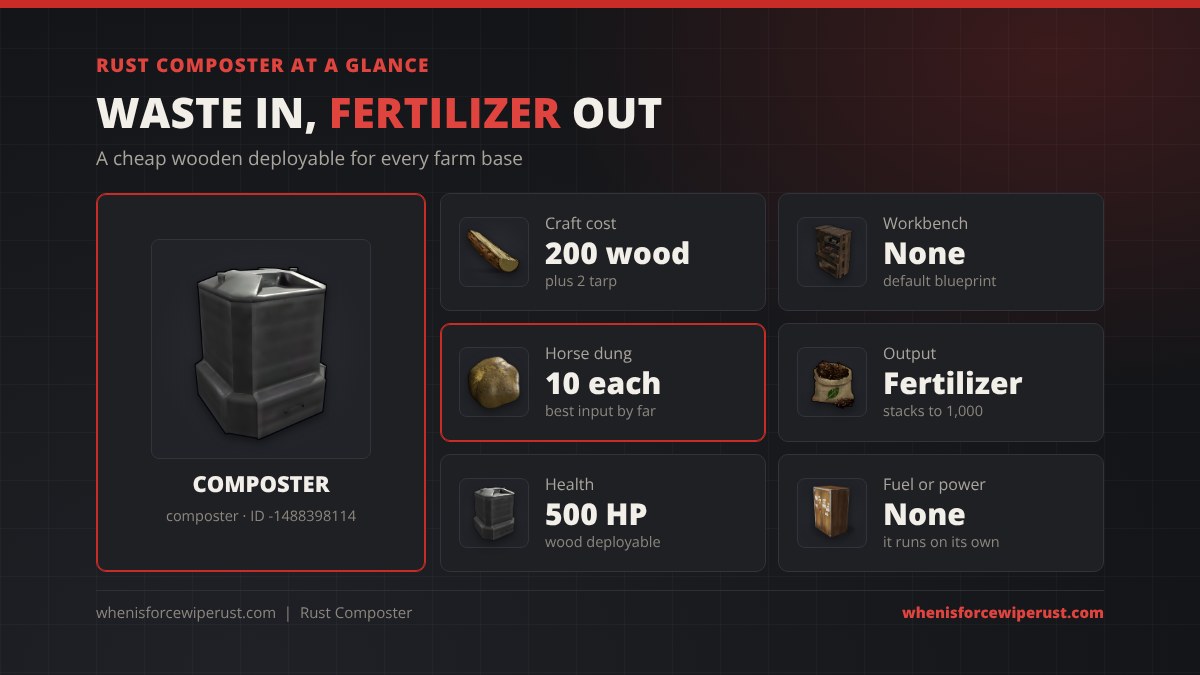
The Composter is the machine that turns your farm’s waste into fertilizer. Horse dung, spare crops, fish and plant fiber go in, and fertilizer comes out to keep your planter boxes at full yield. It costs almost nothing to build and it runs without fuel or power.
This Composter Rust guide covers how to craft one, exactly what you can put in it and how much fertilizer each item gives, how long composting takes, how to use fertilizer on your planters, and how easy a Composter is to break.
What Is the Composter in Rust?
The Composter is a wooden deployable that “produces fertilizer from compostable items”, in the game’s own words. It arrived with the Farming 2.0 update in April 2020, together with horse dung, fertilizer and the four plant conditions (light, water, ground condition and temperature) that decide how well your crops grow.
Fertilizer is the only way to push ground condition up, so the Composter is the heart of any serious farm. If you grow hemp for cloth, berries for the Mixing Table teas, or corn and pumpkins for food, a Composter beside your planters pays for itself on the first day.
Composter Stats
| Stat | Composter |
|---|---|
| Craft cost | 200 Wood, 2 Tarp |
| Workbench | None needed |
| Blueprint | Default, known from the start (not on the tech tree) |
| Craft time | 30 s by hand, 15 s at Workbench 1, 7 s at Workbench 2 or 3 |
| Health | 500 HP |
| Fuel or power | None |
| Compost tick | Every 5 minutes (300 seconds) by default |
| Output | Fertilizer (stacks to 1,000) |
| Stack size | 1 |
| Recycles into | 120 Wood and 1 to 2 Tarp at a monument recycler, 80 Wood and 1 Tarp in a safe zone |
| Hammer repair | 100 Wood, 1 Tarp |
| Shortname / Item ID | composter / -1488398114 |
Fertilizer has its own ID, -930193596. You can find both in our Rust item IDs list.
How to Craft a Composter in Rust
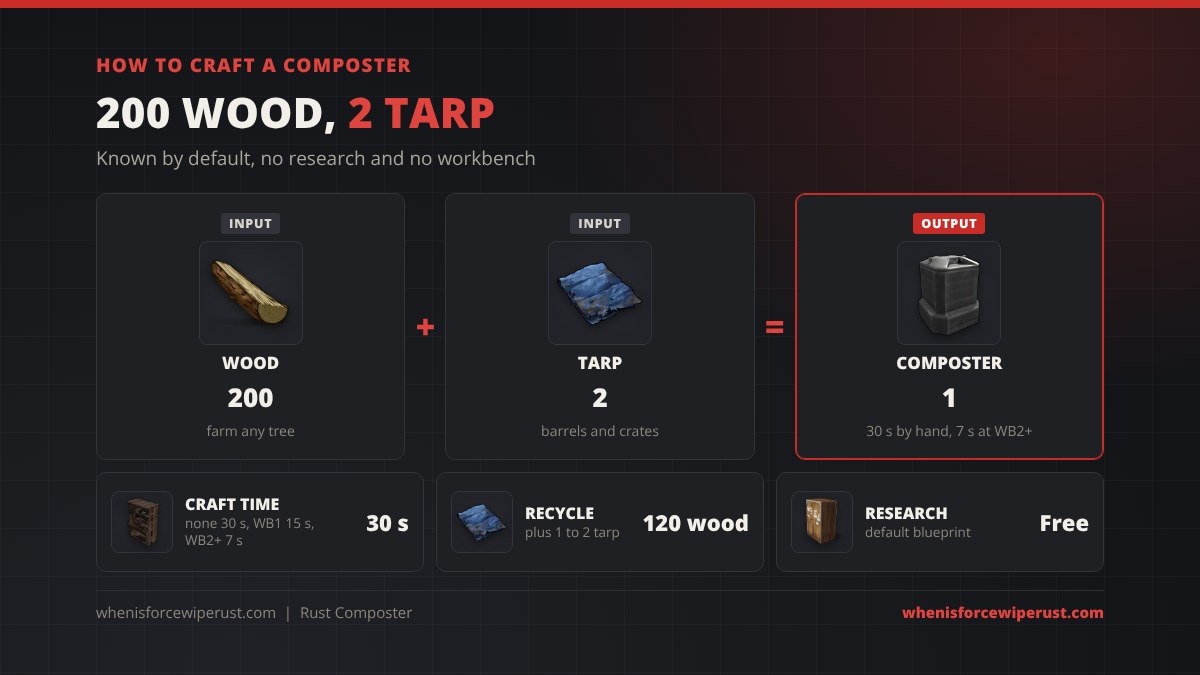
Every player knows the Composter blueprint from the start, so there is nothing to research or unlock on the tech tree. Open your crafting menu and craft it with:
- 200 Wood, a couple of minutes on any tree.
- 2 Tarp, which you find in roadside barrels and crates. Tarps are also the best thing to recycle for cloth, so keep a few spare when you run a road loop.
It crafts in 30 seconds from your inventory, or faster next to a workbench. Place it like any other deployable inside your building privilege.
What Can You Put in a Composter?
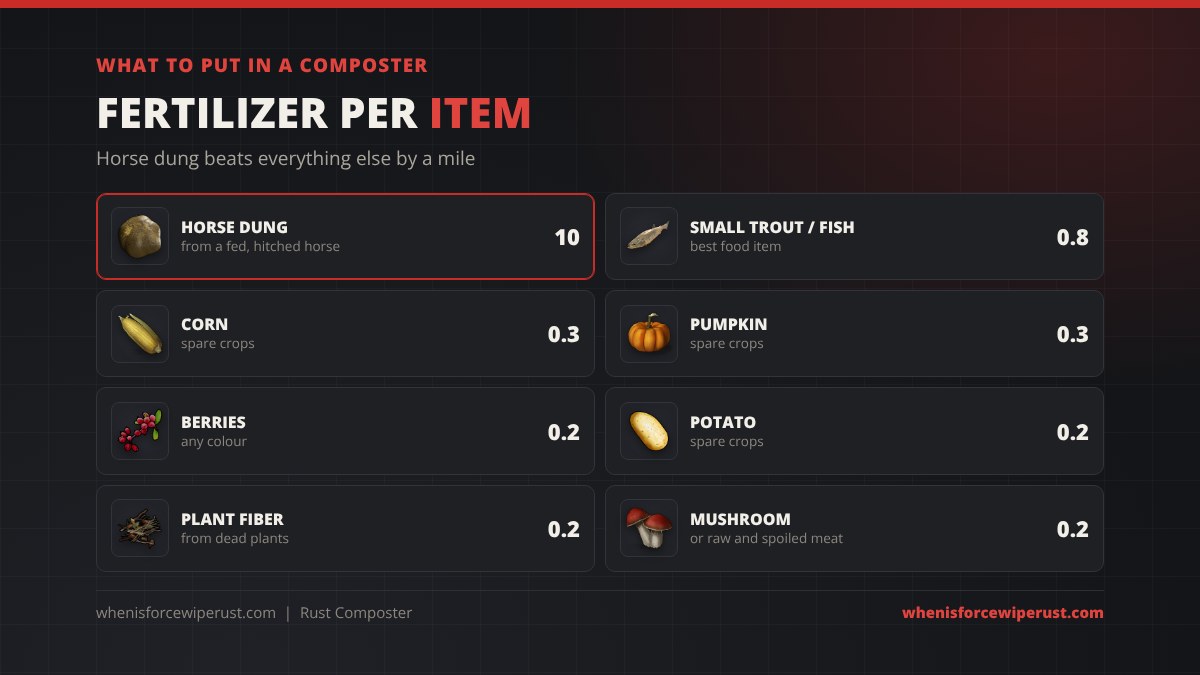
Only compostable items fit in a Composter. That means dung, food and plant matter. Each item has a fixed fertilizer value, and the Composter adds them up and hands you a whole fertilizer each time the total passes 1:
| Item | Fertilizer each | Items per fertilizer |
|---|---|---|
| Horse Dung | 10 | 0.1 (one dung = 10 fertilizer) |
| Small Trout and other fish | 0.8 | about 1.25 |
| Corn, Pumpkin | 0.3 | about 3.3 |
| Berries (any colour), Potato, Mushroom | 0.2 | 5 |
| Plant Fiber | 0.2 | 5 |
| Raw, cooked or spoiled meat | about 0.1 to 0.2 | 5 to 10 |
Will not compost: wood, bones, animal fat, cans, bottles and water jugs. Seeds and clones are better planted than composted.
How the Composter Works
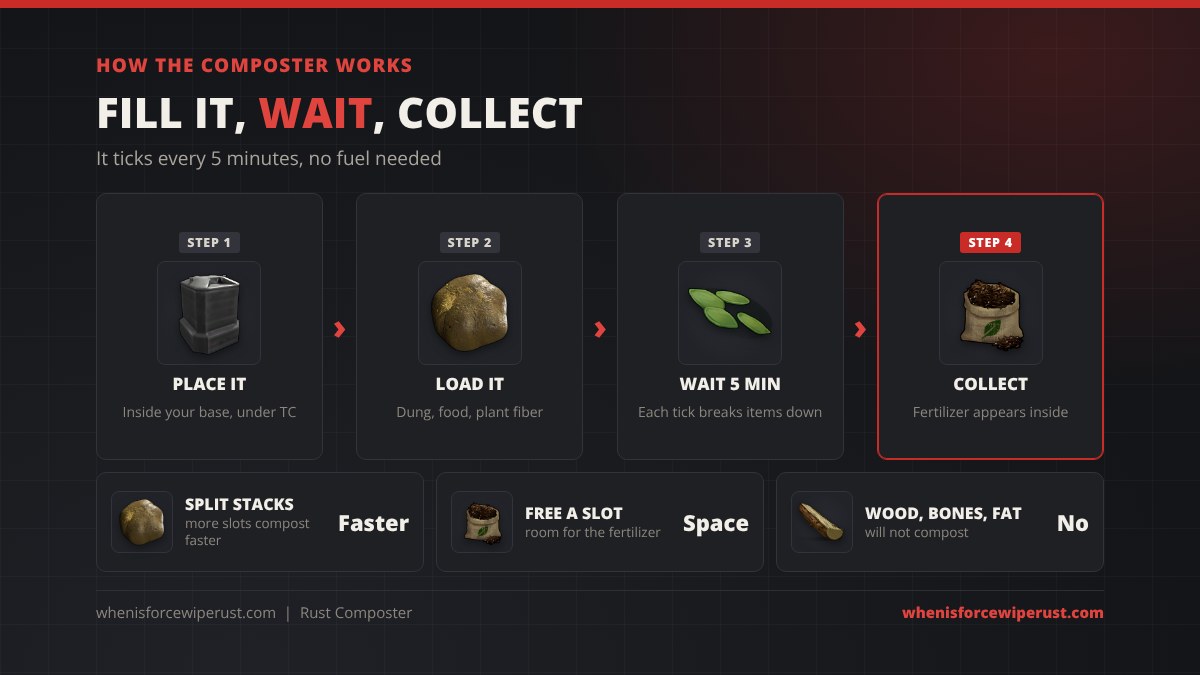
- Place the Composter inside your base, close to your planters.
- Open it and load it with compostable items. It works like a furnace: drag stacks into the slots.
- Wait. Every 5 minutes the Composter breaks down items from its slots and adds up their fertilizer value.
- Collect the fertilizer that appears in its inventory and take it to your planters.
Two things speed it up. Split your stacks over several slots, because each stack is worked on separately, so more stacks means more items composted per tick. And leave a slot free, or the fertilizer has nowhere to go. There is no on switch and nothing to refuel; it composts whenever something compostable is inside.
How to Use Fertilizer in Rust
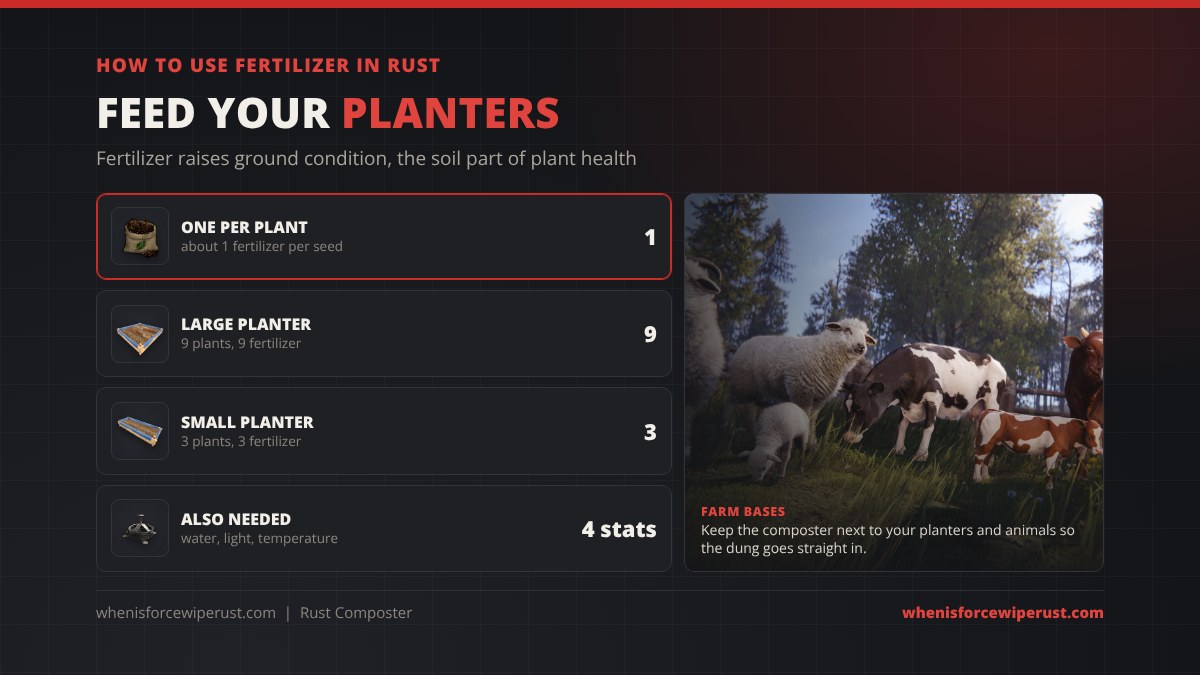
Fertilizer raises a planter’s ground condition, one of the four conditions that decide plant health, growth speed and yield. The other three are light, water and temperature, so fertilizer works best in a planter that already has sunlight and a water supply.
- Open the planter box and drop the fertilizer in. It raises the soil score for the plants in that box.
- Plan on about 1 fertilizer per plant each grow cycle: 9 for a Large Planter Box, 3 for a Small Planter Box.
- Top it up every cycle. Plants use the ground condition as they grow, so a planter that started at 100% will drop by harvest.
Better ground condition means faster growth and a bigger harvest, which is how a few planters of hemp can keep a whole group in cloth. More water ideas are in our Rust water guide.
Composter Raid Cost & Decay
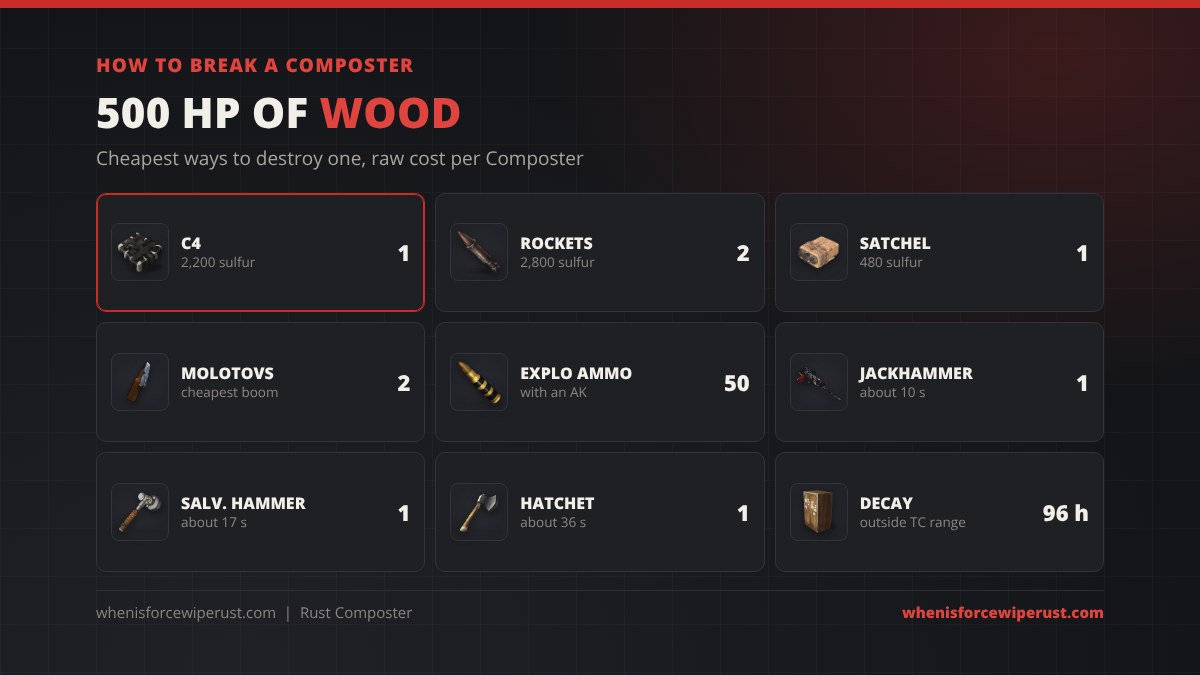
A Composter is 500 HP of wood, so it falls to almost anything:
| Tool | Needed | Notes |
|---|---|---|
| Molotov Cocktail | 2 | Cheapest explosive option |
| Satchel Charge | 1 | 480 sulfur |
| Timed Explosive Charge (C4) | 1 | 2,200 sulfur, overkill |
| Rocket | 2 | 2,800 sulfur |
| Explosive 5.56 Ammo | 50 | From an Assault Rifle |
| Jackhammer | 1 | About 10 seconds |
| Salvaged Hammer | 1 | About 17 seconds |
| Hatchet | 1 | About 36 seconds |
Outside your Tool Cupboard’s range, a Composter decays away in about 96 hours. For costs on the walls and doors in front of it, use our Rust raid calculator.
Composter Tips
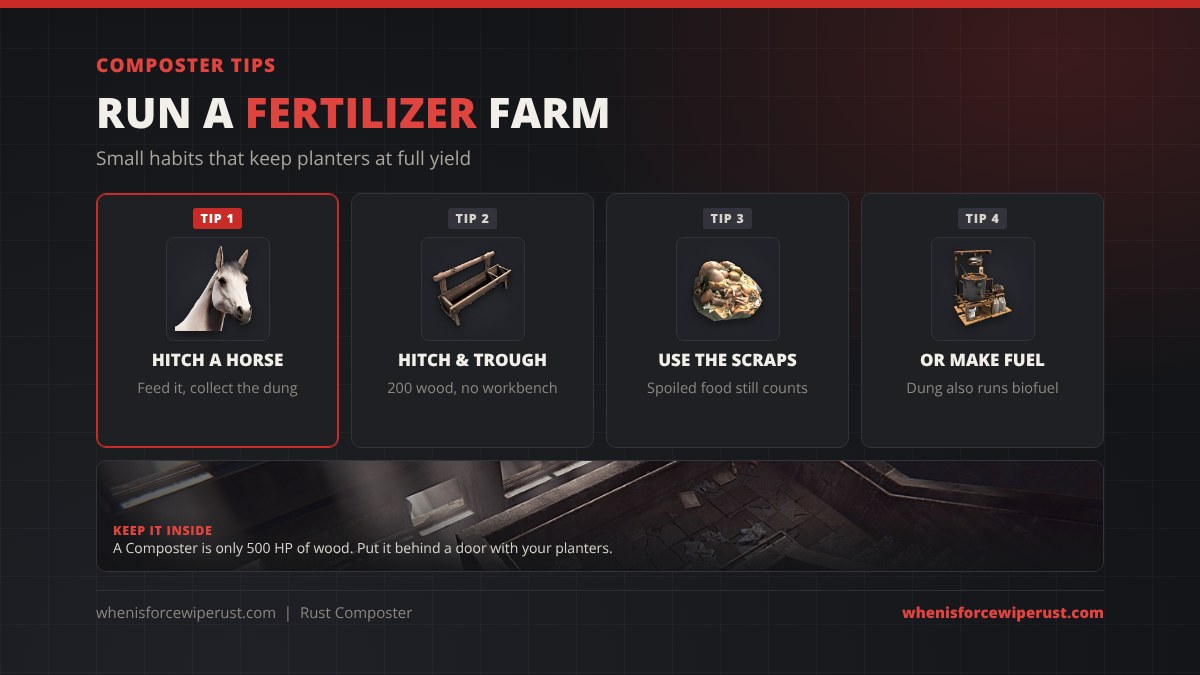
- Keep a horse. A fed, hitched horse drops dung, and one dung is worth 10 fertilizer. Our horse guide covers feeding and keeping one alive.
- Build a Hitch & Trough. It costs 200 wood with no workbench, keeps the horse in place and lets you feed it your spare crops.
- Compost what you would throw away. Spoiled food, extra berries and plant fiber still give fertilizer, so nothing from the farm is wasted.
- Choose fuel or fertilizer. Dung also burns in the new Biofuel Generator for low grade. A farm base wants the fertilizer, a base that runs on low grade wants the fuel. The livestock update added more animals to farm alongside your horse.
- Keep it behind a door. At 500 HP it is an easy target, and losing it costs you the dung inside too.
Rust Composter FAQ
How do you craft a Composter in Rust?
A Composter costs 200 wood and 2 tarp. It is a default blueprint, so every player knows it, and it needs no workbench. It crafts in 30 seconds by hand or 7 seconds at a Workbench 2 or 3.
How long does a Composter take in Rust?
The Composter ticks every 5 minutes by default. Each tick it breaks down items from its slots, so splitting your items over more slots composts them faster.
What is the best thing to put in a Composter?
Horse dung. Each piece gives 10 fertilizer, while fish give about 0.8, corn and pumpkin 0.3, and berries, potatoes, mushrooms and plant fiber 0.2 each.
Does the Composter need fuel or power?
No. The Composter runs on its own with no fuel and no electricity. It composts whenever there is something compostable inside.
How much fertilizer does a plant need in Rust?
About 1 fertilizer per plant each grow cycle keeps ground condition high. That is 9 for a Large Planter Box and 3 for a Small Planter Box.
How many explosives does it take to destroy a Composter?
A Composter has 500 HP. It takes 1 satchel charge, 1 C4, 2 rockets or 2 molotovs, or one hatchet in about 36 seconds.