
In Rust, you can die of thirst long before anyone shoots you. Your hydration drains all the time, and it drains faster when you run, farm or fight. The good news is that water is everywhere. The bad news is that most of it is the ocean, and drinking the ocean makes you sicker, not better.
This Rust water guide covers everything you need to stay hydrated and keep a farm running. You will learn the difference between fresh, salt and radioactive water, every way to get drinkable water, what each container holds, how fast water catchers fill, how both purifiers work, and how to build an automated pump-to-sprinkler line. It also covers the new Water Wheel from the 2026 Spring Clean update. Every number is checked against the Facepunch wiki and RustClash item data.
- Water Basics
- Fresh vs Salt
- How to Get Water
- How to Drink
- Containers
- Water Catchers
- Purifiers
- Water Pump Setup
- Water for Farming
- Water Wheel
- Craft Costs
- Pro Tips
- FAQ
How Water Works in Rust
Every player has a hydration meter, the blue water drop in the bottom-right of your HUD. It slowly drops over time and drops faster when you are active or hot. When it runs out, you start taking damage and your health stops regenerating. Keep it topped up and you heal faster between fights.
Water in Rust is also an item. You can carry it in bottles, jugs and buckets, pour it into barrels and purifiers, and pipe it through hoses to sprinklers. That is what makes it more than a survival stat. Once your base is set up, water becomes the backbone of your farm, and a good farm is where your teas, food and cloth come from.
Fresh Water vs Salt Water vs Radioactive Water
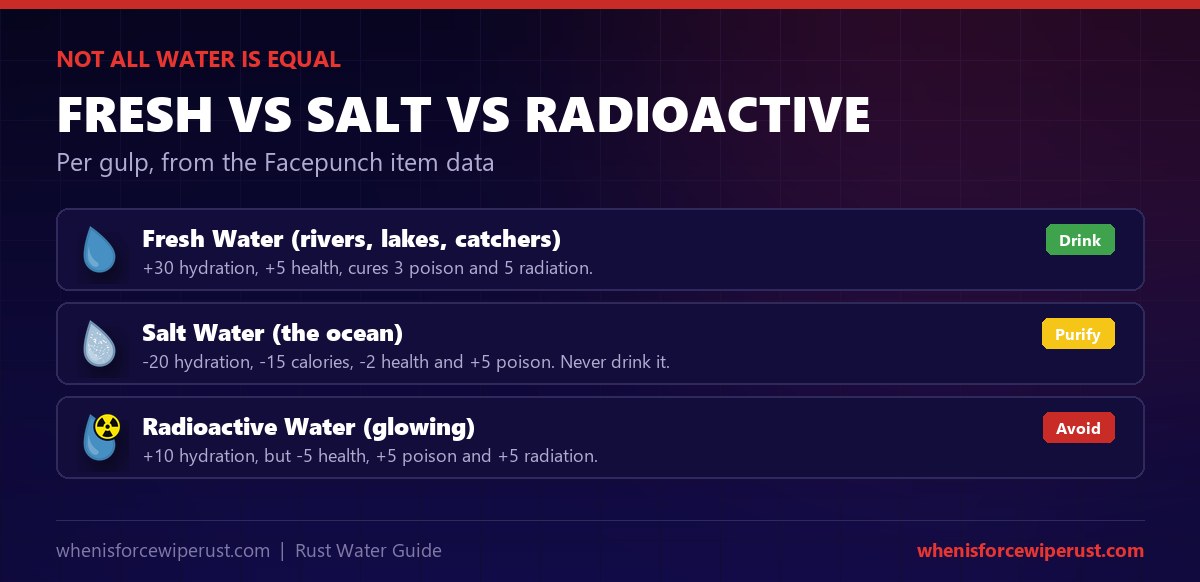
Rust has three kinds of water, and only one of them is safe to drink. Here is what each gulp does, from the official Facepunch item data.
| Water | Where you find it | Effect per gulp | Verdict |
|---|---|---|---|
| Fresh Water Drink | Rivers, lakes, catchers, purifiers | +30 hydration, +5 health, -3 poison, -5 radiation | Always safe |
| Salt Water | The ocean and anything pumped from it | -20 hydration, -15 calories, -2 health, +5 poison | Purify first |
| Radioactive Water | Glowing, irradiated water | +10 hydration, -5 health, +5 poison, +5 radiation | Avoid |
Salt water is the one that catches new players out. If you are on a beach spawn with a red hydration bar, it is tempting to drink the sea. Don’t. It drains your hydration and poisons you. Walk inland to a river instead, or look for a trash pile with a water bottle.
How to Get Water in Rust
There are six ways to get drinkable water. The first three are all you need for most of a wipe.
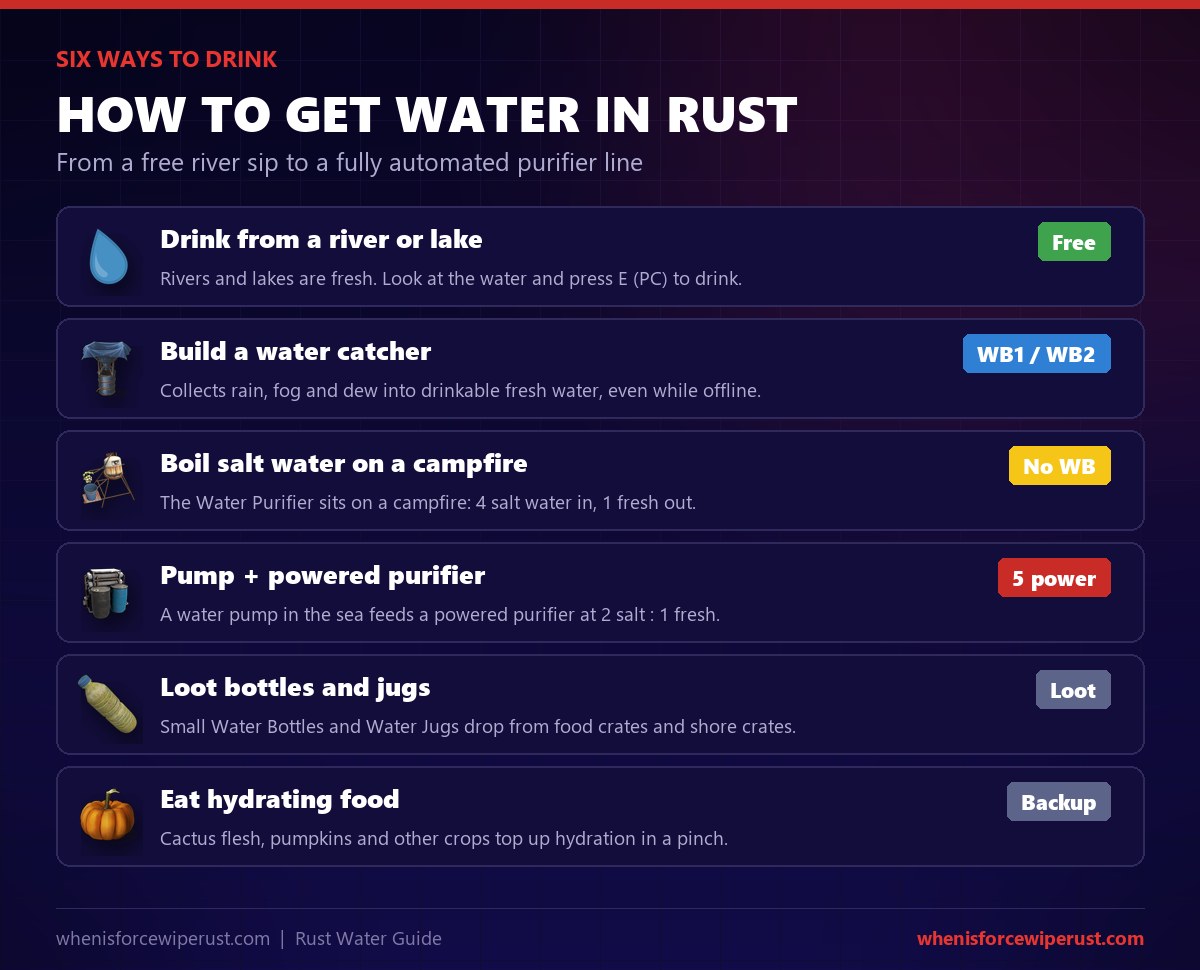
- Drink from rivers and lakes. All inland rivers and lakes are fresh water. It costs nothing, which is why building near a river is such a strong early-wipe choice.
- Build a water catcher. Catchers collect rain, fog and dew into fresh water, even while you are offline. A small one is only Workbench 1.
- Purify salt water on a campfire. The Water Purifier is known by default and sits on top of a lit campfire.
- Pump and purify. A powered Water Pump in the sea feeds a Powered Water Purifier. This is the mid-game, fully automated option.
- Loot water. Small Water Bottles (250 ml) and Water Jugs (5,000 ml) drop from food crates, shore crates and trash piles, sometimes already useful for a quick drink.
- Eat hydrating food. Cactus flesh in the desert, pumpkins and other crops restore some hydration. It is a backup, not a plan.
You can also drink fresh water at Water Wells, the small walled roadside monuments in temperate biomes. Since the 2024 world update they also have a friendly shopkeeper who sells farming gear and teas.
How to Drink Water in Rust (PC and Console)
- From a river or lake: walk into shallow fresh water, look down at the surface and press E on PC, or the interact button on console, to take a drink.
- From a bottle or jug: equip it, right-click while looking at a water source to fill it, and left-click to drink. Right-click again to pour it out.
- From a catcher, barrel or purifier: look at it and use the Drink prompt, or open it and fill your jug.
- Transferring water: with a jug in hand, hold the give or take button on a barrel or purifier to move water in bulk.
Rust Water Containers and How Much They Hold
Here is every water container in Rust, sorted by capacity. 1,000 ml is one litre.
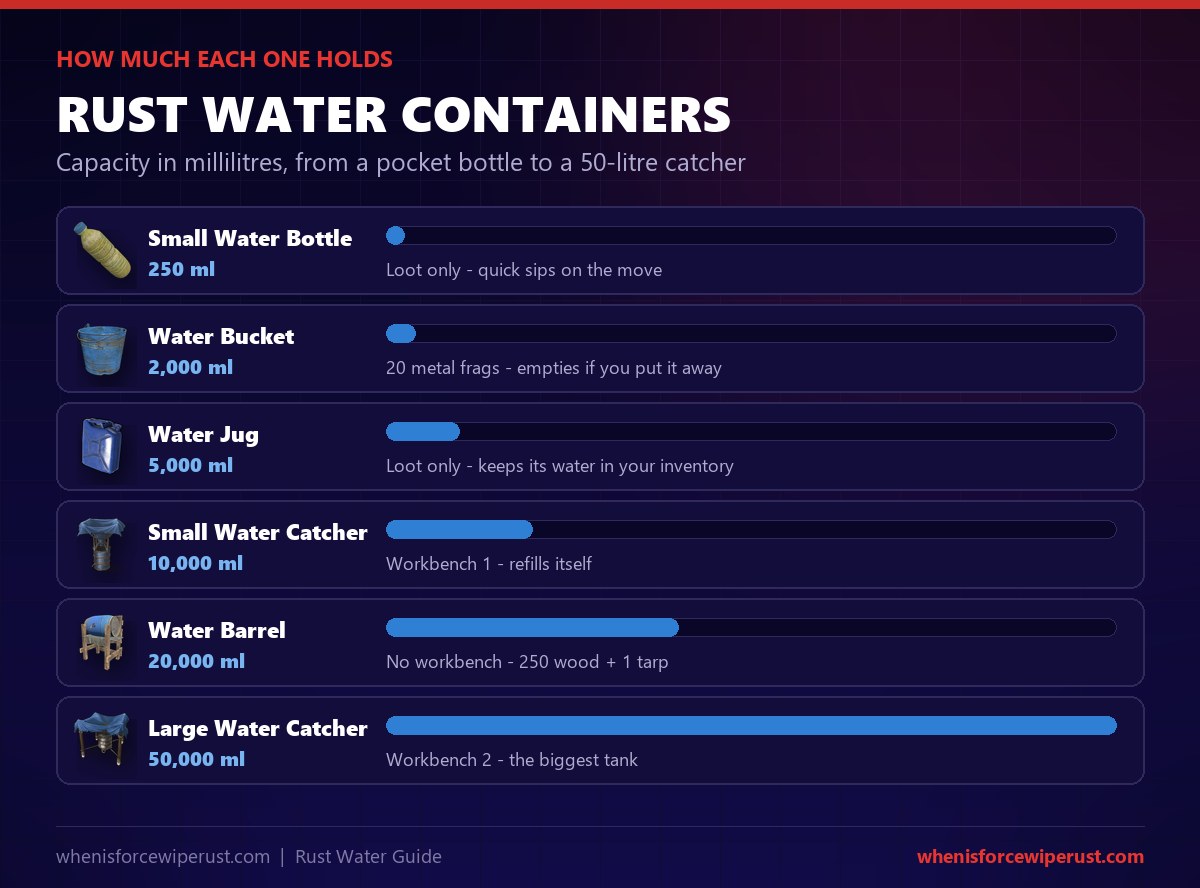
| Container | Capacity | How to get it | Note |
|---|---|---|---|
| Small Water Bottle | 250 ml | Loot only (food crates, trash piles) | Quick sips on the move |
| Water Bucket | 2,000 ml | Craft: 20 metal fragments, no workbench | Spills everything if you put it in your inventory |
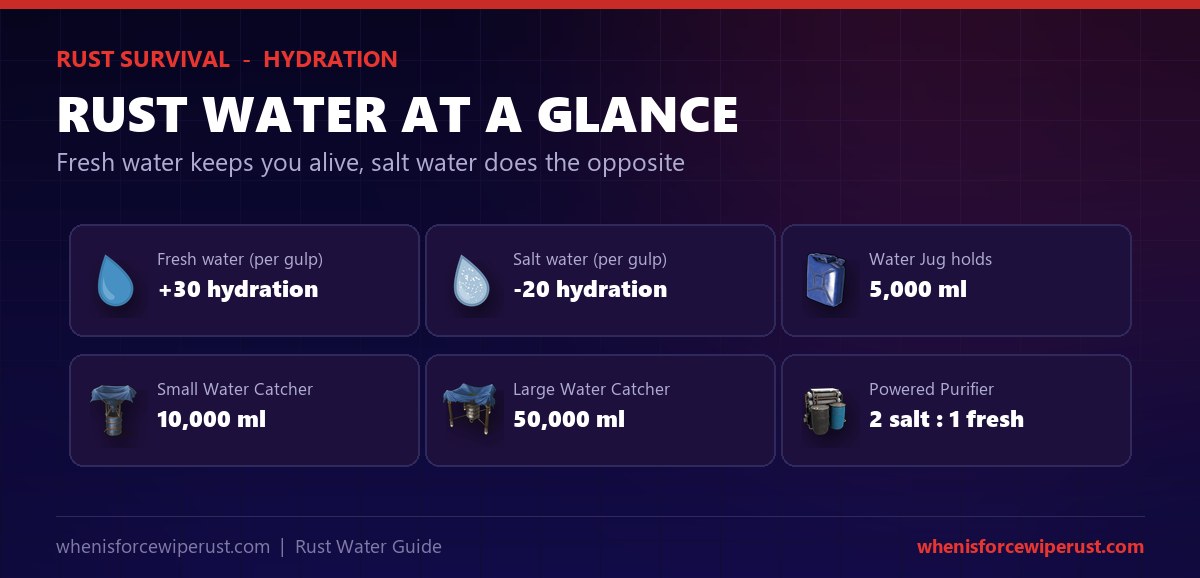
| Water Jug Best carrier | 5,000 ml | Loot only (shore crates ~35%, food crates) | Keeps its water in your inventory |
| Small Water Catcher | 10,000 ml | Craft at Workbench 1 | Fills itself from the weather |
| Water Barrel | 20,000 ml | Craft: 250 wood + 1 tarp, no workbench | Outputs 10 ml a second through a hose |
| Large Water Catcher | 50,000 ml | Craft at Workbench 2 | The biggest tank in the game |
The Water Jug is the one to hoard. It holds two and a half buckets and does not spill when you swap items. If you find spares, stack a few in a box next to your farm. You can also recycle a jug for 60 metal fragments.
Water Catchers: Rates and Capacity
Water catchers are the easiest hands-off water source. They collect water from the weather, so their speed depends completely on whether it is raining.
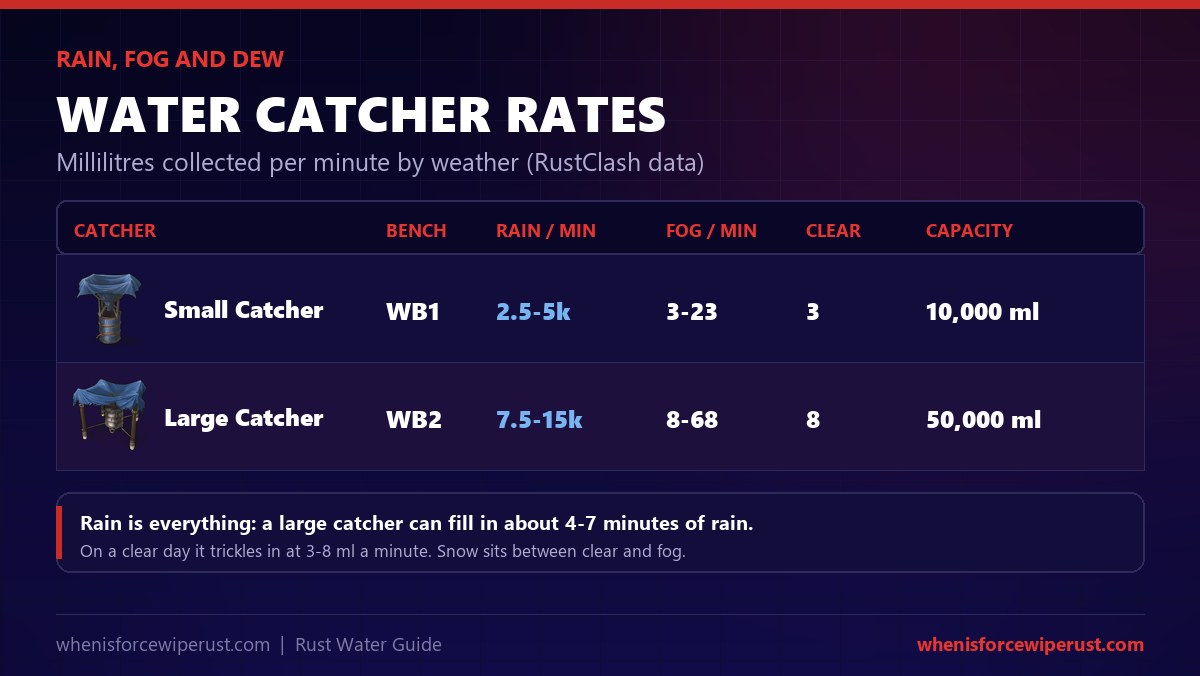
| Catcher | Rain | Fog | Snow | Clear | Capacity |
|---|---|---|---|---|---|
| Small Water Catcher | 2,503-5,003 ml/min | 3-23 ml/min | 3-8 ml/min | 3 ml/min | 10,000 ml |
| Large Water Catcher | 7,508-15,008 ml/min | 8-68 ml/min | 8-23 ml/min | 8 ml/min | 50,000 ml |
- Small Water Catcher: Workbench 1, 100 wood, 50 metal fragments and 1 tarp. Research it for 15 scrap. 200 HP.
- Large Water Catcher: Workbench 2, 500 wood, 200 metal fragments and 2 tarps. Research it for 30 scrap. 300 HP.
Place catchers on your roof or just outside your walls, somewhere open to the sky. They have both a water input and output, so you can hose them into a barrel or straight into sprinklers. Remember they are raidable deployables and they decay like anything else outside your Tool Cupboard range.
Rust Water Purifiers: Campfire vs Powered
The ocean is the biggest water source on any map. A purifier is how you make it drinkable. There are two, and they are very different.

| Purifier | Recipe | Needs | Salt : Fresh |
|---|---|---|---|
| Water Purifier | 15 metal fragments, 10 cloth, 1 empty propane tank | A lit campfire, no workbench, known by default | 4 : 1 |
| Powered Water Purifier Best | 300 metal fragments, 100 wood, 20 cloth | Workbench 2, 5 power | 2 : 1 |
The campfire Water Purifier is the early-game fix for beach spawns. Place it on a campfire, pour salt water in, and fresh water drips into the bucket. Players testing it report around 30 wood and 5 minutes to turn 5,000 ml of salt water into 1,250 ml of fresh water. It is slow, but it works on day one.
The Powered Water Purifier is the real upgrade. It holds 5,000 ml of salt water in and 5,000 ml of fresh water out, and converts at 2 salt to 1 fresh. Research it for 30 scrap at a Research Table, unlock it in the Engineering Workbench tech tree, or buy one at Outpost.
How to Set Up a Water Pump in Rust
The Water Pump costs 250 wood, 200 metal fragments and 1 gear at Workbench 2. It must be placed in a body of water and uses 5 power. It pumps whatever water it sits in, so a pump in a river gives fresh water and a pump in the sea gives salt water. Players measure its output at around 510 ml a minute.
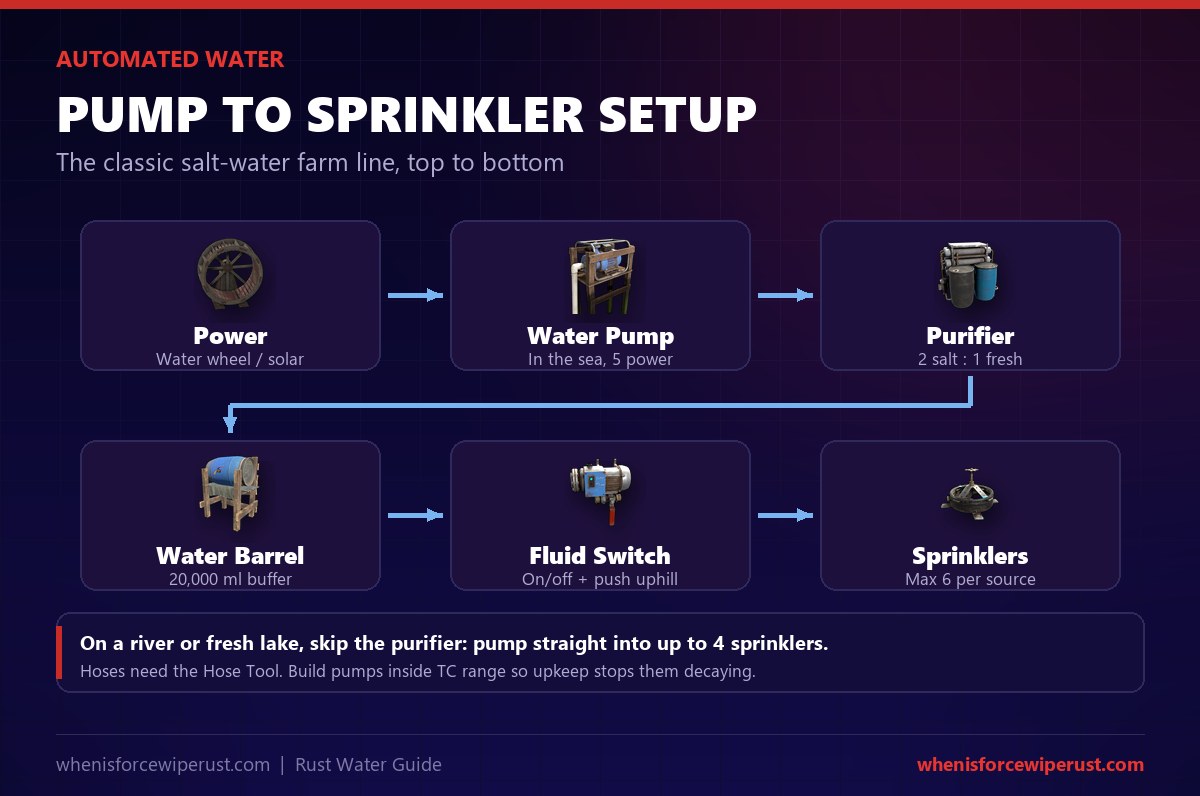
- Power it. Each pump and each powered purifier needs 5 power. A small solar panel, a small generator on low grade fuel, or a Water Wheel all work.
- Place the pump in the water. Build a foundation out over the shore and drop the pump into the sea or river.
- Hose it to a purifier (salt water only). Use the Hose Tool to connect the pump’s output to the purifier’s input. The Facepunch farming guide recommends two pumps per powered purifier.
- Store the output. Run the purifier into a Water Barrel so you have a 20,000 ml buffer.
- Control it. A Fluid Switch & Pump (150 metal fragments, Workbench 1) turns the flow on and off, and when powered it can push water uphill.
- Feed sprinklers. One barrel can feed up to 6 sprinklers.
On a river or fresh lake, skip the purifier: the Facepunch guide says one powered pump can feed up to 4 sprinklers directly.
Water for Farming
Crops in planters need water to grow well, and a well-watered planter is the difference between a slow garden and a farm that feeds your whole group. That is where most of your Rust water ends up by mid-wipe.
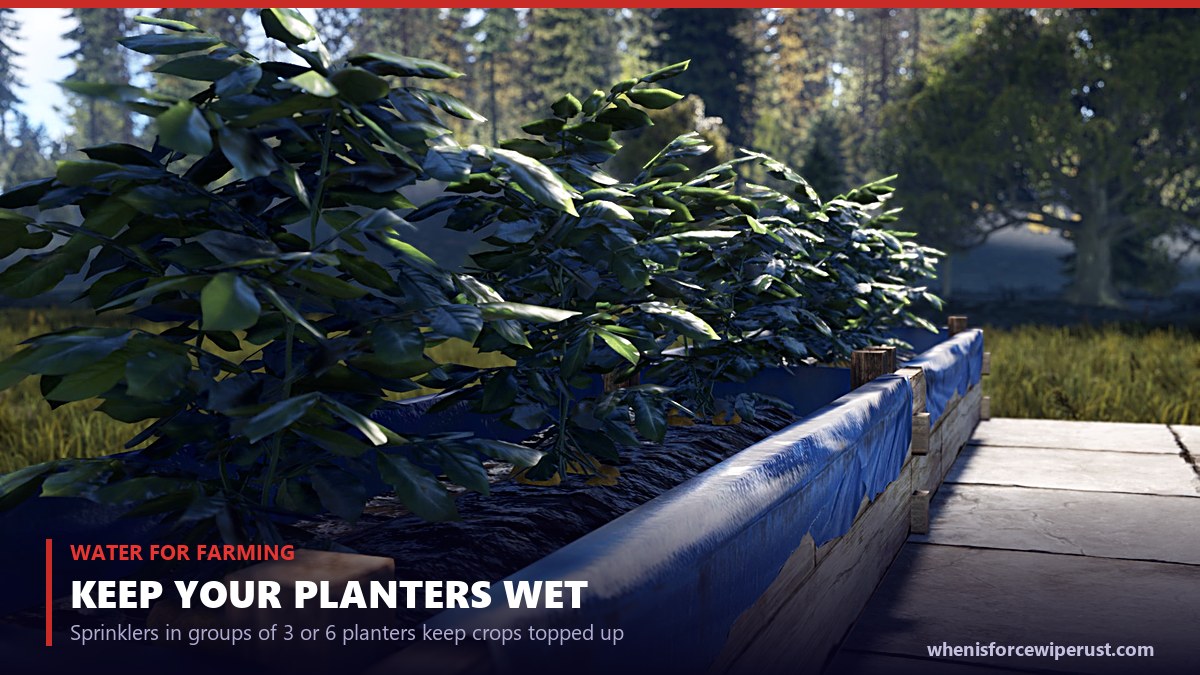
- Sprinklers cost 75 metal fragments at Workbench 1 and use roughly 2 ml of water a second.
- Lay out planters in groups of 3 or 6 so each sprinkler only sees the planters it can keep full.
- Do not chain more than 6 sprinklers on one source. Extra ones spin but do not water.
- You can also water a planter by hand: pour a jug or bucket straight into it.
Sprinklers also soak anyone standing under them, and being wet makes you cold. On a snow map, that is a free defence tool.
The Water Wheel (New in 2026)
The Water Wheel arrived in the April 2026 Spring Clean update. Place it in a river and it turns the current into free electricity, which is perfect for powering the pumps and purifiers above.
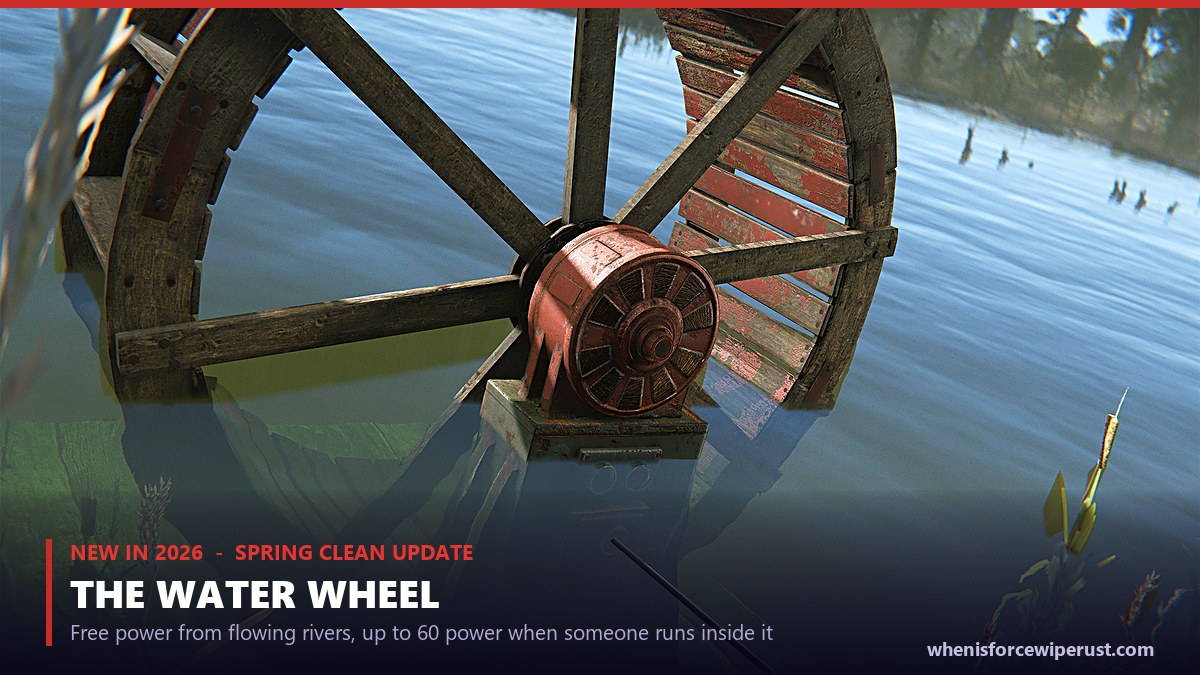
- Output: 0-60 power. Flowing rivers give steady passive power. In the ocean it works, but the output changes with the tides.
- Hamster mode: a player can run inside the wheel to generate power, trading calories for electricity.
- Cost: Workbench 1, 500 wood and 2 gears (RustHelp also lists 1 sheet metal), researched for 60 scrap.
- Why it matters for water: a single wheel on a river easily powers a pump and purifier (10 power), with plenty left over for lights.
Every Rust Water Item: Craft Cost and Research
| Item | Workbench | Recipe | Research |
|---|---|---|---|
| Water Bucket | None | 20 metal fragments | 15 scrap |
| Water Barrel | None | 250 wood, 1 tarp | 15 scrap |
| Water Purifier | None | 15 metal fragments, 10 cloth, 1 empty propane tank | Known by default |
| Small Water Catcher | Level 1 | 100 wood, 50 metal fragments, 1 tarp | 15 scrap |
| Sprinkler | Level 1 | 75 metal fragments | 15 scrap |
| Fluid Switch & Pump | Level 1 | 150 metal fragments | 15 scrap |
| Water Wheel | Level 1 | 500 wood, 2 gears | 60 scrap |
| Large Water Catcher | Level 2 | 500 wood, 200 metal fragments, 2 tarps | 30 scrap |
| Water Pump | Level 2 | 250 wood, 200 metal fragments, 1 gear | 30 scrap |
| Powered Water Purifier | Level 2 | 300 metal fragments, 100 wood, 20 cloth | 30 scrap |
Water Jugs and Small Water Bottles cannot be crafted, so you have to loot them. All the others follow the normal blueprint rules and reset at every force wipe.
Rust Water Pro Tips
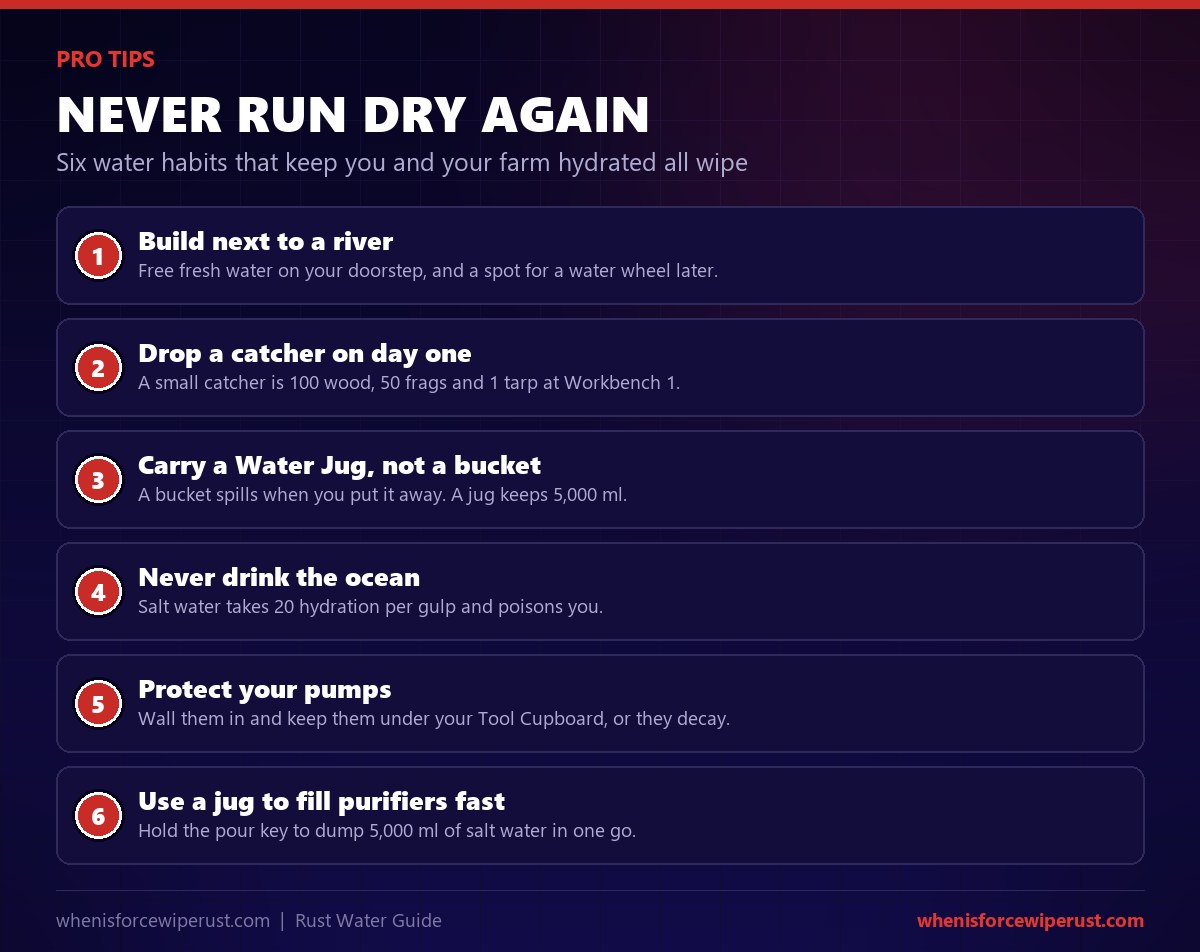
- Build next to a river. Free fresh water on your doorstep, plus a spot for a water wheel later.
- Drop a catcher on day one. A small catcher is cheap and fills up in any rain, so you always come home to water.
- Carry a Water Jug, not a bucket. The bucket spills when you put it away. The jug keeps 5,000 ml.
- Never drink the ocean. Salt water takes 20 hydration per gulp and poisons you.
- Protect your pumps. Wall them in and keep them inside your Tool Cupboard range so upkeep covers them.
- Fill purifiers with a jug. If your pump is down, 5,000 ml poured in by hand keeps the farm running.
Going out to sea? Our RHIB guide and boat building guide cover the boats, and Fishing Village is the safe zone where you can buy them.
Setting up your farm for the month? Every pump, purifier and catcher disappears at the monthly force wipe. Check the live countdown so you know how long your water setup has left.
See the Force Wipe CountdownRust Water FAQ
How do you get water in Rust?
Drink from rivers and lakes, which are all fresh water. You can also build water catchers to collect rain, purify salt water with a Water Purifier on a campfire or a Powered Water Purifier, loot water bottles and jugs from food and shore crates, or eat hydrating food like cactus flesh and pumpkins. Our Rust food and hunger guide lists the water each food gives.
Can you drink salt water in Rust?
You can, but you should not. Each gulp of salt water removes 20 hydration and 15 calories, deals 2 damage and adds 5 poison. Always purify ocean water first.
How do you drink water in Rust on console?
Stand in shallow fresh water, look down at the surface and press the interact button. With a bottle or jug, fill it from a water source and use the primary action to drink.
How much water does a water catcher hold in Rust?
A Small Water Catcher holds 10,000 ml and a Large Water Catcher holds 50,000 ml. In rain, the large catcher collects about 7,500 to 15,000 ml a minute, so it can fill in under 7 minutes.
How does the water purifier work in Rust?
The Water Purifier sits on top of a lit campfire and turns 4 salt water into 1 fresh water. The Powered Water Purifier uses 5 power and converts at a much better 2 salt to 1 fresh, holding 5,000 ml of each.
How much power does a water pump use in Rust?
A Water Pump uses 5 power, and so does the Powered Water Purifier. A pump and purifier together need 10 power, which a small solar panel setup or a Water Wheel on a river can supply.
Does the water pump work in fresh water?
Yes. The Water Pump collects whatever water it is placed in. In a river or lake it pumps fresh water that can go straight to sprinklers. In the ocean it pumps salt water that needs a purifier.
How many sprinklers can one water pump run?
According to the Facepunch farming guide, one powered pump on fresh water can run up to 4 sprinklers. For salt water, use two pumps into a powered purifier. A single water barrel can feed up to 6 sprinklers.
What is the best way to carry water in Rust?
The Water Jug. It holds 5,000 ml and keeps its water in your inventory, while the Water Bucket only holds 2,000 ml and spills when you put it away. Jugs are loot only, mainly from shore crates and food crates.
Sources and Further Reading
- Official item data for water, salt water, catchers, pumps and purifiers: Facepunch Wiki, Large Water Catcher and Salt Water
- Pump, purifier and sprinkler layouts: Facepunch Wiki, Farming Basics
- Catcher rates by weather and container capacities: RustClash Wiki, Large Water Catcher
- Purifier behaviour and conversion rates: RustClash Wiki, Powered Water Purifier
- Water Wheel announcement: Facepunch, Spring Clean update
- Water Wheel stats and research cost: RustHelp, Water Wheel
- The water monument: whenisforcewiperust.com, Water Treatment Plant
- The game itself: Facepunch Studios