
Cloth is the first resource that matters in Rust. Before you own a gun, before you build a wall, you need Cloth. It makes your first bandage so a bleed does not kill you, your first bow so you can hunt back, a sleeping bag so death is not a full reset, and every scrap of clothing on your back. No other early resource is stitched into so much of a fresh spawn’s life.
Here is the catch that trips up new players: you cannot craft Cloth. It has no recipe. You gather it, and only gather it, from hemp plants, animal corpses, cactus and the recycler. Knowing which of those to lean on at each stage of a wipe is the whole game. On hour one you punch hemp bushes. By day three you are recycling road junk. Once you are settled, a hemp farm quietly prints thousands of Cloth an hour while you do other things.
This guide covers all of it: what Cloth is, its exact item data, every source with real numbers, the animal yield chart, how much you get from recycling, how to build a hemp farm and chase the best genetics, the full list of what Cloth crafts, and the fastest route at each point in the wipe. Every figure is cross checked against the Facepunch wiki, RustHelp and Corrosion Hour.
- What It Is
- Stats
- How to Get It
- Hemp & Farming
- Animal Yields
- Recycling
- What It Builds
- Fastest Way
- Pro Tips
- FAQ
What Is Cloth in Rust?
Cloth is a raw base resource, the same tier as wood, stone and metal fragments. The game’s own item description sums it up: “Cloth from an animal or a Hemp Bush. Used in many clothing items, weapons, and more.” That “and more” is doing a lot of work, because Cloth appears in over two hundred recipes across every tier of the game.
The single most important fact about Rust Cloth is that it is gather only. It is not craftable, not researchable, and it will not go through a recycler to be made from something else. If you open your crafting menu looking for a Cloth recipe, you will not find one, and that is by design. Every point of Cloth you ever own came off a plant, an animal, a cactus, or out of a recycler that was fed finished items.
That makes Cloth a soft bottleneck early on. Wood and stone are everywhere and metal comes from nodes, but Cloth forces you to actually hunt or farm for it. A fresh spawn who ignores hemp bushes will be short a sleeping bag and a bow when it matters most, while the player who grabs every bush on the way inland is already stitching up clothing by the time they reach a monument.
Rust Cloth Stats
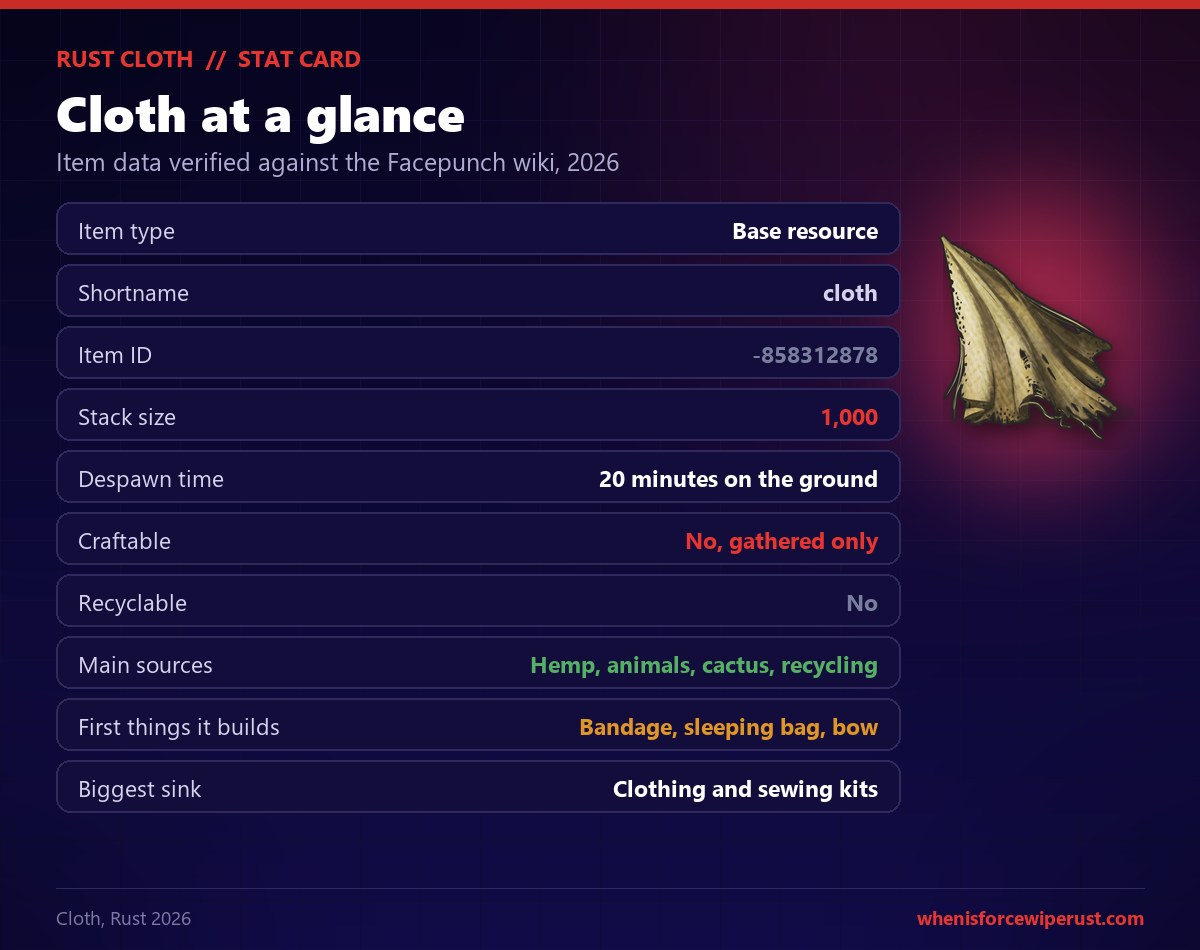
| Stat | Value | Notes |
|---|---|---|
| Item type | Base resource | Same tier as wood or stone |
| Shortname | cloth | Item ID -858312878 |
| Stack size | 1,000 | Big stacks, easy to hoard |
| Craftable | No | Gathered only, no recipe exists |
| Recyclable | No | It is the output of recycling, not the input |
| Despawn time | 20 minutes | If dropped on the ground |
| Main sources | Hemp, animals, cactus | Plus recycling finished items |
| First uses | Bandage, sleeping bag, bow | All craftable with no workbench |
| Biggest sink | Clothing & sewing kits | Armor gates on sewing kits |
How to Get Cloth in Rust
There are four reliable ways to get Cloth in Rust, and the best one depends entirely on where you are in the wipe. Here they are side by side, then we break down the two big ones, hemp and recycling, in their own sections.
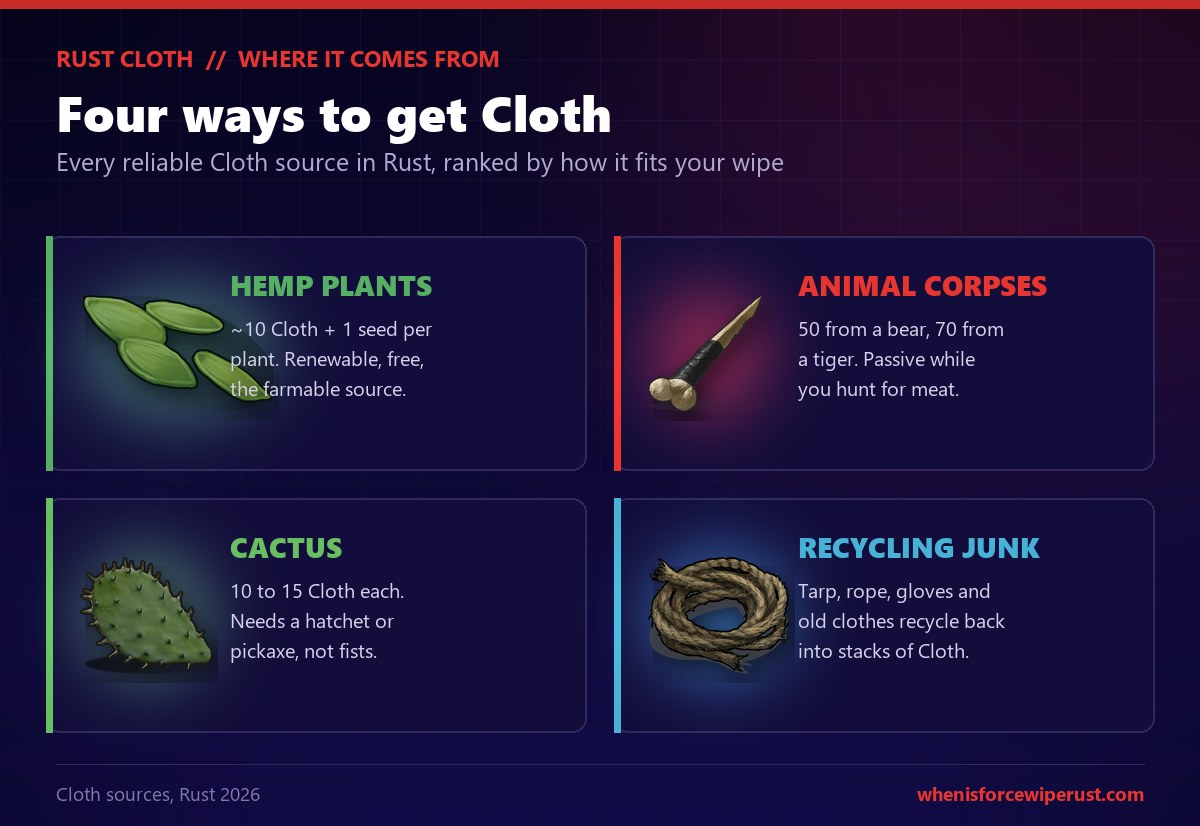
| Source | Yield | Best for |
|---|---|---|
| Hemp plantsFarmable | ~10 Cloth + 1 seed each | Renewable, free, scales into a farm |
| Animal corpses | 6 to 70 Cloth per animal | Passive Cloth while you hunt for meat |
| Cactus | 10 to 15 Cloth each | Desert runs, needs a cutting tool |
| Recycling junk | 12 to 60 Cloth per item | 300 to 500 Cloth on a single road loop |
Hemp and recycling are the two you will actually build your wipe around. Animals are a bonus you pick up while hunting for meat and fat anyway, and cactus is situational unless you spawn in the desert. Everything below is really about doing hemp and recycling well.
Hemp: Wild Picking vs a Hemp Farm
Hemp is the heart of Cloth farming in Rust. It is the only renewable source, which means it is the only one that scales. Wild hemp gets you started for free, and a planter farm turns Cloth from a chore into a background process.
Wild hemp
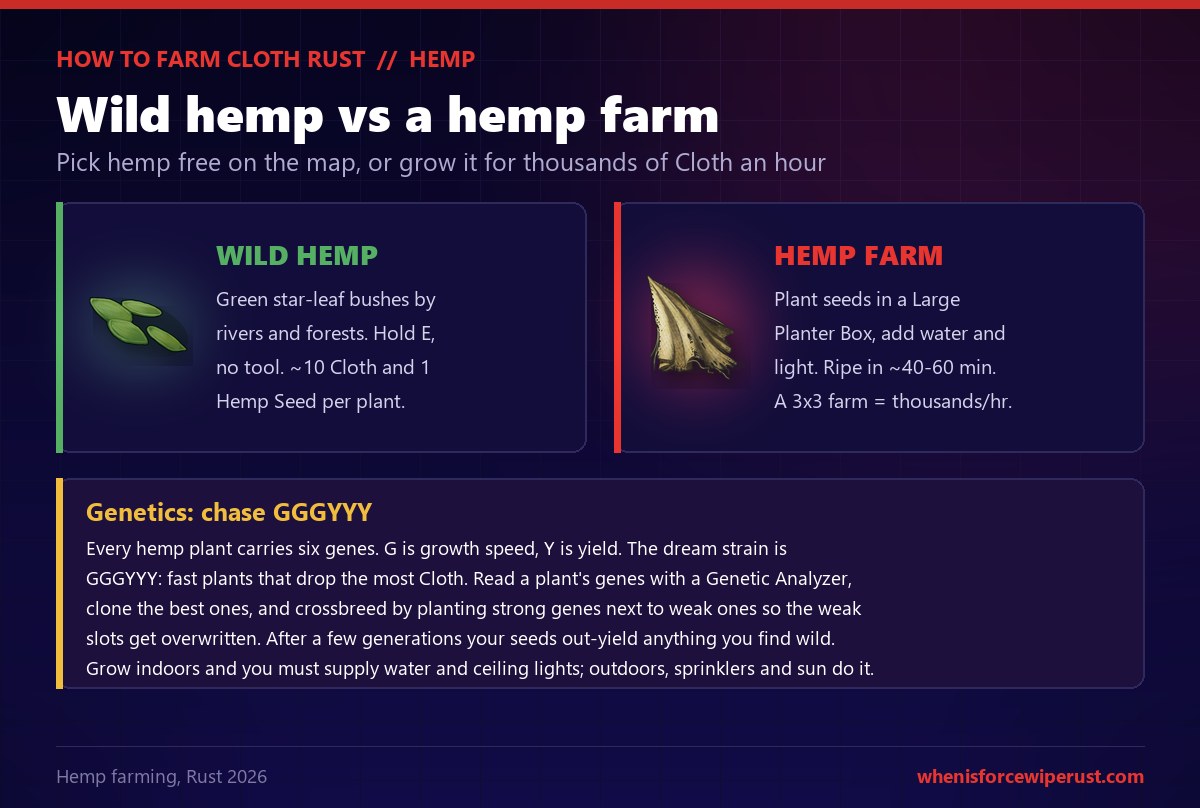
Wild hemp grows as small green bushes with a distinctive star leaf pattern, most often near rivers and in grassy forest and beach zones. You harvest it by walking up and holding E, no tool required. A fully grown plant gives roughly 10 Cloth and 1 Hemp Seed, though smaller plants can drop as little as 2 to 5 depending on how far they have grown. Grab every bush you pass on your run inland and you will have a stack of Cloth before you reach your first monument, plus the seeds that start your farm.
The hemp farm
Once you have a base and a few seeds, a farm is the endgame Cloth answer. Plant Hemp Seeds in a Large Planter Box, which holds the most plants and the most water. Outdoors, sun and rain do most of the work; indoors you must supply a water source and ceiling lights. With decent Growth genes and steady water, hemp is ripe in roughly 40 to 60 minutes, so you clear about one full harvest per planter every hour. A tuned three by three room of large planters pushes out thousands of Cloth an hour, hands free, with zero risk of being killed on a road.
Animal Cloth Yields
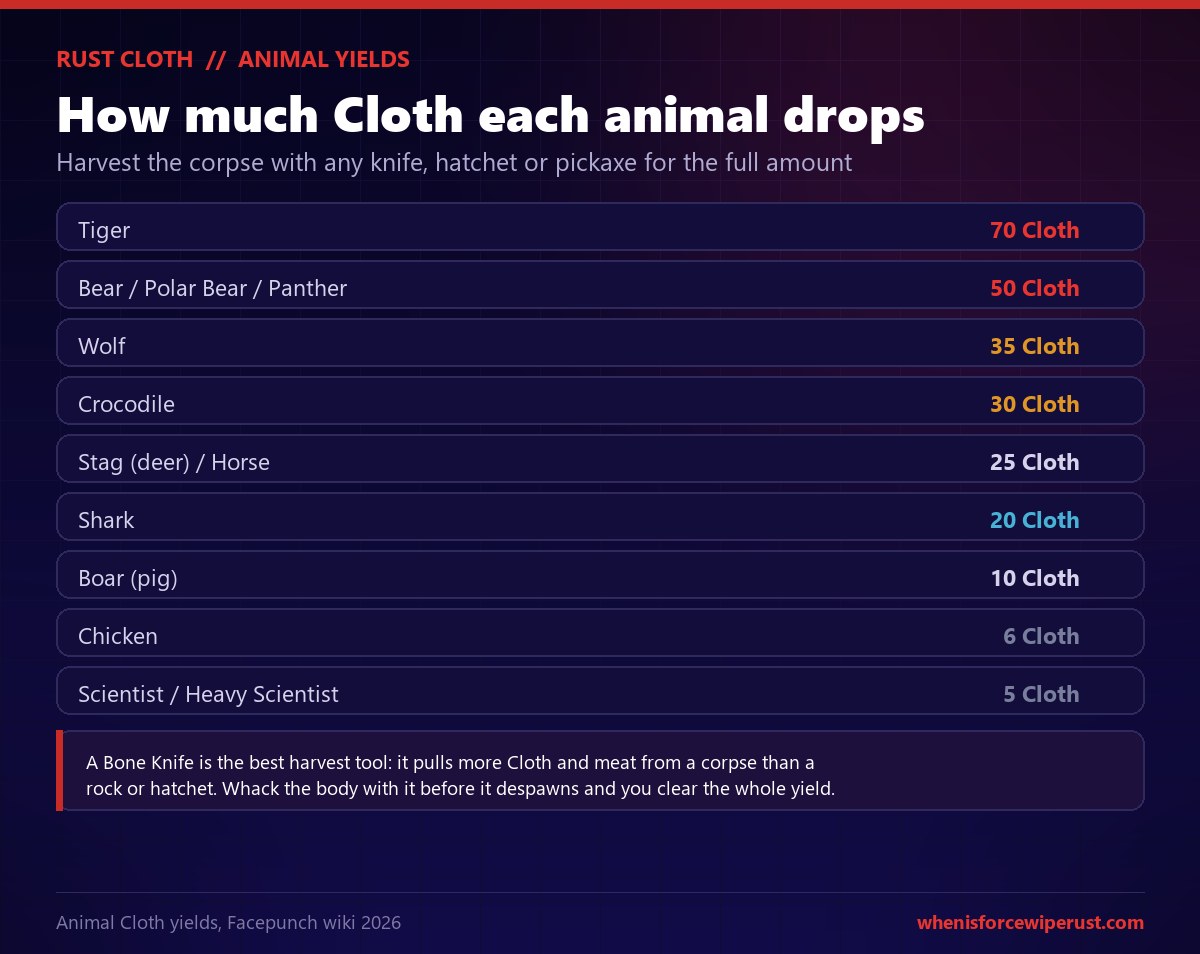
Every animal in Rust drops Cloth when you harvest its corpse, so hunting doubles as a Cloth run. You need a cutting tool to get the full amount: a Bone Knife is the best harvest tool in the early game and pulls more Cloth and meat from a body than a rock or a hatchet. Here is what each animal is worth.
| Animal | Cloth | Notes |
|---|---|---|
| Tiger | 70 | The single best Cloth animal |
| Bear / Polar Bear / Panther | 50 | Common and worth the fight |
| Wolf | 35 | Hunts in packs, decent Cloth |
| Crocodile | 30 | Swamp and jungle biomes |
| Stag (deer) / Horse | 25 | Easy, low-risk kills |
| Shark | 20 | Harvested from the water |
| Boar (pig) | 10 | Everywhere, great meat too |
| Chicken | 6 | Barely worth the arrow |
| Scientist / Heavy Scientist | 5 | A small bonus off scientist kills |
The takeaway is that a tiger or a bear is a walking Cloth pinata, while chickens and scientists are barely a rounding error. If you are hunting for meat and animal fat anyway, you are already stacking Cloth for free, which is why a lot of players never farm hemp until they want industrial volume.
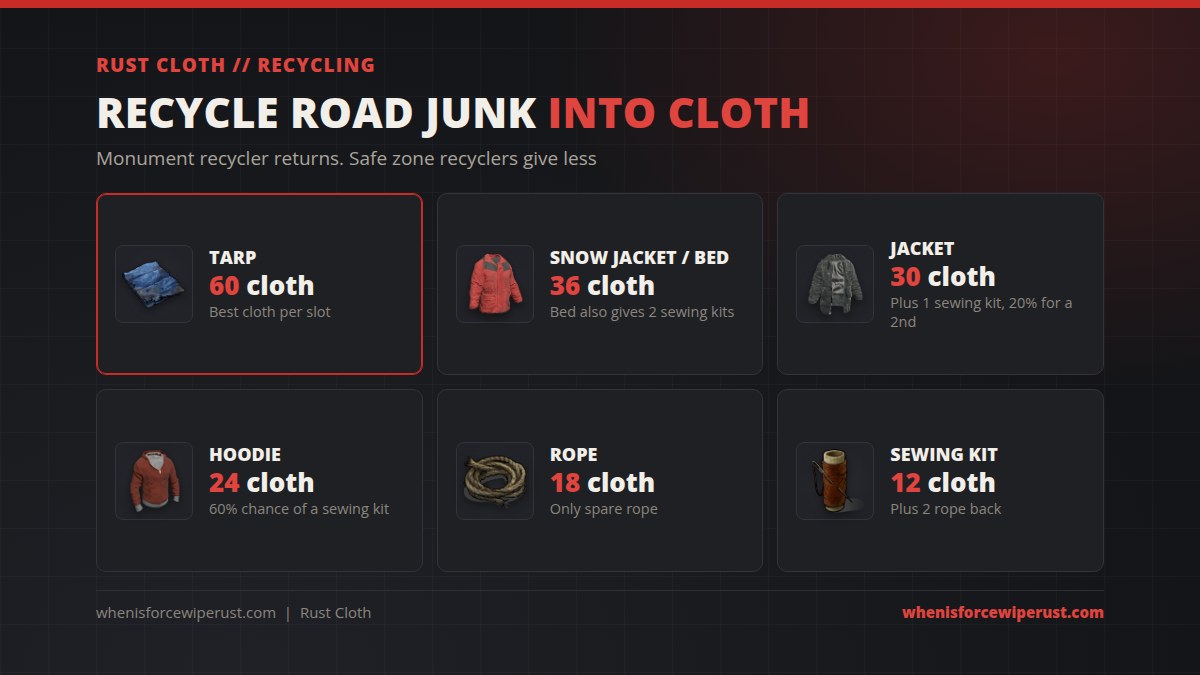
Recycle Road Junk into Cloth
The fastest mid-wipe Cloth is not gathered at all, it is recycled. A huge range of finished items break down into Cloth at a recycler, and roads are littered with exactly those items. A single road loop that clears barrels, dropped clothing and junk piles can net 300 to 500 Cloth once you drop off at the nearest recycler.
| Item recycled | Cloth returned | Where you find it |
|---|---|---|
| Tarp | 60 | Barrels and crates, best Cloth per slot |
| Snow Jacket / Bed | 36 | Loot and old base furniture |
| Jacket / Hoodie | 30 / 24 | Bodies and dropped loot |
| Rope | 18 | Recycle spare rope you will not use |
| Sewing Kit | 12 | Only if you are drowning in kits |
What Cloth Builds in Rust
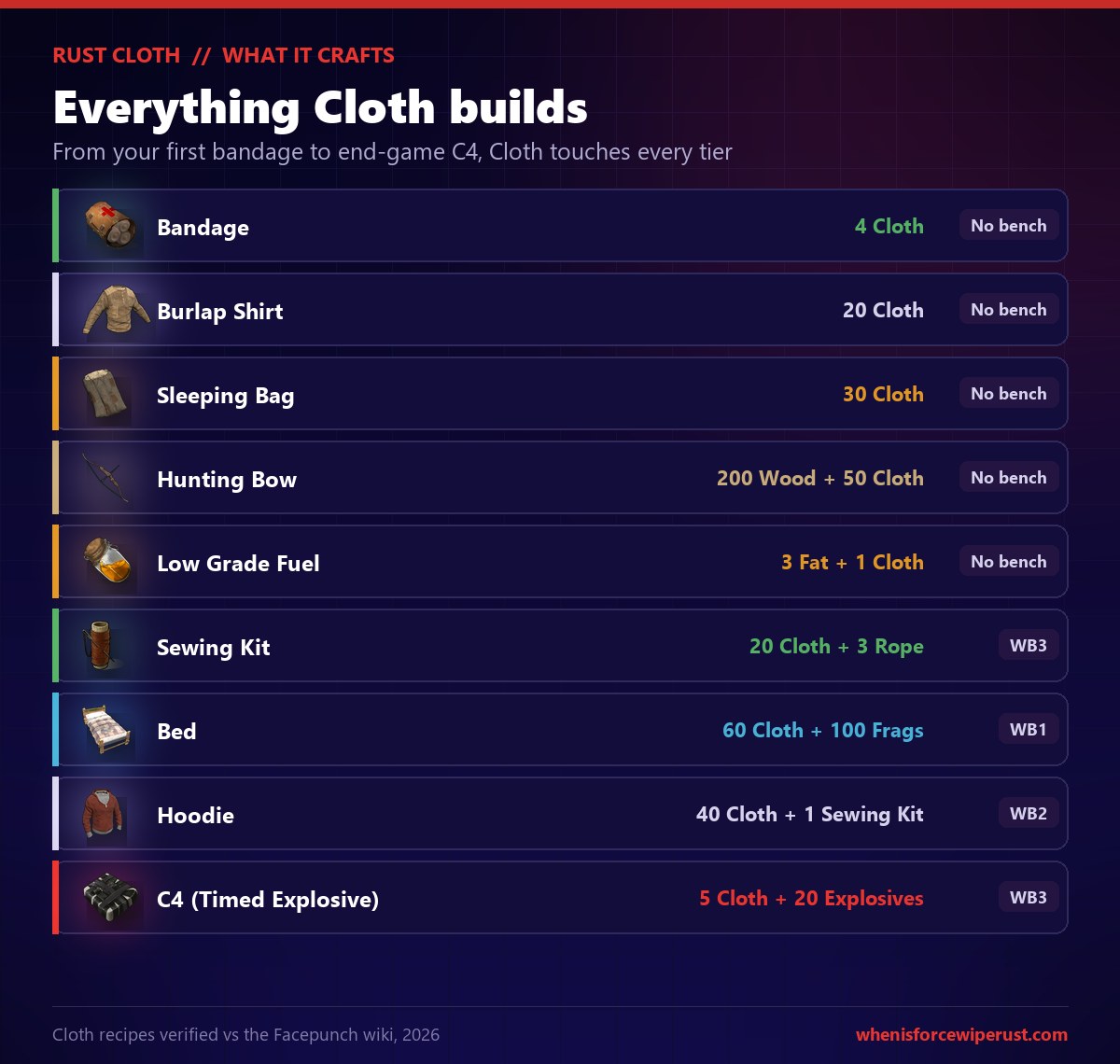
Cloth is woven through every tier of the game. It makes your very first survival gear with no workbench, gates all real armor through the sewing kit, and is even hidden inside end-game explosives. Here is the full list of the recipes that matter.
| Item | Cloth cost | Workbench |
|---|---|---|
| Bandage | 4 Cloth | None |
| Burlap Shirt | 20 Cloth | None |
| Sleeping Bag | 30 Cloth | None |
| Rug | 25 Cloth | None |
| Wallpaper | 10 Cloth per tile (+10 for the tool) | None |
| Hunting Bow | 200 Wood + 50 Cloth | None |
| Low Grade Fuel | 3 Animal Fat + 1 Cloth | None |
| Sewing Kit | 20 Cloth + 3 Rope | Level 3 |
| Bed | 60 Cloth + 100 Metal Frags + 2 Sewing Kits | Level 1 |
| Hoodie | 40 Cloth + 1 Sewing Kit | Level 2 |
| C4 | 5 Cloth + 20 Explosives | Level 3 |
Two things stand out. First, your entire day-one survival kit, bandage, burlap clothes, sleeping bag and bow, is pure Cloth with no workbench needed, which is why Cloth is the resource a fresh spawn chases first. Second, Cloth gates real armor through the Sewing Kit: a Metal Chest Plate needs 8 Sewing Kits, and each kit is 20 Cloth, so a single plate hides 160 Cloth before you count the metal. Cloth never stops mattering, it just moves up the tiers.
The Fastest Way to Get Cloth
There is no single “best” Cloth source, only the right one for your stage of the wipe. Match the method to the moment and you will never be short.

- Hour one: punch every hemp bush you pass and skin any animal you kill. It is free Cloth with zero setup, and it hands you the seeds and gear to snowball.
- Mid wipe: run a road loop and recycle the junk, tarp, spare clothing, rope and old kits. One loop is 300 to 500 Cloth in a few minutes, and you pick up scrap and components on the way.
- Settled: build a hemp farm with GGGYYY seeds. It quietly produces thousands of Cloth an hour with no travel and no risk, so you never think about Cloth again for the rest of the wipe.
Pro Tips for Farming Cloth
- Never walk past a hemp bush. Ten Cloth and a seed for holding E is the best value in the early game. The seeds compound into your farm.
- Carry a Bone Knife. It harvests more Cloth, meat and fat from every corpse than a rock or hatchet, so your hunting doubles your Cloth income.
- Recycle, do not wear, junk clothing. A looted Snow Jacket is 36 Cloth in a recycler. Unless you need the cold protection right now, break it down.
- Grow hemp outdoors when you can. Outdoor planters use free sun and rain. Indoor farms are stealthier but you pay for water and ceiling lights.
- Bank Sewing Kits, not the Cloth for them. Since armor eats kits fast, keep spare kits whole rather than recycling them back into 12 Cloth each.
- Store it in a box, not on you. Cloth despawns in 20 minutes on the ground but is safe in any container, so stash it the moment you get home.
Farming Cloth for the next wipe? Time your hemp farm and stockpile run around the force wipe. Check exactly when it lands.
When Is the Next Force Wipe?Rust Cloth FAQ
How do you get Cloth in Rust?
Can you craft Cloth in Rust?
What is the fastest way to get Cloth in Rust?
How much Cloth does a hemp plant give in Rust?
What are the best hemp genetics in Rust?
How much Cloth do animals drop in Rust?
Does cactus give Cloth in Rust?
What is Cloth used for in Rust?
How much Cloth for a sleeping bag and a bandage in Rust?
Can you recycle items into Cloth in Rust?
Does Cloth despawn in Rust?
What is the Cloth item ID and shortname in Rust?
Do wooden arrows need Cloth in Rust?
How do you farm Cloth fast in Rust?
Is Cloth the same as Hemp Fibers in Rust?
Sources
- Facepunch wiki: Cloth for the shortname, item ID, stack size, despawn time and the gather-only status.
- Facepunch wiki: Sleeping Bag, Hunting Bow, Bed and Hoodie for the exact Cloth recipes and workbench tiers.
- Corrosion Hour: How to Find Cloth in RUST for the animal yields, cactus values and recycling returns.
- RustHelp: Cloth for cross-checking sources, animal ranges and item data.
- XGamingServer: Rust Farming Guide for the hemp farming, planter and genetics workflow.