
Livestock is the biggest farming change Rust has had in years. Cows, bulls, sheep, calves and lambs are joining the chickens and bees you can already keep, and they come with breeding, genetics, milk, wool, new meats, two new pies and a biofuel generator that turns food and dung into low grade fuel. It is Rust, so the bull can also charge you.
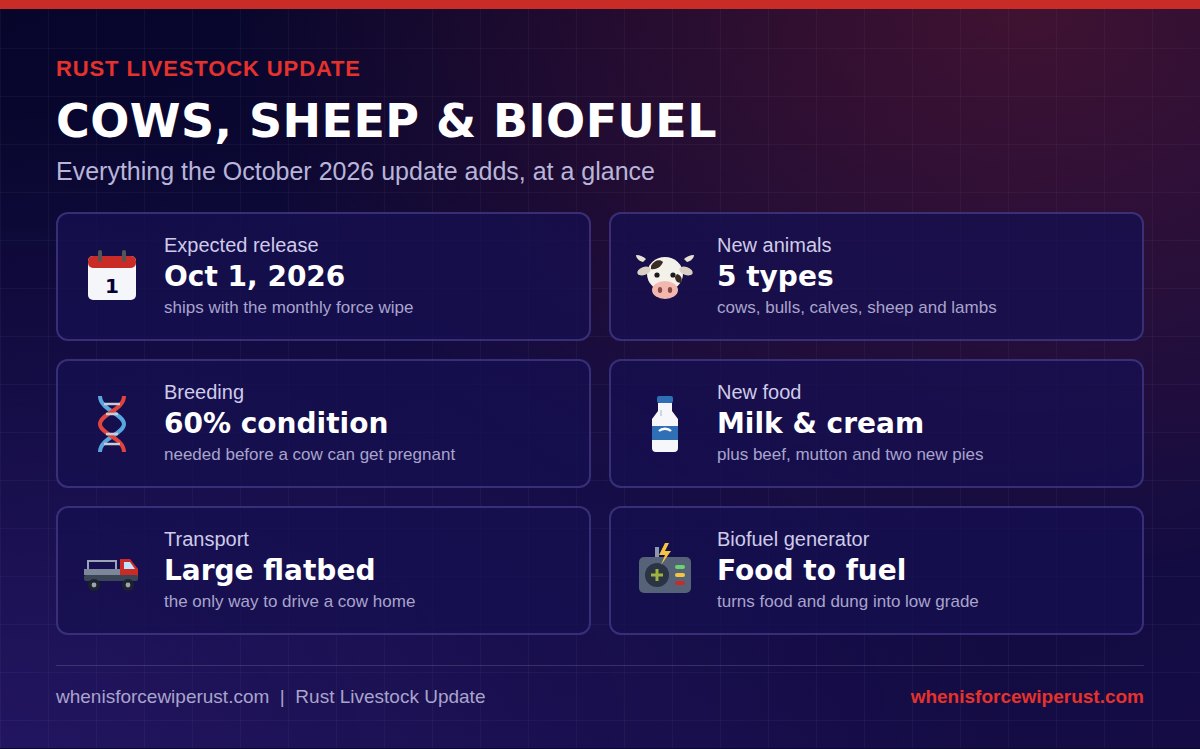
The livestock Rust update has been on the staging branch through September and is expected to land with the October 1, 2026 force wipe. That gives you a few days to plan a ranch before everyone else works it out on wipe day.
This livestock Rust guide covers every new animal, what each one gives you when harvested, how breeding and bonding work, the new milk and pie foods, how to move and sell animals, and how the biofuel generator works. The numbers come from the staging patch notes as reported by Rustafied, Rustpedia and Facepunch’s own commit feed. Staging values can change before release, and we’ll update this page if they do.
- What Is Livestock
- Release Date
- New Animals
- Harvest Yields
- Breeding
- Milk & Pies
- Transport & Selling
- Biofuel Generator
- Starting a Ranch
- Pro Tips
- FAQ
What Is Livestock in Rust?
Livestock is Rust’s system for keeping animals at your base and farming them for resources instead of hunting them in the wild. It builds on the chicken coop and the beehive, which already let you farm eggs and honey (see our Honey Bandage and beekeeping guide). Now it’s scaling up to big animals.
Facepunch listed new animal types, better animal AI, decorative animals and animal breeding on its Q4 2026 roadmap. The livestock update is that plan landing in the game. Here is what it changes in practice:
- Tame herds you own. Cows, bulls, calves, sheep and lambs live in a pen at your base, bond with you and breed.
- Renewable resources. Leather, cloth, bones, fat, meat, milk and wool no longer depend on finding a wild animal.
- A new food chain. Milk, skim milk, cream, beef, mutton, beef pies and mutton pies.
- A new fuel source. The biofuel generator turns food and animal dung into low grade fuel.
Rust Livestock Update Release Date
The Rust livestock update is expected on Thursday, October 1, 2026, with the monthly force wipe at around 18:00 UTC (2 PM ET, 11 AM PT). Cows and sheep have been on the staging branch since mid-September, and the patch notes have filled in more of the system every week.
Want to be first to breed a herd? The livestock update is expected with the next force wipe. Check the live countdown so you are online the minute it drops.
See the Force Wipe CountdownEvery New Livestock Animal in Rust
The update brings five kinds of livestock. Each one has its own job on the farm.
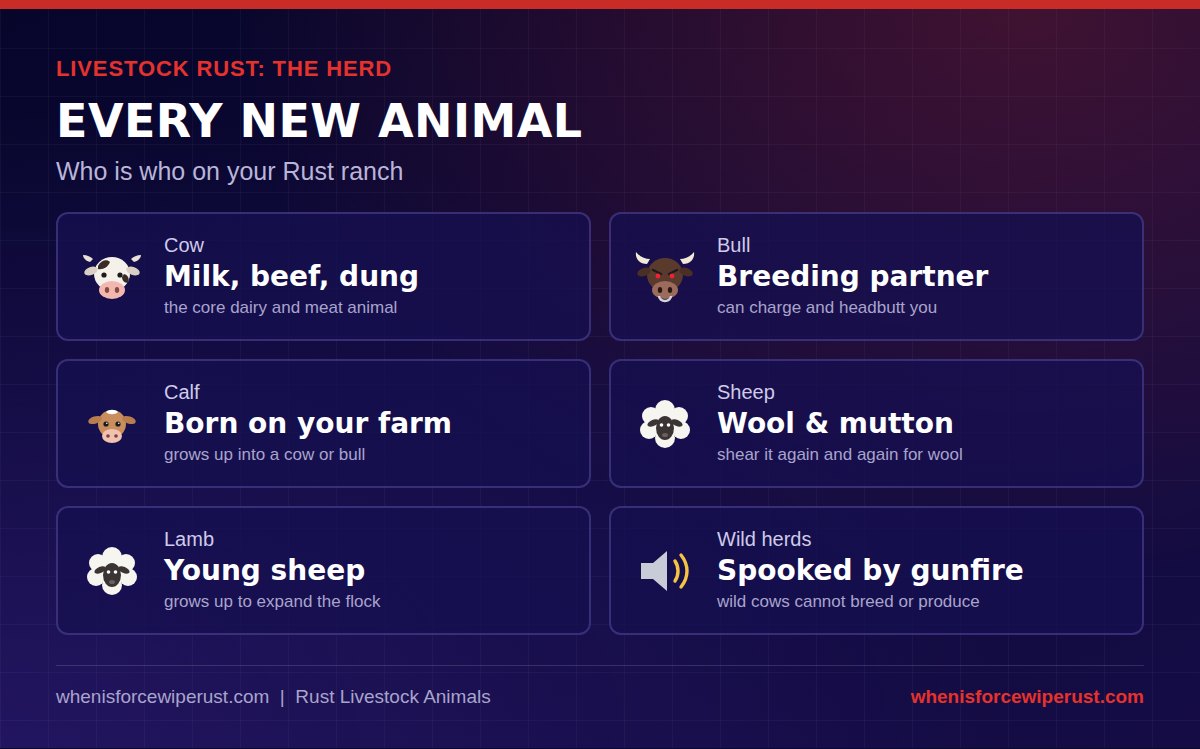
| Animal | What it gives you | Watch out for |
|---|---|---|
| Cow Core animal | Milk, dung, beef and the biggest harvest | Needs a large flatbed to move |
| Bull | Breeding partner for your cows | Can charge and headbutt players |
| Calf | Grows into a new cow or bull | Only comes from bred, healthy parents |
| Sheep | Wool you can shear again and again, plus mutton | Smaller harvest than a cow |
| Lamb | Grows into a new sheep | Needs time before it’s useful |
There is one important rule about wild animals. Wild cows can’t breed, age or produce resources. A wild herd is only a hunting target until you bond with it and bring it home. All livestock also run away from loud noises such as gunshots, so a fight near your pen can scatter the herd. Bulls, cows and sheep can also be mounted as hunting trophies.
Livestock Rust Harvest Yields
When an animal is old or you need resources fast, you can harvest it. These are the current staging yields for one fully harvested animal.
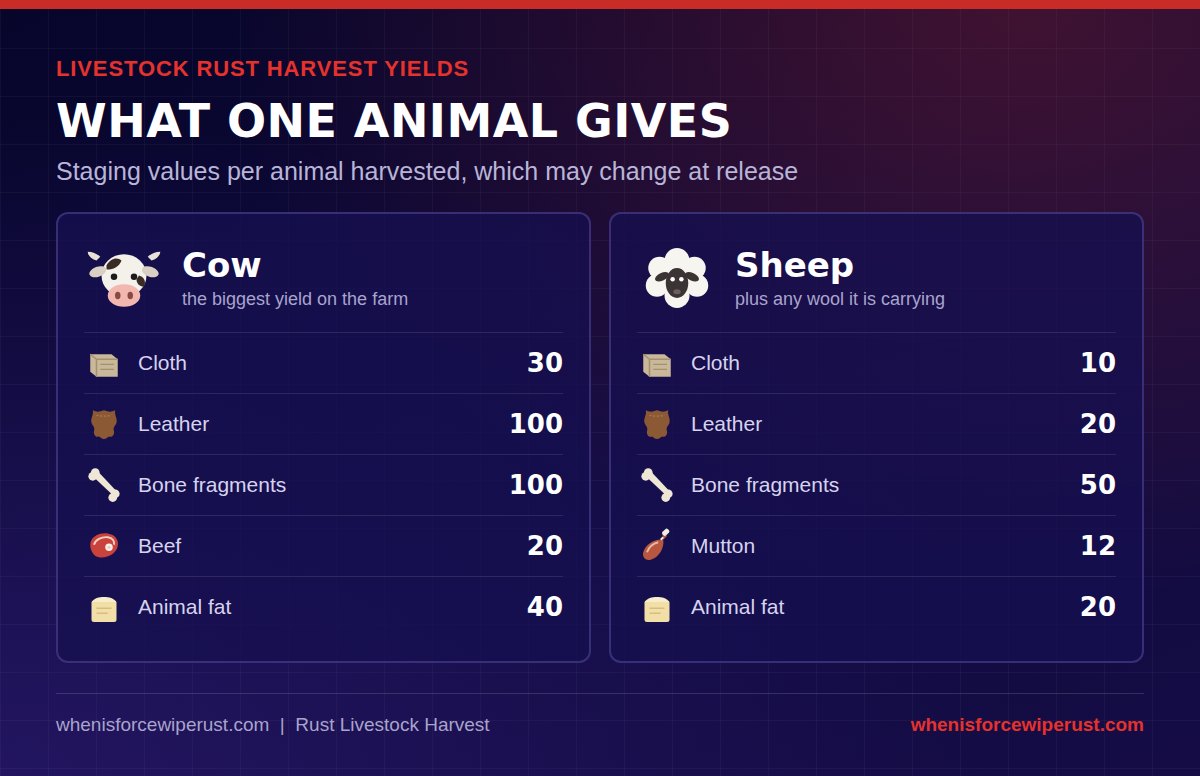
| Resource | Cow | Sheep | Used for |
|---|---|---|---|
| Cloth | 30 | 10 | Sleeping bags, clothing, rope |
| Leather | 100 | 20 | Armour, boots, gloves, hide gear |
| Bone fragments | 100 | 50 | Bone tools, bone arrows, bone armour |
| Meat | 20 beef | 12 mutton | Food and the new pies |
| Animal fat | 40 | 20 | Low grade fuel with cloth |
| Wool | – | Whatever it carries | Shear it instead of harvesting |
How Livestock Breeding Works in Rust
Rust livestock breeding is what turns a couple of animals into a real herd. Facepunch has added bonding, herd behaviour, genetics and crossbreeding, and animals now respect fences.
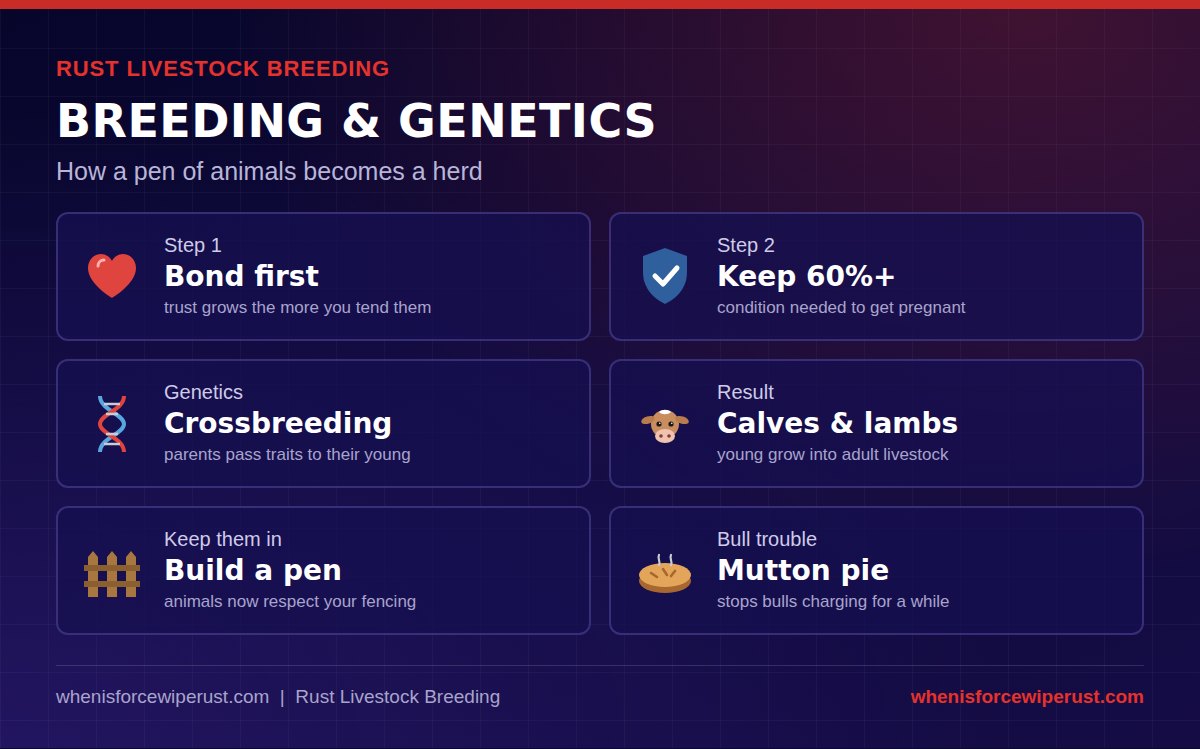
- Bond with the animal. Livestock has a new bonding system. The more you tend an animal, the more it trusts you. A mutton pie speeds this up.
- Keep condition at 60% or higher. A cow needs at least 60% condition before it can get pregnant. A hungry, neglected animal won’t breed.
- Pair a cow with a bull. Genetics and crossbreeding mean the parents pass traits to their young, so it pays to breed your best animals.
- Raise the young. Calves and lambs grow into adult cows, bulls and sheep that can breed in turn.
Milk, Wool, Meat and New Pies
Livestock adds a whole new layer to food in Rust. Cows make milk, sheep grow wool you can shear, and there are two new meats and two new pies.
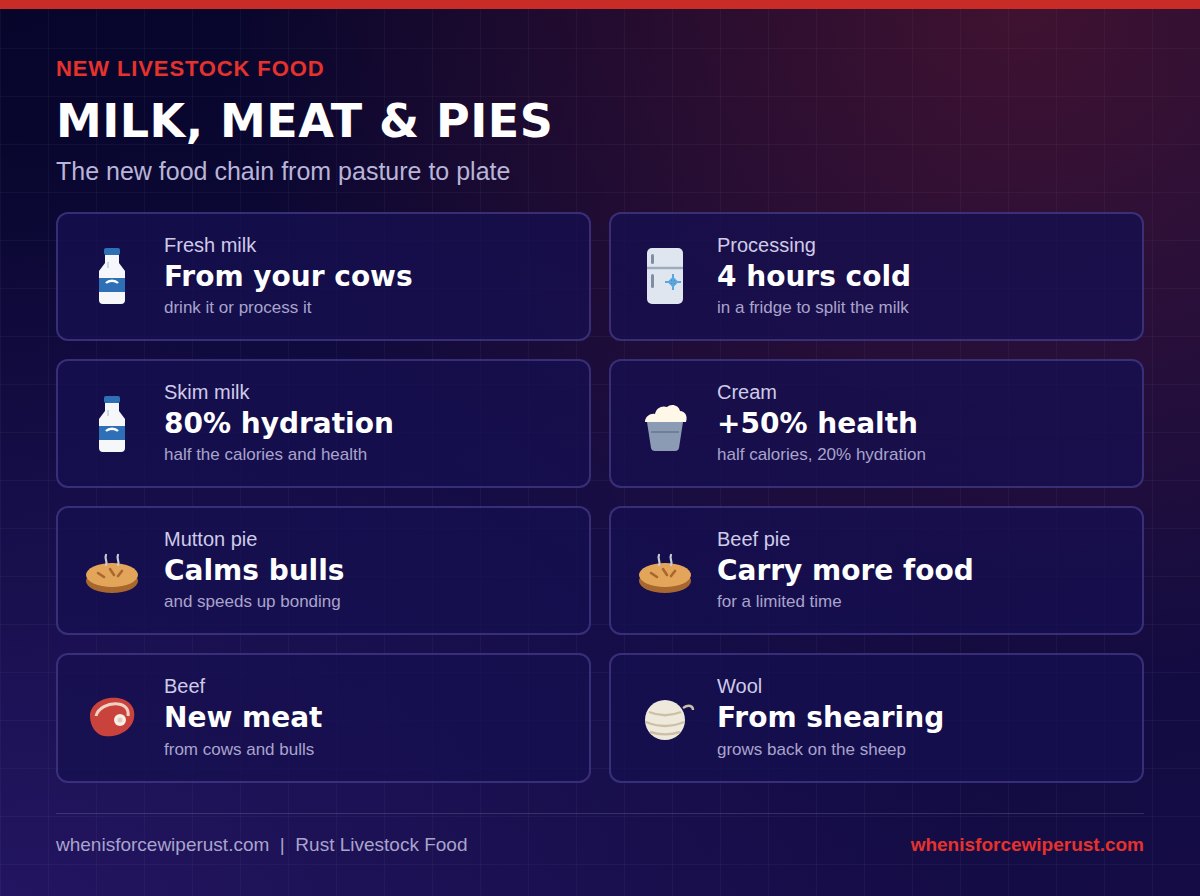
| Item | Where it comes from | What it does |
|---|---|---|
| Milk | Your cows | A new drinkable food item |
| Skim milk | Milk after 4 hours in a fridge | 80% of the hydration, half the calories and health |
| Cream Healing | Milk after 4 hours in a fridge | 50% more health, half the calories, 20% of the hydration |
| Beef | Cows and bulls | New meat for cooking and pies |
| Mutton | Sheep | New meat for cooking and pies |
| Mutton pie Ranch tool | Made with mutton | Speeds up bonding and stops bulls charging for a while |
| Beef pie | Made with beef | Lets you carry more food for a limited time |
| Wool | Shearing sheep | Grows back, and the sheep shows its progress |
To process milk, put it in a refrigerator for four hours and it can then be skimmed into skim milk and cream. Cream is the one to keep. It heals more than milk, which makes it a handy snack before a fight. For the full breakdown, including how cream and milk boost Pure teas, see our milk and cream Rust guide. Wool is saved on each sheep and grows back over time, so shearing a flock is steady, renewable income.
Moving and Selling Livestock
Getting animals home is half the work. Animals can now be led on a visible rope and loaded into vehicle mount slots.
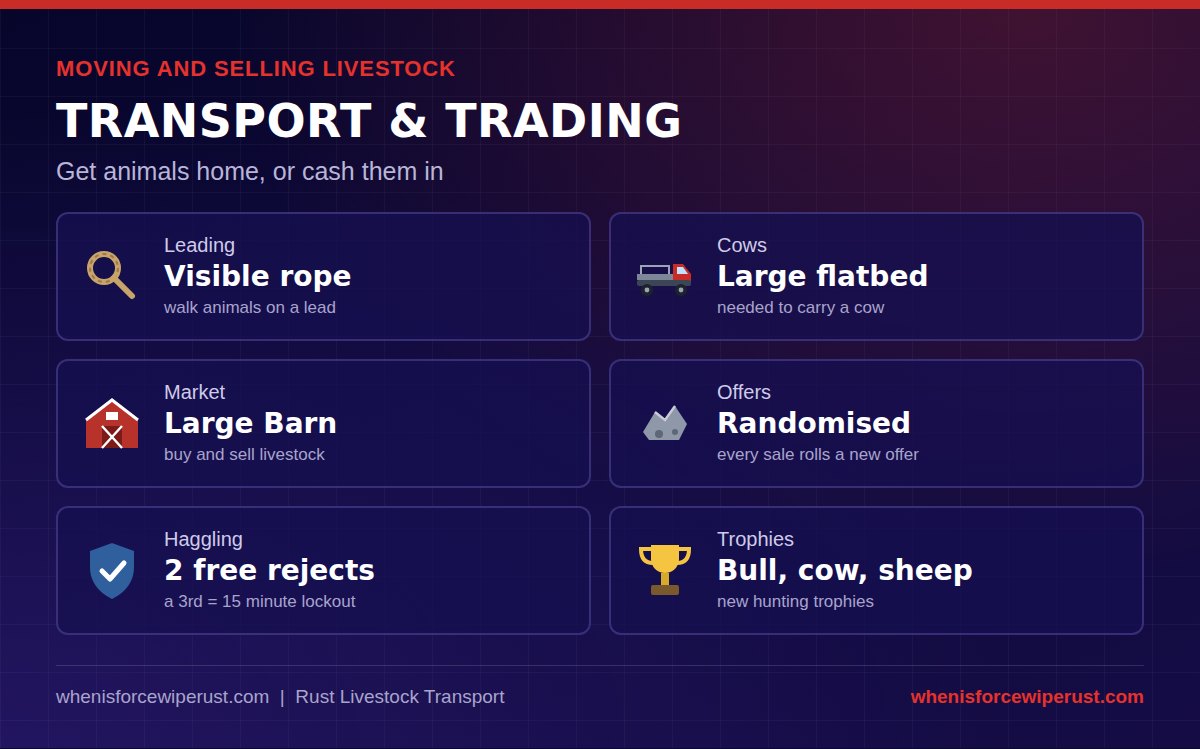
- Lead on a rope. You can walk livestock on a lead, and the rope now shows in the world, so other players can see you coming.
- Cows need a large flatbed. Smaller animals fit in supported vehicle slots, but a cow needs the large flatbed module on a modular car. Plan the route home and avoid busy monuments.
- Sell for random offers. A new ranch selling system gives you a random item offer for each animal. You can turn down two offers and roll again, but if you reject a third the vendor gets annoyed and won’t trade with you for 15 minutes.
- Buy and sell at the Large Barn. Server previews show livestock being bought and sold at the Large Barn, the same safe zone monument where you already buy horses.
Rust Biofuel Generator
The biofuel generator is the other half of the update. It turns food and livestock dung into low grade fuel. That gives farmers a steady fuel supply without farming animal fat and cloth or running a refinery.
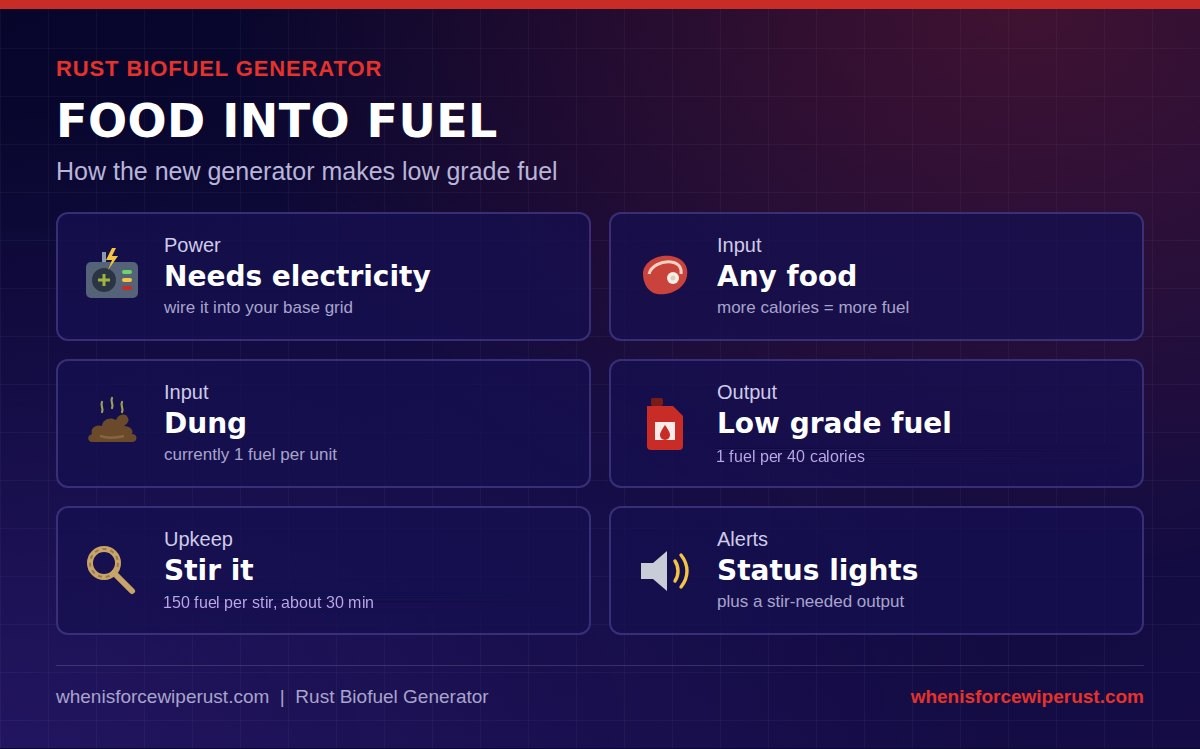
| Mechanic | How it works |
|---|---|
| Power | Needs 5 rW of electricity to run. Wire it into your base grid. |
| Food input | 1 low grade fuel per 40 calories, fresh or spoiled. 3 slots work at once, up to 5 fuel a minute. |
| Dung input | Gives 1 low grade fuel per dung. |
| Stirring | A 10 second stir is good for 150 fuel, about 30 minutes at full load. New food needs a fresh stir. |
| Indicator lights | Show whether it is processing, finished, empty or waiting for a stir. |
| Electrical output | A dedicated output fires when it needs a stir, so you can wire up your own alarm. |
If your base runs on electric furnaces or you burn low grade in a regular furnace, a biofuel generator fed by a herd’s dung and spare food takes some pressure off your fuel supply. Craft cost, fuel per food and wiring are in our full Biofuel Generator guide.
How to Start a Livestock Farm in Rust
Here is a simple plan for a first ranch on wipe day, based on how the system works on staging.
- Secure your base first. Get a Tool Cupboard and a door with a code lock down before you spend time on animals.
- Build a fenced pen. Animals now respect fencing, so a walled yard next to your base keeps the herd in and raiders out. Our building guide covers the costs.
- Find a herd and bond. Wild cows won’t produce anything until they’re yours. Bond with them, bringing a mutton pie if you have one, and lead them home on a rope.
- Bring a flatbed for cows. Sheep are easier to move early. Cows need a large flatbed.
- Keep condition above 60%. Feed and look after them so they can breed.
- Add a fridge and a biofuel generator. Turn milk into cream, and turn dung and scraps into low grade fuel.
Livestock Rust Pro Tips
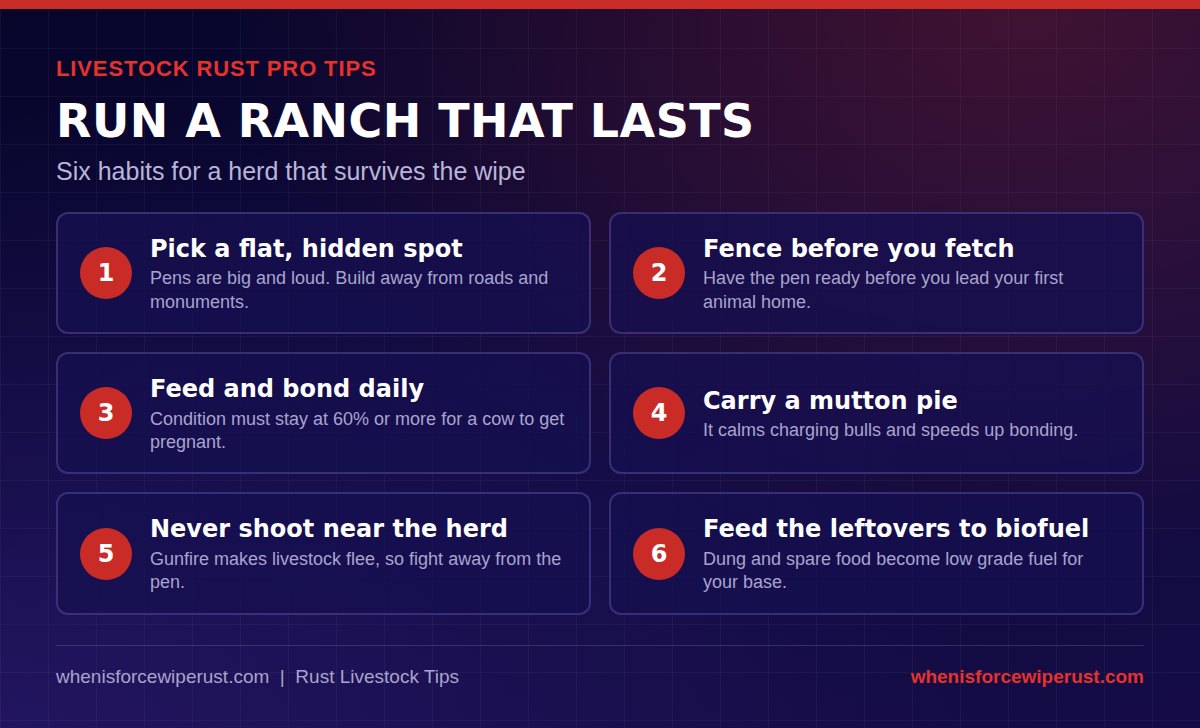
- Pick a flat, hidden spot. Pens are big and noisy. Build away from roads and monuments so roamers don’t find them.
- Fence before you fetch. Have the pen ready before you lead your first animal home.
- Feed and bond daily. Condition has to stay at 60% or more for breeding, and bonding makes the herd easier to handle.
- Carry a mutton pie. It calms charging bulls and speeds up bonding.
- Never shoot near the herd. Gunfire makes livestock flee. Fight away from the pen.
- Feed the leftovers to biofuel. Dung and spare food become low grade fuel for your base. Keep the pen compact too, because a huge compound raises decay and upkeep costs.
Building a ranch this wipe? Your herd won’t survive the monthly force wipe, which clears every base, animal and item. Check the countdown so you know how long you have.
See the Force Wipe CountdownLivestock Rust FAQ
When does the livestock update come out in Rust?
The Rust livestock update is expected with the October 1, 2026 force wipe, at around 18:00 UTC (2 PM ET, 11 AM PT). It was tested on the staging branch through September 2026.
What animals are in the Rust livestock update?
The update adds cows, bulls, calves, sheep and lambs. They join the chickens and bees that players could already farm. Q4 2026 plans also mention decorative animals and more animal types.
How do you breed cows in Rust?
Bond with a tame cow and a bull and keep the cow’s condition at 60% or higher, which is the minimum for pregnancy. Crossbreeding passes genetic traits to the calf. Wild cows cannot breed, age or produce resources until they are yours.
What do you get from harvesting a cow in Rust?
On staging, a cow gives 30 cloth, 100 leather, 100 bone fragments, 20 beef and 40 animal fat. A sheep gives 10 cloth, 20 leather, 50 bone fragments, 12 mutton and 20 animal fat, plus any wool it is carrying.
How do you get milk and cream in Rust?
Cows produce milk. After milk spends four hours in a refrigerator it can be skimmed into skim milk and cream. Skim milk keeps 80% of the hydration and half the calories and health. Cream gives 50% more health with half the calories and 20% of the hydration.
How do you move a cow in Rust?
You can lead livestock on a visible rope, and load animals into supported vehicle mount slots. Cows specifically need the large flatbed vehicle module.
What does the biofuel generator do in Rust?
The biofuel generator turns food and livestock dung into low grade fuel. It needs 5 rW of electricity, makes 1 fuel per 40 calories of food and 1 per dung, and a 10 second stir is good for 150 fuel, about 30 minutes at full load.
Can you sell livestock in Rust?
Yes. The ranch selling system offers a random item for each animal. You can reject two offers, but rejecting a third makes the vendor refuse to trade with you for 15 minutes. Server previews show livestock being bought and sold at the Large Barn.
Do bulls attack you in Rust?
Yes. Bulls can charge and headbutt players. Eating a mutton pie temporarily stops bulls from charging you and also speeds up bonding with your animals.
Does livestock get wiped in Rust?
Yes. Livestock lives on the map like your base, so every map wipe removes it, including the monthly force wipe. You start a new herd each wipe.
Sources and Further Reading
- Milk, cream, selling offers and bonding: Rustafied, Livestock, Milk, and more!
- Harvest yields, breeding, transport and biofuel generator: Rustafied, September 24 staging roundup
- Development commits for livestock animals: Facepunch Commits, Rust
- Q4 2026 animal and biofuel plans: Facepunch, Rust Roadmap
- The farming system that came first: Corrosion Hour, Rust Chicken Husbandry
- Where you buy horses and livestock: RustHelp, Large Barn
- Beekeeping and honey: whenisforcewiperust.com, Honey Bandage Guide
- What to do with the fuel: whenisforcewiperust.com, Low Grade Fuel Guide
- The game itself: Facepunch Studios