
The Biofuel Generator came with the October 2026 Livestock update, and it fixes one of Rust’s oldest chores. Instead of farming animal fat and cloth for low grade fuel, you drop food and animal dung into a tank, give it a stir and let it brew fuel for you, even while you are offline.
This Biofuel Generator Rust guide covers the craft cost and tech tree price, how the stirring works, how much fuel each food makes, how to power and wire it, how to feed it from a herd of cows and sheep, and what it takes to destroy one.
- What It Is
- Stats
- Craft & Unlock
- How It Works
- Fuel per Food
- Power & Wiring
- Dung Farm
- Is It Worth It
- Destroy Cost
- Tips
- FAQ
What Is the Biofuel Generator in Rust?
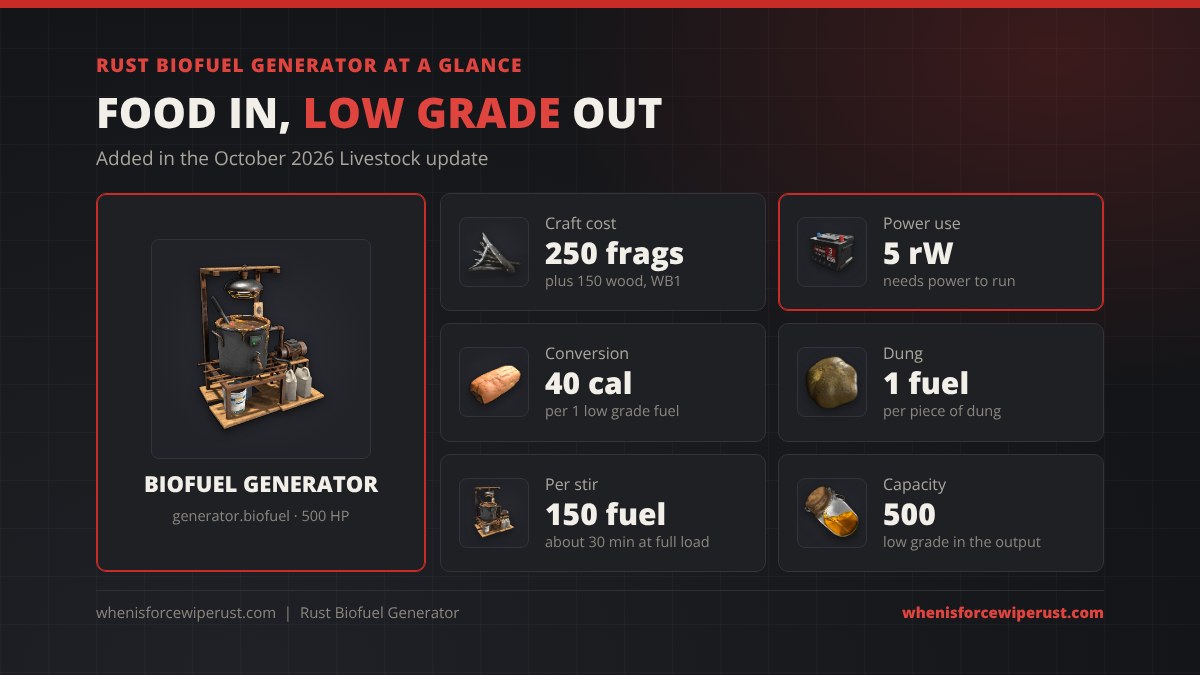
The Biofuel Generator is a deployable that turns organic matter into low grade fuel. It arrived with the Livestock update on October 1, 2026, alongside cows, sheep and the new dung they drop. Despite the name, it does not make electricity. It is a fuel maker that uses electricity.
Any food works, fresh or spoiled, cooked or raw, plus livestock dung. Food with more calories makes more fuel, so a loaf of bread is worth far more than a handful of grubs. That finally gives rotten meat and old crops a use, and it gives a farming base a fuel supply that does not depend on hunting or a furnace full of fat and cloth.
The catch is that it has to be stirred by hand. It only keeps working for so long after each stir, so someone has to walk over and give it a 10 second stir to keep fuel coming.
Biofuel Generator Stats
| Stat | Biofuel Generator |
|---|---|
| Craft cost | 250 Metal Fragments, 150 Wood |
| Crafted at | Workbench Level 1 |
| Unlock | Workbench 1 tech tree, right side (about 105 scrap to reach) |
| Power use | 5 rW |
| Input slots | 3, processed at the same time |
| Speed | 1 fuel every 36 seconds per slot, up to 5 fuel a minute |
| Conversion | 1 low grade per 40 calories of food, 1 per dung |
| Fuel per stir | 150 (about 30 minutes at full load) |
| Stir time | 10 seconds |
| Output capacity | 500 Low Grade Fuel |
| Outputs | Needs Stirring signal (1 power) |
| Health | 500 HP |
| Recycle | 125 metal fragments and 75 wood at a standard recycler, less at a safe zone |
| Shortname | generator.biofuel |
How to Craft and Unlock the Biofuel Generator

The recipe is 250 metal fragments and 150 wood, crafted at a Workbench Level 1 or higher. That is cheaper than a solar panel, so it is realistic on wipe day.
The blueprint is a Tier 1 item on the right side of the Workbench 1 tech tree. Reaching it costs about 105 scrap in total, counting the nodes you unlock on the way. See our Rust tech tree guide for how node prices work and what else sits on that branch.
How the Biofuel Generator Works

- Place it and power it. It needs 5 rW running into its power input, or it does nothing.
- Add food or dung. There are 3 input slots, and all three are processed at the same time.
- Stir it. Hold the stir action for 10 seconds. One stir is good for 150 fuel of processing.
- Let it brew. Each slot makes 1 fuel every 36 seconds, so a full generator makes 5 fuel a minute. At that speed a stir lasts about 30 minutes.
- Collect the low grade. Fuel stacks up in the output, up to 500. Empty it before it fills or it stops.
It keeps working while you are offline, as long as it has power, food and stir time left. Adding fresh food needs a new stir before it starts on it, so top it up and stir in the same trip. Status lights on the front tell you whether it is processing, done, empty or waiting for a stir.
How Much Low Grade Each Food Makes
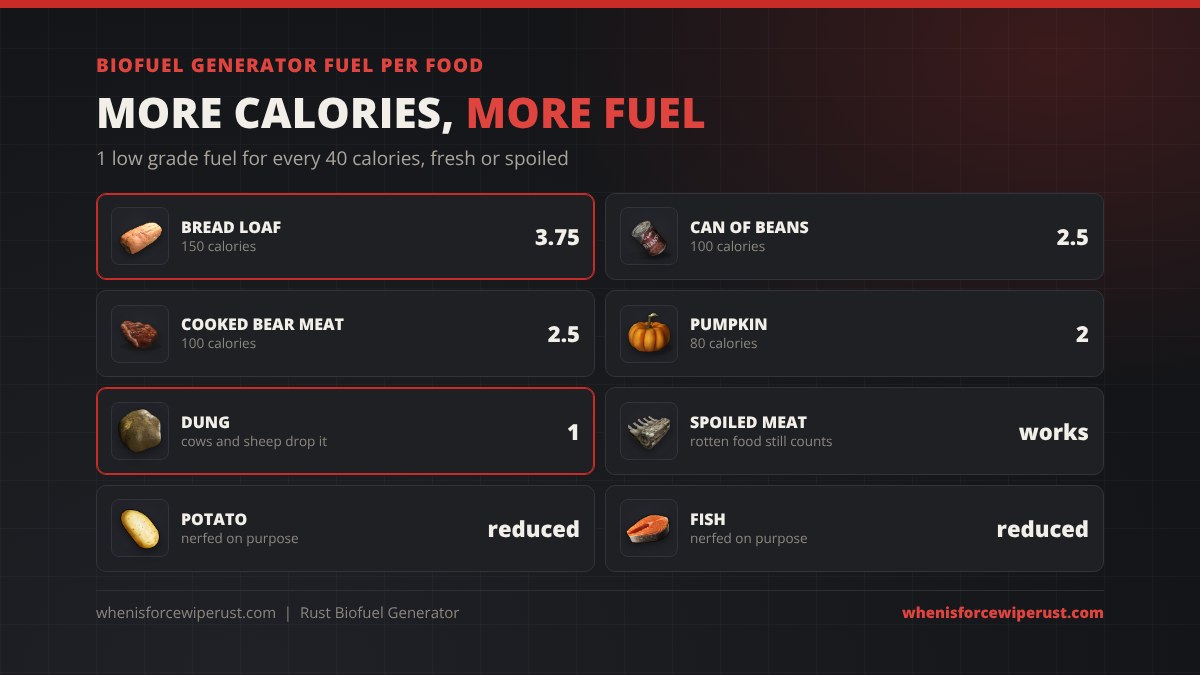
The rule is simple: 1 low grade fuel for every 40 calories. Dung is fixed at 1 fuel per piece. Facepunch deliberately made potatoes and fish less efficient than their calories suggest, so a potato or fish farm is not a fuel exploit.
| Item | Calories | Low grade fuel |
|---|---|---|
| Brioche | 190 | 4.75 |
| Bread Loaf | 150 | 3.75 |
| Cooked Beef / Cooked Mutton | 120 | 3 |
| Cooked Big Cat Meat | 120 | 3 |
| Can of Beans | 100 | 2.5 |
| Cooked Bear Meat | 100 | 2.5 |
| Pumpkin | 80 | 2 |
| Dung (cow or sheep) | – | 1 |
| Potatoes, fish | – | reduced on purpose |
Spoiled food still counts, which is the best part. Meat that rotted in a box, or crops you forgot to put in a fridge, can go straight into the tank instead of the bin. Only feed it food you would not eat or sell, though. A good cooked meal is usually worth more as food than as 3 fuel.
How to Power and Wire the Biofuel Generator
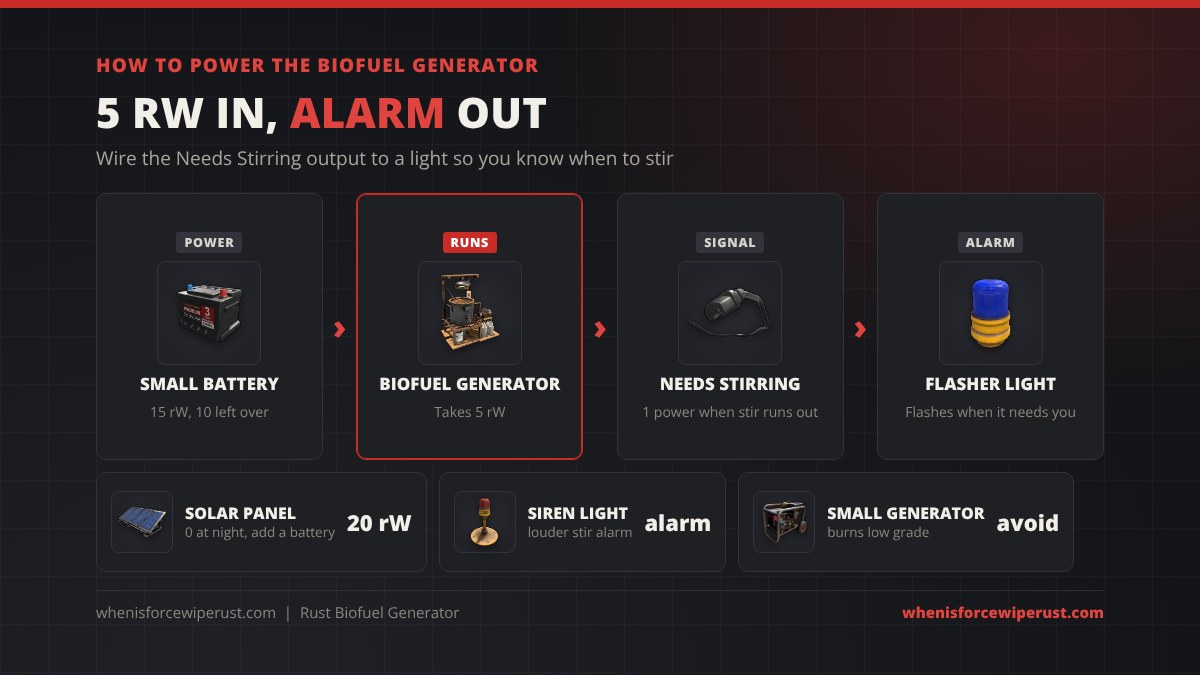
The generator needs 5 rW. A Small Rechargeable Battery puts out 15 rW, so one battery can run the generator and still have 10 rW left for lights. A large solar panel gives up to 20 rW in daylight but 0 at night, so put a battery between them if you want it to work around the clock.
Running it off a small fuel generator makes no sense, since you would be burning low grade to make low grade. Use solar, wind or a battery.
The generator also has a Needs Stirring output. It sends a 1 power signal when the stir time runs out. Wire it with the Wire Tool to a Flasher Light, a Siren Light or a ceiling light by the door, and you will see at a glance when it needs you.
Feeding It From a Livestock Dung Farm
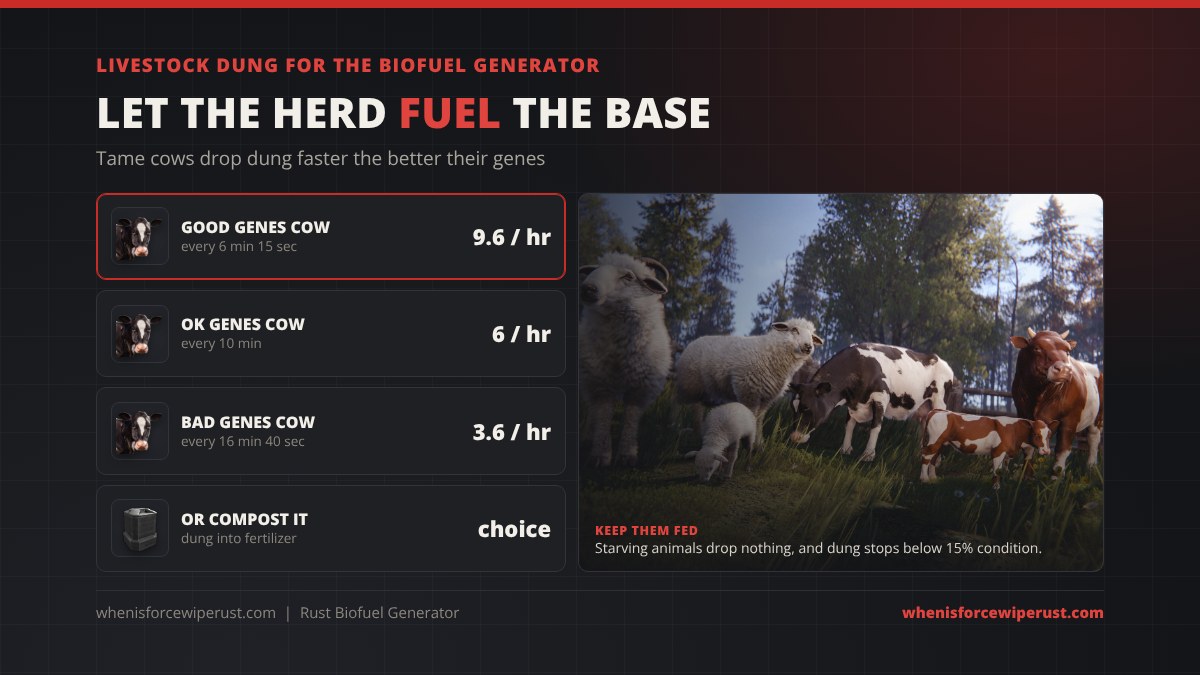
Tame cows and sheep drop dung on their own. For cows the rate depends on genes. At full condition a cow with bad genes drops one about every 16 minutes 40 seconds (3.6 an hour), an OK cow every 10 minutes (6 an hour) and a cow with good genes every 6 minutes 15 seconds (9.6 an hour). Times vary by about 20%.
Condition matters. A cow in poor condition drops dung up to 3 times slower, and below 15% condition it stops completely. Starving animals drop nothing. So the same care that keeps a herd breeding also keeps the fuel coming. Our livestock guide covers feeding, bonding and breeding.
Dung is a choice, not free fuel. You can put it in the Biofuel Generator for 1 low grade each, or in a composter for fertilizer for your crops. A farm that grows its own food may want the fertilizer more. A base that runs on low grade usually wants the fuel. Horses still drop dung too, though much less than they used to, see our horse guide.
Is the Biofuel Generator Worth It?
For most bases, yes. It is cheap, it uses food you would otherwise throw away, and at full speed it makes up to 300 low grade an hour while it stays stirred. Compare that with crafting low grade by hand from 3 animal fat and 1 cloth per 4 fuel, which means hunting and farming hemp.
- Good for: farm bases, solo players with spoiled food, anyone running a herd, and groups that burn lots of low grade in furnaces, lanterns and vehicles.
- Less good for: roam groups that are rarely home, since nobody is there to stir it. Each stir only covers 150 fuel.
- Watch out: fuel stacks up inside it. A generator full of 500 low grade is loot, so keep it behind doors.
How to Destroy a Biofuel Generator
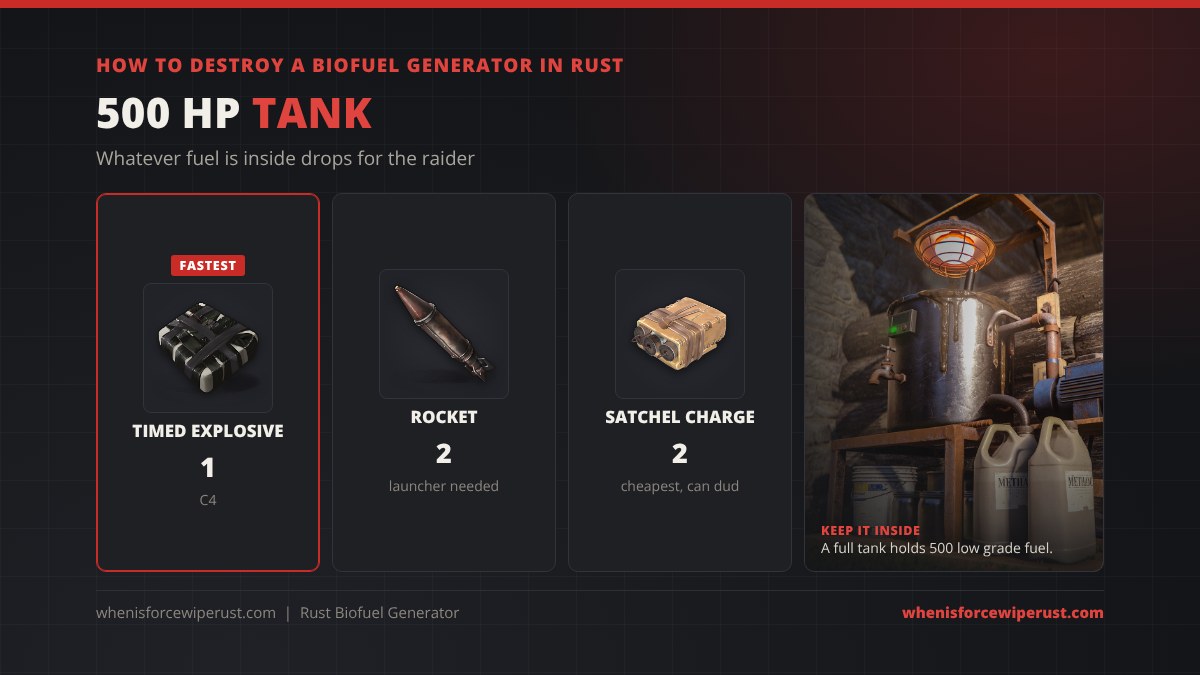
The Biofuel Generator has 500 HP. It takes 1 C4, 2 rockets or 2 satchel charges to destroy. Satchels are the cheapest, but each has a chance to dud. Raiders usually go for the walls and doors first, so check our raid calculator to see how much your base costs to get into.
Biofuel Generator Tips

- Stir every time you top it up. New food waits for a stir, so do both in one trip.
- Fill all 3 slots. The slots work in parallel. One slot makes fuel at a third of the speed.
- Wire a stir alarm. Run the Needs Stirring output to a light near your door or main room.
- Feed it spoiled food first. Rotten meat and old crops make fuel and save your good food.
- Use a battery. A solar panel alone stops it at night. 5 rW is easy for one small battery.
- Empty it often. It stops at 500 fuel, and a full tank is a raid target.
- Pair it with a furnace. Feed the fuel straight into your large furnace or a vehicle and you will rarely need to farm fat and cloth again.
Every base, herd and Biofuel Generator is cleared at the monthly force wipe. Check when the next Rust force wipe is before you build a big ranch.
Biofuel Generator FAQ
What does the Biofuel Generator do in Rust?
The Biofuel Generator turns food and livestock dung into low grade fuel. It needs 5 rW of power and has to be stirred by hand. It makes 1 low grade per 40 calories of food and 1 per dung.
How do you craft a Biofuel Generator in Rust?
A Biofuel Generator costs 250 metal fragments and 150 wood at a Workbench Level 1. You unlock the blueprint on the right side of the Workbench 1 tech tree, which costs about 105 scrap to reach.
How much power does the Biofuel Generator need?
The Biofuel Generator needs 5 rW of power. One Small Rechargeable Battery (15 rW) can run it with power to spare.
How often do you have to stir the Biofuel Generator?
A 10 second stir is good for 150 fuel of processing. With all 3 slots working it makes 5 fuel a minute, so you need to stir it about every 30 minutes. Adding new food also needs a fresh stir.
How much low grade fuel does food make in the Biofuel Generator?
Food makes 1 low grade fuel for every 40 calories. Brioche makes 4.75, a bread loaf 3.75, cooked beef or mutton 3, a can of beans 2.5 and a pumpkin 2. Dung makes 1. Potatoes and fish were made less efficient on purpose.
Does spoiled food work in the Biofuel Generator?
Yes. Fresh and spoiled food both work, so rotten meat and old crops can be turned into low grade fuel.
How much fuel can the Biofuel Generator hold?
The Biofuel Generator holds up to 500 low grade fuel in its output. It stops when the output is full, so empty it regularly.
Does the Biofuel Generator work while offline?
Yes. It keeps making fuel while you are offline as long as it has power, food and stir time left.
How do you destroy a Biofuel Generator in Rust?
The Biofuel Generator has 500 HP. It takes 1 C4, 2 rockets or 2 satchel charges to destroy.
Sources and Further Reading
- Release notes for cows, sheep and the Biofuel Generator: Facepunch, Livestock Update
- Craft cost, power, stir and fuel table: RustHelp, Biofuel Generator
- Development notes on biofuel and dung: Rustafied, Livestock and Biofuel work
- Spoiled meat and the stir mechanic: PCGamesN, Rust Livestock update
- Dung rates by cow gene: BisectHosting, Rust Cow Guide