
The Hazmat Suit is the item that turns half the map from a no go zone into a loot route. Every monument worth running, Launch Site, Military Tunnels, Power Plant, Airfield, sits inside a radiation field that will kill a naked player in under a minute. The suit is the key that opens all of them, and it costs less than most people think.
It is also the most misused item in Rust. Players craft one, wear it everywhere, and then get deleted by the first person they meet holding an AK, because a Hazmat Suit blocks 30% of bullet damage and occupies every single clothing slot you own. There is no helmet on top of it. There is no chest plate under it. What you see is what you get.
This guide covers the real crafting cost, all six protection stats, the four ways to get a suit, which monuments actually need one, and the two rooms in the entire game where a Hazmat Suit is not enough.
- What It Is
- Protection Stats
- How to Get One
- Crafting Cost
- Which Monuments
- How Radiation Works
- Hazmat vs Armor
- Skins & Variants
- Myths & Mistakes
- Pro Tips
- FAQ
What Is the Hazmat Suit in Rust?
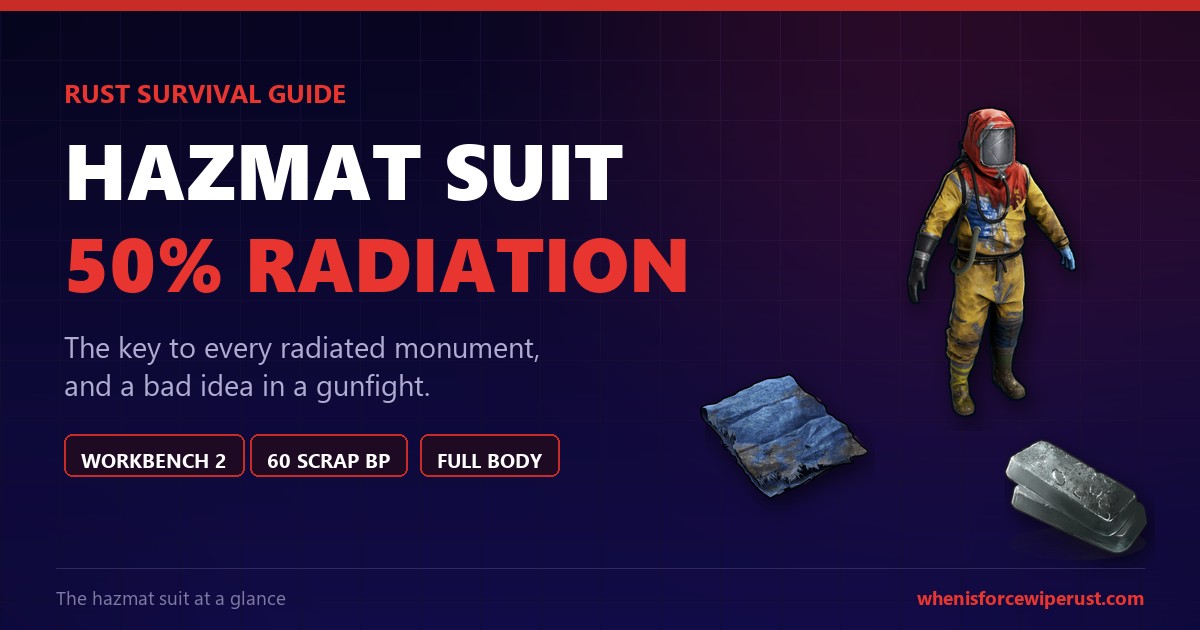
The Hazmat Suit is a full body protective outfit described in game as a suit made from radiation resistant rubber. It is the single best radiation protection item in Rust, and no other piece of gear comes close.
Mechanically it belongs to a small category called full body suits. Rust normally gives you a layered clothing system: head, chest and legs each take one clothing item plus one armor item on top, and hands and feet take one item each. That is up to eight pieces of gear working together. A full body suit throws all of that out. It occupies every slot at once, and nothing else can be equipped alongside it.
That single design decision is what makes the suit interesting. You are not adding radiation protection to your kit, you are replacing your entire kit with radiation protection. Every trip in a hazmat is a bet that you will not be shot at.
The suit does not stack, it despawns in 40 minutes on the ground, and it wears down with damage. Repairs cost 108 Cloth and 2 High Quality Metal at a repair bench, which is cheap enough that a damaged suit is always worth fixing rather than replacing.
Hazmat Suit Protection Stats
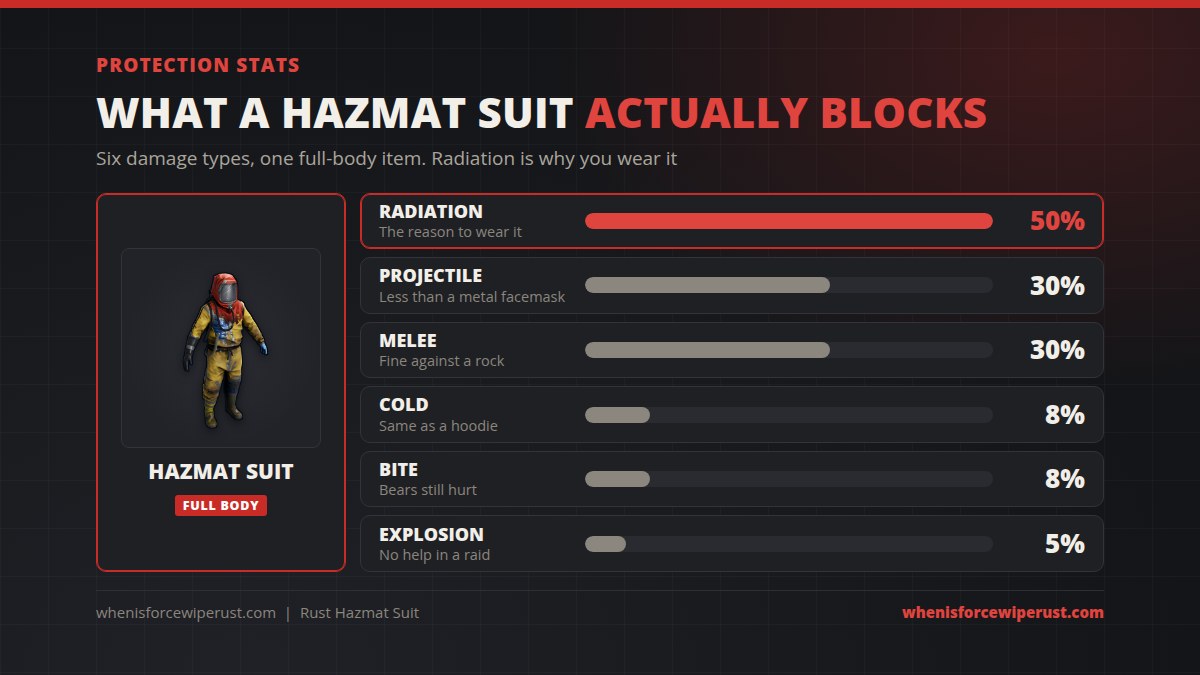
The suit protects against six damage types, and the spread tells you exactly what it was designed for.
| Damage Type | Protection | What That Means in Practice |
|---|---|---|
| Radiation The reason | 50% | Highest of any single item in the game. Covers almost every rad zone. |
| Cold | 8% | About the same as a hoodie. Not a snow biome outfit. |
| Bite | 8% | Bears and wolves still hurt. |
| Projectile | 30% | Less than a metal facemask gives your head alone. |
| Melee | 30% | Fine against a rock, poor against a salvaged sword. |
| Explosion | 5% | Will not save you from anything in a raid. |
Two numbers deserve a second look. The 8% cold protection catches people out: many older guides list 50%, but the suit is only about as warm as a hoodie, so for the snow biome you want a snow jacket and warm clothing instead.
The 30% projectile figure is the one that gets people killed. It sounds reasonable until you compare it to real armor. A metal facemask alone blocks 50% of projectile damage to your head, and you can wear it with a chest plate, a road sign kilt, boots and gloves. The Hazmat Suit gives you 30% everywhere and locks out all of it.
How to Get a Hazmat Suit in Rust
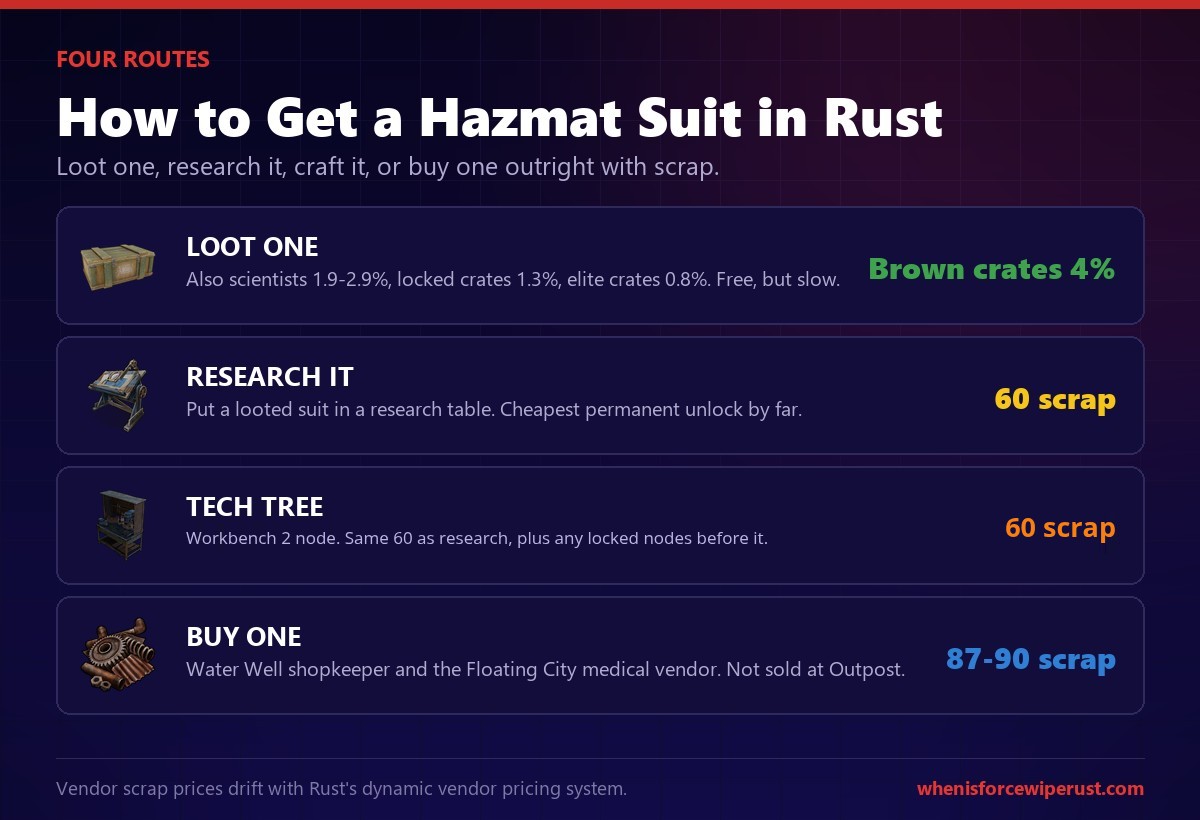
There are four routes, and most players only know about two of them.
1. Loot One
Hazmat Suits drop as loot, and the drop rates are better than the item’s reputation suggests. Brown crates carry them at roughly 4%, which is the best rate in the game and does not require a workbench, scrap or a monument run. Scientists drop them at 1.9% to 2.9% depending on the variant, hackable locked crates at about 1.3%, elite crates at 0.8% and military crates at 0.4%.
In practice that means a normal roadside barrel and crate run will hand you a suit eventually without any effort at all. Most players get their first one this way on day one or two of a wipe.
2. Research It
Put a looted suit into a research table with 60 scrap and the blueprint is yours for the rest of the wipe. This is far and away the best route. Sixty scrap is a single barrel run, and it converts one lucky drop into an unlimited supply.
3. Tech Tree
The Hazmat Suit sits on the Workbench Level 2 tech tree at 60 scrap, the same as the research table, but you also pay for any locked nodes on the path to it. It makes sense when you have scrap to spare and no suit to feed a table with.
4. Buy One With Scrap
This is the route almost nobody uses. The Water Well shopkeeper sells Hazmat Suits for roughly 87 scrap, and the medical supplies vendor at Floating City sells them for around 90 scrap. No workbench, no research, no crafting components. Walk up with scrap, walk away with a suit.
Two caveats. First, prices move: Rust runs a dynamic vendor pricing system that pushes NPC prices up and down based on how much players are buying, so treat 87 to 90 as a ballpark rather than a fixed tag. Second, Outpost does not sell Hazmat Suits. Guides claiming you can buy one there for 40 scrap are wrong. The only clothing Outpost stocks is a t-shirt, a longsleeve, a snow jacket, boots and tactical gloves. If you want the full vendor picture, our Bandit Camp guide covers what the other safe zone actually stocks.
Hazmat Suit Crafting Cost
The recipe is short, and one of the three ingredients is the entire difficulty.
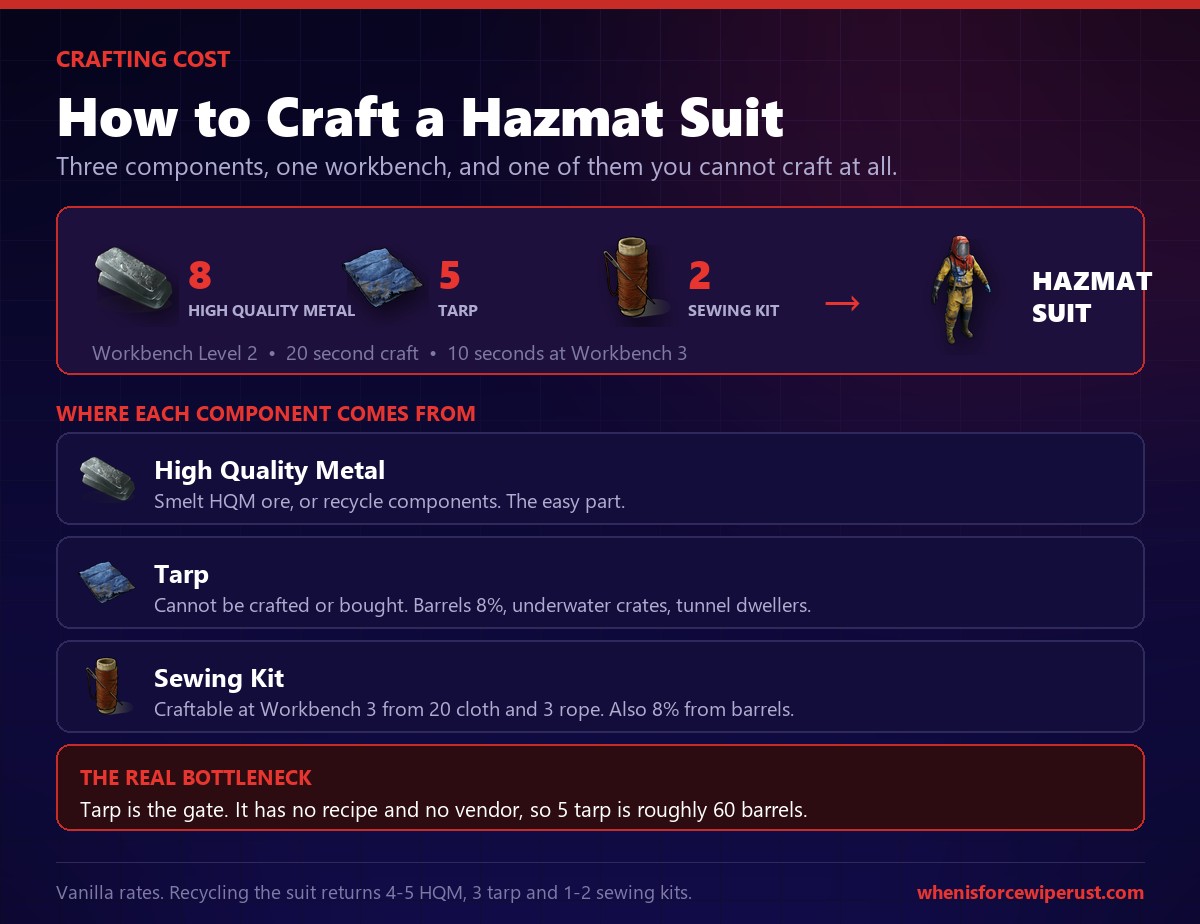
The recipe: 8 High Quality Metal, 5 Tarp and 2 Sewing Kit, at a Workbench Level 2. It takes 20 seconds to craft, dropping to 10 seconds if you happen to be standing at a Workbench 3.
| Component | Amount | Where It Comes From |
|---|---|---|
| High Quality Metal | 8 | Smelted HQM ore, or recycled components. The easy part. |
| Tarp The bottleneck | 5 | Barrels 8%, underwater crates 21% to 38%, tunnel dwellers 15%. No recipe, no vendor. |
| Sewing Kit | 2 | Craftable at Workbench 3 from 20 cloth and 3 rope. Also 8% from barrels. |
Tarp is the only component that matters. It cannot be crafted at any workbench and it cannot be bought from any vendor. Your only options are barrels at an 8% drop rate, underwater crates, or killing tunnel dwellers and lab dwellers. Five tarp is realistically sixty or so barrels, which is why so many players end up looting a finished suit before they ever craft one.
Sewing Kits look like a second problem but they are not. They drop from the same barrels at the same 8% rate, and once you have a Workbench 3 you can craft them outright from 20 cloth and 3 rope. Cloth is not a constraint by mid wipe.
Which Monuments Need a Hazmat Suit
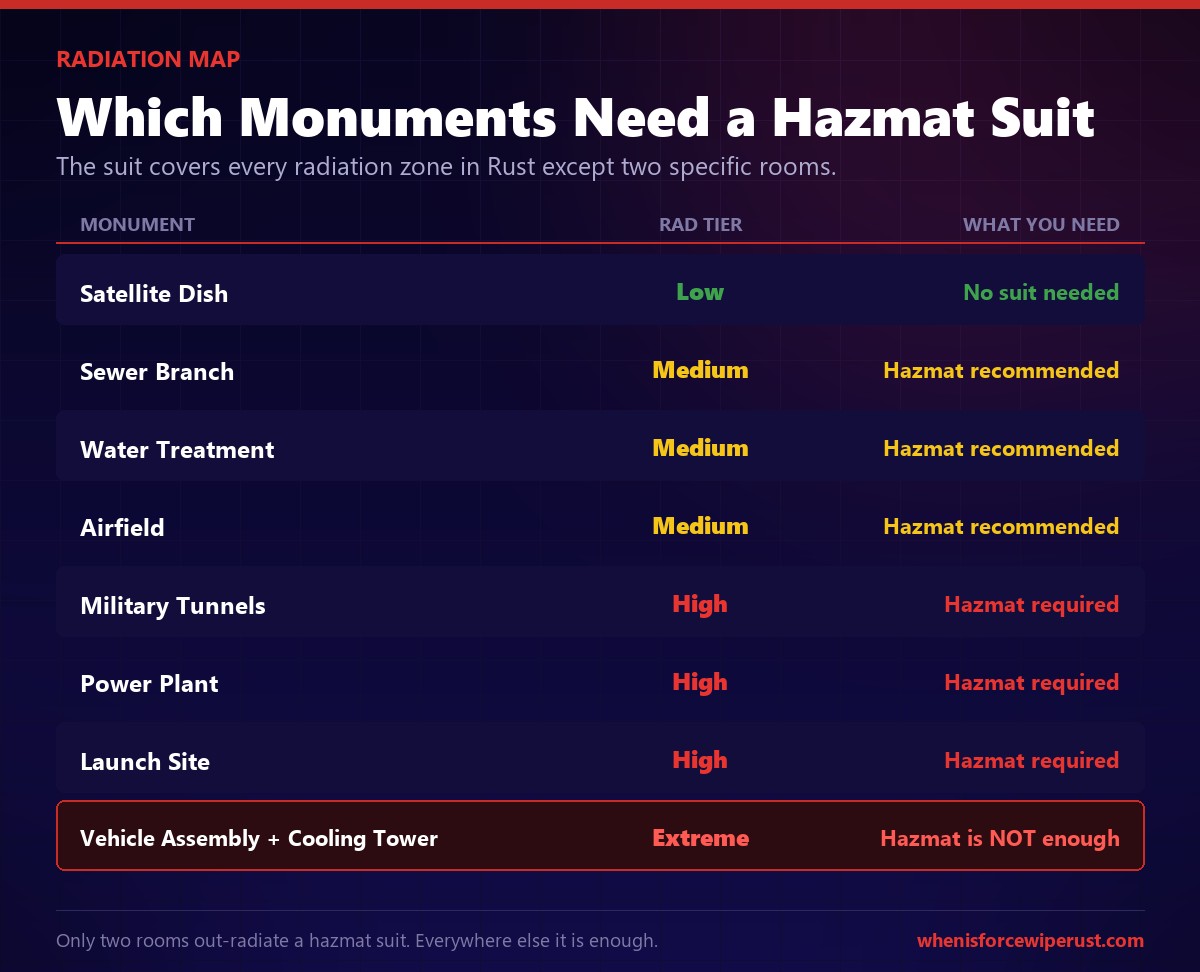
Radiation in Rust is delivered through invisible spherical zones layered around and inside monuments. Different zones sit at different tiers, and the tier decides whether you need a suit, want a suit, or need more than a suit.
| Monument | Radiation Tier | What You Need |
|---|---|---|
| Satellite Dish | Low | Nothing. Clothing is enough. |
| Gas Station, Supermarket | Low | Nothing. Safe to loot naked. |
| Sewer Branch | Medium | Hazmat Suit strongly recommended |
| Water Treatment Plant | Medium | Hazmat Suit strongly recommended |
| Airfield | Medium | Hazmat Suit strongly recommended |
| Military Tunnels | High | Hazmat Suit required |
| Power Plant | High | Hazmat Suit required |
| Launch Site | High | Hazmat Suit required |
| Vehicle Assembly Building Launch Site | Extreme | Hazmat is not enough on its own |
| Broken Cooling Tower Power Plant | Extreme | Hazmat is not enough on its own |
The headline here is how few exceptions there are. A Hazmat Suit fully covers every radiation zone on a procedurally generated map except two specific interiors: the Vehicle Assembly Building inside Launch Site, and the broken cooling tower at Power Plant. Everywhere else, the suit is the complete answer and you can stand in the radiation indefinitely.
Those two rooms still get looted constantly. The trick is that you do not need to survive them forever, you need to survive them for about thirty seconds. Sprint in, grab what you came for, sprint out, and burn an anti-radiation pill on the way home.
How Radiation Actually Works in Rust
Radiation is not instant damage. Standing in a rad zone builds up radiation poisoning, a separate meter from your health, and that meter then drains your health over time. Two consequences follow from that.
First, protection is subtractive. A zone applies a certain amount of radiation per second and your gear cancels out part of it. If your protection covers the zone’s output, you take nothing at all and can stand there as long as you like. If it does not, the difference builds up. This is why a Hazmat Suit either completely solves a monument or completely fails to, with very little in between.
Second, leaving the zone does not fix you. Radiation poisoning stays in your system and keeps draining health after you walk out. Players die on the road home from Launch Site constantly because they escaped the radiation and assumed they were safe.
That is what the cleanup items are for.
| Item | Effect | How to Get It |
|---|---|---|
| Anti-Radiation Pills Best | Removes 75 radiation over 5 seconds. Costs 5 hydration. | Loot only, not craftable. Jungle crates 42%, trash piles 36%, shore and food crates 35%. |
| Rad. Removal Teas | Removes radiation in tiers, basic through pure. | Brewed at a mixing table from berries and water. |
| Water | Drinking flushes a small amount of radiation. | Any water source. Free, slow, always available. |
Anti-radiation pills are the practical answer for almost everyone. They stack to 10, they weigh nothing, they strip 75 radiation in five seconds, and their only real cost is dehydration. Because they are loot only and appear in humble containers like trash piles and food crates, most players already have a pile of them without realising it.
Hazmat Suit vs Armor: The Real Trade
This is the section that decides whether you should be wearing the suit at all right now.
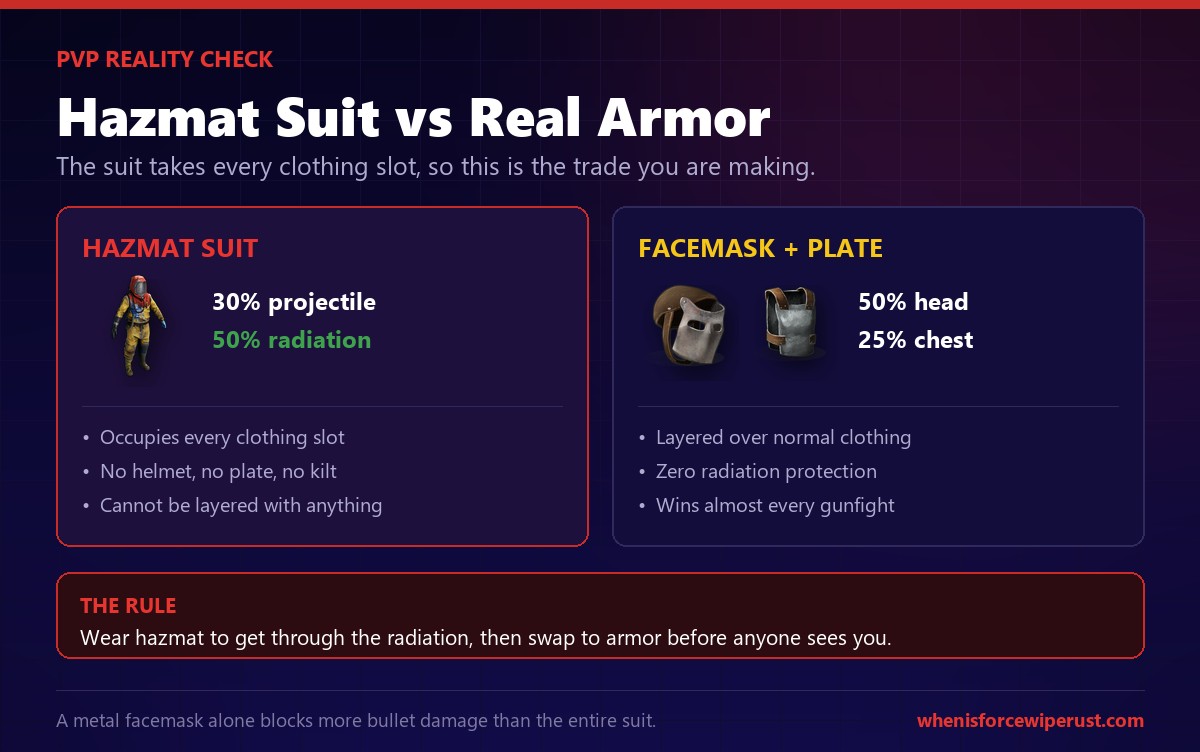
Because the Hazmat Suit occupies every clothing slot, wearing it is not a bonus, it is an exchange. You are giving up an entire armor set to gain radiation immunity.
| Setup | Projectile | Radiation | Best For |
|---|---|---|---|
| Hazmat Suit | 30% everywhere | 50% | Getting through radiation to loot |
| Metal Facemask (head only) | 50% head | None | Surviving a headshot, which is how Rust fights end |
| Metal Chest Plate (chest only) | 25% chest | None | Body shots, layered over normal clothing |
| Facemask + Plate + clothing PvP | 50% head, 25% chest | None | Any fight you expect to have |
Look at the head row. A metal facemask blocks 50% of projectile damage to the head, and the overwhelming majority of Rust deaths are headshots. The Hazmat Suit gives you 30% there. In a rifle fight, that gap is the whole fight, and our Rust weapons guide covers which guns punch through what.
So why do you still see hazmat suits in PvP? Two reasons. Early wipe, a hazmat is often the best armor a player owns, because it drops from brown crates while metal armor needs a workbench and HQM. And on radiated monuments there is no choice: you cannot fight at Launch Site in armor because you cannot get to Launch Site in armor.
Hazmat Suit Skins and Variants
Search results for Hazmat Suits are flooded with skins, and there is a lot of bad information about whether they change anything. They do not.
Skins never change stats in Rust. The Nomad Suit, the Abyss Hazmat Suit, the Pilot suit, the Lumberjack variant and every workshop skin are cosmetic reskins of the same item with identical protection values. Anyone telling you a particular hazmat skin has better radiation protection is guessing.
What they do change is visibility, and that is not nothing. The default suit is bright yellow, which is loud in almost every biome. The Nomad Suit’s earthy browns genuinely blend into the desert, and the darker skins are harder to pick out at range in forest. That is a real if modest advantage, and it is the only mechanical argument for buying one.
There are, however, two genuinely different items people confuse with skins:
| Item | Radiation | What Makes It Different | How to Get It |
|---|---|---|---|
| Hazmat Suit | 50% | The baseline. 30% projectile, 8% cold and bite. | Craft, loot, research or buy |
| Heavy Scientist Suit Better | 50% | Same radiation, but 100% explosion and 90% bite protection. | Loot only. Cannot be crafted or researched. |
| Arctic Suit | Yes | The other full body suit, built around maximum cold protection. | Store DLC pack |
The Heavy Scientist Suit is the sleeper. It carries the same 50% radiation protection as a normal hazmat and adds 100% explosion protection, which is absurd. It cannot be crafted or researched at all, so the only way to own one is to kill a heavy scientist and get lucky. If one drops, wear it instead of your hazmat, because you are strictly upgrading.
Hazmat Suit Myths and Mistakes
Myth: a hazmat skin can give better radiation protection. No skin in Rust changes any stat. Nomad, Abyss, Pilot and every workshop skin are cosmetic only.
Myth: you can buy a Hazmat Suit at Outpost for 40 scrap. Outpost does not sell them at all. The Water Well shopkeeper and the Floating City medical vendor do, at roughly 87 to 90 scrap.
Myth: the tech tree unlock is 250 scrap. That is an old figure. The Workbench 2 node is 60 scrap, the same as research, plus any locked nodes on the path.
Myth: a Hazmat Suit makes you immune to radiation. It covers every zone except the Vehicle Assembly Building at Launch Site and the broken cooling tower at Power Plant, where it slows the damage rather than stopping it.
Mistake: crafting one before checking your loot. Brown crates drop suits at 4%. Many players farm sixty barrels for tarp while a suit was sitting in a crate on the same road.
Mistake: firing the first suit into a research table you have not built. Research the suit before you wear it into a monument where you might die. A worn suit you lose is gone. A blueprint is permanent for the wipe.
Mistake: wearing hazmat into a fight you chose. If you can pick the moment, pick armor. The suit is for the trip, not the trigger pull.
Mistake: hoarding spare suits. Once you own the blueprint, spares are worth more recycled into tarp and HQM than they are hanging in a box.
Kitted out for a monument run? Every suit, blueprint and stack of anti rad pills you own disappears when the map resets. Check the live force wipe countdown before you commit to a big farm.
Force Wipe CountdownPro Tips for Using a Hazmat Suit
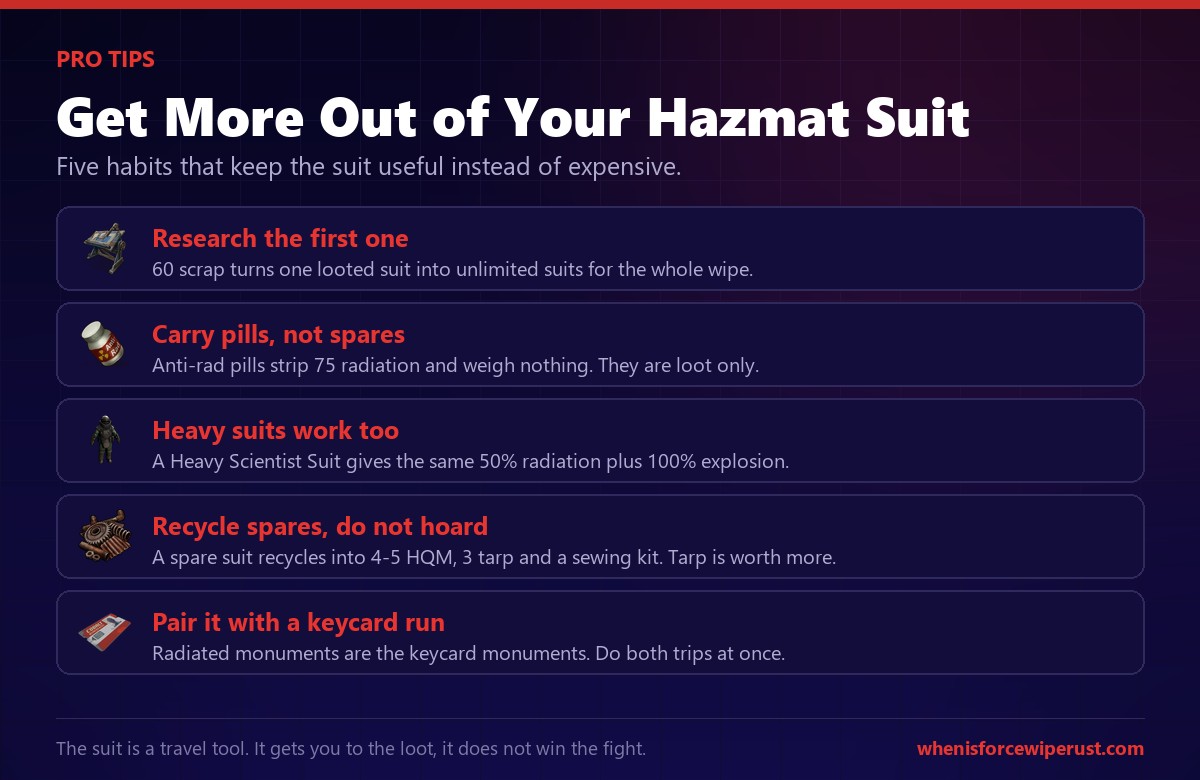
- Research the first suit you find. 60 scrap turns one lucky brown crate into unlimited suits for the whole wipe. Do this before you do anything else with it.
- Carry pills, not spare suits. Anti-radiation pills weigh nothing, stack to 10, and strip 75 radiation each. They solve the poisoning problem that a second suit does not.
- Keep armor in your bag. Cross the radiation in hazmat, then swap into a facemask and plate the moment you are in contested space. The suit is transport, not protection.
- Do not rely on it in the snow. At 8% cold protection the suit is no warmer than a hoodie, so pack a snow jacket for snow biome trips.
- Take the Heavy Scientist Suit if it drops. Same radiation protection, plus 100% explosion and 90% bite. It is a free upgrade and it cannot be crafted.
- Recycle spares for tarp. Three guaranteed tarp per suit beats an 8% barrel drop rate by a wide margin.
- Combine radiation trips with puzzle runs. The radiated monuments are the keycard monuments. One suit, one trip, both objectives.
- Repair instead of recrafting. 108 cloth and 2 HQM at a repair bench is far cheaper than 5 tarp and 2 sewing kits.
Rust Hazmat Suit FAQ
How do you get a Hazmat Suit in Rust?
Can you craft a Hazmat Suit in Rust?
What workbench do you need for a Hazmat Suit?
How much radiation protection does a Hazmat Suit give?
How much scrap is the Hazmat Suit blueprint?
Can you wear armor with a Hazmat Suit in Rust?
Is a Hazmat Suit good for PvP in Rust?
Which monuments need a Hazmat Suit in Rust?
Is a Hazmat Suit enough for Launch Site?
Where do you find Tarp in Rust?
Do Hazmat Suit skins change the stats?
What does a Hazmat Suit recycle into?
How do you repair a Hazmat Suit in Rust?
How do you get rid of radiation poisoning in Rust?
Is the Heavy Scientist Suit better than a Hazmat Suit?
Does a Hazmat Suit carry over a wipe?
Final Thoughts
The Hazmat Suit is one of the few items in Rust that is genuinely cheap for what it unlocks. Sixty scrap and one lucky brown crate buys permanent access to the best loot on the map, and the drop rate is high enough that most players get the chance in the first day of a wipe.
The mistake is treating it as armor. It is not armor, it is a vehicle: it carries you through radiation to a place worth being, and once you are there it stops being useful. Research the first one you find, keep pills in your belt, recycle your spares for tarp, and change into a facemask the moment the radiation stops being the thing most likely to kill you.
Sources
- Protection stats, crafting recipe, research and tech tree costs, recycle and repair values, loot drop rates: Facepunch Rust Wiki, Hazmat Suit
- Full body suits occupy every clothing slot: Facepunch Rust Wiki, Clothing Slots
- Heavy Scientist Suit stats: Facepunch Rust Wiki, Heavy Scientist Suit
- Tarp and Sewing Kit sources and recycle output: Facepunch Rust Wiki, Tarp and Sewing Kit
- Anti-Radiation Pills effect and loot sources: Facepunch Rust Wiki, Anti-Radiation Pills
- Metal Facemask and Metal Chest Plate protection values: Facepunch Rust Wiki, Metal Facemask and Metal Chest Plate
- Water Well shopkeeper stock and prices: RustHelp, Water Well Shopkeeper
- Floating City vendor prices and confirmation Outpost does not stock the suit: Corrosion Hour, Floating City Vendors’ Loot Tables and Outpost Vending Machine Loot Tables
- Dynamic vendor pricing behaviour: Corrosion Hour, The RUST Dynamic Vendor Pricing System
- The game itself: Facepunch Studios