
Every fresh spawn in Rust wakes up on the beach with no clothes on (you see underwear only if you set the censor nudity setting to Underwear), and the first thing you craft after a rock and a torch is usually something to wear. Rust clothing is more than looks. Every hoodie, pair of pants, jacket and boot cuts a share of bullet, melee, bite, radiation and cold damage, and the right pieces under your armor can nearly double the protection on your chest.
This guide covers the clothing side of your kit: how the slots and layers work, the protection numbers for the pieces worth wearing, what each one costs to craft, the two sets you can make on wipe day with no workbench, and the best outfits for the snow, the desert, radiation and diving. For helmets, chest plates and kilts, see our Rust armor guide.
- Slots & Layers
- Protection Stats
- Craft Costs
- Wipe Day Sets
- Cold & Heat
- Radiation
- Diving Gear
- Buy & Recycle
- Best Outfits
- Tips
- FAQ
How Rust Clothing Slots and Layers Work
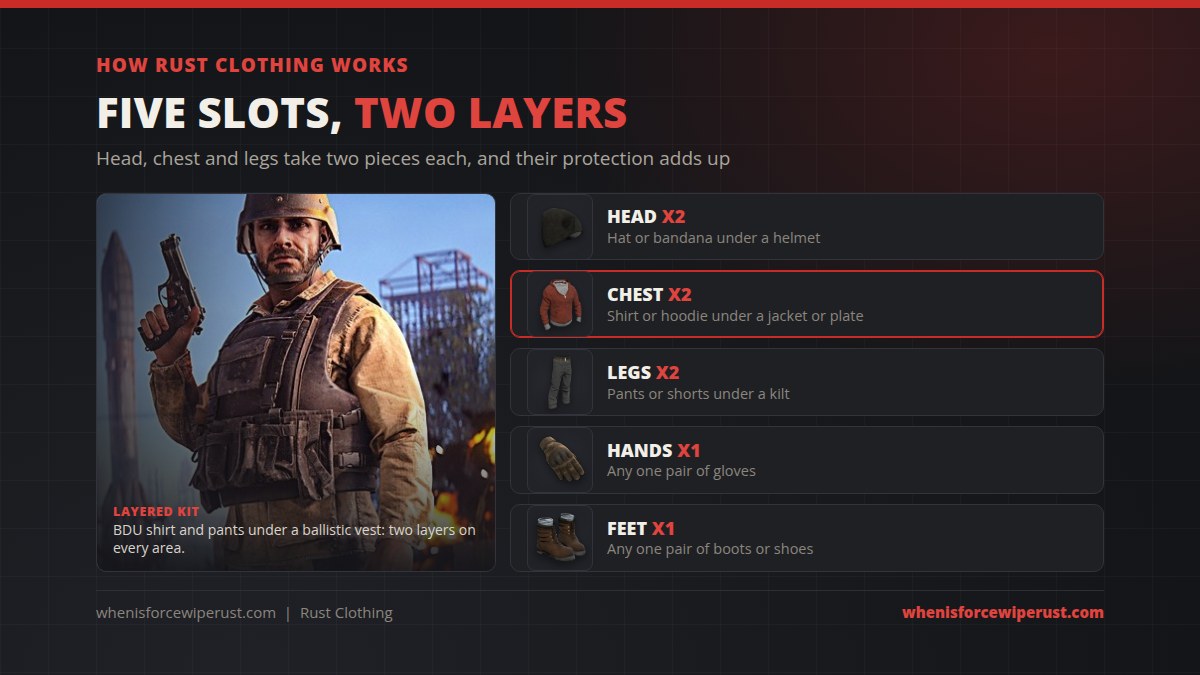
Your character has five clothing areas. The head, chest and legs each take two pieces: a soft under-layer (hat, shirt, hoodie, pants) and an outer layer (helmet, jacket, chest plate, kilt). Hands and feet take one item each. Protection works per body part, so a hoodie only helps when you are hit in the torso or arms, and pants only help on the legs.
The key rule is that both layers add together. A Metal Chest Plate is 25% bullet protection on its own. Put a hoodie under it and your chest is at 45%. That is why every serious PvP kit has a hoodie and pants under the armor, and why running a bare chest plate is a waste.
| Area | Under-layer (clothing) | Outer layer |
|---|---|---|
| Head | Beenie, boonie, baseball cap, bandana, balaclava, burlap headwrap | Helmets and facemasks |
| Chest | T-shirt, longsleeve, shirt, hoodie, BDU shirt, burlap shirt, hide vest | Jacket, snow jacket, hide poncho, chest plates |
| Legs | Pants, shorts, BDU pants, burlap trousers, hide pants or skirt | Kilts and leg armor |
| Hands | One pair: burlap, leather, tactical or road sign gloves | |
| Feet | One pair: burlap shoes, hide boots, boots or frog boots | |
Rust Clothing Protection Stats
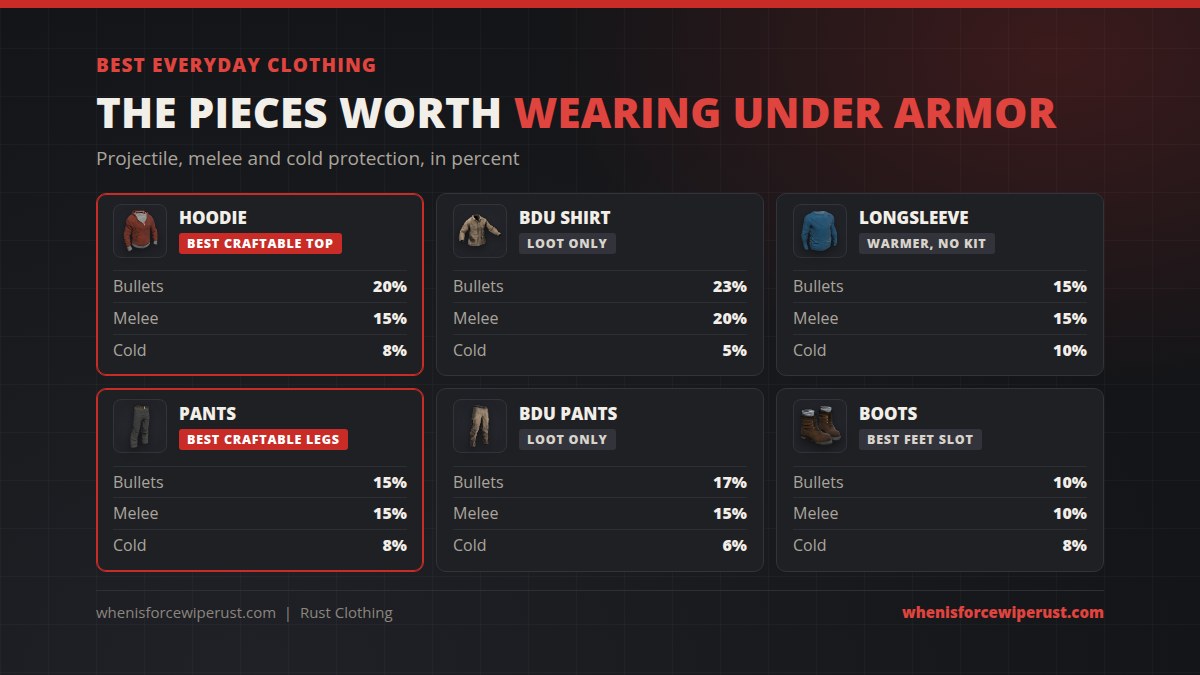
These are the protection values for the clothing pieces you will actually wear, in percent of damage blocked. Projectile is bullets and arrows, melee is spears, swords and rocks, and cold is how much warmer the piece keeps you. A negative cold number makes you colder.
| Item | Slot | Projectile | Melee | Bite | Radiation | Cold |
|---|---|---|---|---|---|---|
| Hoodie | Chest | 20% | 15% | 6% | 5% | 8% |
| BDU Shirt (loot) | Chest | 23% | 20% | 6% | 5% | 5% |
| Shirt | Chest | 17% | 15% | 5% | 6% | 6% |
| Longsleeve T-Shirt | Chest | 15% | 15% | 6% | 5% | 10% |
| T-Shirt | Chest | 15% | 15% | 5% | 3% | 6% |
| Burlap Shirt | Chest | 10% | 10% | 3% | 2% | 7% |
| Hide Vest | Chest | 15% | 15% | 8% | 3% | 5% |
| Jacket | Chest (outer) | 15% | 20% | 7% | 5% | 10% |
| Snow Jacket | Chest (outer) | 20% | 30% | 20% | 20% | 30% |
| Hide Poncho | Chest (outer) | 10% | 40% | 5% | 8% | 8% |
| Pants | Legs | 15% | 15% | 3% | 5% | 8% |
| BDU Pants (loot) | Legs | 17% | 15% | 3% | 5% | 6% |
| Burlap Trousers | Legs | 10% | 10% | 3% | 2% | 7% |
| Hide Pants | Legs | 10% | 10% | 8% | 2% | 4% |
| Burlap Headwrap | Head | 15% | 15% | 3% | 2% | 7% |
| Boots | Feet | 10% | 10% | 3% | 3% | 8% |
| Hide Boots | Feet | 5% | 5% | 3% | 2% | 5% |
| Leather Gloves | Hands | 5% | 5% | 2% | 4% | 5% |
| Tactical Gloves | Hands | 10% | 5% | 2% | 5% | 7% |
| Road Sign Gloves | Hands | 10% | 25% | 10% | 0% | -8% |
| Burlap Gloves | Hands | 5% | 5% | 2% | 3% | 4% |
Two things stand out. The Hoodie is the best under-layer you can craft, and the Snow Jacket is the strongest soft outer layer, but it sits in the outer chest slot, so you cannot wear a chest plate or road sign jacket with it. On the hands, Tactical Gloves also remove most aim sway, which is why geared players wear them over road sign gloves.
Rust Clothing Craft Costs
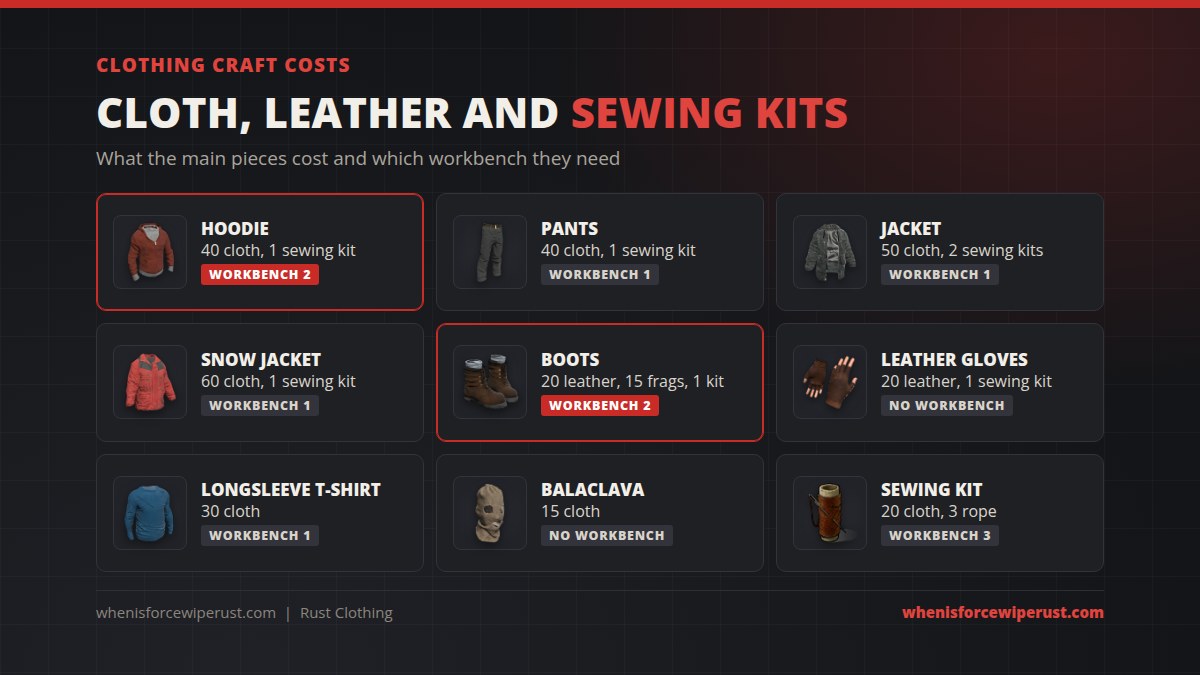
Almost all clothing is made from cloth, leather and sewing kits. Cloth comes from hemp, animals and the recycler, leather from skinning animals, and sewing kits from crates or a Workbench 3 craft (20 cloth and 3 rope each).
| Item | Craft cost | Workbench |
|---|---|---|
| Hoodie | 40 cloth, 1 sewing kit | Level 2 |
| Pants | 40 cloth, 1 sewing kit | Level 1 |
| Jacket | 50 cloth, 2 sewing kits | Level 1 |
| Snow Jacket | 60 cloth, 1 sewing kit | Level 1 |
| Boots | 20 leather, 15 metal fragments, 1 sewing kit | Level 2 |
| Road Sign Gloves | 20 leather, 1 road sign, 2 sewing kits | Level 2 |
| Leather Gloves | 20 leather, 1 sewing kit | None |
| T-Shirt | 25 cloth | Level 1 |
| Longsleeve T-Shirt | 30 cloth | Level 1 |
| Shirt | 25 cloth | Level 1 |
| Tank Top | 20 cloth | None |
| Shorts | 30 cloth | None |
| Beenie Hat | 15 cloth | None |
| Boonie Hat | 10 cloth | None |
| Baseball Cap | 5 cloth | None |
| Bandana Mask | 5 cloth | None |
| Improvised Balaclava | 15 cloth | None |
| Miners Hat | 15 cloth, 10 low grade fuel, 50 metal fragments | Level 1 |
| Wolf Headdress | 10 cloth, 1 wolf skull | Level 1 |
You need the blueprint for most of these first. Learn them from a looted copy at the research table or on the workbench tech tree; see our blueprints guide for how both work.
Wipe Day Clothing: Burlap and Hide Sets
On wipe day you have no workbench, so two cheap sets do the job. Both craft in seconds from cheap early-game materials.
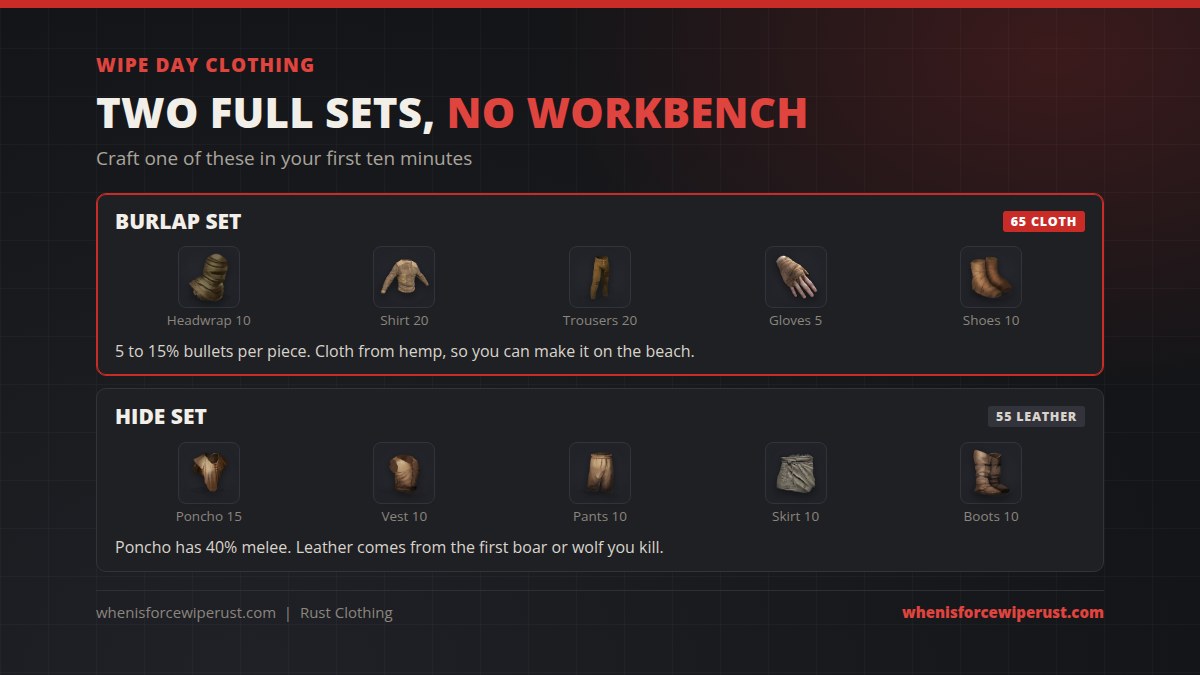
- Burlap set (65 cloth). Headwrap 10, shirt 20, trousers 20, gloves 5 and shoes 10. Each piece blocks 5 to 15% of bullets and keeps you warm at night. Punch a few hemp plants on the walk inland and you can wear the full set within ten minutes.
- Hide set (leather). Vest, pants, skirt, halterneck and boots cost 10 leather each, and the poncho 15. The Hide Poncho is the standout with 40% melee, which makes it a strong outer layer in the spear and rock fights of the first hour. Leather comes from the first boar, wolf or deer you kill, and a cow gives 100 (see our livestock guide).
Neither set stops a rifle, so swap to a hoodie, pants and real armor as soon as you reach Workbench 2.
Cold and Heat: Clothing for the Snow and Desert
Rust tracks your body temperature. At night and in the snow biome you get cold, lose calories faster and eventually take damage. Every clothing piece has a cold protection value, and metal and road sign armor have negative values, so a full metal kit with nothing under it will freeze you.
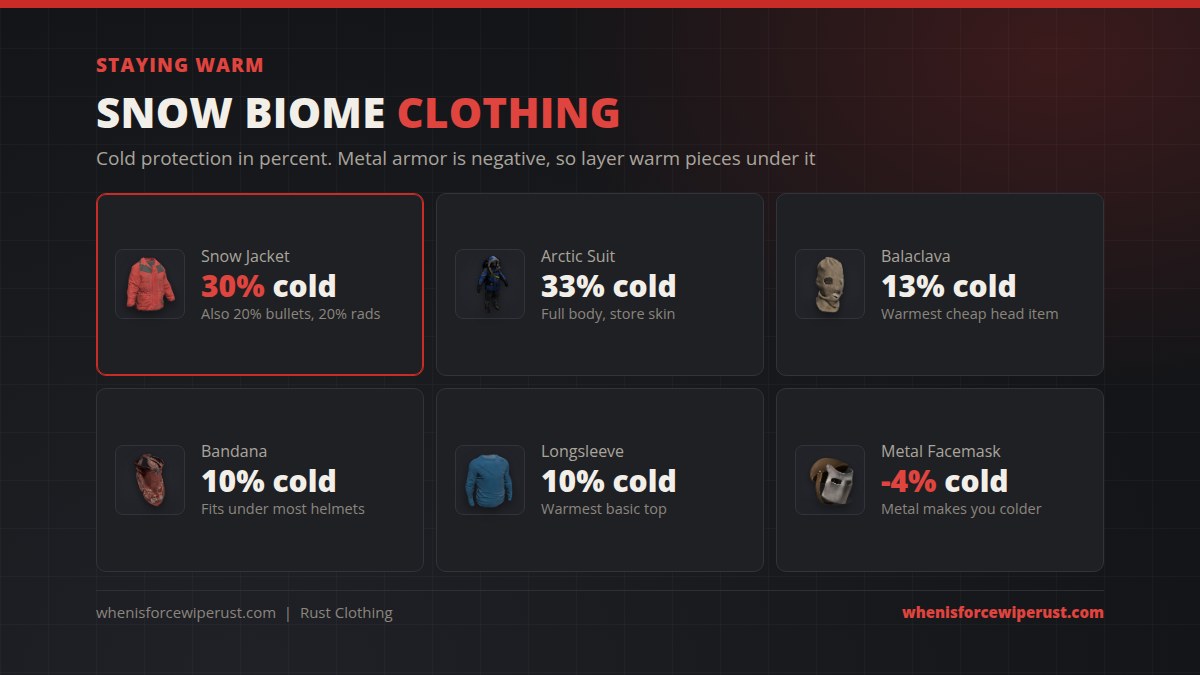
- Snow Jacket: 30% cold, plus 20% bullets, 30% melee and 20% radiation. The best single piece for the snow, but it takes the outer chest slot.
- Improvised Balaclava: 13% cold for 15 cloth, the cheapest warm head piece. The Bandana Mask gives 10% and fits under a Riot Helmet, Bucket Helmet or Wolf Headdress, but not a Metal Facemask or Coffee Can Helmet.
- Longsleeve T-Shirt: 10% cold, the warmest basic top.
- Hoodie, pants and boots: 8% cold each, so your normal PvP base layer already offsets most of the metal penalty.
Radiation Clothing
Most monuments have some radiation. Low-rad sites like the Satellite Dish only need basic clothing, while Military Tunnels and Launch Site need real protection. Our monuments guide lists the radiation level of every site.

- Hazmat Suit: 50% radiation, 30% bullets and melee, 8% cold, 8% bite and 5% explosion. It fills every slot. Full details in our hazmat suit guide.
- Arctic Suit: a Rust Store skin of the hazmat that trades some radiation for cold: 33% radiation and 33% cold.
- Snow Jacket: 20% radiation, the most of any normal clothing piece.
- Lead Armor Insert: +5% radiation per slot on crafted armor. See our armor inserts guide.
Diving Gear
None of the diving gear can be crafted. The Fishing Village Shop Keeper sells all four pieces, and they also drop from underwater crates and divers.

| Item | Base price | What it does |
|---|---|---|
| Wetsuit | 20 scrap | Stops the wet effect and adds some cold protection, so you do not freeze after a swim |
| Diving Mask | 15 scrap | Clear vision underwater |
| Diving Fins | 25 scrap | Faster swimming |
| Diving Tank | 35 scrap | Extends your air supply for long dives |
Where to Buy Clothing and What to Recycle
You do not have to craft everything. The Outpost clothing vending machine sells a t-shirt, longsleeve, snow jacket, boots and tactical gloves. Boots and the snow jacket go for about 20 scrap each and tactical gloves for about 40 scrap, which is the cheapest way to get them.
Spare clothing is worth recycling. At a monument recycler a hoodie returns 24 cloth and often a sewing kit, a jacket returns 30 cloth and a sewing kit (20% chance of a second), a snow jacket 36 cloth, and tactical gloves 12 leather and 6 sewing kits, which is the start of the cheap rope loop. Safe zone recyclers return less.
Best Rust Clothing Outfits
Here is what to wear for each job. For the armor that goes on top in a fight, use the combinations in our Rust armor guide.
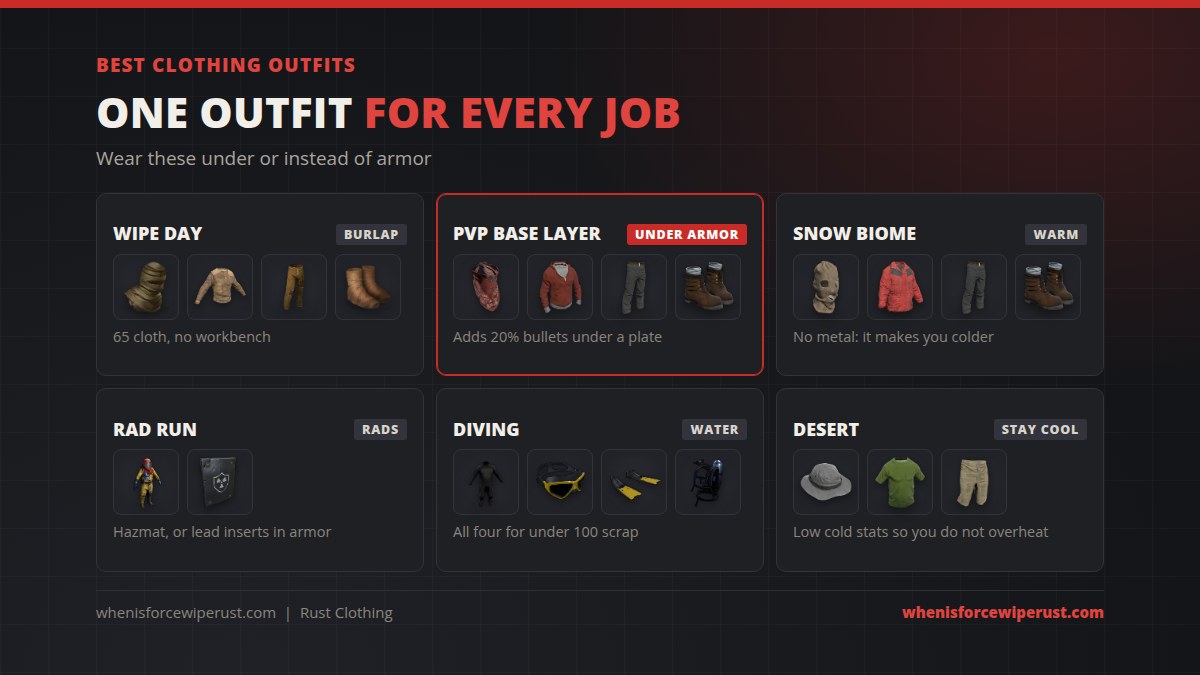
| Job | Outfit | Why |
|---|---|---|
| Wipe day | Burlap headwrap, shirt, trousers, gloves, shoes | 65 cloth, no workbench |
| Early melee fights | Burlap or hide set with a Hide Poncho on top | 40% melee for 15 leather |
| PvP base layer | Hoodie, pants, boots, tactical gloves | Stacks under a facemask, plate and kilt |
| Snow biome | Balaclava, snow jacket, pants, boots | Warm with no metal penalty |
| Rad run | Hazmat Suit, or armor with lead inserts | 50% radiation from the suit |
| Diving | Wetsuit, mask, fins, tank | Under 100 scrap at the Fishing Village |
| Desert | Boonie hat, t-shirt, shorts | Low cold stats, so you do not overheat |
Want your outfit to look the part? Most clothing can be skinned. See our Rust skins guide and this week’s item store.
Rust Clothing Tips
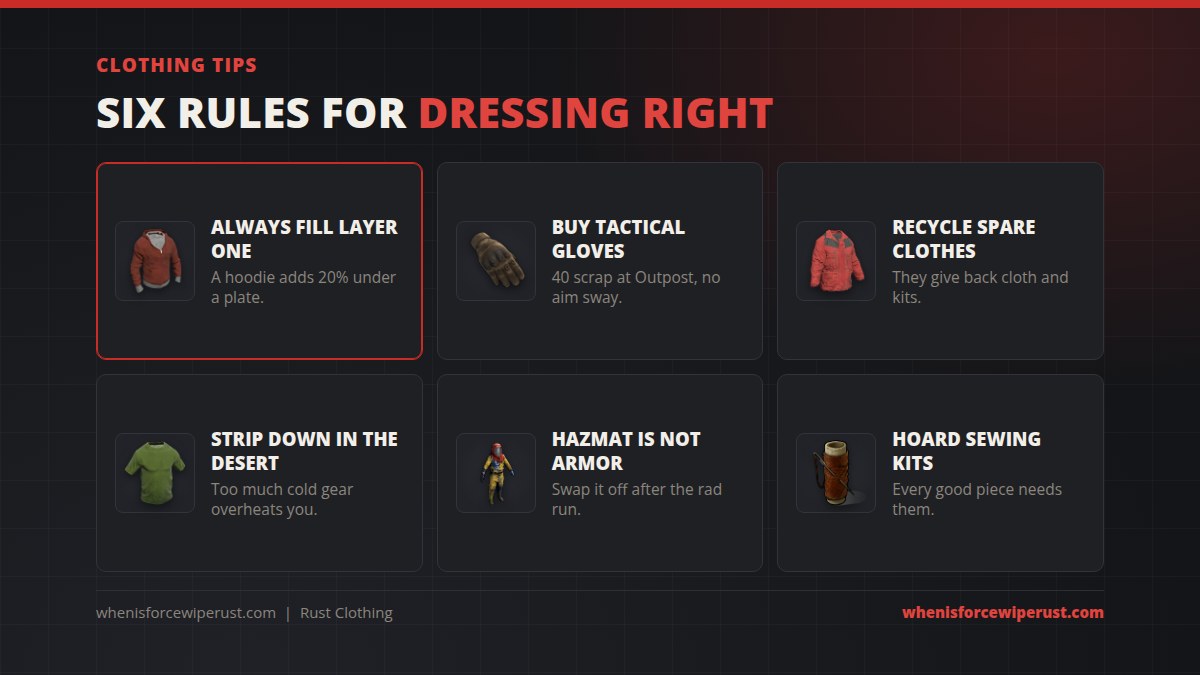
- Always fill layer one. A hoodie and pants under your armor are the cheapest protection in the game.
- Buy tactical gloves. 40 scrap at Outpost gets you 10% bullets, warmth and almost no aim sway.
- Recycle what you do not wear. Looted jackets and gloves turn into cloth, leather and sewing kits.
- Dress for the biome. Warm layers in the snow, light clothes in the desert.
- Take the hazmat off after the rad run. At 30% bullets it loses most fights.
- Hoard sewing kits. The hoodie, boots, jackets and every good armor piece need them.
Clothing, blueprints and everything else reset on the force wipe, so check the force wipe countdown before you sink sewing kits into a stack of hoodies late in the month.
Rust Clothing FAQ
What is the best clothing in Rust?
For fighting, the best craftable clothing is a hoodie (20% bullets) and pants (15%) under your armor, with boots and tactical gloves. The loot-only BDU shirt (23%) and BDU pants (17%) are slightly better. For the cold, the snow jacket is best, and for radiation, the hazmat suit.
How do clothing layers work in Rust?
The head, chest and legs each take two layers, an under-layer like a hoodie and an outer layer like a chest plate. The protection of both layers adds together, so a hoodie under a metal chest plate takes your chest from 25% to 45% bullet protection. Hands and feet take one item each.
How do you craft a hoodie in Rust?
A hoodie costs 40 cloth and 1 sewing kit and needs a Workbench Level 2. You need the blueprint first, from the research table or the tech tree.
What clothing can you craft without a workbench in Rust?
The burlap set (headwrap, shirt, trousers, gloves and shoes), the hide set (vest, poncho, pants, skirt, halterneck and boots), the bandana, baseball cap, boonie hat, beenie, balaclava, tank top, shorts and leather gloves all craft with no workbench.
What is the best clothing for cold in Rust?
The Snow Jacket gives 30% cold protection, the most of any normal piece, and the Arctic Suit gives 33%. Add an improvised balaclava (13%), pants and boots, and avoid metal armor, which has negative cold values.
Can you overheat in Rust?
Yes. In the desert, wearing a lot of warm clothing can push your body temperature over 40 degrees, which gives the Too Hot effect and slowly drains your health. Wear light clothing like a t-shirt and shorts in hot biomes.
Where do you get a wetsuit in Rust?
The wetsuit cannot be crafted. Buy it from the Shop Keeper at the Fishing Village for about 20 scrap, along with the diving mask (15), fins (25) and tank (35).
Can you wear armor over a hazmat suit in Rust?
No. The hazmat suit is a full-body suit that fills every clothing slot, so you cannot wear a facemask, chest plate, gloves or anything else with it.
Sources and Further Reading
- Craft costs, workbench levels and recycle yields: rustlabs item data (July 2026), cross-checked with RustClash, Hoodie and RustHelp, Jacket
- Protection values: RustClash, Wearable database, RustClash, Snow Jacket and RustClash, Hazmat Suit
- BDU shirt and pants: Rustafied, Built Different update and RustHelp, BDU shirt
- Temperature and overheating: Corrosion Hour, Status Effects guide
- Diving gear: RustHelp, Wetsuit