
You crack open a locked crate, push past the guns and the meds, and there it is: a scrappy little pile of circuit boards and wire called Tech Trash. New players toss it. Veterans grab every single one. That gap is the whole point of this guide.
Rust tech trash is one of the most valuable components in the game, and it does two jobs at once. Recycle it and it hands you a fat stack of scrap plus high quality metal. Keep it and it is the crafting gate for almost every electrical item in Rust, from C4 to night vision goggles to base automation. Either way, it is never junk.
This guide covers the whole thing: what tech trash is, exactly how much scrap it gives when you recycle it, every way to get it, which components break back down into it, what it builds, and how to farm it fast. Every number here is checked against the in game data, not guessed.
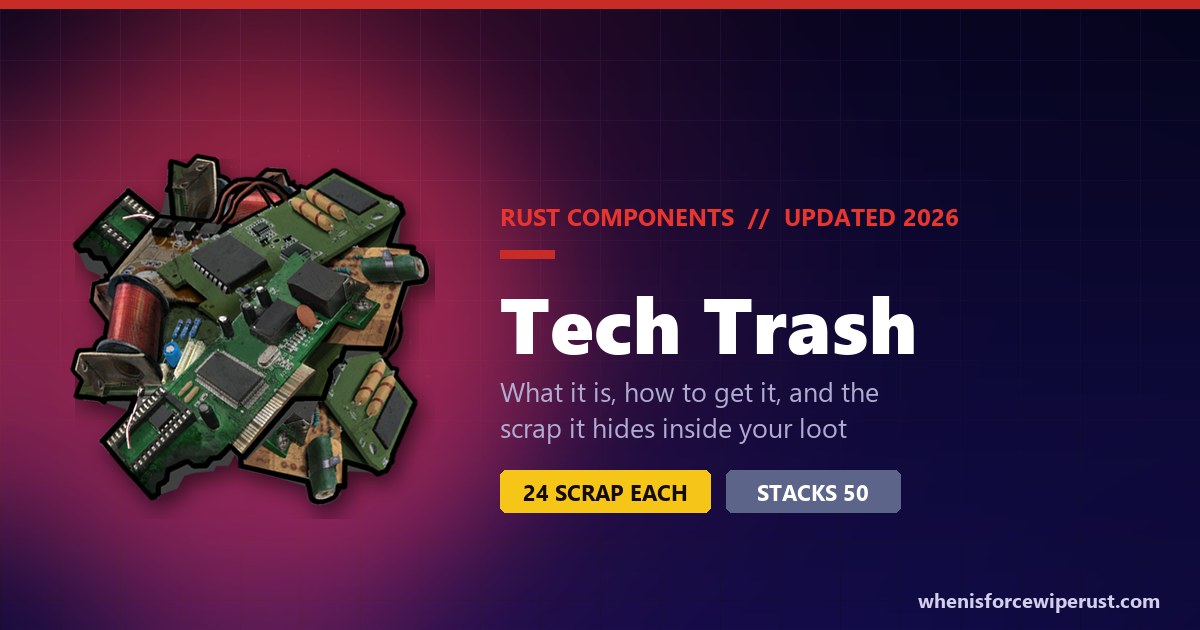
techparts) is a component you loot from crates and scientists, or make by recycling electronics. Recycle it at a monument recycler and each one gives 24 scrap plus 1 high quality metal (16 scrap in a safe zone recycler). It cannot be crafted, only found. On the crafting side it is the key ingredient for high tier electrical gear: C4 needs 2 tech trash each, plus batteries, solar panels, night vision, smart switches and more. It stacks to 50, despawns in an hour on the ground, and like all loot it is wiped every server reset, so spend it before the force wipe.
- What is tech trash
- How much scrap it gives
- How to get tech trash
- What recycles into it
- What it is used for
- Tech trash and C4
- Best way to farm it
- Does it wipe
- Pro tips
- FAQ
What is tech trash in Rust?
Tech Trash is a component, the same class of item as gears, road signs, metal springs and sewing kits. The game describes it simply as “a collection of random tech parts,” and that is exactly what the model shows: a jumbled heap of circuit boards, capacitors and wiring pulled out of ruined electronics.
Components exist for one reason, to be the middle layer between raw resources and finished gear. You gather wood and metal from nodes, but you cannot mine tech trash. It only comes from the world, and that scarcity is what makes it valuable. Tech Trash sits at the high end of the component ladder, reserved for the electrical and endgame recipes that would be too strong if you could farm them from a rock.
Two facts matter most before we go further. First, you cannot craft tech trash, so every one you own was looted or recycled out of another electronic. Second, it is a raw currency for two totally different economies at once, scrap if you recycle it and electrical gear if you craft with it. Deciding which to do with each stack is the real skill.
How much scrap does tech trash give?
This is the number everyone searches for, so let us pin it down. Tech Trash is one of the best scrap-per-slot components in the game, and the exact yield depends on which recycler you use.
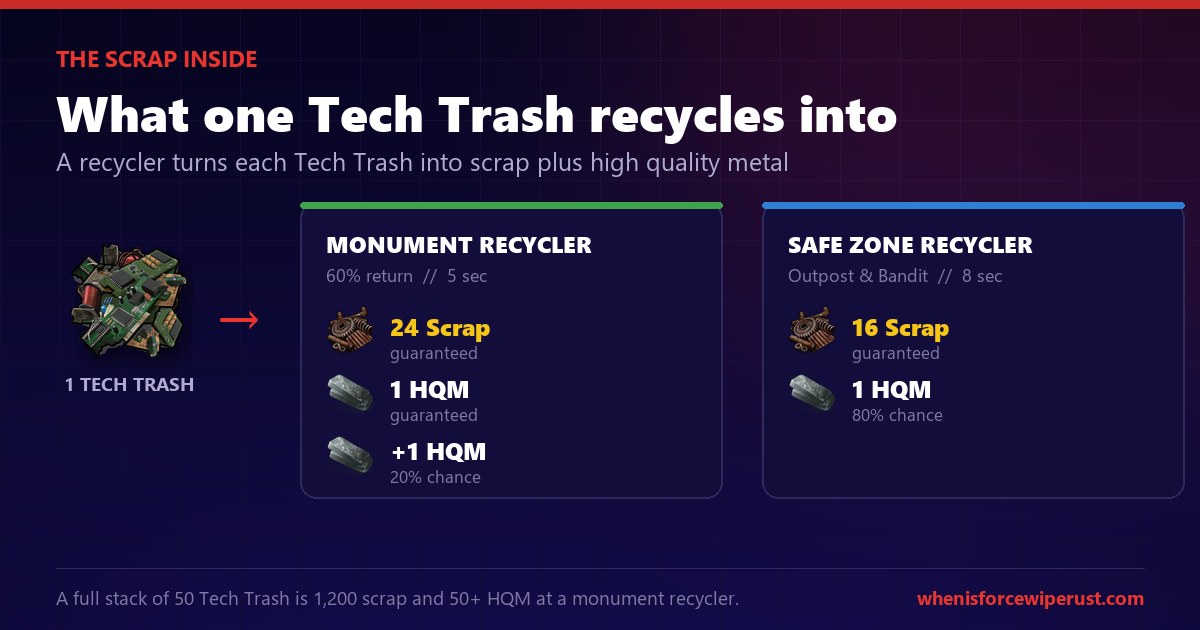
| Recycler | Scrap per tech trash | High quality metal | Speed |
|---|---|---|---|
| Monument recycler | 24 scrap | 1 (plus 20% chance of a 2nd) | 1 item / 5 sec |
| Safe zone recycler (Outpost / Bandit) | 16 scrap | 1 at 80% chance | 1 item / 8 sec |
So a monument recycler is the clear winner at 24 scrap and a guaranteed bar of high quality metal for every tech trash you feed it. Run a full stack of 50 through one and you walk away with 1,200 scrap and roughly 50 to 60 HQM, which is enough scrap to research an AK and then some. Safe zone recyclers in the Bandit Camp and Outpost are safer but pay less, so use them only when the monument version is too hot to reach.
How to get tech trash in Rust
There are two honest ways to get tech trash, and the good players do both. You either loot it raw from the game’s mid and high tier containers, or you recycle the electronics that break down into it. The second route is the one most guides forget, and it is the more reliable of the two.
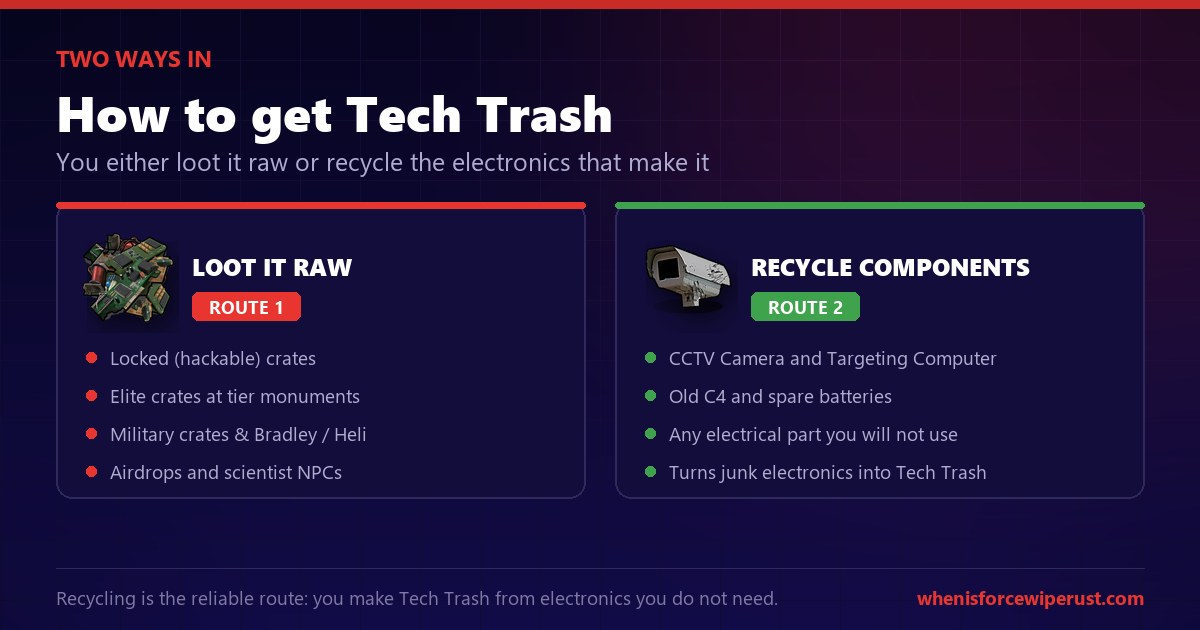
Route 1, loot it raw. Tech Trash drops from the same containers that hold the game’s best gear:
- Locked (hackable) crates are a top source, dropping a big batch once the 15 minute hack finishes.
- Elite crates at high tier monuments carry it at roughly a 1 in 4 chance, several at a time.
- Military crates spread across monuments give a steady trickle.
- Airdrops, the Bradley APC crates and the patrol helicopter all pay tech trash for the fight.
- Scientist NPCs drop the odd one, so clearing a monument adds up.
Route 2, recycle components. Every electrical item in Rust breaks back down into tech trash when you recycle it. Loot a CCTV Camera, a Targeting Computer or a spare battery you will never use? Do not leave it. Feed it to a recycler and it becomes tech trash plus scrap. This is covered in full in the next section, and it is why experienced players never walk past a green box of electronics.
What recycles into tech trash?
Tech Trash is the shared currency of the entire electrical system, which means the components you cannot use are a hidden supply of it. More than 20 electrical items recycle straight back into tech trash, so a “useless” loot pile is often a stack of tech trash in disguise.
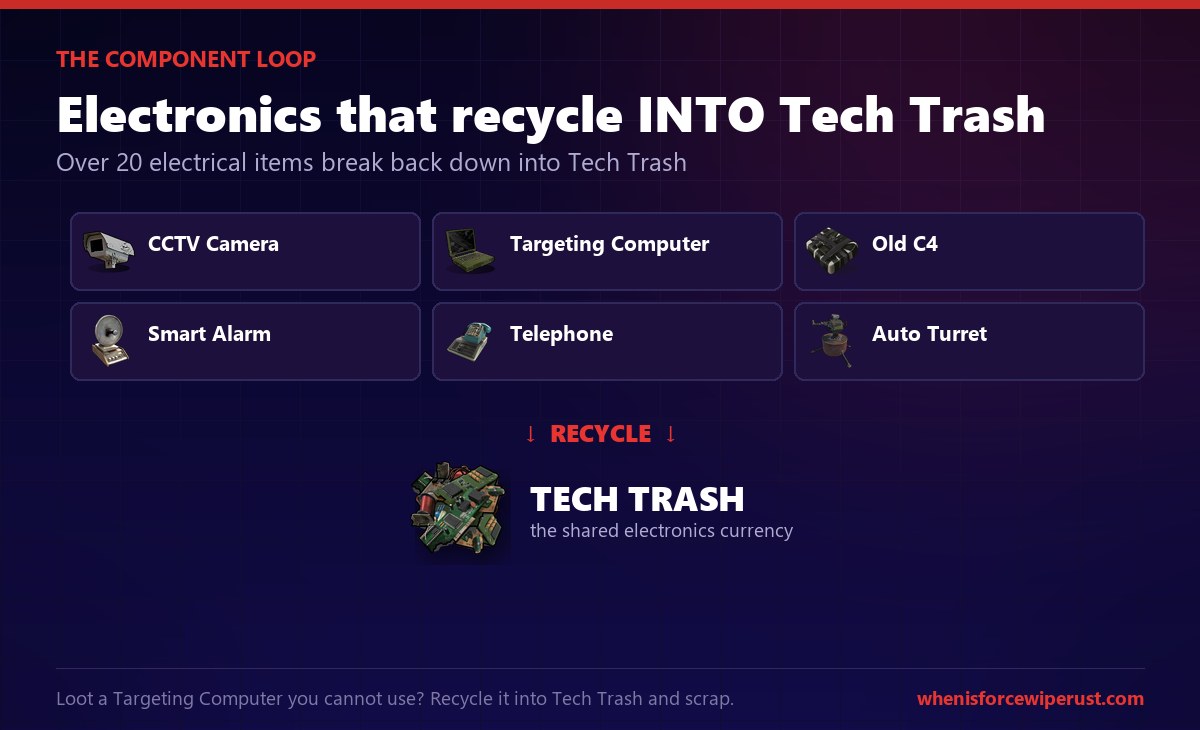
The most common electronics that recycle into tech trash include:
- CCTV Camera and Targeting Computer, the two you loot most and rarely need in bulk.
- Old C4 and rechargeable batteries you are not planning to use.
- Smart Alarms, Smart Switches, Storage Monitors and Telephones from the automation set.
- Tesla Coils, Seismic Sensors, Holosights and Weapon Lasersights.
- An Auto Turret, which returns tech trash and HQM if you break it down.
What is tech trash used for in Rust?
If you are not recycling it, you are crafting with it, because tech trash is the gate to nearly every electrical and endgame item in the game. 18 recipes need it, and the one that matters most to this site is at the top of the list.
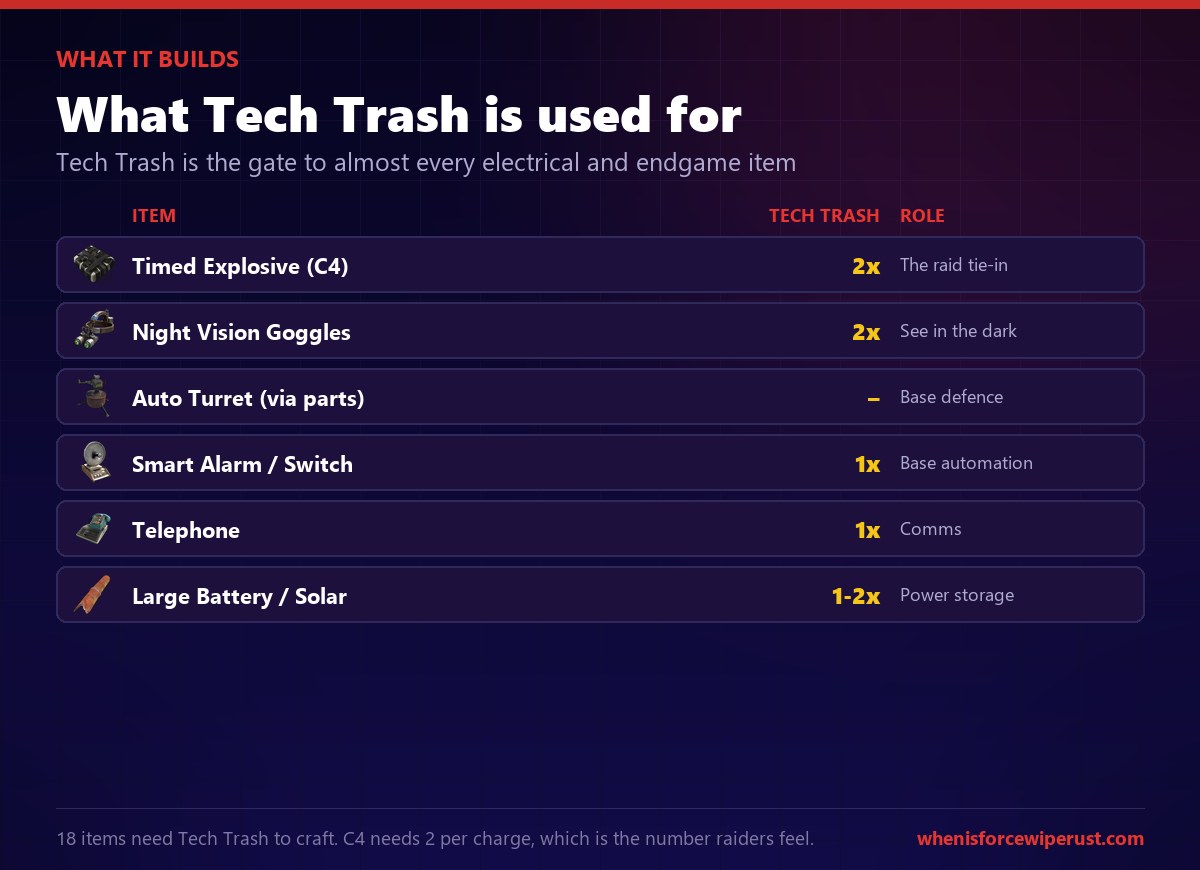
| Item | Tech trash needed | What it does |
|---|---|---|
| Timed Explosive Charge (C4) | 2 | The premier raiding tool |
| Night Vision Goggles | 2 | See in full darkness |
| Large Rechargeable Battery | 2 | Store base power |
| Industrial Crafter | 2 | Automated crafting |
| Medium Battery, Large Solar Panel | 1 | Power generation |
| Tesla Coil, Seismic Sensor | 1 | Base defence and detection |
| Smart Alarm, Smart Switch, Storage Monitor | 1 | Base automation |
| Telephone, Holosight, Weapon Lasersight | 1 | Comms and weapon mods |
Notice the pattern: almost everything that makes a base smart, a raid possible, or a fight fairer in the dark runs through tech trash. It is also worth knowing that the auto turret is built from a Targeting Computer and a CCTV Camera rather than raw tech trash, but those parts come from the exact same loot pool, so the component economy is all tied together.
Tech trash and C4: why raiders farm it
Here is the single fact that turns tech trash from “nice loot” into “must grab.” Every C4 you craft needs 2 tech trash, alongside 20 Explosives and 5 Cloth at a Workbench 3. C4 is the backbone of serious raiding, so tech trash is a hard requirement for anyone who wants to break into bases instead of just defending one.
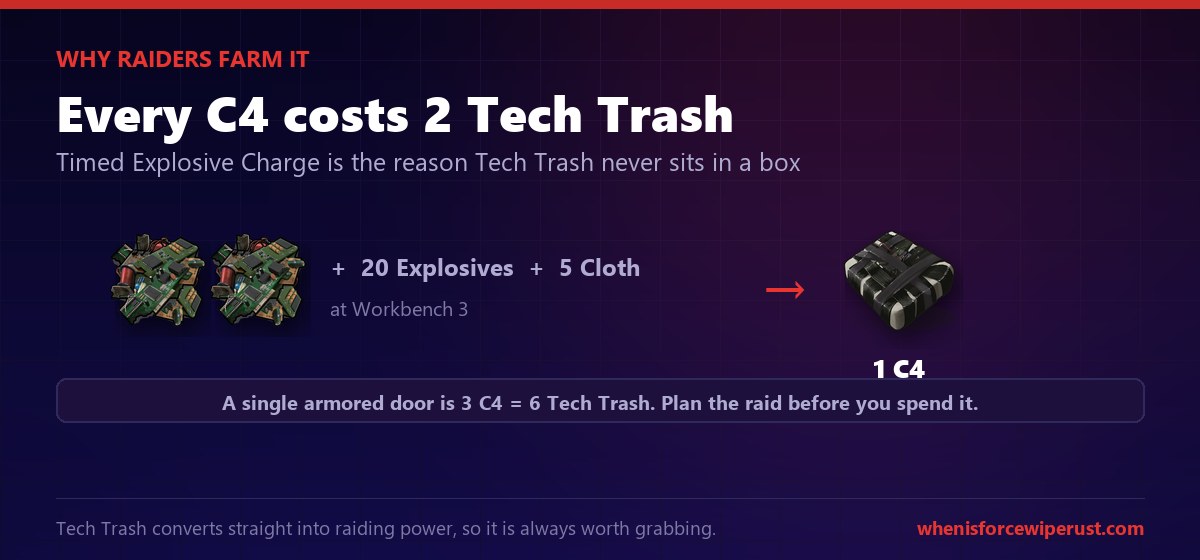
Once you do the math the demand is obvious. A single armored door takes 3 C4 to blow, which is 6 tech trash before you have even touched the loot room. A real raid on a stone or metal base can eat a dozen or more C4, so raiders burn through tech trash faster than almost any other component. That constant drain is exactly why they recycle every spare electronic and hit every hackable crate they pass.
Best way to farm tech trash fast
If you need a pile of tech trash quickly, mix a crate run with aggressive recycling. No single method beats doing both, but here is the priority order by how much tech trash you get for your time.
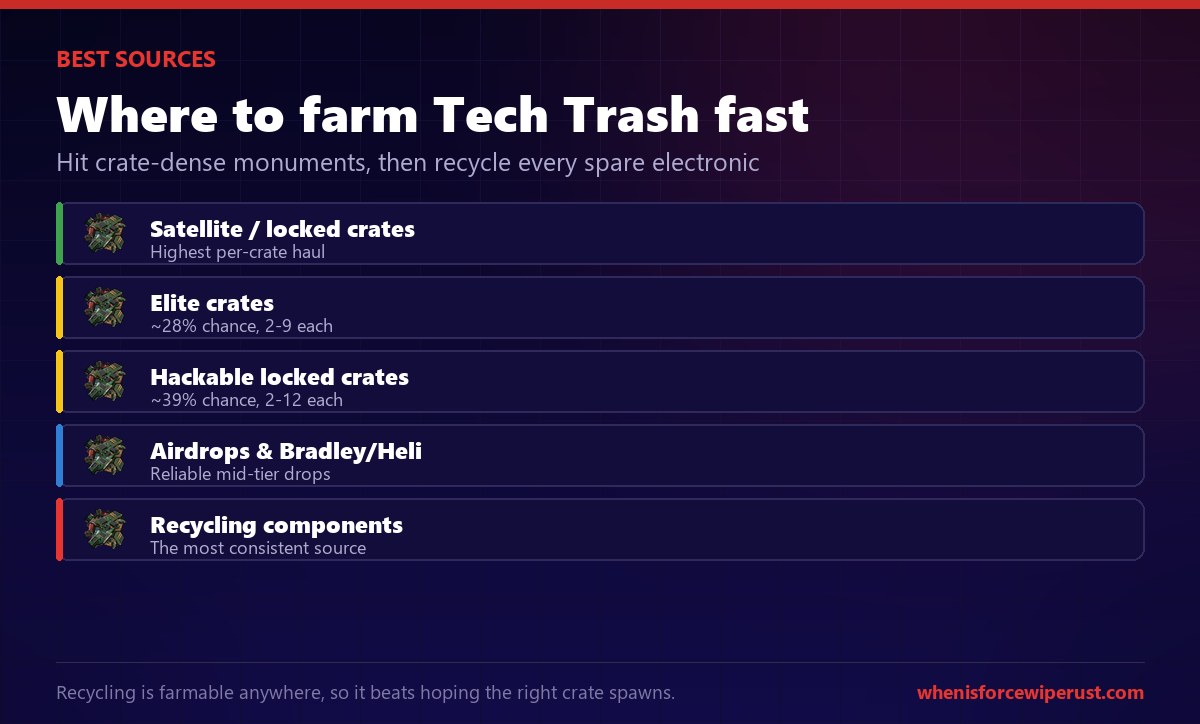
- Run crate-dense monuments. Locked crates, elite crates and military crates cluster at the bigger monuments. A single elite crate room can hand you several tech trash at once.
- Hold hackable crates. Start the 15 minute hack, secure the area, and collect a batch of tech trash along with the rest of the loot when it opens.
- Recycle every spare electronic. CCTV Cameras, Targeting Computers, spare batteries and smart devices all become tech trash. This is the most consistent source because you control it, no luck required.
- Catch airdrops and event loot. Airdrops, the Bradley APC and the patrol helicopter all drop tech trash, so contest them when you can.
Does tech trash wipe in Rust?
Yes. Tech Trash is ordinary loot, and loot does not survive a wipe. When the server resets, every crate empties and every base clears, so any tech trash you stored is gone with it. There is no carry-over, and this is the part that ties straight back to why this site exists.
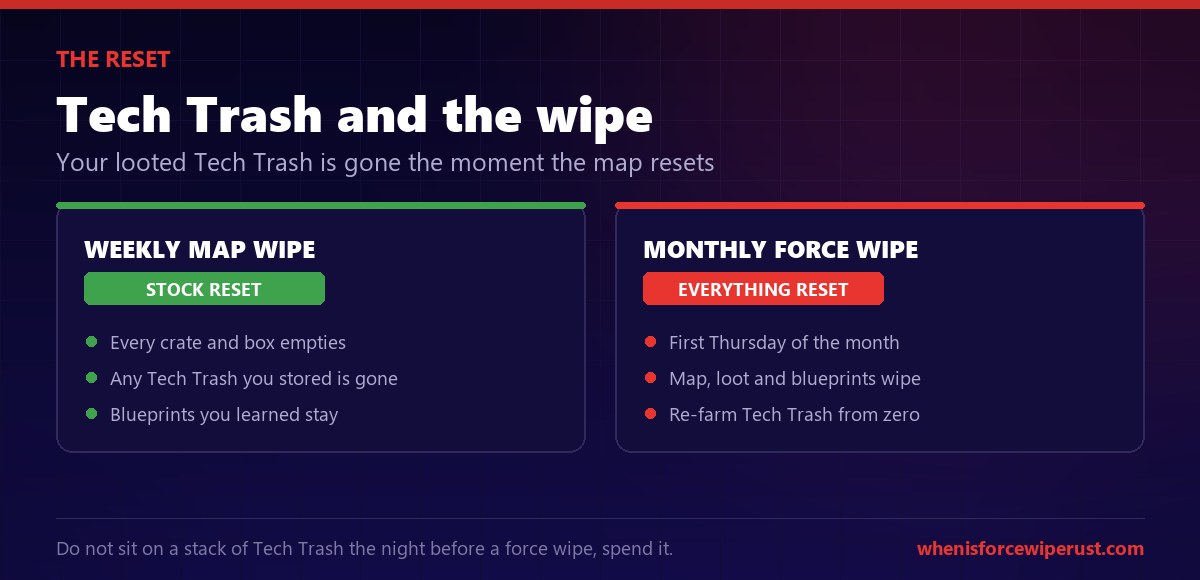
Both wipe cycles clear your tech trash: the weekly map wipe resets the map and all loot, and the monthly force wipe on the first Thursday of the month resets the map, the loot and your blueprints. Either way the tech trash in your box is not coming back, so the rule is simple: do not hoard it into a wipe. If you are sitting on a stack the night before a reset, either recycle it for the scrap or spend it on the C4 for one last raid.
Do not let a full stack of tech trash wipe unused. Check exactly when the next force wipe hits so you can recycle or raid before the reset takes it.
Check the wipe countdownTech trash pro tips
- Recycle at a monument, not a safe zone. The 24 scrap monument return beats the 16 scrap safe zone return by 50 percent, plus it guarantees the high quality metal.
- Never walk past electronics. A stray CCTV Camera or Targeting Computer is free tech trash and scrap the moment you recycle it.
- Split your stacks. Decide up front how much tech trash you want as scrap versus how much you are saving for C4 and batteries, then recycle the rest so it is not a raid target.
- Farm to your raid number. Two tech trash per C4 makes the math easy, so calculate the raid first and farm exactly what you need.
- Grab it even geared. Late wipe, tech trash is still worth the inventory slot because HQM and C4 stay useful right up to the reset.
Rust tech trash FAQ
How much scrap does tech trash give in Rust?
How do you get tech trash in Rust?
Can you craft tech trash in Rust?
What is tech trash used for in Rust?
How much tech trash do you need for C4?
What components recycle into tech trash?
What is the best way to farm tech trash?
How much is a full stack of tech trash worth?
Where do you recycle tech trash?
Does tech trash wipe in Rust?
Is tech trash worth keeping or recycling?
What does tech trash look like in Rust?
Sources
- Facepunch Rust Wiki, Tech Trash (techparts) item page, for the shortname, stack size, despawn time, recycle output and full crafting list.
- RustHelp Rust Wiki, Tech Trash, for the recycle scrap and HQM values, crafting recipes, and the list of components that recycle into tech trash.
- Corrosion Hour, Tech Trash, for the loot sources and the CCTV camera and targeting computer recycling method.
- whenisforcewiperust.com recycler guide and raid calculator, for the monument versus safe zone recycler rates and the C4 raid costs.