
Every wipe, someone farms 20 high quality metal, slaps an armored door on the front of a stone 2×1 and calls the base raid proof. Then it gets opened for two C4 that never touched the door.
Search armored door Rust and you will find a lot of confident numbers. Some of them are from a patch that shipped eight years ago. Here are the current ones, checked against the game’s own entity data.
The armored door is the top tier door in Rust. It has 1,000 health, roughly four times a sheet metal door, and it is the only door in the game with a working hatch you can shoot through. It is genuinely excellent. It is also the single most commonly misused item in base building, because its strength only matters if everything around it is at least as expensive to break.
This guide gives you the real numbers. Exactly how many satchels, C4, rockets and explosive rounds it takes, what each of those routes costs in sulfur, the cheapest mixed combination that most players never work out, how to get the blueprint, why gears are the actual bottleneck, and the doorway frame maths that decides whether your door is doing anything at all.
- What it is
- Stats
- Craft cost
- How to get it
- Satchels
- C4
- Rockets
- Explo ammo
- Full raid cost
- Cheapest raid
- The frame trap
- Vs other doors
- Double door
- The hatch
- Upkeep and decay
- Where to place them
- Skins
- Mistakes
- FAQ

What is the armored door in Rust?
The armored door is the fourth and final tier of hinged door. Facepunch describes it in one line: an extremely strong door with a hatch to see and shoot out of. Both halves of that sentence matter.
The strength. At 1,000 health it is the toughest single door in the game, four times a sheet metal door and well ahead of a garage door. It is also the only door made from high quality metal rather than fragments, which is why it sits behind a Workbench Level 3.
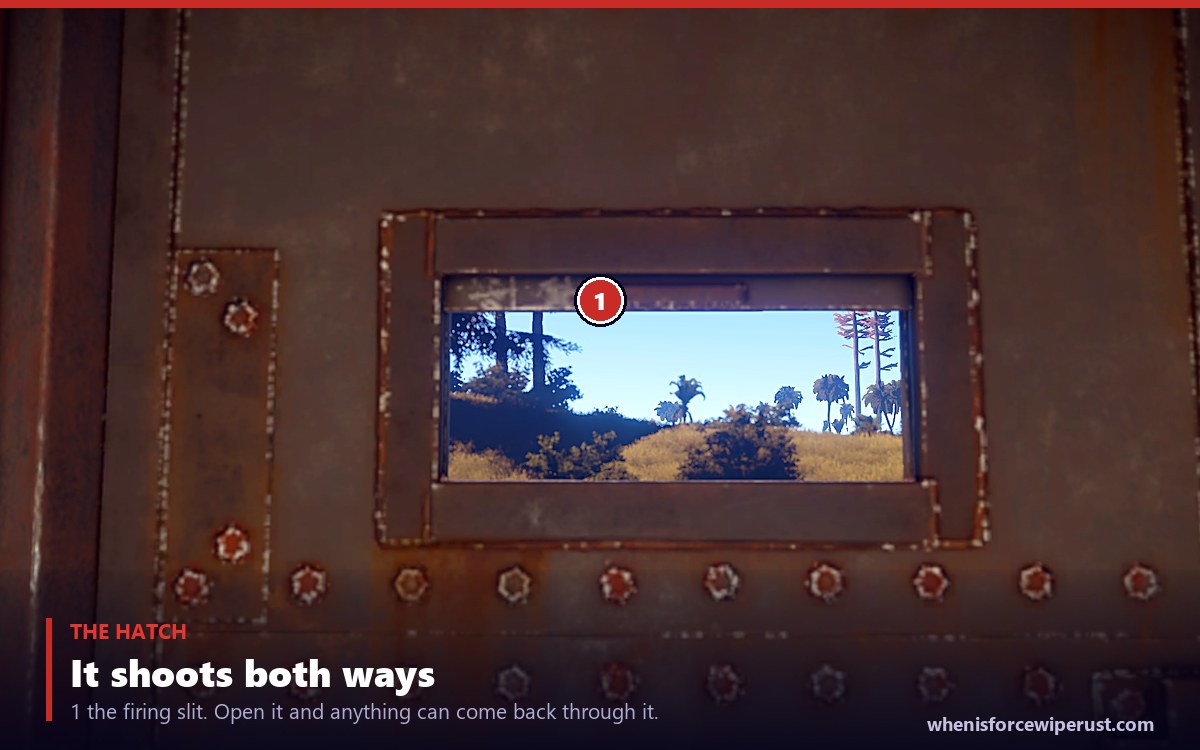
The hatch. A small horizontal slit near eye level that you open and close with a separate interaction. It is not decoration. Since Devblog 147 in February 2017 the hatch has been fully functional, meaning bullets, arrows, grenades and thrown items pass through it in both directions. That is the feature that makes an armored door a defensive position rather than just a wall with hinges.
Mechanically it behaves like any other door. It needs a doorway to hang in, it accepts a code lock or a key lock, it can be picked up while you have building privilege, it decays without upkeep, and it can be repaired at a hammer or a repair bench. What separates it is cost, health, and the slit.
Armored door stats
| Stat | Value | Notes |
|---|---|---|
| Health | 1,000 HP | Highest of any door in Rust. |
| Craft cost | 20 High Quality Metal, 5 Gears | Workbench Level 3, 30 seconds. |
| Research table | 120 scrap | You need a physical armored door to copy. |
| Tech tree | Workbench 3 branch | Sits behind the Reinforced Glass Window node. |
| Recycler output | 12 HQM, 3 Gears | 8 HQM and 2 Gears in a safe zone recycler. |
| Hammer repair | 25 Metal Fragments, 10 HQM | Full repair from near dead. |
| Upkeep | 2 to 7 HQM per 24 hours | Scales with how many blocks your base has. |
| Decay | 12 hours | Slowest decay tier in the game. |
| Stack size | 1 | One inventory slot per door. |
| Despawn time | 1 hour | If dropped on the ground. |
| Shortname | door.hinged.toptier | Item ID 1353298668. |
Armored door crafting cost, and the gears problem
Twenty high quality metal and five gears. That is it. Thirty seconds at a Workbench Level 3 and you have a door.
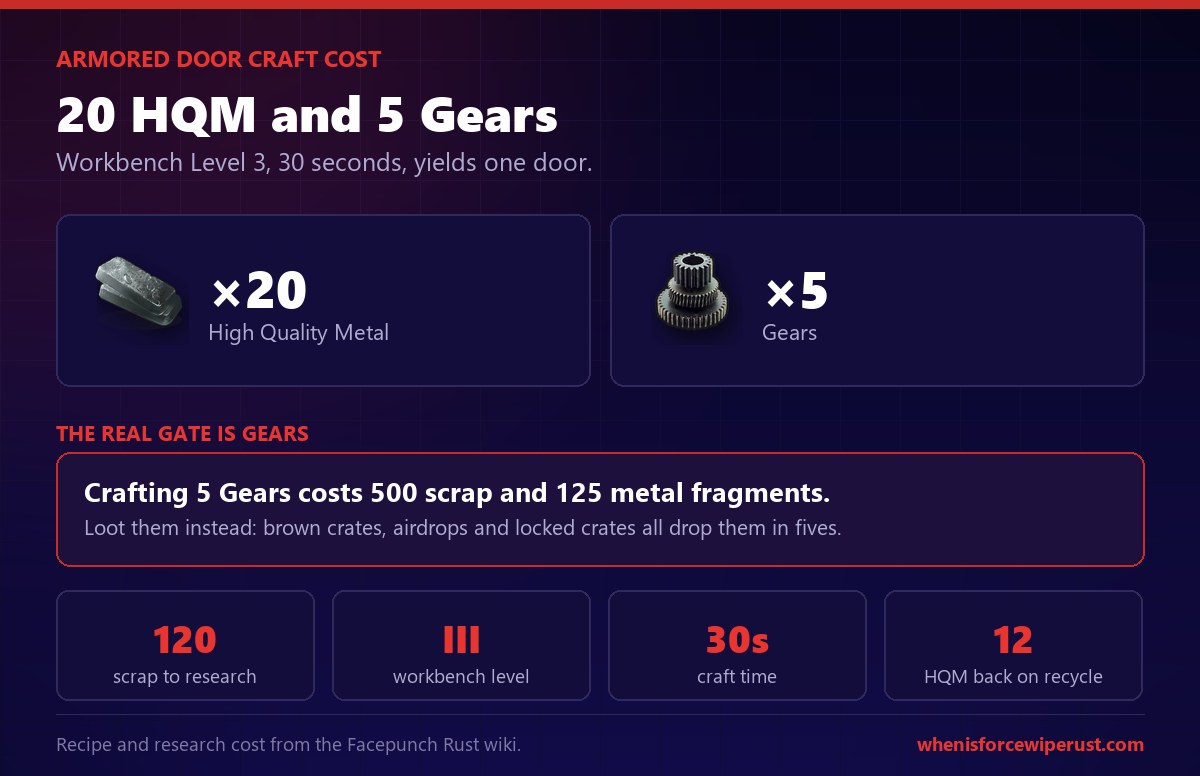
Twenty HQM is not much by mid wipe standards. A single stack of high quality metal ore run through a furnace covers several doors, and you will have hundreds by the time your workbench is up.
Gears are the actual bottleneck. A gear is a component, and the crafting recipe for one gear is 100 scrap and 25 metal fragments at a Workbench Level 3. Five gears means 500 scrap and 125 metal fragments if you craft them, which is an enormous amount of scrap to spend on a single door. Nobody sensible does that.
The correct approach is to loot gears and never craft them. They are a common component and they drop in fives from the good containers:
| Source | Amount | Chance |
|---|---|---|
| Locked Crate (hackable) | 5 | 31.2% |
| Tech Parts crate | 2 to 6 | 26.5% |
| Airdrop | 5 | 16.0% |
| Brown Crate | 2 to 3 | 14.3% |
| Underwater Advanced Crate | 2 to 3 | 14.3% |
| Scarecrow | 2 to 9 | 8.8% |
The practical read is that one hackable crate has roughly a one in three chance of handing you an entire door’s worth of gears at once. If you are running Missile Silo or any monument with a hackable crate on the reset cycle, your armored doors are already paid for.
How to get armored doors in Rust
Three routes, and the fastest one is not crafting.
1. Loot a door and use it directly
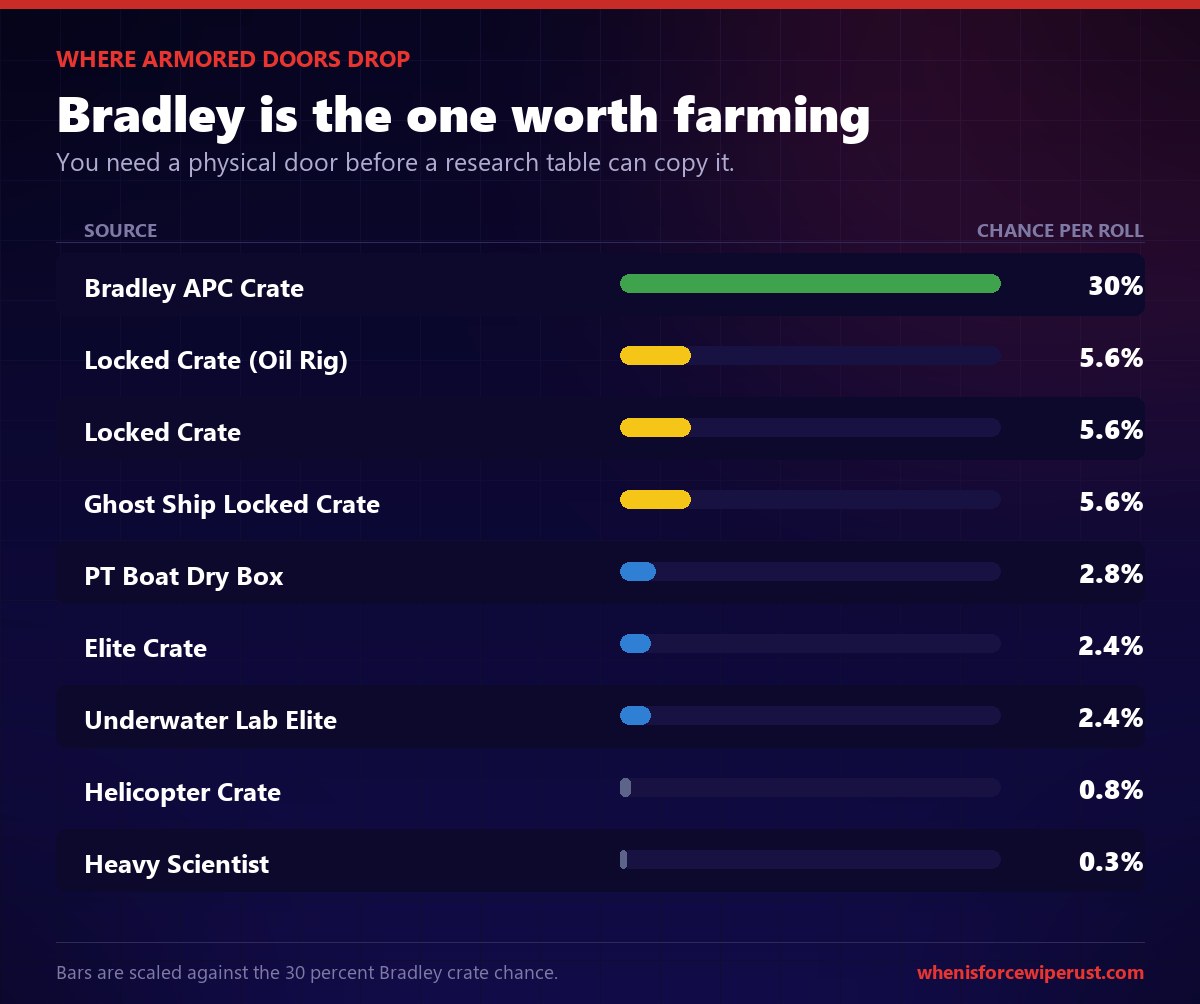
Armored doors drop as finished items from high tier containers. You can hang a looted door immediately with no workbench, no blueprint and no scrap spent. On day two of a wipe this is how almost every armored door in the game gets placed.
| Source | Chance per roll | Notes |
|---|---|---|
| Bradley APC crate | 30% | Three crates per kill, so three rolls. |
| Locked Crate (Oil Rig) | 5.6% | Hackable crate, 15 minute timer. |
| Locked Crate | 5.6% | The Chinook drop crate. |
| Ghost Ship Locked Crate | 5.6% | Same table as the other hackables. |
| PT Boat Dry Box | ~2.8% | Can roll one or two. |
| Elite Crate | 2.4% | Rolls 1 to 2 doors when it hits. |
| Underwater Labs Elite Crate | 2.4% | Same as the surface elite table. |
| Helicopter Crate | 0.8% | Rare, and you already have better problems. |
| Heavy Scientist | 0.3% | Effectively a novelty drop. |
Thirty percent per crate on the Bradley is the number that matters. Every Bradley APC kill drops three crates and each rolls independently, so a single Bradley run gives you very good odds of walking away with at least one free armored door and often two.
2. Research table, 120 scrap
Put a looted armored door into a research table with 120 scrap and you get the blueprint permanently. This is the cheapest unlock and the one most groups use, because you almost always have a spare door before you have spare scrap.
Note the catch that trips people up: you cannot research a blueprint you have never physically held. You need the door in hand first. That is also true of gears, which research for 60 scrap if you want to craft your own.
3. Tech tree at Workbench 3
The armored door sits on the Workbench Level 3 tech tree, downstream of the Reinforced Glass Window node. Unlocking it through the tree costs roughly 180 scrap once you account for the prerequisite, which is more than the research table route but does not require you to find a door first.
How many satchels for an armored door?
Fifteen. A satchel charge deals 70 damage to an armored door, and 15 x 70 is 1,050 against a 1,000 health pool. Fourteen leaves it at 20 health, which is exactly enough for the owner to run up and hammer it back to full while you stand there swearing.
Fifteen satchels costs 7,200 sulfur and takes about 30 seconds of throwing. That makes satchels the most expensive of the four mainstream routes, which surprises people who think of them as the budget option. Satchels are cheap per unit and terrible per point of damage against high health targets.
You will also see 12 satchels quoted on a few sites. That figure is wrong and comes from an older health value. Fifteen is the current number and it is what the entity data says.
How many C4 for an armored door?
Three. A Timed Explosive Charge deals 440 damage to an armored door, so two get you to 880 and the third finishes it with 320 damage of overkill.
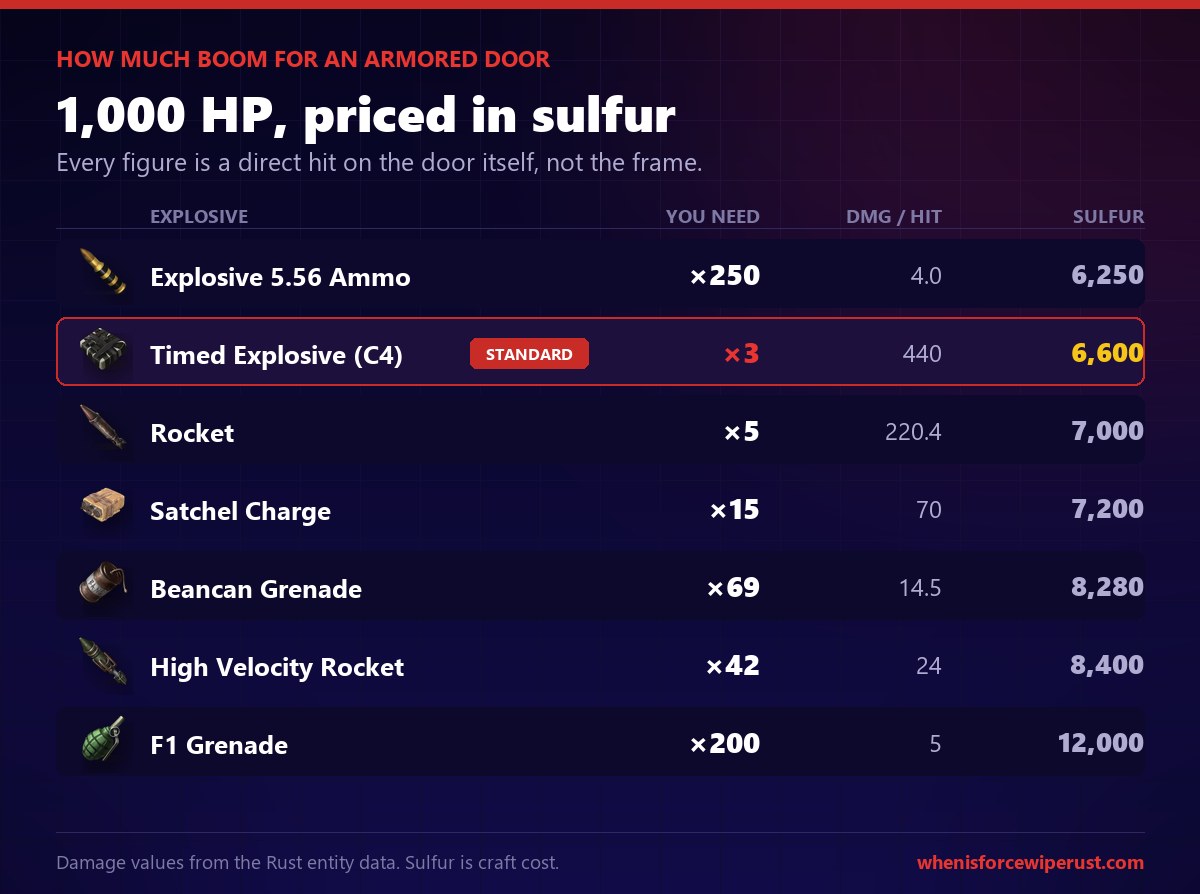
Three C4 is 6,600 sulfur and roughly 13 seconds from first stick to open doorway. It is the standard answer, the fastest answer, and the one every raid group defaults to because it does not require thinking. It is also, as the numbers below show, not the cheapest.
If you have never crafted C4 before, the recipe and full unlock path are in the timed explosive charge guide. The short version is 20 Explosives, 5 Cloth and 2 Tech Trash, and 2,200 sulfur each.
How many rockets for an armored door?
Five. A standard rocket deals 220.4 damage to the door, so five covers 1,102 damage against 1,000 health. Four rockets leave it at 118 health, which is not enough.
Five rockets is 7,000 sulfur and about 24 seconds. Rockets are the wrong tool for a single door and the right tool the moment there is more than one thing to break, because a rocket has splash on building blocks and a well placed shot can damage the door and the wall behind it. If you are already rocketing a base, the door costs you five. If the door is the whole job, use C4.
How much explosive ammo for an armored door?
250 rounds. Explosive 5.56 rifle ammo deals just over 4 damage per shot to an armored door, so 250 rounds covers it with a handful to spare.
That is 6,250 sulfur, which technically makes pure explosive ammo the lowest sulfur route on the whole board. It is also the loudest, the slowest to farm and the one that leaves you standing in the open for over a minute of continuous fire. You need a rifle, you need to hold the trigger, and every player within a very generous radius knows exactly where you are.
Where explosive ammo genuinely shines is as a finisher. Not 250 rounds on its own, but 30 rounds to top off two C4. That combination is covered below and it is the real answer to the cheapest way in.
Full armored door raid cost
Every option against 1,000 health, priced in sulfur.
| Explosive | Damage per hit | You need | Sulfur | Time |
|---|---|---|---|---|
| Explosive 5.56 Rifle Ammo | 4.0 | 250 | 6,250 | ~1m 07s |
| Timed Explosive Charge (C4) Standard | 440 | 3 | 6,600 | ~13s |
| Rocket | 220.4 | 5 | 7,000 | ~24s |
| Satchel Charge | 70 | 15 | 7,200 | ~30s |
| Beancan Grenade | 14.5 | 69 | 8,280 | ~4m 21s |
| High Velocity Rocket | 24 | 42 | 8,400 | ~4m 12s |
| F1 Grenade | 5 | 200 | 12,000 | ~8m 21s |
| MLRS Rocket | 280.4 | 4 | Not craftable | Instant |
| 40mm HE Grenade | 28.3 | 36 | Not craftable | ~42s |
| Mortar Shell | 48.4 | 21 | 6,300 | ~53s |
The no sulfur option: siege weapons
Since siege weapons arrived, there is a route to an armored door that costs zero sulfur.
| Siege weapon | Damage per hit | Hits needed | Cost | Time |
|---|---|---|---|---|
| Battering Ram | 80.3 | 13 | 81 HQM of ram wear | ~58s |
| Ballista, Hammerhead Bolt | 20 | 50 | 250 HQM | ~3m 16s |
Thirteen battering ram hits at a cost of 81 high quality metal is a genuinely competitive way to open an armored door if you already have the ram parked outside. It is slow, it is loud, and the ram is a large obvious target, but it converts a 6,600 sulfur problem into an 81 HQM problem. The ballista is not worth it at 250 HQM and over three minutes.
Planning a raid around the reset? Loot is fattest right before a wipe and defences are weakest right after one.
Check the force wipe countdownThe cheapest way to break an armored door
Three C4 does 1,320 damage to a 1,000 health door. You are paying 2,200 sulfur for a charge that only needs to deliver 120 damage. That waste is the whole opportunity.
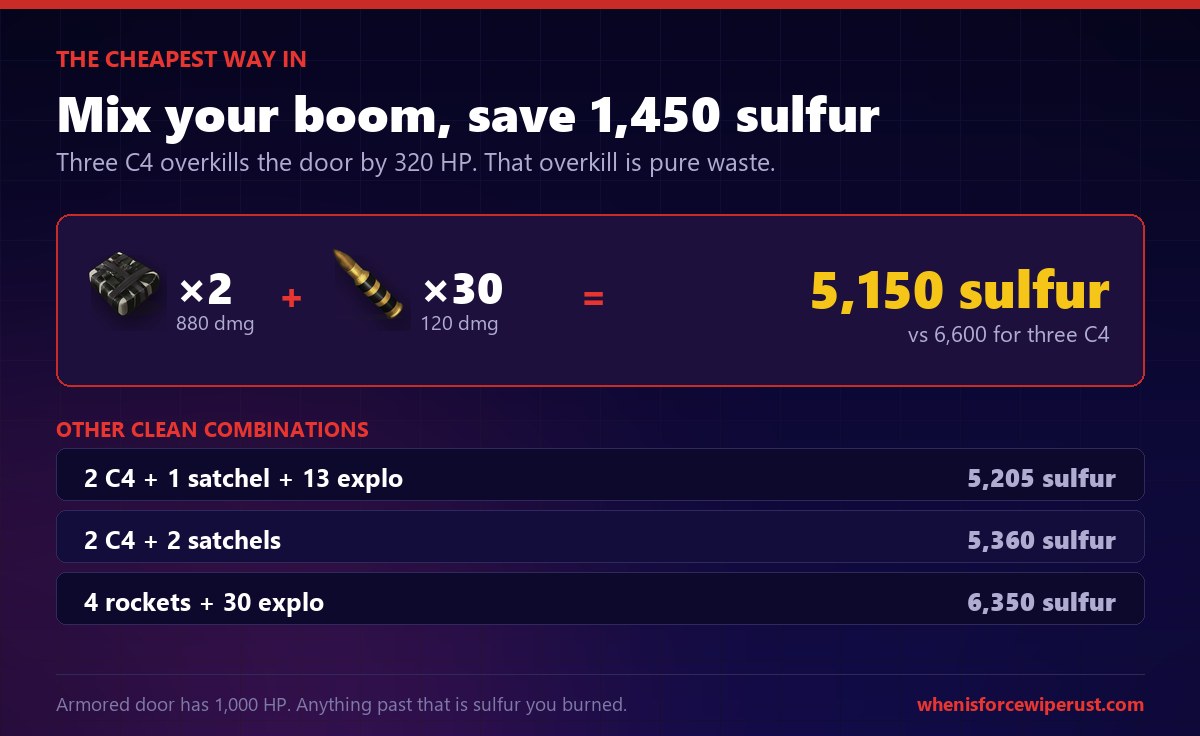
Two C4 plus 30 explosive 5.56 rounds. The two charges do 880, leaving 120 health, and 30 explosive rounds cover 120 damage exactly. Total cost 5,150 sulfur, a saving of 1,450 over the three C4 route. That is most of another C4 back in your pocket on every door you open.
| Combination | Damage | Sulfur | Saving vs 3 C4 |
|---|---|---|---|
| 2 C4 + 30 explosive rounds | 1,000 | 5,150 | 1,450 |
| 2 C4 + 1 satchel + 13 explosive rounds | 1,002 | 5,205 | 1,395 |
| 2 C4 + 2 satchels | 1,020 | 5,360 | 1,240 |
| 4 rockets + 30 explosive rounds | 1,002 | 6,350 | 250 |
| 3 C4 | 1,320 | 6,600 | Baseline |
- Stick both C4 on the door and let them blow. The door will be at roughly 120 health.
- Swap to a rifle loaded with explosive 5.56. Any 5.56 weapon works, and damage per round is effectively identical across them.
- Empty a magazine into the door. Thirty rounds is one full AK magazine, which is a convenient coincidence worth remembering.
If you want to price a whole raid rather than a single door, the site’s Rust raid calculator holds the same per target numbers for every wall, door and deployable in the game.
Your armored door is only as strong as its doorway
This is the section that matters more than every raid number above it, and it is the reason most armored doors in Rust do nothing at all.
A door hangs inside a doorway, and the doorway is a separate building block with its own health and its own damage multipliers. A raider is not obliged to hit your door. They will hit whichever of the two is cheaper, and on anything below sheet metal, that is never the door.
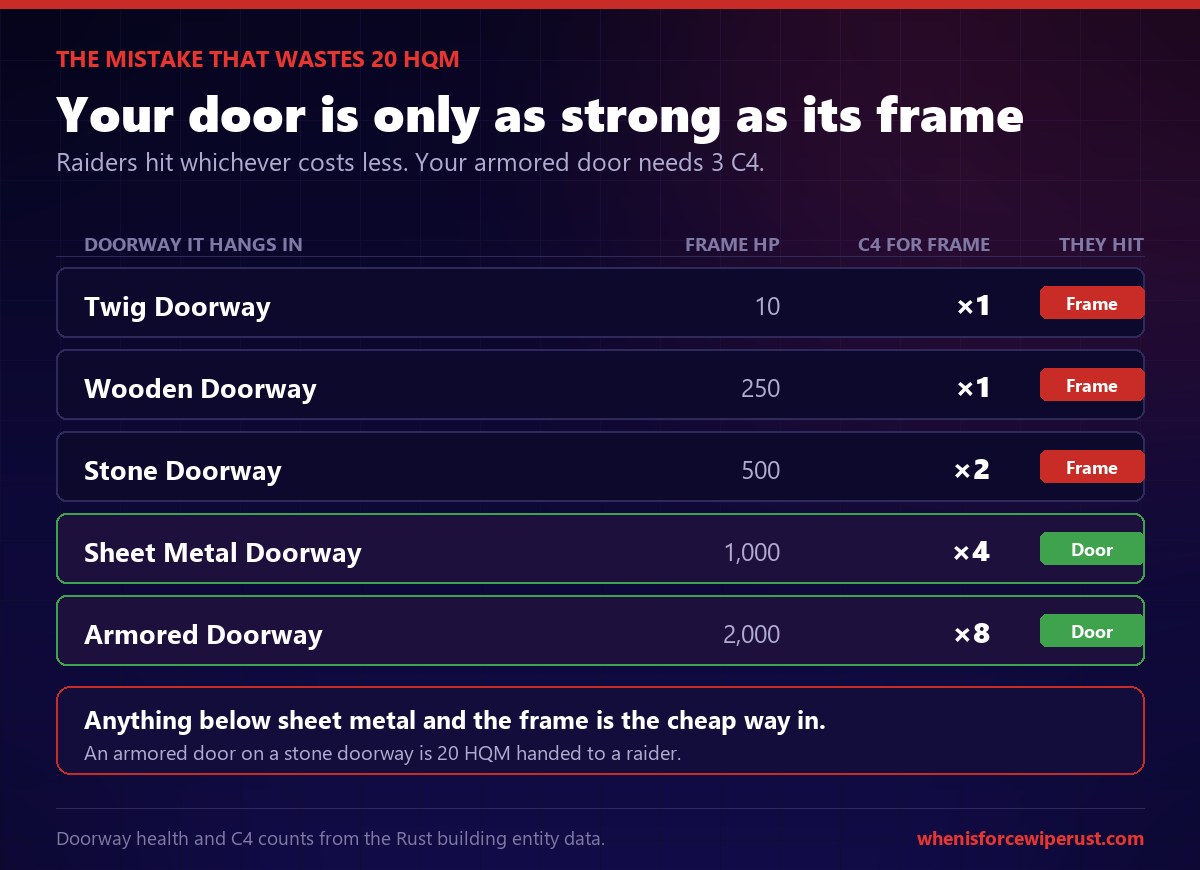
| Doorway tier | Frame HP | C4 for the frame | Rockets | Satchels | They break |
|---|---|---|---|---|---|
| Twig Doorway | 10 | 1 | 1 | 1 | Frame |
| Wooden Doorway | 250 | 1 | 2 | 3 | Frame |
| Stone Doorway | 500 | 2 | 4 | 10 | Frame |
| Sheet Metal Doorway | 1,000 | 4 | 8 | 23 | Door |
| Armored Doorway | 2,000 | 8 | 15 | 46 | Door |
| Armored Door | 1,000 | 3 | 5 | 15 | – |
Read the stone row again. A stone doorway is 500 health and falls to two C4. Your armored door needs three. Every raider in the game knows this, which means an armored door on a stone base is worth exactly nothing. You spent 20 high quality metal and five gears to make your entrance one C4 cheaper for the attacker than the wall beside it.
The same is true, more obviously, on wood. A wooden doorway is one C4. You could hang a solid gold door in it and it would still be one C4.
There is one important corollary. Because a sheet metal doorway takes 4 C4 and an armored door takes 3, upgrading a doorway to armored does not make your entrance harder to open. It just changes where they put the charges. The only way to actually raise the price of getting through an entrance is to add another door behind it, which is what airlocks are for.
If you are still building in stone, the stone wall guide covers what your walls are actually worth and when the upgrade to sheet metal pays for itself.
Armored door vs every other door in Rust
The full door ladder, with what each one costs a raider.
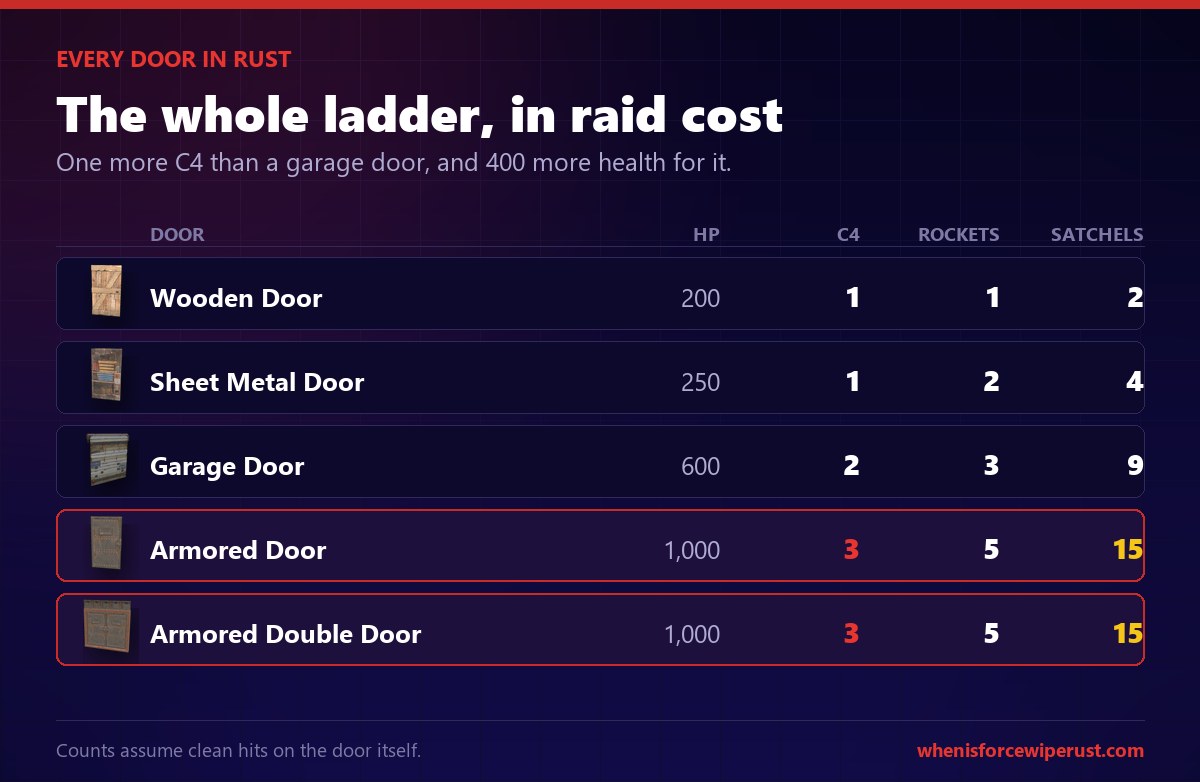
| Door | HP | Craft cost | C4 | Rockets | Satchels | Explo ammo |
|---|---|---|---|---|---|---|
| Wooden Door | 200 | 300 Wood | 1 | 1 | 2 | 18 |
| Sheet Metal Door | 250 | 150 Metal Fragments | 1 | 2 | 4 | 63 |
| Garage Door | 600 | 300 Frags, 2 Gears | 2 | 3 | 9 | 150 |
| Armored Door This guide | 1,000 | 20 HQM, 5 Gears | 3 | 5 | 15 | 250 |
| Armored Double Door | 1,000 | 25 HQM, 5 Gears | 3 | 5 | 15 | 250 |
Three things worth pulling out of that table.
The garage door is the value pick, not the armored door. A garage door is 600 health for 300 metal fragments and 2 gears, no high quality metal and only a Workbench Level 2. It costs a raider two C4 against the armored door’s three. You are paying 20 HQM, five gears and a Workbench 3 for one extra charge. On a small base that is a bad trade. On a main base with loot worth defending it is a good one, because that extra C4 is repeated at every layer.
Sheet metal is barely better than wood. Fifty more health and the same single C4. If you are still running sheet metal fronts on a base you care about, the upgrade is overdue.
Satchels scale worst. Look at the satchel column. Wood 2, sheet metal 4, garage 9, armored 15. Satchel raiders feel the door tier far more sharply than C4 raiders do, which is exactly the argument for armored doors on a low population server where most raids are satchel raids.
Armored double door
The armored double door is the same door in a wider frame. It costs 25 High Quality Metal and 5 Gears, five more HQM than the single, and it has the same 1,000 health and the same raid cost of 3 C4, 5 rockets or 15 satchels.
Two practical notes. First, the double door goes in a wall frame, not a doorway, so you cannot swap one for the other after the fact without replacing the wall piece. Second, it recycles slightly better at 15 HQM and 3 gears against the single’s 12 and 3, and it repairs for 25 metal fragments and 12 HQM against 25 and 10.
The reason to use one is width, not toughness. Wall frames with double doors give you a wide opening for large deployables and two players at once, and they are the standard for garage rooms and workshop bays. If you are building a vehicle bay, a garage door is usually still the better answer because it rolls up out of the way. If you want an entrance you can fight from with a hatch, the armored double door is the one.
The hatch, and how it gets you killed
The armored door hatch is the only firing port in Rust that comes attached to a door. Open it and you have a letterbox at eye height that you can shoot, throw and look through, without opening the door itself.
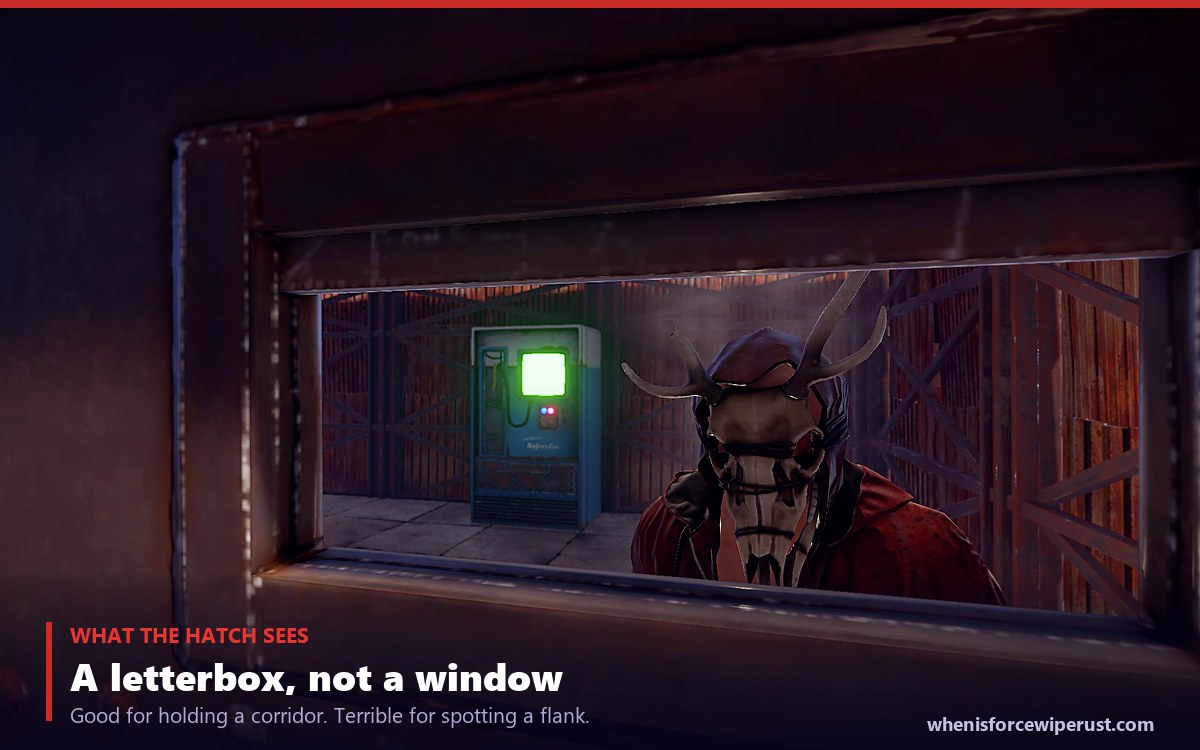
What the hatch is good for. Holding a corridor. If your base has a long straight approach to a door, an armored door with the hatch open turns that approach into a shooting gallery you can cover in near total safety. It is also the correct way to defend a vending machine or a shop front, since you can see who is outside without exposing yourself.
What the hatch does to you. It works in both directions. Bullets, arrows, grenades and thrown explosives all pass through an open hatch from the outside just as happily as they pass out. A single F1 grenade posted through an open hatch clears the room behind it. So does a Molotov. So does a shotgun at point blank range from someone who heard you open it.
The discipline is simple. Open, look or shoot, close. Never leave it open while you are away from the door, and never leave it open on a door that faces open ground you cannot see all of.
Upkeep, decay and repair
Armored is the most expensive building tier to maintain and the slowest to fall over. Both of those come from the same place.
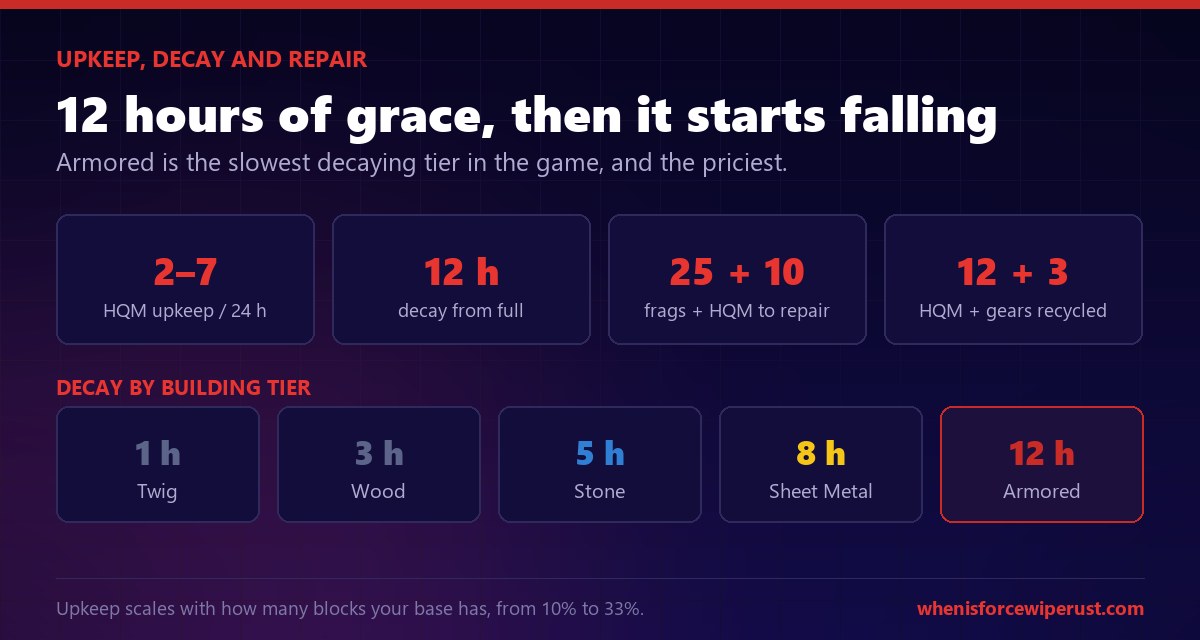
Upkeep. An armored door adds roughly 2 to 7 high quality metal per 24 hours to your tool cupboard bill. The range exists because upkeep in Rust is a percentage of build cost that scales with how many building blocks you own, from about 10 percent on a tiny base up to roughly 33 percent on a large one. A 1×1 with one armored door pays near the bottom of that range. A clan base with forty of them pays near the top, and it adds up fast.
Decay. If the cupboard runs dry, armored structures decay over 12 hours, the longest grace period of any tier. For comparison: twig 1 hour, wood 3, stone 5, sheet metal 8, armored 12. That extra half day is a real safety margin if you play irregularly, and it is one of the underrated reasons to upgrade a small base to armored rather than a big one.
Repair. A hammer repairs an armored door for 25 metal fragments and 10 high quality metal. That is cheap enough that repairing a door mid raid is always correct if you have the materials and the raid stalls. A door at 20 health and a door at full health both take the same three C4, so a single hammer swing during a lull can cost the attacker an entire extra charge.
Where to actually put armored doors
Assume you have limited gears, because you do. Here is the priority order that survives contact with a real wipe.
- The tool cupboard room. Always first. Everything else in your base is replaceable and the cupboard is not. If a raider gets the TC they own your walls.
- The loot room. Second layer in, wherever the boxes actually are.
- The airlock, inner door. The door between your airlock and the base proper. Not the outer one.
- Bunker and shooting floor access. Anywhere you need to fight from during a raid.
- The front door. Last, and only if you have spares.
The other placement rule is that doors are useless without honeycomb. A raider facing an expensive door will simply blow the cheaper wall next to it. Every door in your base should have building blocks either side of it that cost at least as much to break as the door does, which loops straight back to the doorway table above.
Armored door skins
There are dozens of workshop skins for the armored door, and every one of them is cosmetic. Skins never change health, cost, upkeep or raid cost in Rust, on any item, ever. An Apocalypse Door and a stock armored door take exactly three C4.
What skins do change is what a raider sees before they commit. Some armored door skins read as much less threatening than the default rusted plate, and a few look close enough to a lower tier door at a glance to buy you a moment of confusion. That is a very small edge and it disappears the second anyone looks at the hatch, which every skin keeps.
The reverse is also worth knowing as a raider. If you see a door with a horizontal slit at eye height, it is an armored door regardless of what it is painted like. Count on 3 C4, not 2.
Six mistakes that waste an armored door
- Hanging it in a stone doorway. The frame is two C4 and the door is three. You made your entrance cheaper to raid, not harder.
- Crafting the gears. Five hundred scrap for five gears is one of the worst trades in the game. Loot them from hackable crates and brown crates instead.
- Using it as a front door. It is a billboard advertising loot. Sheet metal on the outside, armored on the inside.
- Leaving the hatch open. The slit works both ways. Open it, shoot, close it.
- Assuming a double door is tougher. Same 1,000 health, same 3 C4, just wider.
- Not honeycombing. A 1,000 health door in a wall of 500 health blocks protects nothing. Raiders go around.
Armored Door Rust FAQ
How many satchels for an armored door in Rust?
How many C4 for an armored door in Rust?
How many rockets for an armored door in Rust?
How much explosive ammo for an armored door in Rust?
How much HP does an armored door have in Rust?
How do you get armored doors in Rust?
How much does an armored door cost in Rust?
Are armored doors worth it in Rust?
How many C4 for an armored double door?
What is the strongest door in Rust?
Does the armored door have a soft side in Rust?
Can you shoot through an armored door hatch?
What is the cheapest way to raid an armored door?
Does an armored door recycle in Rust?
Final Thoughts
Every armored door Rust guide ends up at the same three numbers, and they are correct: 1,000 health, 3 C4, 15 satchels. What almost none of them tell you is that a door does not exist on its own. Nothing about 1,000 health, 3 C4 and 15 satchels is complicated. What catches people out is that a door does not exist on its own. It is one entity in a wall, and the price of getting past it is set by the cheapest thing next to it, not by the door itself.
So the checklist is short. Loot your gears rather than crafting them. Research a door for 120 scrap the first time you find one. Hang armored doors in sheet metal or armored doorways only, never in stone. Put them on the tool cupboard room and the loot room before the front door. Honeycomb around them. Open the hatch, shoot, close the hatch.
Do that and every armored door in your base is genuinely charging raiders three C4 or fifteen satchels. Skip it and you have handed away 20 high quality metal and five gears for a decorative slab of metal in a wall that opens for two charges anyway.
And if you are about to spend a night farming sulfur for a door raid, check the clock first. Nothing is more expensive than 6,600 sulfur burned on a base that wipes six hours later.
Sources
- Armored door recipe of 20 High Quality Metal and 5 Gears, Workbench Level 3, 30 second craft, 120 scrap research table cost, recycler output of 12 HQM and 3 Gears, hammer repair of 25 Metal Fragments and 10 HQM, stack size, despawn time and the full loot source table: Facepunch Rust Wiki, Armored Door
- Armored double door recipe of 25 HQM and 5 Gears, its recycler output and repair cost: Facepunch Rust Wiki, Armored Double Door
- Armored door health of 1,000, upkeep range of 2 to 7, the 12 hour decay timer, per explosive damage values and quantities (C4 440 x3, Rocket 220.4 x5, Satchel 70 x15, Explosive 5.56 x250, Beancan x69, HV Rocket x42, F1 x200, Battering Ram x13) and the note that a weaker door frame gets targeted instead of the door: Rust Wiki (RustClash), Armored Door
- Doorway health and raid cost by building tier, used for the frame comparison table: RustClash, Stone Doorway, Sheet Metal Doorway and Armored Doorway
- Gears recipe of 100 scrap and 25 metal fragments at Workbench Level 3, and the gear loot table led by the hackable Locked Crate at 31.2 percent: Facepunch Rust Wiki, Gears
- Confirmation that all explosives deal equal damage to the hard side and soft side of structures, so doors have no explosive soft side: Rustafied, Raiding in Rust
- The 15 satchel and 3 C4 figures, the mixed 2 C4 plus satchel plus explosive ammo approach, and the long standing quirk where a door in the open position takes reduced damage: Corrosion Hour, The Best Way to Destroy Doors in RUST
- Armored door skins, the recommendation to keep armored doors on inner rooms rather than the front door, and the hatch description: Corrosion Hour, RUST Armored Door
- Armored door health, tech tree placement behind the Reinforced Glass Window, and deployability on boats: RustHelp, Armored Door
- The armored door hatch being made fully functional, shootable and throwable through in both directions: Facepunch, Devblog 147
- The armored tier rebalance that cut door cost to 20 HQM, and the 12 hour armored decay figure: Facepunch, Devblog 189
- Upkeep being quoted per 24 hours and the decay timers for every building tier: Facepunch Rust Wiki, The Tool Cupboard
- Wooden, sheet metal and garage door health and raid costs used in the comparison table: RustClash, Sheet Metal Door and RustClash, Garage Door