
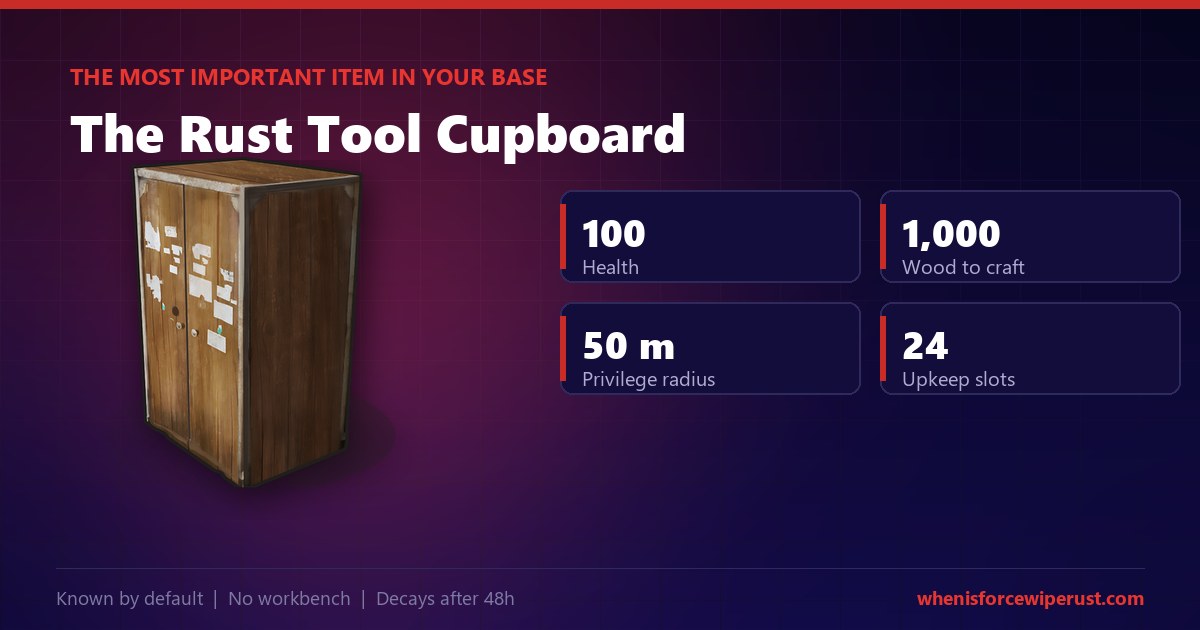
Tool cupboard Rust protection is the foundation of every secure base. You can build the prettiest bunker on the server, wall it in armored, hang a sheet metal door on every frame, and still lose the whole thing in a day. Not to C4. To a little wooden box you forgot to fill.
The tool cupboard Rust players depend on is the single most important deployable in the game, and it is the one new players understand the least. It decides who is allowed to build on your land, it quietly pays the rent that stops your walls rotting, and if a raider gets their hands on it, they own your base without spending a rocket.
This tool cupboard Rust guide covers everything: what a TC actually does, the 50 metre building privilege bubble, how upkeep and decay really work, whether you can pick one up and move it, the cheapest ways to break an enemy one (one molotov, usually), skins, and the griefing trick that ends more bases than sulfur ever will. Every number here is checked against the in game data, not guessed.
- What is a TC
- At a glance
- Building privilege
- Place and authorise
- Upkeep
- Decay
- Upkeep calculator
- Pick up or move it
- How to break a TC
- Skins
- TC griefing
- Pro tips
- FAQ
Tool cupboard Rust guide: what is a TC?
TC is short for tool cupboard. This essential tool cupboard Rust deployable goes inside your base, and it does two jobs that nothing else in the game does.
First, it sets building privilege. The moment you place a cupboard and authorise yourself on it, you claim a sphere of ground around it. Inside that sphere, only authorised players can build new structures, upgrade walls from wood to stone, rotate a wall, or pick up placed deployables. Everyone else gets the dreaded “Building is blocked” message. That is how you stop a stranger from door camping your loot room by slapping their own wall down inside your house.
Second, it holds your upkeep. Rust bases do not last forever on their own. Every structure slowly decays, and the cupboard pays a daily resource cost out of its own inventory to keep everything at full health. Empty cupboard, no upkeep, dead base.
So when a Rust player says “protect the TC” or “go for their TC”, they mean the cupboard. It is the beating heart of the base. Take it and the base is yours. Lose it and the base is nobody’s.
Tool cupboard Rust stats at a glance
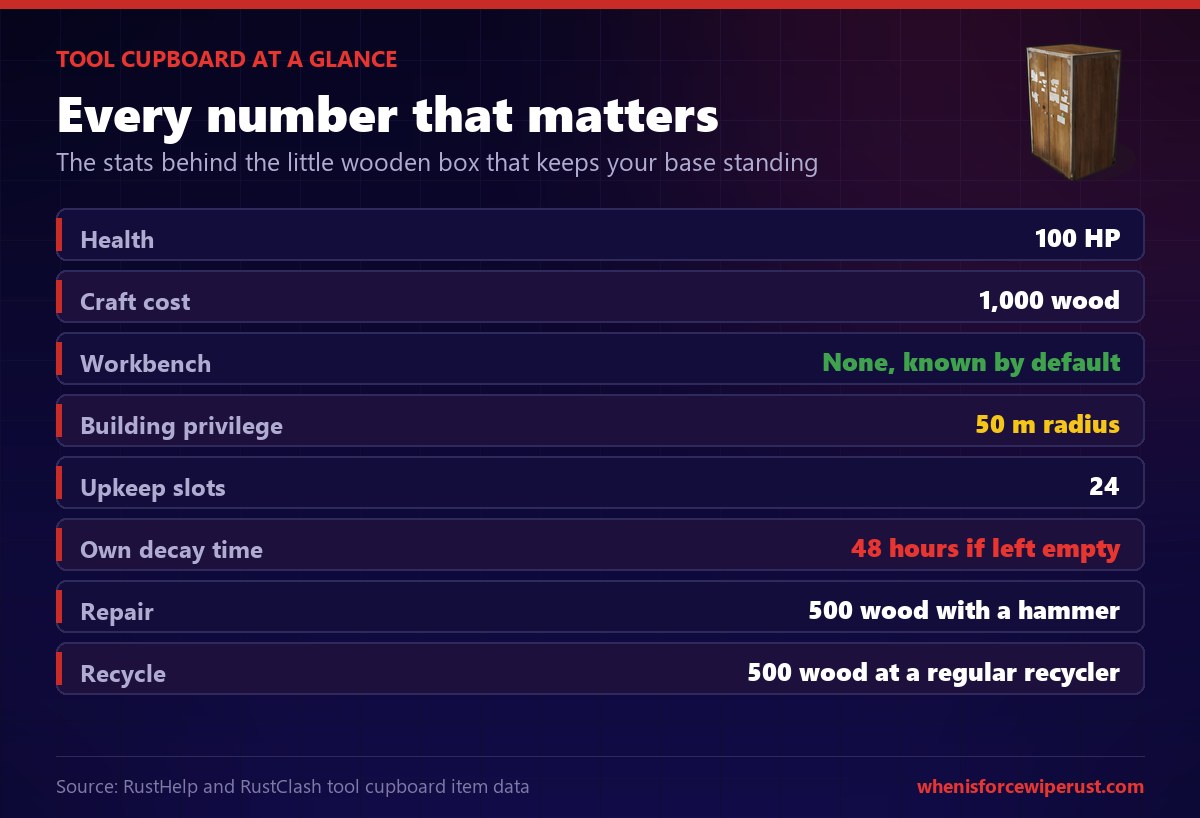
| Stat | Value | Notes |
|---|---|---|
| Health | 100 HP | Very low, but it resists melee heavily |
| Craft cost | 1,000 wood | No other material needed |
| Workbench required | None | Known by default, craftable from hour one |
| Craft time | 7 to 30 seconds | Faster at a workbench |
| Building privilege radius | 50 metres | The area where your authorisation applies |
| Upkeep slots | 24 | Holds wood, stone, metal fragments and HQM |
| Own decay time | 48 hours | If left with no upkeep of its own |
| Repair | 500 wood | With a hammer or at a repair bench |
| Recycle output | 500 wood | 50 percent at a regular recycler |
| Stack size | 1 | You carry one at a time |
What is building privilege in Rust?
Building privilege is the invisible claim a cupboard puts on the ground. Place a TC, authorise on it, and you own a 50 metre radius of build rights. It works both ways, and understanding both sides is what separates a base that holds from a base that gets grubbed on day one.
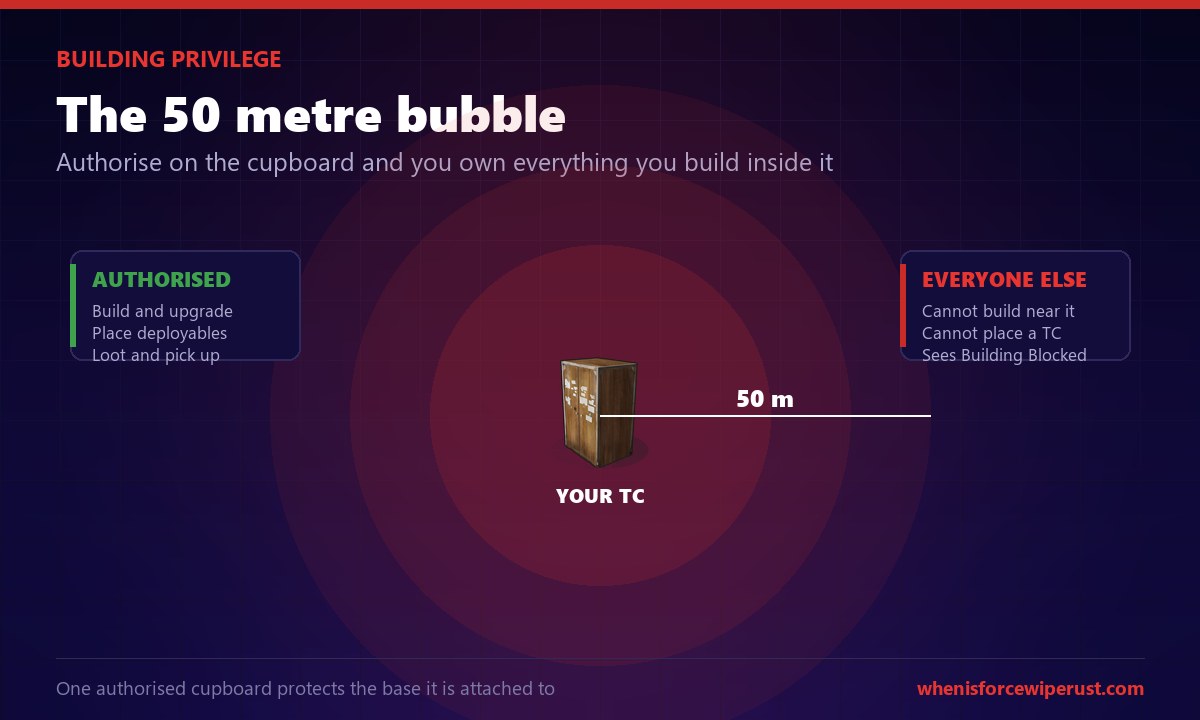
For you and your team: anyone authorised on the cupboard can place walls and floors, upgrade them, rotate them, and pick up deployables inside the radius. If a friend wants to help build, they walk up to the same TC and authorise too. No auth, no building, even for a teammate.
For everyone else: a player who is not authorised cannot build inside your privilege at all. They cannot even place their own tool cupboard within range of yours. That is why you sometimes try to build a base near a monument or another player and get “Building is blocked”. Somebody else’s cupboard is claiming that ground.
How to place and authorise a tool cupboard Rust base
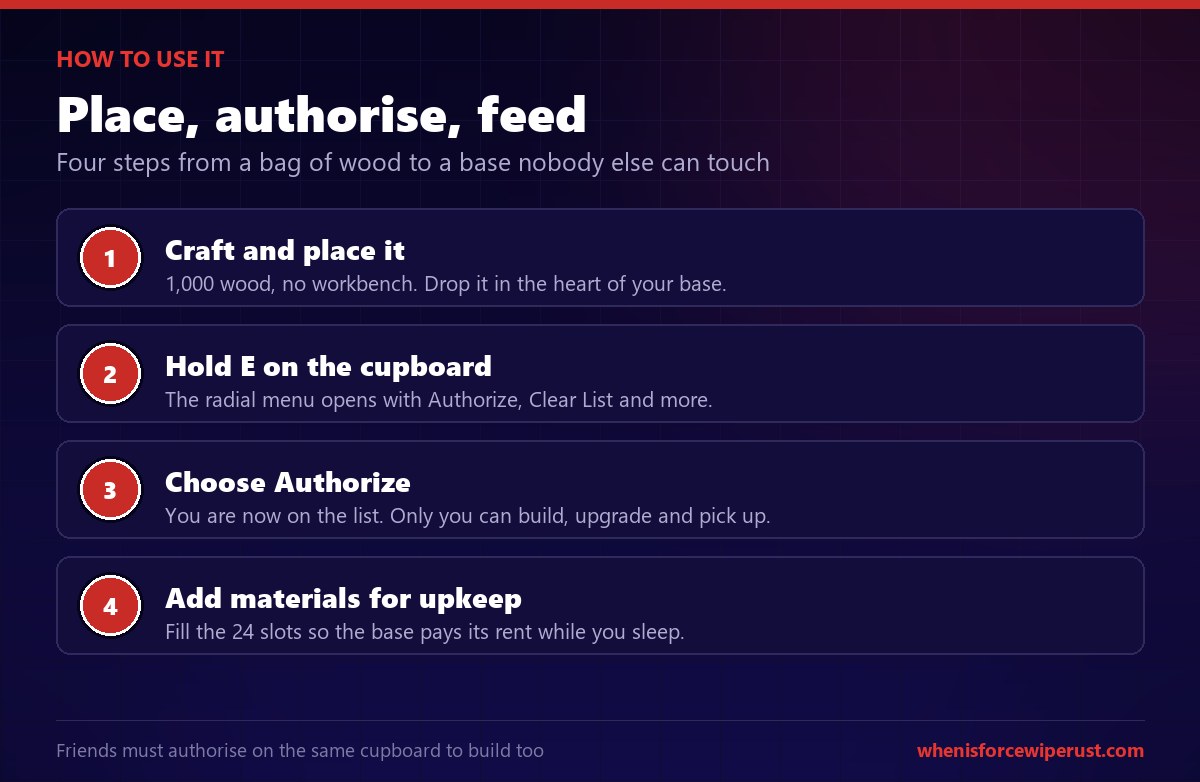
- Craft and place it. The cupboard costs 1,000 wood and needs no workbench, so you can make one in the first minutes of a wipe. Place it deep inside your base, ideally walled off in its own compartment.
- Hold E on the cupboard. The radial menu opens with options including Authorize Me, Clear List and Show Building Privilege.
- Choose Authorize. You are now on the authorised list. From this moment only you (and anyone else who authorises) can build, upgrade and pick up inside the 50 metre radius.
- Load it with upkeep materials. Open the cupboard like a box and drop wood, stone, metal fragments and HQM into its 24 slots. This is the fuel that keeps the base standing while you are offline.
Tool cupboard Rust upkeep: feeding your base
Upkeep is the daily resource cost the cupboard pays to stop your structures decaying. Think of it as rent. You stock the cupboard, and every day the game deducts a portion to keep every wall, floor and door at full health.
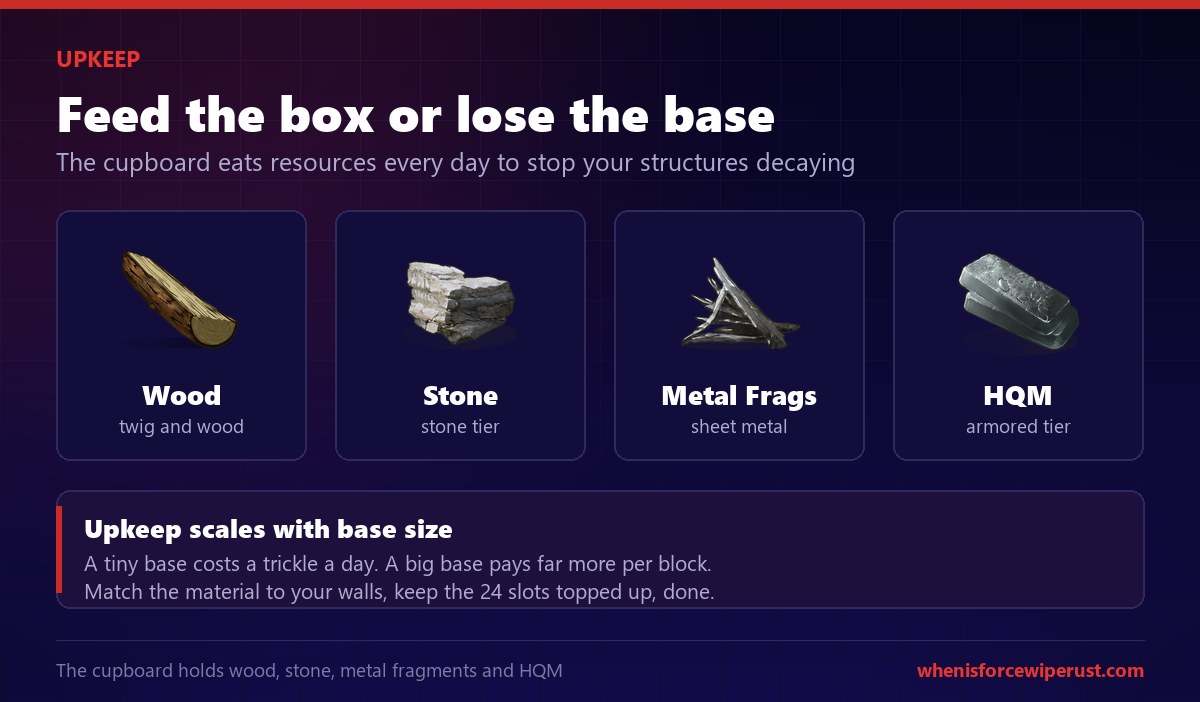
Two things decide your daily bill:
- What your base is made of. The cupboard consumes the same materials you built with. A stone base burns stone, a sheet metal base burns metal fragments, an armored base burns high quality metal. Keep the right material stocked or that tier will not get paid.
- How big your base is. Upkeep scales with the number of building blocks in your privilege. A 2×2 costs almost nothing. A giant clan compound costs a mountain of resources every day, because the per block cost climbs the more you build. This is Facepunch’s deliberate brake on endless megabases.
As a feel for it, a single stone wall costs up to around 99 stone a day at the top bracket, while a sheet metal wall costs somewhere between 20 and 66 metal fragments a day. Upgrading from stone to sheet metal actually lowers your fragment upkeep relative to health, which is one reason metal is the sweet spot for most bases.
Rust decay: what happens when the cupboard runs dry
If your cupboard runs out of upkeep materials, decay begins. Decay chews health off your structures over time until they collapse. Different tiers rot at very different speeds, which is exactly why people ask how long a stone wall or a sheet metal wall lasts.
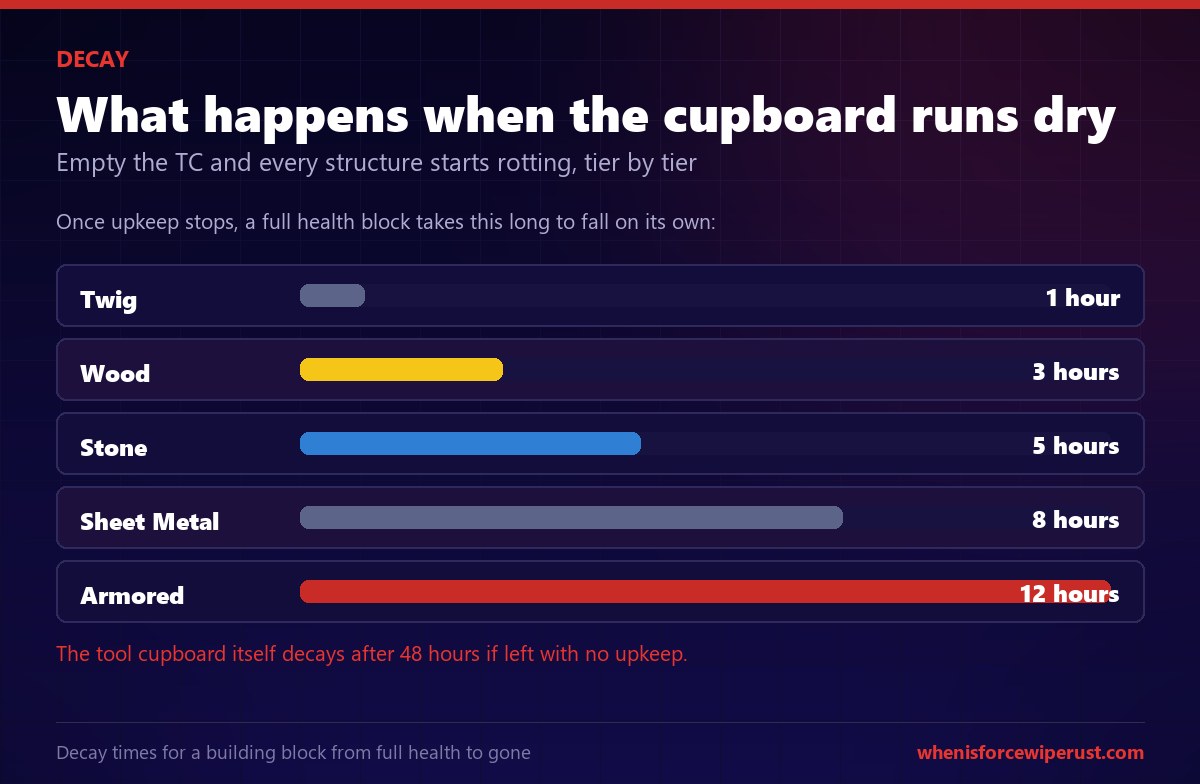
| Building tier | Time to decay from full | Notes |
|---|---|---|
| Twig | ~1 hour | Barely there, breaks by hand anyway |
| Wood | ~3 hours | Also takes full fire damage |
| Stone | ~5 hours | The most common base tier |
| Sheet Metal | ~8 hours | Immune to fire, the value pick |
| Armored | ~12 hours | Longest grace, highest upkeep |
Those are the times for a single full health block to fall on its own after upkeep stops. A stacked, honeycombed base takes far longer to fully collapse because the outer layers rot first and buy the core more time. But the clock only starts when the cupboard is empty, so the real lesson is simple: never let it hit zero.
Rust upkeep and decay calculator: how to estimate your costs
There is no need to guess your daily bill, because the cupboard tells you. You do not need a separate Rust decay calculator or upkeep calculator to run a normal base. The information is baked into the game.
- Hold E on the cupboard and read the panel. The tool cupboard UI shows the current daily upkeep cost for each material, and how long your stocked resources will last at that rate. That is your live decay timer.
- Hit it with a hammer to see privilege info. A hammer swing on the cupboard, or the Show Building Privilege option, highlights the blocks it is paying for and confirms you are authorised.
- Do the quick maths. Upkeep is charged per building block as a fraction of that block’s build cost, and the fraction climbs the more blocks you have. Roughly, a small solo base runs on a few hundred resources a day, while a large clan compound can burn thousands.
If you want a hard number before you build, community decay and upkeep calculators let you enter your wall count and tier to estimate the daily draw. They are useful for planning a big base, but for day to day play the in game cupboard panel is the only calculator you actually need. Stock it above your daily cost, check it each time you log in, and decay never touches you.
Can you pick up or move a tool cupboard Rust deployable?
This is one of the most common questions, and the answer surprises people: no, you cannot pick up a placed tool cupboard. There is no hammer pickup for it the way there is for a box or a furnace. Once it is down, it is down.
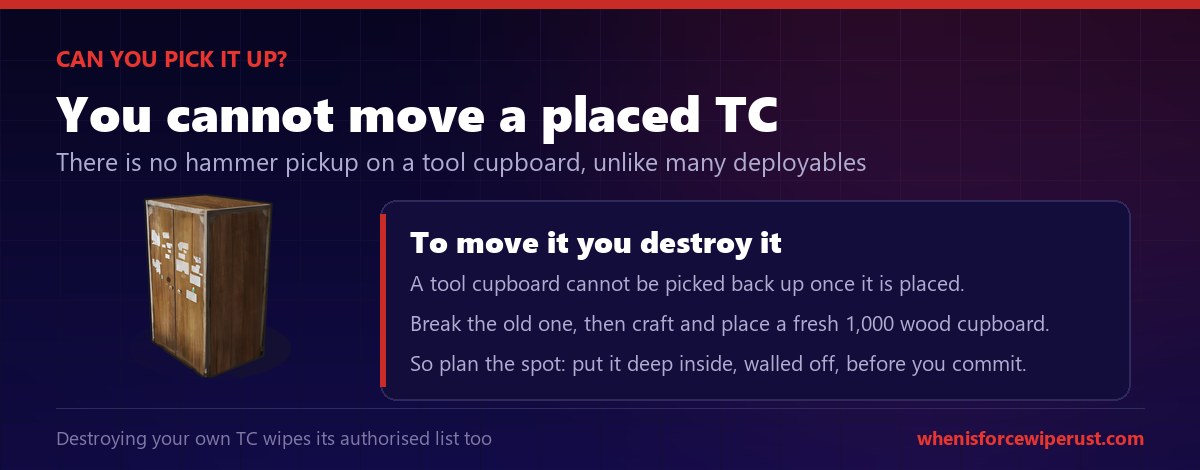
To move a tool cupboard, you destroy the old one and place a fresh one where you actually want it. A new cupboard is only 1,000 wood, so the cost is trivial. The annoying part is that destroying it clears its authorised list and resets your privilege, so do it when the base is safe, not mid raid.
How to break a tool cupboard Rust TC
When you raid, destroying the enemy cupboard is what unlocks the base for you, and it is shockingly cheap because a TC only has 100 HP. The catch is that it resists melee hard, so the smart tools are fire and small explosives, not your hatchet.

| Method | Amount | Sulfur cost | Notes |
|---|---|---|---|
| Molotov Cocktail | 1 to 2 | 0 sulfur | Fire ignores its armor, cheapest option |
| 12 Gauge Incendiary Shell | 2 shells | 40 sulfur | Eoka or any shotgun, dirt cheap |
| Incendiary Rocket | 1 rocket | 300 sulfur | Instant, if you have a launcher |
| Beancan Grenade | 4 | 480 sulfur | Watch for duds |
| Satchel Charge | 1 | 480 sulfur | One does it, but can misfire |
| Explosive 5.56 Ammo | 9 to 10 | ~225 sulfur | Any assault rifle, very reliable |
| Rocket | 1 | 1,400 sulfur | Massive overkill |
| Timed Explosive (C4) | 1 | 2,200 sulfur | Never do this to a bare TC |
How many molotovs for a TC? One molotov does around 147 fire damage over its burn, which is more than the cupboard’s 100 HP, so a clean throw kills it. In practice, bring two in case the first does not fully ignite the box. At zero sulfur, this is the cheapest raid tool in the game.
How many spears to break a TC? If you insist on melee, expect to wear out roughly 48 wooden spears or 52 stone spears. The cupboard has heavy melee resistance, so each hit chips only a sliver and your spears break long before it does. Salvaged axes are the “best” melee at about four axes destroyed, but honestly, throw a molotov.
Tool cupboard Rust skins
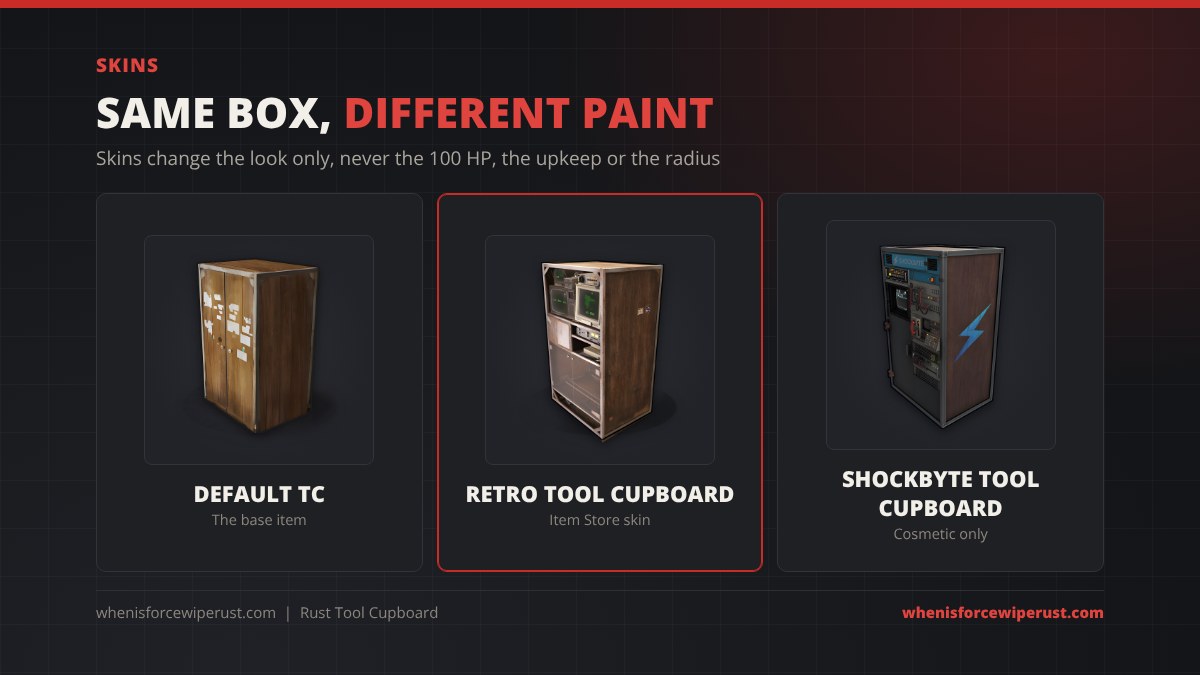
Yes, the tool cupboard has skins, and they are purely cosmetic. A skin swaps the wooden cabinet for something like the store’s Retro Tool Cupboard or a workshop design, but it does not touch the 100 HP, the 50 metre radius, or the upkeep cost. Nobody can tell how tanky your TC is from its paint job, because the stats are identical across every skin.
You apply a skin through a repair bench or on craft, the same as any other deployable. It is a nice touch for a base tour, but it changes nothing that matters mechanically. Do not pay for a skin thinking it protects your base better. It does not.
TC griefing: the trick that ends bases
Because a cupboard controls who can build, players weaponise it. TC griefing is when someone uses building privilege to ruin your base rather than loot it.
The classic version: a raider breaks in, and instead of just taking your loot, they place their own tool cupboard inside your base and authorise on it. Now their privilege overlaps yours. You come back online and find you cannot repair your walls, cannot upgrade, and cannot pick up your own deployables, because an enemy cupboard is claiming the ground. Your base is intact and completely unusable.
Another version happens before a raid even starts: an enemy builds twig right up against your walls, using their privilege to deny you the space to expand or add external defences.
Tool cupboard Rust pro tips
- One cupboard, buried deep. Never place the TC on an outer wall or anywhere with a soft side facing out. It should be the last thing a raider reaches, not the first.
- Overstock before you log off. Fill all 24 slots before a long break. Upkeep only pulls what it needs, and a full cupboard can carry a small base through several offline days.
- How many turrets per TC? There is no cap tied to the cupboard itself. The real limit is turret interference: only 12 powered auto turrets work within a 40 metre bubble, so space them out.
- Check upkeep with the hammer. Hold E on the cupboard and pick Show Building Privilege, or hit it with a hammer, to see the daily cost and how long your current stock lasts.
- Do not store loot in the TC. It is not a box for your guns. Keep it for upkeep materials only, so a raider who cracks it gets wood, not your kits.
Your upkeep clock resets on force wipe. When the map wipes, every base, every cupboard and every scrap of upkeep is gone, so know the date before you overstock for the week.
Check the wipe countdownTool cupboard Rust FAQ
What does TC mean in Rust?
What does a tool cupboard do in Rust?
How much does a tool cupboard cost in Rust?
How much health does a tool cupboard have?
Can you pick up a tool cupboard in Rust?
How do you move a tool cupboard in Rust?
How many molotovs does it take to break a tool cupboard?
How many spears does it take to break a tool cupboard?
What is building privilege in Rust?
How long does it take for a base to decay in Rust?
What happens if the tool cupboard runs out of upkeep?
Can you have more than one tool cupboard in a base?
Do tool cupboard skins change the stats?
What is TC griefing in Rust?
Sources
- Official Facepunch Rust Wiki, Tool Cupboard item page, for the core item reference.
- RustClash Rust Wiki, Tool Cupboard durability table, for raid damage and durability figures.
- Official Facepunch guide to the tool cupboard, decay and building privilege, for authorisation, upkeep and decay mechanics.
- The whenisforcewiperust.com stone wall guide and metal wall guide for the per tier decay times and daily upkeep ranges used in the decay and upkeep sections.