
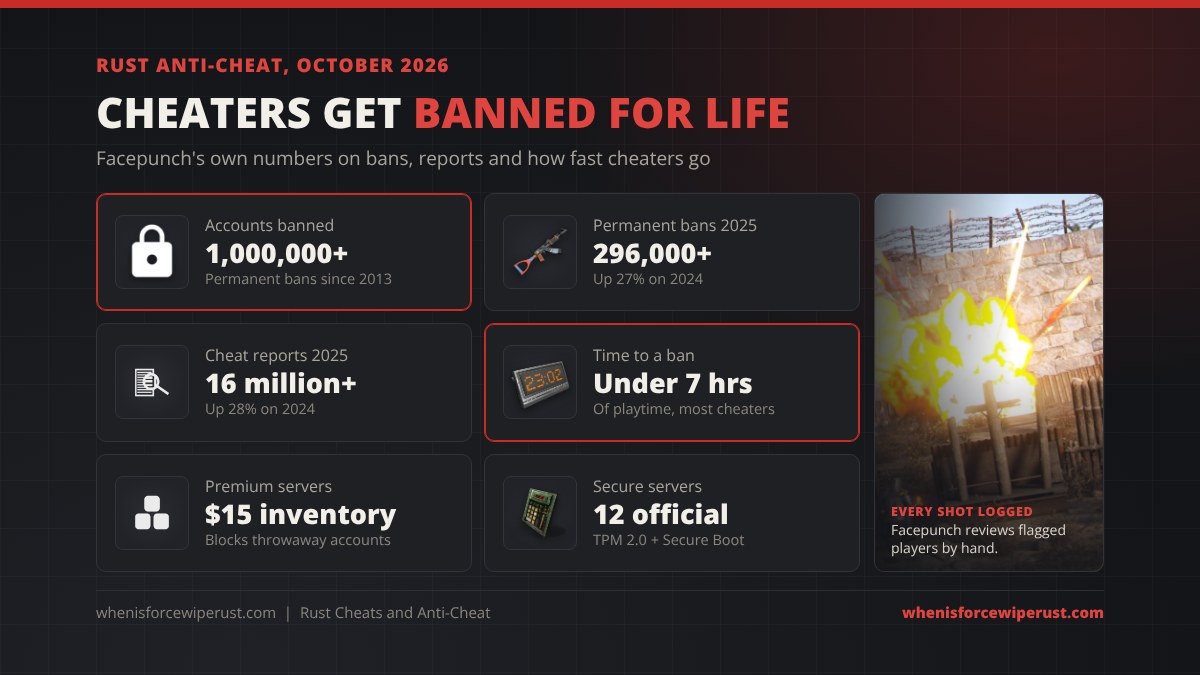
Rust cheats are third-party programs and scripts that give a player an unfair edge: aimbots, ESP wallhacks, no-recoil scripts and fly hacks. Rust on PC is protected by Easy Anti-Cheat (EAC) plus Facepunch’s own detection team, and every confirmed cheater gets a permanent game ban. Facepunch says it has permanently banned over one million accounts since 2013.
This guide is the player’s side of the story. It explains what counts as cheating in Rust, how EAC, Premium servers and the new Secure servers catch and block cheaters, how ban waves really work, how to report a cheater properly, and what happens if you get banned. We don’t link to or recommend any cheat. Everything here was checked against Facepunch’s own devblogs and support pages in October 2026. Want to know when the next fresh start is? Check the Rust force wipe countdown.
- What Counts as Cheating
- Types of Cheats
- Easy Anti-Cheat
- Every Anti-Cheat Layer
- Ban Waves
- How to Report
- Bans and Appeals
- Console
- Stay Safe
- FAQ
What Counts as Cheating in Rust?
In Rust, cheating is anything outside the game that changes what you can see, how you aim or how your character moves. That covers cheat programs that read or change the game’s memory, “external” overlays, scripts in mouse or keyboard software, and hardware devices that fake mouse input. If it gives you information or control that the normal game doesn’t, it is cheating, and EAC and Facepunch ban for it.
Not everything that looks like an edge is a cheat. These are allowed:
- Console commands and binds from the F1 menu, like graphics settings, FOV and quick-craft binds. They are part of the game. Our Rust console commands and best settings guide lists the safe ones.
- Crosshair overlays inside the game, using the built-in crosshair settings. See our Rust crosshair codes.
- Server plugins that the server owner runs, like kits, teleport or stack sizes on modded servers.
- Practice on aim train servers. Our Rust aim training guide shows how to learn recoil legitimately.
Types of Rust Cheats
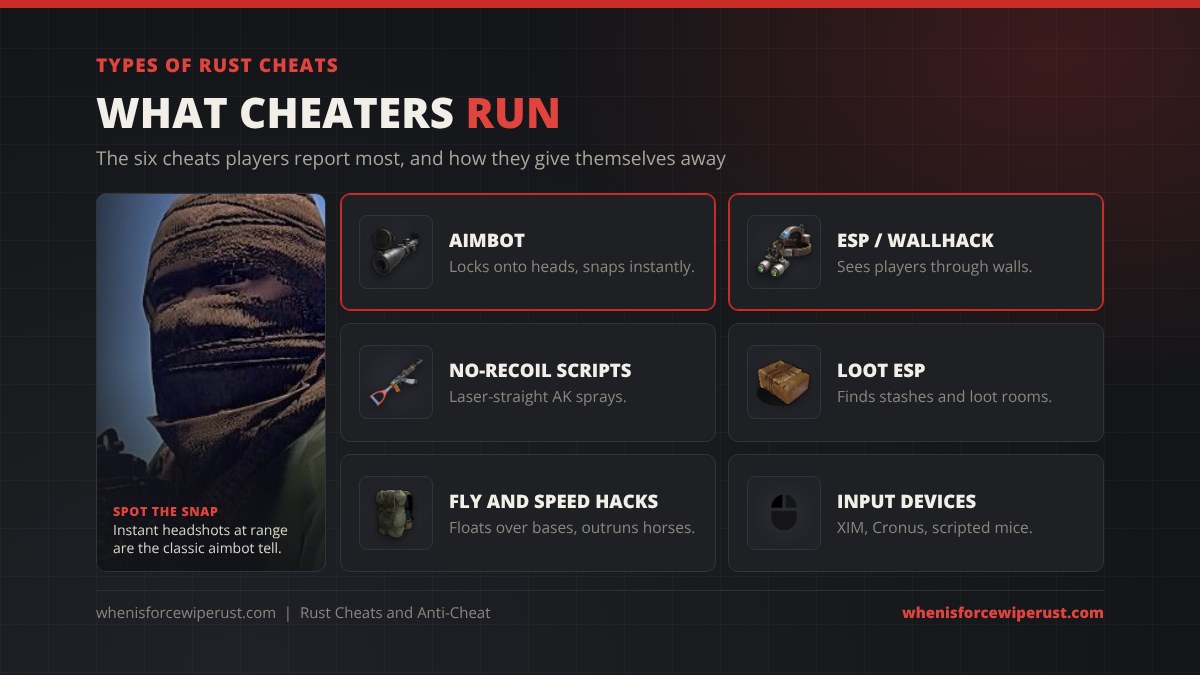
| Cheat | What it does | How it gives itself away |
|---|---|---|
| Aimbot / silent aim | Locks the crosshair onto players, often only the head | Instant snaps, impossible long-range headshots, kills through foliage |
| ESP / wallhack | Shows players, names and gear through walls and terrain | Pre-aiming you behind a rock, tracking you through your base |
| No-recoil scripts and macros | Pulls the mouse down for you so sprays stay in one spot | Laser-straight AK or M249 sprays at long range |
| Loot and stash ESP | Shows crates, hidden stashes, sleepers and loot rooms | Going straight to your stash or loot room with no searching |
| Fly, speed and spider hacks | Moves faster than possible, flies or climbs walls | Floating over bases, outrunning horses on foot |
| Hardware input devices | XIM, Cronus-style adapters and scripted mice that fake input | Mouse-like aim on controller, perfect recoil every time |
Since May 2025, Facepunch has run server-side player culling on all servers by default: if you can’t possibly see a player, the server doesn’t send their position to your game. That makes long-range ESP much less useful, because the cheat simply doesn’t have the data. It’s one reason cheaters now lean more on aimbots and recoil scripts, which are easier for EAC and Facepunch’s logging to spot.
What Is Easy Anti-Cheat (EAC)?
Easy Anti-Cheat is the anti-cheat that runs alongside Rust on PC. It’s made by Epic Games (it ships through Epic Online Services) and loads every time you launch Rust from Steam. It checks for known cheat programs, protects the game’s memory from being read or changed, and reports suspicious behavior. Official servers and almost every community server require EAC, so if EAC isn’t running you can’t join them.
EAC is also why Rust doesn’t run on Steam Deck or Linux: Facepunch has never turned on EAC’s Proton support, so those players can’t join EAC-protected servers. Our Rust crossplay guide covers the workarounds like cloud streaming.
Every Layer of Rust Anti-Cheat
EAC is only one layer. Facepunch stacks several systems so that a cheat that slips past one gets caught by another.
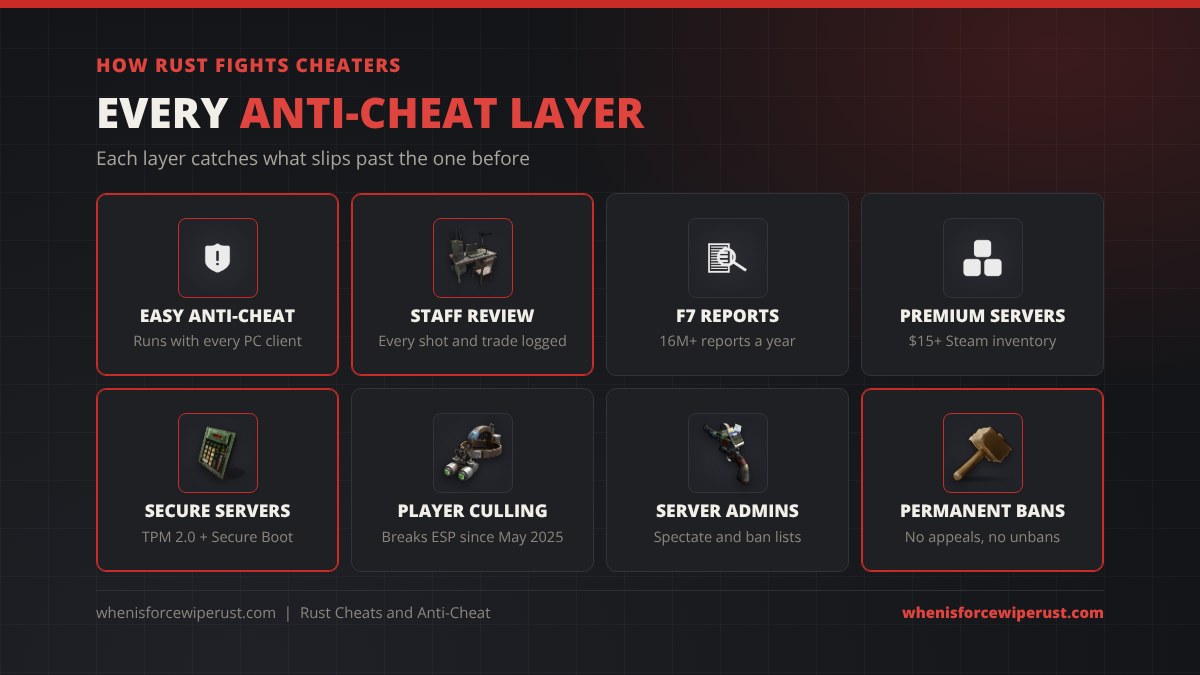
| Layer | What it does | Since |
|---|---|---|
| Easy Anti-Cheat | Detects cheat software on your PC and bans it | Years, on every PC client |
| Facepunch review team | Logs every shot, message and interaction, then reviews flagged players by hand | Ongoing |
| F7 reports | Sends the player and server data to Facepunch and EAC | Ongoing |
| Premium servers | Only players with a $15+ Steam inventory can join, so fresh cheat accounts can’t | March 2025 |
| Server-side culling | Doesn’t send players you can’t see, breaking ESP | On by default since May 2025 |
| Secure servers (TPM + Secure Boot) | Only PCs with TPM 2.0 and Secure Boot turned on can join | 6 servers March 2026, 12 since October 1, 2026 |
| Community admins | Spectate, ban and share ban lists on their own servers | Depends on the server |
Premium servers
Premium servers launched in March 2025. To see and join them, your Steam account needs a Rust inventory worth $15 or more: store items and tradable skins count, but standalone DLC like Instruments or Sunburn doesn’t. A banned cheater would have to buy the game again and spend $15 on skins before getting back on these servers, which kills throwaway accounts. Facepunch’s 2026 review says Premium servers are “doing an excellent job of gatekeeping cheaters out” and that it sees no need to raise the $15 bar. Not sure what your skins are worth? Use our Rust inventory value checker.
Secure servers (TPM 2.0 and Secure Boot)
Since March 2026, server owners can require TPM 2.0 and Secure Boot, two Windows security features that make kernel-level cheats far harder to run. Servers that enforce it for everyone get a Secure tag in the server browser. Facepunch started with six official servers (EU 3, EU East 3, EU 14, EU Large 2, US West 3 and US East 3), saw fewer cheaters on them, and switched six more official servers on October 1, 2026. Facepunch has said it plans to make this mandatory on every server later, with the date to come in a monthly devblog. Most modern PCs have TPM already; Secure Boot is usually just a setting in your motherboard’s BIOS. Our Rust system requirements guide shows how to check both.
Community servers
Good community servers add their own layer: active admins who spectate reported players, shared ban lists and anti-cheat plugins. Our Rust server mods guide covers the admin plugins, and the Rust admin commands guide shows the ban and spectate commands. In our Rust server browser you can filter by anti-cheat.
Do Rust Ban Waves Exist?
Yes and no. Facepunch doesn’t announce scheduled ban waves, and claims like “every Thursday” come from cheat sellers, not Facepunch. What does happen:
- Delayed bans. When a new cheat is detected, EAC often waits and bans everyone using it at once, so the cheat makers learn less. To players this looks like a wave.
- Manual bans. Facepunch staff review logged gameplay and reports, and ban by hand. Facepunch says most cheaters are now removed in under 7 hours of playtime, down from 10 hours at the start of 2025.
- Steady numbers. In 2025 Facepunch applied 338,000+ bans, of which 296,000+ were permanent (27% more than 2024), from 16 million+ cheat reports (up 28%).
If a “Rust cheat” is sold as undetected, that only means it hasn’t been banned yet. When it is, everyone who used it goes at once.
How to Report a Cheater in Rust
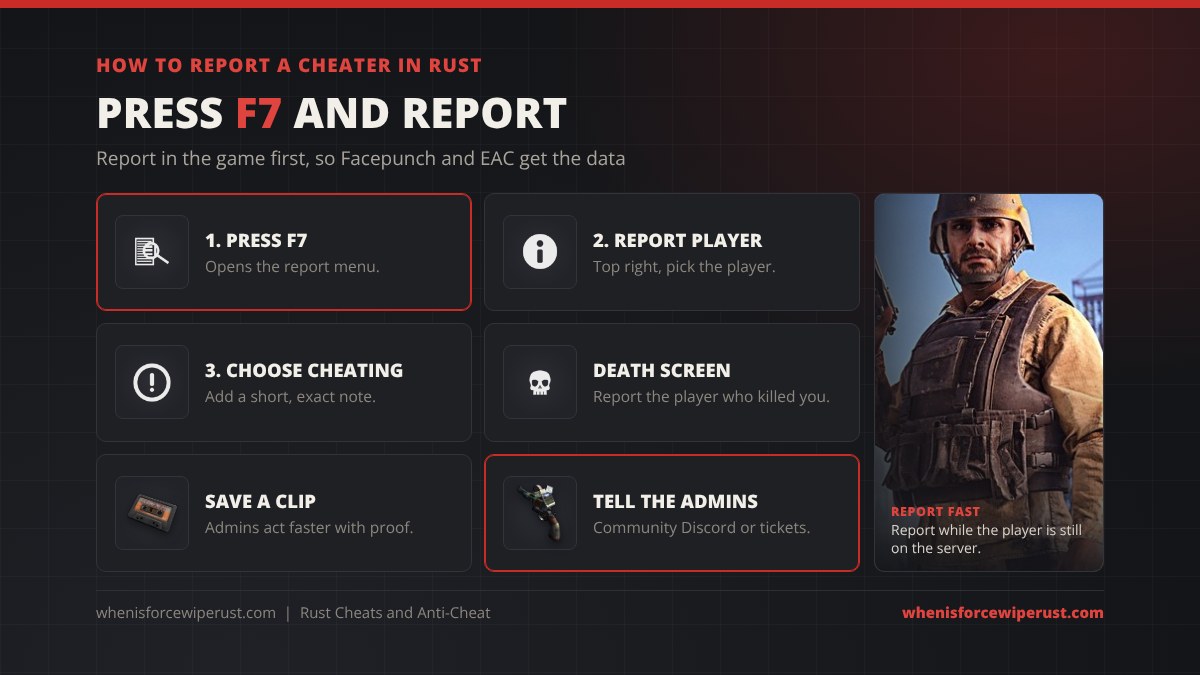
Facepunch wants reports made in the game, as soon as you see the cheating, because an in-game report sends the data Facepunch and EAC need to investigate.
- Press F7 to open the report menu.
- Click Report Player at the top right to see everyone on the server.
- Pick the player, choose Cheating and add a short note (for example “aimbot, headshots through bushes at 200m”).
- Or report straight from the death screen, the player’s contact card, or by clicking their name in chat.
- On community servers, also report in the server’s Discord or ticket system, so a live admin can spectate. Clips help a lot.
combatlog in F1 to see the hits from your last fight.
What Happens If You Get Banned?
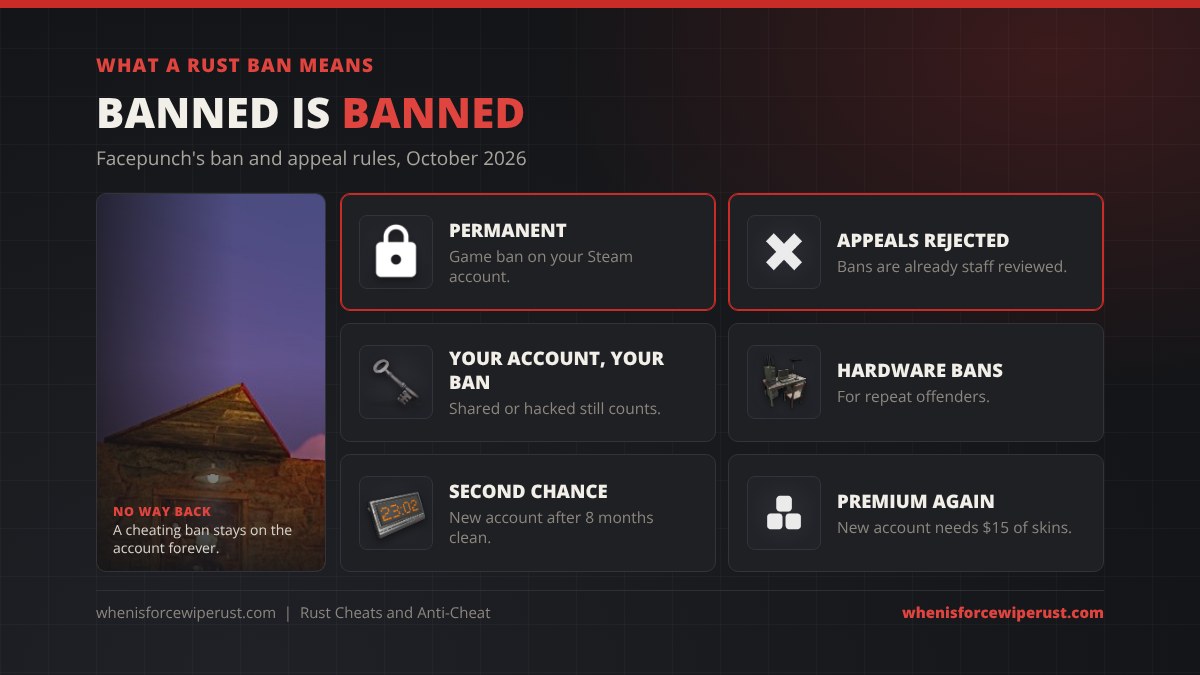
- Bans are permanent. A cheating ban is a game ban on your Steam account and shows on your profile.
- Appeals don’t work. Facepunch’s support page says bans are placed manually and already reviewed by staff, so appeals sent to support are automatically rejected. Steam Support can’t lift them either.
- You are responsible for your account. If a friend or a hacker cheats on your account, the ban still stands. Turn on Steam Guard and never share your login.
- Hardware bans are used for repeat offenders, so buying a new account on the same PC doesn’t help them.
- One second chance. Since June 2025, if you were banned more than 8 months ago and haven’t cheated or ban-evaded since, you can come back by buying Rust on a new account. The old ban stays. Repeat cheaters and hardware-banned players don’t qualify, and coming back before 8 months is likely to get the new account banned too.
Community servers can also ban you from their own servers for cheating or breaking their rules. Those bans only apply to that server or group, not to Rust as a whole.
Cheating on Rust Console Edition
Rust Console Edition on PS5 and Xbox is a separate game run by Double Eleven, with its own moderation. Software cheats are much rarer on console, so the common problems there are XIM and Cronus-style adapters that let a mouse or scripts pass as a controller, and players abusing bugs. Report them through the in-game report option and through PlayStation or Xbox’s own player report tools, because using these devices also breaks Sony’s and Microsoft’s terms. Console and PC never share servers, so PC cheaters can’t reach you on console. See our Rust on Xbox and PS5 guide for the console versions.
How to Stay Safe From Cheaters (and Cheats)
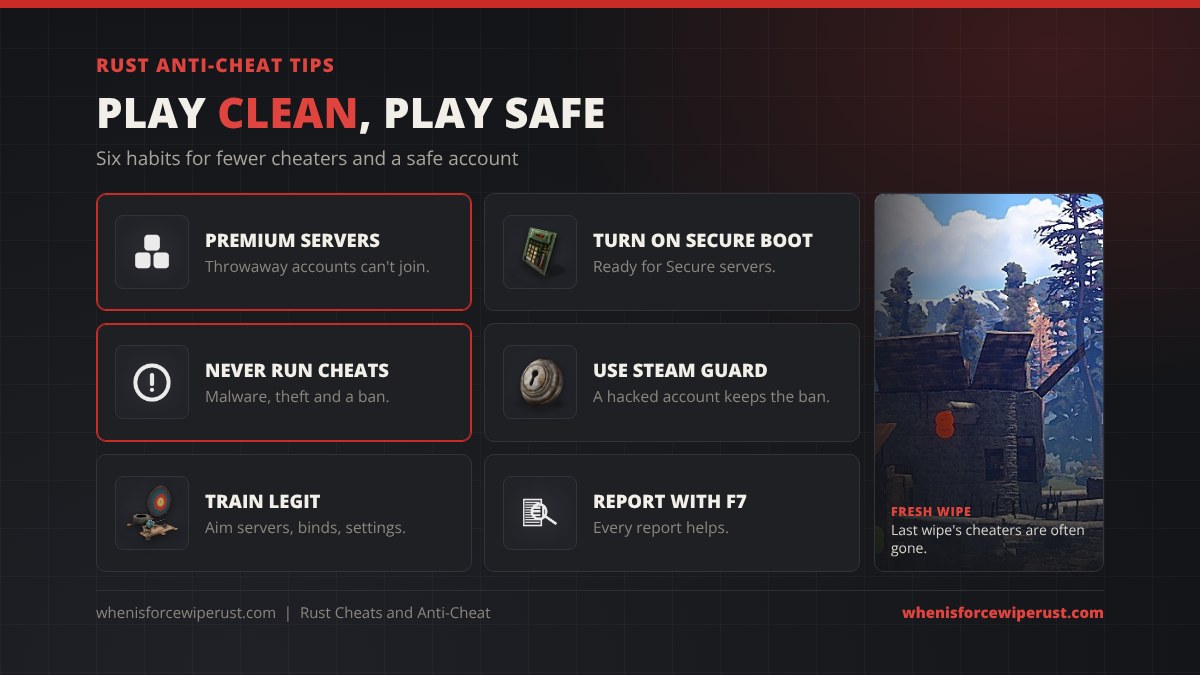
- Play Premium or Secure servers. Fresh throwaway cheat accounts can’t join them. Look for the Premium and Secure tags in the server browser.
- Turn on TPM 2.0 and Secure Boot now, so you’re ready when more servers require it.
- Never download cheats or “free scripts”. Besides the ban, cheat loaders are a common way to spread malware and steal Steam accounts and skins.
- Lock down your Steam account with Steam Guard. A hacked account that gets used for cheating keeps the ban.
- Get good the legit way with settings, binds and aim training instead.
- Report every time with F7. 16 million reports a year is a big part of how Facepunch finds cheaters fast.
A fresh wipe is also the best time to dodge last wipe’s cheaters, because many of them were banned in between. Check the next Rust force wipe date and how many people are online with our Rust player count page.
Rust Cheats and Anti-Cheat FAQ
What anti-cheat does Rust use?
Rust on PC uses Easy Anti-Cheat (EAC) from Epic Games, plus Facepunch’s own logging and manual review team, Premium servers, server-side player culling and, on Secure servers, TPM 2.0 and Secure Boot checks.
Are Rust bans permanent?
Yes. Cheating bans are permanent game bans on the Steam account, and Facepunch automatically rejects appeals sent to support. The only way back is the one-time second chance: after 8 months clean you can buy Rust on a new account, unless you are a repeat or hardware-banned cheater.
How do I report a cheater in Rust?
Press F7, click Report Player at the top right, pick the player and choose Cheating. You can also report from the death screen, the player’s contact card or by clicking their name in chat. On community servers, tell the admins on Discord too.
Are no-recoil scripts and macros bannable in Rust?
Yes. Any script or macro that controls recoil or aims for you counts as cheating, whether it runs in cheat software or in your mouse’s own software, and EAC and Facepunch ban for it.
Are console commands and binds cheating?
No. F1 console commands, graphics settings, FOV and key binds are part of the game and allowed on every server. Only outside programs, scripts and devices count as cheats.
What are Premium servers in Rust?
Premium servers, added in March 2025, only let in players whose Steam account has a Rust inventory worth $15 or more. That stops banned cheaters from jumping straight back in on cheap new accounts.
What does the Secure tag mean on Rust servers?
Secure servers require TPM 2.0 and Secure Boot turned on in Windows. Facepunch tested it on six official servers from March 2026 and added six more on October 1, 2026, and plans to require it everywhere later.
Are there Rust ban waves?
There is no fixed schedule. EAC sometimes delays bans and removes everyone using a detected cheat at once, which looks like a wave, while Facepunch staff ban by hand every day. Most cheaters are removed within 7 hours of playtime.
Can I get banned for playing with a cheater?
The cheater’s account is what gets banned. But if someone cheats on your account, even a friend, your account is banned, and teaming with a known cheater can get you looked at. Never share your login and leave a team that cheats.
Why can’t I play Rust on Steam Deck or Linux?
Because of Easy Anti-Cheat. Facepunch has not enabled EAC’s Proton support, so Steam Deck and Linux players can’t join EAC-protected servers, which is almost all of them.
Sources and Further Reading
- Ban numbers, time to ban, culling and Premium results: Facepunch, Surviving 12 Years
- Premium server rules: Facepunch, Premium Servers
- Secure servers: Facepunch, Shipshape devblog and How to Turn On TPM and Secure Boot
- Reporting: Facepunch Support, Reporting Tools within Rust
- Bans and appeals: Facepunch Support, EAC Banned and Ban Second Chances
- How Facepunch watches cheaters: PC Gamer, Rust devs surveil cheaters like they’re playing an RTS game