
Gears in Rust are the quiet tax on every base you have ever built. They are not a weapon, they are not a placeable, and you never actually deploy one. Instead, gears are a crafting component buried in the recipe of nearly everything with a moving part, from your armored door and your garage door to gates, traps, turbines and vehicles. If it swings, spins or slides, it almost certainly ate a few gears to build.
That makes gears one of the most-needed and least-understood items in the game. New players craft them at 100 scrap a pop and wonder why they are always broke. Veterans loot and recycle them and barely spend a coin. This is the complete guide to gears in Rust: what they are, everything they build, where to find them, the crafting recipe, why crafting is usually a trap, and how to farm gears by recycling. The numbers are all straight from the item files.
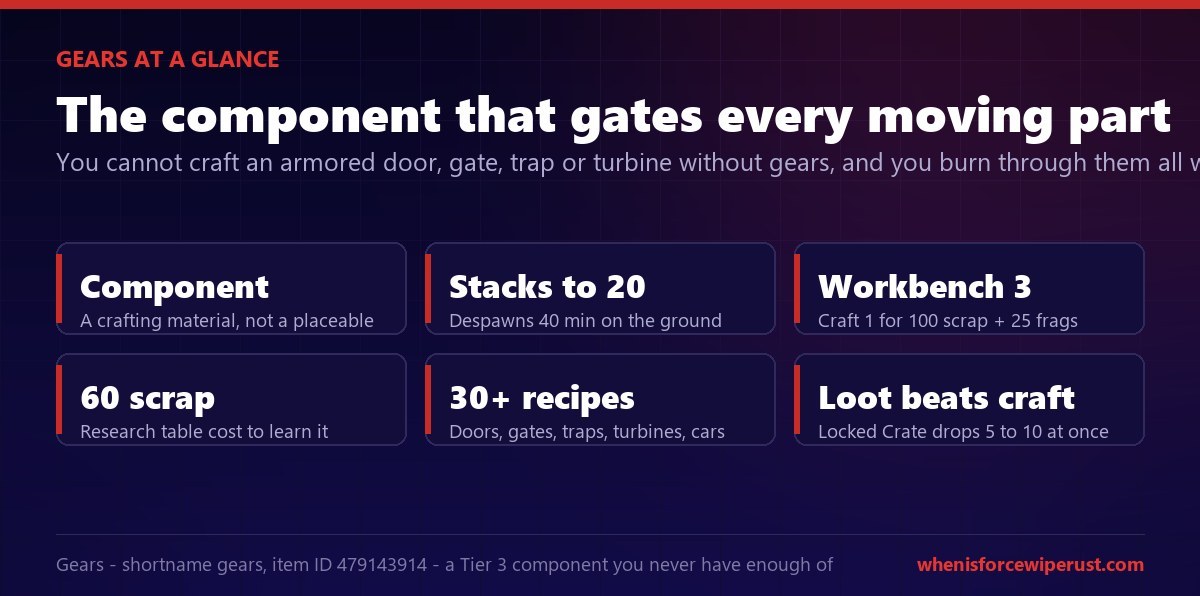
Gears are a Tier 3 crafting component (shortname gears). One gear crafts at a Workbench Level 3 for 100 scrap + 25 metal fragments, but you should rarely craft them. They drop in loot, best of all from the Locked Crate (about 31% for 5 to 10 at once), sell at Outpost for roughly 125 scrap each, and pop out of recycled doors and gates. They stack to 20 and are used in 30-plus recipes including armored doors (5), garage doors (2), high gates (5) and turbines (3). Loot them, do not grind them.
- What gears are
- What gears build
- How to get gears
- Crafting recipe
- Craft vs loot
- Recycling gears
- Gears and the wipe
- FAQ
What are gears in Rust?
Gears are a crafting component, the same category of item as tech trash, rope and metal springs. On their own they do nothing. Their entire purpose is to sit in the recipe of larger items, specifically anything mechanical: hinged doors, external gates, defensive traps, generators, wind turbines, vehicle parts and more. Rust models the “moving parts” of those builds as gears, so the harder something is to swing open or spin, the more gears it costs.
Because they gate so much of the mid-game, gears sit right alongside scrap and metal fragments as a currency you are constantly short on. You will happily have the wood and stone for a base upgrade, then realize you are two gears away from the door that actually keeps people out. Here are the raw item stats.
| Detail | Value |
|---|---|
| Item type | Crafting component |
| Item shortname | gears |
| Item ID | 479143914 |
| Stack size | 20 |
| Despawn time | 40 minutes on the ground |
| Crafted at | Workbench Level 3 |
| Craft cost | 100 Scrap + 25 Metal Fragments (yields 1) |
| Craft time | 1 second |
| Research cost | 60 scrap at a research table |
| Recycles into | 15 Metal Fragments + 12 Scrap (regular recycler) |
A couple of these numbers matter more than they look. The stack of 20 means a full stack of gears is a real chunk of inventory space when you are hoarding for a wipe. And the 40 minute despawn means gears you drop on death sit around long enough for someone else to grab, so do not treat a death near your base as no big deal when your loot room is full of them.
What are gears used for in Rust?
This is the whole reason gears matter. They appear in more than 30 recipes, and almost all of them are things you genuinely want to build. If you have ever asked “why do I need gears in Rust,” the answer is: because you cannot lock your base, gate your compound, trap your loot room or power your electricity without them.
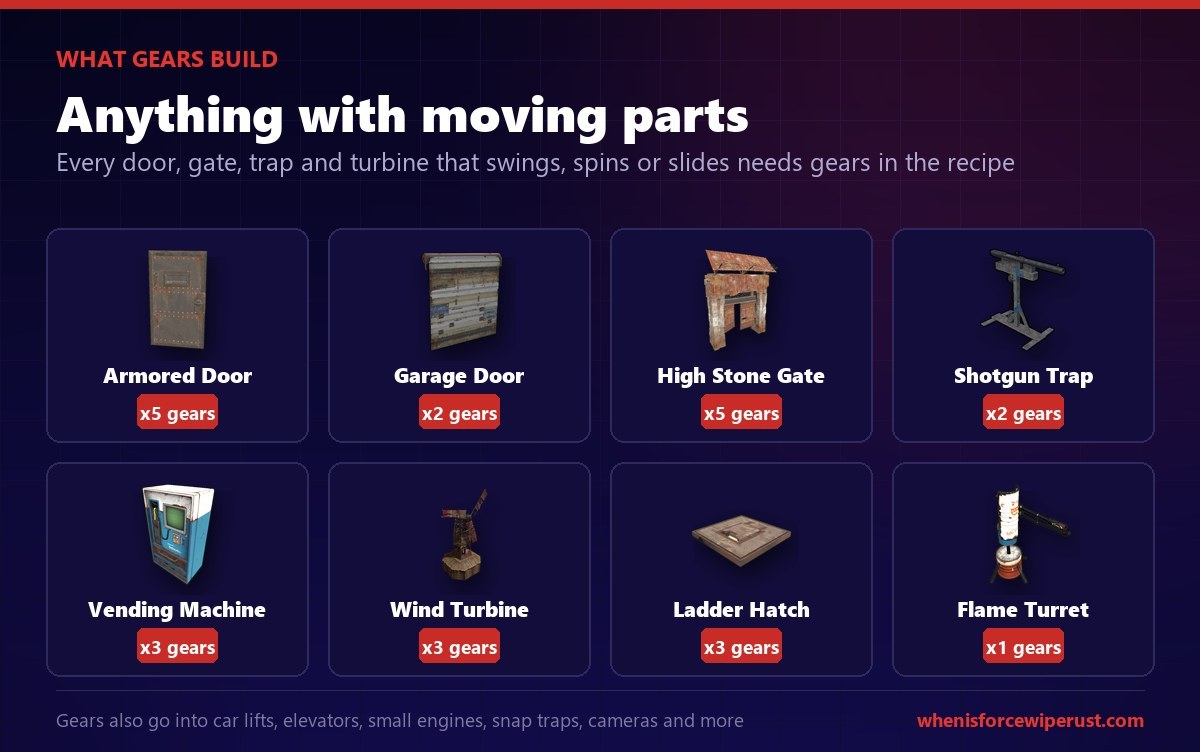
The heaviest gear sinks are your best defensive building pieces, which is exactly why gears feel scarce right when you want to fortify. Here are the common recipes and their gear cost.
| Item | Gears needed | What it is |
|---|---|---|
| Armored Door | 5 | The strongest door in the game |
| Armored Double Door | 5 | Double-wide armored entry |
| High External Stone Gate | 5 | Compound wall gate |
| High External Wooden Gate | 2 | Cheap early compound gate |
| Garage Door | 2 | Popular bunker and loot-room door |
| Ladder Hatch | 3 | Vertical access for base design |
| Vending Machine | 3 | Player shops and trade |
| Scrap Wind Turbine | 3 | Free electricity from wind |
| Small Generator / Small Boat Engine | 2 | Power and boats |
| Shotgun Trap | 2 | No-power automated defense |
| Flame Turret | 1 | Area-denial fire trap |
| Snap Trap / Pressure Pad | 1 | Cheap trip and trap wiring |
| High Caliber Revolver / HMLMG | 1 / 2 | Craftable weapons |
| Modular Car Lift / Elevator | 1 | Vehicles and multi-floor bases |
The pattern is obvious once you see it: the good stuff costs gears, and the great stuff costs a lot of them. A single armored door is 5 gears, and a serious base has several of them plus a gate or two, so it is entirely normal to need 20 to 40 gears across one wipe. Nobody finds that many by accident, which is why knowing how to get them is the actual skill.
When gears are tight early wipe, spend them on the doors that stop a raid, not on convenience. An armored door or a garage door on your loot room does more for you than a vending machine or a second wind turbine. Build the shop and the electricity once your core is actually secure.
How to get gears in Rust
Gears come from four places: loot containers, recycling, the Outpost vendor, and crafting. For all but the richest players, the first three beat the fourth every single time. Crafting is covered in its own section below, so here is everything that does not involve burning 100 scrap.
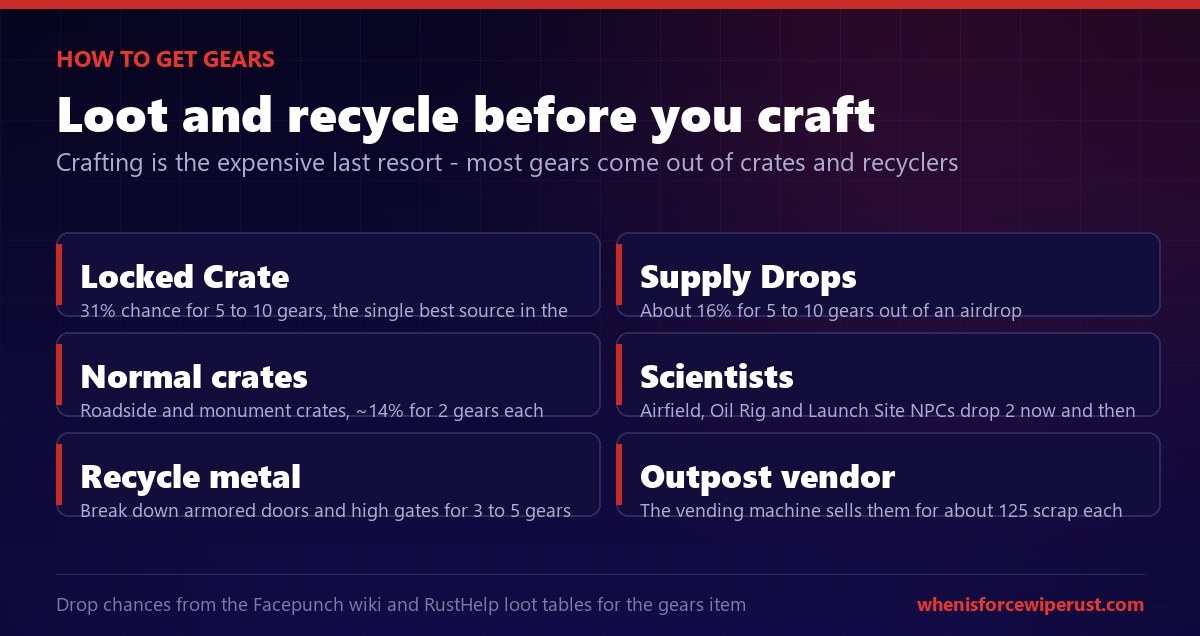
- Locked Crates (the jackpot). The hackable Locked Crate has roughly a 31% chance to drop 5 to 10 gears, the best single source in the game. You find them on the Oil Rig, dropped by the Chinook after a full hack, and on the Cargo Ship. One good hack can hand you a whole armored door’s worth of gears.
- Supply drops. An airdrop has about a 16% chance for 5 to 10 gears, so calling in or contesting a supply signal is a strong gear play on top of the guns and components.
- Normal crates and barrels. The everyday roadside crates, monument crates and underwater crates carry gears at roughly 14% for 2 each. Individually small, but they add up fast on a monument sweep.
- Scientists. The NPCs at Airfield, Oil Rig, Military Tunnels and Launch Site drop 2 gears now and then (about a 5% roll), so farming scientists nets you gears alongside the scrap and components.
- Outpost vendor. The Outpost vending machine sells gears for around 125 scrap each. That is more than the raw craft cost, but it needs no Workbench 3 and no blueprint, so it is a fine option for a fresh solo who has scrap but no bench.
Facepunch runs dynamic vendor pricing, so the Outpost gear price moves with supply and demand across the wipe. The ~125 scrap figure is a baseline, not a fixed number. If gears are cheap the day you visit, buy a stack; if they have spiked, loot them instead.
The gears crafting recipe
Yes, you can craft gears, and sometimes you should. The recipe is simple but locked behind the top workbench tier, which is part of why crafting them is a late-wipe move rather than an early one.
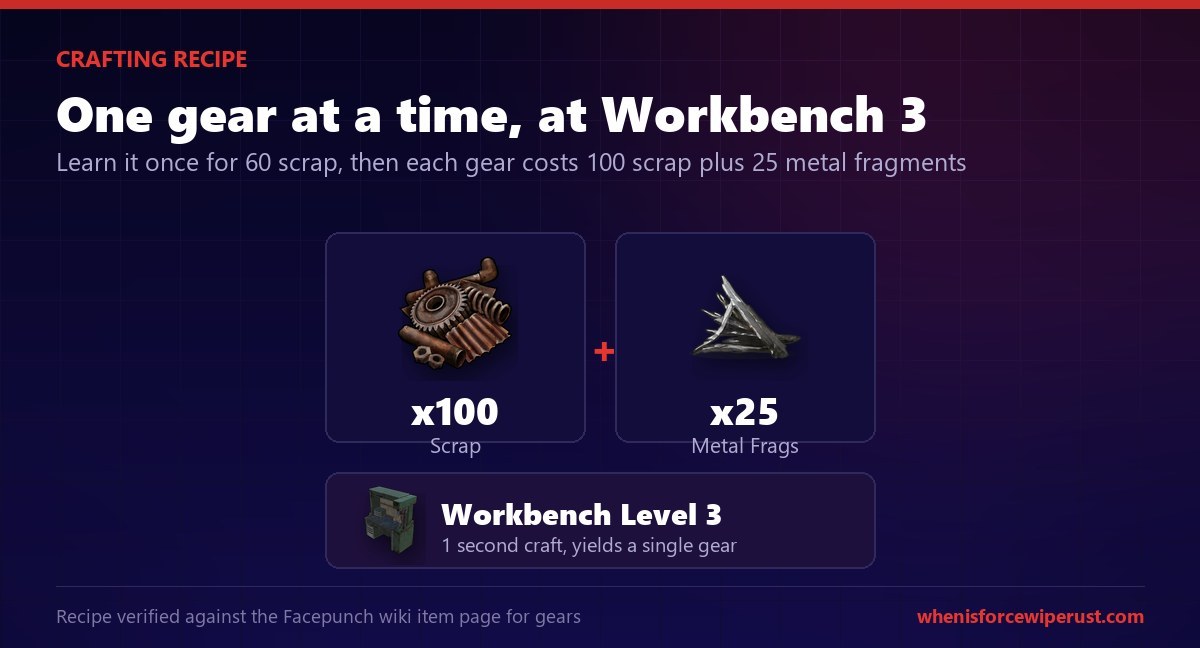
Each gear costs 100 scrap and 25 metal fragments, crafted in one second at a Workbench Level 3. Before you can craft it at all you need the blueprint, unlocked for 60 scrap at a research table (or through the Tier 3 tech tree). The fragments are trivial, so the entire cost is really that 100 scrap per gear, and that is the number that makes crafting hurt.
Craft gears when you are swimming in scrap late wipe and short on time for loot runs, or when you need an exact number right now, for example the last 2 gears for a garage door before a raid defense. Outside those cases, your scrap is better spent on guns, blueprints and workbenches.
Craft vs loot: the gears economy
Here is the single most important thing to understand about gears, and the mistake that keeps new players poor: crafting gears in bulk is one of the worst uses of scrap in the game. Do the math on a single armored door and it becomes obvious.
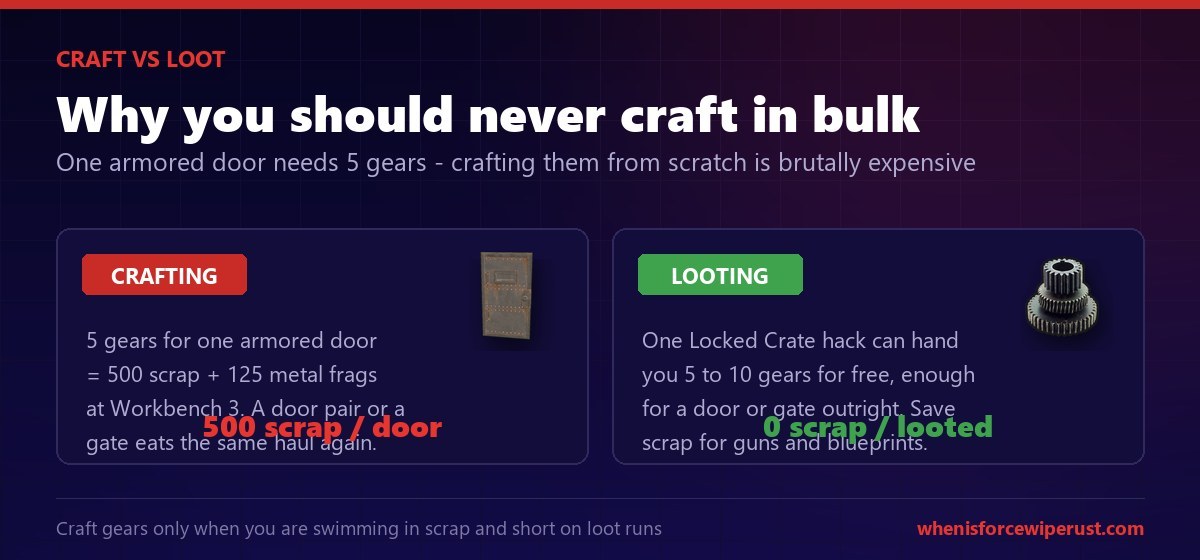
An armored door needs 5 gears. Craft those from scratch and you have spent 500 scrap and 125 metal fragments, just on the gears, before the 20 high quality metal the door itself costs. Build a second armored door or a high stone gate and you pay it all again. That scrap could have bought you an assault rifle, a stack of blueprints, or several trips through the Outpost vendor for other components.
Now compare that to looting. One Locked Crate hack that rolls gears hands you 5 to 10 of them for the price of a 15 minute wait, effectively free. A single Oil Rig run or a contested airdrop can cover most of a wipe’s gear needs. The lesson every experienced player has internalized: scrap is for guns and blueprints, gears are for looting.
Researching gears and mass-crafting them because you “always need gears” feels productive, but it quietly drains the scrap you need for actual progression. If you catch yourself crafting a stack of gears every wipe, switch to running monuments and recycling instead. Your scrap balance will thank you.
Recycling gears (and recycling for gears)
Recycling cuts both ways with gears, and both directions are useful to know. You can recycle spare gears into raw materials, and, far more importantly, you can recycle looted items to get gears in the first place.

Put a gear through a regular recycler and you get 15 metal fragments and 12 scrap back. A safe zone recycler, like the ones at Outpost and Bandit Camp, returns a bit less, 10 metal fragments and 8 scrap. Note that this means a crafted gear (100 scrap in) only ever gives you 12 scrap back, another reminder that crafting them is a one-way expense.
The move that actually matters is recycling to harvest gears. Looted armored doors, garage doors and high external gates recycle back into 3 to 5 gears each. So when you raid a base and find spare doors, or clear a monument with locked components, running them through a recycler is one of the most reliable gear farms in the game.
After a successful raid, do not vendor the enemy’s leftover armored and garage doors, recycle them. Five looted armored doors can recycle into enough gears to rebuild your own compound for free. This is the loop that keeps established players permanently stocked on gears while newer players are still crafting them.
Gears and the wipe cycle
Like every item in your base, your entire gear stockpile disappears the moment the server force wipes. Every armored door, gate and turbine you spent gears on is gone, and the map resets to a blank slate. That is not a bad thing, it is the reset that makes gears findable again, because fresh crates, untouched monuments and full Locked Crate loot tables are what refill your supply.
The players who dominate a fresh wipe are the ones who hit the Oil Rig and the first airdrops early, bank a pile of gears, and have their armored doors up while everyone else is still on twig and wood. Timing your session to the wipe is how you get first crack at those loot sources instead of fighting over the scraps left behind.
Farm gears before the server empties. Line your play session up with the reset so you get the first monument and crate runs of the wipe.
Check the force wipe countdownGears in Rust FAQ
How do you get gears in Rust?
You get gears by looting crates, recycling and buying, and only craft them as a last resort. The best source is the Locked Crate, which has about a 31% chance to drop 5 to 10 gears. Supply drops (about 16% for 5 to 10), normal crates and barrels (about 14% for 2), and scientists at monuments also drop them. The Outpost vending machine sells gears for around 125 scrap each, and recycling looted armored doors and high gates returns 3 to 5 gears apiece.
How do you craft gears in Rust?
You craft gears at a Workbench Level 3 using 100 scrap and 25 metal fragments per gear, which takes one second. You first need the blueprint, unlocked for 60 scrap at a research table or through the Tier 3 tech tree. Because each gear costs 100 scrap, crafting them in bulk is expensive, so most players loot or recycle gears instead and save their scrap for guns and blueprints.
What are gears used for in Rust?
Gears are a crafting component used in more than 30 recipes, mostly things with moving parts. That includes the armored door (5 gears), armored double door (5), high external stone gate (5), high external wooden gate (2), garage door (2), ladder hatch (3), vending machine (3), scrap wind turbine (3), small generator and small boat engine (2), shotgun trap (2), flame turret (1), snap trap, pressure pad, high caliber revolver, HMLMG, modular car lift and elevator.
How many gears do you need for an armored door in Rust?
An armored door needs 5 gears, along with 20 high quality metal, crafted at a Workbench Level 3. An armored double door also uses 5 gears. Because five crafted gears cost 500 scrap, it is far cheaper to loot the gears from crates or recycle them out of other doors and gates than to craft them from scratch.
Where do gears drop the most in Rust?
The Locked Crate is by far the richest gear source, with roughly a 31% chance to drop 5 to 10 gears at once. You find Locked Crates on the Oil Rig, dropped by the Chinook helicopter after a full hack, and on the Cargo Ship. Supply drops are the next best source at about 16% for 5 to 10, followed by regular monument and roadside crates at around 14% for 2 each.
Do gears recycle in Rust?
Yes. A gear recycles into 15 metal fragments and 12 scrap at a regular recycler, or 10 metal fragments and 8 scrap at a safe zone recycler like Outpost or Bandit Camp. More usefully, you can recycle looted armored doors, garage doors and high external gates to pull 3 to 5 gears back out of each one, which is one of the best ways to farm gears.
How much do gears cost at Outpost in Rust?
The Outpost vending machine sells gears for around 125 scrap each. Because Facepunch uses dynamic vendor pricing, that number drifts up and down with supply and demand over the wipe, so treat 125 as a baseline rather than a fixed price. Buying from Outpost needs no Workbench 3 and no blueprint, which makes it handy for a fresh solo who has scrap but no bench yet.
What is the item shortname and stack size for gears?
The item shortname is gears and the item ID is 479143914. Gears stack to 20 per slot and despawn after 40 minutes if left on the ground. They are classed as a crafting component, in the same family as tech trash, rope and metal springs, and cannot be placed or equipped on their own.
Should you craft or loot gears in Rust?
Loot them in almost every case. Crafting a gear costs 100 scrap, so a five-gear armored door costs 500 scrap in gears alone, while a single Locked Crate hack can hand you the same amount for free. Save crafting for late wipe when you have surplus scrap and no time for loot runs, or when you need one or two exact gears immediately for a build.
Are gears used as currency at Bandit Camp?
No. Some guides claim gears are a special currency used to buy the Apartment Key or other items at Bandit Camp, but that is incorrect. Gears are a normal crafting component. Rust vendors trade in scrap, and gears are simply an item you can buy from the Outpost vending machine for scrap like any other component.
The bottom line
Gears are the invisible cost behind almost every base you build in Rust. They lock your doors, gate your compound, arm your traps and spin your turbines, and you will need dozens of them across a single wipe. The players who never seem to run out are not crafting them at 100 scrap each, they are looting Locked Crates, farming scientists, and recycling every spare door and gate they pick up.
Treat gears like the loot-first component they are, keep your scrap for guns and blueprints, and you will always have an armored door ready when you need one. The one thing that resets it all is the wipe, so the real edge is being online when the fresh map drops, ready to hit the first crates before anyone else.
Get first crack at the gear crates. Know exactly when the next force wipe lands so you are running monuments the moment the map goes live.
See the force wipe countdownSources
- Facepunch Wiki, Gears for the shortname gears, item ID 479143914, stack size of 20, 40 minute despawn, the 100 scrap + 25 metal fragments Workbench 3 recipe, the 60 scrap research cost, the recycle output, and the full list of items that use gears as an ingredient.
- RustHelp, Gears for the loot drop chances (Locked Crate 31% for 5 to 10, supply drop 16%, normal crates 14% for 2, scientist drops), and the Outpost vending price of around 125 scrap.
- Corrosion Hour, How to Find Gears in RUST and their Gears item page for where gears appear in loot, the recycling-for-gears strategy, and how many gears the common defensive builds require.