
Rope in Rust is the component that trips up more new players than almost any other, and for a strange reason: you cannot craft it. Open the crafting menu, search “rope,” and you will find nothing. There is no recipe, no blueprint to research, and no tech tree node. Yet half the useful items in the game, from your satchel charges to the sewing kits behind every good armor set, quietly demand it.
That combination makes rope one of the sneakiest bottlenecks on the map. You will have a stack of cloth, a workbench and a plan, then realize the one thing standing between you and a raid or a suit of armor is three pieces of rope you do not have. This is the complete guide to rope in Rust: what it is, everything it builds, where to loot it, the cheapest way to stockpile it, why it gates your armor, and what recycling it is actually worth. Every number here is straight from the item files.
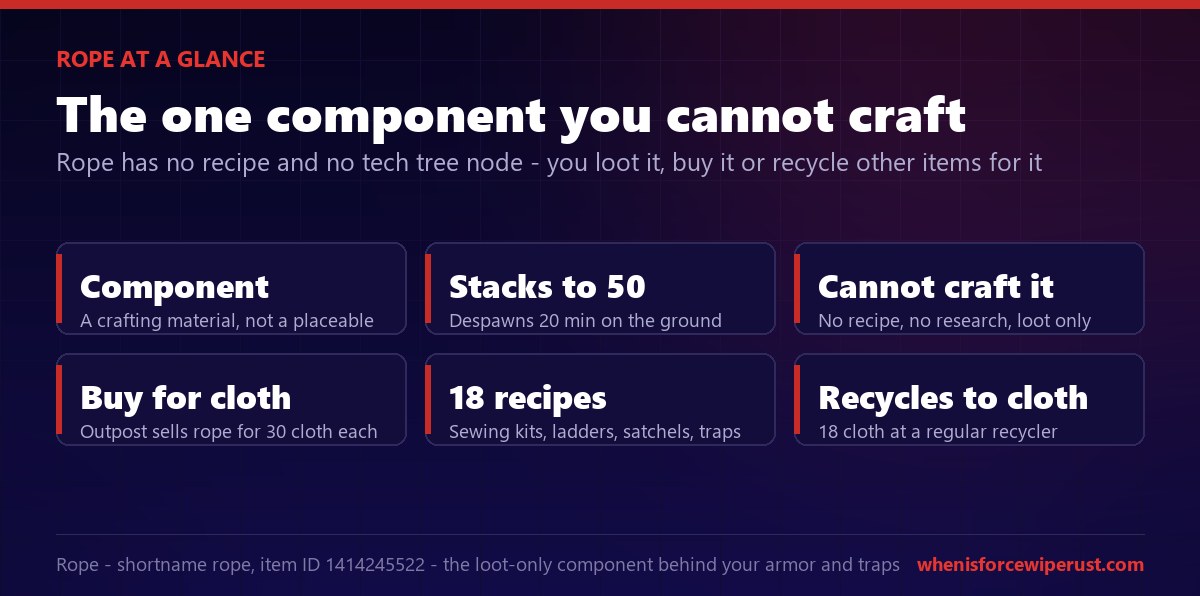
Rope is a crafting component (shortname rope) that you cannot craft or research. You loot it, buy it, or recycle other items into it. Every tacklebox has a guaranteed rope, underwater and jungle crates are stuffed with it, and the Outpost vending machine sells it for 30 cloth each. The cheapest bulk supply is the Tactical Gloves recycle loop. Rope stacks to 50, despawns in 20 minutes, and recycles into 18 cloth. It is used in 18 recipes, most importantly the Sewing Kit, which gates nearly all real armor.
- What rope is
- What rope builds
- How to get rope
- Cheapest way to stockpile
- Rope, sewing kits and armor
- Recycling rope
- Rope and the wipe
- FAQ
What is rope in Rust?
Rope is a crafting component, the same category of item as tech trash, gears and metal springs. On its own it does nothing. Its entire purpose is to sit inside the recipe of larger items, specifically anything that needs to be bound, strung or stitched: bows and crossbows, ladders, fishing rods, traps, barricades and, above all, sewing kits.
What sets rope apart from other components is that it is loot-only. Gears, tech trash and metal springs can all be crafted if you are desperate. Rope cannot. There is no recipe anywhere in the game, so every single piece of rope you have ever used came out of a crate, a vendor or a recycler. That one fact drives everything else about how you manage it. Here are the raw item stats.
| Detail | Value |
|---|---|
| Item type | Crafting component |
| Item shortname | rope |
| Item ID | 1414245522 |
| Stack size | 50 |
| Despawn time | 20 minutes on the ground |
| Craftable | No, there is no recipe |
| Researchable | No, it has no blueprint |
| Bought at | Outpost vending machine, 30 cloth each |
| Recycles into | 18 Cloth (regular recycler) |
The stack of 50 is generous for a component, so a full stack of rope is barely any inventory space, which means there is no real reason not to hoard it for a wipe. The 20 minute despawn is on the shorter side, so rope you drop on death will not sit around forever, but it lasts long enough for someone to grab if your loot room spills.
What is rope used for in Rust?
This is the whole reason rope matters. It appears in 18 different recipes, and they cover an unusually wide spread of the game: clothing, tools, weapons, traps and building pieces all pull from the same rope pile. If you have ever asked “why do I need rope in Rust,” the answer is that you cannot stitch armor, string a bow, build a ladder or arm a satchel without it.
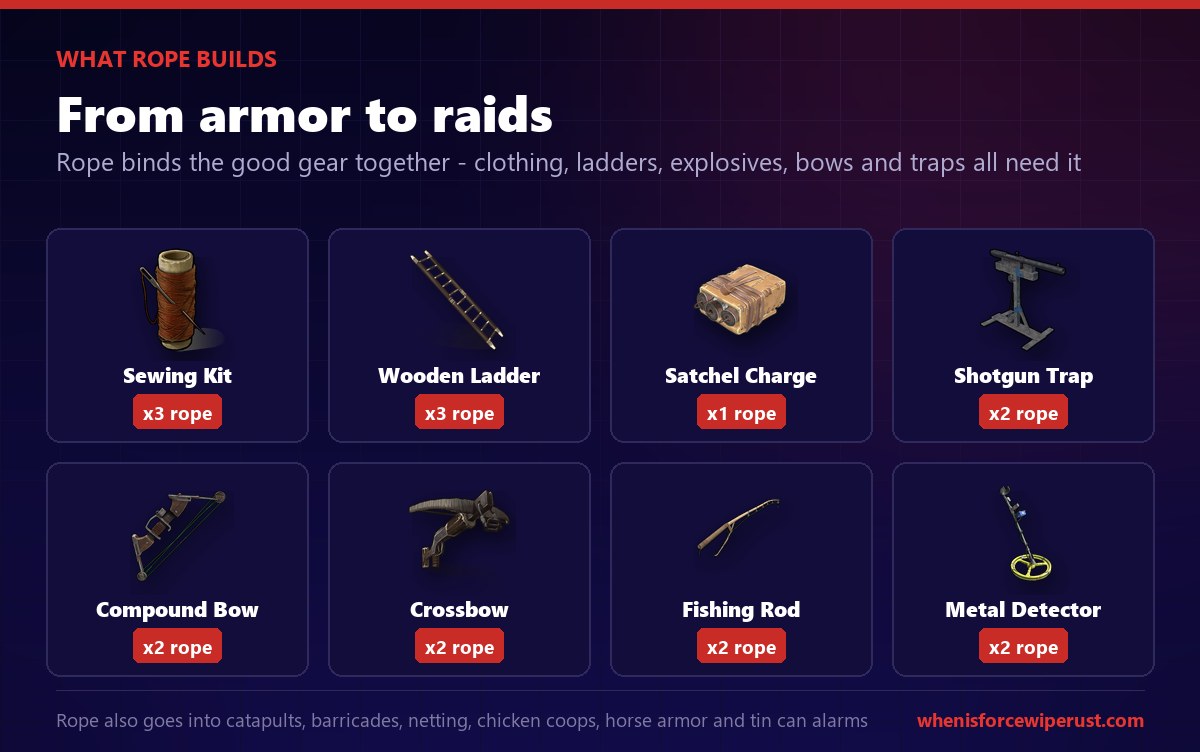
The single most important use by far is the Sewing Kit, because sewing kits are the gate in front of nearly every armor and clothing piece in the game. Everything else is situational, but the sewing kit line is what makes rope a genuine survival item rather than a curiosity. Here are the common recipes and their rope cost.
| Item | Rope needed | What it is |
|---|---|---|
| Sewing Kit | 3 | Gates most armor and clothing |
| Wooden Ladder | 3 | Raid and base-access ladder |
| Compound Bow | 2 | Silent early-game weapon |
| Crossbow | 2 | Cheap ranged opener |
| Handmade Fishing Rod | 2 | Fishing and cloth farming |
| Metal Detector | 2 | Hunts buried loot |
| Satchel Charge | 1 | Early-game raiding explosive |
| Shotgun Trap | 2 | No-power base defense |
| Small Ramp / Wooden Barricade | 2 / 1 | Building and cover pieces |
| Catapult | 1 | Siege raiding weapon |
| Tin Can Alarm | 1 | Cheap trip-wire warning |
| Wooden Horse Armor | 2 | Protects your horse |
The pattern is clear once you see it: rope is not tied to one playstyle, it is spread across all of them. A raider needs it for satchels and ladders, a builder needs it for barricades and traps, a farmer needs it for fishing rods, and everyone needs it for sewing kits. That is exactly why running out of rope feels like it stops three different projects at once.
When rope is tight, spend it on sewing kits and satchels before ladders, barricades or fishing rods. Armor keeps you alive and satchels get you into bases, while the cheaper builds can usually wait or be substituted. Because you cannot craft more rope on demand, treating it as a limited resource is the whole skill.
How to get rope in Rust
Since there is no recipe, getting rope is entirely about knowing which containers and vendors carry it. The good news is that rope is common in the right places, so you rarely have to go far out of your way. Here is where it actually comes from.
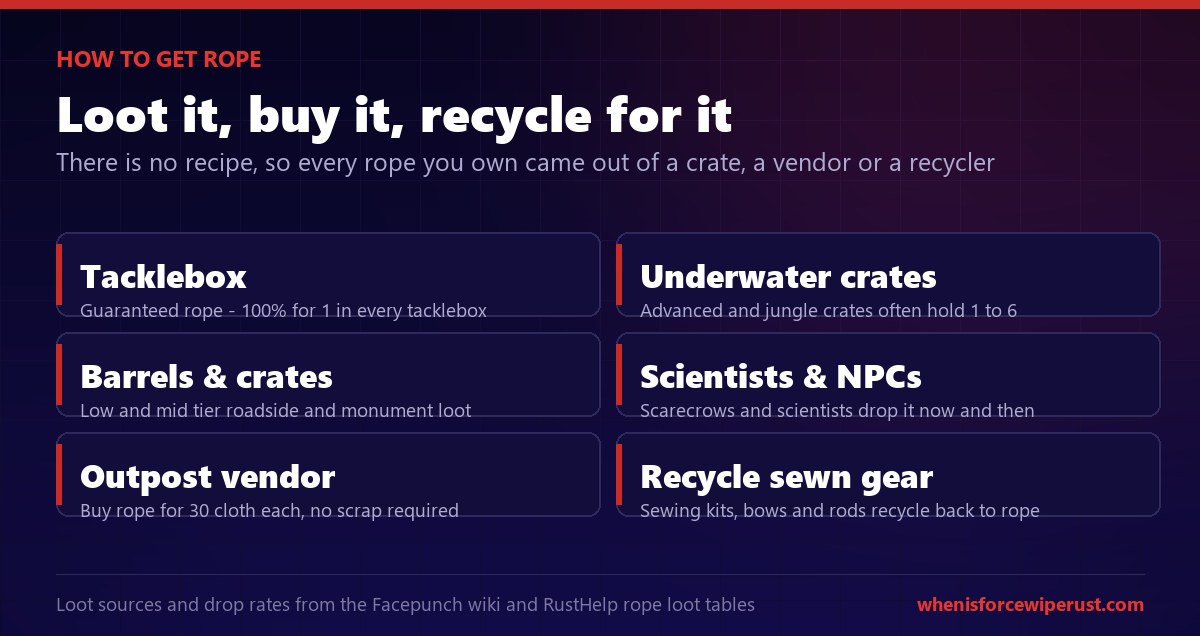
- Tackleboxes (guaranteed). Every tacklebox contains a rope at a 100% drop rate. Tackleboxes turn up in the water and around fishing spots, so a run to a Fishing Village or a dive on the coast is a reliable rope source on top of the fishing gear itself.
- Underwater and jungle crates. The Advanced Underwater Crate carries rope roughly 63% of the time, often 1 to 6 at once, and the basic jungle crates are close behind at about 42%. Diving crates or sweeping the jungle biome is the fastest way to bank a real stockpile in one trip.
- Barrels and normal crates. Everyday roadside barrels, monument crates and food crates carry rope at lower rates. Individually small, but they add up fast on any monument sweep, and you are opening them anyway.
- Scientists and NPCs. Scarecrows and various scientist types drop rope now and then (around 40% on some NPCs), so farming monument NPCs nets rope alongside the scrap and components.
- Outpost vendor. The Outpost vending machine sells rope for 30 cloth each, not scrap. Cloth is cheap and easy to farm from hemp, so this is a steady, safe-zone way to top up your rope whenever you visit.
- Recycling sewn items. Sewing kits, compound bows, crossbows and fishing rods all recycle back into rope. That makes the recycler a second-hand rope tap, covered in its own section below.
New players routinely waste time searching the crafting menu and the tech tree for a way to make rope. It is not there and never has been. Rope is a loot-and-vendor item by design, in the same boat as Tarp. If you need rope, you need to loot, buy or recycle for it, full stop.
The cheapest way to stockpile rope
Here is the trick that separates players who are always short on rope from players who never think about it. You can buy rope directly at Outpost for 30 cloth, but there is a much cheaper route through the Tactical Gloves recycle loop, and it is one of the best-value plays at the Outpost vending machines.
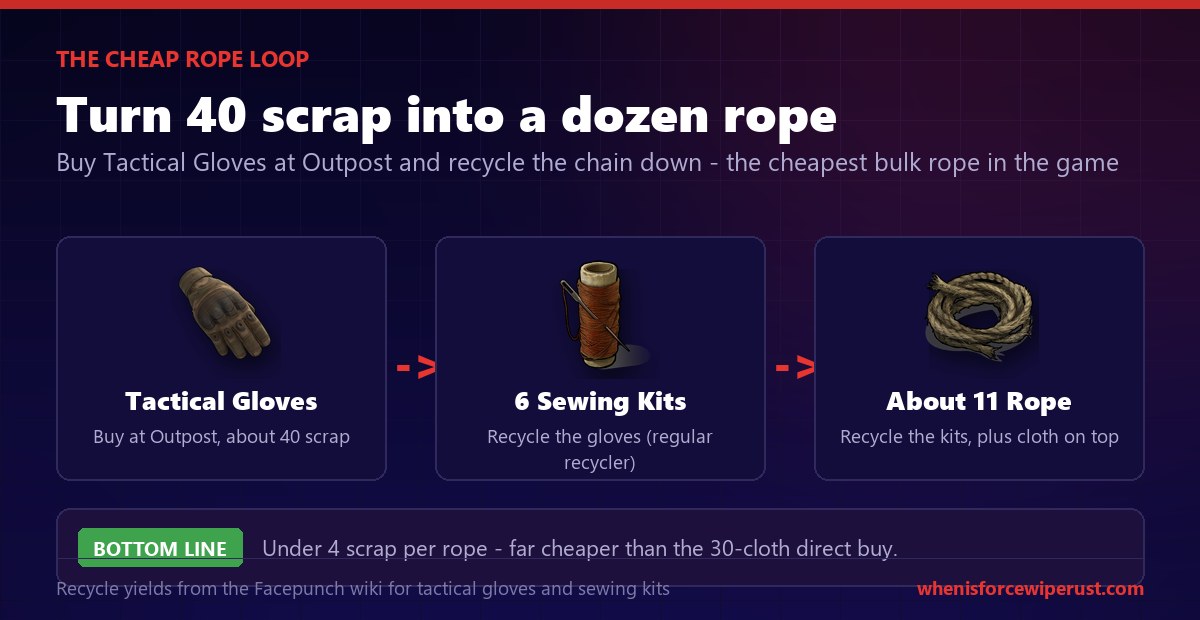
The chain works like this. Buy a pair of Tactical Gloves at Outpost for about 40 scrap. Run them through a regular recycler and they break down into 6 Sewing Kits (plus leather). Recycle those sewing kits and each one returns roughly 2 rope, so a single glove purchase nets you around 11 rope, with a pile of cloth on the side. That works out to under 4 scrap per rope, well below the effective cost of the 30-cloth direct buy.
Recycle rates matter here. A green monument recycler returns 60% once the Power Plant grid is powered (50% at wipe start, since the Power Trip update), so a sewing kit gives you close to 2 rope. The safe-zone recyclers at Outpost and Bandit Camp only return 40%, so you get fewer rope per kit. If you want the maximum haul, buy the gloves at Outpost and carry them to a monument recycler to break the chain down. If you just want convenience, doing it all in the safe zone still beats crafting anything, and rope cannot be crafted anyway.
The takeaway is simple. If you ever find yourself repeatedly short on rope, do not grind cloth for the direct 30-cloth buy. Grab a stack of gloves, recycle the chain, and you will walk away with rope, cloth and leather for a handful of scrap. It is the closest thing to a rope factory the game allows.
Rope, sewing kits and your armor
If you only remember one use for rope, make it this one. Rope’s most important job is the Sewing Kit, and sewing kits are the hidden gate in front of almost all real armor in Rust. No rope means no sewing kits, and no sewing kits means you are stuck in cloth clothing while everyone else is wearing metal.

A Sewing Kit costs 20 cloth and 3 rope at a Workbench Level 3. From there, sewing kits go into an enormous list of gear: the Hazmat Suit and Arctic Suit, roadsign chest and kilt armor, the coffee can helmet, boots, jackets, hoodies, sleeping bags, beds and parachutes. The heaviest single sink is the Metal Chest Plate, which needs 8 sewing kits, meaning 24 rope just to stitch one of the best chest pieces in the game.
Do that math across a full loadout and rope quietly becomes one of your most important armor materials, despite never appearing on a stat sheet. This is the real reason experienced players grab every rope they see and never leave a tacklebox behind. They are not hoarding for the sake of it, they are banking future armor.
Before you spend rope on ladders, barricades or fishing rods, make sure you have enough set aside for the sewing kits your next armor set will need. A raid you win in cloth armor is still a raid you nearly lost. Prioritizing rope into armor is one of the quiet habits that keeps you alive longer each wipe.
Recycling rope (and recycling for rope)
Recycling cuts both ways with rope, and only one direction is usually worth it. You can recycle spare rope into cloth, and, far more usefully, you can recycle other items to get rope in the first place.
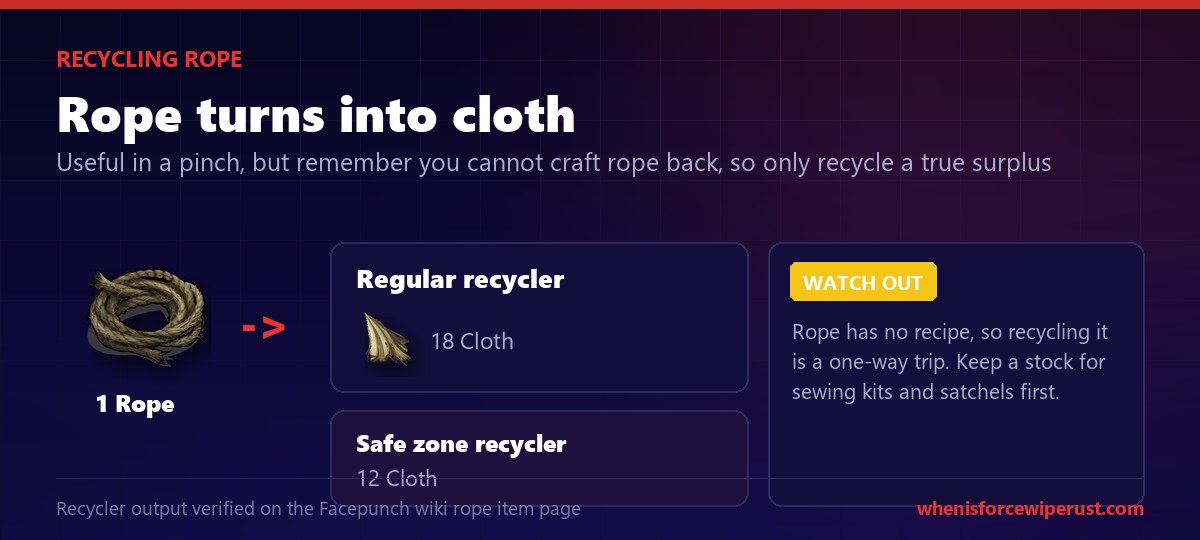
Put a single rope through a regular recycler and you get 18 cloth back. A safe-zone recycler, like the ones at Outpost and Bandit Camp, returns less, 12 cloth. That can be handy if you are drowning in rope and short on cloth, but remember the golden rule: you cannot craft rope back. Recycling rope is a one-way trip, so only do it with a genuine surplus you know you will not need for sewing kits or satchels.
The direction that actually matters is recycling to harvest rope. Looted sewing kits return about 2 rope each, and compound bows, crossbows and handmade fishing rods all recycle back into rope as well. So when you clear a monument or raid a base and find spare stitched gear, running it through a recycler is a reliable way to top up your rope supply without spending a thing.
Because rope has no recipe, recycling your last few pieces for a little cloth is one of the easiest self-inflicted mistakes in the game. If you recycle down to zero and then find a sewing kit or satchel recipe you want to build, you are back to looting for rope from scratch. Keep a small buffer at all times.
Rope and the wipe cycle
Like every item in your base, your entire rope stockpile disappears the moment the server force wipes. Every sewing kit, satchel and ladder you spent rope on is gone, and the map resets to a blank slate. That is not a bad thing, it is the reset that refills the world’s rope supply, because fresh tackleboxes, untouched underwater crates and full jungle loot tables are exactly what you raid for it.
The players who dominate a fresh wipe are the ones who dive the first crates, hit the Fishing Villages, and bank a pile of rope early, so they have sewing kits and satchels ready while everyone else is still hunting for their first tacklebox. Timing your session to the wipe is how you get first crack at those loot sources instead of picking over what is left.
Stock up on rope before the server empties. Line your play session up with the reset so you get the first crate dives and monument runs of the wipe.
Check the force wipe countdownRope in Rust FAQ
Can you craft rope in Rust?
No. Rope cannot be crafted, and it has no blueprint to research. There is no recipe for it anywhere in the crafting menu or the tech tree. The only ways to get rope are to loot it from crates and barrels, buy it from the Outpost vending machine for 30 cloth, or recycle other items like sewing kits, bows and fishing rods back into rope.
How do you get rope in Rust?
You get rope from loot, vendors and recycling. Every tacklebox has a guaranteed rope, and underwater advanced crates and basic jungle crates carry it often, frequently one to six at a time. Barrels, monument crates, scarecrows and scientists also drop it. The Outpost vending machine sells rope for 30 cloth each, and you can recycle sewing kits, compound bows, crossbows and handmade fishing rods to pull rope back out.
What is rope used for in Rust?
Rope is a crafting component used in 18 recipes. The most important is the Sewing Kit (3 rope), which gates most armor and clothing. It is also used in the wooden ladder (3), compound bow (2), crossbow (2), handmade fishing rod (2), metal detector (2), satchel charge (1), shotgun trap (2), small ramp (2), catapult (1), tin can alarm (1), wooden and barbed barricades, netting, chicken coop and wooden horse armor (2).
What is the cheapest way to get rope in Rust?
The cheapest bulk rope comes from the Tactical Gloves recycle loop. Buy a pair of Tactical Gloves at Outpost for about 40 scrap, recycle them into 6 sewing kits at a regular recycler, then recycle those kits into roughly 11 rope plus cloth. That works out to under 4 scrap per rope, cheaper than buying rope directly for 30 cloth each. Use a monument recycler rather than a safe-zone one: 60% once the Power Plant is powered (50% before) against 40%.
How much rope do you need for a sewing kit in Rust?
A sewing kit costs 3 rope and 20 cloth, crafted at a Workbench Level 3. Sewing kits then gate most armor and clothing, including the hazmat suit, roadsign armor and the coffee can helmet. The metal chest plate alone needs 8 sewing kits, which is 24 rope, so rope is quietly one of the most important armor materials in the game.
Does rope recycle in Rust?
Yes. A single rope recycles into 18 cloth at a regular recycler, or 12 cloth at a safe-zone recycler like Outpost or Bandit Camp. Because rope cannot be crafted back, recycling it is a one-way trip, so only recycle rope you are sure you will not need for sewing kits, satchels or ladders. Recycling other items to get rope is usually the smarter move.
Where do you buy rope in Rust?
You buy rope at the Outpost vending machine for 30 cloth each. Note that it costs cloth, not scrap, which makes it easy to afford since cloth farms quickly from hemp plants. Because Facepunch uses dynamic vendor pricing on many items, treat 30 cloth as the baseline. For bulk rope, the Tactical Gloves recycle loop is cheaper than buying it directly.
What is the item shortname and stack size for rope?
The item shortname is rope and the item ID is 1414245522. Rope stacks to 50 per slot and despawns after 20 minutes if left on the ground. It is classed as a crafting component, in the same family as tech trash, gears and metal springs, and cannot be placed or equipped on its own.
Why can’t I find a rope recipe in Rust?
Because there is not one. Rope is a loot-only component by design, similar to Tarp. It has no crafting recipe and no researchable blueprint, so searching the crafting menu or tech tree for it will always come up empty. If you need rope, you have to loot it, buy it from Outpost, or recycle sewn items like sewing kits, bows and fishing rods into it.
How many rope does a satchel charge need in Rust?
A satchel charge needs 1 rope, along with 4 beancan grenades and 1 small stash, crafted at a Workbench Level 1. Because satchels are an early-game raiding staple, that single rope per charge adds up fast during a raid, which is another reason to keep a rope reserve rather than recycling it all for cloth.
The bottom line
Rope is the quiet bottleneck behind more of your Rust progression than its plain appearance suggests. It stitches your armor, strings your bows, builds your ladders and arms your satchels, and the one thing you can never do is craft it. That is what makes rope worth understanding: you have to plan around a resource you cannot manufacture on demand.
Grab every tacklebox, dive the underwater crates, run the Tactical Gloves loop when you need a stack, and always keep a reserve for sewing kits before you recycle a single piece for cloth. Do that and rope stops being a bottleneck and starts being an edge. The one thing that resets it all is the wipe, so the real advantage is being online when the fresh map drops, ready to dive the first crates before anyone else.
Get first crack at the rope crates. Know exactly when the next force wipe lands so you are diving loot the moment the map goes live.
See the force wipe countdownSources
- Facepunch Wiki, Rope for the shortname rope, item ID 1414245522, stack size of 50, 20 minute despawn, the fact that it is not craftable or researchable, the recycle output of 18 cloth (12 in a safe zone), and the full list of items that use rope as an ingredient.
- RustHelp, Rope for the loot drop chances (tacklebox 100%, underwater advanced crate around 63% for 1 to 6, basic jungle crate around 42%, scarecrow and scientist drops), the Outpost vending price of 30 cloth, and the recycling-for-rope sources.
- Corrosion Hour, RUST Rope for the loot overview, the Outpost vendor detail, and the Tactical Gloves to Sewing Kits to rope recycling strategy for stockpiling rope cheaply.