
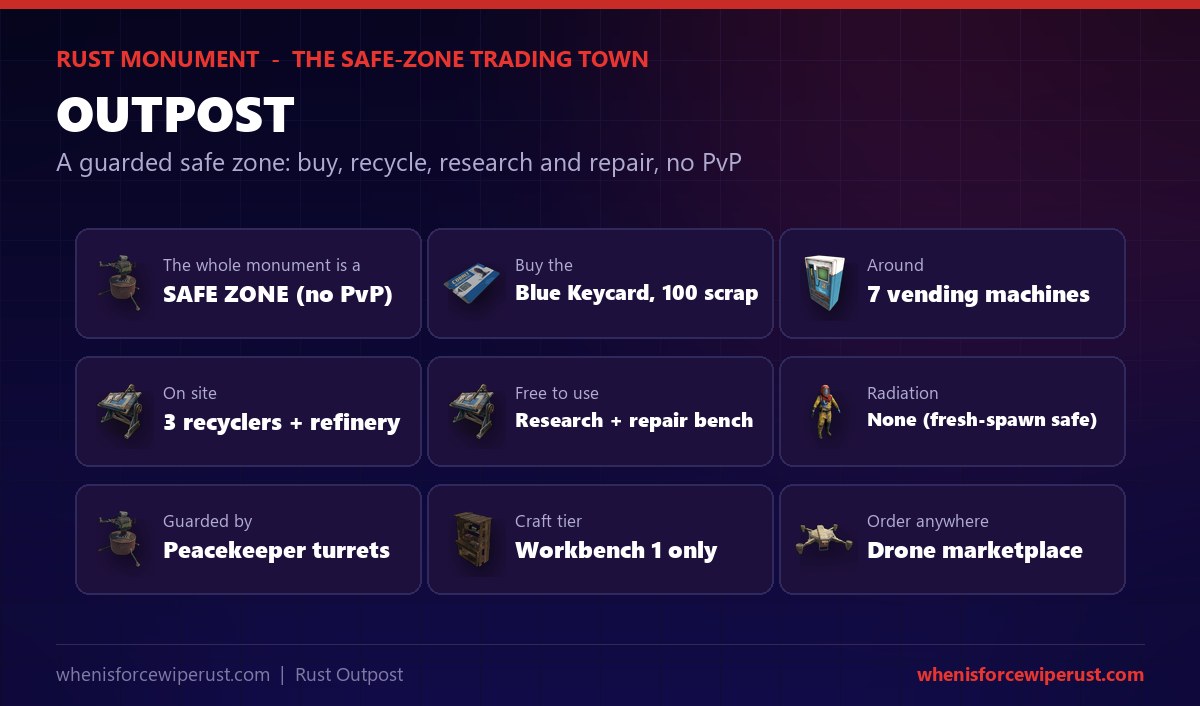
The Outpost is the one place in Rust where nobody can shoot you. It is a walled dystopian trading town, ringed by peacekeeper turrets and patrolled by NPC guards, and the whole compound is a safe zone where open-world PvP is switched off. You walk in, you trade, you recycle, you research and repair your gear, and you walk out again, all without a single bullet coming your way, as long as you keep your own gun holstered.
What makes the Outpost in Rust so central to a wipe is not just the safety, it is the shopping. Behind those turrets sit around seven vending machines that sell almost everything a fresh base needs: components, tools, clothing, defensive deployables, and most importantly the Blue Keycard for 100 scrap. Blue is the only keycard you can actually buy in the game, and Outpost is where you buy it, which turns a scary puzzle run into a quick shopping trip.
This Outpost Rust guide covers all of it: how the safe zone and the hostile timer work, exactly what every vending machine sells and for how much, the blue keycard and where it fits on the ladder, the recyclers, refinery and repair bench, and how Outpost stacks up against its sibling safe zone at Bandit Camp. Every number here is checked against RustHelp’s monument data, Corrosion Hour and the Facepunch devblog, not guessed.
- What Is Outpost
- Outpost Stats
- Is Outpost a Safe Zone
- What Outpost Sells
- The Blue Keycard
- Recyclers & Amenities
- Outpost vs Bandit Camp
- How to Use Outpost
- Pro Tips
- FAQ
What Is the Outpost in Rust?
The Outpost monument, originally called the Compound, is a self-contained town built inside a walled compound and connected to the road network that links every other monument. It was added in the Compound Update on 3 May 2018 as the game’s first proper safe zone, designed to give fresh spawns and established players alike somewhere to trade and regroup without instantly dying. It has two main entrances plus underground tunnel access, and the whole thing is watched over by rooftop peacekeeper turrets and NPC guards.
On the monument tier list, Outpost sits in its own safe-zone tier alongside Bandit Camp. It is not a loot-and-shoot monument like the Airfield or the Oil Rig. There is no keycard puzzle, no radiation and no crates to fight over. Instead it is a services hub: a row of vending machines, three recyclers, a refinery, a research table, a repair bench and a drone marketplace, all wrapped in a bubble where nobody can attack you.

Because it is so useful and so safe, Outpost is one of the busiest spots on any map. Players funnel in and out all wipe to spend scrap, dump loot into the recyclers and grab a blue card. The danger is not inside the walls, it is the ring just outside them, where campers wait for loaded players to step back into the open world. Treat the safe zone as safe and the approach and exit as hostile, and you will keep your scrap.
Is Outpost a Safe Zone in Rust?
Yes. Outpost is a safe zone, which means player-versus-player combat is disabled inside its borders. You cannot be shot, meleed or blown up by another player while the safe zone is protecting you, and you cannot attack them either. The moment you cross the border with a weapon or lethal tool drawn, the game auto-holsters it and gives you a warning. This is the single most important thing to understand about the monument.
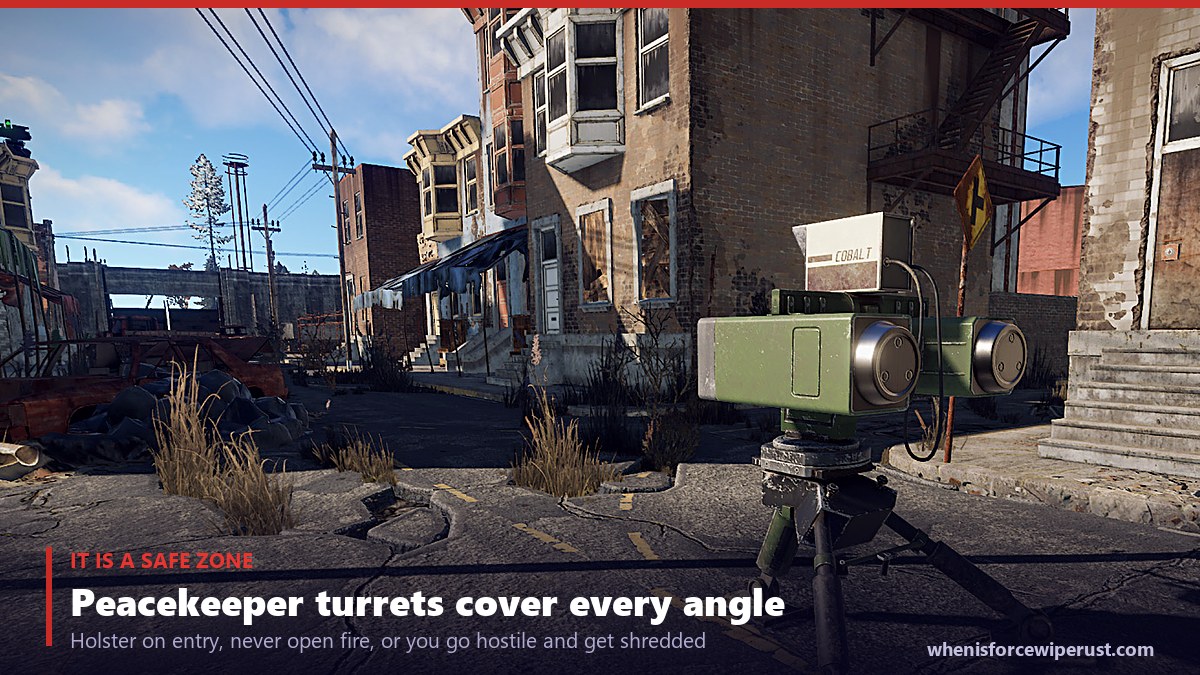
The peace is enforced, not just requested. Dotted around the rooftops and streets are peacekeeper sentry turrets, and the compound is patrolled by NPC guards. If you break the rules they open fire, and they hit hard enough that there is no shooting your way out. The rules are simple, but breaking them by accident is the classic new-player mistake, so here is exactly how the hostility system works.
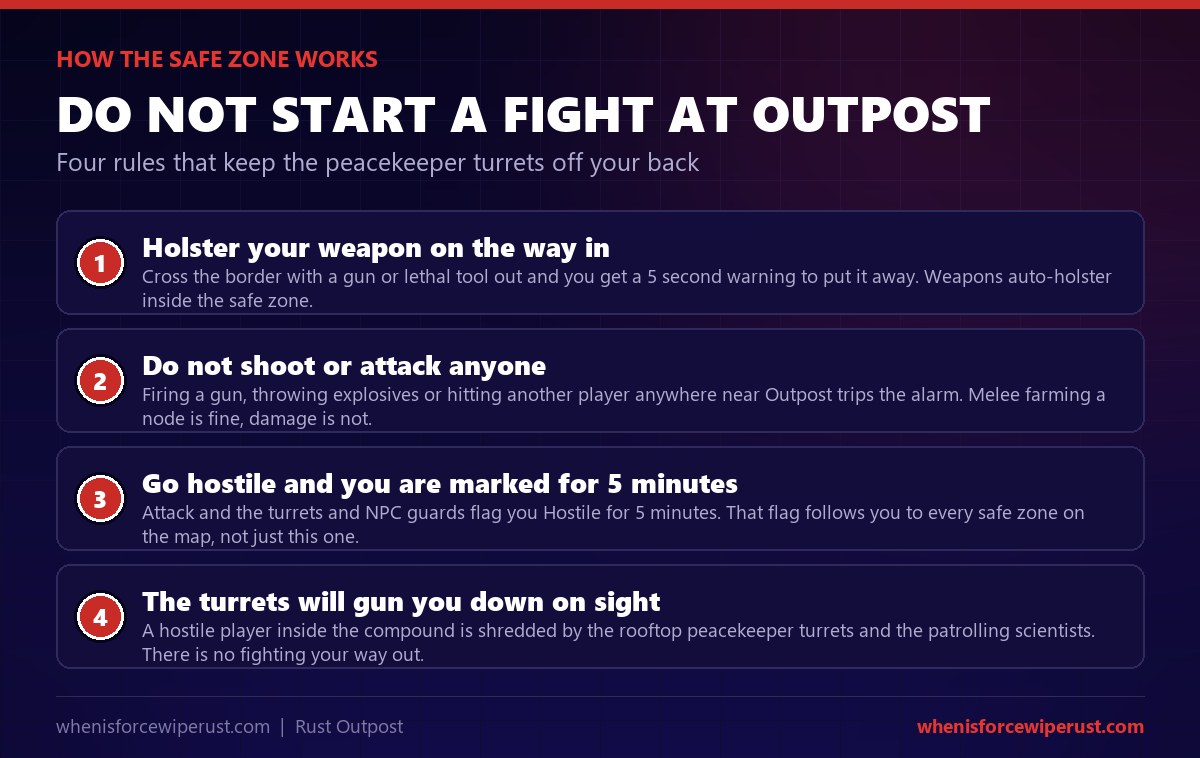
- Holster on entry. Cross the border with a gun or lethal tool out and you get a 5 second warning to put it away. Weapons auto-holster inside, so usually you do not even have to think about it.
- Do not attack anything. Firing a weapon, throwing an explosive or hitting another player anywhere near the safe zone trips the alarm. Melee farming a stone node is fine, but damaging a player is not.
- Going hostile marks you for 5 minutes. Attack and the turrets and guards flag you hostile for 5 minutes, and that flag follows you to every safe zone on the map, so you cannot just run to Bandit Camp instead.
- The turrets finish the job. A hostile player inside the compound is gunned down by the rooftop turrets and the patrolling scientists. Wait out the timer in the open world before you come back.
What Does the Outpost Sell? Vending Machines & Prices
The reason you keep coming back to Outpost is the shopping. Around seven vending machines line the compound, each themed to a category, and between them they sell components, tools, clothing, building supplies, resources and finished defensive deployables. You pay in scrap, and every machine restocks in about 10 seconds, so you rarely wait long for a sold-out item.
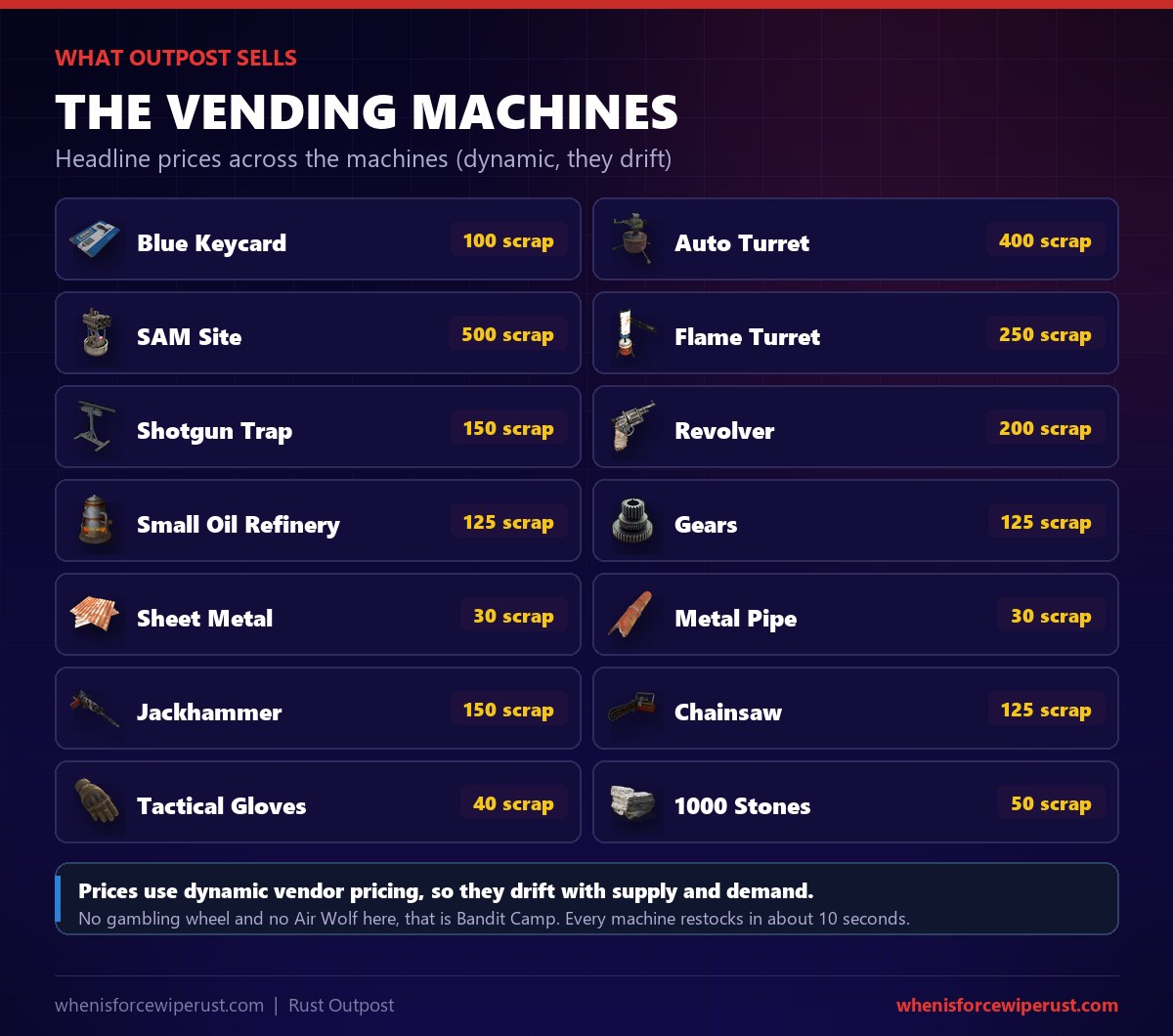
The one thing to know before you memorise any price is that Rust uses dynamic vendor pricing. NPC prices shift with supply and demand, so the numbers below are the baseline you should expect, not fixed forever. Here is a rundown of the standout items across the machines.
| Machine | Standout items | Baseline price |
|---|---|---|
| Tools & keycard | Blue Keycard | 100 scrap |
| Weapons | Auto Turret | 400 scrap |
| Weapons | SAM Site | 500 scrap |
| Weapons | Flame Turret | 250 scrap |
| Weapons | Shotgun Trap | 150 scrap |
| Weapons | Revolver / Double Barrel | 200 / 250 scrap |
| Building | Small Oil Refinery | 125 scrap |
| Building | Large Furnace | 350 scrap |
| Components | Gears | 125 scrap |
| Components | Sheet Metal / Metal Pipe | 30 scrap each |
| Tools & Stuff | Jackhammer / Chainsaw | 150 / 125 scrap |
| Clothing | Tactical Gloves | 40 scrap |
| Clothing | Snow Jacket / Boots | 20 scrap each |
| Resources | 1000 Stones / 1000 Wood | 50 / 20 scrap |
The Weapons machine is the one most guides forget to mention, and it is the most useful of the lot for base defence. It sells finished deployables you would otherwise have to research and craft: the Auto Turret for 400 scrap, the SAM Site for 500, the Flame Turret for 250 and the Shotgun Trap for 150. If you have the scrap, you can kit out a base with traps straight from Outpost without ever unlocking them.
Buying the Blue Keycard at Outpost
The blue keycard is the headline purchase, and it is genuinely special: blue is the only keycard you can buy in Rust. Green cards are sold at Bandit Camp and red cards cannot be bought at all, but the blue one sits in an Outpost vending machine for 100 scrap. That means you can skip an entire puzzle monument and just pay for the card instead.
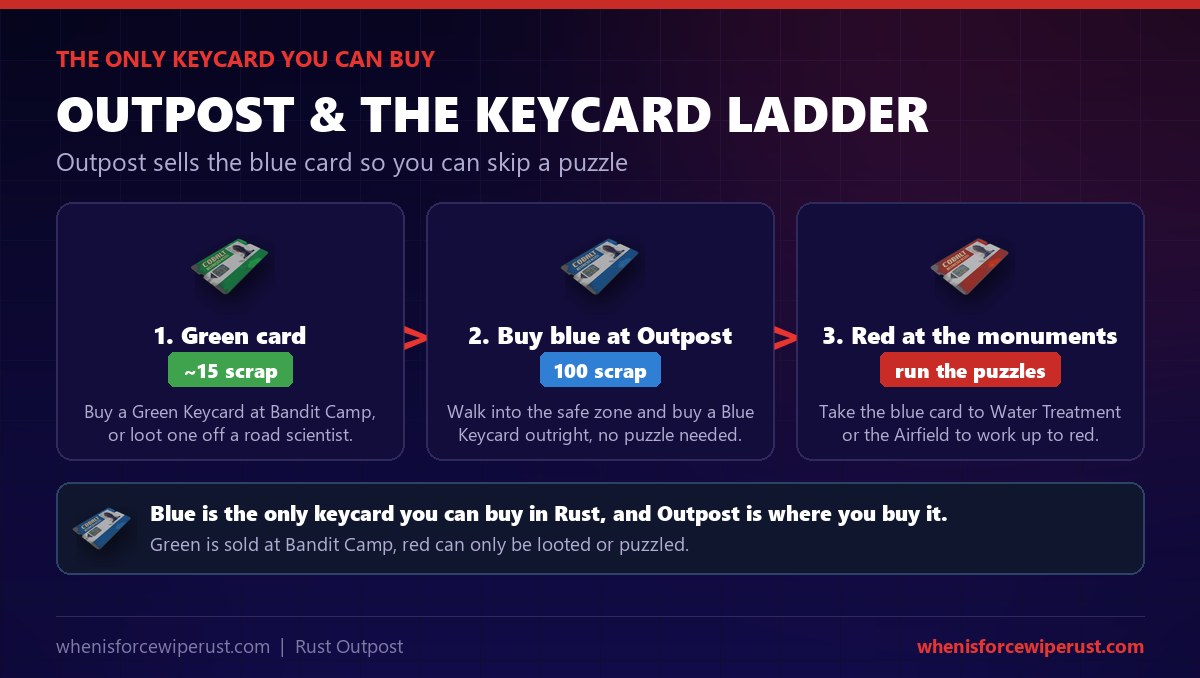
Here is how it fits the wider ladder. A Green Keycard costs about 15 scrap at Bandit Camp. A Blue Keycard costs 100 scrap here at Outpost, no card and no fuse required. You then take that blue card to a blue-tier monument like Water Treatment or the Airfield and run its puzzle to reach the Red Keycard, which opens the end-game monuments. Outpost is the shortcut that skips the cheap early rungs.
Recyclers, Refinery & Amenities
Outpost is not only a shop, it is a full processing stop. For the price of a walk through a safe zone you get a genuinely deep set of amenities, so you can turn a bag of loot into scrap, refine crude oil, research a new item and repair your gear all in one visit.
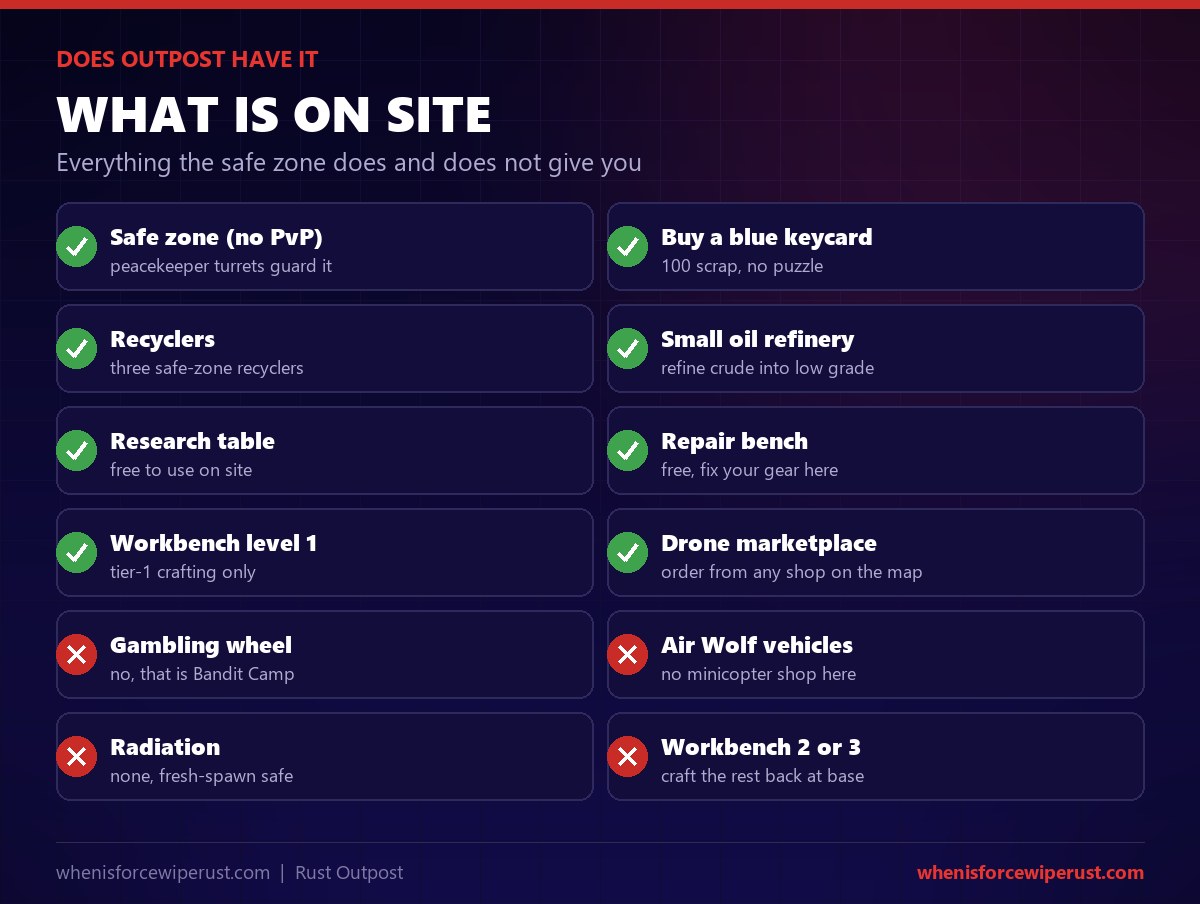
There are three recyclers on site, which is one more than Bandit Camp, so even when the monument is busy you can usually find a free one to break components down into scrap. Bear in mind these are safe-zone recyclers: they run a little slower and return a little less than a normal monument recycler, the trade-off for recycling somewhere you cannot be shot. There is also a free Small Oil Refinery for turning crude oil into low grade fuel, a free research table for unlocking blueprints, a repair bench for fixing gear, and a Workbench Level 1 for tier-1 crafting.
The modern addition is the drone marketplace. From the marketplace terminal you can order items from any shop or player vending machine on the map and have a delivery drone bring them to the Outpost pickup point, so you can buy from a base across the map without leaving the safe zone. There is also a barbecue for cooking, a telephone, and, in the fenced area by the research table, a free static Clan Table you can use without crafting one. For where Outpost fits among every other landmark, see our full Rust monuments guide.
Outpost vs Bandit Camp
Rust has two safe-zone towns, and new players constantly mix them up. Outpost and Bandit Camp are both no-PvP trading hubs with recyclers, a research table, a repair bench and a drone marketplace, but each one does a different job, so it is worth knowing which to visit for what.
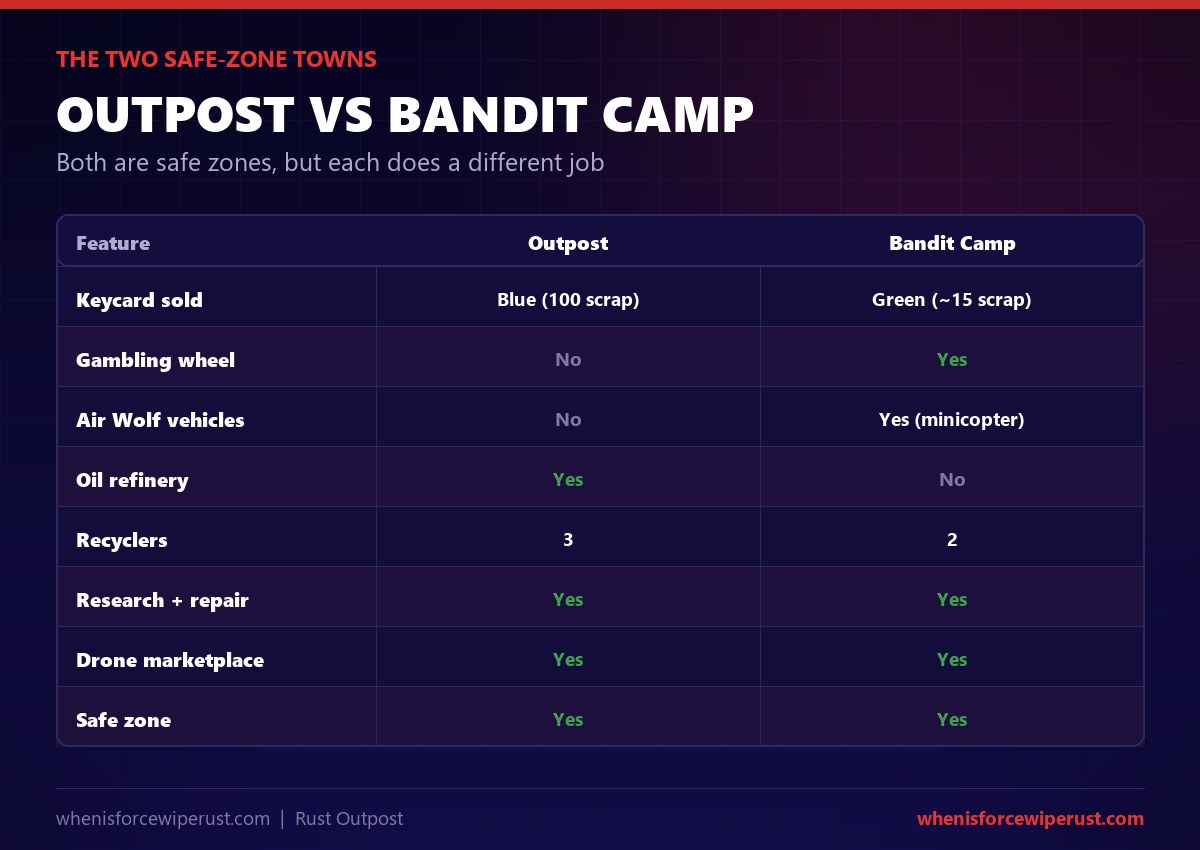
Outpost is the shopping and processing town. It sells the blue keycard, it has the oil refinery and it has three recyclers, and the weapons machine sells traps and turrets. Bandit Camp is the risk-and-vehicles town: it sells the green keycard for around 15 scrap, it has the gambling wheel for betting scrap, and it is the only place with the Air Wolf vendor that sells the Minicopter and Scrap Transport Helicopter. If you want to fly or gamble, go to Bandit Camp. If you want to buy a blue card, refine oil or recycle a big haul, go to Outpost.
How to Use the Outpost
Outpost asks nothing of you except scrap and common sense. You do not need rad gear, a puzzle card or a fuse. What you bring is loot to process and scrap to spend, and what you take care over is the walk in and out.
- Scrap to spend. The whole point is buying, so carry the scrap for whatever you came for: 100 for a blue card, 400 for an auto turret, or a stack for a shopping spree.
- Loot to recycle. Bring the components and gear you want to break down. Three recyclers means you can process a big haul in one visit.
- Crude oil to refine. If you have crude from an oil barrel or a pump jack, the free refinery turns it into low grade fuel on site.
- A holstered weapon only. Bring a gun for the walk in and out, but never draw it inside. Let it auto-holster and keep it away until you are clear of the safe zone.
- Nothing you cannot afford to lose on the way out. The safe zone protects you inside, not on the approach, so plan your exit before you load up.
Outpost Rust Pro Tips
- Never draw your weapon inside. The number one way new players die at Outpost is misclicking and firing a shot. Keep the weapon holstered and let the safe zone do its job.
- Recycle before you buy. Break your loot down at the three recyclers first, then spend the scrap you just made. It saves a second trip and means you leave lighter.
- Buy the blue card when scrap is flowing. 100 scrap for a blue keycard with no puzzle and no risk is one of the best scrap deals in the game once you are established.
- Kit out base defence from the weapons machine. Auto turrets, flame turrets and shotgun traps come pre-made, so you can defend a base before you have unlocked any of them.
- Watch the exit, not the interior. Assume someone is watching the door. Take an unusual exit, move at night, or leave before you are carrying anything worth killing you for.
- It all wipes anyway. The monument, its vending stock and your scrap balance reset on the monthly force wipe, so spend your scrap rather than hoarding it into wipe day.
Planning your wipe-day shopping run? The monthly force wipe resets the whole map, every monument and all your scrap and blueprints. Check the live countdown so you know exactly when the Outpost prices and your scrap balance start fresh.
See the Force Wipe CountdownOutpost Rust FAQ
Is the Outpost a safe zone in Rust?
Yes. The Outpost is a safe zone, so player-versus-player combat is disabled inside its borders. You cannot be attacked by other players and you cannot attack them. When you cross the border with a weapon or lethal tool drawn, the game gives you a 5 second warning and auto-holsters it. If you fire a weapon or attack anyone, the peacekeeper turrets and NPC guards flag you hostile and gun you down. The only real danger is just outside the walls, where players wait for you to leave.
How do you buy a blue keycard at Outpost?
Walk into the Outpost safe zone, find the vending machine that stocks the Blue Keycard, and buy it for 100 scrap. There is no puzzle, no card and no fuse required, you just pay the scrap and take the card. Blue is the only keycard you can buy in the game, so Outpost is the one place you can shortcut straight to a blue card. You then take that blue card to a blue-tier monument like Water Treatment or the Airfield to run its puzzle.
How much is a blue keycard at Outpost?
A blue keycard costs 100 scrap at the Outpost vending machine. Because Rust uses dynamic vendor pricing, the exact number can drift a little with supply and demand, but 100 scrap is the baseline. It is the only keycard you can buy directly: green keycards are sold at Bandit Camp for around 15 scrap, and red keycards cannot be bought at all and must be looted or earned from a monument puzzle.
What does the Outpost sell in Rust?
Around seven vending machines sell components (sheet metal, gears, metal pipe, metal spring), tools (pickaxe, hatchet, chainsaw, jackhammer), building parts (small oil refinery, large furnace, computer station, generators), clothing (t-shirt, longsleeve, snow jacket, boots, tactical gloves), resources (stone, wood, metal fragments, low grade fuel), and finished defensive deployables from the weapons machine: auto turret 400 scrap, SAM site 500, flame turret 250, shotgun trap 150, revolver 200. It also sells the blue keycard for 100 scrap. All prices are dynamic and restock about every 10 seconds.
Does the Outpost have a recycler?
Yes, the Outpost has three recyclers, one more than Bandit Camp. That makes it one of the best places on the map to break a big haul of components down into scrap, since you can run several stacks at once with no risk of being attacked. They are safe-zone recyclers, so they run slightly slower and return a little less than a regular monument recycler, which is the trade-off for recycling somewhere completely safe.
Does the Outpost have radiation?
No. The Outpost has no radiation at all, so you never need a hazmat suit to visit it. You can walk in wearing anything, or nothing, and take no radiation damage. That, combined with the safe zone, makes it one of the friendliest monuments in the game for freshly spawned players. The only threat is the peacekeeper turrets, and they only fire on players who go hostile by attacking someone.
What happens if you shoot at the Outpost?
If you fire a weapon or attack a player at or near the Outpost, you are flagged hostile for 5 minutes. The rooftop peacekeeper turrets and the NPC guards will open fire on you and they hit hard enough that you cannot fight your way out. The hostile flag follows you to every safe zone on the map, so you cannot escape to Bandit Camp either. You have to leave, survive the 5 minute timer in the open world, and only then can you safely re-enter a safe zone.
How long does the Outpost hostile timer last?
The hostile timer lasts 5 minutes in vanilla Rust. It starts the moment you attack a player or fire a weapon in or near a safe zone, and it applies at every safe zone at once, not just the one you triggered it at. While it is counting down you will be shot on sight by the turrets and guards if you enter any safe zone. Some modded and community servers change this duration, but on official and most community servers it is 5 minutes.
What is the difference between Outpost and Bandit Camp?
Both are safe zones with recyclers, a research table, a repair bench and a drone marketplace, but they specialise differently. Outpost sells the blue keycard for 100 scrap, has a small oil refinery and three recyclers, and its weapons machine sells traps and turrets. Bandit Camp sells the green keycard for around 15 scrap, has the gambling wheel for betting scrap, and is the only place with the Air Wolf vendor that sells the minicopter and scrap transport helicopter. Outpost has no gambling and no vehicles, and Bandit Camp has no oil refinery.
Can you build at the Outpost?
No. The Outpost has a large no-build zone of roughly 125,663 square metres, so you cannot place a base, a tool cupboard or deployables on or right next to the monument. This stops players from walling off the vending machines or trapping others at the safe zone. You can still build outside the no-build radius, and plenty of players set up a base a short run away so they can pop into Outpost to recycle and shop throughout the wipe.
Does the Outpost have a workbench?
Yes, the Outpost has a Workbench Level 1, so you can do tier-1 crafting on site, plus a free research table for unlocking blueprints and a repair bench for fixing gear. It does not have a Workbench Level 2 or Level 3, so anything that needs a higher workbench has to be crafted back at your base. For most players the research table is the bigger draw, since you can research a looted item into a blueprint there for free.
When was the Outpost added to Rust?
The Outpost was added on 3 May 2018 in the Compound Update, where it was originally called the Compound. It was Rust’s first proper safe zone, built to give players somewhere to trade and regroup without instant PvP. The same update introduced the peacekeeper turret system and the vending machines. Over the years it has gained more features, including the drone marketplace, but its core role as the game’s safe-zone shopping town has stayed the same.
Can you get on the Cargo Ship or fly out of Outpost?
No. Outpost has no vehicle vendor, so you cannot buy a minicopter, scrap heli or any aircraft there. That is the Air Wolf vendor at Bandit Camp. Outpost is purely a shopping, recycling and processing hub. If you want to fly, buy a minicopter at Bandit Camp for around 750 scrap, or find one in the world. The drone marketplace at Outpost only delivers items by delivery drone, it does not sell you a vehicle to pilot.
Is the Outpost worth visiting in Rust?
Yes, constantly. For the price of a walk through a safe zone you can buy a blue keycard, recycle a farm across three recyclers, refine crude oil, research a blueprint, repair your gear and buy trap turrets for your base, all with zero PvP risk inside the walls. Few monuments give you so much value for so little danger. The only skill involved is managing your exit, since players camp the border waiting for loaded targets to step back into the open world.
Sources and Further Reading
- Outpost monument data, recyclers, no-build and amenities: RustHelp, Outpost
- Outpost vending machine loot tables and prices: Corrosion Hour, Outpost Vending Machine Loot Tables
- Outpost amenities and safe-zone layout: Facepunch Wiki, Outpost
- The safe zone and peacekeeper turrets, primary source: Facepunch, The Compound Update Devblog
- How the safe zone hostility rules were introduced: Rustafied, Safe Spaces
- Where the blue keycard leads next: whenisforcewiperust.com, Blue Keycard Guide
- The other safe-zone town: whenisforcewiperust.com, Bandit Camp Guide
- Every monument on the map: whenisforcewiperust.com, Rust Monuments Guide
- The game itself: Facepunch Studios