
Rust armor inserts are the quiet upgrade that most players still ignore, and that most guides written before 2025 do not even mention. They let you take a piece of crafted armor and slot in extra plates that stack onto its protection, turning a plain metal chest plate into a noticeably tankier one. A few percent projectile does not sound like much until it is the difference between eating a fifth AK round and dropping on the fourth.
The catch is that inserts come with their own set of rules that are easy to get wrong: armor only rolls insert slots when you craft it, the number of slots is random, some pieces can never hold more than one, and the best insert in the game cannot be crafted at all. Get those rules straight and you will squeeze free value out of every kit you build. This guide covers every insert type, exactly which armor can be slotted, how to apply and swap them, and the setup worth running, all cross checked against Corrosion Hour, RustHelp and the in game files.
- What Inserts Are
- How Slots Work
- The 4 Insert Types
- What Can Be Slotted
- How To Use Them
- The Metal Insert
- Which To Run
- Removing Inserts
- Quality Tea
- Best Setup
- FAQ
What Are Rust Armor Inserts?
An armor insert is a small craftable or lootable plate that fits into a slot on a piece of armor and adds to its protection. They arrived in a 2025 crafting overhaul and were the first way in Rust to customise the stats of a single armor piece rather than just choosing which piece to wear. Think of them like weapon attachments, but for your clothing: the base item sets the floor, and the inserts tune it up from there.
Each insert adds a flat percentage to one or two protection types, and crucially the bonuses stack. Slot three metal inserts into a chest plate and you get the full +12% projectile, on top of the plate’s base value. Because armor in Rust protects per body area, an insert only helps the area the armor covers, so a chest plate insert does nothing for your head. If you are fuzzy on how the underlying protection system works, the main armor guide breaks down the six damage types and the layering rules that inserts build on top of.
How Armor Insert Slots Work
Here is the single most important mechanic, and the one people get wrong: armor rolls its insert slots at the moment you craft it, and the number is random. A freshly crafted chest plate has a chance to come out with 0, 1, 2 or 3 open insert slots. You cannot add slots to a piece that rolled zero, and you cannot re roll a piece without scrapping it and crafting another. Looted armor simply keeps whatever slot count it was crafted with.
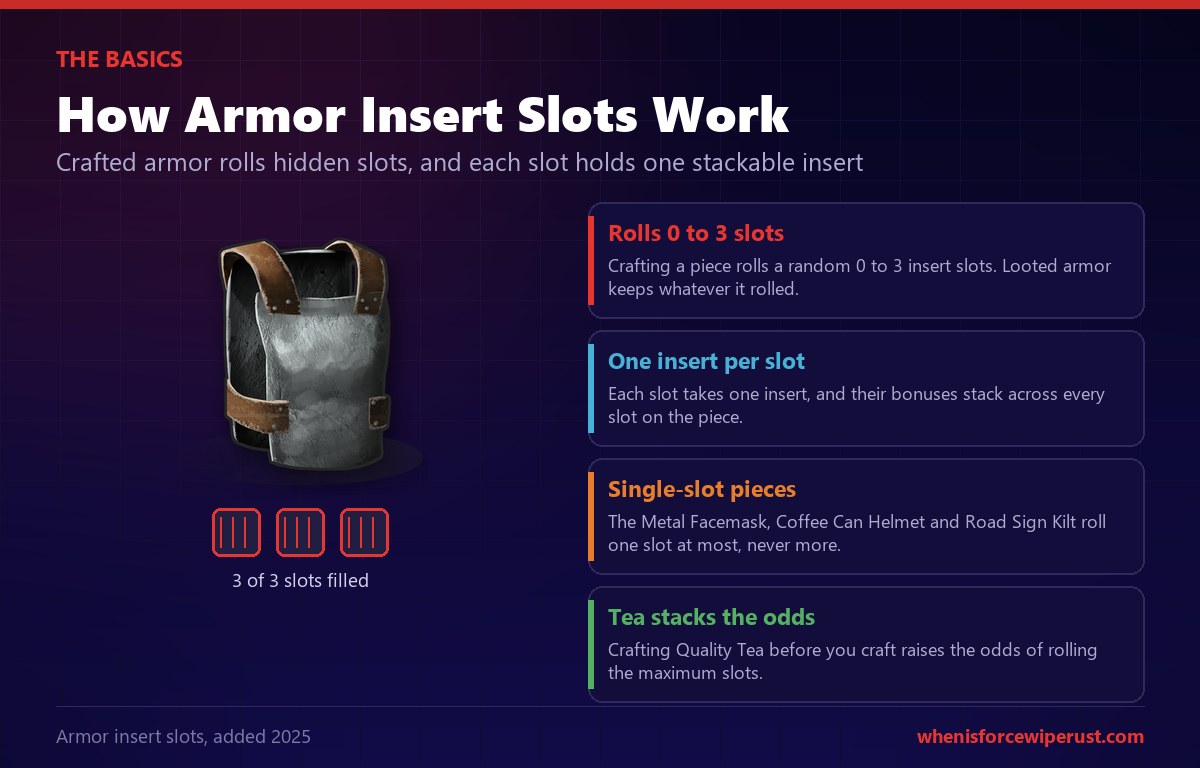
Three specific pieces are the exception. The Metal Facemask, Coffee Can Helmet and Road Sign Kilt are single slot items: they can only ever roll one insert slot, never two or three. Every other insert eligible piece, including chest plates, jackets and full body suits, can roll up to three. That single slot cap is why your head and one leg slot get less out of inserts than your chest does, and it feeds directly into which pieces are worth chasing max slots on.
Because slot count is a dice roll, serious crafters batch craft. They brew a Crafting Quality Tea to tilt the odds toward maximum slots, then craft a stack of chest plates and keep only the three slot rolls, scrapping the rest for the materials back. It is fiddly, but a three slot chest plate with three metal inserts is meaningfully stronger than a bare one, and on a big group server that margin is worth the effort.
The Four Rust Armor Insert Types
There are exactly four inserts, and each one tunes a different protection stat. Three are craftable and one is loot only. Match the insert to the job: projectile for fighting, radiation for monuments, explosion for base defense.
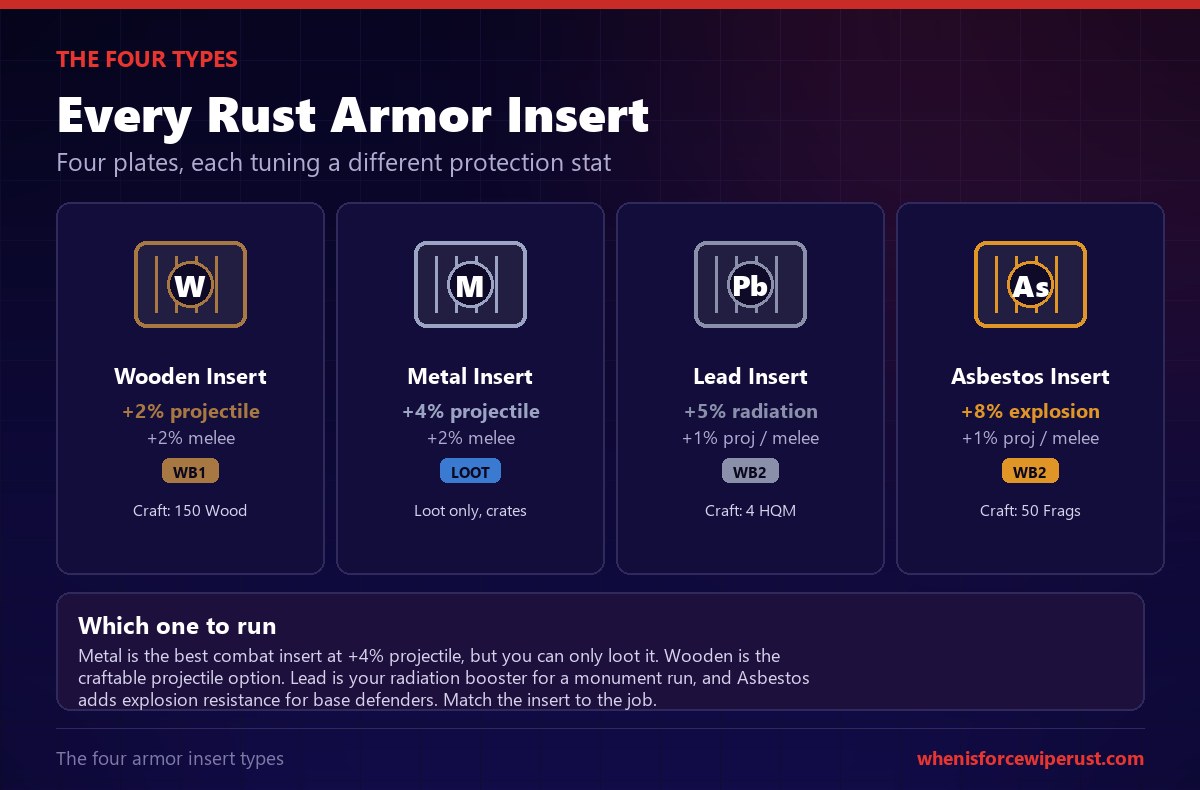
| Insert | Bonus (per insert) | How to get | Workbench |
|---|---|---|---|
| Metal Armor Insert Loot | +4% projectile, +2% melee | Loot from crates only | – |
| Wooden Armor Insert | +2% projectile, +2% melee | Craft: 150 Wood | WB1 |
| Lead Armor Insert | +5% radiation, +1% proj/melee | Craft: 4 High Quality Metal | WB2 |
| Asbestos Armor Insert | +8% explosion, +1% proj/melee | Craft: 50 Metal Fragments | WB2 |
The Wooden Armor Insert is the entry level projectile plate. It crafts at Workbench 1 from 150 wood, is researchable, and adds +2% projectile and +2% melee. It is the insert you spam early because wood is effectively free.
The Lead Armor Insert is your radiation tool, crafted at Workbench 2 from 4 High Quality Metal. At +5% radiation each, a few lead inserts let a normal fighting kit survive milder rad zones without swapping to a hazmat, which is a genuinely modern trick most guides never mention.
The Asbestos Armor Insert crafts at Workbench 2 from 50 Metal Fragments and adds +8% explosion, the largest single stat bonus of any insert. It is a base defender’s plate, softening rocket and C4 splash while you hold a doorway during a raid.
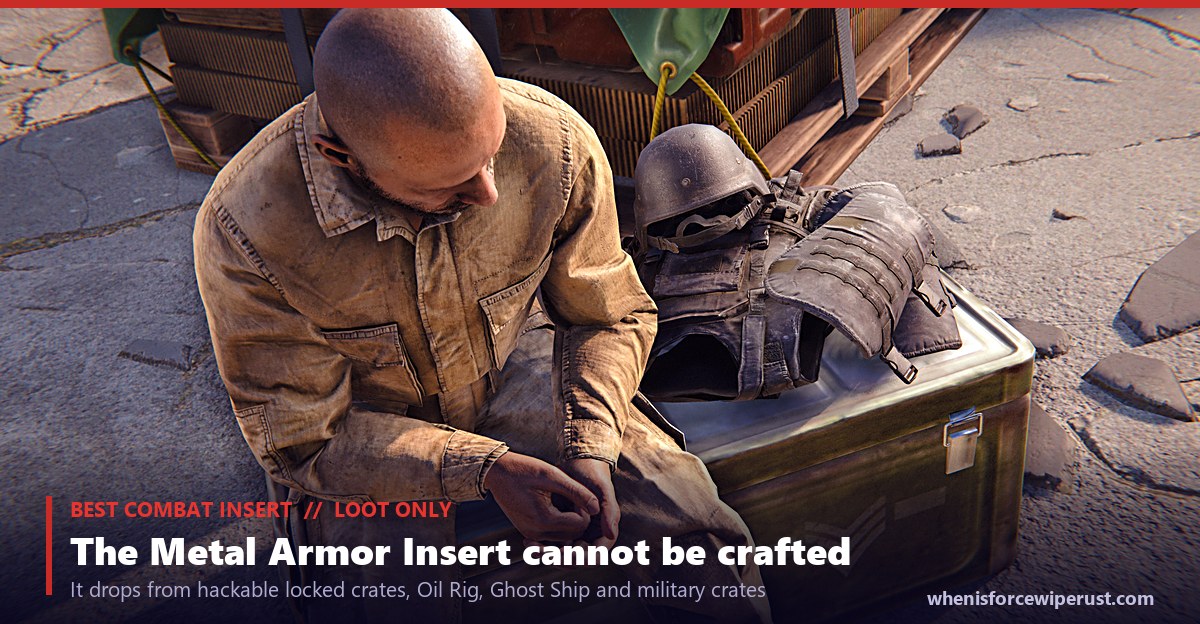
And the Metal Armor Insert is the best combat insert at +4% projectile, but it is the one you cannot craft. It only drops from loot, which gets its own section below.
Which Armor Pieces Can Take Inserts
Not every piece of clothing accepts inserts, and among those that do, the slot cap varies. The rule of thumb: chest, leg and full body pieces can roll up to three slots, while the three single slot pieces roll one at most. Bandanas, hoodies, pants, gloves and boots do not take inserts at all.
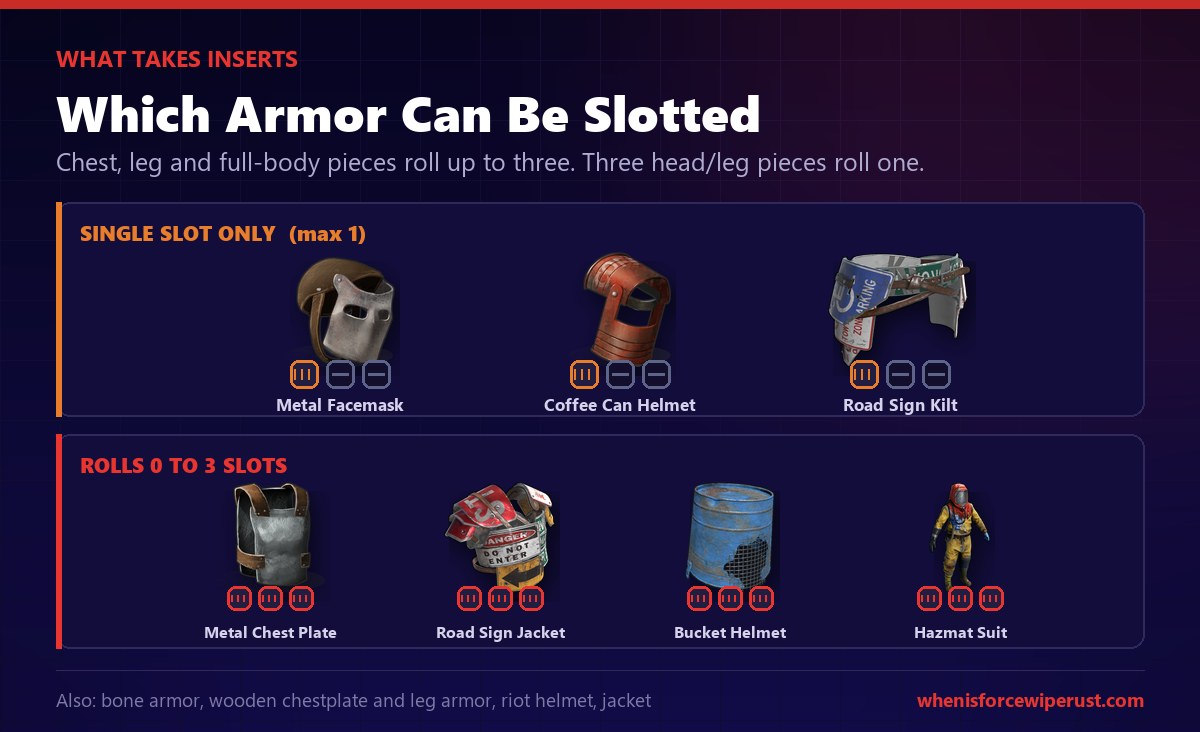
| Armor piece | Max insert slots | Notes |
|---|---|---|
| Metal Facemask | 1 | Single slot, best craftable head |
| Coffee Can Helmet | 1 | Single slot, value head |
| Road Sign Kilt | 1 | Single slot leg piece |
| Metal Chest Plate | 0–3 | The prime insert target |
| Road Sign Jacket | 0–3 | Cheap 3 slot chest option |
| Bucket Helmet & Riot Helmet | 0–3 | Only helmets that roll 3 |
| Bone Armor, Wood Chestplate, Wood Leg Armor | 0–3 | Early game slottable |
| Jacket, Hide Poncho | 0–3 | Basic chest layers |
| Hazmat & full body suits | 0–3 | Arctic, Nomad and similar suits |
How To Use Armor Inserts
Applying inserts is drag and drop, and it takes about five seconds once you know where to look. The only real gotcha is that the slots have to exist first, which comes back to the craft roll.

- Get a piece with slots. Craft the armor (it rolls the slots) or loot a piece that already has open insert slots.
- Open the item. Bring the armor up in your inventory so its insert slots are visible next to it.
- Drag an insert into each open slot. The bonus applies instantly and stacks across every slot on that piece.
- Wear it. The slotted armor works like any other, now with the extra protection baked in.
- Swap when you want. Drag a new insert onto an old one to replace it, and the old insert drops back into your inventory.
That last point is the good news that trips people up: removing or replacing an insert does not destroy it. You can pull your metal inserts out of one chest plate and move them into a fresh one, so a small set of good inserts follows you across every kit you build. More on that below, because there is a catch.
The Metal Armor Insert: Best For Combat
The Metal Armor Insert is the one everyone wants and nobody can craft. At +4% projectile and +2% melee it is double the projectile of the wooden insert, and it is the plate that actually matters in gunfights. Because it is loot only, finding them is part of the endgame gear grind rather than something you produce on demand.
| Source | Drop | Notes |
|---|---|---|
| Hackable Locked Crate | 100%, x1 | The reliable source, every crate |
| Oil Rig & Ghost Ship locked crates | x1 each | Guaranteed on the timed hack |
| Deepsea Treasure box | x4 | Best single haul when it appears |
| Military Crate | ~5%, x1 | Common crate, low chance |
| Scientist drybox / bodies | ~0.1–4% | Trickle from monument scientists |
The practical takeaway: run high tier monuments. A Oil Rig hack or a Military Tunnels run drops locked and military crates, which are your steady supply of metal inserts. Every hackable Locked Crate anywhere on the map guarantees one, so calling in and holding a crate is the single best way to farm them.
Wooden vs Metal vs Lead vs Asbestos: Which To Run
The right insert is entirely about what you are doing that session. Here is the quick decision:
- Roaming and PvP: Metal inserts if you have looted any, otherwise Wooden. Projectile is what keeps you alive in a rifle fight, so fill every slot you own with the best projectile plate you can.
- Monument and rad runs: Lead inserts. A few of them let a road sign or metal kit tank light radiation, so you can skip the hazmat swap at milder monuments and keep your projectile protection.
- Base defense and raids: Asbestos inserts. When you expect to be raided, +8% explosion per insert blunts rocket and C4 splash while you hold a choke.
- Early wipe: Wooden inserts in whatever slotted armor you rolled. They cost 150 wood and are pure upside.
You do not have to commit a piece to one job forever, because inserts pop back out when you swap them. Many players keep a small pouch of each type and re slot on the fly: metal in for a roam, lead in before a monument, asbestos in when the rockets start landing.
Do Inserts Break When You Remove Them?
No. This is the question that stops people from experimenting, so it is worth being blunt: removing or replacing an armor insert never destroys it. Drag a new insert onto a slotted one and the old plate returns to your inventory, ready to go into another piece. Your inserts are a reusable investment, not a one time consumable, which is exactly why a small set of metal inserts is worth hoarding across a wipe.
Crafting Quality Tea And Maximum Slots
Slot count is random when you craft, but you can lean on the dice. Crafting Quality Tea, brewed at a mixing table from ingredients you farm, raises the chance that a crafted piece rolls its maximum insert slots while the tea is active. For the three single slot pieces it effectively guarantees that one slot; for chest plates and jackets it pushes you toward the full three.
The workflow that gear crafters use is simple: drink the tea, then batch craft. Queue up a stack of chest plates, keep the three slot rolls, and recycle the low rolls for most of the materials back. On a solo or small group server it is overkill, but if you are outfitting a large team it is how you make sure your fighters are all running maxed, slotted armor instead of bare plates.
Your inserts, your armor and every plate you looted vanish on force wipe. All of it goes in the bin on wipe day, and your blueprints reset on most servers. Know exactly when the next force wipe hits so you can time your grind.
See the wipe countdownThe Best Armor Insert Setup
If you want one plan to copy, here it is. Build your normal fighting kit, roll for slots, and fill a max slot chest plate with the best projectile inserts you own. The math is what sells it.

A base Metal Chest Plate is 25% projectile. Roll it with three slots, drop in three metal inserts at +4% each, and you are at 37% on the torso. Layer a hoodie underneath for another 20% and your chest is past 55% projectile, from a single crafted piece plus loot you found anyway. Do the same on a three slot bucket or riot helmet and a road sign jacket, and your whole kit creeps up several percent for almost no extra cost.
Inserts do not replace a good armor loadout, they sharpen it. Start from the crafted meta of Metal Facemask, Metal Chest Plate and Road Sign Kilt, layer the L1 pieces underneath, then slot metal or wooden inserts into every open slot. That is the strongest kit a crafter can put together short of looting a full ballistic set, and it wins the marginal trades that decide most fights.
Rust Armor Inserts FAQ
What are armor inserts in Rust?
How do you use armor inserts in Rust?
How many insert slots can armor have?
What is the best armor insert in Rust?
How do you get metal armor inserts?
Can you craft metal armor inserts?
Do armor inserts break when you remove them?
How much protection do armor inserts add?
Which armor pieces can take inserts?
Does Crafting Quality Tea affect insert slots?
Are armor inserts worth it in Rust?
Can you use lead inserts instead of a hazmat suit?
Can you recycle armor inserts?
Where do armor inserts go when you craft armor?
Sources
- Corrosion Hour: Armor & Weapon Inserts Guide for the insert types, per insert bonuses, slot mechanics and the list of insert eligible armor pieces.
- Rust 420: Armor & Weapon Inserts Guide for the craft costs, workbench tiers and the single slot piece list.
- RustHelp: Metal Armor Insert for the loot sources, drop chances, stack size and recycle output of the metal insert.
- Corrosion Hour: Asbestos Armor Insert for the +8% explosion value and Workbench 2 craft cost.
- RustClash: Armor Insert item data for cross checking the protection values and slot behaviour.