
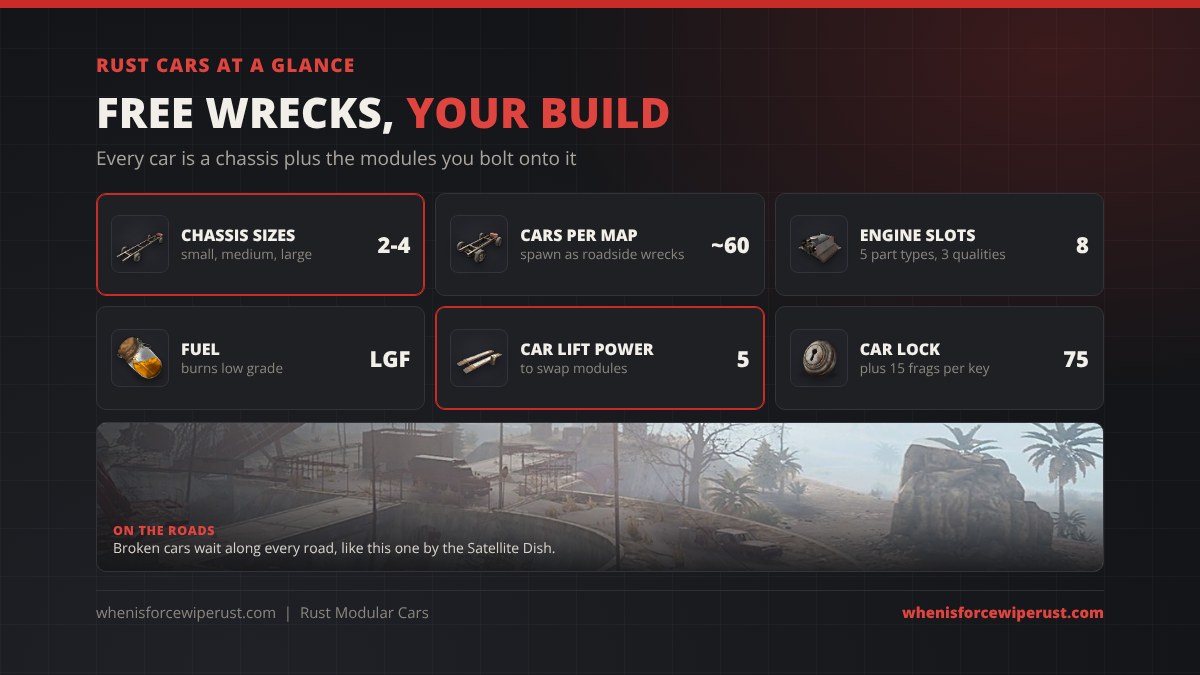
Rust cars are modular. Every car on the map is a bare chassis with wheels plus a row of modules bolted on top: a cockpit, an engine, seats, storage, a camper, a fuel tank. You find them broken down along the roads, repair them with a hammer, fill the engine with parts, pour in low grade fuel and drive away. No scrap needed.
Then the real game starts: swapping modules on a car lift, upgrading engine parts, locking the car so nobody steals it, and, since the Power Trip update, using it as a tanker to haul crude from the Dome. This guide covers all of it, with the module list, engine part tiers, car lift recipe and the builds that actually work.
- What They Are
- Chassis
- Modules
- Engine Parts
- How to Get a Car
- Car Lift
- Locks and Keys
- Tanker and the Dome
- Best Builds
- Tips
- FAQ
What Are Modular Cars in Rust?
Facepunch added modular cars in the vehicles update of summer 2020, and they replaced the old fixed roadside cars. Instead of one car model, you get a frame with sockets and a set of modules that click into those sockets. Each module is its own part of the car, with its own health. The chassis itself is just wheels and a frame. Everything that matters, from seats to health to storage, comes from the modules.
That makes every car different. One wreck might be a two seat runabout with a cockpit and an engine. The next might be a four socket camper van with beds and a barbecue. Once you own a car lift, you can rebuild any of them into whatever you want.
Cars sit alongside the rest of the land vehicles in our Rust vehicles guide. They are slower than a minicopter and less nimble than a horse, but nothing else on land carries as many people or as much loot.
Rust Car Chassis Sizes
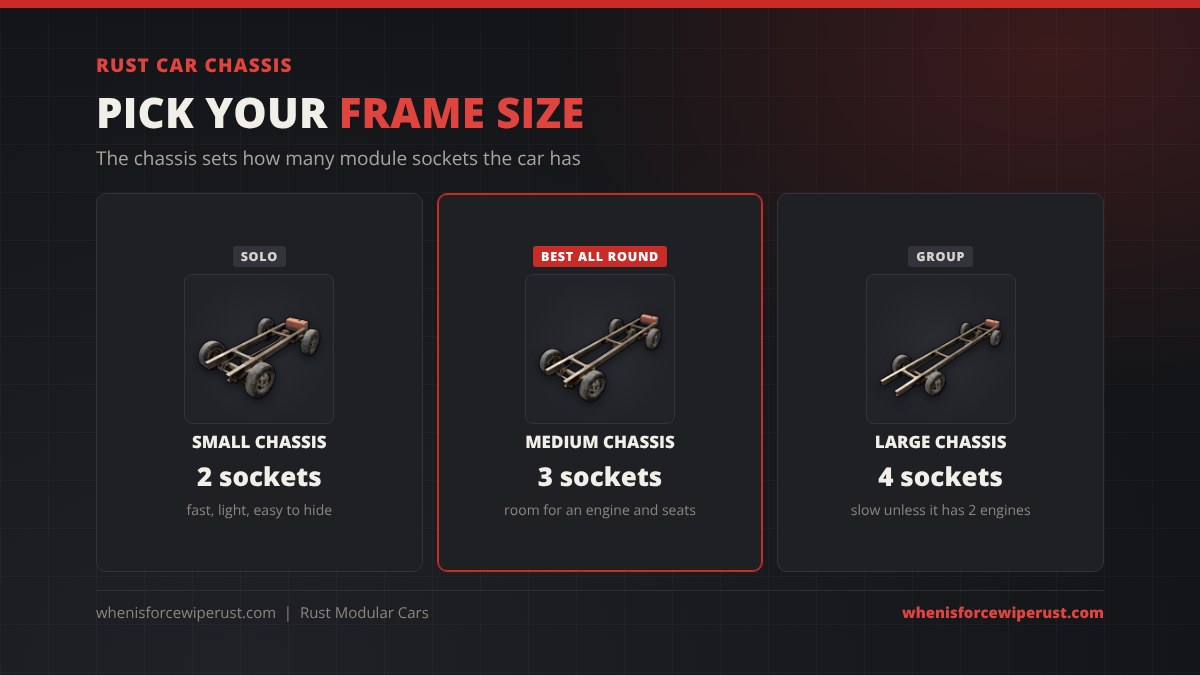
| Chassis | Sockets | Good for |
|---|---|---|
| Small | 2 | Solo players. A cockpit with engine plus one more module. Fast, light and easy to hide. |
| Medium | 3 | Duos and trios. Cockpit with engine, seats and storage. The best all rounder. |
| Large | 4 | Groups and campers. Slow with one engine, so fit two engine modules. |
You cannot craft a chassis. You get one by finding a car on the road. Wrecks of every size spawn, so if you want a specific size, keep driving until you find it. The shortnames are in our Rust item IDs list (2module.car, 3module.car and 4module.car) if you run a server.
Every Rust Vehicle Module
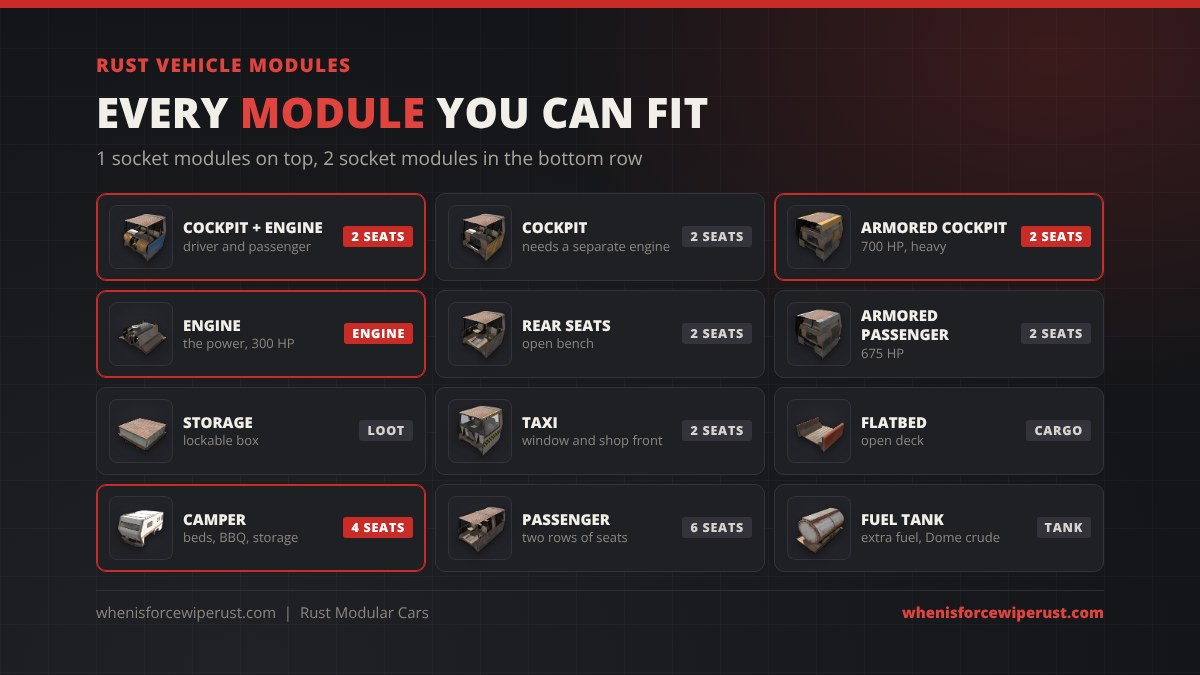
Every car needs a cockpit (somewhere to drive from) and at least one engine. After that, it is up to you.
| Module | Sockets | What it does |
|---|---|---|
| Cockpit With Engine | 1 | Driver seat, passenger seat and a built in engine. The most useful module in the game. |
| Cockpit | 1 | Driver and passenger, no engine. Needs a separate engine module. |
| Armored Cockpit | 1 | 2 seats with armor plating and about 700 HP. Heavy, so it slows the car down. |
| Engine | 1 | A full engine, about 300 HP. Two of them make a large car usable. |
| Rear Seats | 1 | 2 extra open seats. |
| Armored Passenger | 1 | 2 armored seats, about 675 HP. |
| Storage | 1 | A lockable storage box for loot runs. |
| Taxi | 1 | 2 seats, a front window and a shop front to sell from, plus 12 storage slots. |
| Flatbed | 1 | An open deck. Players can ride standing on it. |
| Camper | 2 | 4 seats, sleeping bags you can respawn at, a barbecue, a locker and storage. A base on wheels. |
| Passenger | 2 | Two rows of seats, 6 seats in total. The group bus. |
| Large Flatbed | 2 | A longer open deck. |
| Fuel Tank | 2 | Extra fuel storage, and the tanker you need for the Dome crude pumps. |
Rust Engine Parts
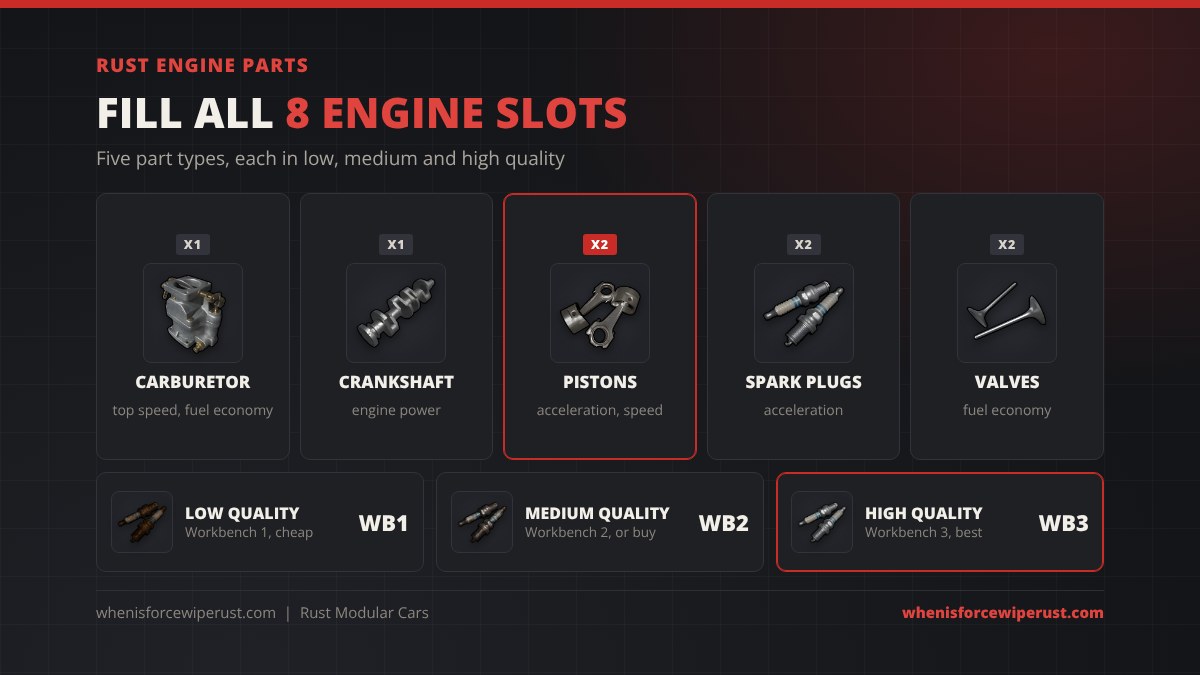
Every engine, in an Engine module or a Cockpit With Engine, has eight slots. Cars spawn with an empty engine, so this is the part you have to sort out.
| Part | Per engine | What it improves |
|---|---|---|
| Carburetor | 1 | Top speed and fuel economy |
| Crankshaft | 1 | Engine power |
| Pistons | 2 | Acceleration and top speed |
| Spark Plugs | 2 | Acceleration |
| Valves | 2 | Fuel economy |
Each part comes in three qualities. Low quality parts craft at a Workbench 1 for about 25 metal fragments. Medium quality parts craft at a Workbench 2, and the vehicle parts vendor at Bandit Camp sells them for scrap. High quality parts craft at a Workbench 3 for about 120 metal fragments. Spark plugs show the gap well: low quality gives 70% of full acceleration, medium 85% and high 100%.
You also loot engine parts from roadside barrels, crates and gas stations, and you can learn the blueprints at a Research Table. Parts wear down as you drive. Low quality ones wear out first. Repair them at a repair bench instead of throwing them away.
How to Get a Car in Rust
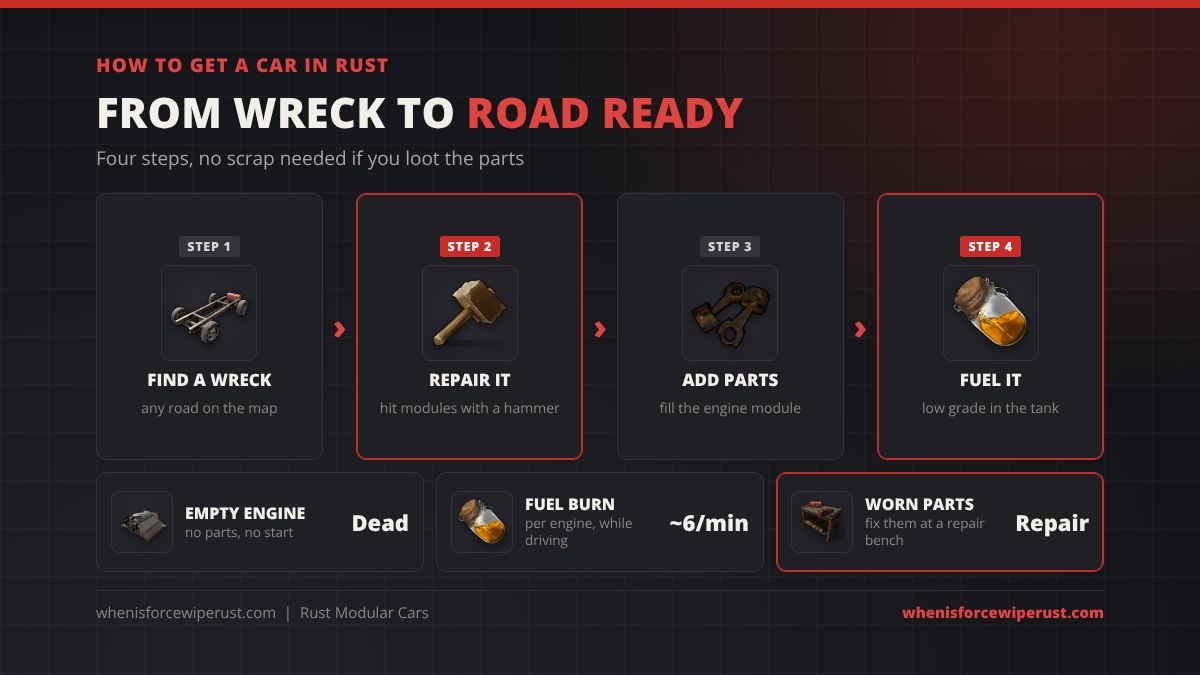
- Find a wreck. Drive or run along any road. Cars spawn heavily damaged, with no fuel and no engine parts.
- Repair it. Hit each module with a hammer. Repairs cost a few metal fragments. A module at zero health is destroyed, and a car with every module destroyed is gone for good.
- Fill the engine. Open the engine module and drop in a carburetor, crankshaft, two pistons, two spark plugs and two valves. Any quality works.
- Add fuel. Put low grade fuel in the fuel tank. An engine burns about 6 low grade a minute while driving, so 100 low grade gets you plenty of trips.
Then press E on the cockpit to get in. W and S drive, A and D steer, and since the Breach and Clear update of 3 September 2026 the handbrake lets you drift and take hairpins properly (see our Breach and Clear notes).
Modular Car Lift
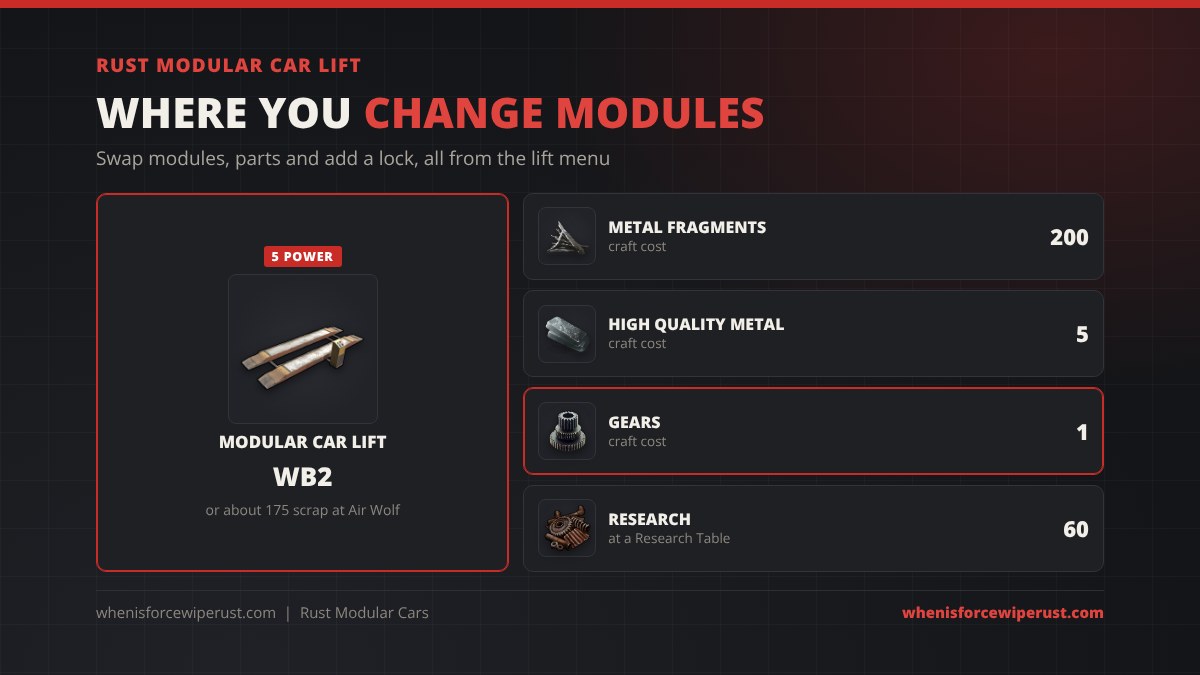
The Modular Car Lift is how you change a car. Drive onto it, open the menu, and you can add, remove and swap modules, move engine parts, add a lock and make keys.
| Stat | Value |
|---|---|
| Workbench | Level 2 |
| Recipe | 200 metal fragments, 5 high quality metal, 1 gear |
| Research | 60 scrap at a Research Table |
| Power | 5 power |
| Buy it | About 175 scrap at the Air Wolf vendor in Bandit Camp |
| Space | A 6 by 3 foundation area that a car can drive onto |
No lift yet? Use a public one. The Junkyard has one next to the shredder, the Ferry Terminal has one beside its recycler, and since the Power Trip update Oxum’s Gas Station has a working lift once the Power Plant grid reaches phase 1. At home, put your lift behind a garage door so the car is inside your base.
Rust Car Locks and Keys

Any car without a lock can be driven off by anyone. To lock yours, drive it onto a car lift and pick Add Lock for 75 metal fragments. Then Create Key for 15 metal fragments per key, one for each teammate. You can add a note to each key so you know which car it opens.
The lock covers the seats, storage and fuel, so nobody can drive it, loot it or drain it without a key. Lost the key? Drive back onto a lift and make a new one. A lock does not stop damage, though. Raiders can still shoot the car apart, which is why it belongs indoors. Cars left outside also decay over time, see Rust decay.
Cars as Tankers: the Dome Crude Pumps
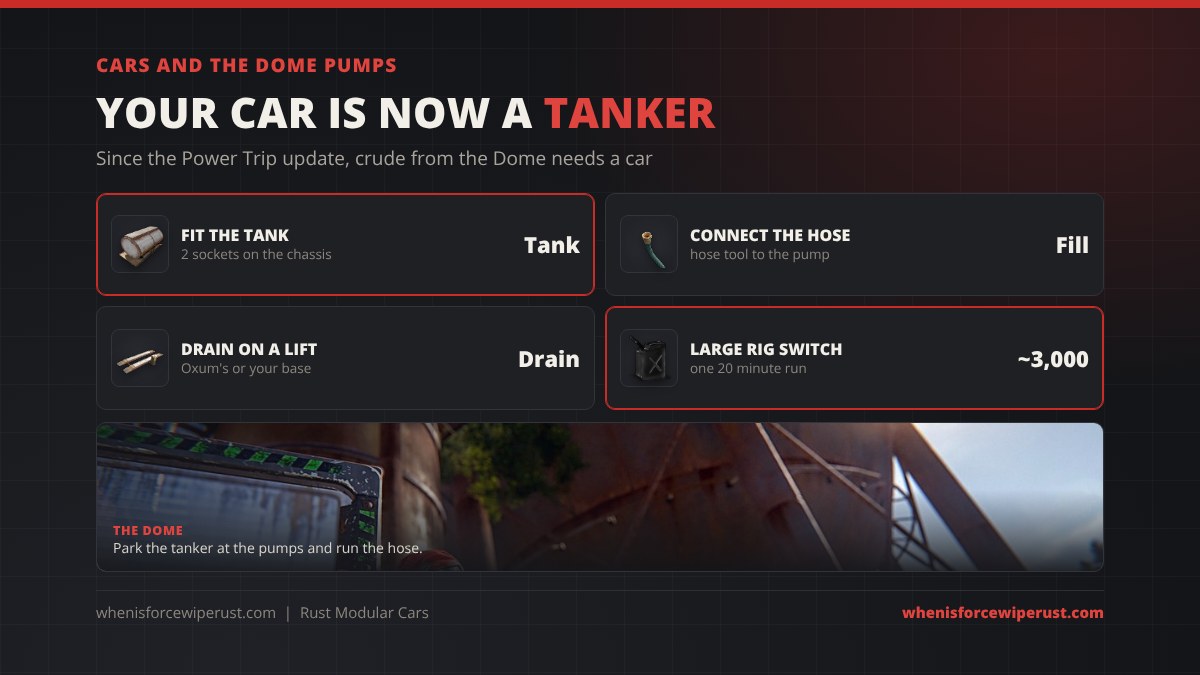
The Power Trip update of 6 August 2026 gave cars a new job. When the Power Plant grid reaches phase 3, a switch in the Large Oil Rig card room starts the crude pumps at the Dome for 20 minutes. You drive a car with a tank module to the pumps, connect it with the hose tool, fill it, then drain it on a car lift.
The Large rig switch gives about 3,000 crude, the Small rig about 1,500, and both together about 4,500. That is around 9,000 low grade fuel once it is refined. The full breakdown is in our crude oil guide.
Best Rust Car Builds
| Build | Modules | Use |
|---|---|---|
| Solo runner | Cockpit With Engine + Storage (small) | Fast loot runs and road farming |
| Duo all rounder | Cockpit With Engine + Rear Seats + Storage (medium) | Monument runs for 2 to 4 players |
| Armored raider | Armored Cockpit + Engine + Armored Passenger (medium) | Drive through fire, about 1,700 HP of modules |
| Group bus | Cockpit With Engine + Engine + Passenger (large) | Moving 8 players at once |
| Camper van | Cockpit With Engine + Engine + Camper (large) | A mobile respawn point with beds and cooking |
| Tanker | Cockpit With Engine + Engine + Fuel Tank (large) | Dome crude runs |
Rust Car Tips
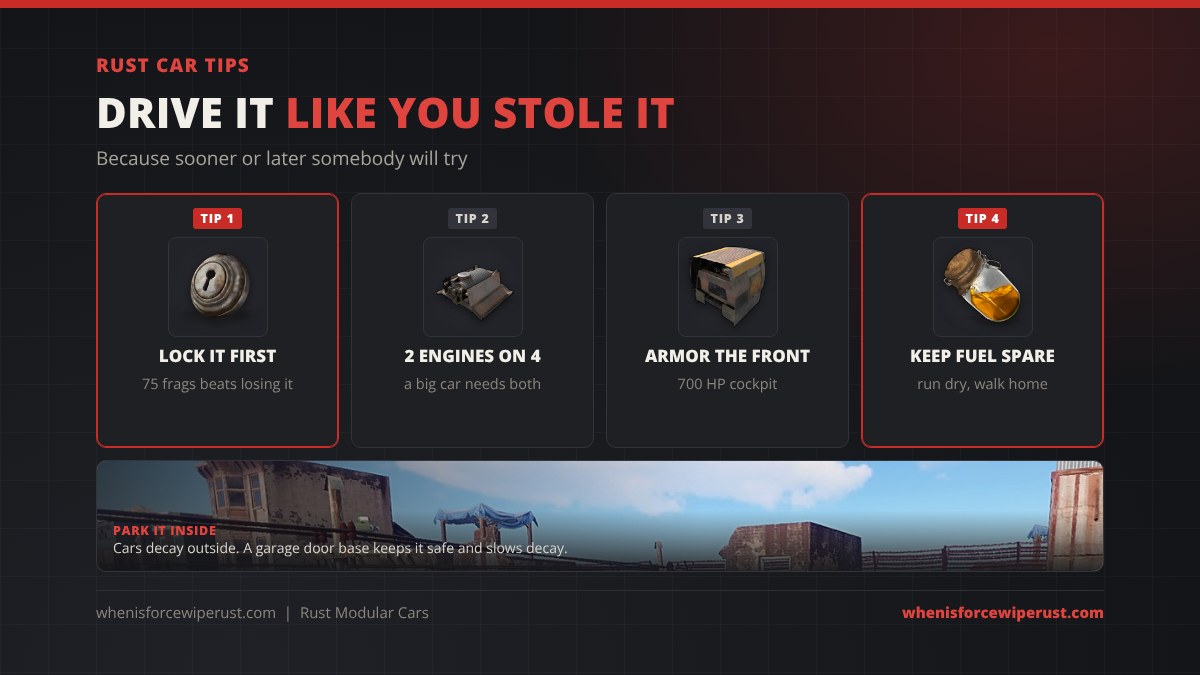
- Lock it before anything else. 75 metal fragments is nothing next to losing the car and everything in it.
- Two engines on a big car. One engine on a four socket chassis is painfully slow on hills.
- Carry a hammer. Fix modules after every fight before they hit zero.
- Keep spare low grade in the car. Running dry far from home means walking back.
- Upgrade parts slowly. Low quality parts drive fine. Save high quality parts for the car you actually keep.
- Park it inside. A garage door and a car lift at home keep the car safe and slow its decay.
- Scrap the leftovers. The Junkyard shredder and magnet crane turn cars you do not want into scrap. More ways to earn it are in our Rust scrap guide.
- It all goes at wipe. Cars, lifts and parts are gone after a force wipe. Check the force wipe countdown before you spend big.
Rust Cars FAQ
How do you get a car in Rust?
Find a broken modular car on any road, repair every module with a hammer, fill the engine with a carburetor, crankshaft, two pistons, two spark plugs and two valves, then add low grade fuel. No scrap is needed.
Can you buy a car in Rust?
No vendor sells a full car. Cars spawn as free wrecks along the roads. You can buy medium quality engine parts and a Modular Car Lift (about 175 scrap) at Bandit Camp.
What engine parts does a Rust car need?
Each engine has 8 slots: 1 carburetor, 1 crankshaft, 2 pistons, 2 spark plugs and 2 valves. Parts come in low, medium and high quality, crafted at Workbench 1, 2 and 3.
How much power does a car lift need in Rust?
5 power. It crafts at Workbench 2 for 200 metal fragments, 5 high quality metal and 1 gear.
How do you lock a car in Rust?
Drive it onto a Modular Car Lift and add a lock for 75 metal fragments, then create keys for 15 metal fragments each. The lock stops anyone without a key from driving, looting or draining the car.
What fuel do cars use in Rust?
Low grade fuel. An engine burns about 6 low grade a minute while driving. Diesel does not work in cars.
Where are the public car lifts in Rust?
The Junkyard, the Ferry Terminal and Oxum’s Gas Station. The gas station lift only works once the Power Plant grid reaches phase 1.
How many cars spawn in Rust?
About 60 on a normal map. When a car is fully destroyed, a new wreck spawns somewhere else on the roads.