
Every base in Rust starts at a stone ore node. Those plain grey boulders scattered over every biome are where your first stone tools, your first stone walls and most of your Tool Cupboard upkeep come from, and you will hit hundreds of them before the next force wipe.
This stone node Rust guide covers exactly how many stones a node gives with every tool, how long each tool takes, how the glowing hotspot works, where stone nodes spawn, how to tell them apart from metal and sulfur nodes, and how to get more out of each one with Ore Tea.
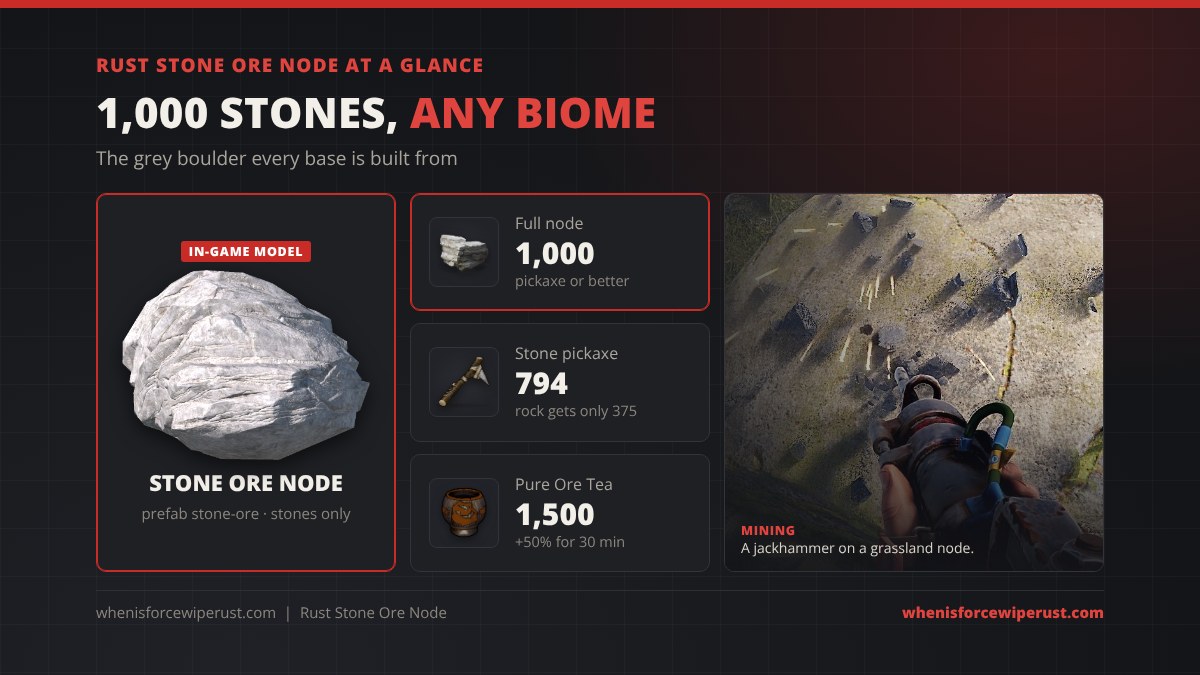
What Is a Stone Ore Node in Rust?
A stone ore node is a large harvestable boulder. The game describes it as “a large stone node, one of the most important resources. Must be mined with a tool to obtain stone.” Hitting it with any gathering tool puts stones straight into your inventory, and when the node runs dry it crumbles and disappears.
In the game files the world node is the stone-ore prefab. There are three versions of it, one for temperate ground (ores/stone-ore), one for the desert (ores_sand/stone-ore) and one for snow (ores_snow/stone-ore), plus a monument version called ore_stone. All of them hold the same stone. If you want the raw IDs, our Rust prefab list has every node prefab.
Stone nodes give stones and nothing else. That is the big difference from a metal node, which drops metal ore plus a little high quality metal ore, and a sulfur node. Stones also need no smelting, so they go straight from the node into your walls.
How Many Stones Does a Stone Node Give?
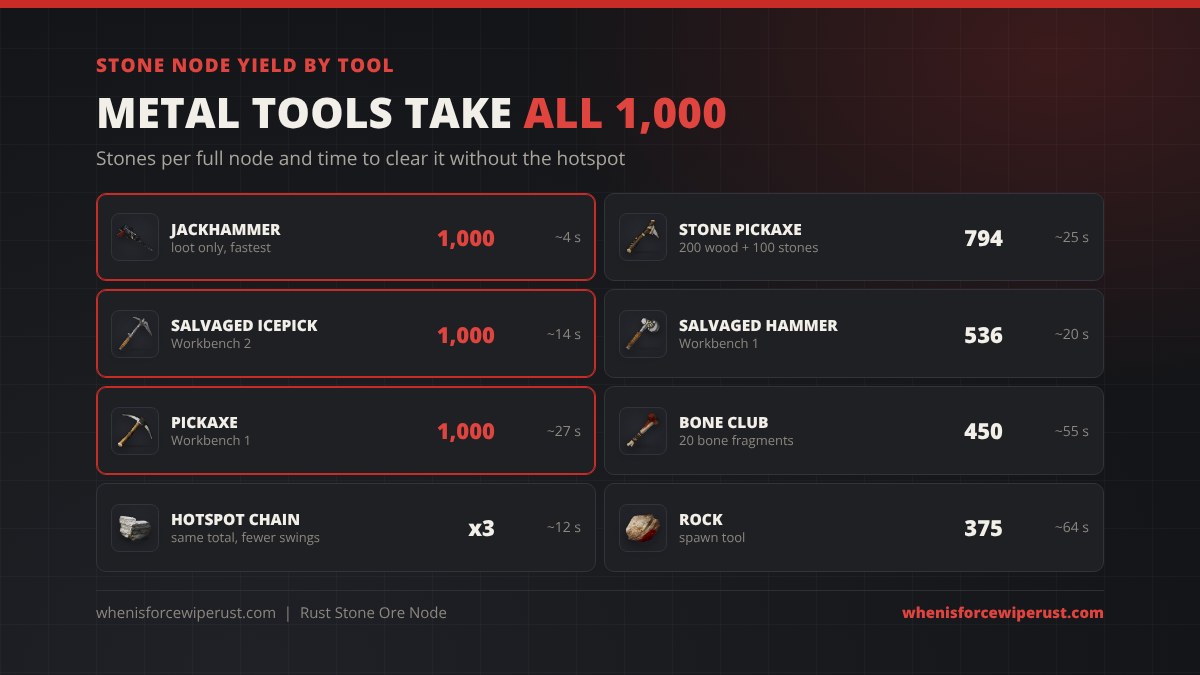
A node holds a fixed amount of stone, but how much of it you actually get depends on the tool. Every tool has a gather efficiency, and weak tools break the node before they have pulled out all of its stone. These are the current numbers for a full node, along with how long a player takes to clear it without and with the hotspot:
| Tool | Stones per node | Time to clear | Time on hotspots |
|---|---|---|---|
| Jackhammer | 1,000 | ~4 s | ~3 s |
| Salvaged Icepick | 1,000 | ~14 s | ~8 s |
| Pickaxe | 1,000 | ~27 s | ~12 s |
| Stone Pickaxe | ~794 | ~25 s | ~11 s |
| Salvaged Hammer | ~536 | ~20 s | ~9 s |
| Bone Club | ~450 | ~55 s | ~20 s |
| Rock | ~375 | ~64 s | ~25 s |
The takeaway is simple. The Stone Pickaxe is the first big jump: it costs 200 wood and 100 stones, needs no workbench and is known from spawn, and more than doubles what a rock gets out of the same node. The Pickaxe (100 wood and 125 metal fragments at a Workbench 1) is the cheapest tool that empties a node completely, and after that you are only paying for speed. The jackhammer clears a node in a few seconds, which matters more than it sounds when you are standing still in the open with a full inventory.
Admins who just want stone can skip the node entirely. This F1 command gives a full node’s worth:
inventory.give stones 1000Our Rust admin commands list covers every other give and spawn command.
How the Stone Node Hotspot Works
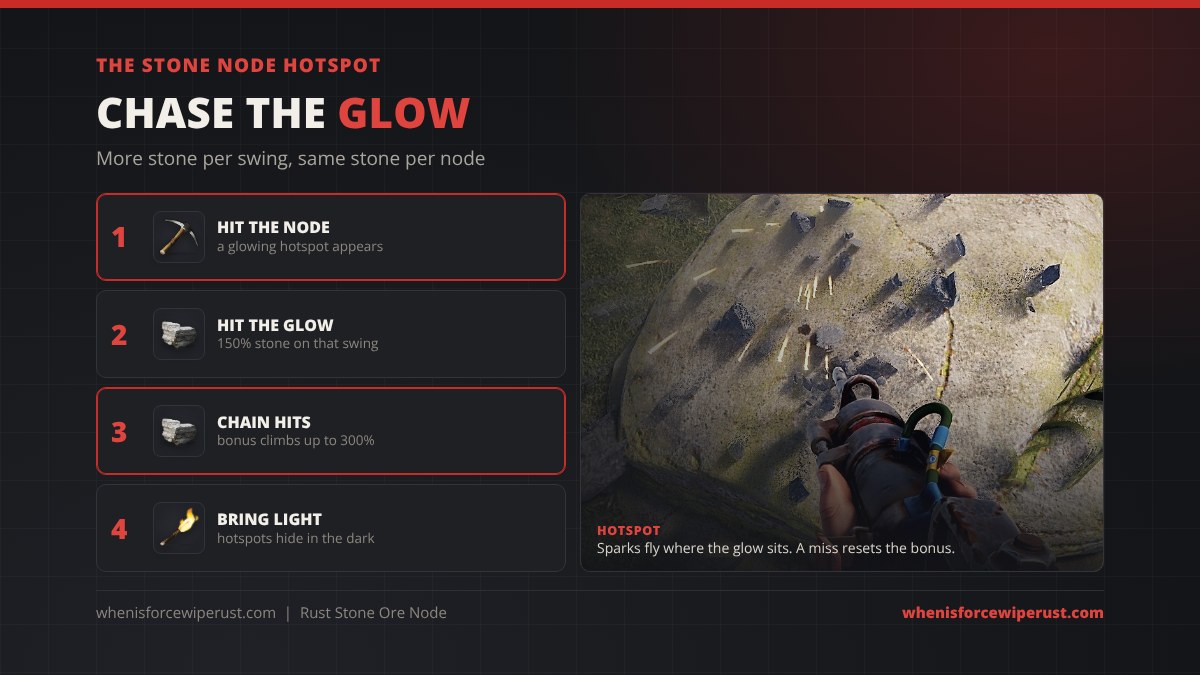
As you hit a node, a glowing hotspot appears on its surface. Hit it and that swing gives 150% of the normal amount. Keep landing consecutive hits on the hotspot as it moves and the bonus climbs up to 300%. Miss once and it resets.
Two things trip people up:
- The node does not hold more. The hotspot gives more stone per swing, so the node breaks in fewer hits. You get the same 1,000 stones, just in about half the time with a Pickaxe.
- You need light to see it. The hotspot only shows up in sunlight or artificial light. At night, hold a torch or a flashlight, or you will be swinging blind and losing the bonus.
Trees work the same way with a red X instead of a glow. Our Rust beginner’s guide covers both tricks for your first hour on a fresh map.
Where to Find Stone Nodes in Rust
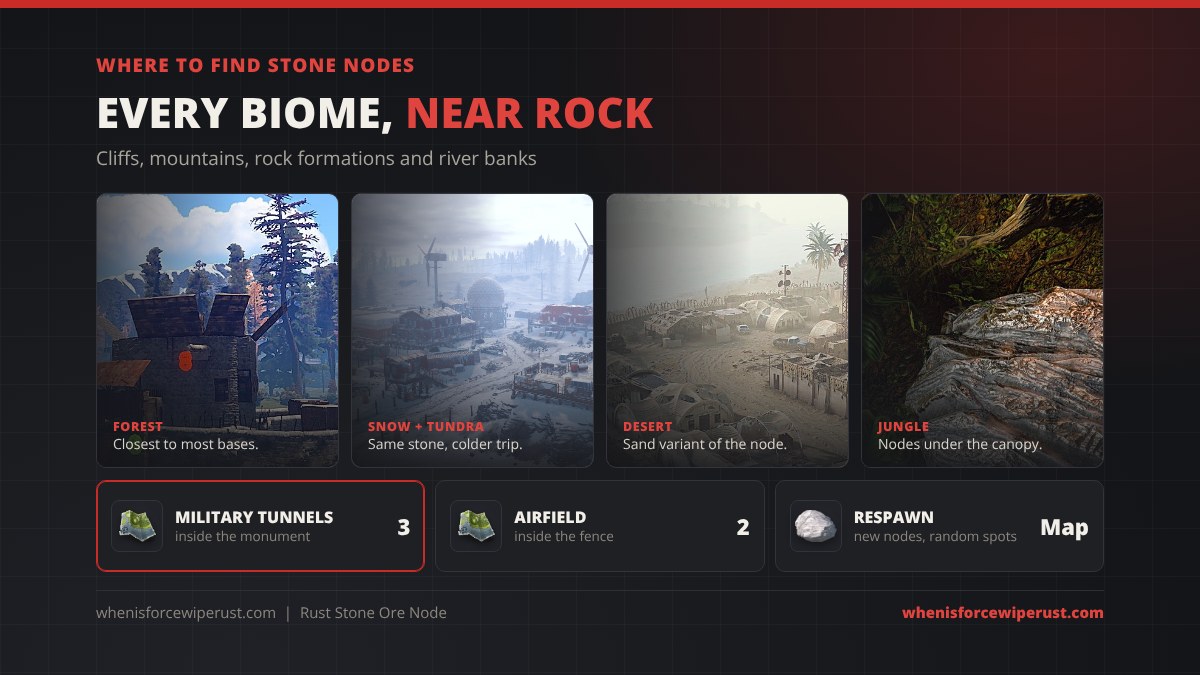
Stone nodes are the most common node in Rust. They spawn in all five biomes, forest (temperate), snow, tundra, desert and jungle, and they cluster where the terrain gets rocky: cliff edges, mountain slopes, rock formations and river banks. You will also find a handful in open fields as random clutter.
A few monuments have their own nodes inside the fence. Military Tunnels has three and the Airfield has two, which is handy if you are already there for loot. Tropical islands off the coast often carry a few as well.
Mined nodes do not come back on a timer in the same spot. The server keeps a target population of ore nodes for the whole map and slowly spawns new ones at random valid places as the count drops, which is why a heavily farmed area near a big clan base stays empty for a while. If your local hills are bare, move along the coast or up the next mountain rather than waiting.
Stone Node vs Metal Node vs Sulfur Node
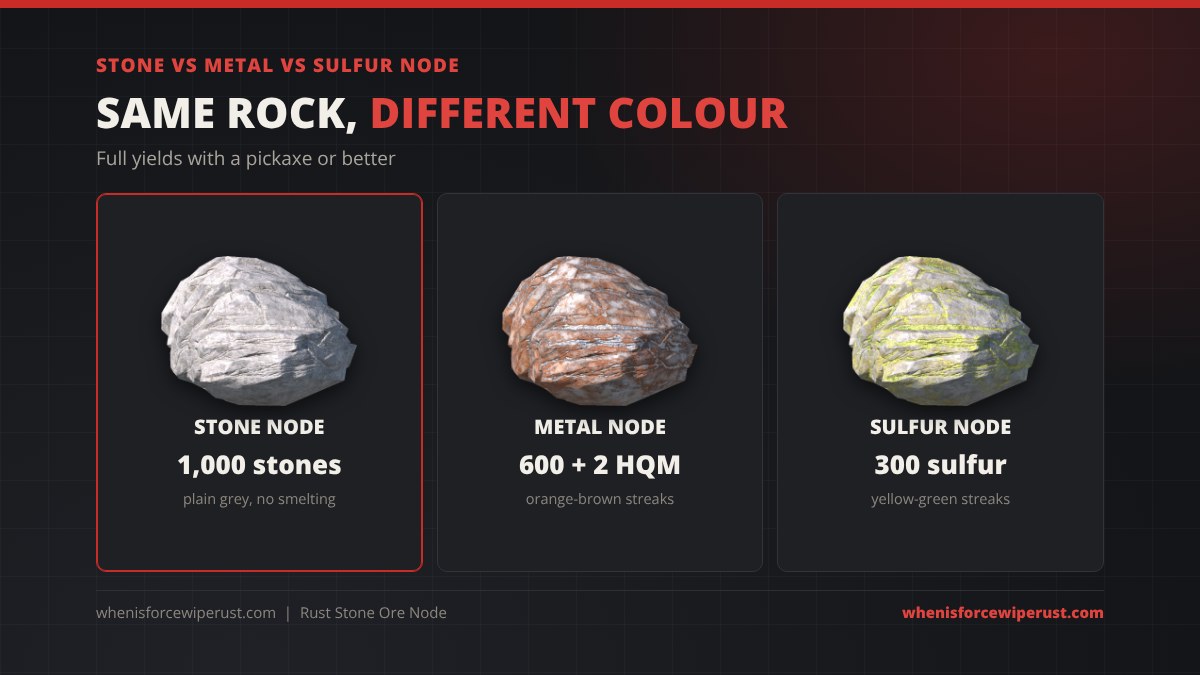
All three ore nodes share the same boulder model, so from a distance they look alike. Up close the colour gives it away:
| Node | Looks like | Full yield (Pickaxe or better) | Smelting |
|---|---|---|---|
| Stone node | Plain grey, pale streaks | 1,000 Stones | None needed |
| Metal node | Orange-brown, rusty streaks | 600 Metal Ore + 2 HQM Ore | Furnace into metal fragments |
| Sulfur node | Yellow-green streaks | 300 Sulfur Ore | Furnace into sulfur, 1:1 |
| HQM node | Special node, rare | High quality metal ore | Furnace into HQM |
Stone is the one you need most in raw numbers. A single stone wall costs 300 stones, a foundation 300 and a floor 150, so a small 2×2 base eats several nodes before you even count doors and upkeep. Metal and sulfur are worth more per node, which is why most players farm stone near home and save the long trips for sulfur.
How to Get More Stone From Every Node
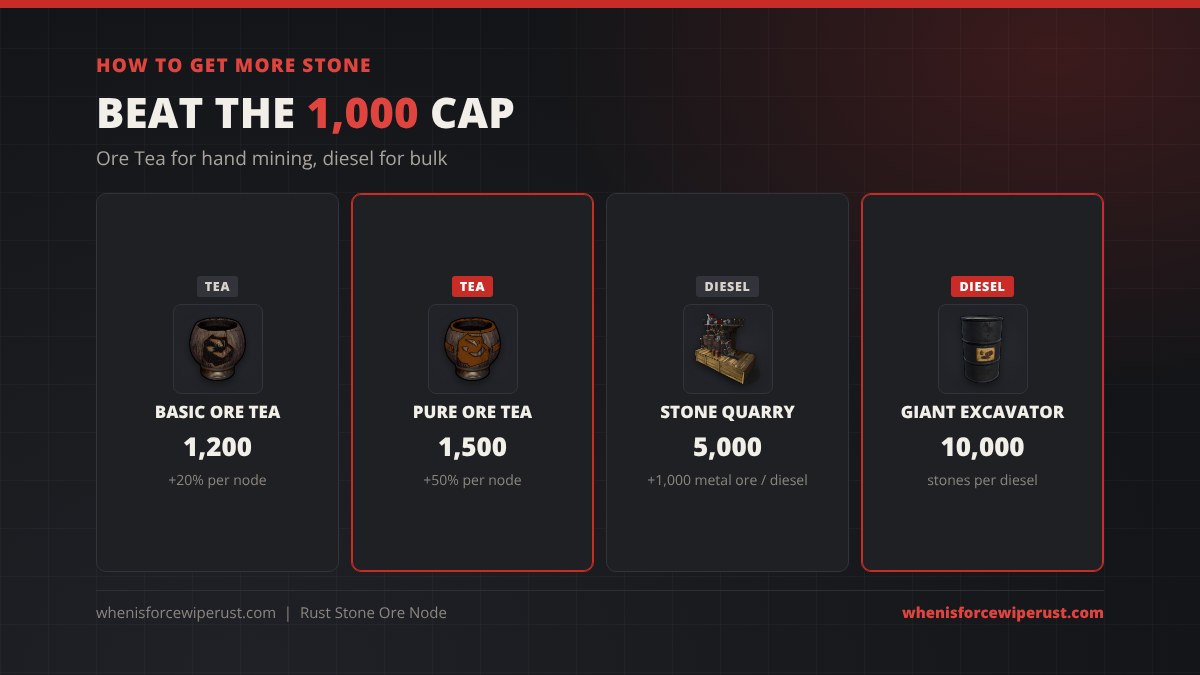
The node itself is fixed at 1,000 stones, but there are three ways to beat that number:
- Ore Tea. Basic adds 20%, Advanced 35% and Pure 50% to everything you mine for 30 minutes, stone included. With a Pure Ore Tea and a Pickaxe a stone node gives 1,500 stones. Brew it at a Mixing Table before a big build session.
- Stone Quarry. The monument quarry turns one diesel into 5,000 stones plus 1,000 metal ore, five nodes’ worth of stone with no swinging.
- Giant Excavator. Set to stone, it gives 10,000 stones per diesel. That is the best bulk source in the game if your group can hold it.
Other small sources are loose stones on the ground (50 each, only worth grabbing in the first minutes of a wipe), recycling stone items, trading at the Outpost and the few stones a survey charge pops out of the ground. Our stones guide compares every one of them.
Stone Node Farming Tips
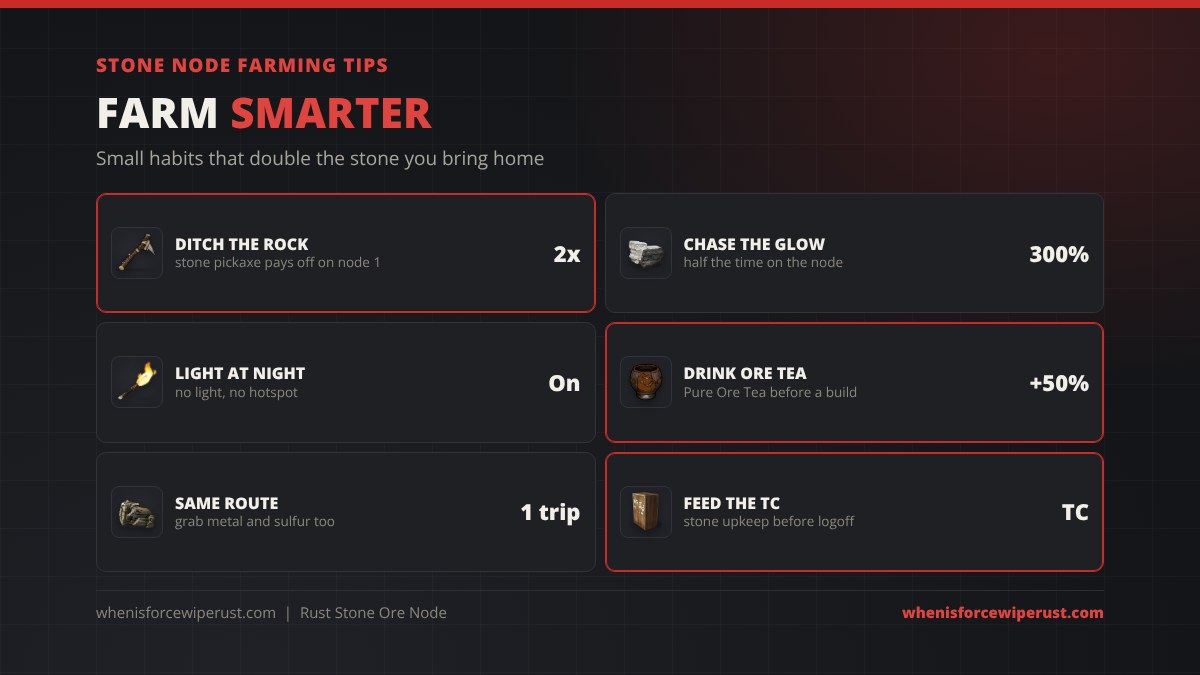
- Ditch the rock straight away. A rock leaves more than 60% of the node in the ground. 200 wood and 100 stones for a Stone Pickaxe pays for itself on the first node.
- Always chase the hotspot. It halves your time on the node, and less time standing still is fewer deaths.
- Carry a light at night. No light means no visible hotspot and no bonus.
- Farm close to home. Stone is heavy on volume and cheap to replace, so mine the nodes around your base and run back often instead of filling a whole inventory far away.
- Grab metal and sulfur on the same route. It is the same tool and the same trip.
- Feed the Tool Cupboard before you log off. Stone upkeep scales with your base and your group size, so check our upkeep calculator and fill the TC for the night.
- Time your big stone build. There is no point stacking 50,000 stones the day before a map reset, so check when the next force wipe is first.
Stone Ore Node FAQ
How many stones are in a stone node in Rust?
A full stone node gives 1,000 stones with a Pickaxe, Salvaged Icepick or Jackhammer. A Stone Pickaxe gets about 794, a Salvaged Hammer about 536, a Bone Club about 450 and a Rock only about 375.
What is the best tool to mine stone nodes in Rust?
The Jackhammer is the fastest and clears a node in a few seconds. The Salvaged Icepick is next. The Pickaxe (Workbench 1) is the cheapest tool that still gets all 1,000 stones.
Does hitting the hotspot give more stone?
It gives more per swing, 150% per hit and up to 300% when you chain hits, but the node’s total stays the same. You get the stone faster, not more of it.
Do stone nodes give metal or HQM in Rust?
No. Stone nodes only give stones. Metal ore and high quality metal ore come from metal nodes, which have orange-brown streaks.
Where do stone nodes spawn in Rust?
Everywhere: forest, snow, tundra, desert and jungle biomes, mostly along cliffs, mountains and rock formations. Military Tunnels has three nodes inside and the Airfield has two.
Do stone nodes respawn in Rust?
Yes, but not in the same spot on a set timer. The server keeps a target number of ore nodes on the map and spawns new ones at random places as players mine them out.
How do you tell a stone node from a sulfur node?
A stone node is plain grey with pale streaks. A sulfur node has yellow-green streaks and a metal node has orange-brown, rusty streaks. The shape is the same.
Does Ore Tea work on stone nodes?
Yes. Ore Tea boosts stone as well as metal and sulfur: +20% Basic, +35% Advanced and +50% Pure for 30 minutes. With a Pure Ore Tea a full node gives 1,500 stones.
How long does it take to mine a stone node?
About 27 seconds with a Pickaxe, or around 12 if you keep hitting the hotspot. A Jackhammer takes a few seconds and a Rock more than a minute.