
Rust is brutal for new players. You spawn on a beach with a rock and a torch, nobody explains anything, and the first player you meet will probably kill you for that rock. Most people quit in their first hour because they do not know what to do first, where to go, or why their base vanished overnight.
This Rust beginners guide fixes that. It walks you through your first wipe in the order you actually play it: picking a server, what to craft in the first ten minutes, how to build a starter base that does not get raided by the first passer-by, how scrap and the tech tree work, how to stay alive, and the beginner mistakes that cost new players the most. Every craft cost below comes from the current game item files.
- Pick the Right Server
- What You Spawn With
- First 10 Minutes
- Gathering Resources
- Your First Base
- Scrap, Recyclers and the Tech Tree
- Staying Alive
- Monuments and Safe Zones
- First Hour Plan
- Beginner Mistakes to Avoid
- FAQ
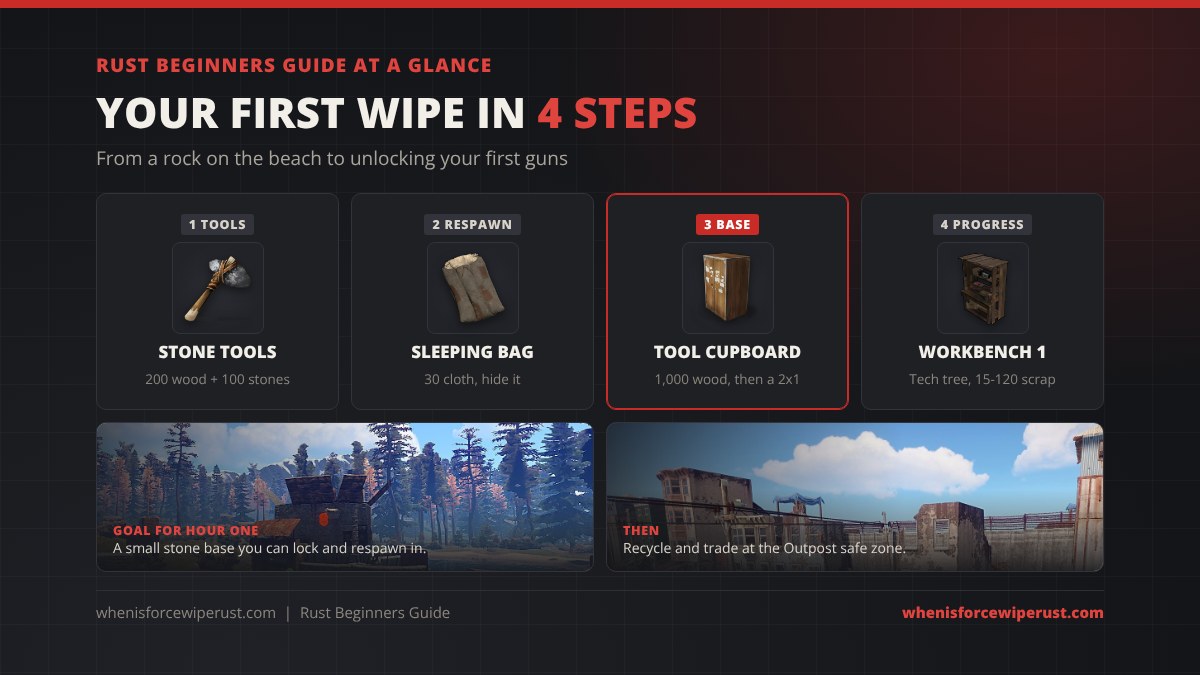
Step 1: Pick the Right Server
The server you pick decides how your first wipe goes more than anything else. A packed official server on wipe day is a meat grinder full of players with thousands of hours. A quieter server lets you actually learn the game.
- Pick a low or medium population server. 50 to 150 players is plenty. Fewer people means fewer fights while you learn. Our Rust server browser shows live player counts and wipe dates.
- Look for “noob”, “beginner” or “newbie” in the name. Many community servers ban players over a set number of hours or add PvE zones. Our server types guide explains official, community, modded, PvE and the difference between vanilla and 2x or 3x gather rates.
- Join close to the wipe. On a fresh map everyone starts with nothing, so you are not up against players in full metal armor on day one. See just wiped servers and the server wipe schedules.
- Know the force wipe. Every server wipes its map on the monthly force wipe, the first Thursday of every month. Starting a few days after it is a good balance between a fresh map and a calmer server.
- Small groups help. Solo is the hardest way to play. A team of 2 or 3 friends can share farming and watch each other’s backs. Our Rust teams and clans guide covers team limits and how to make a team.
What You Spawn With in Rust
Every fresh spawn gets the same kit: a rock and a torch. You wake up on or near a beach with no clothes. The Rock is your first tool and first weapon. Hit trees for wood and stone nodes for stone and ore. The torch gives light at night and keeps you a little warmer.
If you are new, Rust may also offer you Tutorial Island. Facepunch added it in March 2024: a private island where a guide NPC takes you through movement, crafting, building, looting, cooking, furnaces and the workbench in about half an hour. New players are asked to play it when they join a server that has it turned on, and anyone can start it from the options menu. It is worth doing once, because nobody can kill you there.
If you die you respawn on a random beach with the same rock and torch, or at a sleeping bag or bed you placed. That is why a sleeping bag is one of the first things you craft.
The First 10 Minutes: What to Craft First

Open your inventory with Tab and the crafting menu with Q. Everything below is known by default and crafts by hand, no workbench needed. Grab hemp for cloth as you go (the tall green plants), and smash every barrel you pass.
| Item | Cost | Why you want it |
|---|---|---|
| Stone Hatchet | 200 wood, 100 stones | Gathers wood far faster than the rock |
| Stone Pickaxe | 200 wood, 100 stones | Mines stone, metal and sulfur ore |
| Wooden Spear | 300 wood | Cheap melee weapon, add 20 stones for a Stone Spear |
| Hunting Bow | 200 wood, 50 cloth | Your first ranged weapon, great for hunting |
| Wooden Arrow (x2) | 25 wood, 10 stones | Ammo for the bow, you can pick most back up |
| Sleeping Bag | 30 cloth | Respawn point, so you do not walk back from the beach |
| Building Plan | 20 wood | Places foundations, walls and floors |
| Hammer | 100 wood | Upgrades, repairs and rotates building parts |
| Bandage | 4 cloth | Stops bleeding and heals a little |
| Burlap Shirt / Trousers | 20 cloth each | Cheap warmth and a little protection |
| Campfire | 100 wood | Cooks meat and keeps you warm at night |
A good order: rock for about 500 wood and 300 stones, then the stone hatchet and pickaxe, then a spear, then a sleeping bag once you have 30 cloth. Put the bag down somewhere hidden before you go any further. The bow comes next once you have 50 cloth. Our Rust crafting calculator adds up costs for anything else you want to make.
Gathering Resources the Smart Way
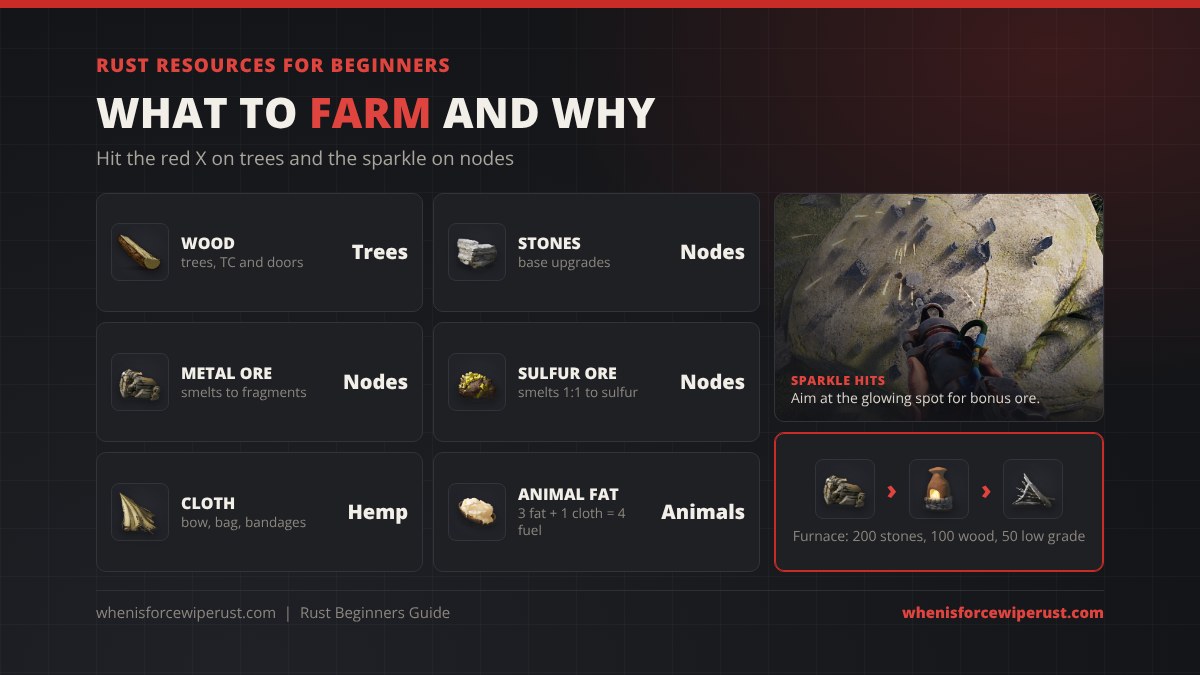
Two tricks double your farming speed. On a tree, aim at the red X that appears after your first hit. On a stone or ore node, aim at the glowing sparkle. Each bonus hit gives more and finishes the node faster.
- Wood: trees. You need lots of it for the Tool Cupboard, doors and twig.
- Stones: plain grey nodes. Your base upgrades eat thousands of them.
- Metal ore: nodes with brown and silver streaks. Smelt it into metal fragments for tools, locks and the workbench.
- Sulfur ore: yellow nodes. Smelts 1:1 into sulfur, which becomes gunpowder, ammo and explosives later.
- Cloth: hemp plants and animals. Needed for the bow, bags, bandages and clothes.
- Animal fat: hunt boars, deer and chickens. 3 fat + 1 cloth makes 4 Low Grade Fuel for your furnace and torch.
Once you have 200 stones, 100 wood and 50 Low Grade Fuel, build a Furnace inside your base. Put wood and ore in, light it, and it turns ore into usable metal while you do other things. The wood also turns into charcoal, which you will need for gunpowder.
Building Your First Base
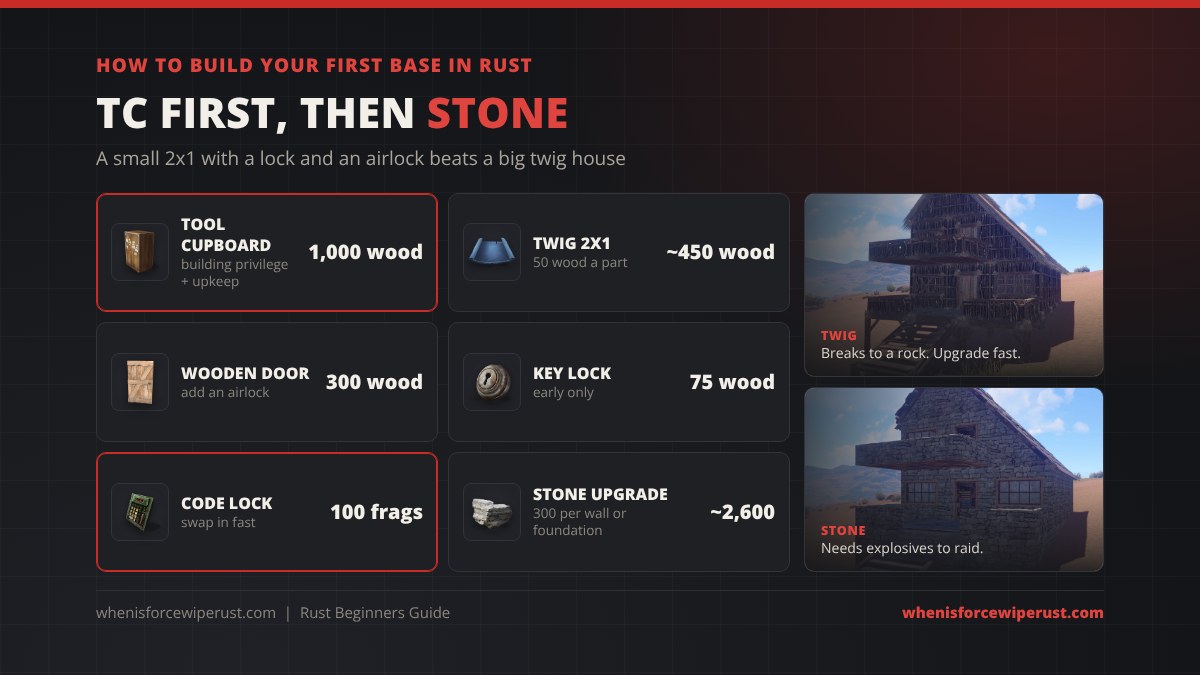
A base is where you store loot, craft, smelt and respawn. Your first one should be small, cheap and quick to upgrade.
- Pick a spot. Close to trees and stone, away from roads and big monuments like the Launch Site or Military Tunnels where geared players roam. A little hidden is better than a great view.
- Lay foundations. Equip the Building Plan, right click to choose a part and place a 2×1 (two foundations). Twig costs 50 wood per foundation or wall.
- Place the Tool Cupboard right away. It costs 1,000 wood and gives you building privilege, which stops other players building in your area and lets you authorize your team.
- Walls, doorway, floor. Close it in with walls, one doorway and a ceiling.
- Door and lock. A Wooden Door costs 300 wood. Add a Key Lock (75 wood) at first, then a Code Lock (100 metal fragments) as soon as you can, because key locks can be stolen with the key.
- Upgrade to stone. Hold the hammer, right click a wall and pick stone. It costs 300 stones per foundation or wall and makes a raid far more expensive. A stone 2×1 costs about 2,600 stones in total.
- Add an airlock. A second door inside the first, so nobody can push in behind you when you open up.
Want a proven layout instead of guessing? Our Rust base designs list ranks the best solo and duo starter bases with video tutorials, and the Rust building guide covers every tier from twig to armored.
Scrap, Recyclers and the Tech Tree
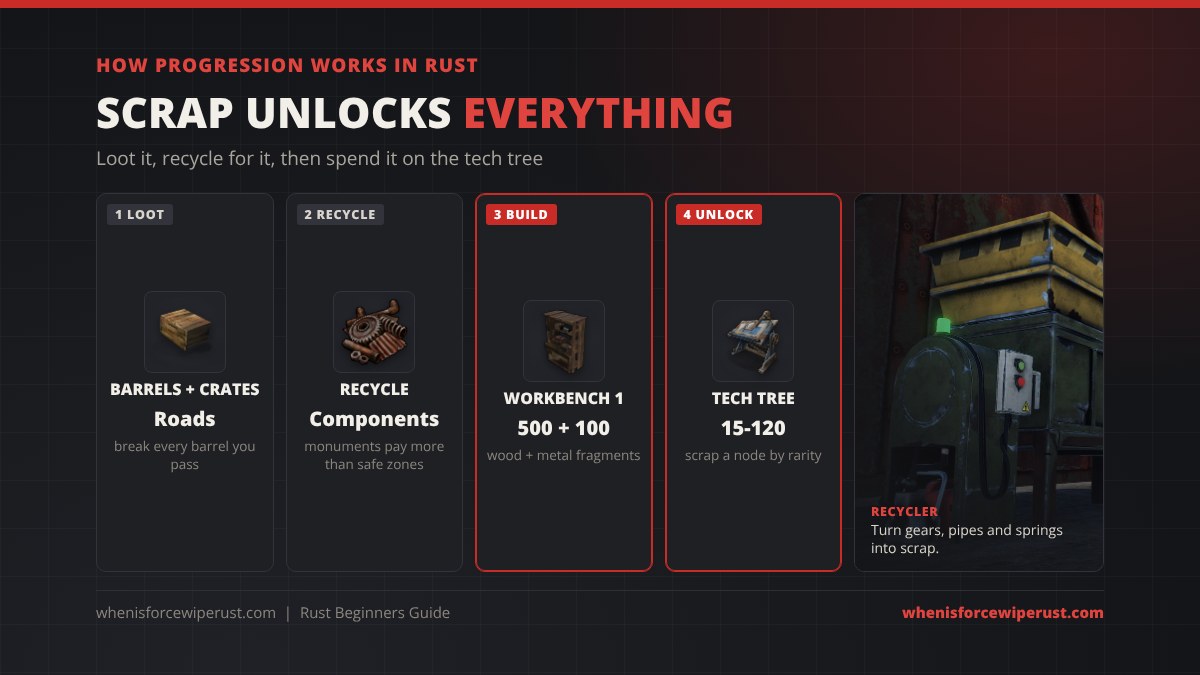
Scrap is how you progress. You get it three ways:
- Barrels and crates. Roads are lined with blue and yellow barrels and brown crates. A road run with a hatchet is the classic way to start a wipe.
- Recycling. Components like gears, pipes and springs turn into scrap and resources in a Recycler. Monument recyclers return more than safe zone ones.
- Selling and trading. Vending machines at Outpost, Bandit Camp and in player shops.
With scrap in hand, build a Workbench Level 1 for 500 wood and 100 metal fragments. Open it and you get the tech tree, where each node costs 1 Blueprint Fragment, Page or Book depending on the workbench tier. If you find an item you have not unlocked, you can also put it in a Research Table (200 metal fragments + 20 scrap, needs a Workbench 1) and learn it for the same price.
Good first unlocks for beginners: the Crossbow (no node needed, crafts at Workbench 1), Revolver, Waterpipe Shotgun, Hatchet and Pickaxe (metal tools gather much faster, a few Blueprint Fragments from an empty tree), and Large Wood Box for storage. Later, a Workbench Level 2 opens the guns most players fight with. Our best weapons tier list shows which ones are worth the scrap.
Staying Alive: Food, Water, Health and Bags
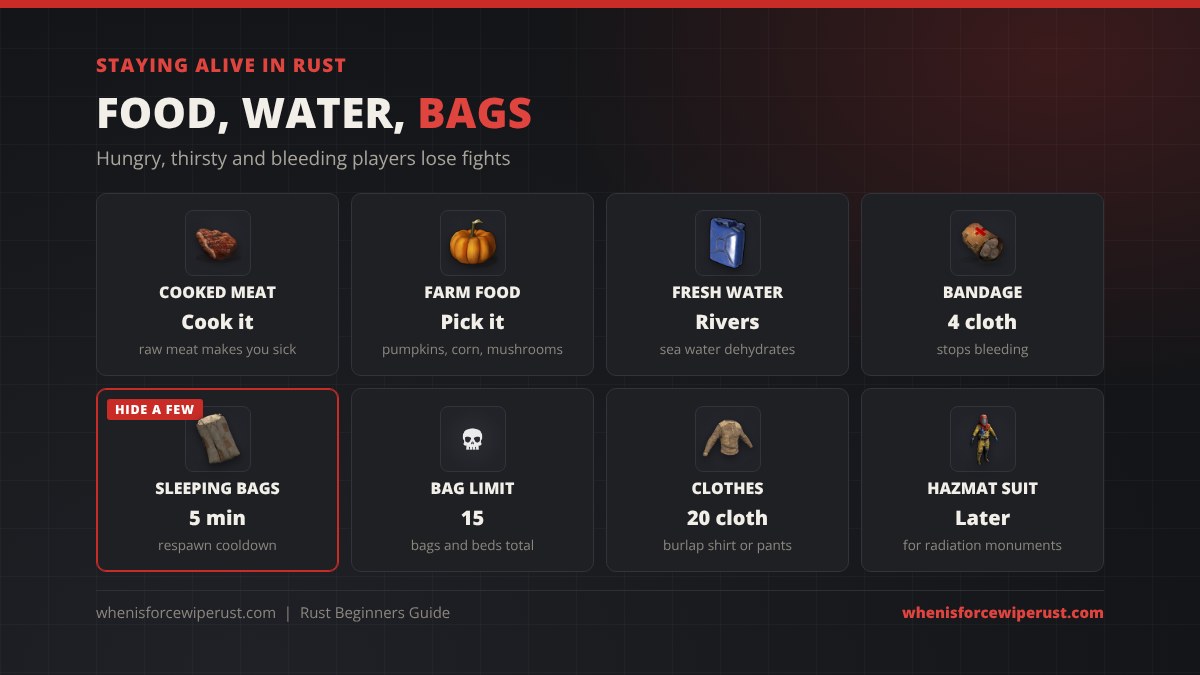
- Food: Your calories drop over time. Kill animals and cook the meat on a campfire (raw meat can make you sick). Mushrooms, corn, pumpkins and canned food from crates all work. See our Rust food guide.
- Water: Drink from rivers and lakes by looking at the water and pressing E. Sea water dehydrates you. Our water guide covers bottles and catchers.
- Health: Bandages (4 cloth) stop bleeding. Later, medical syringes heal fast in a fight.
- Sleeping bags: Each bag has a respawn cooldown of about 5 minutes, and you can have 15 bags and beds in total. Keep one in your base and a few hidden in bushes around the map. Upgrade to a Bed later for a shorter cooldown.
- Cold and heat: Snow and desert biomes punish you without the right clothes. Start in a forest biome if you can (our Rust biomes guide explains all five). Our clothing guide lists what keeps you warm.
Monuments and Safe Zones for Beginners
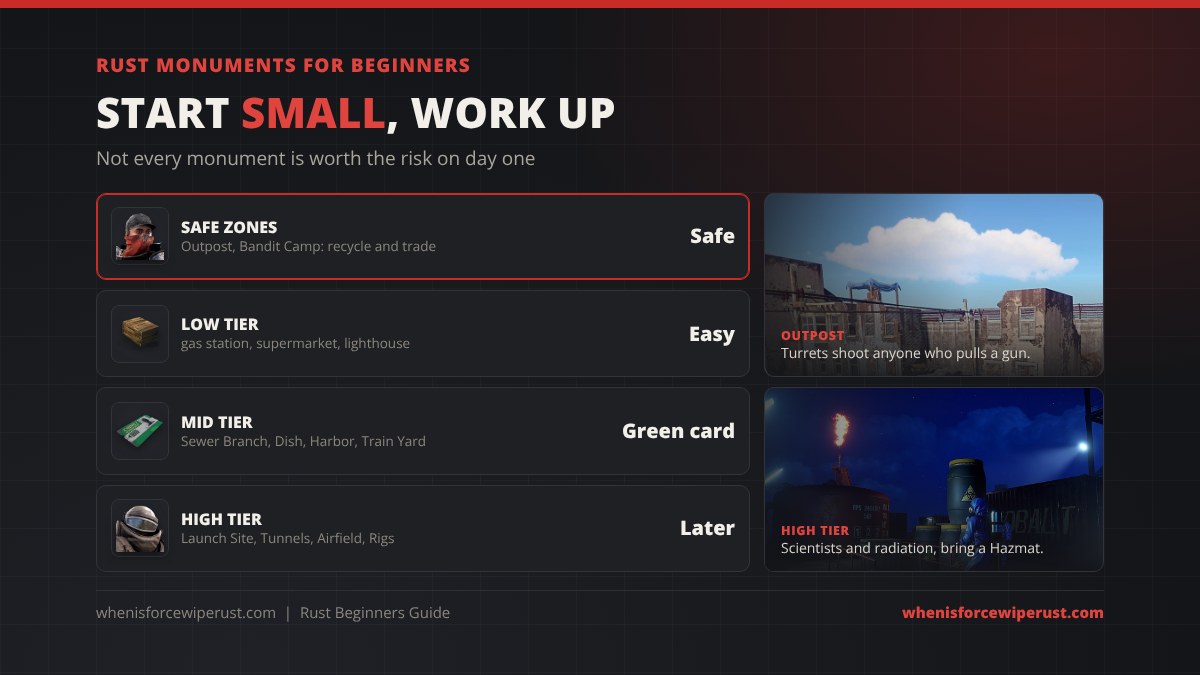
Monuments are the abandoned sites around the map with the best loot. They are not all equal.
- Safe zones: Outpost and Bandit Camp have turrets that shoot anyone who pulls a weapon. They are the safest place to recycle, trade at vending machines and buy basic gear. Players can still wait outside to ambush you on the way out.
- Low tier: gas stations, supermarkets, the Mining Outpost, lighthouses and the Junkyard. Barrels, crates and a recycler with little danger beyond other players.
- Mid tier: Sewer Branch, Satellite Dish, the Harbor, Water Treatment Plant and the Train Yard. These have keycard puzzles that start with a green keycard.
- High tier: Launch Site, Military Tunnels, Airfield and the Oil Rigs. Armed scientists, radiation and geared players. Leave these until you have a Hazmat Suit, a real gun and a teammate.
Your First Hour on a Fresh Wipe
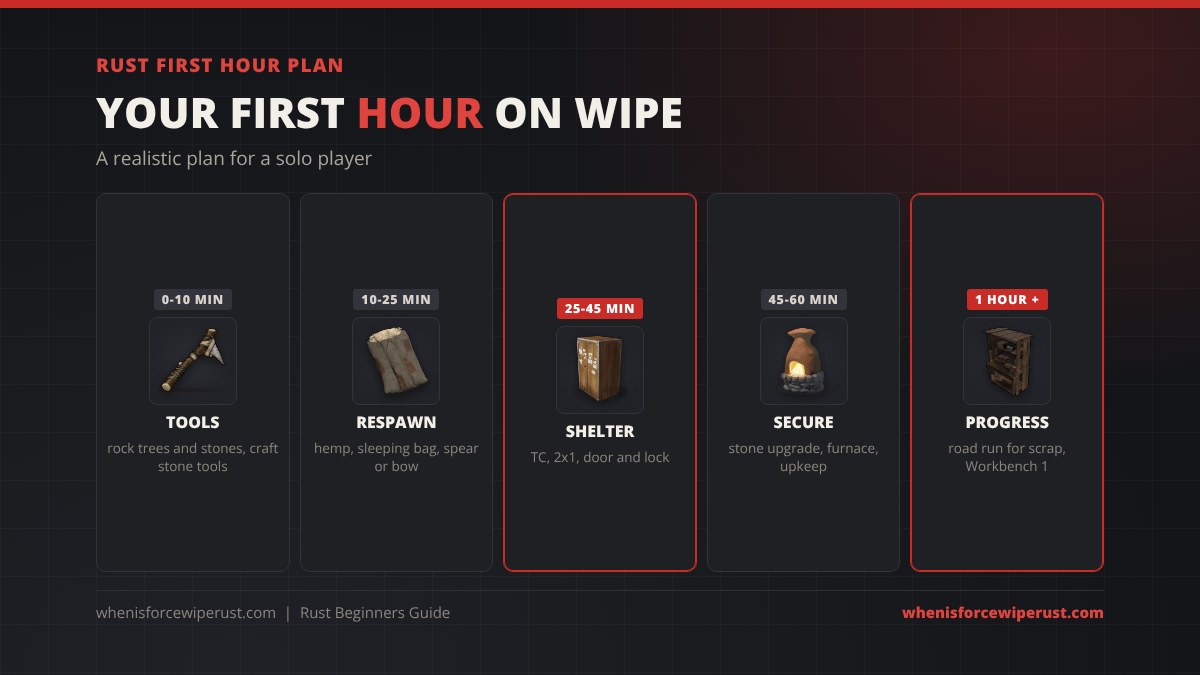
| Time | Goal | What to do |
|---|---|---|
| 0 to 10 min | Tools | Leave the beach, rock trees and stones, craft a stone hatchet and pickaxe |
| 10 to 25 min | Respawn and defence | Collect hemp, craft a sleeping bag and hide it, then a spear or bow |
| 25 to 45 min | Shelter | Farm 1,500+ wood, place a Tool Cupboard, build a 2×1 with a door and lock |
| 45 to 60 min | Secure it | Upgrade to stone, add a furnace, fill the TC with upkeep |
| 1 hour + | Progress | Road run barrels for scrap, build a Workbench 1, unlock your first items |
Do not try to do it all in one trip. Drop off loot at base often. A full inventory of wood and stone is a gift to the next player who sees you.
15 Beginner Mistakes to Avoid
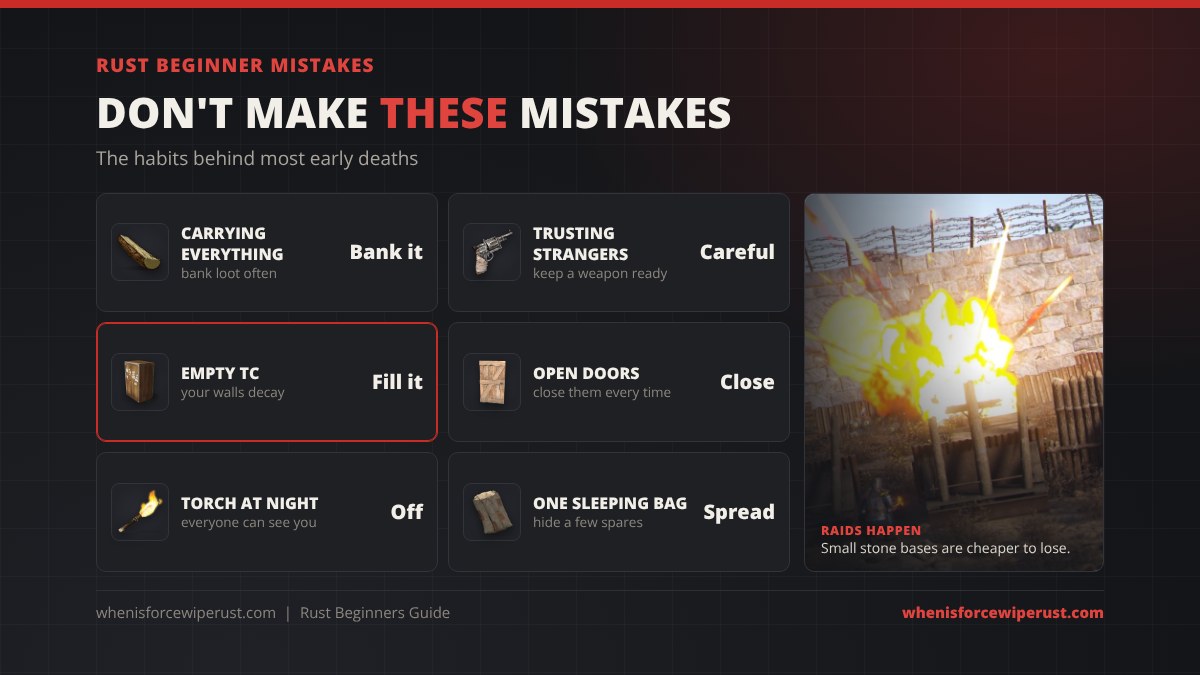
- Carrying everything. Bank your loot. Die with 2,000 sulfur on you once and you will never do it again.
- Trusting “friendly” strangers. Some are friendly. Many are not. Keep your weapon ready and do not let anyone into your base.
- Building next to a monument or road. More traffic means more raids.
- Skipping the Tool Cupboard. Without one, anyone can build on your base and your base has no upkeep.
- Forgetting upkeep. An empty TC means your walls start decaying.
- Leaving the door open. Close it every time, even for ten seconds.
- Staying in twig. Twig breaks to a rock. Upgrade to stone straight away.
- Making a huge base early. Small bases are cheaper to build, upgrade and keep up.
- Holding a torch at night. It shows everyone where you are. Turn it off when you hear footsteps.
- Only one sleeping bag. Spread a few around so one raid does not send you to the beach.
- Eating raw meat. Cook it first.
- Running into high tier monuments. Scientists and radiation will end you without the right gear.
- Ignoring sound. Rust is a game of footsteps and gunshots. Play with headphones.
- Bad settings. A low frame rate gets you killed. Our best Rust settings and console commands guide gets you smooth FPS in a few minutes.
- Taking deaths personally. Everyone dies a lot in Rust. Every death teaches you something, and on wipe day everyone starts from zero again.
Not sure which crates are worth opening? Our Rust loot tables guide lists the scrap and best drops from every container.
Rust Beginners Guide FAQ
What should I do first in Rust?
Leave the beach, use your rock to collect about 500 wood and 300 stones, and craft a stone hatchet and stone pickaxe (200 wood + 100 stones each). Then collect hemp for a 30 cloth sleeping bag and hide it, and craft a spear or bow so you can defend yourself.
What do you spawn with in Rust?
A rock and a torch. You spawn on a random beach with no clothes. If you die you can respawn at a sleeping bag or bed you placed, or on a random beach again with the same rock and torch.
How do I stop my base from being taken in Rust?
Place a Tool Cupboard (1,000 wood) first so nobody else can build in your area, put a lock on every door, upgrade your walls to stone, add an airlock, and keep wood, stone and metal fragments in the Tool Cupboard so the base does not decay.
What is the best starter base in Rust?
A stone 2×1 with a Tool Cupboard inside and an airlock. It costs about 2,600 stones in total, is quick to build and is much harder to raid than twig or wood. Once you have more resources, build around it or move into a bigger design.
How do you get scrap fast in Rust as a beginner?
Run the roads breaking barrels and looting crates, then recycle the components you find at a recycler. Monument recyclers return more than the ones in safe zones like Outpost and Bandit Camp.
Is Rust hard for beginners?
Yes. Rust is one of the hardest survival games to start because other players can kill you and take everything. Playing on a low population or beginner server, starting with a small team and doing Tutorial Island makes it much easier.
What server should a new Rust player join?
A low or medium population server (about 50 to 150 players) that wiped recently, ideally with “noob” or “beginner” in the name or an hour limit for players. Softcore servers are also friendlier because you keep half of each item when you die.
When do Rust servers wipe?
Every server wipes its map on the monthly force wipe, the first Thursday of every month. Many servers also wipe weekly or every two weeks. Blueprints only reset when the server chooses a BP wipe, which most do once a month on force wipe.