
 By
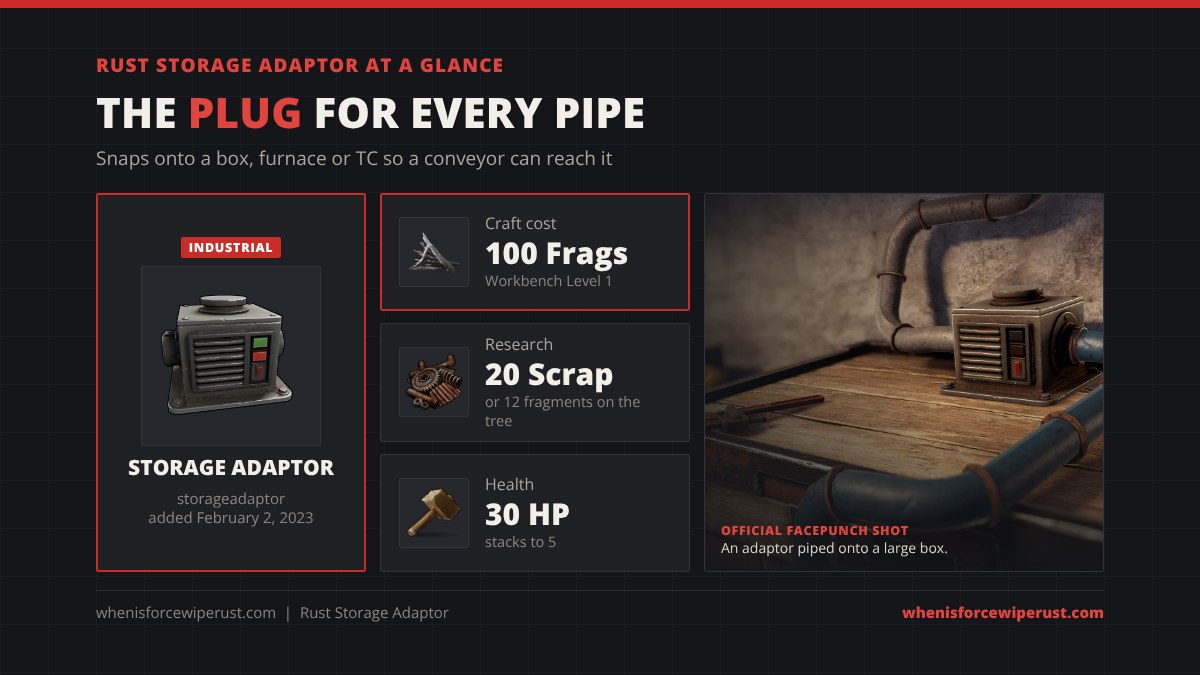
The Storage Adaptor is the small grey box that turns an ordinary container into part of Rust’s industrial system. On its own a large box, furnace or tool cupboard has no way to connect to pipes. Snap an adaptor onto it and it gets an Industrial In and an Industrial Out port, so an Industrial Conveyor can fill it or empty it for you.
This storage adaptor Rust guide covers the exact craft and research cost, where it sits on the Engineering Workbench tech tree, every container it attaches to and how many ports each one has, how to set up your first line, the special rules for furnaces and lockers, the best builds, and how little it takes to break one.
storageadaptor, ID -1049172752) costs 100 Metal Fragments at a Workbench Level 1 and researches for 20 scrap, or 12 Blueprint Fragments in total on the Engineering Workbench tech tree, right after the Electric Furnace. It attaches to boxes, furnaces, the tool cupboard, lockers, refineries, fridges, drop boxes, vending machines and more, giving each one an industrial input and output. A Large Wood Box takes 4 adaptors, a locker 3, a small box 2. You link adaptors to a conveyor with the Pipe Tool and power the conveyor, not the adaptor. It has only 30 HP, stacks to 5 and recycles for 50 to 75 frags.
- What It Does
- Craft & Research
- Supported Containers
- How to Use It
- Special Rules
- Best Builds
- How to Destroy
- Tips
- FAQ
What Does the Storage Adaptor Do in Rust?
The Storage Adaptor arrived on February 2, 2023 in Facepunch’s Industrial Update, together with the Industrial Conveyor, Pipe Tool, Splitter, Combiner, Industrial Crafter and Electric Furnace. Facepunch calls it “the starting point for most of your Industrial plans”: you “simply attach an adaptor to an existing storage entity to make that entity compatible with your Industrial systems.”
In practice it is a plug. Each adaptor has one Industrial In port, which lets items be pushed into the container, and one Industrial Out port, which lets items be pulled out. The adaptor does not move anything itself. The conveyor does the moving, and the adaptor is just the point where the pipe meets the box. Game data also lists a 1 rW power socket with a passthrough on the adaptor, but Facepunch’s own notes say “the adaptor does not require power”. You power the conveyor instead.
Without adaptors, a conveyor has nothing to connect to. The only industrial machine that skips the adaptor is the Industrial Crafter, which has pipe ports built in.
Storage Adaptor Craft Cost and Research
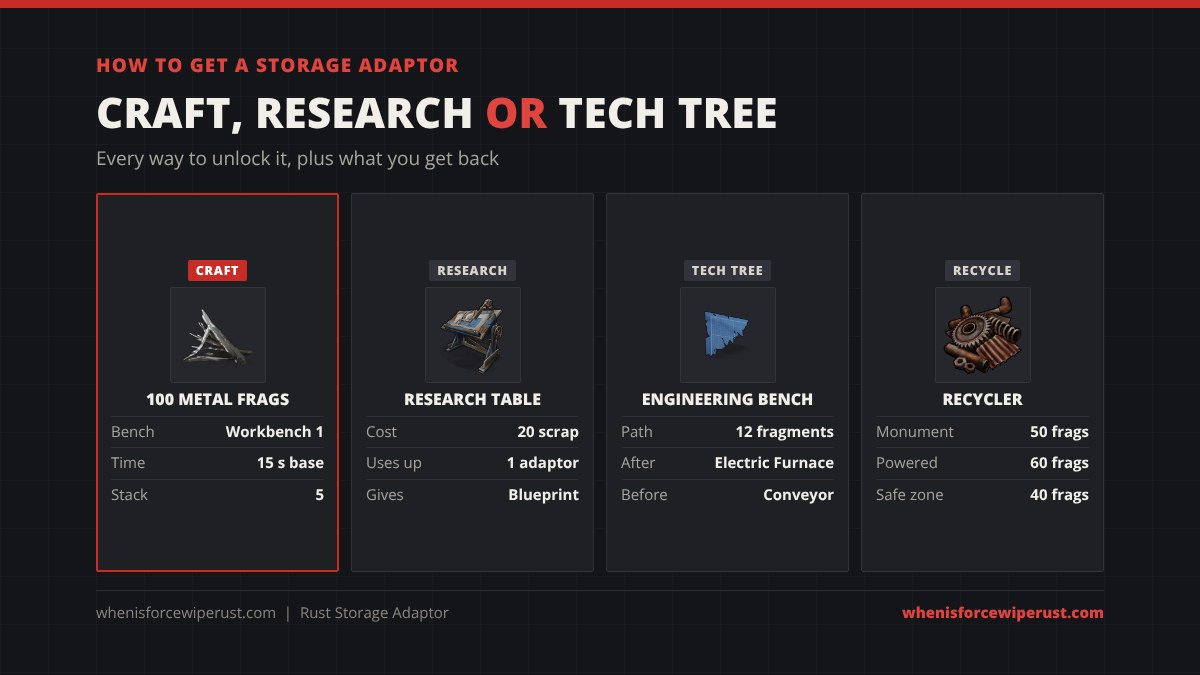
The adaptor is one of the cheapest industrial parts in the game:
| Stat | Value |
|---|---|
| Craft cost | 100 Metal Fragments |
| Workbench | Level 1 |
| Craft time | 15 seconds base, faster at higher workbench tiers |
| Research cost | 20 scrap |
| Tech tree | Engineering Workbench, 12 Blueprint Fragments in total, after the Electric Furnace |
| Health | 30 HP |
| Stack size | 5 |
| Despawn time | 5 minutes |
| Recycle | 50 frags (monument), 60 (powered recycler), 75 (red recycler), 40 (safe zone) |
| Item ID | -1049172752 (shortname storageadaptor) |
Since the Crafting Update moved everything electrical and industrial onto its own bench, the adaptor is unlocked on the Engineering Workbench tech tree. Each node costs 1 Blueprint Fragment since the November 2026 update, and the path from the start to the adaptor adds up to 12. The Electric Furnace comes right before it and the Industrial Conveyor right after it, at 13. If you already have an adaptor in hand, a research table is cheaper: 20 scrap and the adaptor itself.
You will rarely find one in loot. Brown crates drop one 0.4% of the time, underwater advanced crates 1.1%, and most scientists, including tunnel dwellers, about 0.2%. Craft them instead.
What Containers Does the Storage Adaptor Work With?
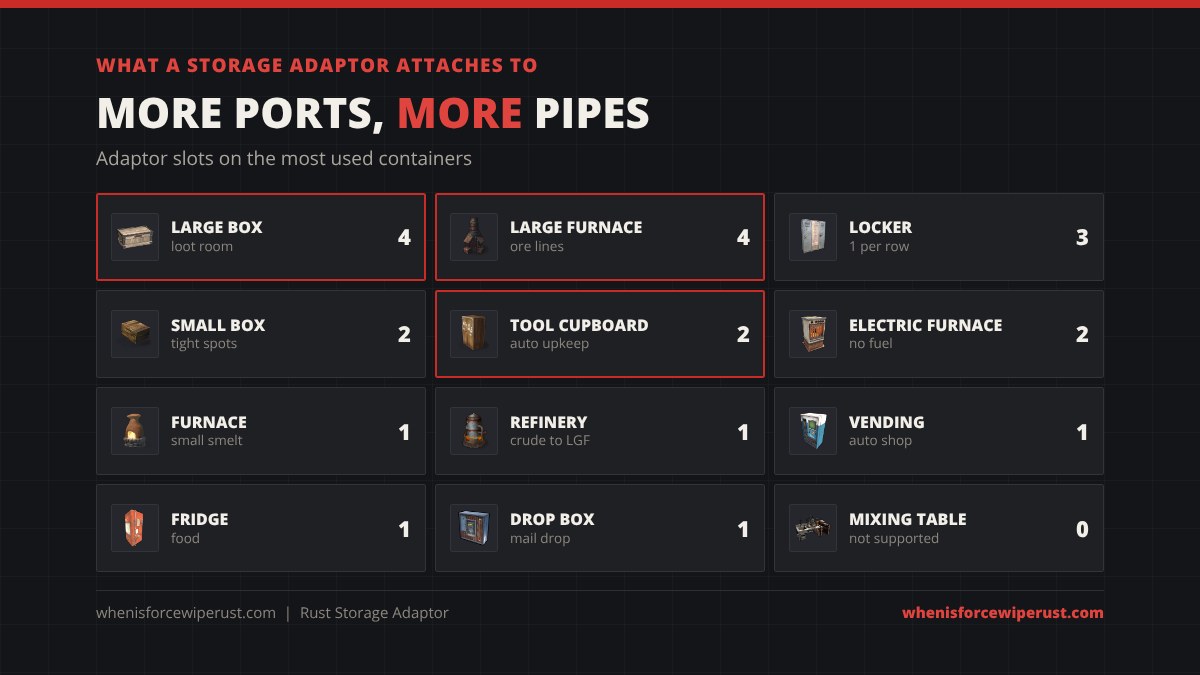
Facepunch’s launch list was the Tool Cupboard, Large and Small Wooden Box, Furnace, Large Furnace, Small Oil Refinery, Electric Furnace, Locker, Fridge, Drop Box and Vending Machine. Later updates added more containers, and current game data also lists the Wall Cabinet, Coffin, Mini Fridge, the vertical and horizontal Storage Barrels, Wicker and Bamboo Barrels, the Industrial Storage Barrels, the Abyss and Krieg storage pieces, the Hitch & Trough and the Industrial Electric Furnace.
Some containers have several adaptor slots, so you can run more than one pipe in or out:
| Container | Adaptor slots | Typical use |
|---|---|---|
| Large Wood Box | 4 | Loot rooms, dump boxes |
| Large Furnace | 4 | Ore lines |
| Locker | 3 | One per loadout row |
| Wood Storage Box | 2 | Small sorted storage |
| Tool Cupboard | 2 | Automatic upkeep |
| Electric Furnace | 2 | Smelting without wood |
| Furnace | 1 | Small smelting |
| Small Oil Refinery | 1 | Crude oil in, low grade out |
| Vending Machine | 1 | Restocking a shop |
| Fridge, Drop Box | 1 | Food storage, mail drops |
| Mixing Table | None | Loaded by hand only |
Workbenches, research tables, repair benches and the mixing table do not take an adaptor. To automate crafting, put an Industrial Crafter on a workbench instead.
How to Use a Storage Adaptor
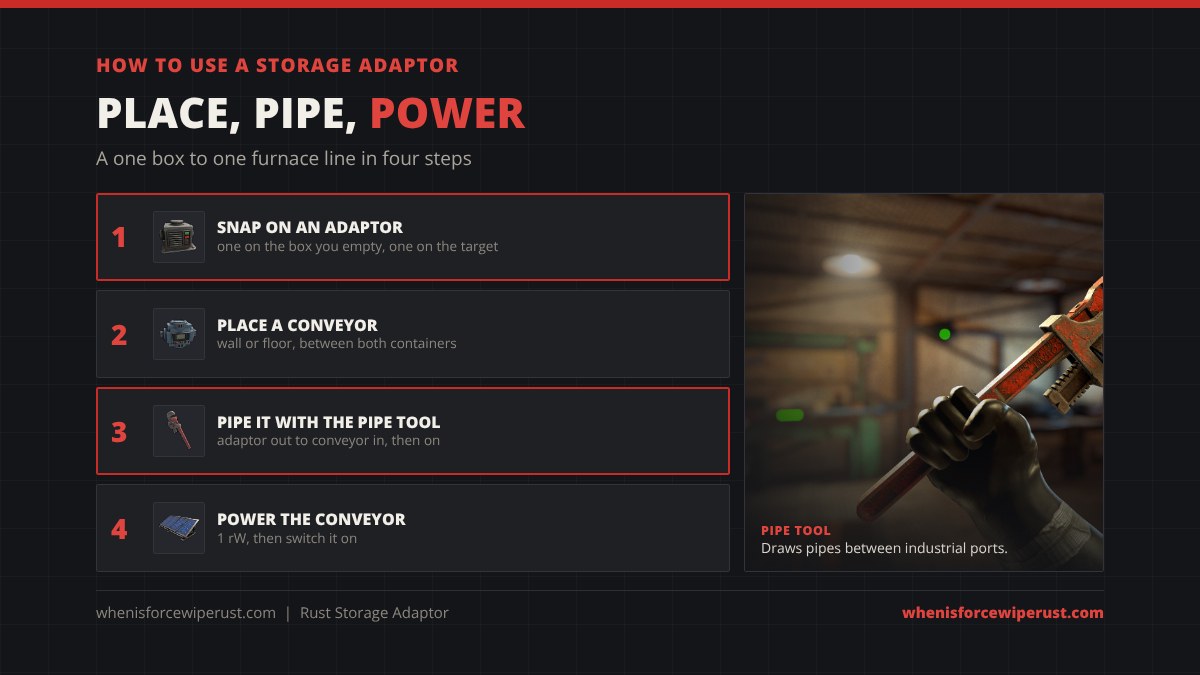
Here is the simplest line, one box feeding one furnace. It costs 275 metal fragments (two adaptors and one conveyor) plus a power source.
- Place the adaptors. Hold the adaptor and look at the container. A ghost shows where it snaps on. Put one on the box you want to empty and one on the furnace you want to fill.
- Place a conveyor. The conveyor goes on a wall or floor near both containers.
- Draw the pipes. With the Pipe Tool (2 high quality metal, known by default), click the Industrial Out on the box’s adaptor, then the conveyor’s input. Then click the conveyor’s output and the Industrial In on the furnace’s adaptor. You can click walls and floors on the way to route a pipe around doors.
- Power the conveyor. Wire 1 rW into the conveyor with the Wire Tool and switch it on. A small solar panel and battery is enough. See our Rust electricity guide for wiring.
Every five seconds the conveyor now pulls items from the box and pushes them into the furnace. Add filters on the conveyor to choose what moves. Our conveyor filter guide explains Min, Max and Buffer.
Storage Adaptor Rules for Furnaces, Lockers and the TC
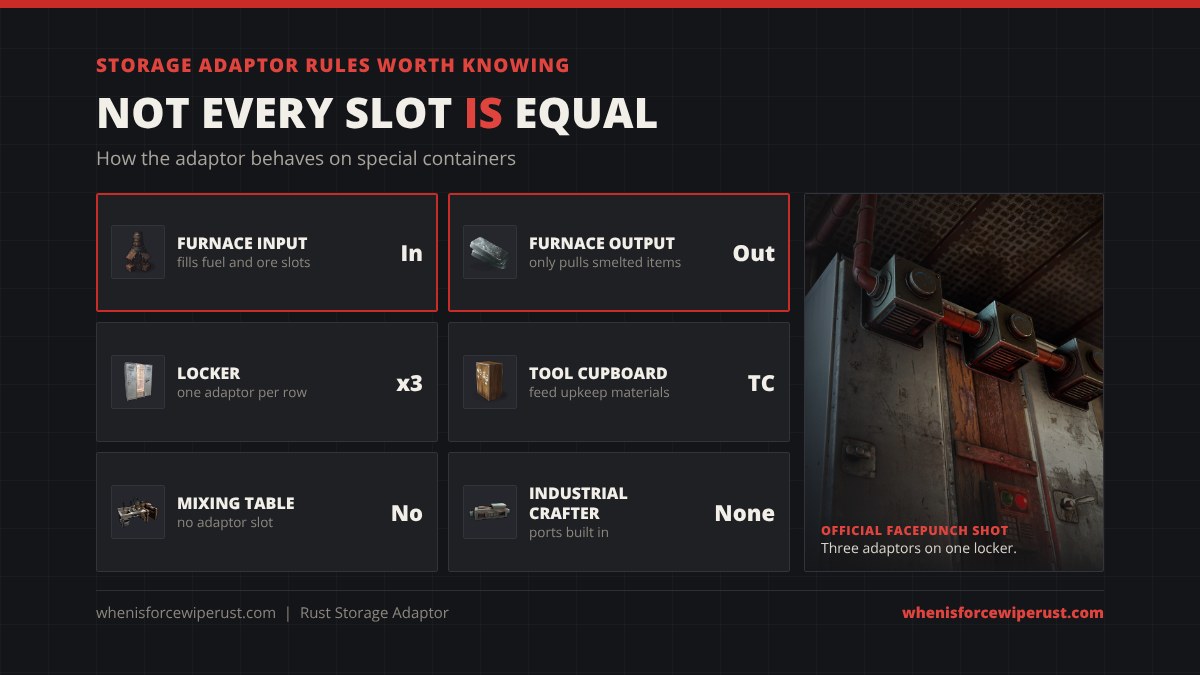
On most containers an adaptor can use every inventory slot. A few containers work differently:
- Furnaces. Facepunch: “the Input will insert items into the Fuel/Inputs item slots while the output will remove items from the output slots.” So ore and wood go in, and only metal, sulfur and charcoal come out. You never pull unsmelted ore back out by mistake.
- Lockers. One adaptor “will only access one partition, to access all partitions you’ll need to place three storage adaptors.”
- Tool Cupboard. An adaptor on the TC lets a conveyor top up wood, stone, metal and high quality metal for upkeep, so the base keeps paying while you are offline.
- Vending Machine. An adaptor lets you restock the shop from a box behind your walls, so you never open the machine’s back to refill it.
- Industrial Crafter. No adaptor needed, it has industrial slots built in, plus a Blueprint In/Out slot.
Best Storage Adaptor Builds
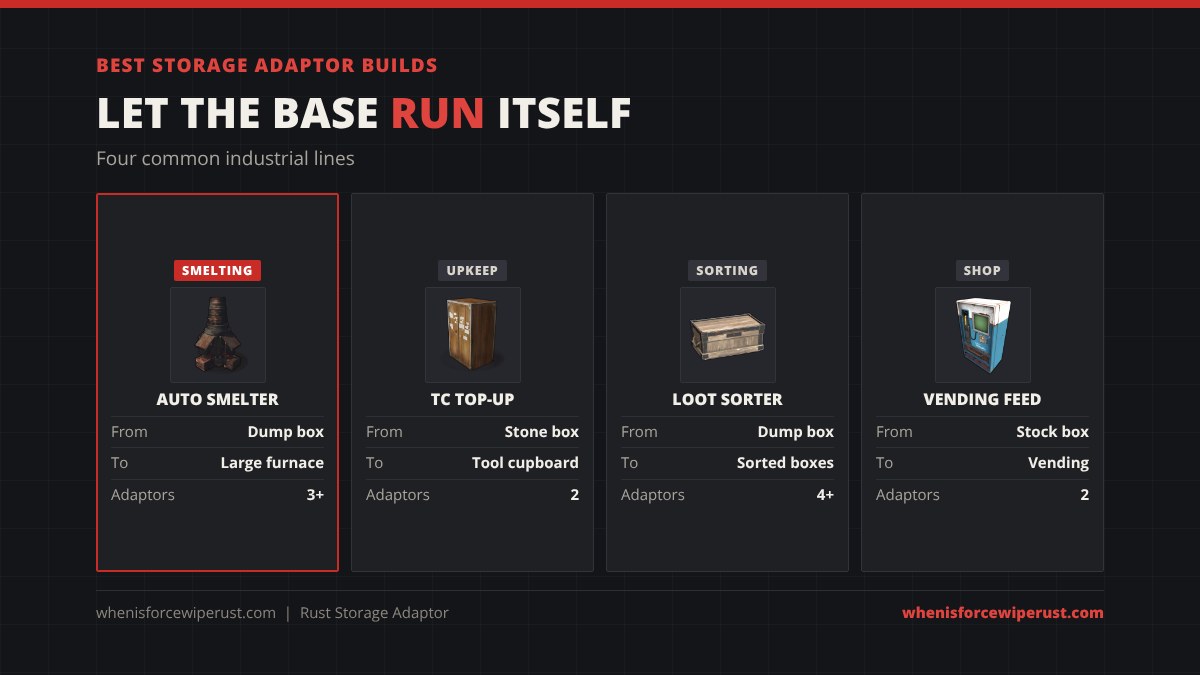
- Auto smelter. A dump box near your door, a conveyor filtered to ore and wood, and adaptors on one or more large furnaces. A second conveyor pulls the smelted output into a storage box.
- TC top-up. A box of building materials feeding the tool cupboard, with a Max filter so the TC never holds more than a few days of upkeep. Raiders take less when the TC is not overflowing.
- Loot sorter. One dump box, one conveyor per category (components, weapons, resources, medical), and an adaptor on each target box. A Large Wood Box takes four adaptors, so one box can feed several lines.
- Vending feed. A stock box behind your walls keeps the shop full. Pair it with a Storage Monitor to see stock levels on Rust+.
For whole base layouts with loot rooms and furnace rooms already planned, see our Rust base designs.
How to Destroy a Storage Adaptor

The adaptor has just 30 HP, so once a raider is inside your base it is the easiest part of your industrial system to break. Destroying it stops every pipe that runs through it.
| Tool | Amount or time |
|---|---|
| Explosive 5.56 | 3 rounds |
| 12 Gauge Buckshot | 2 shells |
| F1 Grenade, Satchel Charge, Rocket | 1 |
| Chainsaw | about 2 seconds |
| Hatchet | about 3 seconds |
| Rock | about 8 seconds |
A hammer repairs it for up to 50 metal fragments. If you are planning a raid on the walls in front of a loot room, our Rust raid calculator works out the cost.
Storage Adaptor Tips
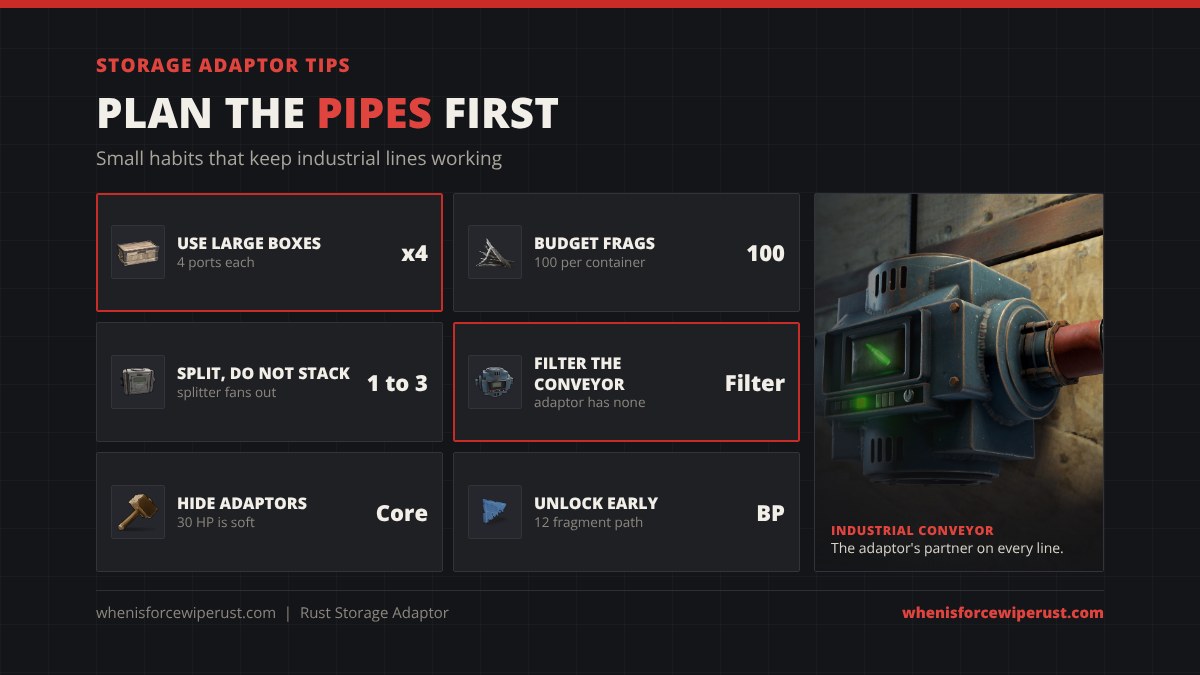
- Use large boxes. Four adaptor slots means one box can feed or receive four lines.
- Budget the frags. Every container on a line needs its own adaptor at 100 frags, so a ten box loot room costs 1,000 frags in adaptors alone.
- Split, do not stack. An Industrial Splitter (1 into 3) is cheaper than piping three conveyors out of one box.
- Filter on the conveyor. The adaptor has no settings at all. All the logic lives on the conveyor.
- Keep adaptors in your core. At 30 HP they are soft. Do not leave a TC line exposed in an outer room.
- Unlock it early. At 20 scrap or a 12 fragment path it is cheap, and an auto smelter saves hours of furnace babysitting.
Want to know when your server’s next fresh start is so you can plan the build? Check the Rust force wipe countdown.
Rust Storage Adaptor FAQ
How much does a storage adaptor cost in Rust?
100 Metal Fragments at a Workbench Level 1. Researching it costs 20 scrap, or 12 Blueprint Fragments in total on the Engineering Workbench tech tree.
What does a storage adaptor do in Rust?
It attaches to a container and gives it an Industrial In and Industrial Out port, so an Industrial Conveyor can push items into it or pull items out of it through pipes made with the Pipe Tool.
Does the storage adaptor need power?
No. Facepunch says the adaptor does not require power. The Industrial Conveyor that moves the items needs 1 power.
How many storage adaptors can you put on a large box?
Four. A Large Furnace also takes 4, a Locker 3 (one per row), and a small Wood Storage Box, Tool Cupboard and Electric Furnace 2 each.
Can you put a storage adaptor on a tool cupboard?
Yes. The Tool Cupboard has 2 adaptor slots, so a conveyor can top up your upkeep materials automatically.
Can you put a storage adaptor on a mixing table or workbench?
No. The Mixing Table, workbenches and research tables do not support adaptors. To automate crafting, attach an Industrial Crafter to a workbench; it has industrial ports built in.
How much health does a storage adaptor have?
30 HP. Three explosive 5.56 rounds, two buckshot shells or one F1 grenade break it, and a hatchet takes about 3 seconds.
When was the storage adaptor added to Rust?
February 2, 2023, in the Industrial Update, along with the Industrial Conveyor, Pipe Tool, Splitter, Combiner, Industrial Crafter and Electric Furnace.
Sources
- Facepunch: Industrial Update (February 2, 2023), storage adaptor behaviour and supported containers
- Facepunch Rust Wiki: Storage Adaptor item data, ports and loot sources
- RustHelp: Storage Adaptor, health, raid costs and attachable containers
- Craft, research, tech tree and recycle numbers: Rust game item data (November 2026). Screenshots: official Facepunch Industrial Update images. Item icons from the Rust game files.