
There is a moment on every wipe where you have a stone base, a pile of metal fragments you do not know what to do with, and a decision to make. Spend them on guns, or spend them on walls.
Spend them on walls. The metal wall is the single best value upgrade in Rust and it is not close. Two hundred metal fragments doubles a wall’s health from 500 to 1,000, doubles the C4 bill from two to four, and somehow costs you less in daily upkeep than the stone wall it replaced.
Search metal wall Rust and you get a wall of numbers, half of them copied from a patch that shipped years ago. Here are the current ones, cross checked against the game’s own entity data, plus the parts nobody tells you: the soft side rule that turns a 439 hit wall into a 44 hit wall, the mixed charge combo that saves you 450 sulfur per wall, and the siege weapon route that opens one for 7,200.
- What it is
- Stats
- Cost to build
- Vs other tiers
- Soft side
- Satchels
- C4
- Rockets
- Explo ammo
- Full raid cost
- Cheapest raid
- Siege weapons
- Upkeep and decay
- Where to use them
- High external walls
- Mistakes
- FAQ

What is the metal wall in Rust?
The metal wall is the third of four building grades, sitting above stone and below armored. In game it is called the Sheet Metal tier, which is why you will see the same thing written as “metal wall”, “sheet metal wall” and “metal tier” depending on who is writing.
Every building piece in Rust starts as twig. You hold right click with a hammer to open the upgrade wheel and pick a grade, provided you have the materials and building privilege. Sheet metal is one of those options, and it needs 200 metal fragments per wall.
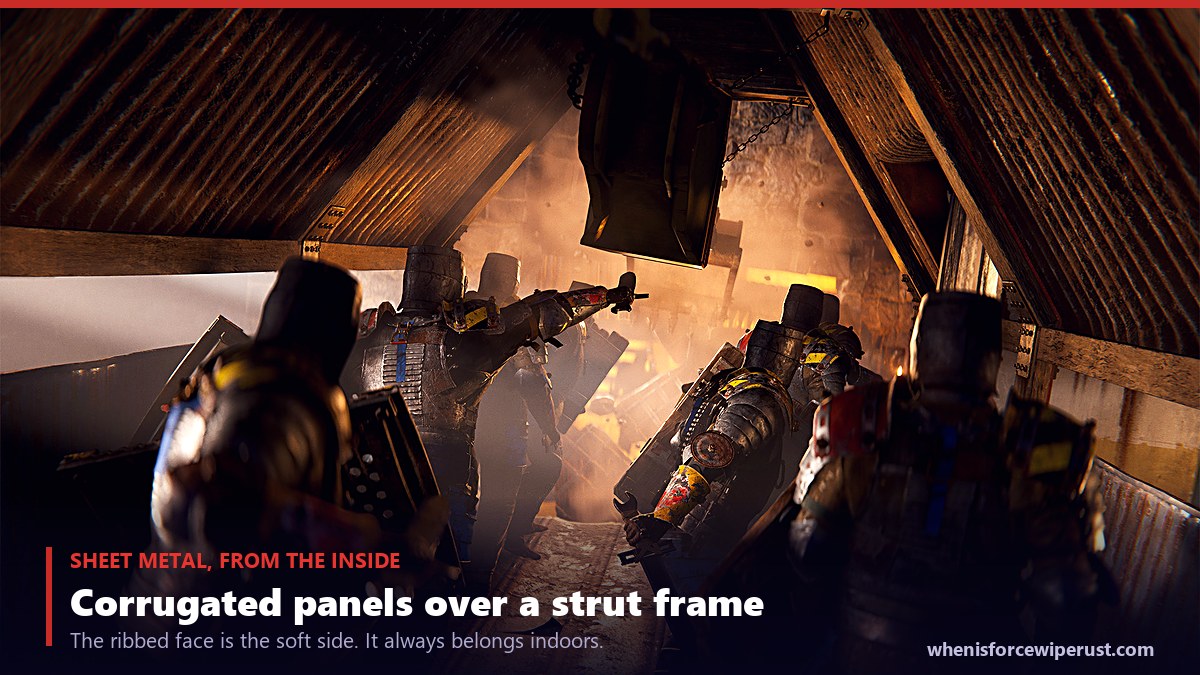
Visually it is unmistakable. Rusted corrugated panels of slightly different shades, riveted in overlapping sheets over a support frame. If you can see the frame struts crossing the surface, you are looking at the soft side, and it should be pointing into your base rather than out at the world.
Three things separate it from the tiers around it:
- No workbench. Building grades are not blueprints. There is nothing to research, nothing to unlock, no bench to build. If you have 200 fragments and a hammer, you can build sheet metal on day one.
- It is the melee wall. Stone can be picked through in about 90 hits on its soft side. Sheet metal takes 345 pickaxe hits on the hard side, which effectively ends offline melee raiding as a threat.
- It is loud. A metal base is visible from a long way off and it tells every roaming group on the server that somebody in there has fragments to spare. That is a real cost, and it is covered further down.
Metal wall stats
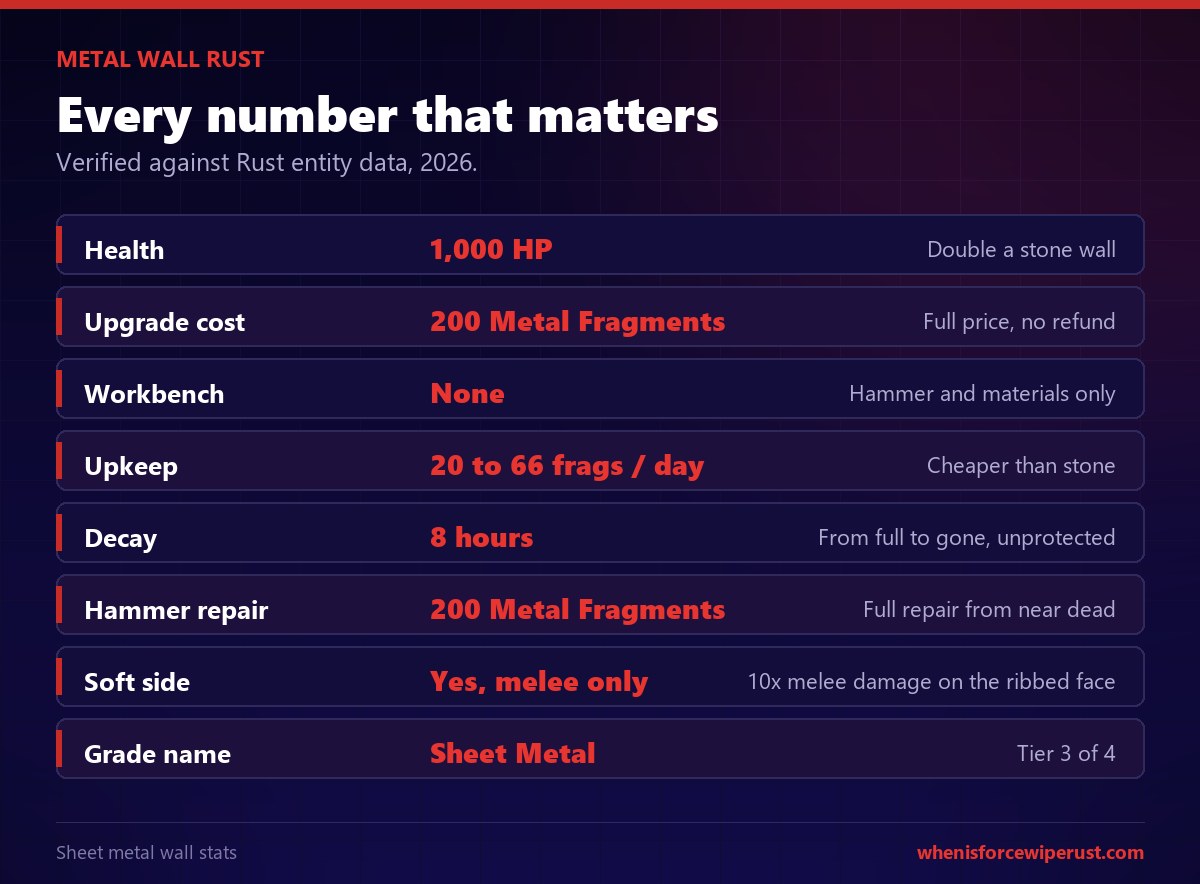
| Stat | Value | Notes |
|---|---|---|
| Health | 1,000 HP | Exactly double a stone wall. |
| Grade name | Sheet Metal | Tier 3 of 4, above stone, below armored. |
| Upgrade cost | 200 Metal Fragments | Per wall. Foundations 200, floors 100. |
| Workbench needed | None | Hammer, materials and building privilege only. |
| Upkeep | 20 to 66 fragments / 24 h | Scales with total base size. |
| Decay | 8 hours | Full health to destroyed, with no tool cupboard. |
| Hammer repair | Up to 200 Metal Fragments | Full repair from near dead. |
| Soft side | Yes, melee and bullets only | Explosives hit both faces identically. |
| C4 to destroy | 4 | 275 damage each. |
| Rockets to destroy | 8 | 137.6 damage each. |
| Satchels to destroy | 23 | 43.5 damage each. |
| Explosive 5.56 | 400 rounds | 2.51 damage each. |
What a metal wall costs to build
Two hundred metal fragments. That is the entire answer for a wall, and it is worth spelling out what that actually means in farming terms.
Two hundred fragments is roughly one and a bit stacks of metal ore through a furnace. A single decent node gives you a few hundred ore, and a road run past a couple of quarries or a loop of barrels will cover several walls. Compared to the 300 stone a stone wall wants, it is a smaller number, and metal ore is denser to carry.
You can jump grades. The upgrade wheel offers every tier you can currently afford, so twig straight to sheet metal is one interaction and one payment. Most experienced players build the shell in twig, then upgrade the pieces that matter directly to their final grade.
Other sheet metal pieces cost different amounts. A wall is the expensive one at 200 fragments. Floors, wall frames, low walls and roofs cost 100, and triangle floors 50, which is why a full sheet metal base is cheaper than “200 times the number of pieces” would suggest.
Metal wall vs every other wall tier
This is the table people actually come for. Health, upgrade cost and the raid bill for every wall grade in the game.
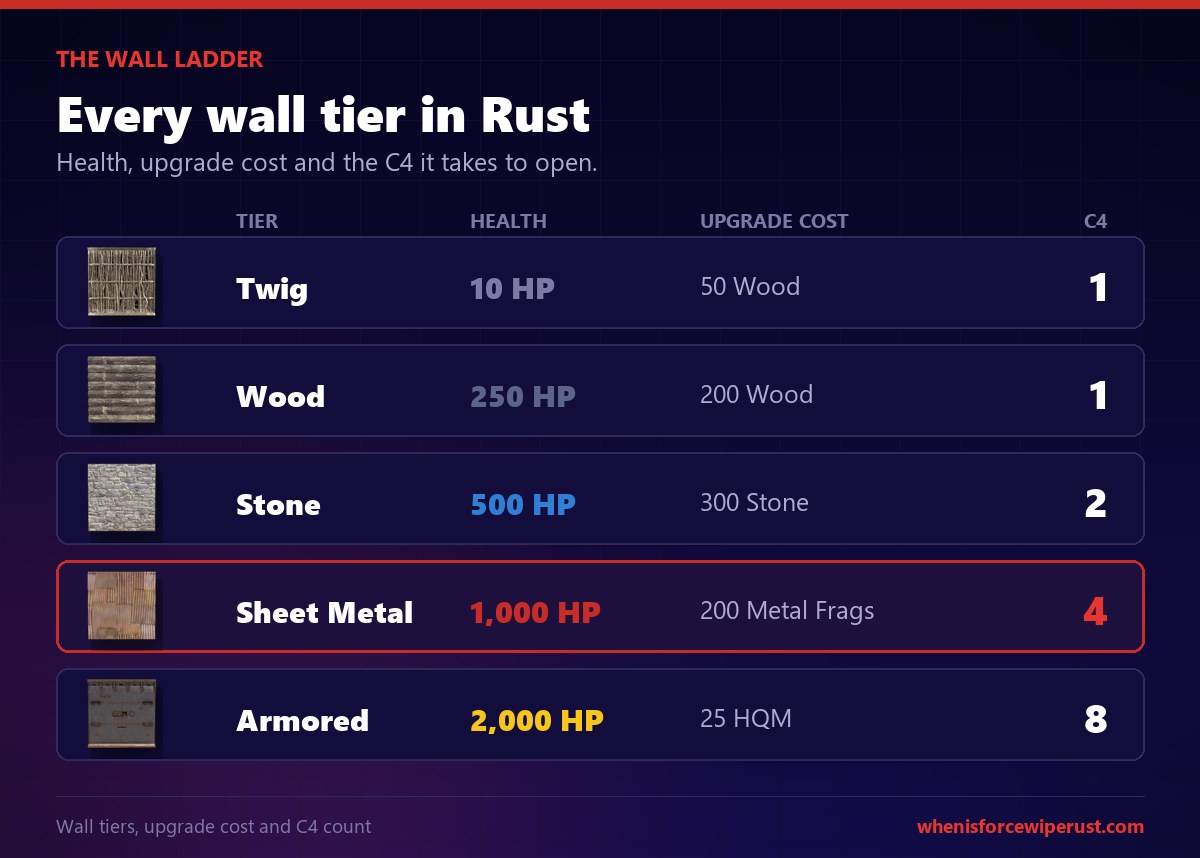
| Tier | Health | Upgrade cost | C4 | Rockets | Satchels | Explo 5.56 |
|---|---|---|---|---|---|---|
| Twig | 10 | 50 Wood | 1 | 1 | 1 | 1 |
| Wood | 250 | 200 Wood | 1 | 2 | 3 | 49 |
| Stone | 500 | 300 Stone | 2 | 4 | 10 | 185 |
| Sheet Metal | 1,000 | 200 Metal Frags | 4 | 8 | 23 | 400 |
| Armored | 2,000 | 25 HQM | 8 | 15 | 46 | 799 |
Read the satchel column. Wood to stone triples the satchel bill from 3 to 10. Stone to sheet metal more than doubles it again to 23. For an early wipe group throwing satchels, a sheet metal shell is close to unraidable, because 23 satchels per wall is 11,040 sulfur and nobody has that on day two.
The jump that matters most is stone to metal. Not because of the raw health, but because it moves a raider from “two C4 and I am inside” to “four C4 and I still have honeycomb to chew through”. Doubling the entry price is what makes a base look like a bad idea from the outside.
The metal wall soft side, and why it matters less than you think
Every building block in Rust has a hard side and a soft side. The soft side is the one with the visible support struts crossing it, and the rule has never changed: the soft side must face inwards, into your base, as if it were an interior wall.
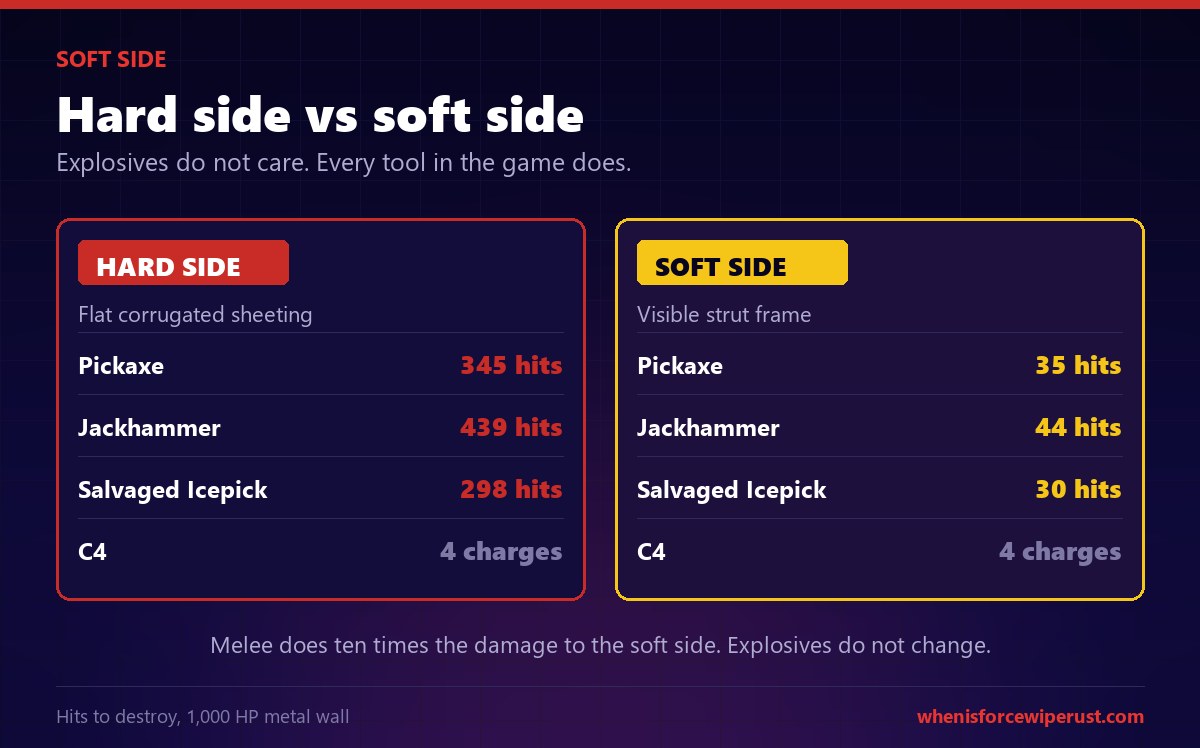
Here is the part most guides get wrong. On a metal wall the soft side does nothing at all against explosives. C4, rockets, satchels and explosive ammo all deal identical damage to both faces. Four C4 is four C4 whether you are stood inside or outside.
What the soft side changes is melee, and the multiplier is roughly ten times:
| Tool | Hard side | Soft side | Soft side time |
|---|---|---|---|
| Jackhammer | 439 hits | 44 hits | About 9 minutes |
| Pickaxe | 345 hits | 35 hits | About 51 minutes |
| Salvaged Icepick | 298 hits | 30 hits | About 35 minutes |
| 5.56 Rifle Ammo | 400,000 rounds | 200,000 rounds | Never going to happen |
Forty four jackhammer hits is about three full fuel loads and nine minutes of noise. That is a real raid on an offline base if you get a soft side facing outwards. On the hard side it becomes 439 hits and roughly 25 refills, which nobody is doing.
Regular bullets are worth a line of their own. A standard 5.56 round does 0.0025 damage to the hard side of a metal wall. You would need four hundred thousand of them. Guns do not raid metal. Only explosives and, on the soft side, tools.
How many satchels for a sheet metal wall?
Twenty three. A satchel charge deals 43.5 damage to a metal wall, and 23 charges deliver 1,000.5 against a 1,000 health pool. Twenty two leaves it alive on 43 health, which is exactly enough for the owner to hammer it back to full while you stand outside with an empty bag.
Twenty three satchels costs 11,040 sulfur and about 42 seconds of throwing. That makes satchels one of the worst value routes into a metal wall, which surprises people who think of them as the budget option. They are cheap per charge and awful per point of health.
The honest read on satchels against sheet metal: they are for wooden and stone bases. Once a base is metal, satchels stop being a raid tool and become a way to finish something that a C4 already softened.
How many C4 for a metal wall?
Four. A Timed Explosive Charge deals 275 damage to a metal wall, so three get you to 825 and the fourth finishes it with 100 damage of overkill.
Four C4 is 8,800 sulfur and roughly 19 seconds from the first stick to an open wall. It is the standard answer, the fastest answer, and the one every raid group defaults to because it needs no thought. It is also not the cheapest, and the gap is bigger than you would guess.
If you have never crafted it, the full recipe and unlock path is in the timed explosive charge guide. Short version: 20 Explosives, 5 Cloth and 2 Tech Trash, 2,200 sulfur each, Workbench Level 3.
How many rockets for a sheet metal wall?
Eight. A standard rocket deals 137.575 damage to a metal wall, so seven cover 963 and leave it alive at 37 health. Eight is the number.
Eight rockets is 11,200 sulfur and about 43 seconds. On paper that is dreadful next to four C4 at 8,800. In practice, rockets are still the right call in one situation: when you are already firing rockets at the base. Rockets splash, so a shot into a corner damages two walls at once, and a rocket raider punching a line through honeycomb is getting value that a per wall table cannot show.
High velocity rockets are the wrong tool here. An HV rocket does 15 damage to a metal wall. You would need 67 of them, for 13,400 sulfur. HVs are for Bradley and for doors, not for building blocks.
How much explosive ammo for a metal wall?
Four hundred rounds. Explosive 5.56 does 2.5075 damage per round to a metal wall, so 399 to 400 rounds covers the full 1,000 health depending on which gun you fire it from.
Four hundred rounds is 10,000 sulfur and around two to three minutes of continuous fire. That is cheaper than rockets and cheaper than satchels, and it needs no Workbench 3 gate, which is why explosive ammo is the classic mid wipe raiding tool for groups that cannot make C4 yet.
| Gun | Rounds | Time to break |
|---|---|---|
| M249 | 398 | 1 min 12 sec |
| HMLMG | 399 | 1 min 31 sec |
| Assault Rifle | 399 | 1 min 51 sec |
| LR-300 | 399 | 1 min 41 sec |
| Semi-Automatic Rifle | 400 | 2 min 51 sec |
| Bolt Action Rifle | 398 | 18 min 30 sec |
The round count barely moves between guns. What moves is the time, and the noise. Two minutes of automatic fire into a wall is an invitation to every player within a grid square, so explosive ammo raids are almost always offline raids.
Full metal wall raid cost
Everything that can break a metal wall, with the sulfur it actually costs you.

| Raid tool | Damage each | Amount | Sulfur | Time |
|---|---|---|---|---|
| Timed Explosive Charge (C4) | 275 | 4 | 8,800 | 19 sec |
| Explosive 5.56 Rifle Ammo | 2.51 | 400 | 10,000 | 1 to 3 min |
| Satchel Charge | 43.5 | 23 | 11,040 | 42 sec |
| Rocket | 137.6 | 8 | 11,200 | 43 sec |
| Propane Bomb (placed) | 80.1 | 13 | 11,700 | 1 min 18 sec |
| High Velocity Rocket | 15.0 | 67 | 13,400 | 6 min 46 sec |
| Beancan Grenade | 9 | 112 | 13,440 | 7 min |
| Mortar Shell | 30.1 | 34 | 10,200 | 1 min 28 sec |
| MLRS Rocket | 175.1 | 6 | Looted only | Instant |
| 40mm HE Grenade | 17.6 | 57 | Looted only | 1 min 12 sec |
| F1 Grenade | 1.0 | 993 | 59,580 | 41 min |
A few of those deserve a comment.
F1 grenades do essentially nothing. One damage per grenade against a metal wall. Nine hundred and ninety three of them. If you see somebody sticking F1s to sheet metal, they have confused it with a wooden door.
Beancans are worse than they look. One hundred and twelve beancans is 13,440 sulfur, more than rockets. Beancans are for wood and for softening, never for a metal shell.
MLRS is six rockets. If a group has an MLRS up, a metal shell is not slowing them down. That is a monument problem, not a building problem, and it is covered in the Rust monuments guide.
The cheapest way to raid a metal wall
Every route above assumes you use one tool. Nobody good does that. The cheapest raid on a metal wall is a mixed one, and the maths is simple: use the expensive high damage charge to get most of the way, then finish with the cheapest damage per sulfur you have.
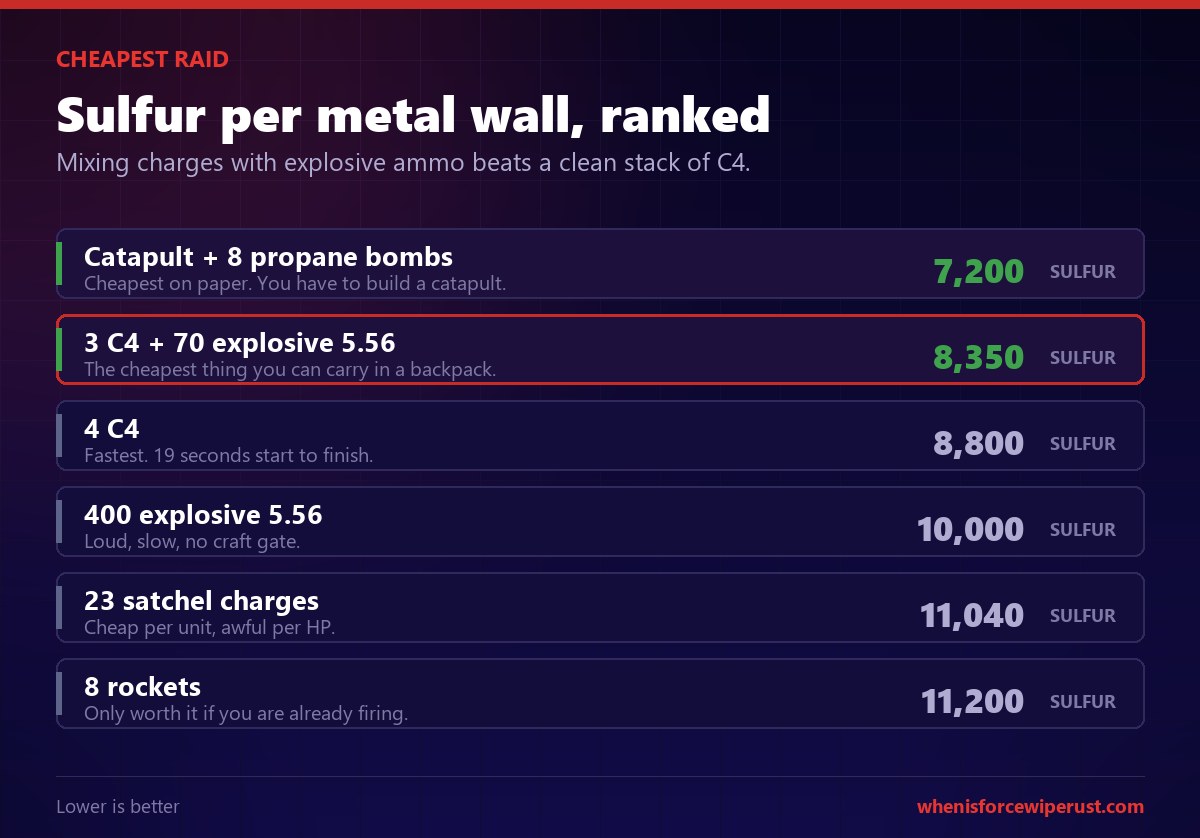
| Route | Sulfur | Verdict |
|---|---|---|
| Catapult with 8 propane bombs | 7,200 | Cheapest on paper, needs a siege weapon on site. |
| 3 C4 + 70 explosive 5.56 | 8,350 | Cheapest thing you can carry in a backpack. |
| 4 C4 | 8,800 | Fastest. The default for a reason. |
| 3 C4 + 5 satchels | 9,000 | For when you have satchels and no gun. |
| 400 explosive 5.56 | 10,000 | No Workbench 3 gate. Very loud. |
| 23 satchel charges | 11,040 | Cheap per charge, terrible per wall. |
| 8 rockets | 11,200 | Only if you are already rocketing. |
The headline is 3 C4 plus 70 explosive rounds for 8,350 sulfur. Three charges take the wall to 175 health, and 70 rounds of explosive ammo at 2.5 damage each finish it. You save 450 sulfur versus four C4, which does not sound like much until you multiply it by the eight walls in a real raid path. That is 3,600 sulfur, or nearly two extra C4 for free.
Siege weapons and the mortar
The Primitive update on 6 February 2025 added catapults, ballistae, battering rams and siege towers to Rust, and quietly changed the cheapest way into a metal base.
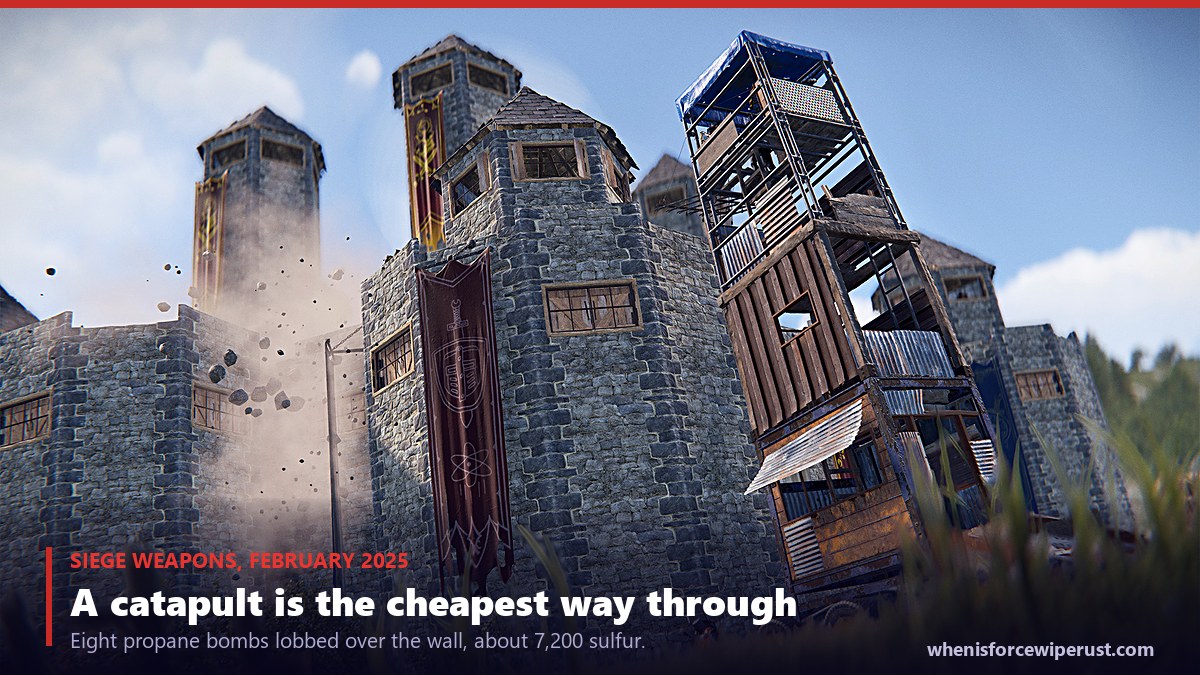
A catapult loaded with propane explosive bombs does 137.575 damage per bomb, the same as a rocket, and eight of them break a metal wall for around 7,200 sulfur. That is the cheapest number on this entire page, roughly 18 percent below four C4.
The catch is that you have to build and tow a catapult to the base, aim it by feel, and stand next to it while you do. It is a group raid tool, not a solo one, and it is glacial compared to sticking four charges on a wall. But if you are raiding a big compound and sulfur is the bottleneck rather than time, it is the correct answer.
Two more things worth knowing:
- Battering rams do not touch walls. The ram’s arm is built for doors and lower tier construction. It has no entry at all against a sheet metal wall, so a ram in your compound is a door problem, not a wall problem.
- Mortars arrived in May 2026. The Upgrade Hard, Raid Harder update added a placeable mortar that lobs shells over long distances with no visual aiming guide. Structure shells do 30 damage each to a metal wall, so 34 of them is 10,200 sulfur. It is not cheap, but it is the only tool on this list that lets you break walls from outside turret range.
Metal wall upkeep and decay
This is the section that changes minds. Sheet metal is not just tougher than stone, it is cheaper to keep.
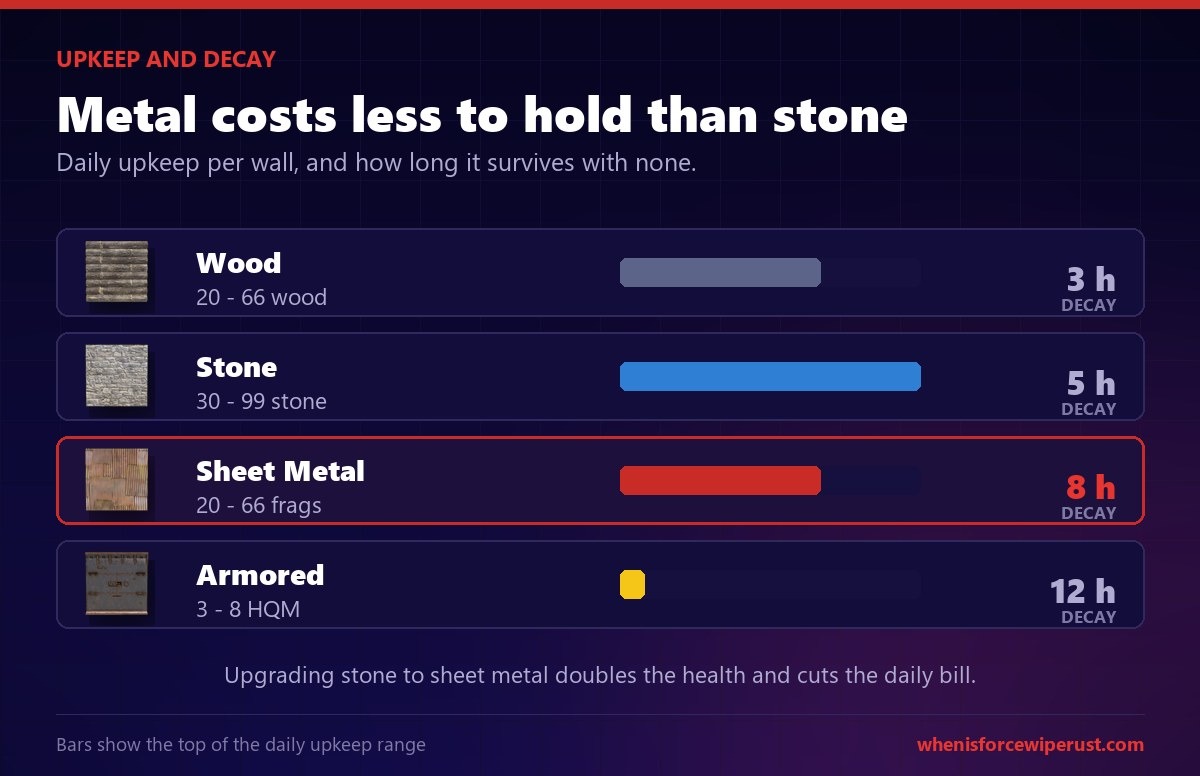
| Tier | Upkeep per 24 h | Decay time | Health |
|---|---|---|---|
| Wood | 20 to 66 Wood | 3 hours | 250 |
| Stone | 30 to 99 Stone | 5 hours | 500 |
| Sheet Metal | 20 to 66 Metal Fragments | 8 hours | 1,000 |
| Armored | 3 to 8 HQM | 12 hours | 2,000 |
A stone wall bills up to 99 stone a day. A metal wall bills up to 66 fragments. You get double the health for a third fewer upkeep units. The only reason not to upgrade is that fragments have competing uses and stone does not, so early on your stone is genuinely free and your fragments are not.
Decay goes 5 hours to 8 hours. That is the other half of the value. If your tool cupboard runs dry while you are asleep, a stone base has five hours of life and a metal base has eight. Those three hours are often the difference between logging in to a base and logging in to a foundation.
Where metal walls actually belong
Having the fragments is not the same as knowing where to spend them. The most common mistake in Rust base building is metalling the outside first.
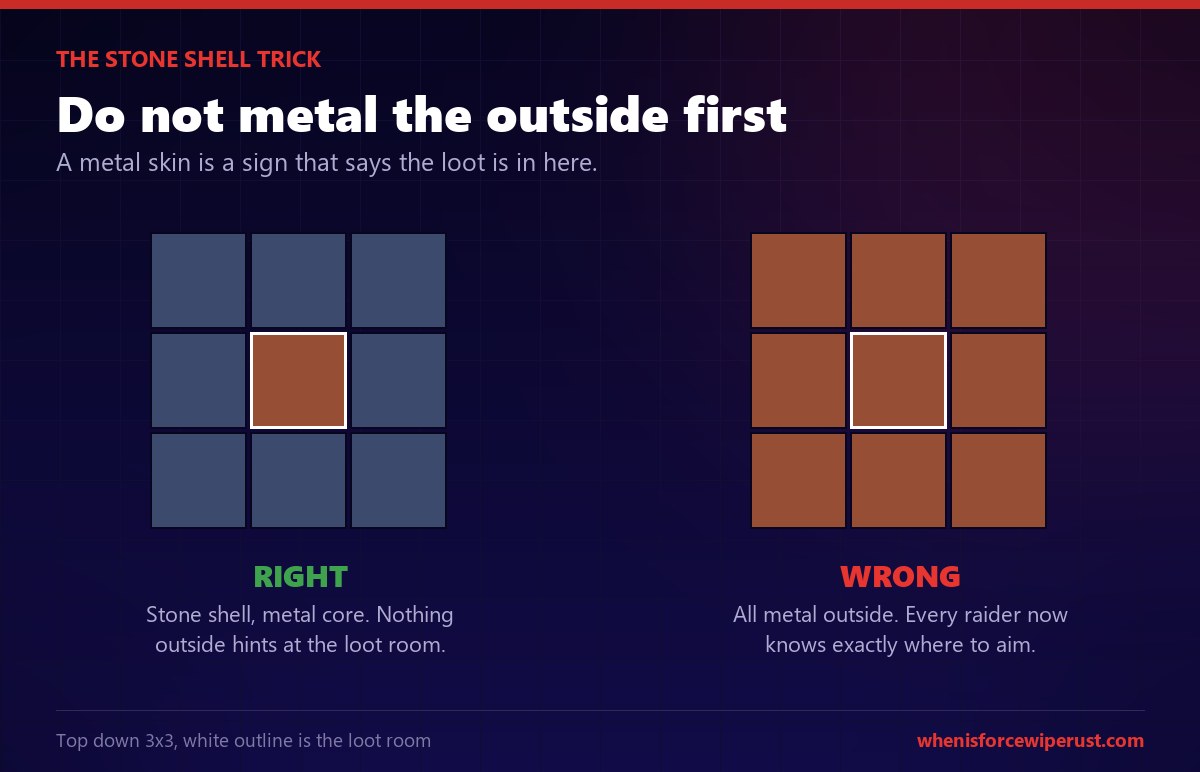
A metal exterior is a billboard. Everyone on the server can see it from a hill. It says two things at once: there is somebody in here with resources to spare, and this base is worth more than the two C4 a stone base would cost. Plenty of raids happen purely because a base looked expensive.
The approach most experienced groups use is the opposite:
- Stone shell. Keep the outer walls and honeycomb in stone. It looks like every other base on the server, and honeycomb only exists to be broken anyway.
- Metal core. Upgrade the loot room, the airlock and the walls immediately around your tool cupboard to sheet metal. That is where the C4 bill needs to bite.
- Armored the last layer. If you have the HQM, the single wall between the raider and the boxes is the one worth 2,000 health.
The effect is that a raider pays a stone price to get in, then discovers the expensive part starts after they have already committed their charges. That is when raids get abandoned halfway.
Is there a high external metal wall?
No. Rust has a High External Wooden Wall and a High External Stone Wall, and that is the whole list. There has never been a metal or armored version, and any site that lists one is inventing it.
The high external stone wall is 500 health, the same as a stone building block, and it takes 2 C4 or 10 satchels. It is a delaying tool and a splash absorber, not real protection. Nobody raids through a compound wall when they can place a ladder on it or build a twig ramp over it.
If you want a genuinely hard perimeter, the answer is not external walls. It is a real building block shell, upgraded to sheet metal, with the external walls used only to stop people casually walking up to your door.
Building for the next wipe? Do not upgrade a base you are about to lose. Check exactly how long you have left before the next force wipe.
Force wipe countdownFive metal wall mistakes that cost people bases
- Soft side facing out. A 439 hit wall becomes a 44 hit wall. Check every exterior wall for visible struts before you log off, and remember that upgrading a block lets you rotate it again.
- Metalling the shell instead of the core. You paid extra to advertise your loot room. Stone outside, metal inside.
- Walking up the tiers. Wood then stone then metal costs you 200 wood and 300 stone you never get back. Go twig to sheet metal in one hop for anything you know is ending up metal.
- A cheap door in an expensive wall. Raiders price the cheapest route, not the average one. Your doors, window frames and hatches all need to cost at least as much as the wall around them.
- Forgetting upkeep is in fragments now. Your tool cupboard needs metal fragments the moment you go metal. Plenty of bases have decayed because the cupboard was still full of stone and nobody noticed the fragments had run out.
Metal wall Rust FAQ
How much HP does a metal wall have in Rust?
How many C4 for a metal wall in Rust?
How many rockets for a sheet metal wall?
How many satchels for a sheet metal wall?
How much explosive ammo for a metal wall in Rust?
How much does a metal wall cost in Rust?
Which side of a metal wall is the soft side?
Does a metal wall need a workbench in Rust?
Is a metal wall worth it over stone in Rust?
How long does a metal wall take to decay in Rust?
What is the cheapest way to raid a metal wall?
How many jackhammers does it take to break a sheet metal wall?
Can you break a metal wall with bullets in Rust?
Is there a high external metal wall in Rust?
Can you rotate a metal wall after placing it?
Final thoughts
Sheet metal is where a Rust base stops being a suggestion and starts being a problem. Two hundred fragments for double the health, double the C4 bill, three extra hours of decay protection and a lower daily upkeep count is the best trade in the building system, and almost every player who gets wiped early got wiped in stone.
Spend the fragments inwards, keep the struts pointing indoors, and make sure your doors cost as much as your walls. Then check the countdown, because none of this matters if the wipe is on Thursday.
Sources and further reading
- Metal wall health, upgrade cost, decay, repair cost, and the full per tool damage tables for both the hard side and the soft side: RustClash, Metal Wall
- Build cost, 1,000 HP, 8 hour decay, the 20 to 66 fragment daily upkeep range, and the mixed raid combinations: RustHelp, Metal Wall
- Comparison figures for the wood, stone and armored tiers and their upkeep ranges: RustHelp, Stone Wall and RustHelp, Armored Wall
- Building grades, per tier upgrade costs, tool cupboard building privilege and the rule that the rougher textured face belongs outward: Rustafied, Building: What you need to know
- Confirmation that all explosives deal equal damage to the hard side and the soft side of structures: Rustafied, Raiding in Rust
- The hammer upgrade wheel, the rotation window after placement, and the soft side described as the face with support palings crossing it: Corrosion Hour, How to Build in RUST
- The ten minute demolish window on a freshly placed building block: Corrosion Hour, How to Remove Walls in RUST
- Catapults, ballistae, battering rams and siege towers arriving on 6 February 2025, including the propane tank projectile: Facepunch, Primitive Update
- The placeable mortar, its structure damage shell and the lack of any aiming guide: Facepunch, Upgrade Hard, Raid Harder
- The building upkeep system and the original per tier decay table it shipped with: Facepunch, Devblog 189