
Nothing in Rust clears a wooden base, a hemp field or a tight doorway quite like a stream of fire. The Flame Thrower is the game’s only handheld fire weapon: a Workbench 2 gun that burns low grade fuel instead of bullets and turns anything made of wood into ash.
This flamethrower Rust guide covers the exact recipe, every stat, how fast it eats fuel, how much low grade it takes to burn through doors and walls, where to loot one, how the loot-only Military Flame Thrower differs, and when it is honestly the wrong tool.
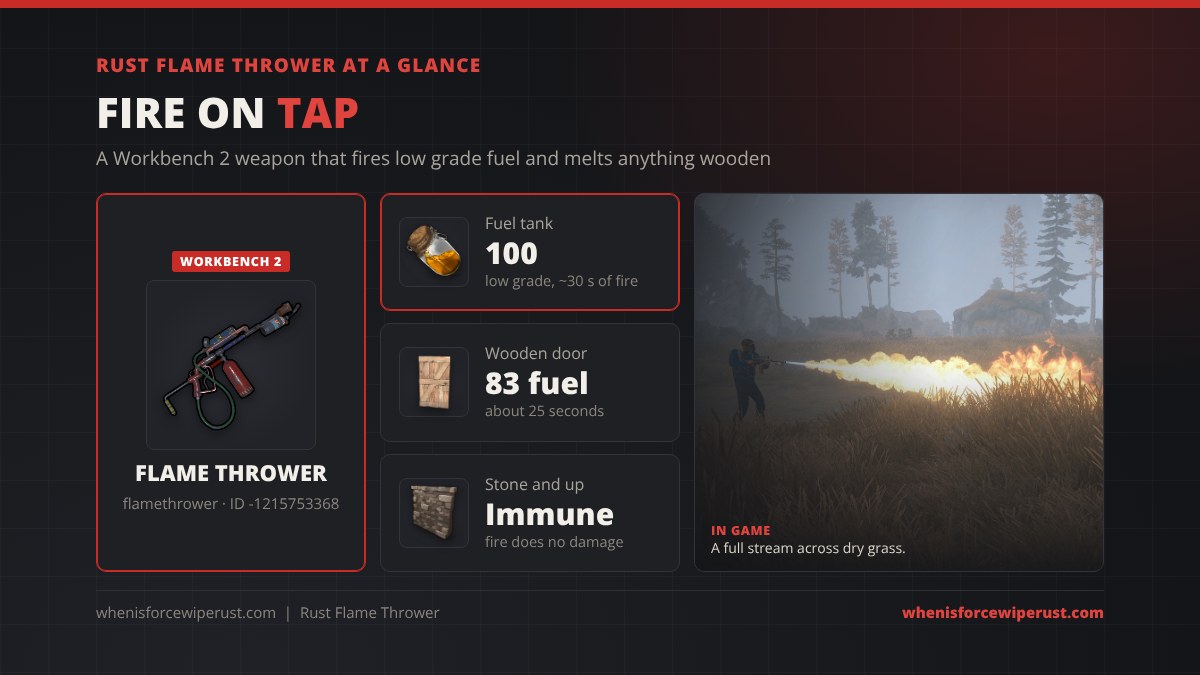
What Is the Flame Thrower in Rust?
The Flame Thrower arrived in April 2016 (Devblog 106) and has been in the game ever since. The in-game description is short: “A Flamethrower. Uses low grade fuel as ammunition.” In the game files it is flamethrower with item ID -1215753368, and you can look up every other ID in our Rust item IDs list.
Instead of firing bullets, it sprays burning fuel a few metres in front of you. Each hit does about 10 damage at around 400 ticks a minute, and the fireballs leave patches of flame on the ground that keep burning anyone who walks through them. That makes it deadly in a 1×1 doorway and nearly useless across an open field.
Where it really earns its slot is fire damage. Wooden building parts, wooden doors and almost every wooden deployable take fire damage, so a Flame Thrower can open a wooden base with zero sulfur. That is also its hard limit: the moment a base is stone or better, the flames do nothing.
How to Craft a Flame Thrower
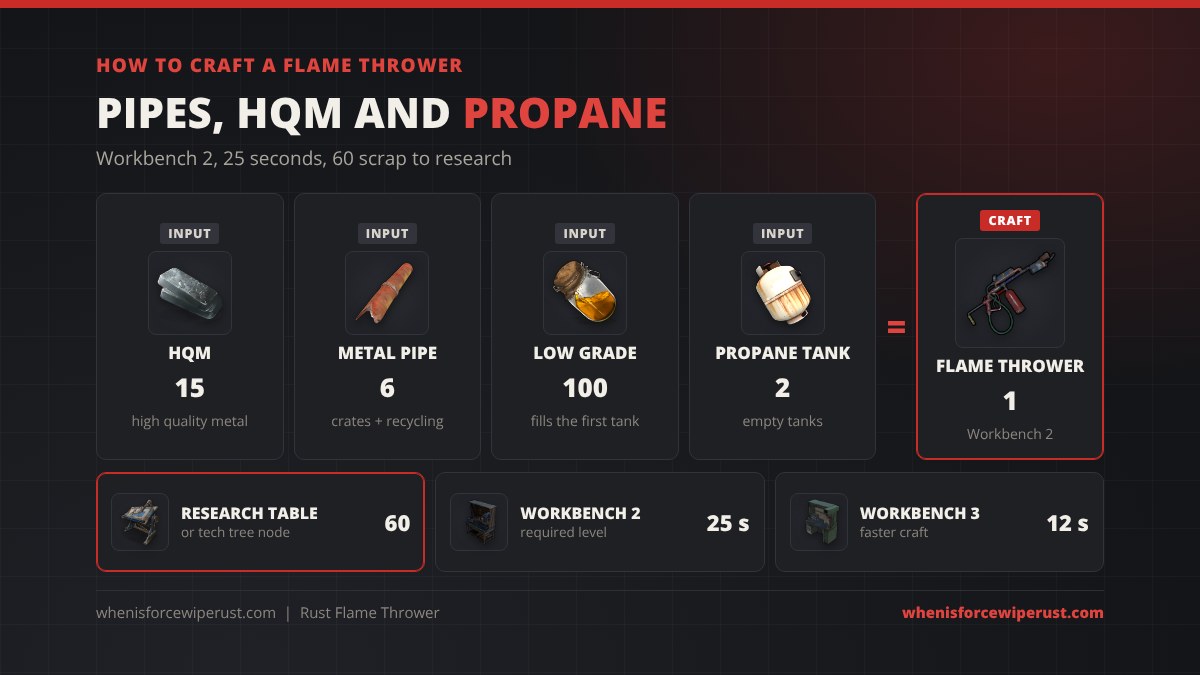
You need the blueprint first. Put a Flame Thrower in a Research Table for 100 scrap, or unlock it on the Workbench 2 branch of the tech tree. On the tree the node itself costs 1 Blueprint Page, but the path of nodes you have to open before it adds up to several Blueprint Pages.
| Stat | Flame Thrower |
|---|---|
| Recipe | 15 High Quality Metal, 6 Metal Pipes, 100 Low Grade Fuel, 2 Empty Propane Tanks |
| Workbench | Workbench Level 2 |
| Craft time | 25 s at Workbench 2, about 12 s at Workbench 3 |
| Research | 100 scrap (Research Table or tech tree node) |
| Fuel capacity | 100 Low Grade Fuel |
| Damage | About 10 per hit, roughly 400 hits a minute |
| Reload / draw | 3.5 s reload, 1.8 s to draw |
| Repair (Repair Bench) | Up to 6 HQM, 20 low grade and 40 metal fragments |
| Recycles into | About 7 HQM, 3 pipes, 50 low grade and 1 propane tank (monument recycler) |
| Stack / despawn | 1 / 40 minutes |
| Short name / ID | flamethrower / -1215753368 |
The 6 metal pipes are the real bottleneck, since pipes come from crates and recycling rather than mining. The propane tanks are easy: recycle a few or grab them from barrels on the road. Our crafting calculator breaks the whole recipe down to raw resources.
Running a server? Admins can spawn one straight from the F1 console:
inventory.give flamethrower 1Our Rust admin commands list has every other give and spawn command.
Flame Thrower Fuel: How Much Low Grade It Burns
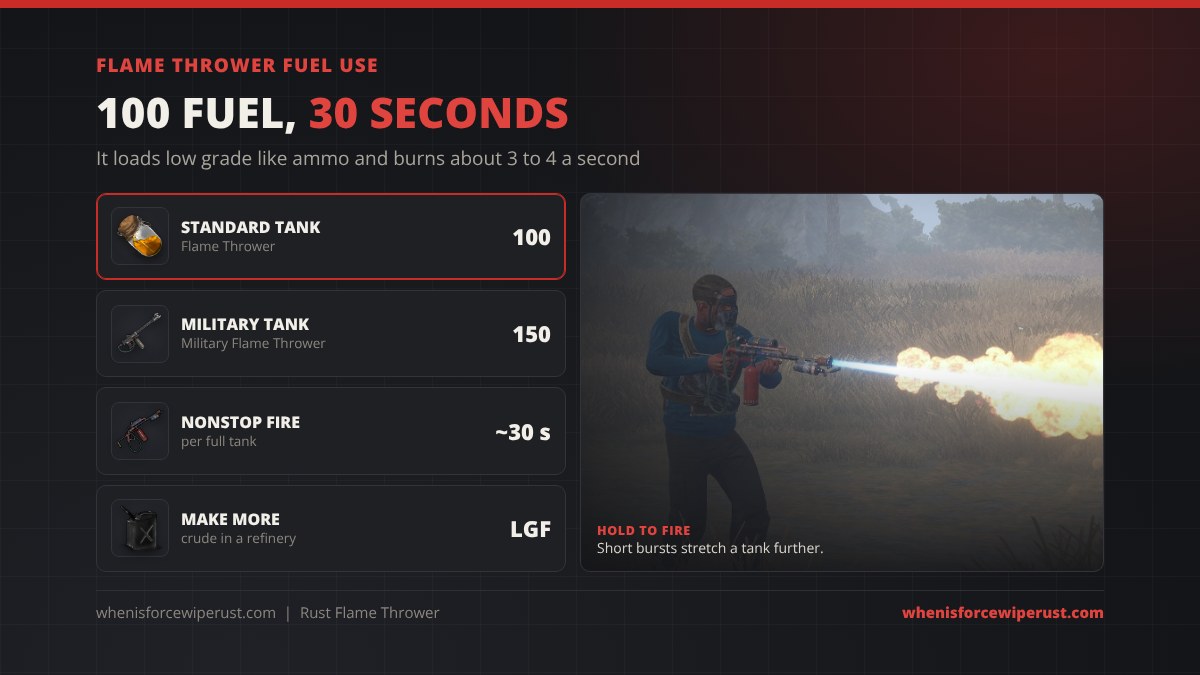
The Flame Thrower loads low grade fuel exactly like a gun loads ammo, and a full tank is 100 units. Holding the trigger burns roughly 3 to 4 fuel a second, so one tank gives you about 30 seconds of continuous fire. Reloading takes 3.5 seconds.
That sounds like a lot until you raid with it. A single wooden wall eats about two full tanks, so bring a few hundred low grade for anything serious. The easiest supply is a Small Oil Refinery turning crude oil into low grade, or crafting it by hand from animal fat and cloth.
How to Use the Flame Thrower
Treat it as a doorway and close-quarters weapon, never a rifle. In practice:
- Fight in tight spaces. Corridors, 1×1 doorways, stairwells and loot rooms are where the stream and the burning ground patches stack up. In the open, anyone with an AK or a better gun just backs off and shoots you.
- Use the ground fire. Spray the floor of a doorway and anyone who pushes through it burns. It is a great way to hold a room while your team loots.
- Burn the farm. Hemp, crops and enemy planter boxes go up fast. So do dry grass fields, which also spread fire toward anyone hiding in them.
- Mind your own base. Fire spreads from wood to wood. Spraying inside a wooden base you are standing in can burn your own walls, boxes and sleeping bags.
Flame Thrower Raid Costs

The Flame Thrower is a pure eco raid tool. It costs no sulfur at all, but it only works on wood. These are the numbers we use across the site, from a standard Flame Thrower spraying the target directly:
| Target | Low grade fuel | Time | Molotovs instead |
|---|---|---|---|
| Tool Cupboard | 42 | about 13 s | 1 |
| Wooden Door | 83 | about 25 s | 2 |
| Wooden Wall | 206 | about 44 s | 4 |
| Wooden Window Bars | 206 | about 44 s | 4 |
| High External Wooden Wall | 412 | about 1.5 min | 7 |
| Auto Turret | 412 | about 1.5 min | 7 |
| Stone, sheet metal, armored | No damage | – | No damage |
Two things matter more than the raw numbers. First, the fuel figures assume you keep the stream on the target, so plan on a full tank per door and two per wall. Second, fire spreads. Burning one wooden wall in a fully wooden base often sets the pieces next to it alight, so the real cost of clearing a wood base can be far lower than the chart.
Where to Find a Flame Thrower
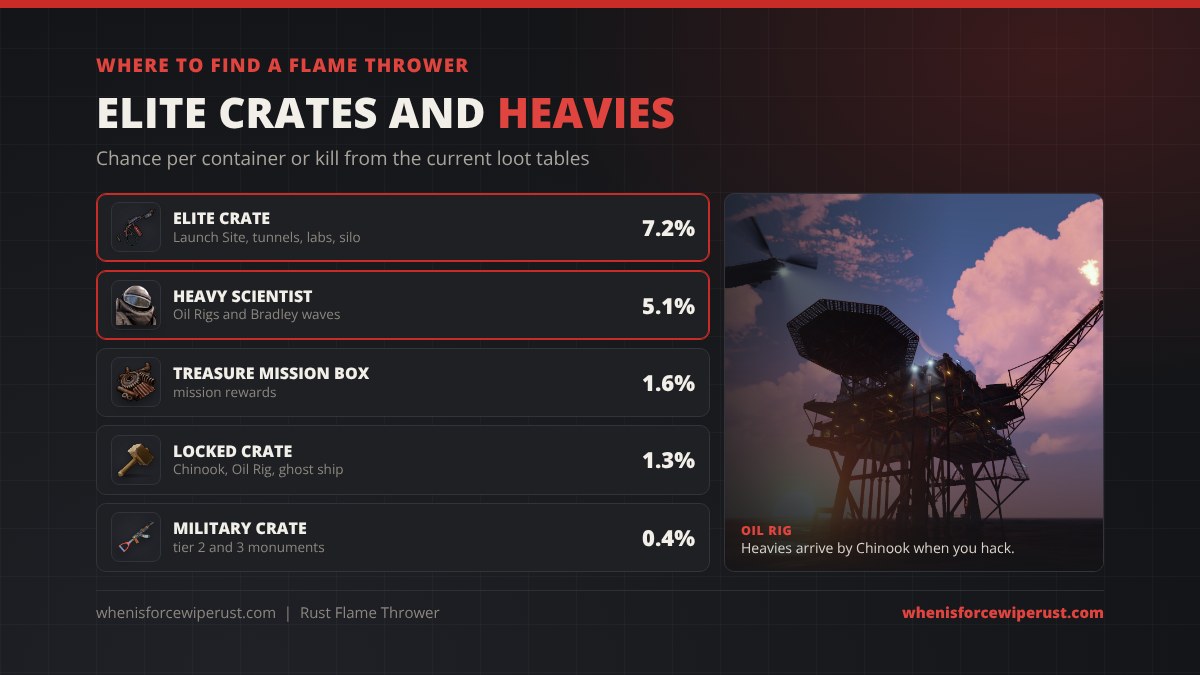
If you do not have the blueprint yet, looting one to research is the usual route. Current drop chances from the game’s loot tables:
| Source | Chance | Where |
|---|---|---|
| Elite Crate | about 7.2% | Launch Site, Military Tunnels, Underwater Labs, Missile Silo |
| Heavy Scientists | about 5.1% | Oil Rigs and Bradley waves |
| Treasure mission box | about 1.6% | Mission rewards |
| Locked Crate | about 1.3% | Chinook drops, Oil Rigs, ghost ships |
| Military Crate | about 0.4% | Tier 2 and 3 monuments |
| Regular scientists | about 0.1% | Almost every monument |
Our Rust loot tables page lists everything else those crates can roll.
Military Flame Thrower vs Flame Thrower
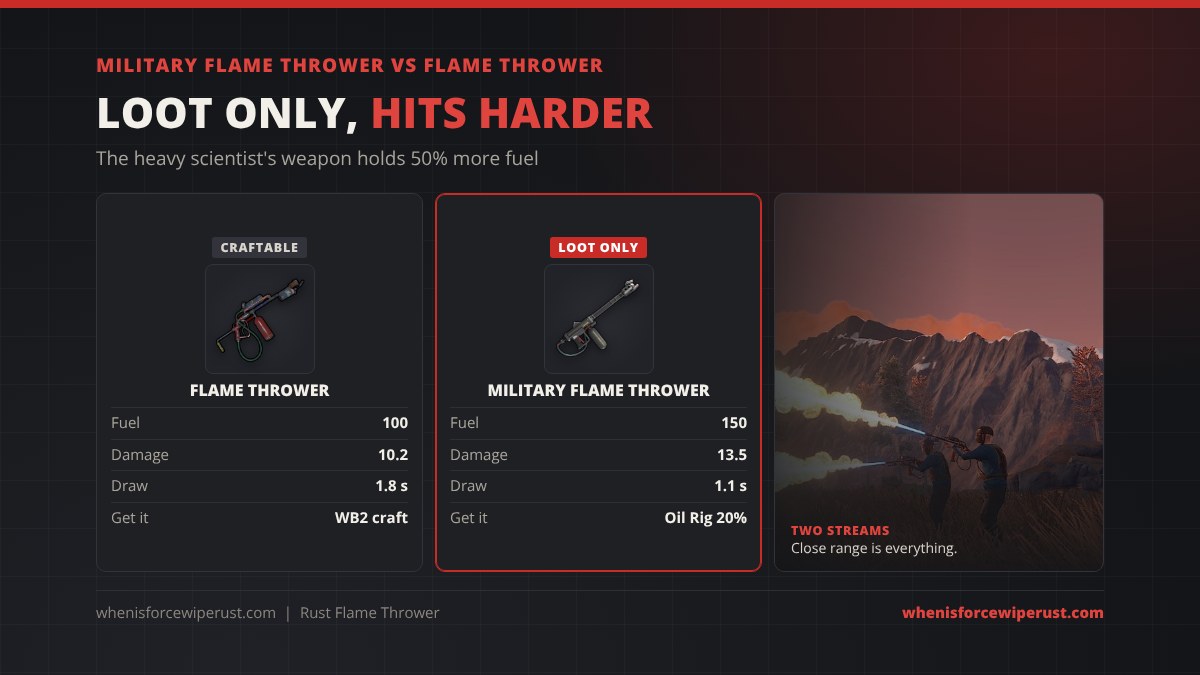
The Military Flame Thrower came with the Waves of Change update in April 2024, alongside the minigun. It is the weapon the flame-wielding heavy scientists carry, and it is loot only: you cannot research or craft it.
| Stat | Flame Thrower | Military Flame Thrower |
|---|---|---|
| How to get | Craft at Workbench 2, or loot | Loot only |
| Fuel capacity | 100 | 150 |
| Damage per hit | about 10.2 | about 13.5 |
| Draw time | 1.8 s | 1.1 s |
| Reload | 3.5 s | 3.5 s |
| Wooden door | 83 fuel, about 25 s | 102 fuel, about 27 s |
| Recycles into | about 7 HQM, 3 pipes, 50 low grade, 1 tank | about 17 HQM, 4 pipes, 50 low grade, 2 tanks |
| Short name / ID | flamethrower / -1215753368 | military flamethrower / 703057617 |
The best farm is the Large Oil Rig. When you start the hack, a Chinook drops heavy scientists, and each flame heavy has about a 20% chance to drop its Military Flame Thrower. Even if you never use it, it recycles into roughly 17 HQM, which is a good haul on its own.
Flame Thrower vs Molotov vs Flame Turret
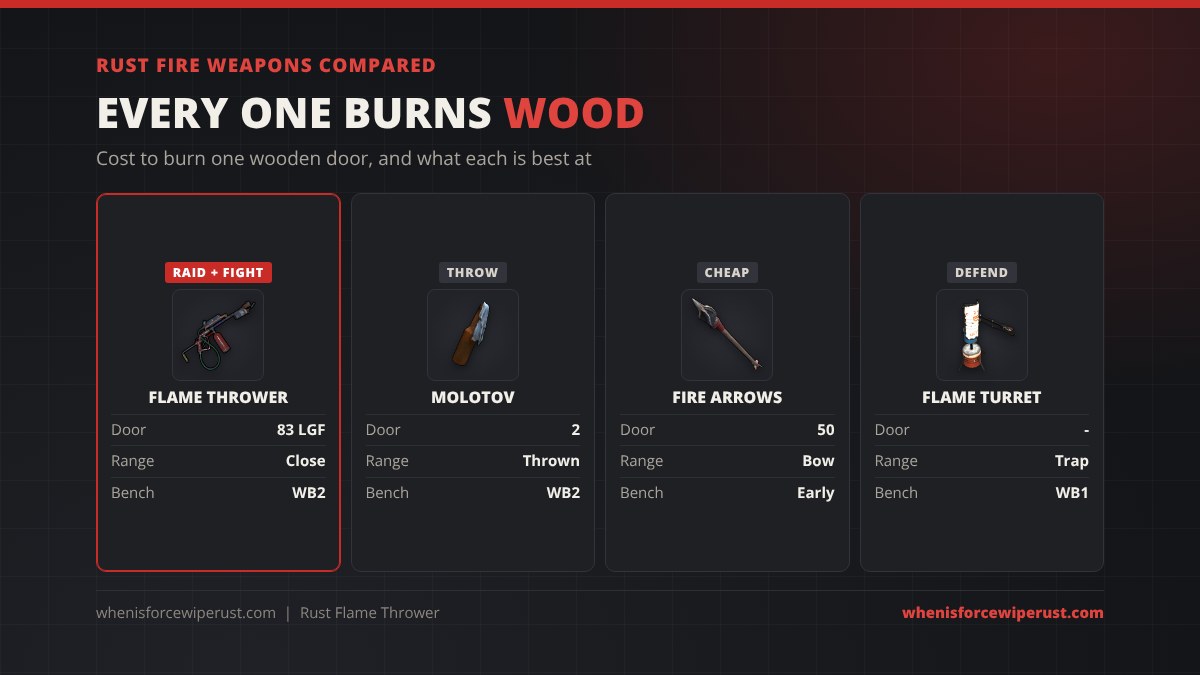
| Fire source | Wooden door | Best for |
|---|---|---|
| Flame Thrower | 83 low grade | Clearing many wooden parts in a row, doorway fights |
| Molotov | 2 molotovs (100 low grade + 20 cloth) | Fast, thrown from cover, no gun to carry |
| Fire arrows | 50 arrows | Cheap early-wipe raids from range |
| Flame Turret | Defence only | Guarding doorways and loot rooms |
Fuel for fuel, molotovs and the Flame Thrower are close on a single door. The Flame Thrower wins when there is a lot of wood to get through, because you reload from a stack of low grade instead of crafting dozens of molotovs, and you can also fight with it. Molotovs win when you need to stay in cover or throw over a wall.
Flame Thrower Tips
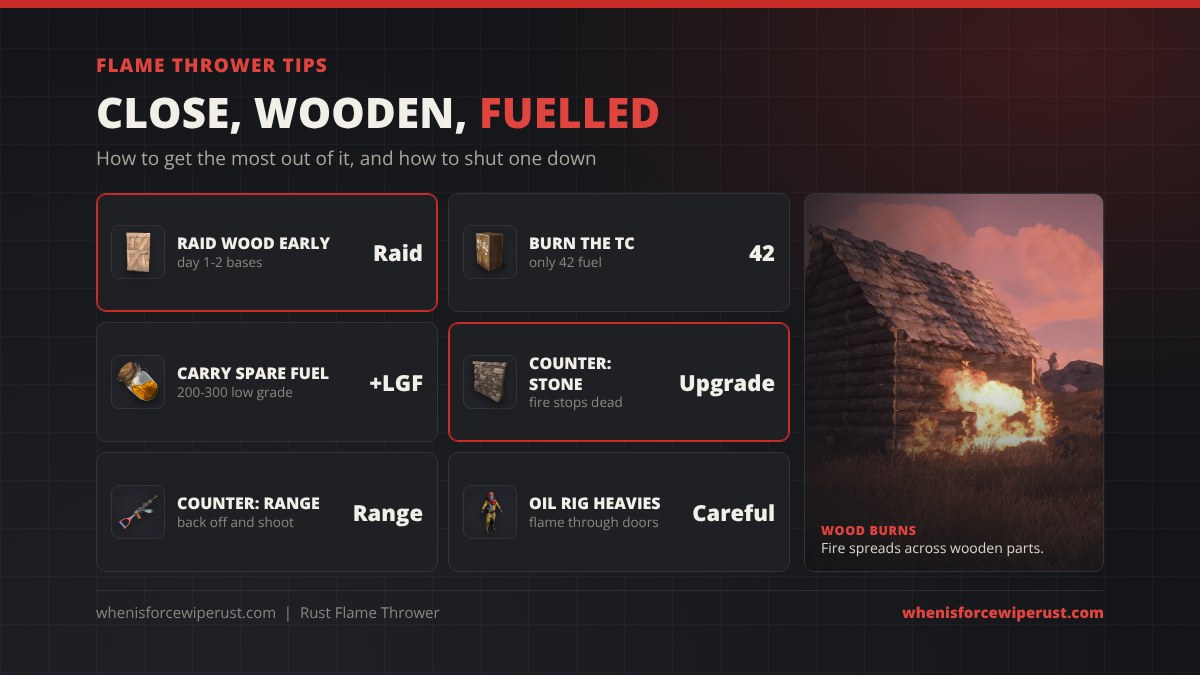
- Raid wood early in the wipe. Day one and day two bases are often still wooden, which is when a Flame Thrower is worth its pipes.
- Hit the Tool Cupboard. A wooden TC takes only about 42 fuel. Kill it and the base stops paying upkeep, and you can build in.
- Carry spare low grade. Two or three hundred low grade in your inventory turns one tank into a full raid.
- Counter it with stone. If someone is burning your base, upgrade the walls they are on to stone and swap wooden doors for sheet metal. Fire stops instantly.
- Fight back from range. Never trade shots with a flamer in a doorway. Step back and use any rifle.
- Watch out at the Oil Rig. The flame heavies will burn you through a doorway you think is cover. Our Oil Rig guide shows where to hold.
Running a wooden base yourself? Our wood wall guide and beginner’s guide explain why stone should be your first upgrade.
Flame Thrower FAQ
How do you make a flamethrower in Rust?
Craft it at a Workbench 2 from 15 high quality metal, 6 metal pipes, 100 low grade fuel and 2 empty propane tanks. You need the blueprint first, which costs 100 scrap at a Research Table.
What ammo does the flamethrower use in Rust?
It uses Low Grade Fuel as ammo. A full tank holds 100 low grade fuel, or 150 in the Military Flame Thrower.
How long does a flamethrower tank last?
About 30 seconds of nonstop fire. It burns roughly 3 to 4 low grade fuel a second, and reloading takes 3.5 seconds.
How much low grade does it take to burn a wooden door with a flamethrower?
About 83 low grade fuel and 25 seconds of steady fire with a standard Flame Thrower. A wooden wall takes about 206 fuel and a wooden Tool Cupboard about 42.
Can a flamethrower destroy stone walls in Rust?
No. Stone, sheet metal and armored building parts and doors take no fire damage. The Flame Thrower only hurts wooden parts and most wooden deployables.
Where can I find a flamethrower in Rust?
Elite crates have about a 7% chance, heavy scientists at the Oil Rigs and Bradley about 5%, locked crates about 1.3% and military crates about 0.4%.
What is the difference between the Military Flame Thrower and the Flame Thrower?
The Military Flame Thrower holds 150 fuel instead of 100, hits for about 13.5 instead of 10.2 and draws faster. It cannot be crafted and mainly drops from flamethrower heavy scientists at the Oil Rig, about 20% of the time.
Is the flamethrower good in Rust?
It is a niche weapon. It is excellent for burning wooden bases, farms and fighting inside doorways, but it has very short range and does nothing to stone, so most players keep it for early-wipe raids rather than PvP.
How much scrap is the flamethrower blueprint?
100 scrap at a Research Table. On the Workbench 2 tech tree the node also costs 1 Blueprint Page, but the nodes before it bring the full path to several Blueprint Pages.