
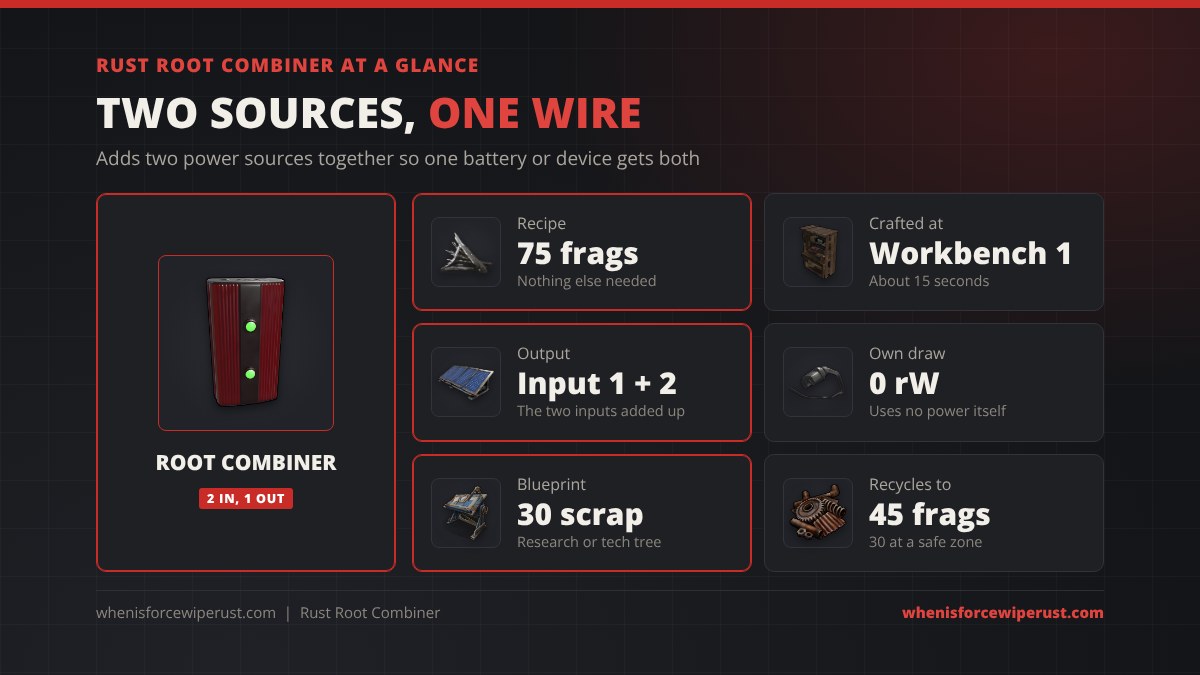
The Root Combiner is the Rust electrical part that adds two power sources together into one wire. It costs just 75 metal fragments at a Workbench 1, and it is how you get a solar panel and a wind turbine, or four solar panels, charging the same battery. It is also the part that confuses new players the most, because it only works with power that comes straight from a source.
This root combiner Rust guide covers the craft cost and blueprint, how the two inputs add up, what you can and cannot plug into it, how to chain several combiners, how it behaves with batteries, how it compares with the splitter and branch, and the setups worth building.
- What It Is
- Stats
- Craft Cost
- How It Works
- What Counts as Root
- Chaining
- With Batteries
- vs Splitter & Branch
- Best Setups
- Not Working?
- Tips
- FAQ
What Is a Root Combiner in Rust?
A Root Combiner (shortname electrical.combiner) is a small wall-mounted box with two Power In sockets and one Power Out socket. Whatever reaches the two inputs comes out of the output as one total. In-game it is described as combining “two root electrical sources into a single signal”, and the word root is the important part: a root is the place power is made or stored, not a part that just passes power along.
You need one any time more than one generator should feed the same battery or device. A battery has only one Power In socket, so without a combiner two solar panels cannot both charge it. If you are new to wiring, start with our Rust electricity guide, which covers sources, batteries and the wire tool before you get to combining.
Rust Root Combiner Stats
| Stat | Root Combiner |
|---|---|
| Craft cost | 75 Metal Fragments |
| Workbench | Workbench 1 |
| Craft time | About 15 seconds |
| Blueprint | 40 scrap at a research table, or a node on the Engineering Workbench tech tree |
| Inputs / outputs | 2 Power In, 1 Power Out |
| Output | Input 1 + Input 2 |
| Own power draw | 0 rW |
| Recycle | 45 Metal Fragments (monument, 60%), 30 at a safe zone recycler (40%) |
| Rarity | Uncommon |
| Stack size | 5 |
| Despawn | 20 minutes on the ground |
| Shortname / Item ID | electrical.combiner / -458565393 |
Every other item ID is in our Rust item IDs list, and you can spawn one on your own server with the admin commands.
How to Craft a Root Combiner in Rust
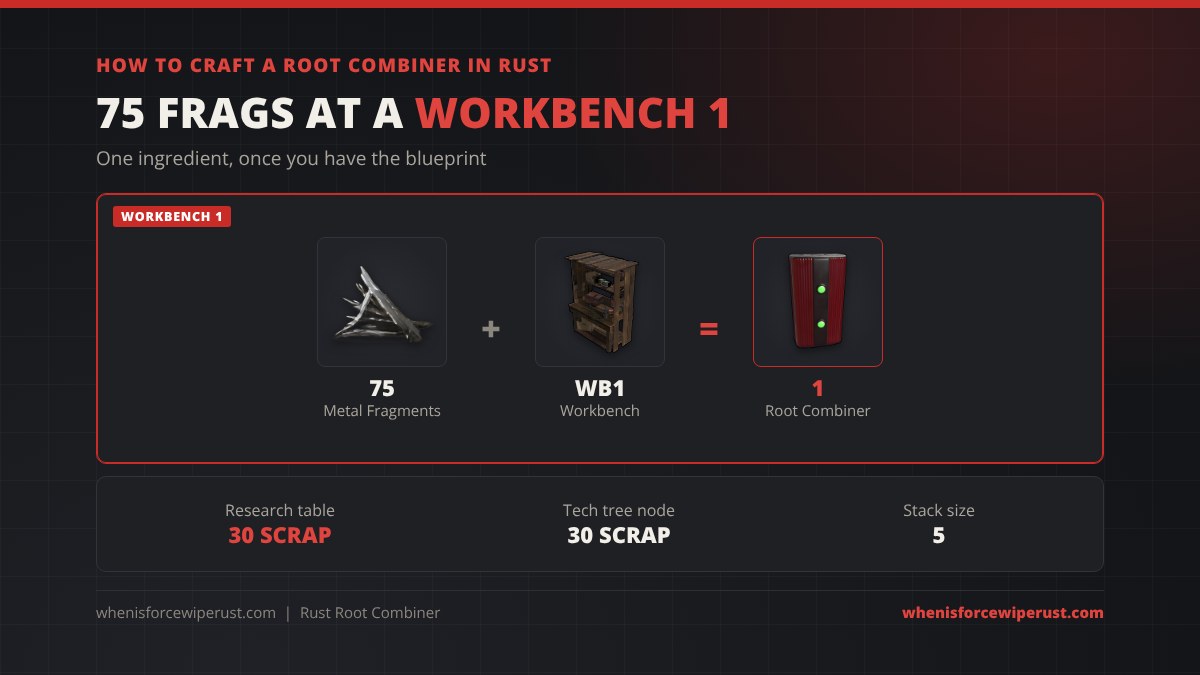
- Get the blueprint. Put a root combiner in a research table with 40 scrap, or unlock its node on the Engineering Workbench tech tree for 1 Blueprint Fragment per node.
- Collect 75 metal fragments. Smelt metal ore in a furnace, or recycle components. Our metal fragments guide covers the fastest ways.
- Stand at a Workbench 1. Any Workbench Level 1 or higher works.
- Craft it. One craft makes one combiner. Make a spare or two, they stack to 5.
How Does the Root Combiner Work?
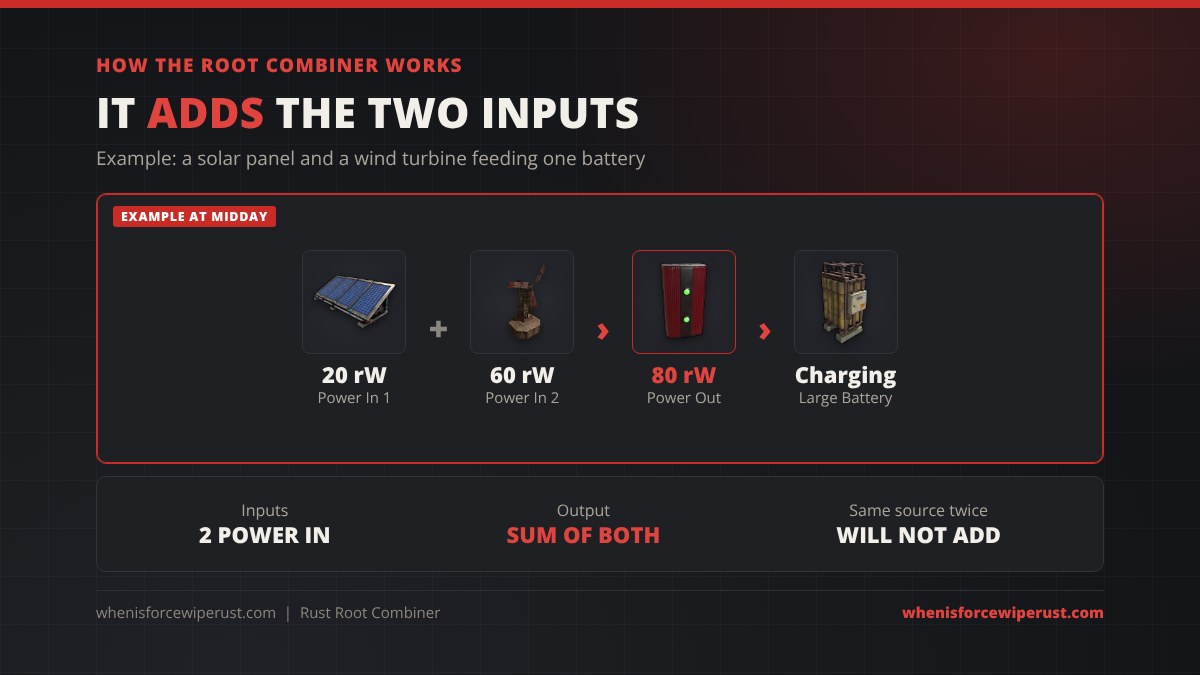
The combiner does one thing: it adds. If a solar panel sends 20 rW into Power In 1 and a wind turbine sends 60 rW into Power In 2, the Power Out socket gives 80 rW. When one source drops (the sun goes down, the wind dies), the output drops with it, and the other source keeps going.
- Take the Wire Tool and click the Power Out of your first source.
- Click Power In 1 on the root combiner.
- Wire your second source’s Power Out into Power In 2.
- Run the combiner’s Power Out into your battery’s Power In, or straight into a device.
- Hover over the combiner with the wire tool to check the total it is passing.
The combiner itself uses no power, so you lose nothing by adding one. It also will not count the same power twice: two wires that both come from one source do not add up, so you cannot loop a single panel into both sockets to double it.
What Can You Plug Into a Root Combiner?
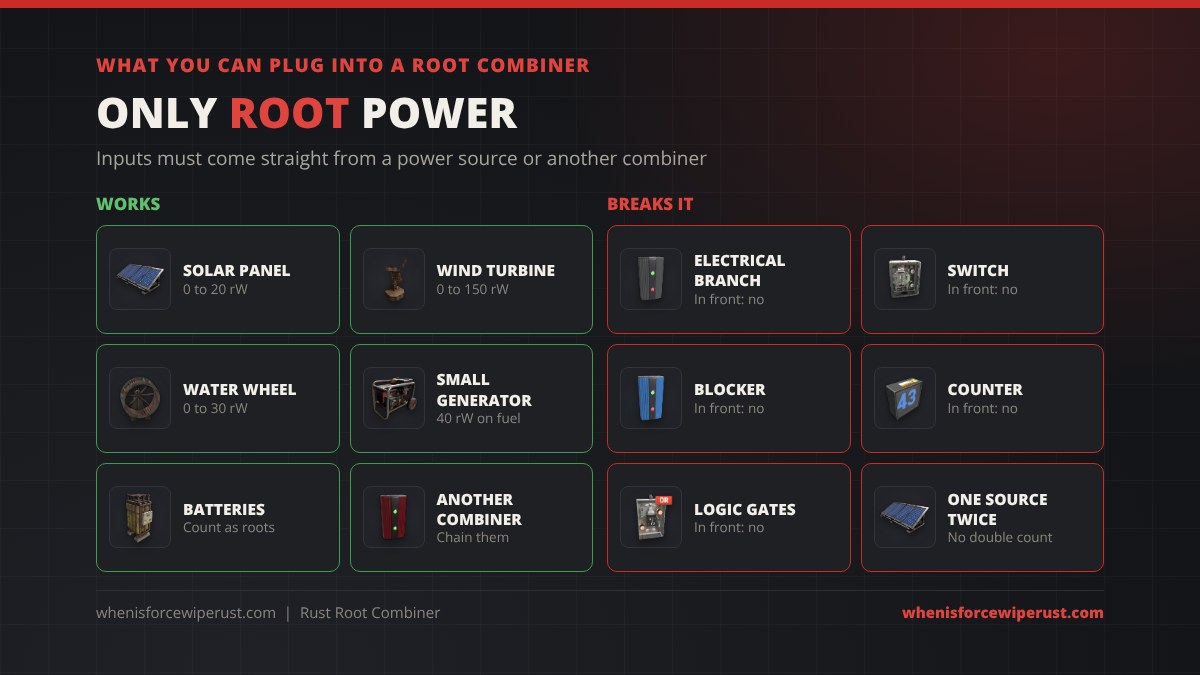
This is the rule that catches everyone. Each input must come directly from a root: something that makes or stores power.
| Into a combiner input | Works? | Notes |
|---|---|---|
| Large Solar Panel | Yes | 0 to 20 rW, daytime only |
| Wind Turbine | Yes | 0 to 150 rW, higher up is better |
| Water Wheel | Yes | 0 to 30 rW in water |
| Small Generator | Yes | 40 rW while it burns low grade fuel |
| Test Generator | Yes | 100 rW, creative and admin servers |
| Rechargeable batteries | Yes | Count as roots, see the battery section below |
| Another Root Combiner | Yes | This is how you chain them |
| Electrical Branch | No | Put the branch after the combiner instead |
| Switch, Blocker, Timer, Counter | No | Logic parts in front stop it combining |
| AND, OR, XOR gates, sensors | No | Same rule, they are not roots |
If you want to switch a source on and off, do it after the combiner or after the battery, never between the source and the combiner.
How to Chain Root Combiners
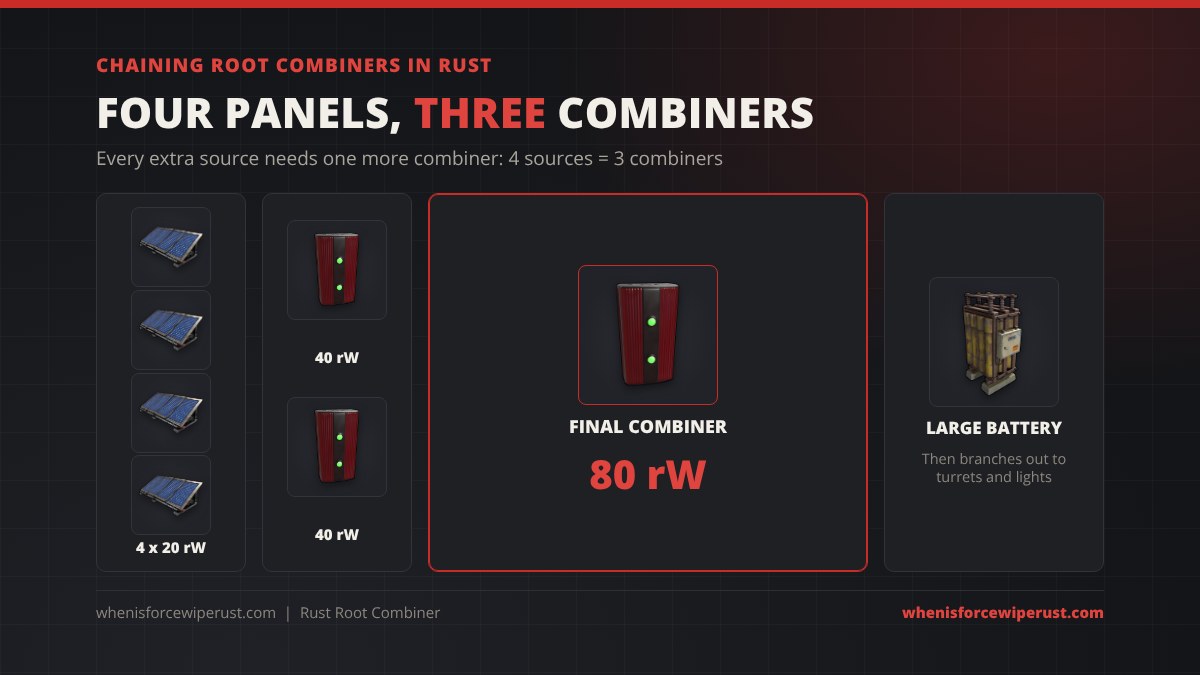
One combiner takes two inputs, but a combiner’s output counts as a root, so you can feed it into another combiner. Build them in pairs like a tournament bracket:
- 2 sources: 1 combiner.
- 3 sources: 2 combiners (combine two, then add the third).
- 4 sources: 3 combiners (two pairs, then one to join them).
- 6 panels: 5 combiners, 375 metal fragments.
The rule is simple: sources minus one. A full roof of solar panels needs a lot of combiners, but at 75 frags each they are the cheapest part of the build.
Root Combiner and Batteries
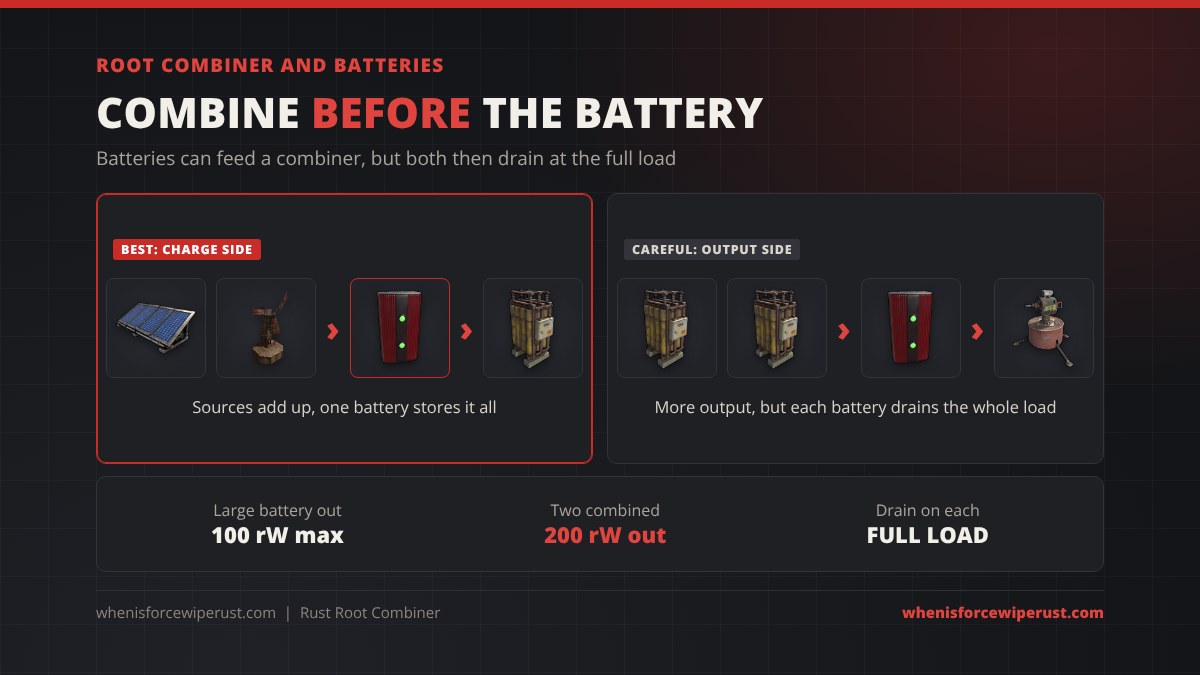
There are two ways to use a combiner with batteries, and only one is a good idea most of the time.
- Charge side (best): sources into the combiner, combiner into one battery. All your power goes into storage, and the battery smooths out the night and the calm days. This is the standard layout in our solar panel guide.
- Output side (careful): two batteries into a combiner, combiner into your devices. A Large Battery gives up to 100 rW, so two combined can push about 200 rW, enough for a heavy load like a SAM site line or a wall of turrets. The catch is that each battery drains at the full load rather than half of it, so both empty much faster than you expect.
Root Combiner vs Splitter vs Electrical Branch
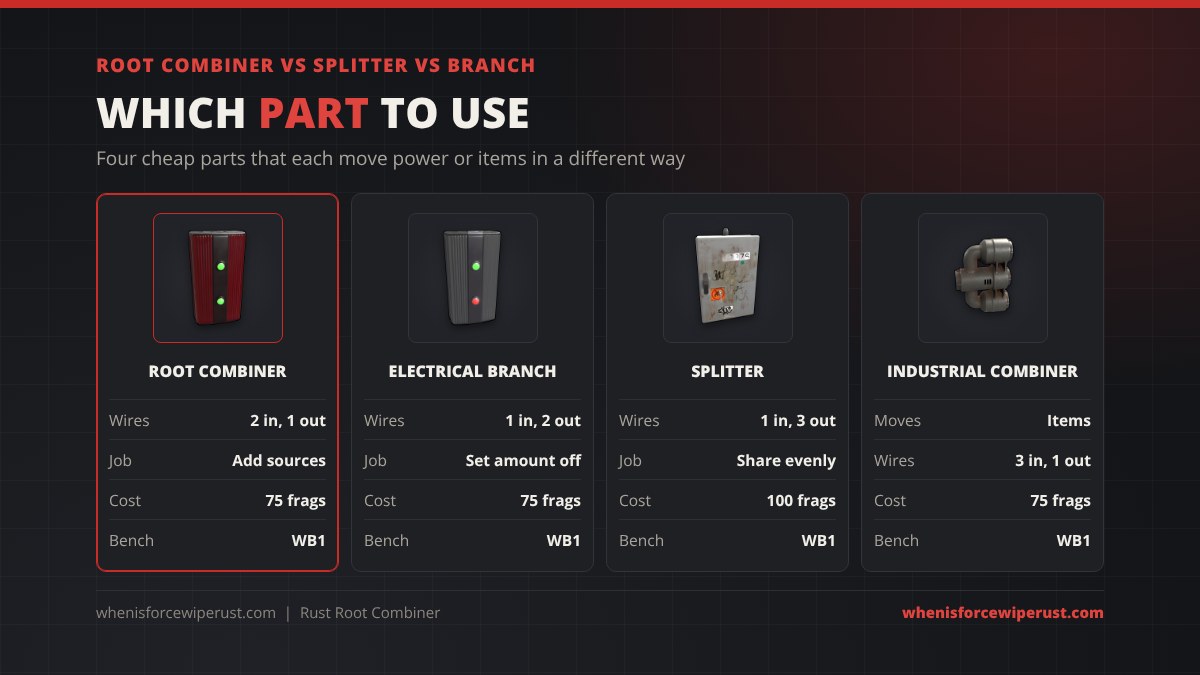
| Part | Cost | Sockets | Job |
|---|---|---|---|
| Root Combiner | 75 frags, WB1 | 2 in, 1 out | Adds two power sources together |
| Electrical Branch | 75 frags, WB1 | 1 in, 2 out | Sends a set amount to one device, passes the rest on |
| Splitter | 100 frags, WB1 | 1 in, 3 out | Shares power evenly between up to three outputs |
| Industrial Combiner | 75 frags, WB1 | 3 in, 1 out | Merges item lines from industrial conveyors, not power |
| Fluid Combiner | 75 frags, WB1 | 3 in, 1 out | Merges water hoses, see our fluid switch guide |
Combiners bring power together, branches and splitters spread it out. A full base grid usually uses all three: combiners on the roof, one battery in the core, then a chain of branches to each device.
Best Root Combiner Setups
- Solar starter: 2 solar panels → 1 combiner → small or medium battery → branch → electric furnaces or lights. Cheap and silent.
- Day and night mix: solar panel + wind turbine → combiner → large battery. Solar covers the day, the turbine covers the night.
- Water base: water wheel + solar panel → combiner → battery. The wheel runs all night in a river or lake.
- Turret core: 4 solar panels + wind turbine → 4 combiners → large battery → branches set to 10 rW each for auto turrets.
- Backup generator: solar line + small generator → combiner → battery. Turn the generator on for a quick top-up when the battery runs low.
Root Combiner Not Working? Common Fixes
- Output shows 0: something that is not a root sits between a source and the combiner. Rewire the source straight into the combiner.
- Output is lower than expected: check each source with the wire tool. Solar panels drop to 0 at night and wind turbines change with height and wind.
- Only one input counts: both wires may come from the same source. Each socket needs its own source or its own combiner.
- Battery not charging: the battery’s own output may be feeding back toward the combiner. Keep the line one way: sources, combiner, battery, devices.
- Batteries draining fast: you combined batteries on the output side. Move the combiner to the charge side.
Rust Root Combiner Tips

- Combine first, store second. Combiners go between your sources and your battery.
- Keep the wires direct. No branches, switches or gates in front of a combiner.
- Hide it in the core. Combiners, batteries and branches die to a single explosive, so keep them behind your tool cupboard where raiders cannot cut your turrets from outside.
- Mix sources. A turbine or water wheel next to solar panels keeps the battery charging after dark.
- Research it early. At 40 scrap it is one of the cheapest electrical blueprints, and almost every power build needs one.
- Remember the wipe. Blueprints usually reset with the server. Check when the next force wipe is.
Rust Root Combiner FAQ
What does a root combiner do in Rust?
A root combiner adds two power sources together. It has two Power In sockets and one Power Out, and the output is the total of both inputs, so two solar panels or a panel and a wind turbine can feed one battery.
How do you craft a root combiner in Rust?
Craft a root combiner from 75 metal fragments at a Workbench 1. You need the blueprint first, which costs 40 scrap at a research table or on the Engineering Workbench tech tree.
Why is my root combiner not working?
Both inputs must come straight from a power source such as a solar panel, wind turbine, water wheel, generator or battery, or from another root combiner. A branch, switch, blocker, timer or logic gate between the source and the combiner stops it working. Two wires from the same source also will not add up.
Can you combine solar panels and a wind turbine in Rust?
Yes. Wire the solar panel into Power In 1 and the wind turbine into Power In 2 of a root combiner, then run the combiner’s output into a battery. The battery gets both sources added together.
How many root combiners do you need?
You need one fewer combiner than you have sources. Two sources need one combiner, four sources need three, and six solar panels need five.
Does a root combiner use power in Rust?
No. The root combiner draws 0 rW itself, so all the power from both inputs comes out of its output.
Can you put batteries into a root combiner?
Yes, batteries count as root sources. Two large batteries combined can give about 200 rW, but each battery drains at the full load, so it is usually better to combine your sources before a single battery.
What is the difference between a root combiner and a splitter?
A root combiner brings two power sources into one output. A splitter does the opposite: it takes one input and shares it evenly between up to three outputs. The splitter costs 100 metal fragments, the combiner 75.
What is the root combiner item ID in Rust?
The root combiner uses the shortname electrical.combiner and the item ID -458565393.
Sources and Further Reading
- Recipe, workbench, craft time, research cost, stack size and item ID: Rust game item files (items.craft.json, October 2026 build)
- Item description and stats: Facepunch Wiki, Root Combiner
- Power draw and battery behaviour: The RUST Electrical Handbook, Distribution Systems
- Input rules and setups: Corrosion Hour, Power Minute: Root Combiner