
An airdrop is the closest thing Rust has to free money falling from the sky. A cargo plane drones across the map, an army-green crate tumbles out of it under a parachute, and everyone within earshot drops what they are doing to race for it. Inside is a randomised pile of loot: ammo, high quality metal, scrap, grenades, sometimes C4 or a rifle, and every single drop guarantees a pair of Basic Blueprint Fragments. It is free, it is open to anyone, and it is one of the most reliable ways to kick a wipe into gear.
The catch is that a Rust airdrop is never really free. That slow parachute is a flare that pulls in every player nearby, so a supply drop is as much a PvP event as a loot event. Whether it falls at a random spot because the server called it, or lands on your own position because you threw a Supply Signal, the loot only counts if you can hold the ground long enough to open the crate.
This guide covers the whole thing: what an airdrop is, the two ways one appears, how supply signals work and where you get them, the full loot table, how the drop plays out from plane to crate, and how to actually win the fight for one. Every mechanic here is checked against the Facepunch wiki and Corrosion Hour, not guessed.
- What Is an Airdrop
- Two Ways to Get One
- How Supply Signals Work
- Airdrop Loot Table
- How a Drop Plays Out
- Signal vs Random Drop
- Calling One at the Excavator
- How to Win an Airdrop
- FAQ

What Is an Airdrop in Rust?
An airdrop, officially a supply drop, is a loot crate delivered by a server-controlled cargo plane that flies across the map and releases the crate mid-flight. The crate is an army-green box that floats down under a parachute, giving it a slow, obvious descent that anyone nearby can see and run toward. When it lands, you open it like any other container and take whatever the game rolled inside.
What makes airdrops special compared to the rest of the loot in Rust is that they are a public event. A hackable locked crate makes you wait out a timer, and a monument puzzle needs keycards, but a supply drop has none of that. There is no lock, no hack and no keycard. The only barrier between you and the loot is every other player who also saw the parachute. That is the whole tension of an airdrop: the loot is guaranteed to be good, but so is the company.
Airdrops have been in Rust since the early days and remain one of the core world events, sitting alongside the Bradley APC, the patrol helicopter and the Cargo Ship. For a new player they are a fast route to gear you could not otherwise craft yet, and for a team they are a scheduled excuse to go looking for a fight with loot on the line.
The Two Ways to Get an Airdrop
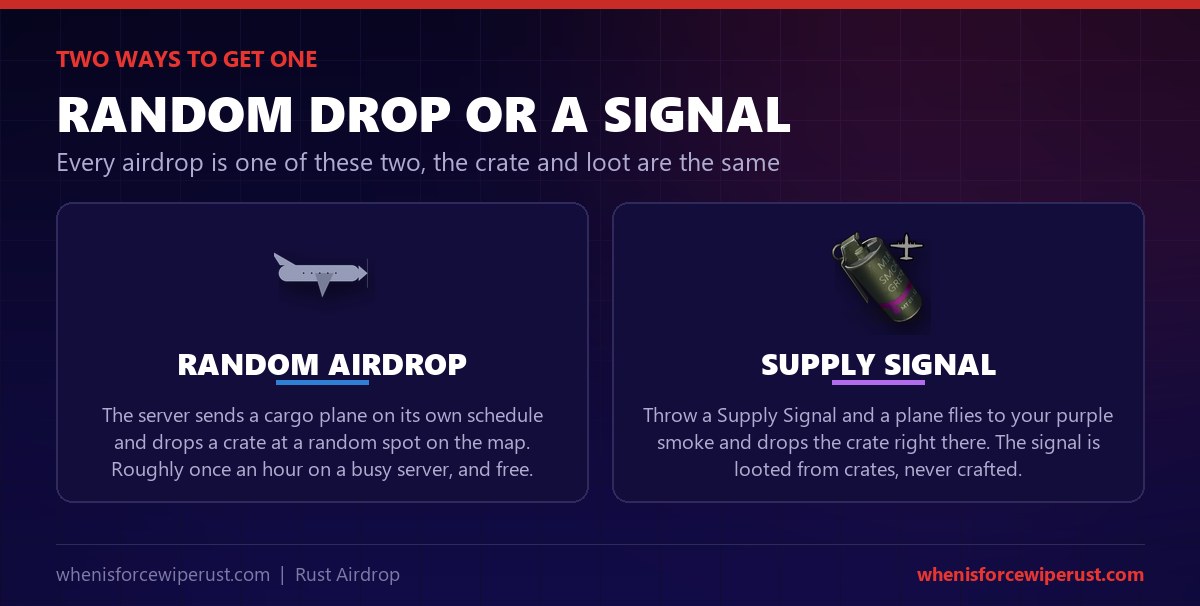
Every airdrop you will ever see comes from one of two triggers. The crate itself and the loot inside are exactly the same either way. The only thing that changes is whether the server picked the spot or you did.
The first is the random airdrop. The server runs its own event schedule and, on its own timing, sends a cargo plane over the map to drop a crate at a random location. There is no reliable countdown you can read, and the frequency scales with how busy the server is. On a high-population server you might see several drops an hour, while on a near-empty server you can play a whole session without one. It is free loot for whoever happens to be closest and willing to fight for it.
The second is the Supply Signal. This is a throwable item that calls a plane to a location you choose, marked by a tall column of bright purple smoke. Throw one and the plane routes to your smoke and drops the crate right there. That makes the signal the only way in the game to decide exactly where an airdrop lands, which is powerful and dangerous in equal measure, because that purple smoke is visible from a long way off.
How Supply Signals Work in Rust
The Supply Signal is the item that turns an airdrop from something you wait for into something you summon. It is a small grenade-like device that, when thrown, releases purple signal smoke and calls in a plane. Here is the important part that trips up new players: you cannot craft a Supply Signal. There is no blueprint for it. The only way to get one is to loot it.
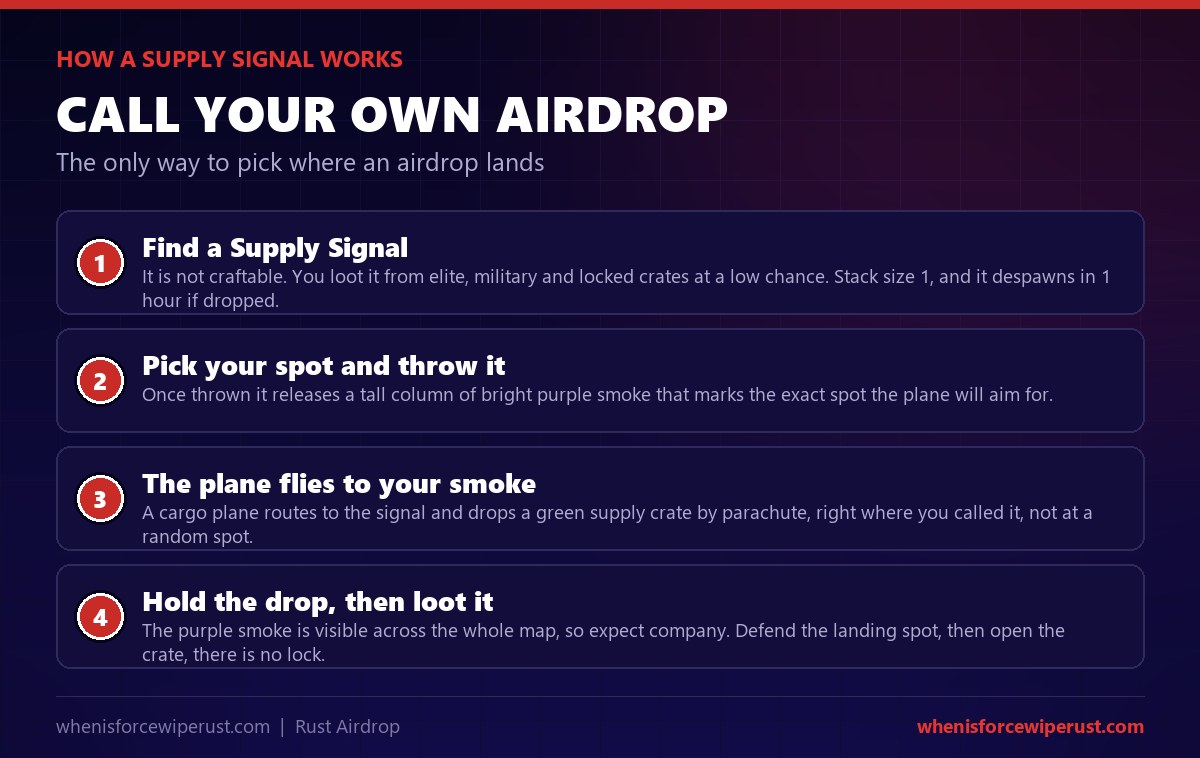
Supply Signals drop from the better loot containers in the game: elite crates, military crates and locked crates, the kind you find at high-tier monuments, in Military Tunnels, and from Oil Rig hackable crates. The drop chance is low, roughly in the low single digits of a percent per crate, so a signal is genuinely a small prize in its own right. The item has a stack size of 1 and, if you drop it on the ground, it despawns after about an hour, so do not leave it lying around.
Using one is simple. Once you are somewhere you are happy to fight, you throw the signal like a grenade. It lands, hisses out a thick column of purple smoke, and the cargo plane is dispatched to that smoke. After a short flight the plane arrives overhead and releases the crate, which parachutes down onto the marked spot. From there it is a normal supply drop: no lock, open it and loot it, assuming nobody takes it off you first.
Rust Airdrop Loot Table
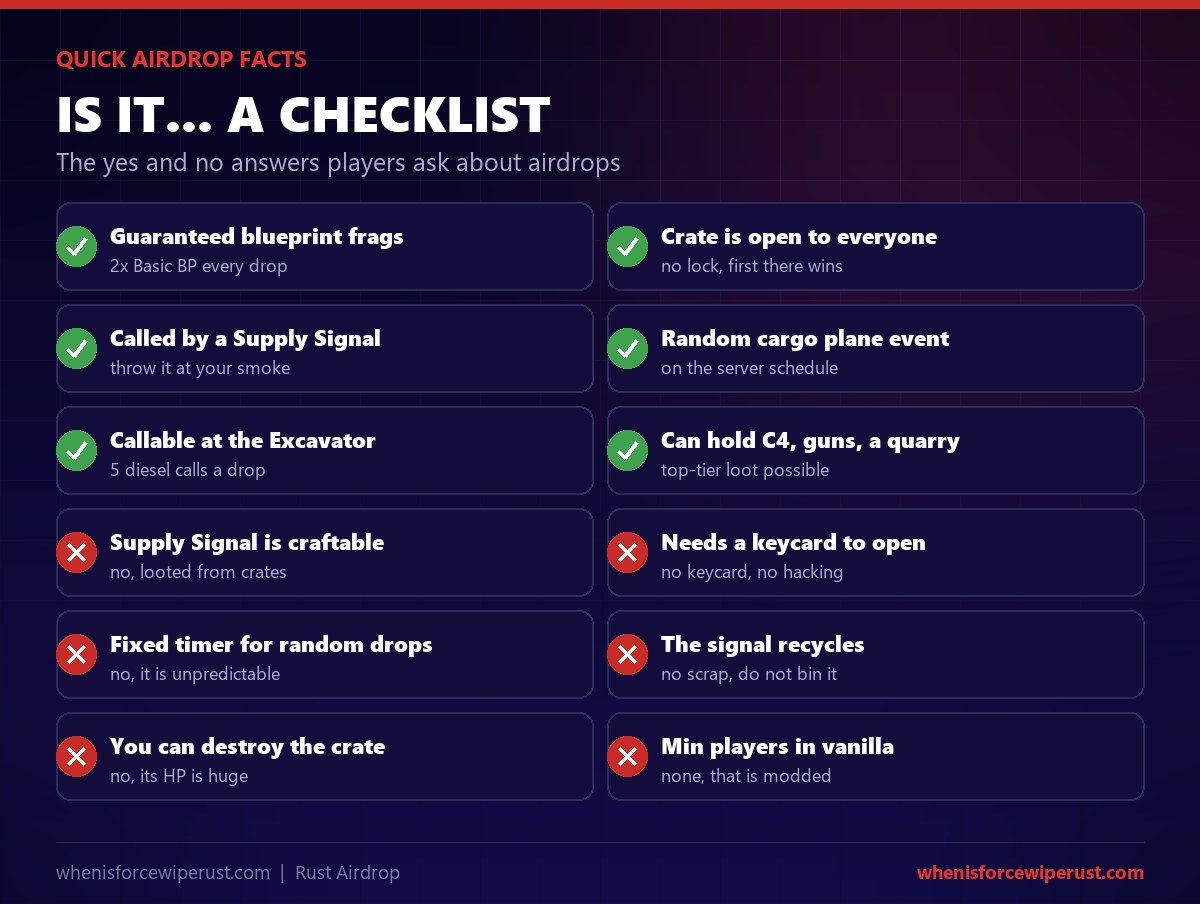
The reason anyone sprints toward a parachute is the payout. An airdrop rolls its contents from a large pool, so no two crates are identical, but there is one thing you can always count on: every airdrop guarantees 2x Basic Blueprint Fragments, which feed straight into the blueprint and tech tree progression. Everything else is a chance-based roll.
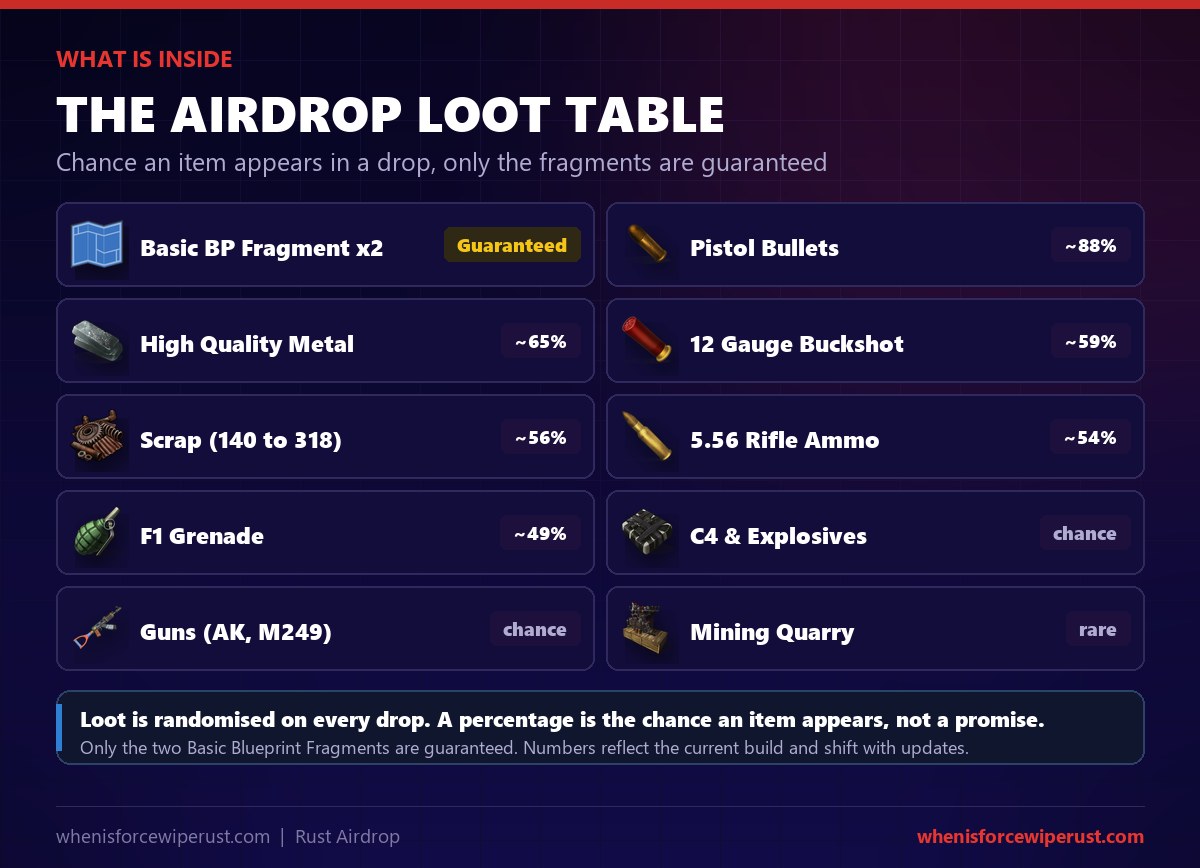
Below are the most common rolls in the current build. A percentage is the chance an item shows up in a given drop, not a promise, and these numbers drift a little with each update, so treat them as a guide to what a crate tends to contain rather than fixed law.
| Item | Roughly how often | Notes |
|---|---|---|
| Basic Blueprint Fragment x2 | Guaranteed | Always in every drop |
| Pistol Bullets | ~88% | The most common roll |
| High Quality Metal | ~65% | Always useful |
| 12 Gauge Buckshot | ~59% | Shotgun ammo |
| Scrap | ~56% | Around 140 to 318 |
| 5.56 Rifle Ammo | ~54% | Feeds the AK and others |
| F1 Grenade | ~49% | Handy for the fight over the crate |
| C4 and explosives | Chance | The jackpot roll for raiders |
| Guns (AK, M249 and more) | Chance | Occasionally a full weapon |
| Mining Quarry | Rare | One of the standout drops |
The takeaway is that an airdrop is reliably worth your time. Even a plain drop hands you ammo, HQM, scrap and blueprint fragments, and the best drops can spit out C4, a rifle or a quarry. That range is exactly why every airdrop pulls a crowd, because the person who walks away with the crate might be walking away with a fresh weapon and the explosives to raid you with next.
How an Airdrop Plays Out
Whether it is random or signalled, every supply drop follows the same five beats. Knowing them lets you read a drop from the first engine hum and get to the crate before the people who are still looking up trying to work out what the noise is.
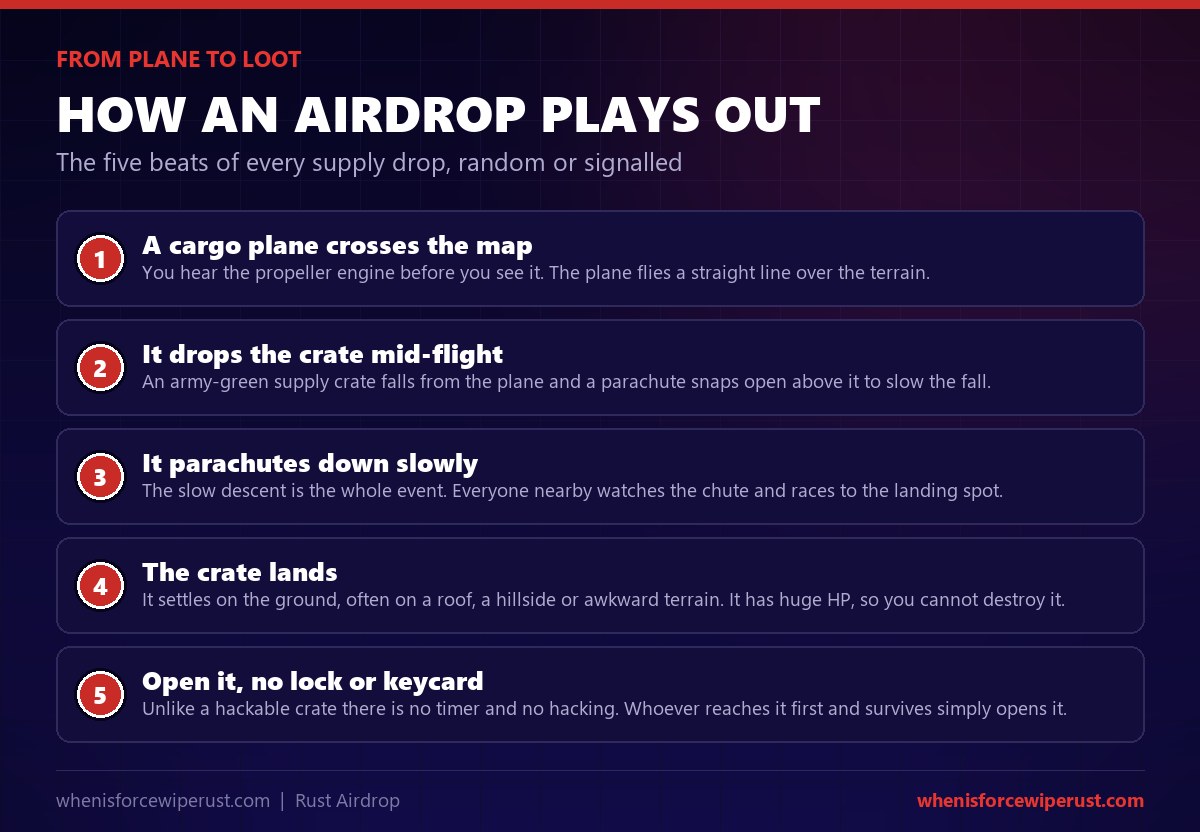
- The plane crosses the map. You hear the propeller engine before you see it. The cargo plane flies a straight line over the terrain toward the drop point.
- It releases the crate mid-flight. The army-green supply crate falls out of the plane and a parachute snaps open above it to slow the descent.
- The crate parachutes down. This slow float is the whole event. Anyone who can see the chute is now moving toward where it will land.
- It lands. The crate settles on the ground, often on a roof, a hillside or awkward terrain that decides who can actually reach it. It has huge health, so you cannot destroy it.
- You open it. No lock, no timer, no keycard, no hacking. Whoever gets to the crate and survives simply opens it and loots it.
Supply Signal vs Random Airdrop
Because the crate and loot are identical, choosing between waiting for a random drop and spending a Supply Signal comes down to control and cost. A signal buys you the power to pick the spot, at the price of a rare item and a giant purple sign over your head. A random drop costs you nothing but hands all the control to chance and geography.
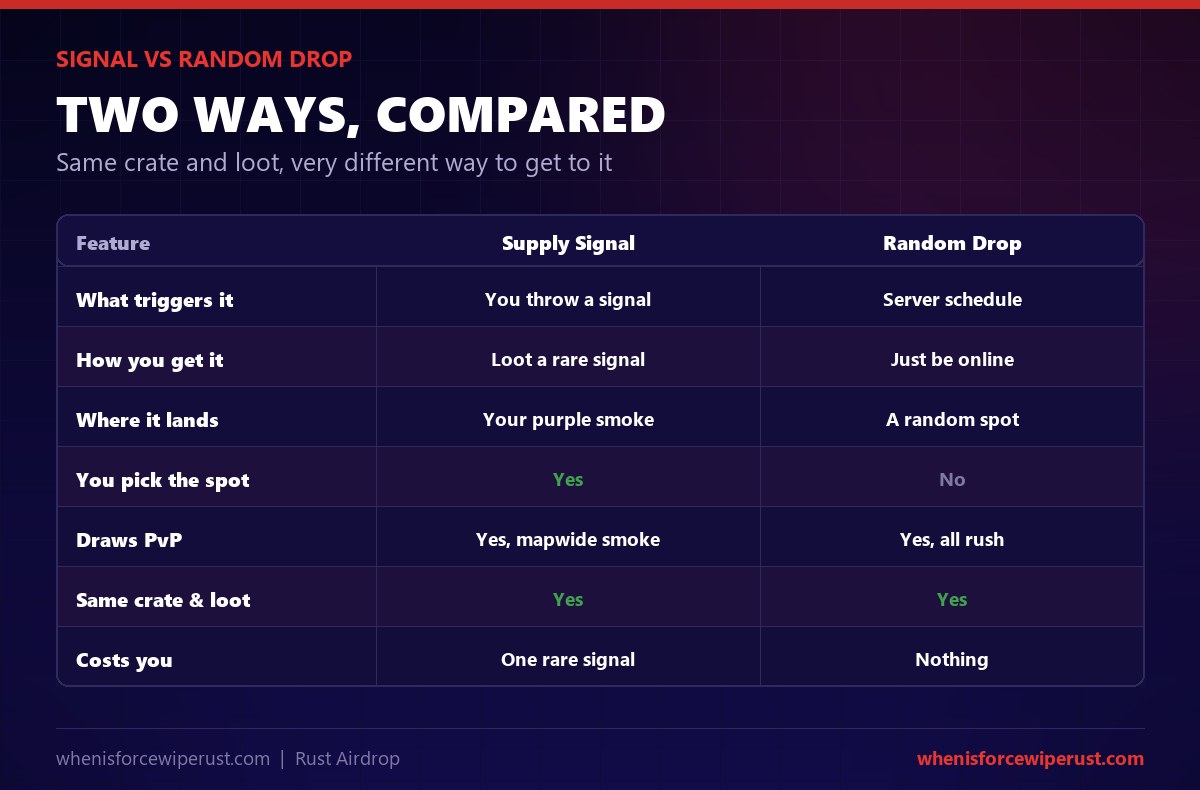
| Feature | Supply Signal | Random Airdrop |
|---|---|---|
| What triggers it | You throw the signal | The server schedule |
| How you get it | Loot a rare signal first | Just be online |
| Where it lands | Your purple smoke | A random spot |
| You pick the spot | Yes | No |
| Draws other players | Yes, mapwide smoke | Yes, everyone rushes |
| Crate and loot | Identical | Identical |
| Costs you | One rare signal | Nothing |
In practice, most players hoard signals for a reason: to drop a crate somewhere they hold the high ground, to bait enemies into a killbox, or to grab loot without leaving a base under siege. A random airdrop, by contrast, is an opportunity you react to. Both are worth chasing, they just ask different things of you.
Calling an Airdrop at the Giant Excavator
There is a third, less obvious way to pull an airdrop that does not need a signal at all. The Giant Excavator monument has an airdrop terminal next to its generator. Feed it fuel and, once it is fully charged, it calls a supply drop straight onto the monument.
The charge cost is about 5 diesel to reach 100 percent, the same fuel that powers the Excavator’s mining. That makes a trip to the Excavator a double payout: you can run the mining operation for ore and call an airdrop for bonus loot on the same tank of diesel. The obvious downside is the same as always, a called drop at a known monument is a magnet, so anyone else on the map who wants that crate knows exactly where to go.
How to Win an Airdrop in Rust
Getting to the crate is only half the job. Airdrops are PvP events first and loot events second, so the players who consistently come home with the loot treat them like a fight they planned, not a prize they stumbled into.
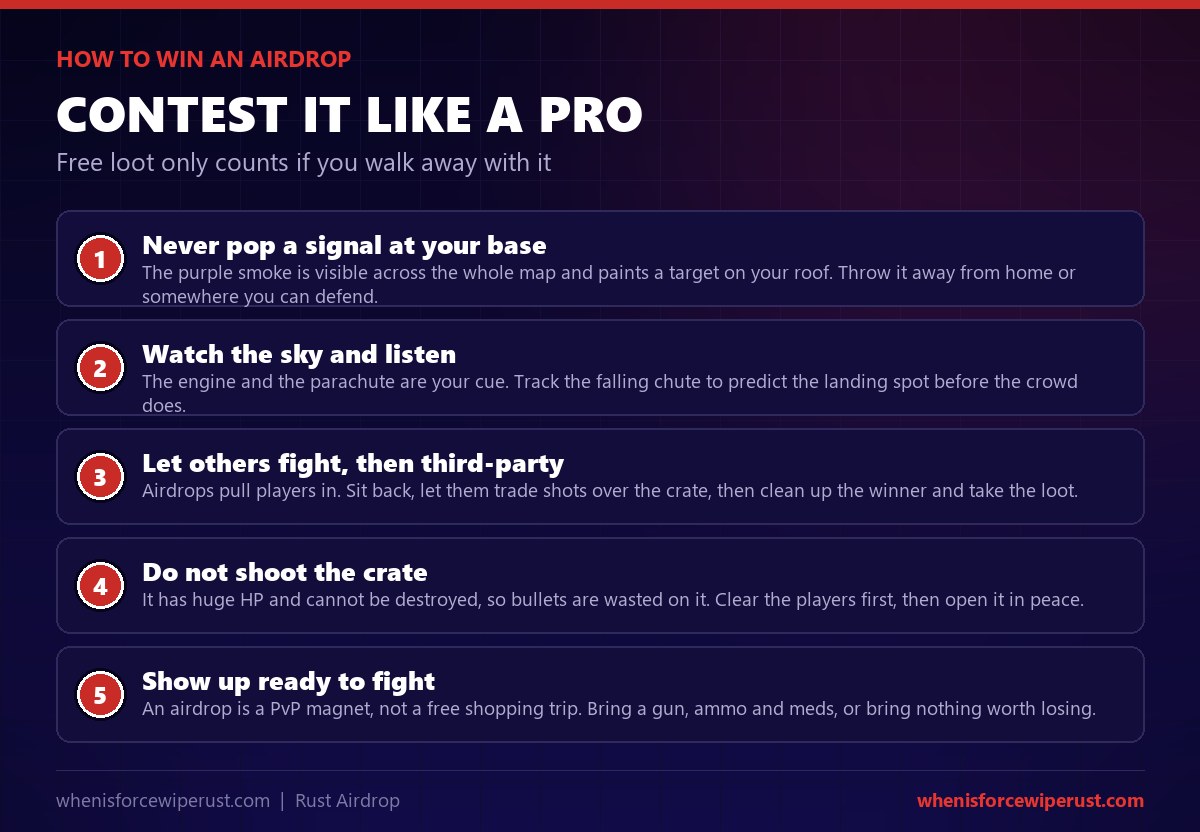
- Never pop a signal at your base. The purple smoke paints a target on your roof for the whole server. Throw signals away from home, or somewhere with cover you can defend.
- Watch the sky and listen. The engine and the parachute are your only tracker. Read the plane’s line and the chute’s drift to predict the landing spot before the crowd does.
- Let others fight, then third-party. Airdrops pull players in. Sitting back, letting them trade shots over the crate, then cleaning up the survivor is often the highest-value play.
- Do not shoot the crate. It has huge health and cannot be destroyed, so bullets fired at it are wasted. Clear the players first, then open it in peace.
- Show up ready to fight. An airdrop is a magnet, not a shopping trip. Bring a gun, ammo and meds, or bring nothing you would hate to lose on the way there.
Timing your wipe-day loot run? The monthly force wipe resets the whole map, every monument and all your loot and blueprints. Check the live countdown so you know exactly when the server starts fresh and the first airdrops of the wipe start falling.
See the Force Wipe CountdownRust Airdrop FAQ
What is an airdrop in Rust?
An airdrop, or supply drop, is a loot crate delivered by a server-controlled cargo plane. The plane flies over the map, drops an army-green crate mid-flight, and the crate parachutes slowly to the ground. It is open to anyone, with no lock, keycard or hacking, so whoever reaches it first and survives can open it. Every drop guarantees two Basic Blueprint Fragments plus a random roll of ammo, high quality metal, scrap, grenades and a chance at C4, guns or a mining quarry. Because the parachute is visible from far away, airdrops are a major PvP event.
How do you call an airdrop in Rust?
You call an airdrop by throwing a Supply Signal. It works like a grenade: throw it where you want the drop, it releases a column of purple smoke, and a cargo plane flies to that smoke and drops a supply crate by parachute. That is the only way to choose exactly where an airdrop lands. You can also call one at the Giant Excavator’s airdrop terminal for about 5 diesel, and random airdrops happen on their own on the server schedule without any input from you.
How do you get a Supply Signal in Rust?
Supply Signals are not craftable, so you can only get them by looting them. They drop from the higher-tier loot containers: elite crates, military crates and locked or hackable crates, the kind found at high-tier monuments, Military Tunnels and on the Oil Rigs. The drop chance is low, in the low single digits of a percent per crate, which is why a signal is treated as a small prize in itself. The item has a stack size of 1 and despawns about an hour after being dropped on the ground.
What is inside a Rust airdrop?
Every airdrop guarantees two Basic Blueprint Fragments. The rest is a random roll from a large pool. The most common rolls in the current build are pistol bullets (around 88 percent), high quality metal (around 65 percent), 12 gauge buckshot (around 59 percent), scrap of roughly 140 to 318 (around 56 percent), 5.56 rifle ammo (around 54 percent) and an F1 grenade (around 49 percent). Rarer rolls include C4 and explosives, full weapons such as the AK or M249, and occasionally a mining quarry. Percentages shift slightly with each game update.
Is an airdrop crate locked in Rust?
No. Unlike a hackable locked crate, a supply drop is not locked and has no unlock timer. There is no keycard and no hacking involved. When the crate lands you simply open it and take the loot. The only thing standing between you and the contents is other players, since the slow parachute draws a crowd. The crate also has very high health, so you cannot destroy it by shooting it, you have to reach it and open it.
How often do airdrops happen in Rust?
Random airdrops are on the server’s own event schedule and do not follow a countdown you can read. Roughly speaking you can expect around one an hour on a reasonably busy server, but it scales with population: a high-population server can see several an hour, while a near-empty server may go a whole session without one. There is no fixed timer in vanilla Rust, and any minimum-player requirement you see mentioned comes from server plugins, not the base game.
Can you call an airdrop at the Giant Excavator?
Yes. The Giant Excavator monument has an airdrop terminal next to its generator. You charge it with diesel, and once it reaches 100 percent, which costs about 5 diesel, it calls a supply drop directly onto the monument. This is handy because diesel also powers the Excavator’s mining, so a single fuel run can both mine ore and call a bonus airdrop. The downside is that a drop called at a known monument is easy for other players to contest.
Does a Supply Signal recycle for anything?
No. A Supply Signal cannot be recycled and returns no scrap or components, so there is no point putting one in a recycler. If you are not going to use it, it is more valuable traded or kept. Since it is not craftable and only drops from good crates at a low rate, most players either save signals for a planned drop or throw them for the guaranteed loot rather than binning them.
How long after throwing a Supply Signal does the plane arrive?
Not instantly. After you throw a signal and the purple smoke starts, the cargo plane is dispatched and flies in from off the map, so there is a short delay of a couple of minutes while it travels to your smoke and lines up the drop. Then the crate is released and parachutes down, which adds more time. In total, expect it to take a little while from throw to lootable crate, which is exactly the window in which rival players who saw the smoke can converge on you.
Can you shoot down or destroy an airdrop crate?
No. The supply crate has very high health and is effectively indestructible, so firing at it in the air or on the ground just wastes ammo. You also cannot shoot down the cargo plane. The only way to get the loot is to reach the crate where it lands and open it. Because of this, the smart play at a contested drop is to ignore the crate entirely until the players around it are dealt with, then walk up and open it safely.
Where does a random airdrop land?
A random airdrop lands at a random location chosen by the server, which could be anywhere on the map: open fields, hills, monuments, even on top of a base or awkward terrain. There is no marker, so you find it by spotting the plane and tracking the parachute. Because the spot is random and the descent is slow, whoever is physically closest usually has the advantage, which is why players who live near the map center or a busy area tend to contest more drops.
Is it worth throwing a Supply Signal?
It depends on your situation. The loot is the same as a random drop, so a signal is not about better rewards, it is about control. It is worth throwing when you want a crate in a spot you can defend, when you want to bait enemies into a fight on your terms, or when you want guaranteed loot without leaving your area. It is not worth throwing carelessly near your base, because the purple smoke advertises your location to the whole server and can invite a rush or a raid.
What is the difference between a supply signal and a random airdrop?
They deliver the exact same crate with the same loot table. The difference is the trigger and the control. A random airdrop is sent by the server on its own schedule and lands at a random spot for free, so you react to it. A supply signal is a rare item you throw to call a plane to your own purple smoke, so you choose the landing spot, at the cost of the signal and a very visible smoke column. One is opportunity, the other is control.
Do airdrops need a minimum number of players online?
Not in vanilla Rust. The base game has no minimum-player requirement for random airdrops, they simply run on the server’s event schedule, though drops naturally feel rarer on empty servers. Some community servers add a minimum-players rule or change the frequency through plugins, so behaviour can vary from server to server. Supply Signals always work regardless of population, since you are the one triggering the drop by throwing the item.
Sources and Further Reading
- Supply Signal item facts, obtain sources and despawn: Facepunch Wiki, Supply Signal
- How the airdrop and cargo plane event works: Corrosion Hour, RUST Airdrop Command and Tips
- Supply Signal loot sources and usage: Corrosion Hour, Supply Signal
- Diesel fuel and the Excavator airdrop terminal: Corrosion Hour, Diesel Fuel
- Where signals drop and where to call a crate: whenisforcewiperust.com, Giant Excavator Guide
- What the blueprint fragments feed into: whenisforcewiperust.com, Rust Blueprints Guide
- The game itself: Facepunch Studios