
 By
The Splitter is the simplest way to send one power line to three places in Rust. You wire a battery, solar panel or generator into its single input, and it shares that power evenly across up to three outputs. It is cheap, it needs no settings, and it draws nothing itself. It also wastes power when you use it the wrong way, which is why most builders end up mixing it with the Electrical Branch.
This Rust splitter guide covers the exact craft and research cost, how the power is divided, the one catch that trips up new builders, when a splitter beats a branch or a Root Combiner, the best setups, and the two other splitters in the game: the Industrial Splitter for conveyors and the Fluid Splitter for water.
electric.splitter, ID -563624462) costs 100 Metal Fragments at a Workbench Level 1 and researches for 20 scrap, or 5 Blueprint Fragments in total on the Engineering Workbench tech tree. It has 1 input and 3 outputs, and each output gets the input divided by the number of outputs you actually use: 30 rW in gives 30 to one output, 15 each to two, or 10 each to three. It draws no power of its own. Use it when every output needs the same amount. For mixed devices, use an Electrical Branch. The Industrial Splitter (75 frags) does the same 1 into 3 job for conveyor pipes and the Fluid Splitter (75 frags) for water hoses.
- What It Does
- Craft & Research
- How Power Divides
- The Big Catch
- vs Branch & Combiner
- Best Setups
- Industrial Splitter
- Fluid Splitter
- Tips
- FAQ
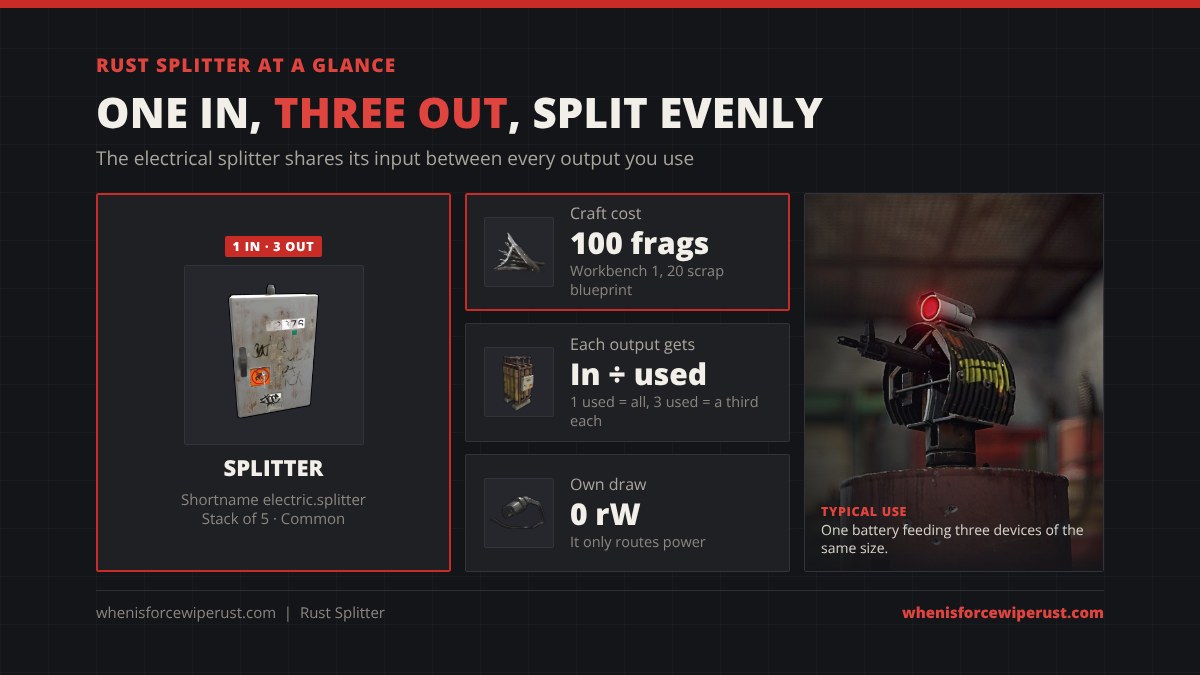
What Does the Splitter Do in Rust?
The game’s own description is short: it “splits an electrical signal into 3 multiple signals. The amount passed through is equal to the input amount divided by the number of used output slots.” That is the whole item. It has one Power In socket and three outputs, Power Out 1, 2 and 3, and you connect them with the Wire Tool like every other part of Rust electricity.
There is nothing to set. You cannot open it, you cannot give one output more than another, and it does not care what is plugged in. It simply looks at how much power is coming in, counts how many of its outputs have a wire on them, and gives each one the same share. Because it has no logic of its own it draws no power, unlike the Electrical Branch, which takes 1 rW for itself.
Splitter Craft Cost and Research
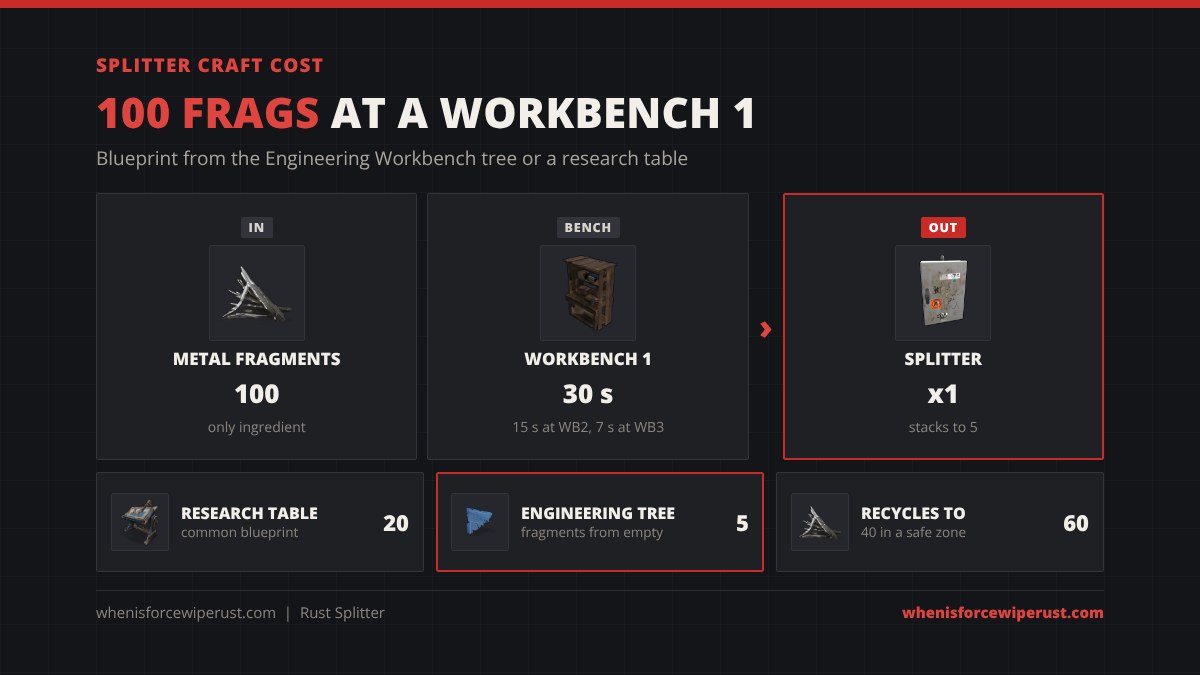
| Stat | Splitter |
|---|---|
| Craft cost | 100 Metal Fragments |
| Workbench | Level 1 |
| Craft time | 30 s at Workbench 1, 15 s at Workbench 2, 7 s at Workbench 3 |
| Research cost | 20 scrap at a Research Table (common) |
| Tech tree | Engineering Workbench, 5 Blueprint Fragments in total from an empty tree; the Electrical Branch comes right after it |
| Inputs / outputs | 1 Power In, 3 Power Out |
| Own power draw | 0 rW |
| Stack size | 5 |
| Despawn | 5 minutes |
| Recycle | 60 Metal Fragments (40 in a safe zone) |
| Repair bench | 20 Metal Fragments |
| Loot | Brown crates, wagon and Underwater Lab brown crates (about 1.3%), Underwater Lab advanced crates (1.1%), scientists (0.2%) |
| Shortname / ID | electric.splitter / -563624462 |
At 100 frags it is the most expensive of the basic routing parts. The branch and root combiner are 75 each. You can price a full wiring kit in our crafting calculator.
How the Splitter Divides Power
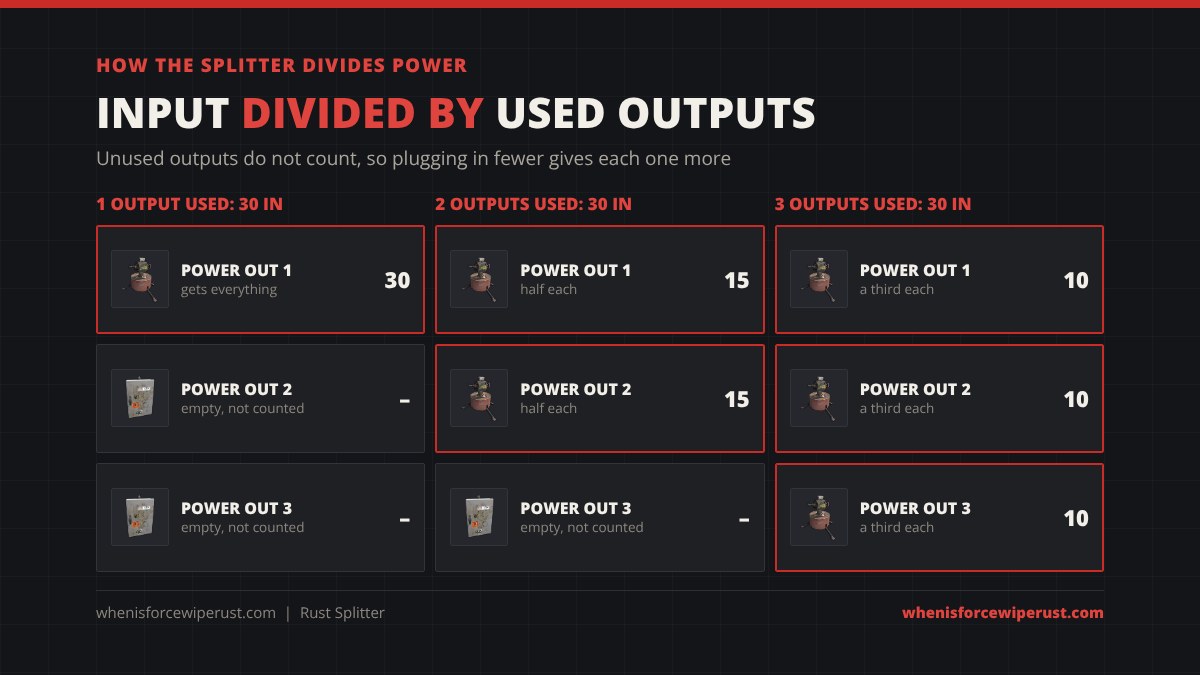
The rule is input divided by used outputs. Only outputs with a wire attached count, so the same splitter behaves very differently depending on how many devices you plug in:
| Power in | 1 output used | 2 outputs used | 3 outputs used |
|---|---|---|---|
| 30 rW (3 turrets’ worth) | 30 | 15 each | 10 each |
| 60 rW | 60 | 30 each | 20 each |
| 75 rW (3 SAM sites) | 75 | about 37 each | 25 each |
| 9 rW (3 furnaces) | 9 | about 4 each | 3 each |
A quick way to size the input: multiply the biggest device on the splitter by three. Three auto turrets at 10 rW need 30 rW in. Three SAM sites at 25 need 75. If the input is lower, every output is short by the same amount and every device on it can switch off at once.
The Splitter’s Big Catch: Even Is Not Smart
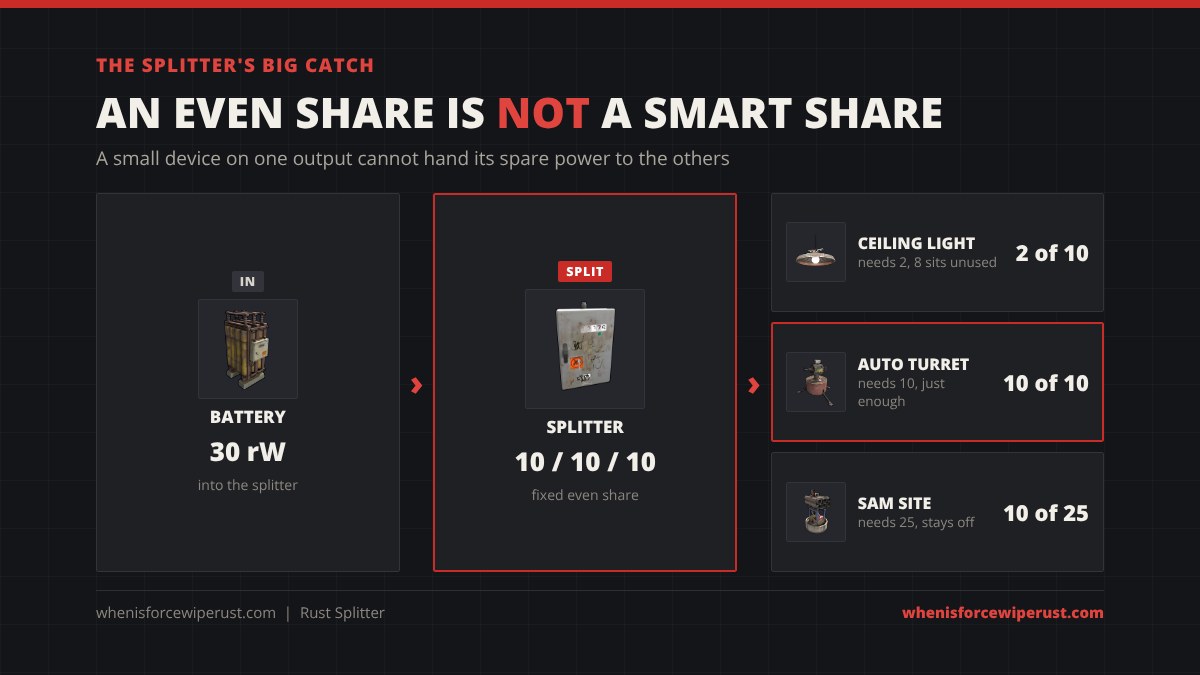
The splitter does not know what each device needs. Put a ceiling light (2 rW), an auto turret (10 rW) and a SAM site (25 rW) on one splitter fed with 30 rW, and each output still gets 10. The light uses 2 and the other 8 just sit there, the turret is fine, and the SAM site never turns on, even though the total input was close to enough.
That is why experienced builders say “use branches, not splitters” for most base wiring. An Electrical Branch sends an exact amount to one device and passes everything else on, so no output is ever given power it cannot use. Our electric furnace guide shows the same problem with a long furnace line.
Splitter vs Electrical Branch vs Root Combiner
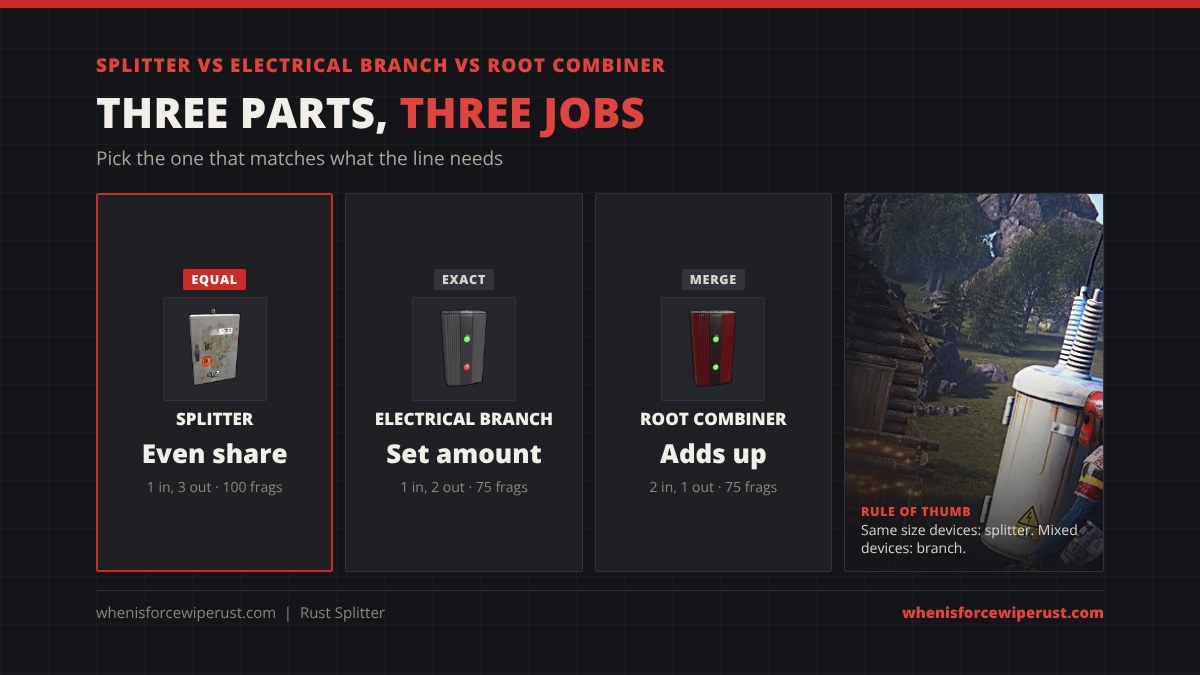
| Part | Cost | Ports | What it does | Own draw |
|---|---|---|---|---|
| Splitter | 100 frags, WB1 | 1 in, 3 out | Shares the input evenly between used outputs | 0 |
| Electrical Branch | 75 frags, WB1 | 1 in, 2 out | Sends a set amount out one side, the rest out the other | 1 rW |
| Root Combiner | 75 frags, WB1 | 2 in, 1 out | Adds two power sources together | 0 |
A clean base line usually uses all three: combine your solar panels and turbines with root combiners, store it in a battery, put a switch after the battery, then branch to each different device. The splitter fits at the end of that line where three identical devices sit together.
Best Splitter Setups
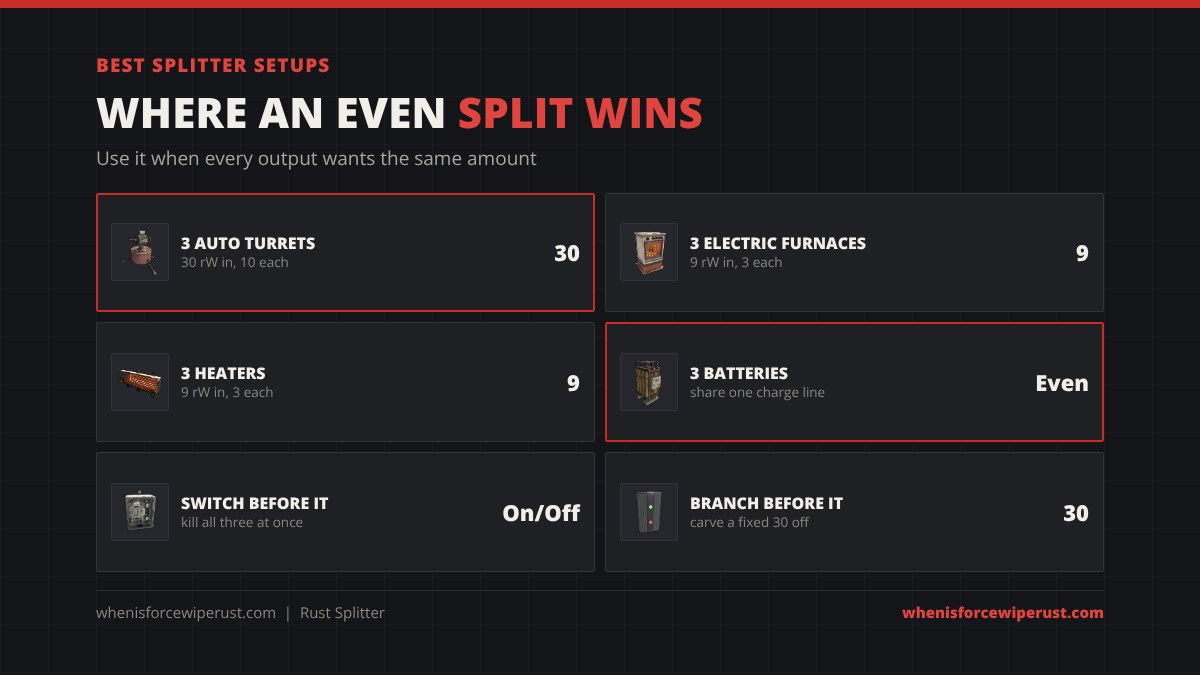
- Turret cluster. Branch exactly 30 rW off your main line, then split it into three auto turrets covering the same doorway or roof. Each gets its 10.
- Furnace or heater bank. Branch 9 rW into a splitter and feed three electric furnaces or three heaters at 3 rW each.
- Battery bank charging. Split one charge line into three batteries of the same size so they fill together.
- Quick test lines. On a fresh wipe a splitter is the fastest way to get three things running before you have the fragments for proper branches.
- Switch it first. A switch, smart switch or timer in front of a splitter turns all three outputs on and off together.
The trick in every setup is to put an Electrical Branch before the splitter. The branch decides the total, the splitter just shares it out evenly.
Industrial Splitter
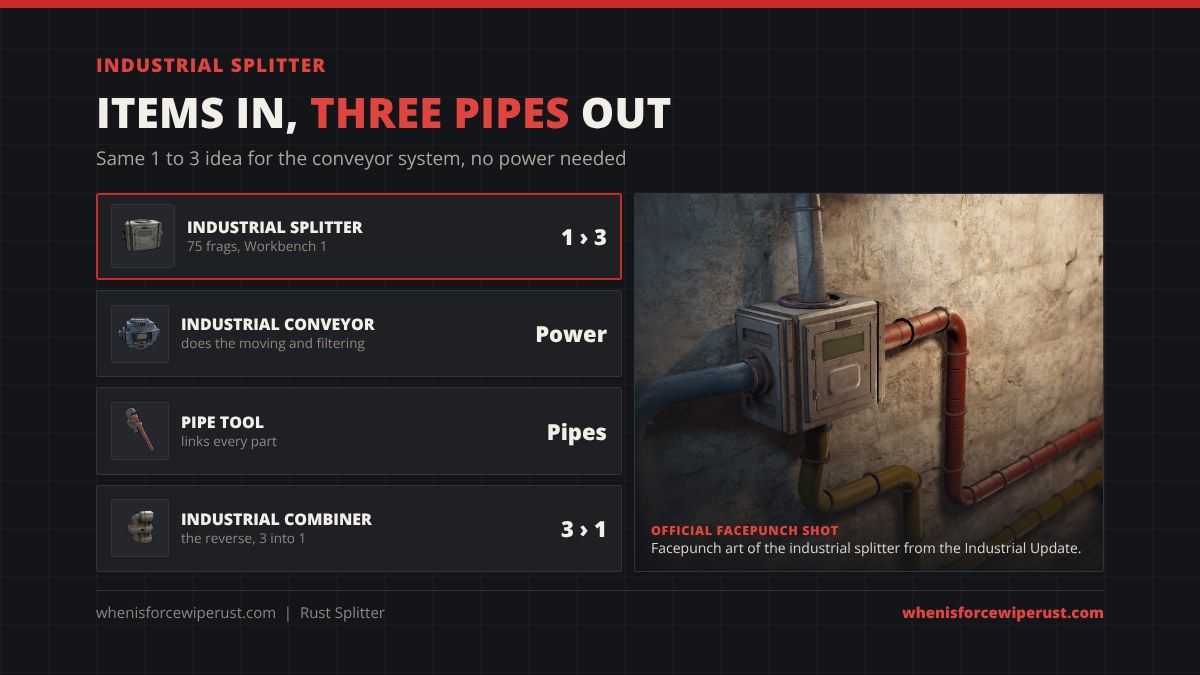
The Industrial Splitter (industrial.splitter, ID 742745918) arrived with the February 2023 Industrial Update. It “splits an industrial connection into three separate connections”, so one Industrial Conveyor line can feed three containers, such as three furnaces from one ore box. It has one Industrial In and three Industrial Out ports, you link it with the Pipe Tool, and it needs no power. The conveyor does the moving and the filtering.
| Stat | Industrial Splitter |
|---|---|
| Craft cost | 75 Metal Fragments, Workbench 1 (30 / 15 / 7 s) |
| Research | 20 scrap; 14 Blueprint Fragments in total on the Engineering tree |
| Ports | 1 Industrial In, 3 Industrial Out |
| Power | None |
| Recycle | 45 Metal Fragments (30 in a safe zone) |
| Stack / despawn | 5 / 5 minutes |
Every container on the far side needs its own Storage Adaptor. Remember that one conveyor can only see 16 containers across its network, so add a second conveyor instead of chaining splitter after splitter. The Industrial Combiner (75 frags) is the reverse part, merging three pipes into one.
Fluid Splitter
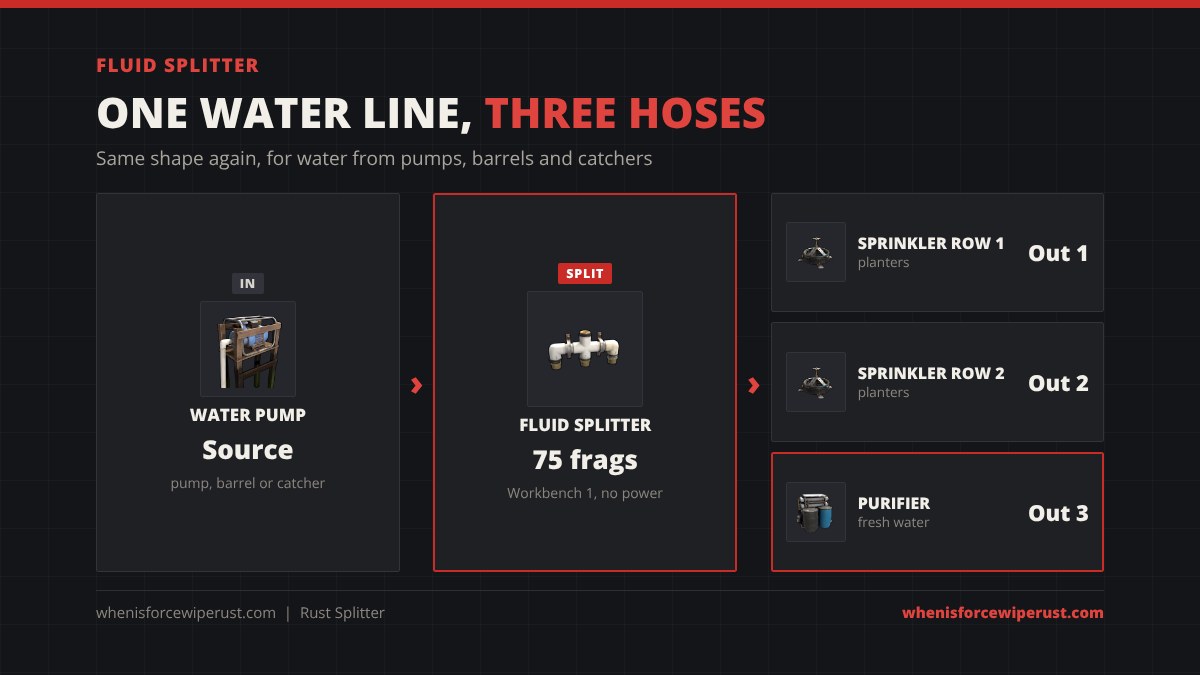
The Fluid Splitter (fluid.splitter, ID -1166712463) “splits a fluid connection into three separate connections”. It costs 75 Metal Fragments at a Workbench 1, researches for 20 scrap (9 Blueprint Fragments in total on the tree) and uses the Hose Tool instead of wires. Its classic job is a farm: one water pump or water barrel into the splitter, then hoses out to sprinkler rows over your planters and a purifier. To lift water uphill or turn a line on and off, pair it with the Fluid Switch & Pump.
Rust Splitter Tips
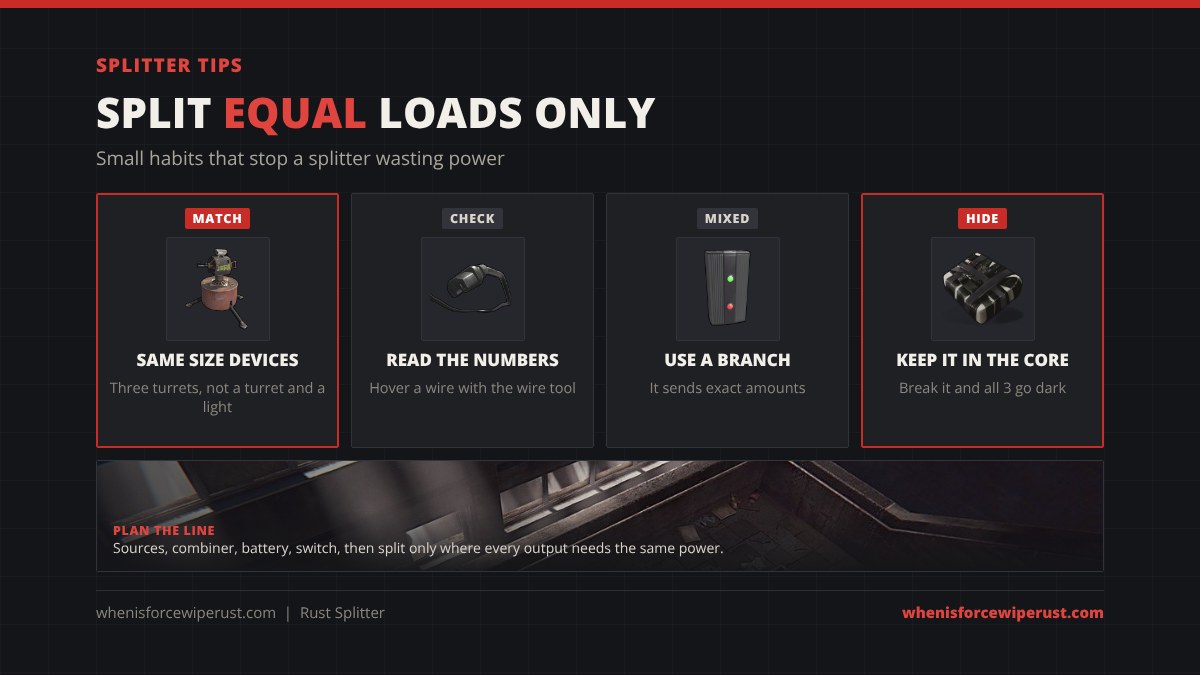
- Split equal loads only. Three turrets, three furnaces, three heaters. Never a turret, a light and a SAM.
- Leave outputs empty on purpose. Unused outputs are not counted, so a splitter with two wires gives each a half.
- Read the numbers. Hold the Wire Tool and look at a wire to see how much power is flowing through it.
- Branch first, split second. Let a branch set the total so the splitter can never take power your turrets need.
- Keep it in the core. One broken splitter shuts off all three outputs, so do not mount it on an outside wall.
- Pick it up with a hammer if you need to move it. Electrical parts lose some health when you do, so repair it after.
Rust Splitter FAQ
How much does a splitter cost in Rust?
The electrical Splitter costs 100 Metal Fragments at a Workbench Level 1. Researching it costs 20 scrap, or 5 Blueprint Fragments in total on the Engineering Workbench tech tree. The Industrial and Fluid Splitters cost 75 Metal Fragments each.
How does the splitter work in Rust?
It takes one power input and divides it evenly between the outputs that have a wire attached. 30 rW in gives 30 to one output, 15 each to two outputs or 10 each to three outputs.
Does the splitter use power?
No. The Splitter draws 0 rW itself and passes all of its input to the outputs. The Electrical Branch is the one that takes 1 rW for itself.
Is a splitter or an electrical branch better in Rust?
Use a branch when your devices need different amounts, because it sends an exact amount to each one and passes the rest on. Use a splitter only when all three outputs need the same power, such as three auto turrets or three electric furnaces.
How many outputs does a splitter have?
Three: Power Out 1, 2 and 3. It has one Power In. The Industrial Splitter and Fluid Splitter also go from one input to three outputs.
Why is my splitter not powering my device?
Each output only gets its share of the input. If you split 30 rW three ways, every output gets 10, so a SAM site that needs 25 stays off. Raise the input, use fewer outputs, or wire the big device to an Electrical Branch instead.
What does the industrial splitter do in Rust?
It splits one industrial pipe into three, so a single Industrial Conveyor line can feed three containers with storage adaptors. It costs 75 Metal Fragments at a Workbench 1 and needs no power.
What does a splitter recycle into?
The electrical Splitter recycles into 60 Metal Fragments at a normal recycler, or 40 in a safe zone. The Industrial and Fluid Splitters give 45, or 30 in a safe zone.
Where do you find a splitter in Rust?
Most players craft it. It also drops from brown crates, wagon crates and Underwater Lab brown crates at about 1.3%, Underwater Lab advanced crates at 1.1%, and from scientists at 0.2%.
Planning a full base grid? Start with our Rust electricity guide, then check the force wipe countdown so your wiring is done before the next wipe.
Sources
- Facepunch Rust Wiki: Splitter item data, craft times, recycling and loot sources
- Facepunch Rust Wiki: Industrial Splitter item data
- Facepunch: Industrial Update (February 2023)
- Craft, research, tech tree and recycle numbers: Rust game item data (November 2026). Item icons from the Rust game files; screenshots in-game and official Facepunch art.