
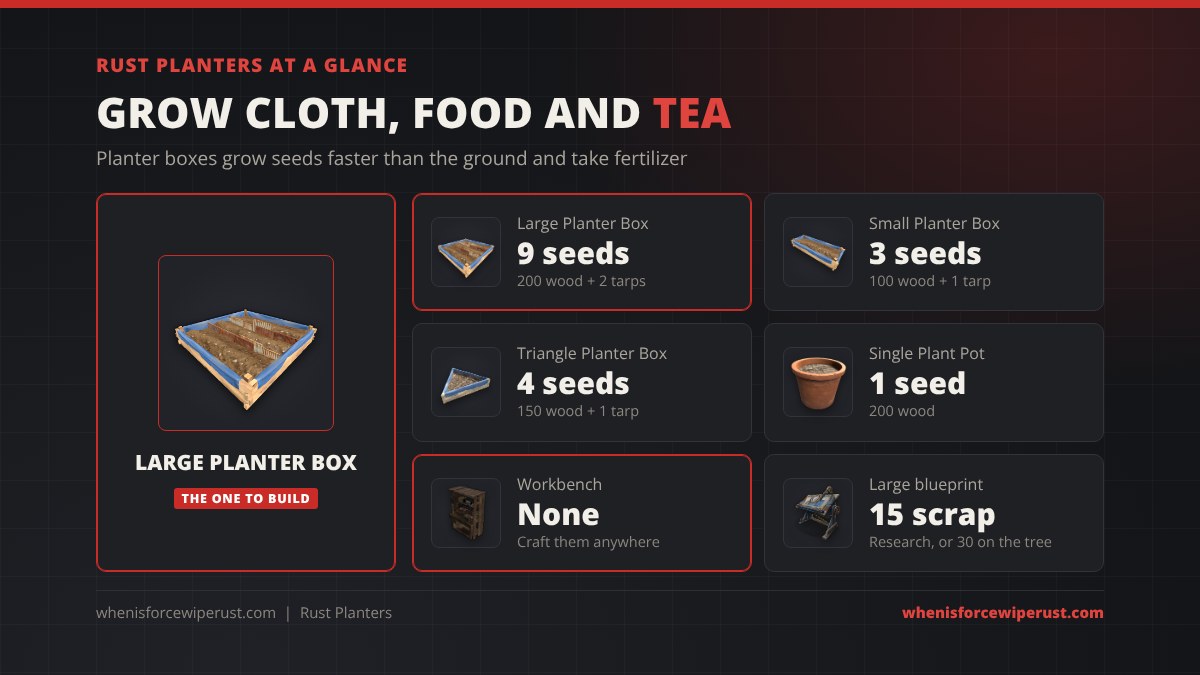
Planters are how you farm in Rust. Drop seeds into a planter box at your base, keep it lit and watered, and you get a steady supply of cloth, food and berries for teas without running around the map. The Large Planter Box costs just 200 wood and 2 tarps, needs no workbench, and holds 9 plants.
This Rust planter guide covers every planter in the game, what each one costs to craft, how many seeds it holds, what a plant needs to grow, how to water planters by hand or with sprinklers, the basics of genetics and growth stages, what planters give back in a recycler, and the tips that turn a few boxes into a real farm.
- What Planters Are
- Every Planter
- Craft Cost
- How to Use
- What Plants Need
- Watering
- Genetics
- What to Grow
- Recycle
- Tips
- FAQ
What Are Planters in Rust?
A planter is a deployable box of soil you place in or around your base and fill with seeds or clones. Anything you can pick in the wild, such as hemp, corn, pumpkins, potatoes, wheat and berries, can be grown in one. Planters beat planting straight into the ground in every way that matters: plants grow faster, the box holds its own water, and it is the only place fertilizer works.
The in-game description of the Large Planter Box sums it up: “A large planter with enough room to plant 9 seeds.” Your first seeds come from wild plants. Pick a hemp bush or a berry bush and you will often get a seed along with the crop, which you can then plant at home.
Every Planter in Rust
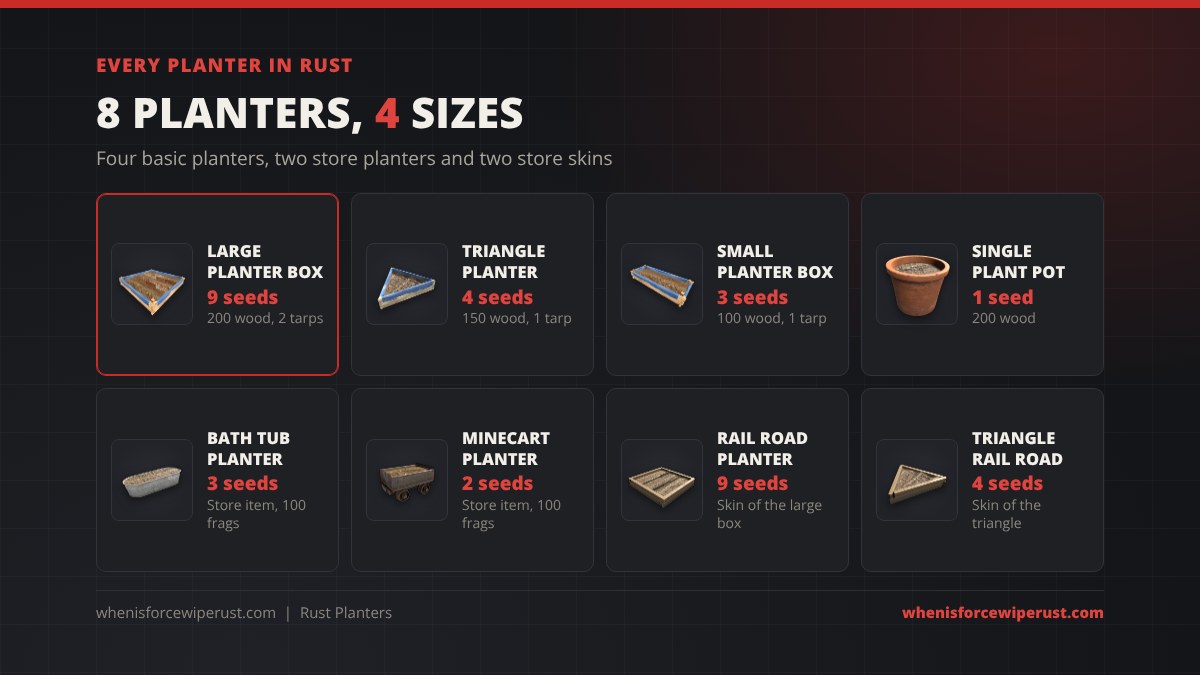
| Planter | Seeds | Craft cost | Blueprint |
|---|---|---|---|
| Large Planter Box | 9 | 200 wood, 2 tarps | 20 scrap research, Blueprint Fragments on the tech tree |
| Triangle Planter Box | 4 | 150 wood, 1 tarp | 20 scrap research, Blueprint Fragments on the tech tree |
| Small Planter Box | 3 | 100 wood, 1 tarp | Default (known from the start) |
| Single Plant Pot | 1 (great for a single rose) | 200 wood | Default (known from the start) |
| Bath Tub Planter | 3 | 100 metal fragments | Needs the Steam store item |
| Minecart Planter | 2 | 100 metal fragments | Needs the Steam store item |
| Rail Road Planter | 9 | 200 wood, 2 tarps | Store skin of the Large Planter Box |
| Triangle Rail Road Planter | 4 | 150 wood, 1 tarp | Store skin of the Triangle Planter Box |
The Large Planter Box is the one to build. It holds the most plants per tarp, it fits one square foundation, and it is the only box big enough for proper crossbreeding, because the middle seed has neighbours on every side. The Triangle Planter Box fills triangle foundations, the Small Planter Box fits half a foundation, and the Single Plant Pot is mostly decoration or a spot to keep one prized clone. The store planters and skins work the same as the box they match; they just look different. The rest of the skins and store items are in our Rust item store guide.
How to Craft Planters in Rust
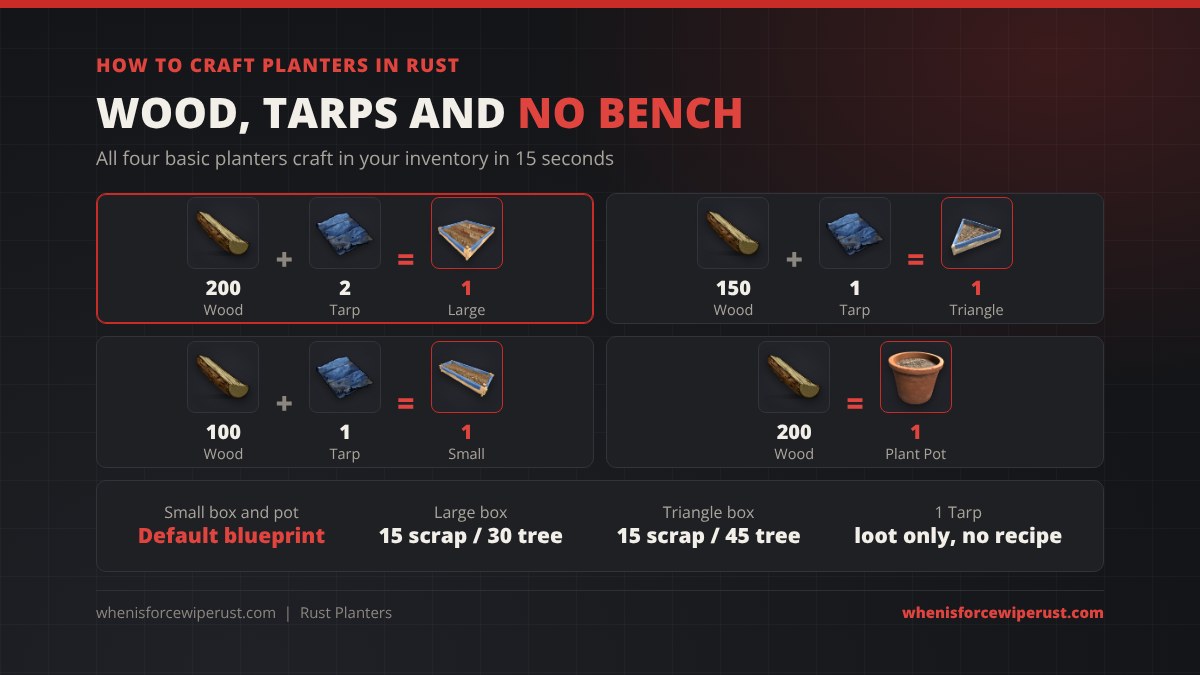
- Get the blueprint. The Small Planter Box and Single Plant Pot are known from the start. For the Large or Triangle box, put one in a research table with 20 scrap, or unlock it on the Workbench 1 tech tree for a few Blueprint Fragments.
- Gather wood. 200 for a large box. One tree is usually enough.
- Find tarps. Tarps cannot be crafted. They drop from barrels (8%), Tunnel Dwellers and underwater crates; see our Rust tarp guide for the best spots.
- Craft it from your inventory. No workbench is needed and each planter takes about 15 seconds. Planters stack to 10 (pots to 5).
How to Use a Planter in Rust
- Place it on a foundation, floor or the ground, inside your building privilege. Indoors is safer; outdoors gets free sun and rain.
- Plant seeds or clones. Hold the seed and look at the planter, or open the planter and drag the seed onto a slot.
- Add water. Pour from a jug or bucket, or put a sprinkler over it (see below).
- Add fertilizer by opening the planter and dropping it in, about 1 per plant each grow cycle.
- Harvest when ripe. Look at a plant and press the gather key. Ripe plants give the most and often a seed back.
What Do Plants Need to Grow in a Planter?
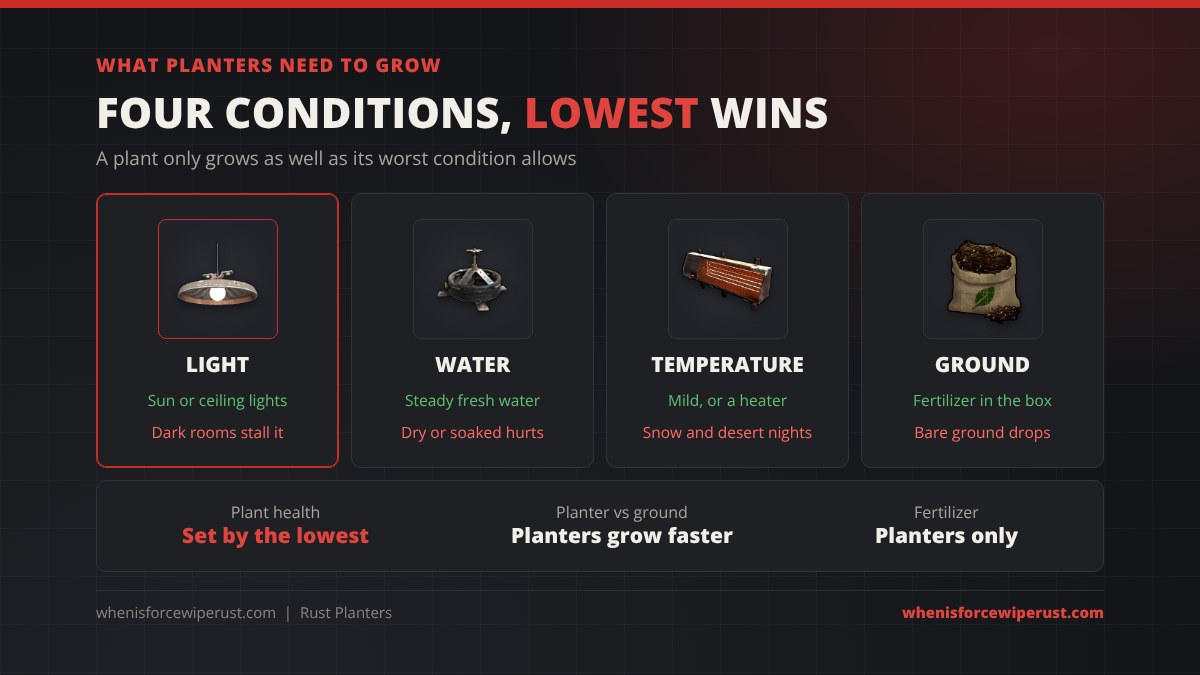
Look at any plant to see its four conditions. Its overall health, growth speed and yield follow the lowest one, so a planter with perfect water still crawls if the room is dark.
| Condition | How to keep it high |
|---|---|
| Light | Open sky outside. Indoors, hang ceiling lights (2 rW each) over the planters and power them with solar panels or batteries. |
| Water | Keep the planter topped up with fresh water, but do not drown it. Salt water hurts plants. |
| Temperature | Mild biomes are easiest. In snow or on cold desert nights, an electric heater or a fire near the planters keeps them warm. |
| Ground | Starts at a reasonable level in a planter and drops as plants feed. Fertilizer pushes it back up. It does nothing for seeds planted in the ground. |
How to Water Planters in Rust
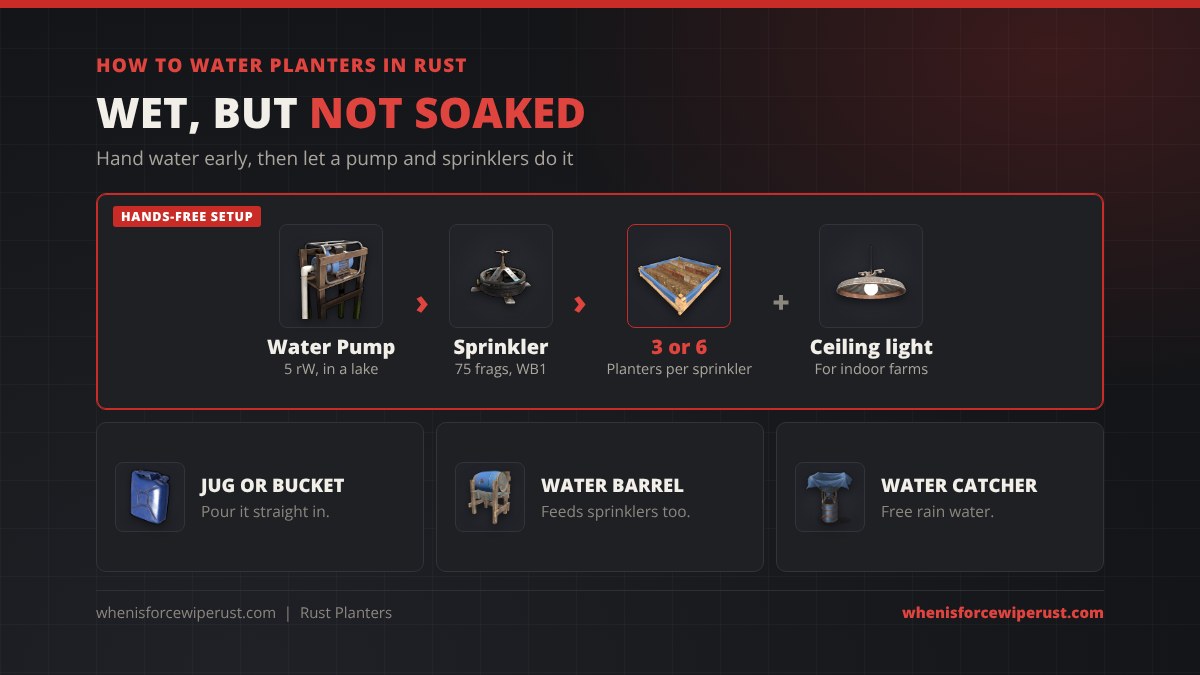
Early in a wipe, fill a water jug or bucket at a lake and pour it straight into the planter. That works for two or three boxes, but it gets old fast. The hands-free setup is a water pump in a lake or river (5 rW), a hose to sprinklers (75 metal fragments at a Workbench 1), and planters under the spray. A water barrel or a water catcher full of rain can feed sprinklers too, and salt water from the sea can go through a powered water purifier first.
Lay planters out in groups of 3 or 6. That is how far one sprinkler and one ceiling light reach comfortably. Put a sprinkler over more boxes than that and none of them stay topped off. Do not leave the water running non-stop on a wet map either: a soaked planter loses condition just like a dry one. A timer or a switch on the pump line fixes that.
Planter Genetics and Growth Stages
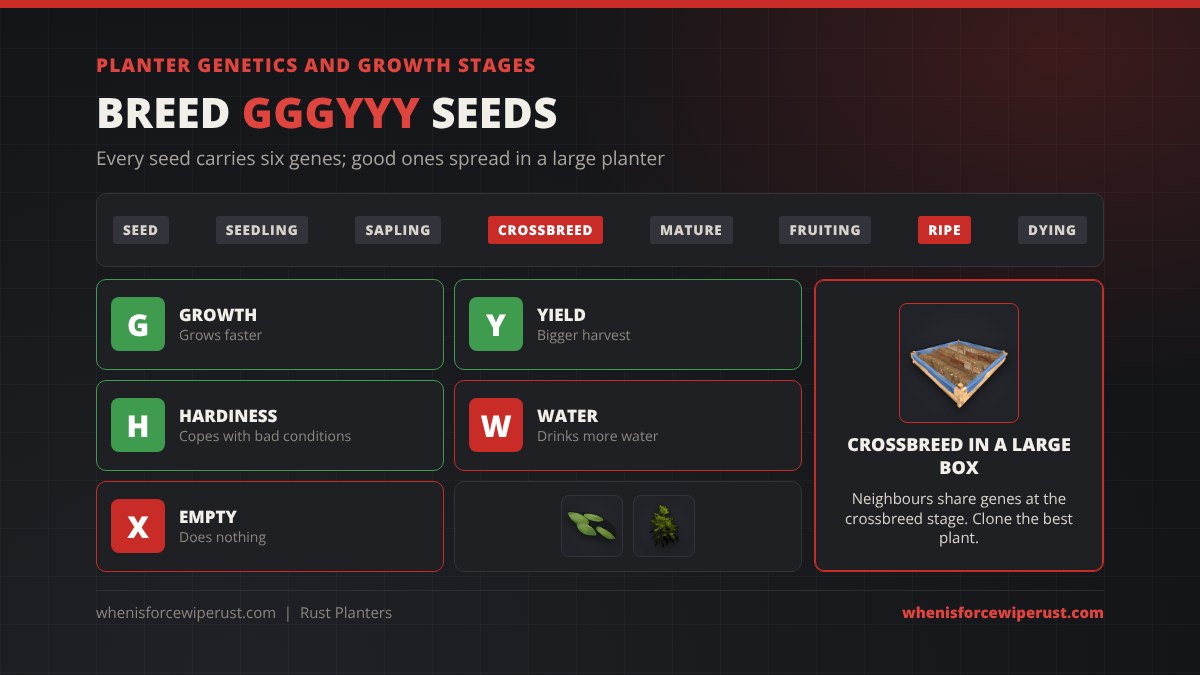
Every seed carries six genes, shown when you look at a growing plant. Three are good: G (growth, ripens faster), Y (yield, bigger harvest) and H (hardiness, copes with poor conditions). Two are bad: W (drinks more water) and X (empty). Most farmers aim for GGGYYY or GGYYYY. Our hemp guide shows what each gene does to cloth yield and how clones copy them.
A plant goes through eight stages: seed, seedling, sapling, crossbreed, mature, fruiting, ripe and dying. At the crossbreed stage, a plant can pick up genes from the plants around it, which is why a Large Planter Box with a strong plant in each neighbouring slot is the breeding tool. Once you have a plant with the genes you want, take clones from it (look at it and use the clone option once it is mature) and plant those: clones copy the parent’s genes exactly. Harvest everything else at ripe for the full yield.
Genetics goes deep: our Rust farming guide covers the crossbreeding math and full breeding layouts. For a first farm, simply clone whichever plant shows the most G and Y genes and you will already out-yield wild seeds.
What to Grow in Your Planters
| Crop | Why grow it |
|---|---|
| Hemp | Cloth for tarps, clothing, sleeping bags and low grade fuel. |
| Berries (red, blue, yellow, green, white, black) | Ingredients for Mixing Table teas such as Scrap Tea, Ore Tea and Wood Tea. |
| Corn, pumpkins, potatoes | Food for your group; see our Rust food guide for calories and pies. |
| Wheat | Bread and other Cooking Workbench recipes. |
| Spare or spoiled crops | Into a Composter for fertilizer, or into a Biofuel Generator. |
Spare produce and fertilizer also sell for scrap at the Bandit Camp produce exchange, so a farm that outgrows your needs still pays.
Planter Recycle Yields
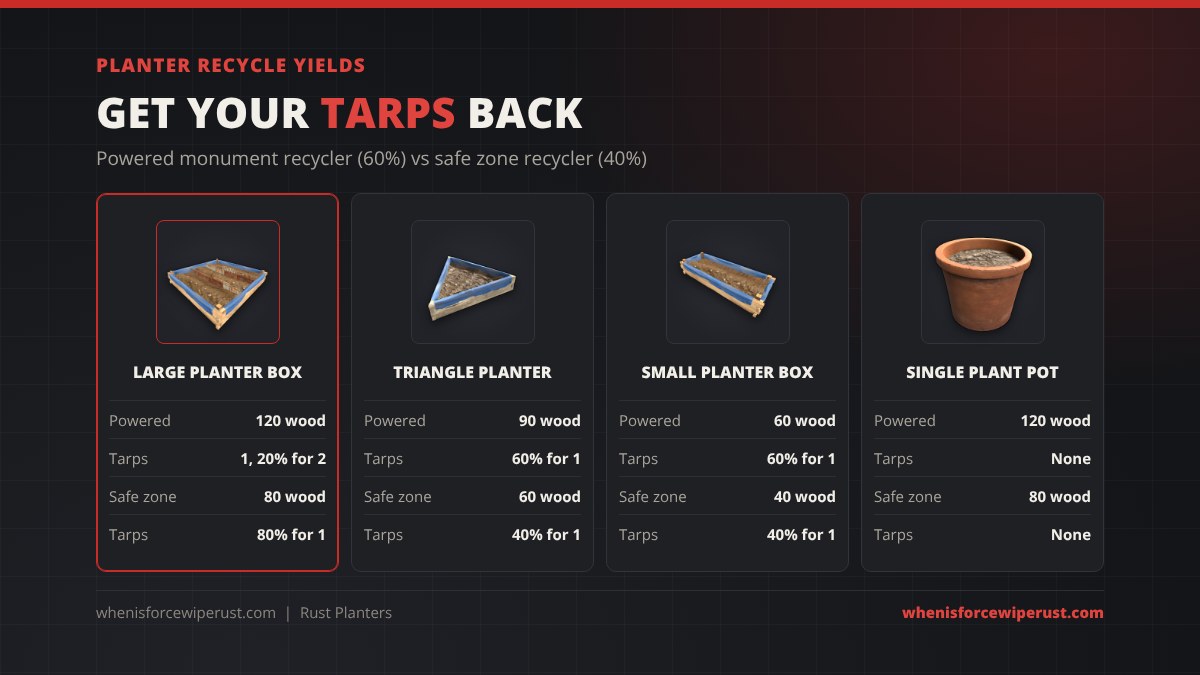
| Planter | Powered monument recycler (60%) | Safe zone recycler (40%) |
|---|---|---|
| Large Planter Box | 120 wood, 1 tarp (20% chance of a 2nd) | 80 wood, 80% chance of 1 tarp |
| Triangle Planter Box | 90 wood, 60% chance of 1 tarp | 60 wood, 40% chance of 1 tarp |
| Small Planter Box | 60 wood, 60% chance of 1 tarp | 40 wood, 40% chance of 1 tarp |
| Single Plant Pot | 120 wood | 80 wood |
| Bath Tub / Minecart Planter | 60 metal fragments | 40 metal fragments |
An unpowered monument recycler gives 50% (a large box returns 100 wood and 1 tarp), and the red Power Plant recycler gives up to 75%. More on the tiers in our Rust recycler guide.
Rust Planter Tips
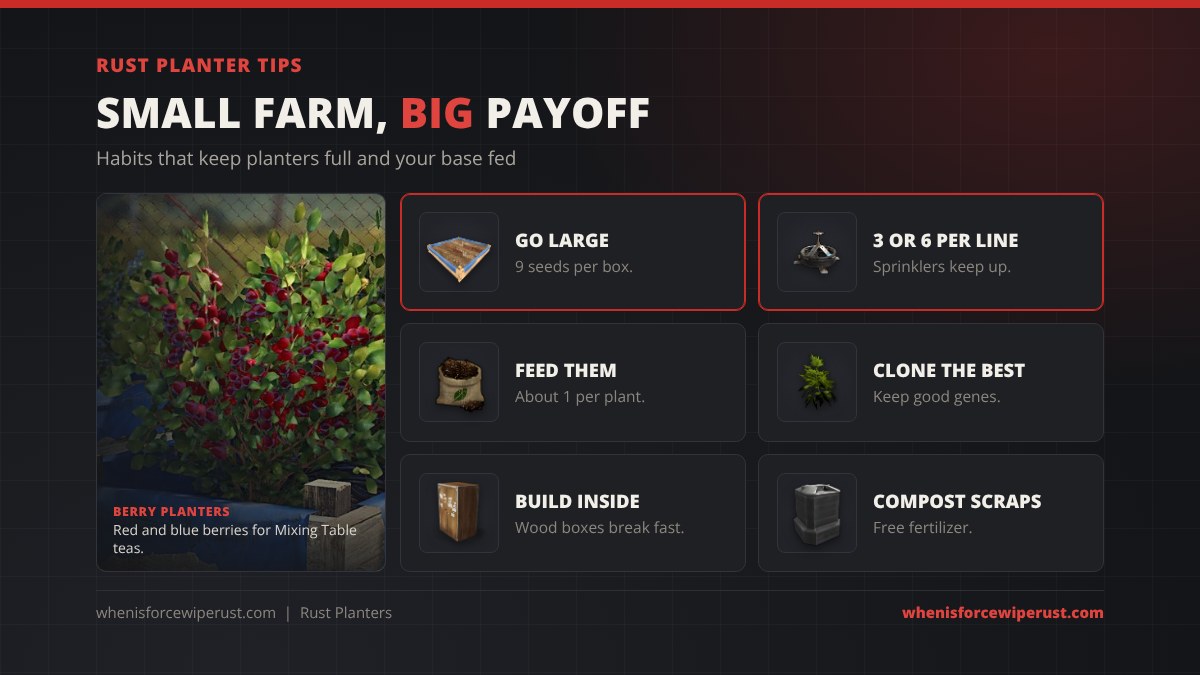
- Go large. Nine seeds for two tarps beats three seeds for one tarp.
- Keep 3 or 6 per line. Sprinklers and ceiling lights cover groups of 3 or 6 best.
- Feed them. About 1 fertilizer per plant per cycle keeps ground condition high.
- Clone the best plant. One great hemp plant cloned nine times out-grows any wild seeds.
- Build inside. Planters are wooden and easy to break, so keep the main farm inside your tool cupboard range and behind walls.
- Compost the scraps. A Composter next to the planters turns spare crops and horse dung into free fertilizer.
- Power the lights once. A couple of solar panels and a battery run an indoor farm all wipe; see our Rust electricity guide.
Rust Planters FAQ
How do you make a planter in Rust?
Craft a Large Planter Box from 200 wood and 2 tarps, a Triangle Planter Box from 150 wood and 1 tarp, a Small Planter Box from 100 wood and 1 tarp, or a Single Plant Pot from 200 wood. None of them need a workbench.
How many seeds fit in a large planter box?
A Large Planter Box holds 9 seeds. A Triangle Planter Box holds 4, a Small Planter Box 3, a Bath Tub Planter 3, a Minecart Planter 2 and a Single Plant Pot 1.
How do you get the large planter box blueprint?
Research a Large Planter Box at a research table for 20 scrap, or unlock it on the Workbench 1 tech tree for 1 Blueprint Fragment per node. The Small Planter Box and Single Plant Pot are known from the start.
Do planters need a workbench in Rust?
No. All planters craft from your inventory without a workbench. Tarps cannot be crafted at all, so loot them from barrels, dwellers and underwater crates.
What do plants need to grow in a planter?
Plants need light, water, a good temperature and ground condition. The lowest of the four sets the growth speed, so a planter needs sunlight or ceiling lights, steady fresh water, warmth and fertilizer to grow at full speed.
How do you water planters in Rust?
Pour water into the planter from a water jug or bucket, or set up a water pump with sprinklers over the planters. Keep 3 or 6 planters per sprinkler and avoid soaking them, because too much water hurts plant condition too.
Can you use fertilizer on plants in the ground?
No. Fertilizer only works in planters, where it raises the ground condition. Seeds planted straight into the ground cannot be fertilized.
What are the best genes for Rust plants?
G (growth), Y (yield) and H (hardiness) are good genes, while W (water) and X (empty) are bad. Most players breed toward GGGYYY or GGYYYY and then clone that plant.
What do planters give in a recycler?
At a powered monument recycler a Large Planter Box gives 120 wood and 1 tarp with a 20% chance of a second tarp. A Small Planter Box gives 60 wood and a 60% chance of a tarp, and a Single Plant Pot gives 120 wood.
Sources and Further Reading
- Recipes, blueprints, tech tree prices, stack sizes, seed counts and recycle yields: Rust game item files (items.craft.json, items.recycle.json, item descriptions, October 2026 build)
- Item descriptions: Facepunch Wiki, Large Planter Box
- Sprinkler and ceiling light grouping: Facepunch Wiki, Farming Basics
- Genetics and growth stages: Corrosion Hour, The Rust Genetics Guide
- Planter list and data: RustClash Wiki, Large Planter Box