
 By
The Igniter is the part that lights fires for you in Rust. Give it power and it sprays sparks, lighting the furnaces, campfires, lanterns and fireworks around it that it can see. It is cheap, you can craft it without a workbench, and one igniter can start a whole furnace room with a single switch. It also wears itself down while it runs, which is the one thing most players get wrong.
This Rust igniter guide covers the exact craft and research cost, how much power it needs, everything it can light, how to wire it, the best furnace and firework setups, how it re-lights dud explosives, and how to stop it breaking.
electric.igniter, ID -44876289) costs 75 Metal Fragments and needs no workbench (30 s by hand, 15 s at Workbench 1, 7 s at Workbench 2 or 3). It researches for 20 scrap, or 8 Blueprint Fragments in total on the Engineering Workbench tree. It draws 2 rW and, while powered, lights any fuel-burning deployable, firework, or dud beancan or satchel in a short radius that it has line of sight to. It cannot put anything out, and it takes damage the whole time it is on, so feed it through a switch or timer and only power it for a few seconds.
- What It Does
- Craft & Research
- Power & Runtime
- What It Lights
- How to Wire It
- Furnace Setup
- Fireworks
- Dud Explosives
- Where to Find It
- Tips
- FAQ

What Does the Igniter Do in Rust?
The game describes it in one line: it “ignites nearby objects such as furnaces and campfires when power is received.” It has a single Power In socket and no outputs, so it is always the last part on a line, and you connect it with the Wire Tool like every other part of Rust electricity.
Facepunch added it in the Lunar New Year update on January 23, 2020. Their devblog explains how it works: while powered it “will automatically start spraying out sparks, igniting anything in a radius that it has line of sight to.” The same post lists what it lights (fireworks, campfires, furnaces, lanterns, and unexploded beancan grenades and satchel charges) and warns that, “much like the Tesla Coil, the Igniter takes damage while it’s running.”
Two things it does not do: it cannot turn a fire off, and it cannot light a furnace with no fuel in it. Cutting its power stops the sparks, but anything it already lit keeps burning until you turn it off or the fuel runs out.
Igniter Craft Cost and Research
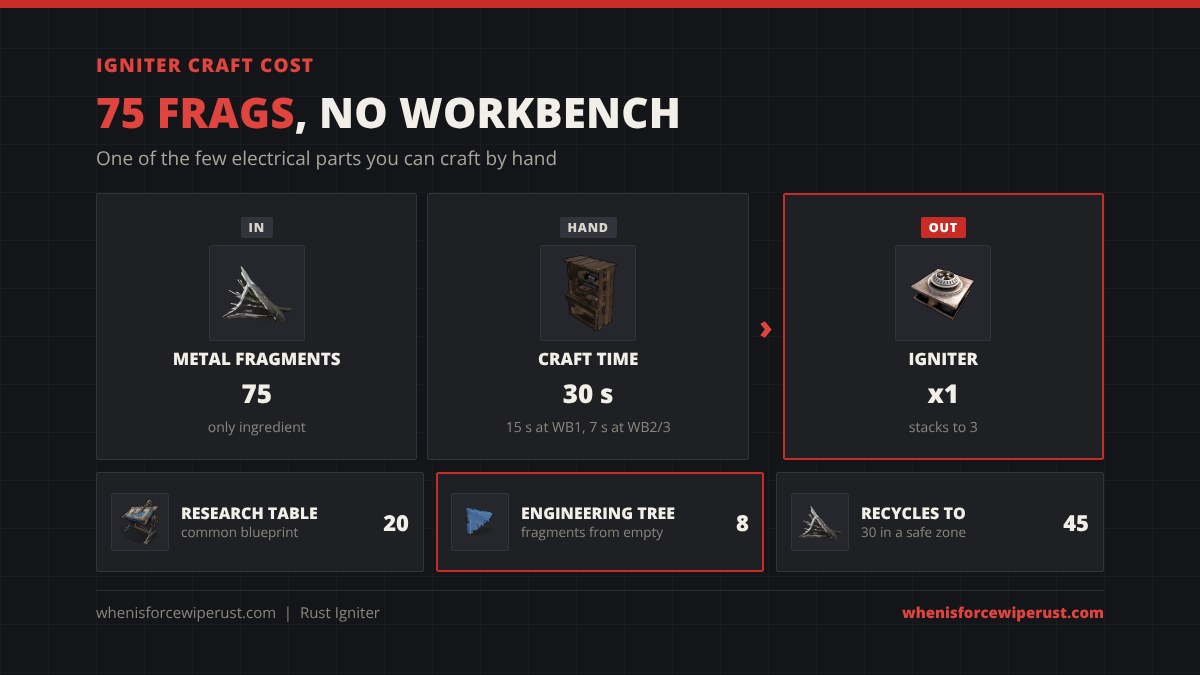
| Stat | Igniter |
|---|---|
| Craft cost | 75 Metal Fragments |
| Workbench | None |
| Craft time | 30 s by hand, 15 s at Workbench 1, 7 s at Workbench 2 or 3 |
| Research cost | 20 scrap at a Research Table (common) |
| Tech tree | Engineering Workbench, 8 Blueprint Fragments in total from an empty tree |
| Power draw | 2 rW |
| Inputs / outputs | 1 Power In, no outputs |
| Stack size | 3 |
| Despawn | 5 minutes |
| Recycle | 45 Metal Fragments (30 in a safe zone) |
| Repair | 15 Metal Fragments at a repair bench, up to 38 with a hammer |
| Added | Lunar New Year update, January 23, 2020 |
| Shortname / ID | electric.igniter / -44876289 |
It is one of only a couple of electrical items you can craft with no workbench at all, alongside the water barrel. Older guides list a different cost or a Workbench 1 requirement, and the Facepunch wiki still shows 15 scrap to research; the current game data says 75 frags, no bench and 20 scrap. You can price a full wiring kit in our crafting calculator.
Igniter Power Use and Battery Runtime
The igniter draws 2 rW, the same as a ceiling light. Any power source in the game can run it, and because you only need it on for a few seconds at a time, even the smallest battery lasts a very long time.
| Power source | Stored power | Igniter left on nonstop | 10 second bursts per charge |
|---|---|---|---|
| Small Battery | 400 rWm | about 200 minutes | about 1,200 |
| Medium Battery | 9,000 rWm | about 75 hours | about 27,000 |
| Large Battery | 24,000 rWm | about 200 hours | about 72,000 |
Those numbers ignore the small charging loss. In practice the battery is never the problem: the igniter breaks itself long before it would drain one, which is why the setups below always switch it off. To size a bigger grid, use our battery calculator.
What Can the Igniter Light?
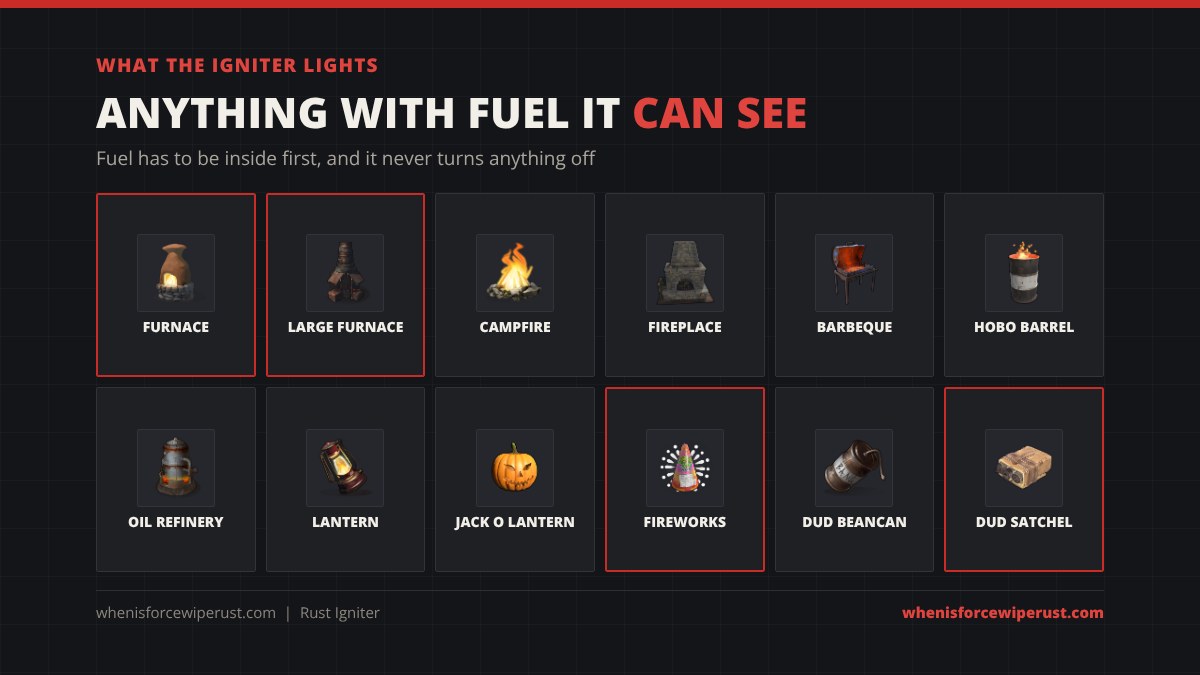
The igniter lights fuel-burning deployables and anything with a fuse. Facepunch names fireworks, campfires, furnaces, lanterns and dud explosives; the same rule covers the other things you light with the same “turn on” button:
- Smelting: the Furnace, the Large Furnace and the Small Oil Refinery.
- Cooking and heat: campfire, stone fireplace, barbeque and the Hobo Barrel.
- Lights: the Lantern, tuna can lamp, jack o lanterns and other fuel lights.
- Fireworks: volcanoes, Roman candles and boomers.
- Duds: a beancan grenade or satchel charge that failed to go off.
The fuel has to be inside first. A furnace needs wood, a refinery needs wood, and a lantern needs low grade fuel. The Electric Furnace is different: it runs on power, so you wire it directly and never need an igniter for it.
The range is short. Facepunch only says “a radius” and does not publish the number, so place the igniter right beside what you want to light, with nothing solid in between, and test it once before you build around it.
How to Wire an Igniter
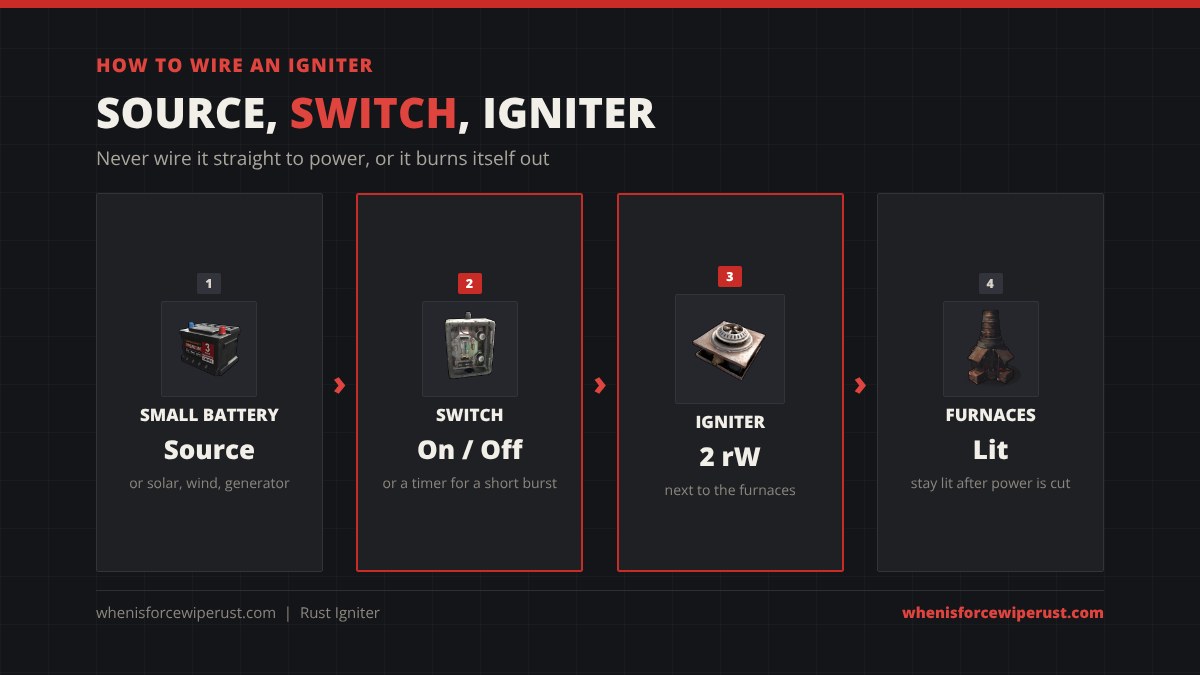
- Pick a power source. A small battery is plenty, or tap a line from your solar panels or wind turbine. If it shares a line with other devices, carve off 2 rW with an Electrical Branch.
- Add a switch or a timer. A switch lets you turn it on and off by hand. A timer is better: press a button and the igniter gets power for the time you set, then turns itself off.
- Wire the switch or timer to the igniter’s Power In and place the igniter beside the things you want to light.
- Power it for a few seconds until everything is lit, then cut the power. The fires stay lit.
Wiring it straight to a battery with no switch is the classic mistake. It sparks nonstop, slowly breaks itself, and you lose control of when your furnaces start.
Best Furnace Setup: Light a Whole Room at Once
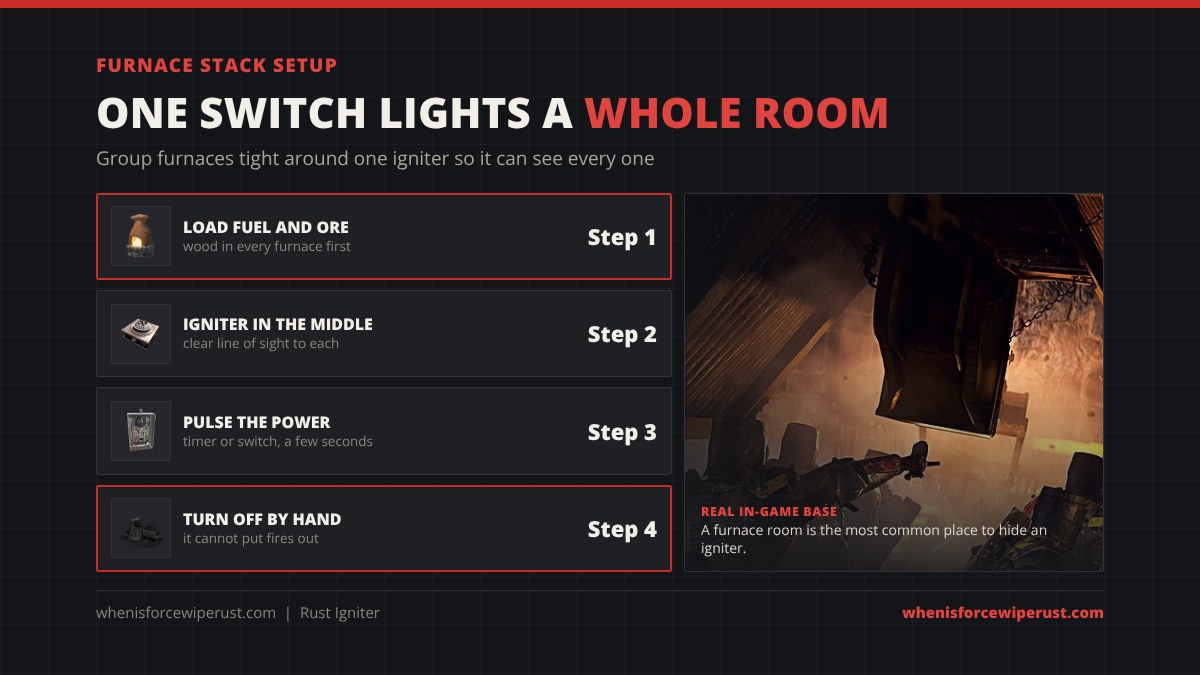
Lighting six large furnaces one by one is slow, and you stand in an open room while you do it. An igniter turns it into one button press:
- Load every furnace with wood and ore. Remember large furnaces burn wood faster, so balance the fuel (our large furnace guide has the rates).
- Place the furnaces in a tight group with the igniter in the middle, low down, where it can see the base of each one.
- Wire a battery into a timer, put a button on the timer, and run the timer into the igniter. A few seconds is enough.
- Press the button. Every furnace lights at once.
- Turn them off by hand when the ore is done, or let the fuel run out. The by-product, charcoal, piles up as normal.
Put the button somewhere safe, such as your bedroom or loot room, so you can start a smelt without walking into the furnace room. If you build with an industrial conveyor feeding the furnaces, the igniter is the last piece that makes the whole room hands-off.
Igniters and Fireworks

Fireworks are why the igniter exists. Facepunch said an item like this would normally wait for a monthly update, but they brought it forward to the Lunar New Year event because “the Igniter would be really useful for setting off fireworks.” Their tip: “use them to wire up remote firework displays.”
For a show, place groups of fireworks around several igniters and give each group its own timer. Chain the timers so each one starts the next, or put each on its own button, and you can fire volcanoes, then Roman candles, then boomers in order without lighting anything by hand. Fireworks are a big part of the Christmas and Lunar New Year events, so this setup comes back every winter.
Re-Lighting Dud Beancans and Satchels

Beancans and satchels sometimes fail to explode. Picking a dud up or re-lighting it by hand puts you right next to a live charge. A powered igniter in sight of the dud re-lights it from a distance instead, which Facepunch listed as one of its main uses.
The catch is placement: you can only deploy the igniter where you are allowed to build, so it is most useful around your own base, test raids, or a raid base you control, not stuck to an enemy wall. For the number of charges each wall or door takes, see our raid calculator.
Where to Find an Igniter
Most players just craft it, since it costs 75 frags and no bench. It also turns up as loot (Facepunch wiki drop rates):
| Source | Amount | Chance |
|---|---|---|
| Basic crate | 1 | 4.8% |
| Halloween scarecrows and Christmas gingerbread dungeons (event only) | 1 to 3 | 3.3% |
| Tunnel Dweller and Underwater Lab dweller | 1 to 2 | 2.2% |
| Yellow and blue barrels | 1 | 1.1% |
| Brown crates (including wagon and Underwater Lab) | 1 | 0.8% |
Spare igniters recycle into 45 metal fragments in a normal recycler, or 30 in a safe zone. Full drop tables for every container are in our Rust loot tables.
Igniter Tips
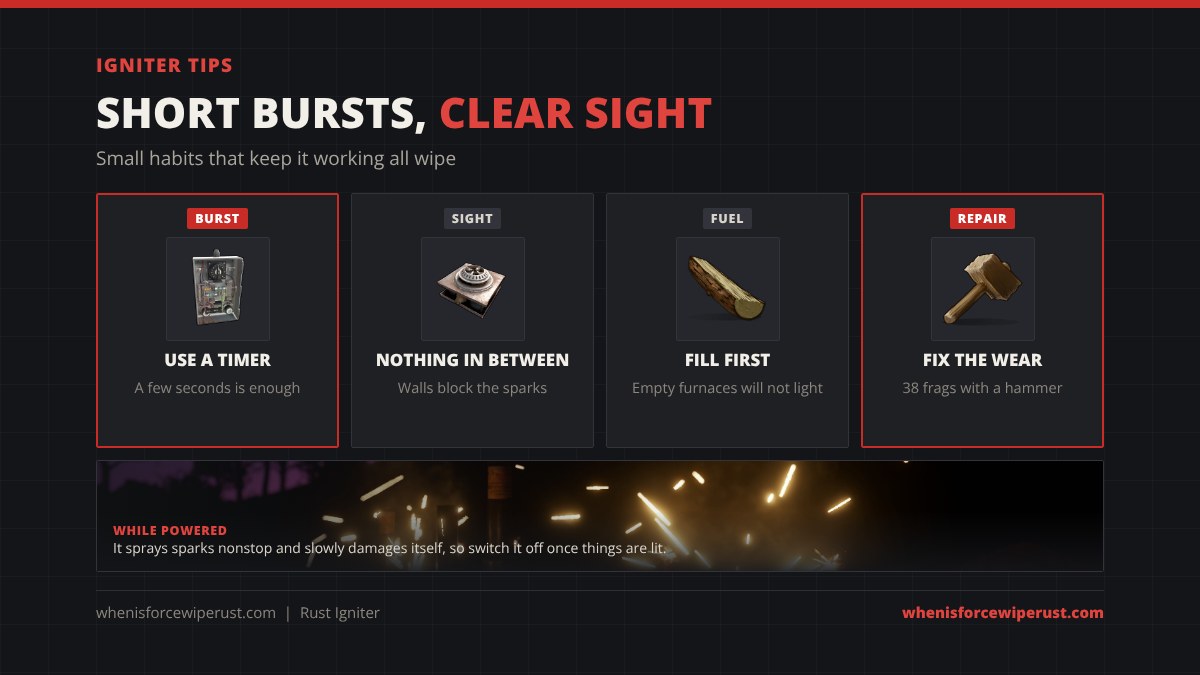
- Use a timer, not a bare switch. It turns itself off, so you cannot forget it and burn the igniter out.
- Keep the path clear. It needs line of sight, so a wall, box or another furnace in the way stops the spark.
- Fuel first. An empty furnace or lantern will not light, however long you power it.
- Repair it now and then. Hit it with a hammer (up to 38 frags) or use a repair bench (15 frags) before it breaks.
- One igniter, many furnaces. Group them tightly instead of crafting one igniter per furnace.
- It is not a trap. Use a flame turret if you want to set raiders on fire.
Rust Igniter FAQ
How much does an igniter cost in Rust?
The Igniter costs 75 Metal Fragments and needs no workbench. It takes 30 seconds by hand, 15 at a Workbench 1 and 7 at a Workbench 2 or 3. Researching it costs 20 scrap, or 8 Blueprint Fragments in total on the Engineering Workbench tech tree.
How much power does an igniter use?
2 rW. A small battery can run it nonstop for about 200 minutes, but you should only power it for a few seconds at a time because it takes damage while it is on.
What does the igniter light in Rust?
Furnaces, large furnaces, campfires, lanterns, fireworks and other fuel-burning deployables, plus beancan grenades and satchel charges that failed to explode. It only lights things in a short radius that it has line of sight to, and they need fuel inside.
How do you use an igniter in Rust?
Place it next to the furnaces or fireworks, wire a power source through a switch or timer into its Power In, then power it for a few seconds. Everything it can see lights, and stays lit after you cut the power.
Does the igniter turn furnaces off?
No. It can only light things. Turning off its power stops the sparks, but furnaces it lit keep burning until you switch them off by hand or the fuel runs out.
Why does my igniter keep breaking?
It takes damage the whole time it is powered, like the Tesla Coil. Feed it through a switch or a timer so it only runs for a few seconds, and repair it with a hammer or a repair bench.
Does the igniter need a workbench?
No. You can craft it by hand anywhere. A Workbench 1 halves the craft time to 15 seconds, and a Workbench 2 or 3 cuts it to 7 seconds.
Can an igniter light dud satchels?
Yes. A powered igniter re-lights an unexploded satchel charge or beancan grenade it can see, so you do not have to walk up to a live dud. You still need to be allowed to place the igniter there.
When was the igniter added to Rust?
In the Lunar New Year update on January 23, 2020, alongside the event fireworks. Facepunch released it early because it is useful for setting off fireworks.
Building out a full base grid? Start with our Rust electricity guide, then check the force wipe countdown so your furnace room is running before the next wipe.
Sources
- Facepunch: Lunar New Year devblog (January 23, 2020), Igniter section and official images
- Facepunch Rust Wiki: Igniter item data, power, recycling, repair and loot sources
- Craft, research, tech tree and recycle numbers: Rust game item data (November 2026). Item icons from the Rust game files; screenshots in-game and official Facepunch art.