
 By
A battery is what keeps your base working after the sun goes down. Solar panels make nothing at night and a wind turbine drops when the wind does, so every serious power setup in Rust runs through a Rechargeable Battery: power goes in when you have spare, and comes back out when your turrets, lights and furnaces need it.
This Rust battery guide covers all three sizes, the Small, Medium and Large Rechargeable Battery: their max output and capacity, craft and research cost, how long each one runs a turret or a SAM site, how long they take to charge from every power source, how to wire them, and what it takes to blow one up. There is also a battery calculator, so you can plug in your own base and see how long your power lasts.
- Battery Types
- Small vs Medium vs Large
- Craft & Research
- Battery Calculator
- How Long It Lasts
- Charge Time
- How to Wire
- How to Destroy
- Tips
- FAQ
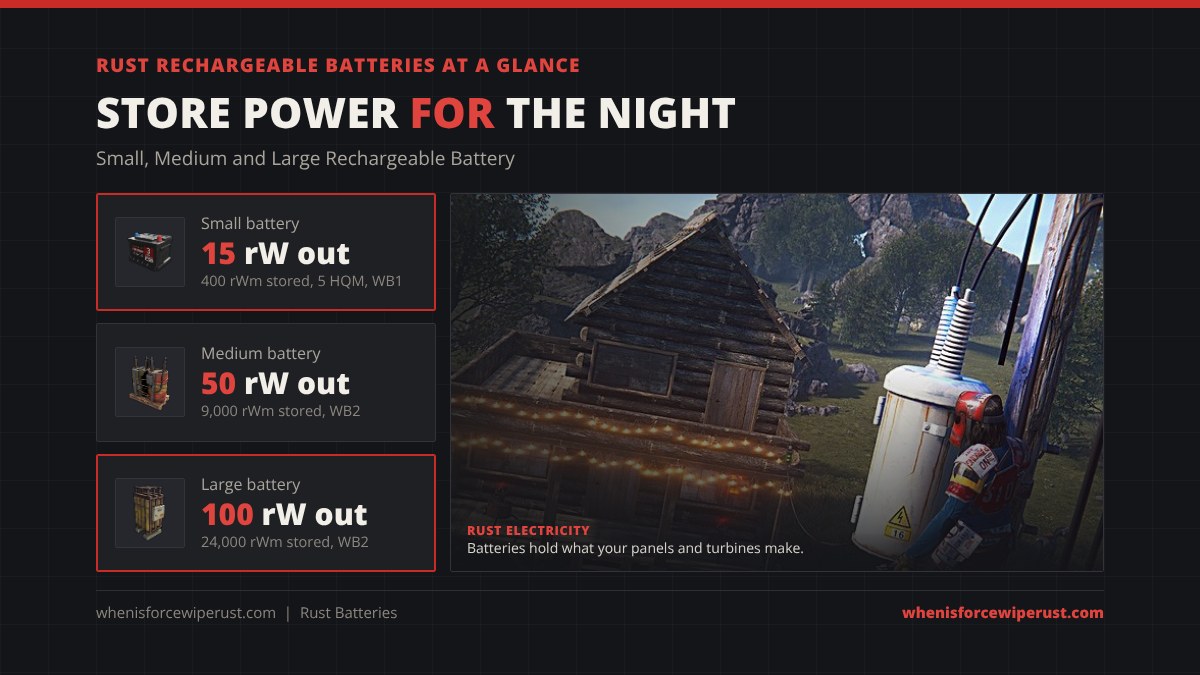
What Are Batteries in Rust?
Rust has three placeable rechargeable batteries. All of them work the same way: a source wired into Power In charges the battery, and Power Out feeds your devices from the stored charge. They only differ in how much power they can push out at once (max output, in rW) and how much they can hold (capacity, in rWm).
- rW (“Rust watts”) is the power a device draws or a source makes right now. An Auto Turret draws 10 rW, a SAM Site 25 rW.
- rWm (“Rust watt minutes”) is stored energy. One rWm runs a 1 rW load for one real minute, so a 400 rWm Small Battery runs a 10 rW turret for 40 minutes.
The game’s own item text spells out the three rules that catch new players out: the battery “must have a minimum charge of 5 seconds to discharge”, it “can be wired in series”, and the “charging rate is dependent on power in, with a maximum of 80% efficiency”. Each battery also has a Fully Charged output that sends a signal once it is full. You also have to press the battery to turn it on before Power Out sends anything.
Do not confuse these with Battery – Small, a separate inventory item that cannot be crafted or placed and does not power anything in your base. If you want the bigger picture first, start with our Rust electricity guide.
Small vs Medium vs Large Battery
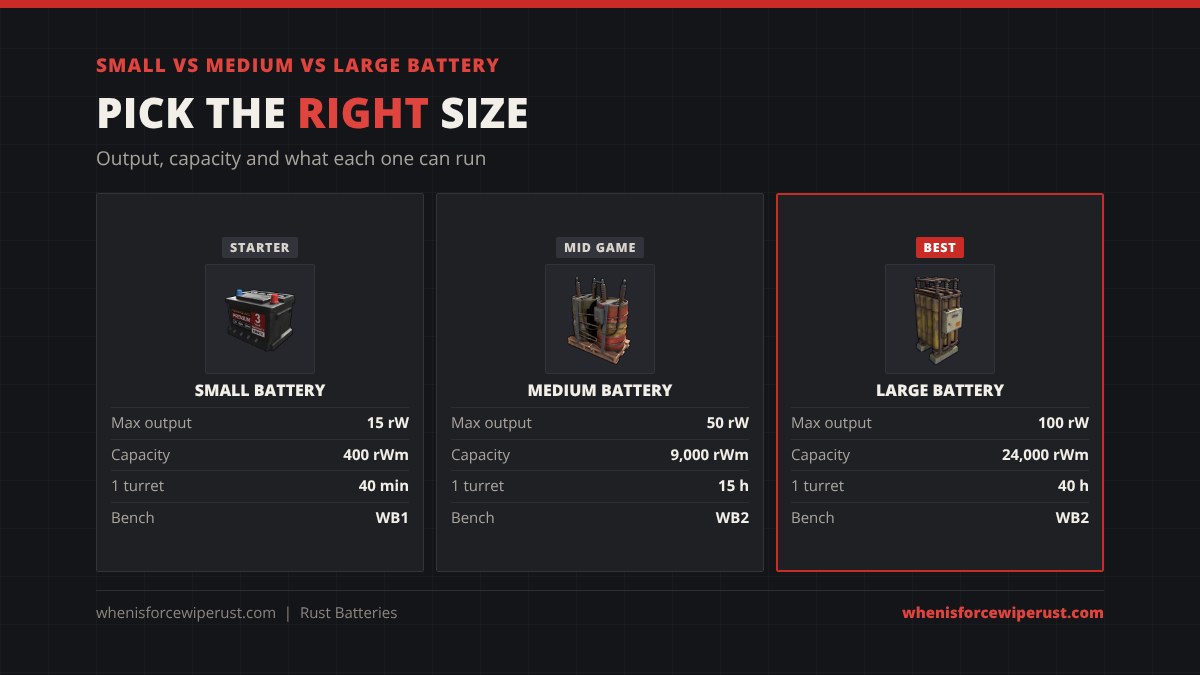
| Stat | Small Battery | Medium Battery | Large Battery |
|---|---|---|---|
| Max output | 15 rW | 50 rW | 100 rW |
| Capacity | 400 rWm | 9,000 rWm | 24,000 rWm |
| Recipe | 5 HQM | 5 HQM, 1 Tech Trash | 10 HQM, 2 Tech Trash |
| Workbench | Level 1 | Level 2 | Level 2 |
| Runs 1 turret (10 rW) | 40 minutes | 15 hours | 40 hours |
| Runs a SAM Site (25 rW) | No, output too low | 6 hours | 16 hours |
| Rarity | Common | Uncommon | Uncommon |
| Item ID | -692338819 | 2023888403 | 553270375 |
| Shortname | electric.battery.rechargable.small | electric.battery.rechargable.medium | electric.battery.rechargable.large |
The Small Battery is the starter option. 15 rW is enough for lights, a heater or one turret, but it holds so little that it is really a buffer, not night storage. The Medium Battery is the odd one out: it needs the same Workbench 2 as the Large, and the Large Battery stores almost three times as much for double the recipe. Once you have a Workbench 2 and a bit of tech trash, go straight to the Large Battery.
Battery Craft Cost and Research
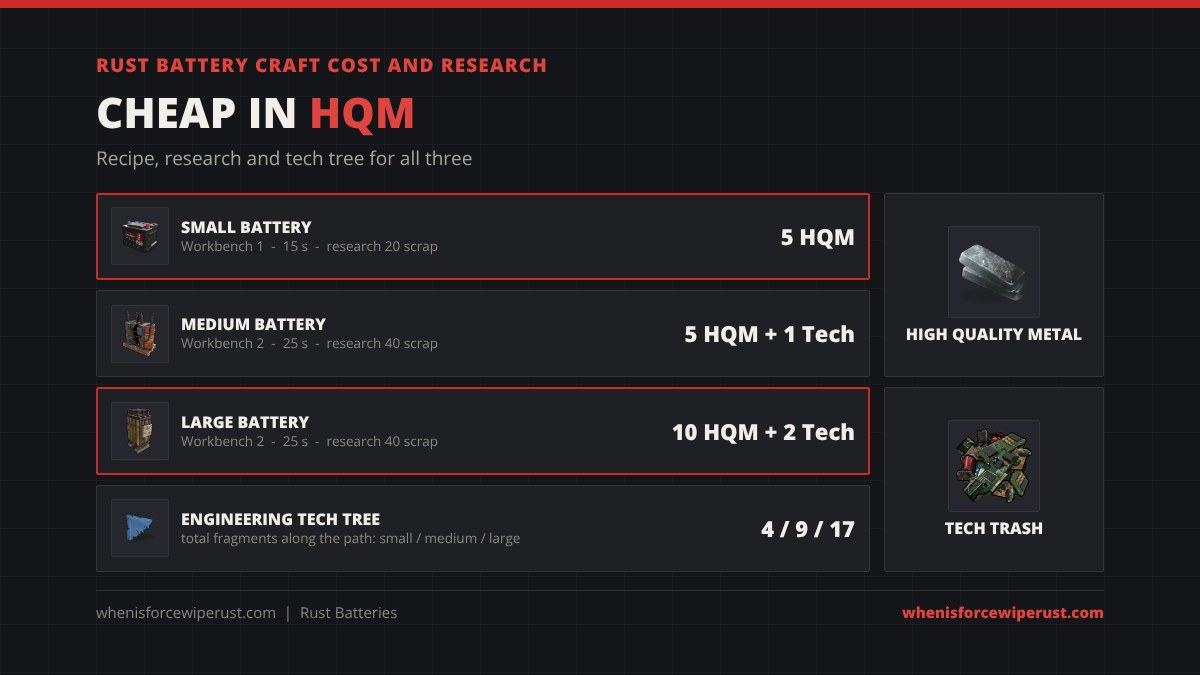
| Small Battery | Medium Battery | Large Battery | |
|---|---|---|---|
| Craft cost | 5 HQM | 5 HQM, 1 Tech Trash | 10 HQM, 2 Tech Trash |
| Workbench | Level 1 | Level 2 | Level 2 |
| Craft time (base) | 15 seconds | 25 seconds | 25 seconds |
| Research | 20 scrap | 40 scrap | 40 scrap |
| Tech tree path | 4 fragments | 9 fragments | 17 fragments |
| Stack size | 1 | 1 | 1 |
| Despawn time | 5 minutes | 20 minutes | 20 minutes |
| Recycle (monument) | 2 HQM, 50% for a 3rd | 2 HQM, 50% for a 3rd, 50% for 1 Tech Trash | 5 HQM, 1 Tech Trash |
| Recycle (safe zone) | 2 HQM | 2 HQM, 40% for 1 Tech Trash | 4 HQM, 80% for 1 Tech Trash |
All three are electrical items, so they unlock on the Engineering Workbench tech tree, not the Workbench 1 or 2 trees. Since the November 2026 blueprint update each node costs 1 Blueprint Fragment, and the totals above are the whole path from the start of the tree. Crafting still needs the normal Workbench 1 or 2. If you find a battery in a crate, researching it at a research table is often quicker than the tree.
Batteries also turn up as loot. The Facepunch wiki lists the Small Battery in brown crates (about 1.3%) and the Medium and Large in locked, elite and military crates plus a few scientists, all at low chances, so plan to craft them.
Rust Battery Calculator
Pick a battery, add the devices it runs and the power that charges it. The calculator tells you how long a full charge lasts, how long it takes to fill from empty, and whether the battery can push enough rW for the load.
Devices on the battery
Power charging it
Charging uses the 80% efficiency from the game’s item text. Runtime is in real time.
How Long Does a Battery Last in Rust?
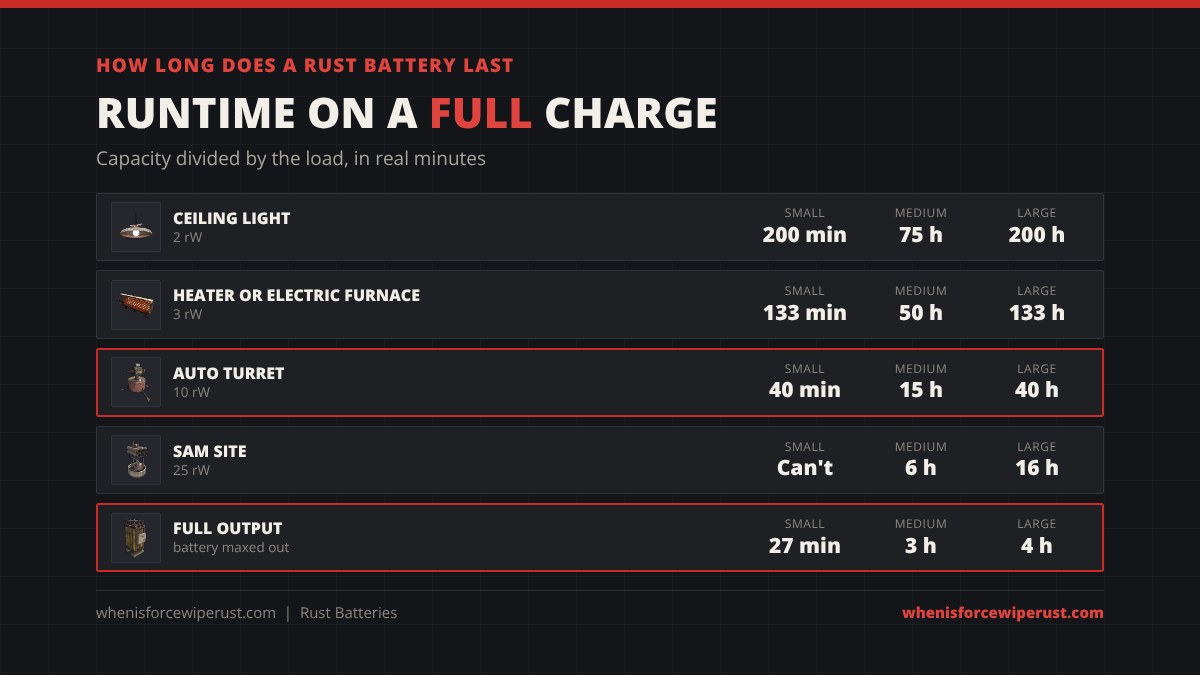
Runtime is simple maths: capacity (rWm) divided by load (rW) = minutes. A battery only sends out what the devices on it actually draw, up to its max output, so a Large Battery running one turret drains at 10 rW, not 100.
| Load | Draw | Small | Medium | Large |
|---|---|---|---|---|
| Ceiling Light | 2 rW | 200 min | 75 h | 200 h |
| Heater or Electric Furnace | 3 rW | 133 min | 50 h | 133 h |
| Auto Turret | 10 rW | 40 min | 15 h | 40 h |
| 3 Auto Turrets | 30 rW | Output too low | 5 h | 13.3 h |
| SAM Site | 25 rW | Output too low | 6 h | 16 h |
| Battery at max output | 15 / 50 / 100 rW | 27 min | 3 h | 4 h |
Most Rust servers run a day and night cycle of about an hour of real time, with night well under that, so even a Medium Battery covers a few turrets through the dark as long as something tops it up in the day.
How Long Does a Battery Take to Charge?
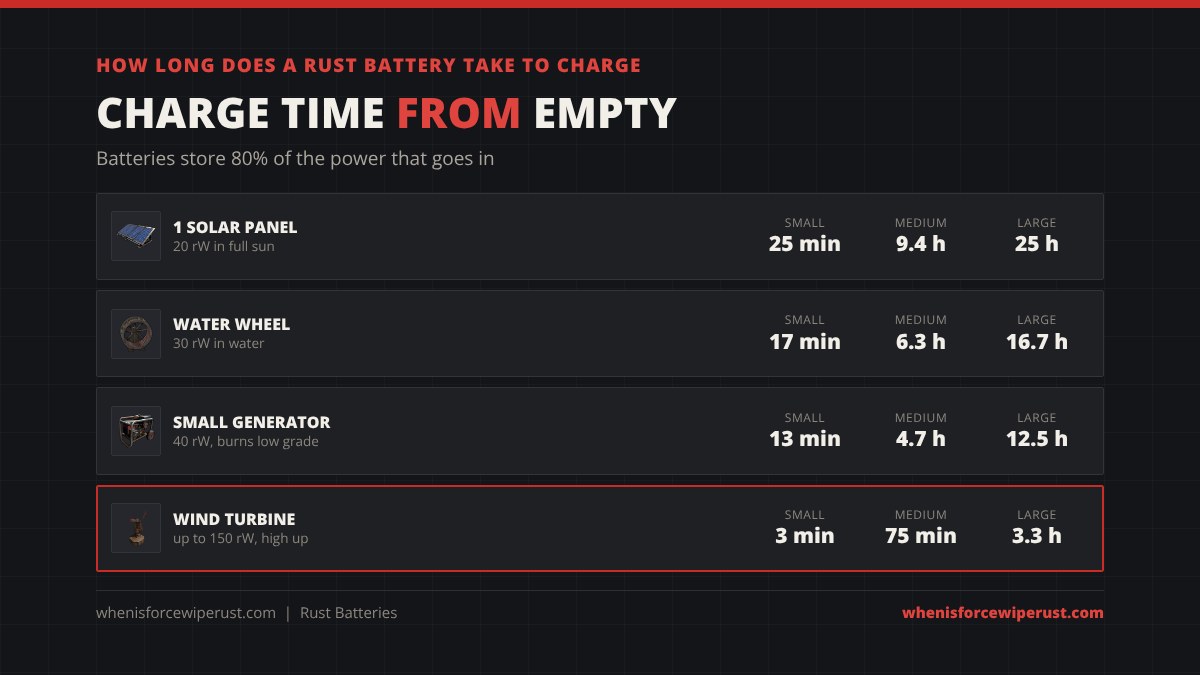
Batteries store at most 80% of the power that goes in. A 20 rW solar panel in full sun adds 16 rWm a minute, so it fills a Small Battery in 25 minutes but needs over a day of real time to fill a Large one. That is why bases with Large Batteries usually add a wind turbine or chain several panels through a Root Combiner.
| Source | Power in | Small (400) | Medium (9,000) | Large (24,000) |
|---|---|---|---|---|
| 1 Large Solar Panel (full sun) | 20 rW | 25 min | 9.4 h | 25 h |
| Water Wheel (in water) | 30 rW | 17 min | 6.3 h | 16.7 h |
| Small Generator | 40 rW | 13 min | 4.7 h | 12.5 h |
| 3 Solar Panels combined | 60 rW | 8 min | 3.1 h | 8.3 h |
| Wind Turbine (max height) | 150 rW | 3 min | 75 min | 3.3 h |
| Test Generator (admin only) | 100 rW | 5 min | 1.9 h | 5 h |
Solar output also falls toward dawn and dusk, so real charge times with panels run longer than the noon figure. The Biofuel Generator is another steady option if you farm.
How to Wire a Battery in Rust
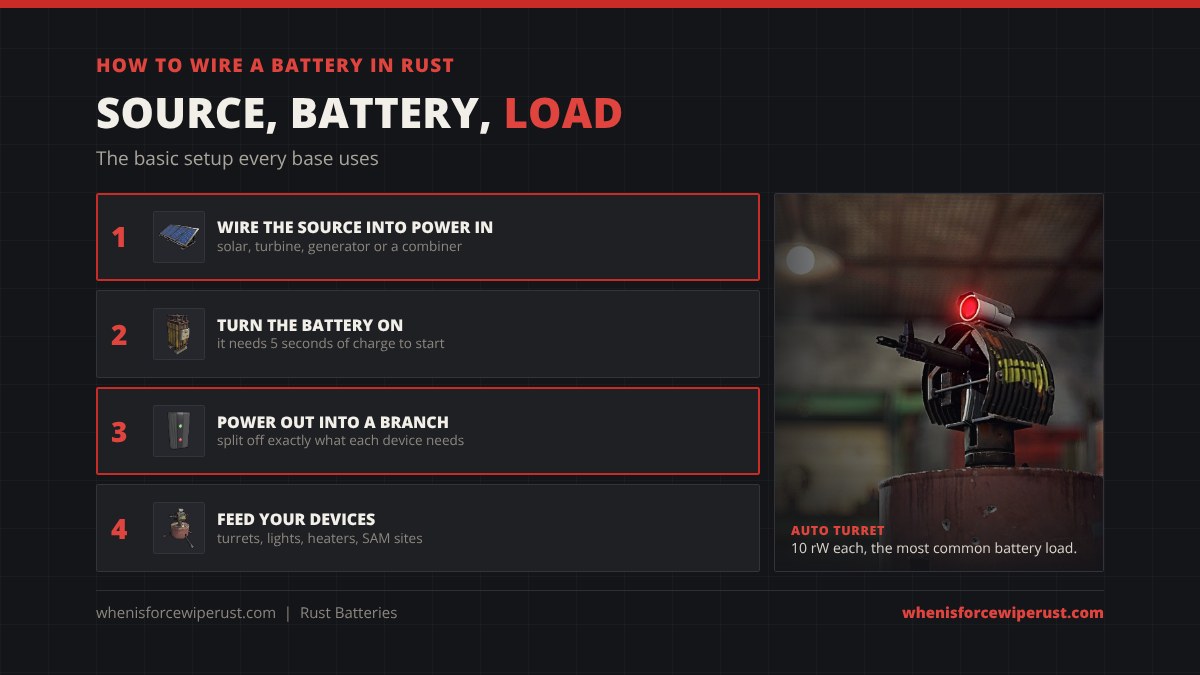
- Craft a Wire Tool (2 HQM, a default blueprint) and place the battery inside your base.
- Wire the source into Power In. One solar panel, a wind turbine, a generator, or a Root Combiner that merges several sources.
- Turn the battery on. Look at it and press the use key. It needs at least 5 seconds of charge before it starts sending power.
- Run Power Out into an Electrical Branch and set each branch to exactly what the next device needs, for example 10 rW per turret. The leftover passes on down the line.
- Optional: use the Fully Charged output. It sends power while the battery is full, which you can wire to a light, or into a switch that turns on extra devices only when there is spare power.
Can you chain batteries? Yes. The game says batteries “can be wired in series”: run one battery’s Power Out into the next battery’s Power In. A common build is a Small Battery right after the solar panels as a buffer, feeding a Large Battery that does the real storing. If you want more output than one battery gives, wire separate batteries to separate devices instead of combining them, because batteries merged on the output side each drain the full load.
How to Destroy a Battery
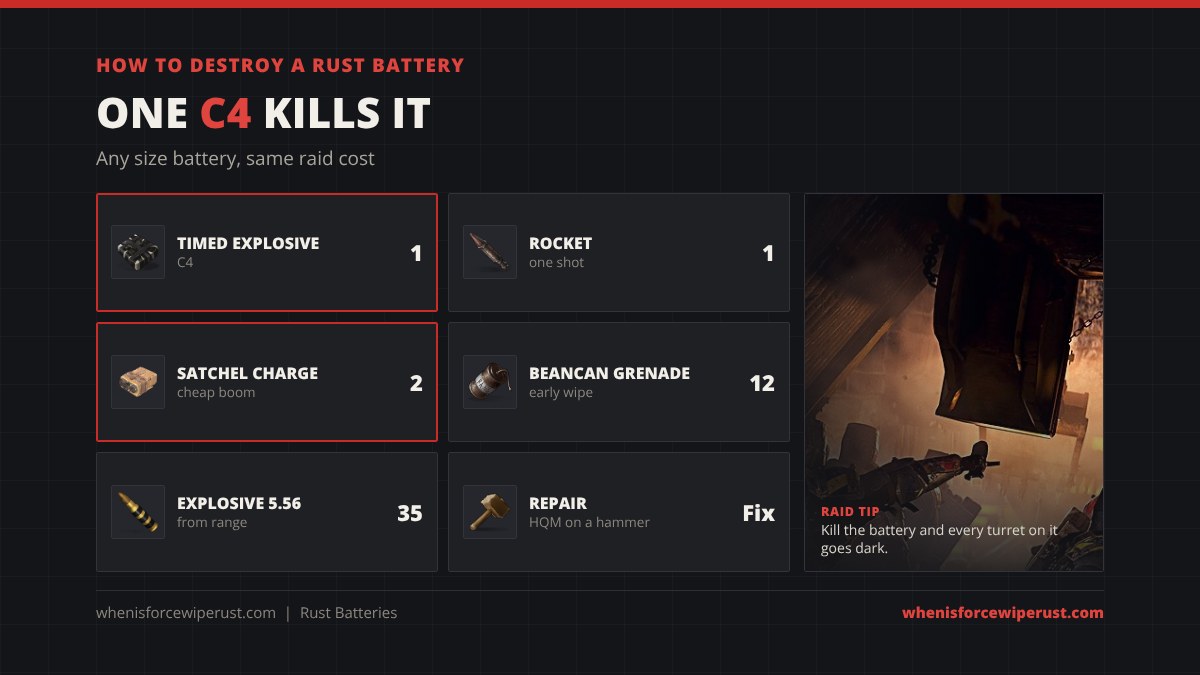
| Explosive | Any battery |
|---|---|
| Timed Explosive Charge (C4) | 1 |
| Rocket | 1 |
| Satchel Charge | 2 |
| Beancan Grenade | 12 |
| Explosive 5.56 ammo | about 35 |
| Fire | 3 molotovs or 1 incendiary rocket |
Raiders love batteries for one reason: break the battery and every turret and SAM site on it goes dark. Keep it deep in your core behind as many walls as your loot room, never on the roof next to the panels. Our Rust raid calculator adds up the walls and doors on the way in.
Rust Battery Tips
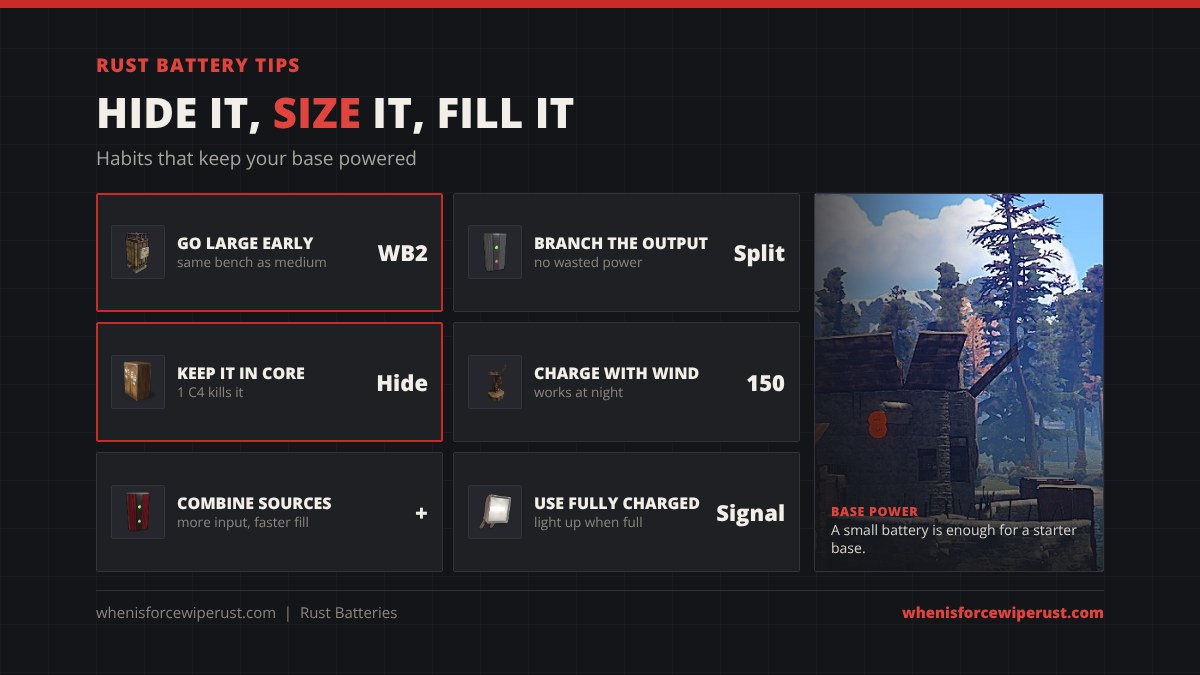
- Skip the Medium Battery. It needs the same Workbench 2 as the Large and stores well under half as much.
- Match the battery to your peak load. Add up every device. A Small Battery cannot run anything over 15 rW, so it will never power a SAM Site or two turrets at once.
- Feed more than you use. Your daytime input has to cover the load plus the 20% charging loss, or the battery slowly drains every day.
- Charge with wind. A high wind turbine keeps working at night and fills a Large Battery in about 3 hours.
- Keep it in the core. One rocket kills any battery, and your turrets go with it.
- Watch your power on the go with the Rust+ app, smart switches and alarms, so you know when a raid cuts it.
Planning a fresh base for next wipe? Check the Rust force wipe countdown to see when your server resets.
Rust Battery FAQ
How much power does a small battery give in Rust?
The Small Rechargeable Battery has a max output of 15 rW and stores 400 rWm. That runs one auto turret (10 rW) for 40 minutes on a full charge.
What is the difference between the small, medium and large battery in Rust?
Output and capacity. Small: 15 rW and 400 rWm. Medium: 50 rW and 9,000 rWm. Large: 100 rW and 24,000 rWm. The small crafts at Workbench 1, the medium and large at Workbench 2.
How much does a large battery cost in Rust?
10 High Quality Metal and 2 Tech Trash at a Workbench Level 2. Researching it costs 40 scrap, or it is 17 fragments along the Engineering Workbench tech tree.
How long does a large battery last in Rust?
24,000 rWm divided by the load. One auto turret (10 rW) runs for 40 hours, a SAM Site (25 rW) for 16 hours, and the battery at its full 100 rW output lasts 4 hours.
How long does it take to charge a battery in Rust?
Batteries store 80% of the power going in. One 20 rW solar panel fills a small battery in about 25 minutes, a medium in about 9.4 hours and a large in about 25 hours. A 150 rW wind turbine fills a large battery in about 3.3 hours.
Why is my battery not giving power in Rust?
Check three things: the battery is switched on, it has at least 5 seconds of charge, and your load is not higher than its max output (15, 50 or 100 rW). Also make sure the wire goes from Power Out, not the Fully Charged output.
Can you connect batteries together in Rust?
Yes, batteries can be wired in series: one battery’s Power Out into the next battery’s Power In. For more output, give each battery its own devices instead of merging their outputs with a combiner.
How many rockets does it take to destroy a battery in Rust?
One rocket or one C4 destroys any battery. It also takes 2 satchel charges, 12 beancan grenades or about 35 explosive 5.56 rounds.
Is Battery – Small the same as the Small Rechargeable Battery?
No. Battery – Small is a separate inventory item that cannot be crafted or placed. The Small Rechargeable Battery is the deployable that stores power for your base.
Sources
- Facepunch Rust Wiki: Small Rechargeable Battery (output, capacity, loot)
- Facepunch Rust Wiki: Medium Rechargeable Battery
- Facepunch Rust Wiki: Large Rechargeable Battery
- Craft cost, craft time, research, tech tree, recycle and item text: Rust game item data (November 2026). Runtime and charge tables are our own maths from those values. Raid costs as on our solar panel guide. Item icons and screenshots from the Rust game files.