
Underwater Labs are the monuments most players never visit, and that is exactly why they are worth running. They sit on the seabed off the coast, every one is built from random rooms, and they hold elite crates, red card rooms and blueprint fragments that hardly anyone else is fighting over.
This Underwater Lab Rust guide covers how to find a lab, how to get inside by submarine or by diving, what to bring, how the green, blue and red keycard rooms work, the Underwater Dwellers that guard them, the loot, the radiation and the tips that keep you alive on the way home.
- What They Are
- Where to Find Them
- How to Get In
- What to Bring
- Keycard Rooms
- Scientists
- Loot
- Dangers
- Vs Oil Rig
- Tips
- FAQ
What Are Underwater Labs in Rust?
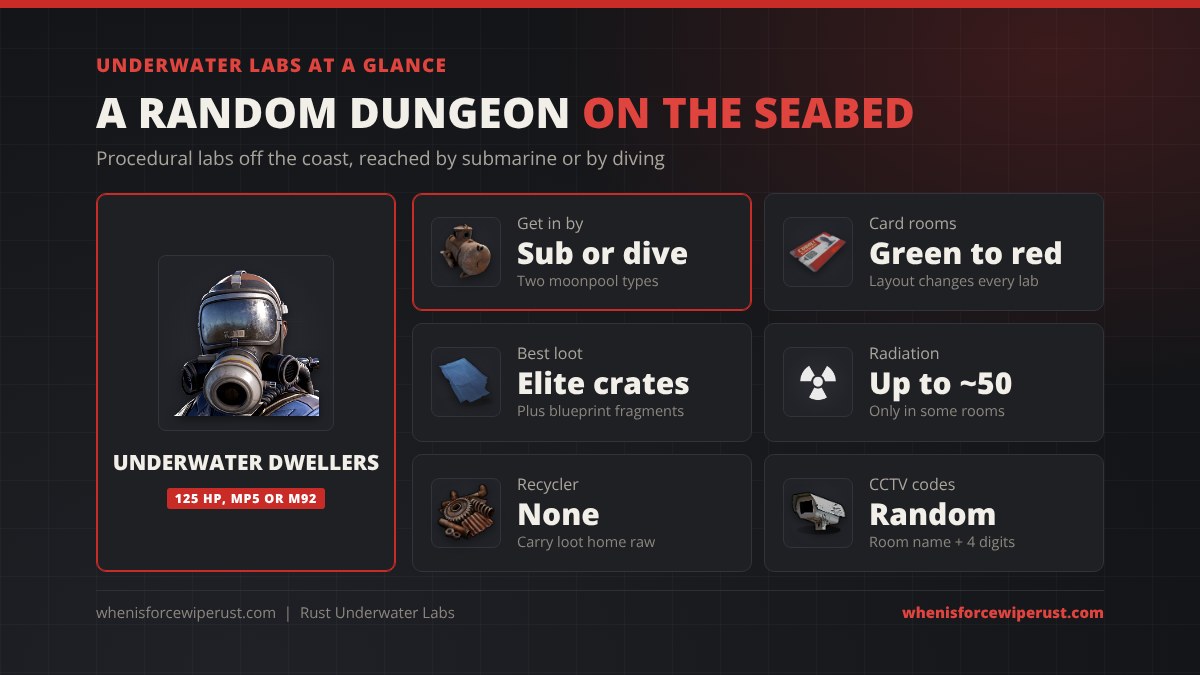
Underwater Labs are underwater research stations that Facepunch added in the Going Deep update on 5 August 2021, together with submarines, torpedoes, sharks and the speargun. Unlike every land monument, they are procedurally generated: each lab is stitched together from modules such as crew quarters, a cantina, an infirmary, a brig, labs, locker rooms and operations rooms, so no two labs on a map look the same.
Inside you get flooded corridors, dry rooms full of crates, keycard doors, fuse boxes and a CCTV station. The guards are Underwater Dwellers, a lab version of the tunnel dwellers. Because the labs are so far from the main island and take some gear to reach, they are among the quietest places to farm high tier loot on a busy server.
| Stat | Value |
|---|---|
| Added | Going Deep update, 5 August 2021 |
| Location | Seabed, offshore around the island |
| Layout | Procedural, different in every lab |
| Entrances | Large moonpool (subs and divers), small moonpool (divers only) |
| Safe zone | No, full PvP |
| Keycards | Green, blue and red rooms; some doors need a fuse |
| Scientists | Underwater Dwellers, 125 HP, MP5A4 or M92 |
| Radiation | None in most rooms, up to about 50 in some |
| Typical crates | About 2 elite, 6 military, 2 tool, plus food, ammo, medical and fuel crates |
| Recycler | None |
| Hackable crate | None |
Where to Find Underwater Labs
Labs spawn in deep water off the coast, out in the same ring of ocean as the Oil Rigs. The number depends on the map: small maps often have just one, while normal sized procedural maps usually have between three and six. Each lab shows up on the in-game map with its own icon, so open the map at the start of a wipe and note which ones are closest to your base.
If you drive a Duo Submarine, its sonar shows lab moonpools as red dots, which makes the last part of the trip much easier. Our procedural map guide explains how offshore content is placed.
How to Get Into an Underwater Lab
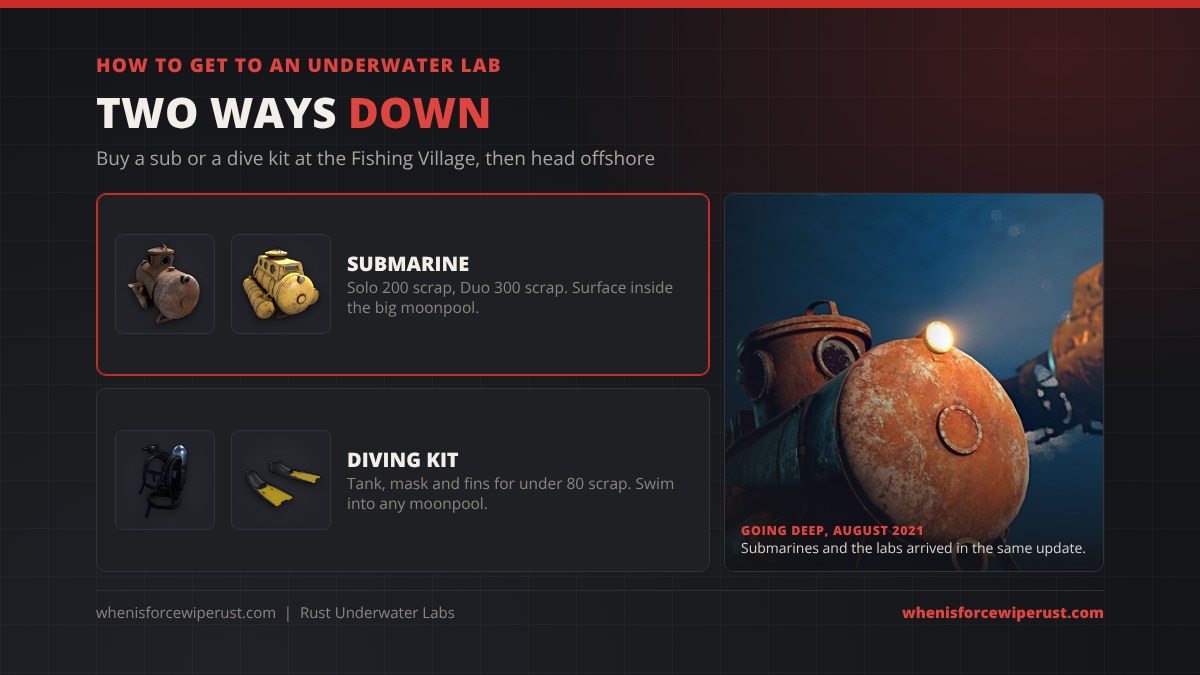
Every lab is entered through a moonpool, an opening in the floor where the water meets the air inside the station. There are two kinds:
- Large moonpool. A long rectangular room with a big opening underneath. Drive a submarine under it and surface, and you can climb straight out into the lab. Divers can use it too.
- Small moonpool. A human sized entrance added for divers. You cannot dock a sub here, so it is the sneaky way in when someone has parked at the big one.
Both routes start at a Fishing Village. The Boat Vendor sells the Solo Submarine for 200 scrap and the Duo Submarine for 300 scrap, and the Shop Keeper sells a diving tank, mask and fins for under 80 scrap together. A sub is faster, carries your loot in its storage and gives you a getaway, while a dive kit is cheaper and quieter. Diving tanks also turn up in underwater crates.
What to Bring to an Underwater Lab
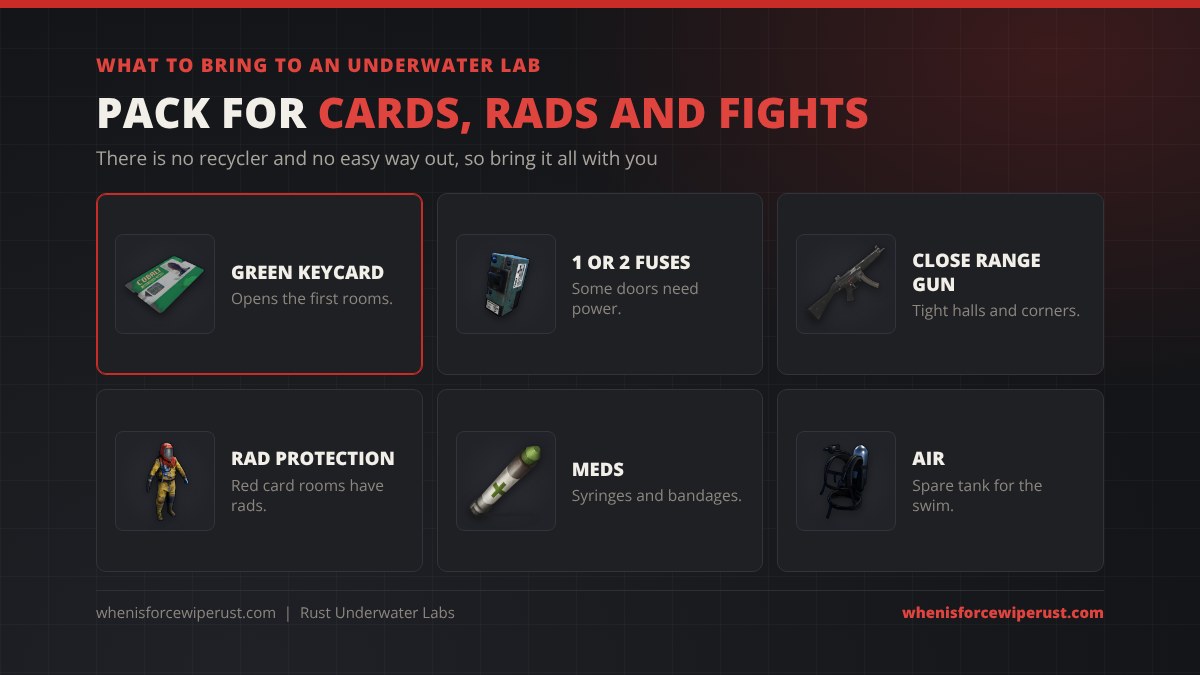
- A green keycard. Green cards spawn inside labs, but bringing one saves time. See our green keycard guide.
- A blue and a red card if you have them. Labs do not reliably spawn either, so carry them from land. Our blue keycard and red keycard guides list every source.
- One or two fuses. Some card doors stay dead until you put a fuse in the nearby fuse box and switch it on.
- A close range gun. The halls are short and full of corners, so an SMG, a shotgun or a rifle with a holo sight works better than a sniper.
- Radiation protection. A hazmat suit or anti-radiation pills for the red card rooms and plant rooms.
- Meds and air. Syringes, bandages, and a spare diving tank if you are swimming.
Underwater Lab Keycard Rooms
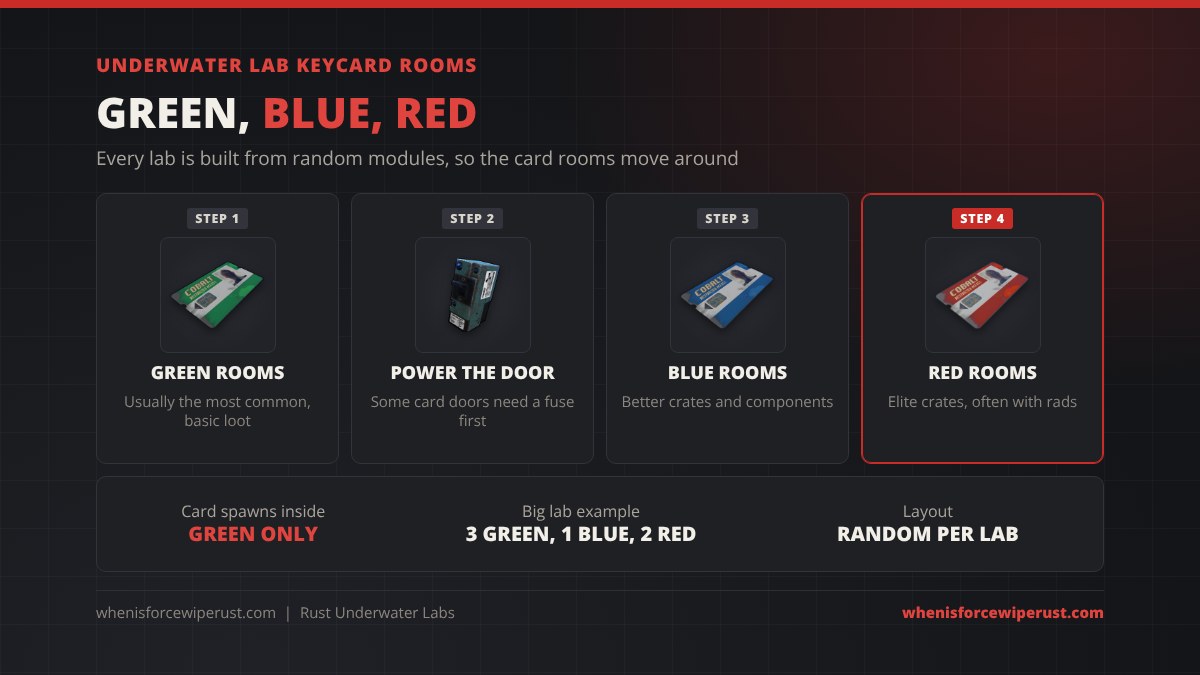
Because the layout is random, there is no single walkthrough. What stays the same is the order: green rooms first, then blue, then red, exactly like the land monuments. A large lab might have three green rooms, one blue room and two red rooms; a small one might have only a couple of card doors.
- Clear the halls. Kill the Dwellers near the moonpool first, then work outward room by room.
- Open the green rooms. They are usually the most common and hold basic crates, and green cards often lie on floors and in locker areas nearby.
- Power the doors that need it. If a card reader does nothing, look for a fuse box in the same module, insert a fuse and flip the switch.
- Swipe blue, then red. Blue rooms hold better crates and components. Red rooms hold the elite crates and are the most likely to have radiation.
Underwater Lab Scientists: Underwater Dwellers
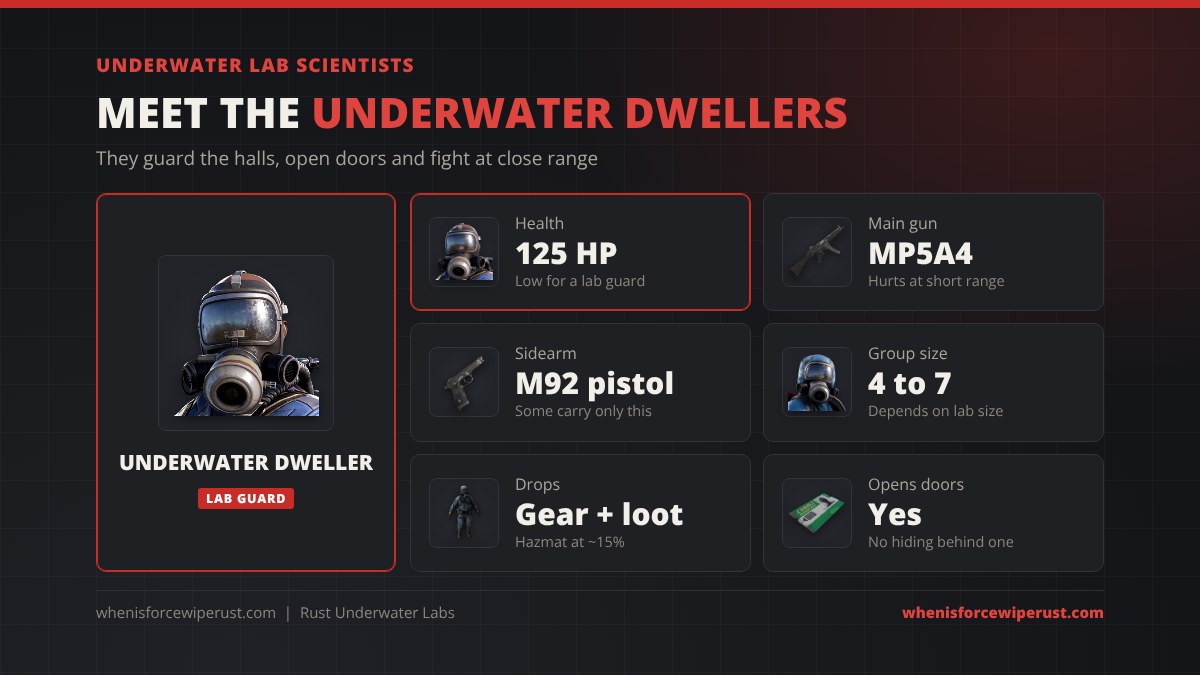
The guards are Underwater Dwellers, the lab cousins of the tunnel dwellers. Each has 125 HP and carries an MP5A4 or an M92 pistol. A typical lab has somewhere around four to seven of them, more in big labs. They can open doors, so closing a door behind you to heal does not buy any time.
Their low health is offset by the range you fight them at. Pre-aim corners, let them come to you, and use the moonpool room as a safe fallback. For every scientist type in the game, see our Rust scientists guide.
Underwater Lab Loot
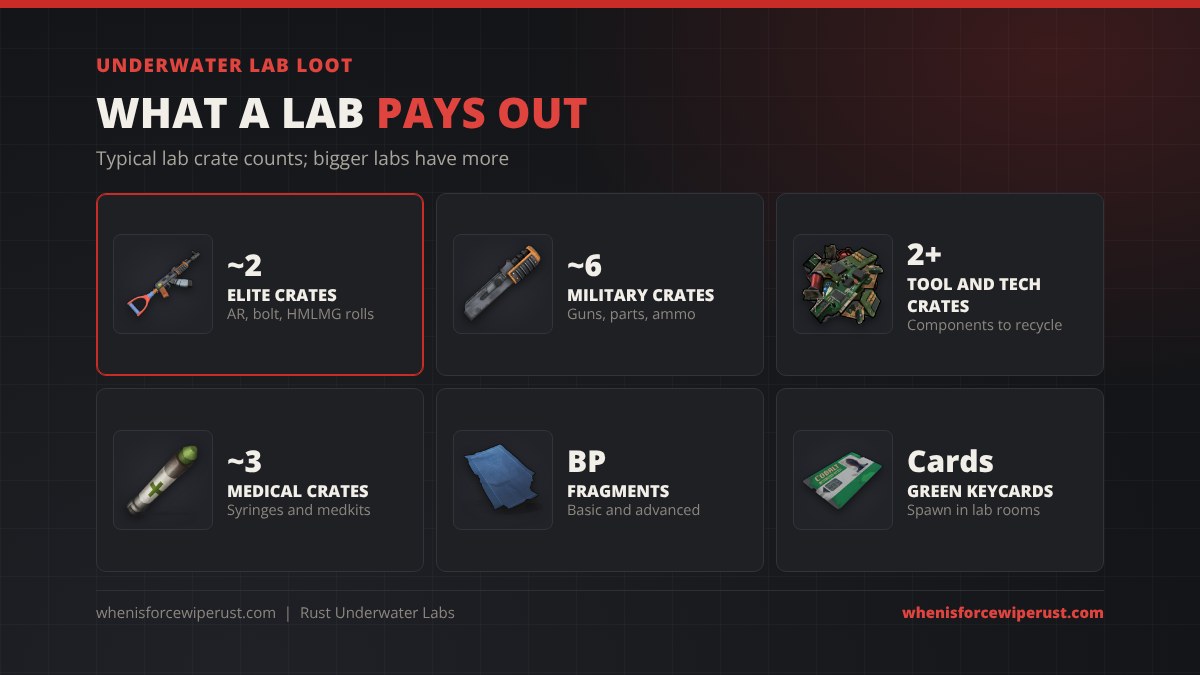
Since each lab is different, crate counts vary. A typical lab holds roughly the following, and big labs have more:
| Container | Typical count | What it rolls |
|---|---|---|
| Elite crate | About 2 | Assault rifle, bolt action, HMLMG, scopes, armor, a 20% chance of an MLRS rocket and a 1 in 10 chance of advanced fragments |
| Military crate | About 6 | Guns, weapon parts, ammo and components |
| Tool and tech crates | 2 or more | Tools, tech trash and other components |
| Medical crate | About 3 | Syringes, medkits and bandages |
| Ammo and food crates | About 3 each | Ammo, food and water |
| Fuel crate and oil barrels | 1 and 2 | Low grade fuel and crude oil |
| Collectibles | Varies | Basic and advanced blueprint fragments, green keycards |
There is no recycler in the labs, so everything comes home raw. Fill the sub storage with components and recycle them at a monument on the coast or at the nearest recycler on your way back. There is also no hackable crate, which is the main thing an Oil Rig has that a lab does not.
Underwater Lab Dangers
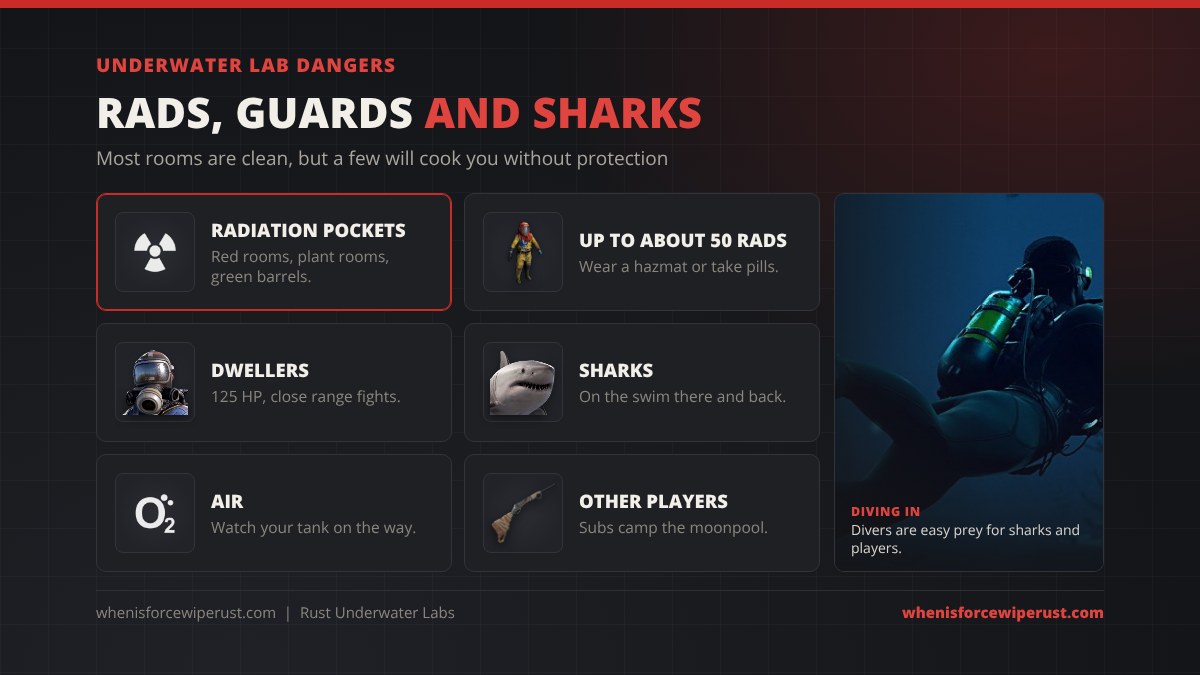
- Radiation. Most of a lab has none, but red card rooms, plant rooms and the glowing green barrels can reach about 50 rads. That is enough to hurt quickly without a hazmat or pills.
- Dwellers. Low HP, but they shoot first at short range and come through doors.
- Sharks. Divers share the water with sharks. A speargun or a quick swim straight to the moonpool is the answer.
- Air. Watch your diving tank, and remember a submarine also needs to surface for air every so often.
- Other players. A sub in the moonpool is an invitation. Torpedoes and players waiting by the exit are the most common way to lose a full run.
Underwater Labs vs Oil Rig
Both are offshore loot runs, and since April 2024 both rigs have moonpools too, so a submarine works for either. They play very differently though:
| Underwater Lab | Oil Rig | |
|---|---|---|
| Layout | Random every lab | Fixed, same every map |
| Guards | Underwater Dwellers, 125 HP | Blue scientists, plus heavies when you hack |
| Hackable crate | No | Yes |
| Recycler | No | No |
| How many per map | Usually several | One small, one large |
| Contested | Rarely | Constantly |
If you want a quiet run with elite crates and no Chinook, pick a lab. If you need guaranteed advanced fragments from a locked crate, go to the Oil Rig. Our monuments guide compares every monument on the map.
Underwater Lab Tips
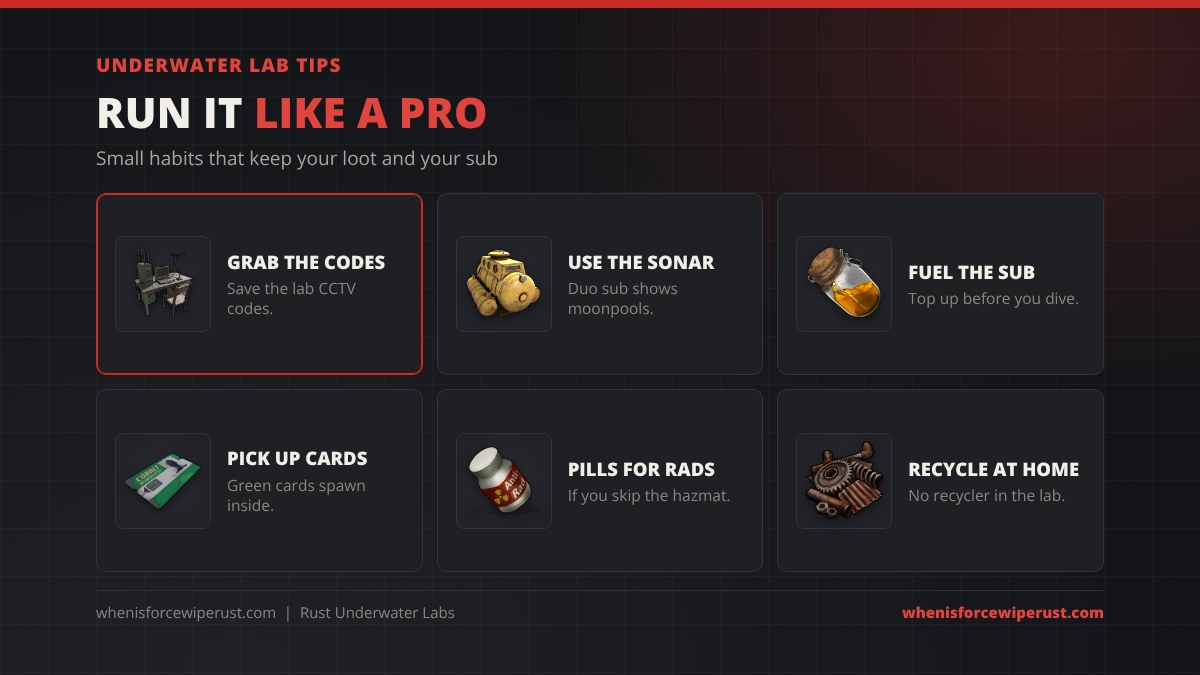
- Save the CCTV codes. Lab cameras use a room name plus four random digits, such as LAB1234, and you read them from the lab’s own computer station. Add them to your computer station at home to see when the lab has been looted. The full list is in our CCTV codes guide.
- Use the sonar. The Duo Submarine shows moonpools and other subs as red dots.
- Fuel up first. Top up the sub with low grade fuel before you leave the coast.
- Grab every green card. They spawn inside the lab and cost nothing to pick up for the next run.
- Run several labs in a row. Labs on the same coast are close together, so one trip with spare cards and fuses can clear two or three.
- Recycle on land. There is no recycler in the lab, so plan your route home past one.
Underwater Lab FAQ
How do you get into an Underwater Lab in Rust?
Through a moonpool. Surface a submarine inside the large moonpool, or swim into the large or small moonpool with a diving tank, mask and fins. Subs and dive kits are sold at the Fishing Village.
Where are the Underwater Labs on the map?
Offshore on the seabed around the island, each marked with its own icon on the in-game map. Small maps often have one lab and normal procedural maps usually have three to six.
What keycards do you need for Underwater Labs?
Green, blue and red. The rooms run green, then blue, then red, and some doors need a fuse first. Green cards spawn inside labs, but bring blue and red cards from land.
Is there radiation in Underwater Labs?
Only in some rooms. Most of a lab has none, but red card rooms, plant rooms and glowing green barrels can reach about 50 rads, so wear a hazmat suit or bring anti-radiation pills.
What scientists are in Underwater Labs?
Underwater Dwellers. They have 125 HP, carry an MP5A4 or an M92 pistol, and can open doors. A typical lab has around four to seven.
Is there a recycler in Underwater Labs?
No. Underwater Labs have no recycler, so take components home and recycle them on land.
Do Underwater Labs have a hackable crate?
No. Labs have elite and military crates but no hackable locked crate. For a hackable crate in the water, go to the Oil Rig or Large Oil Rig.
What loot is in Underwater Labs?
A typical lab has about 2 elite crates, 6 military crates, tool, tech, medical, ammo, food and fuel crates, oil barrels, basic and advanced blueprint fragments and green keycards. Bigger labs have more.
Sources and Further Reading
- Release, moonpools and procedural layout: Facepunch, Going Deep
- Update overview: Rustafied, The Rust Aquatic
- Crates, radiation and recycler: RustHelp, Underwater Lab
- Lab elite crate loot table: Facepunch Wiki, Underwater Labs Elite Crate