
Wild hemp and roadside pumpkins get you through the first hour. A farm is what keeps a group in cloth, food and Pure teas for the whole wipe, and once it is built it runs while you are out raiding.
This Rust farming guide covers every crop you can plant, what a plant needs to grow at full speed, the gear and setup for a working farm, the growth stages and how long they take, how the six genes work, the exact crossbreeding math that turns random seeds into GGGYYY clones, and the habits that keep a farm producing all wipe.

Every Crop You Can Farm in Rust
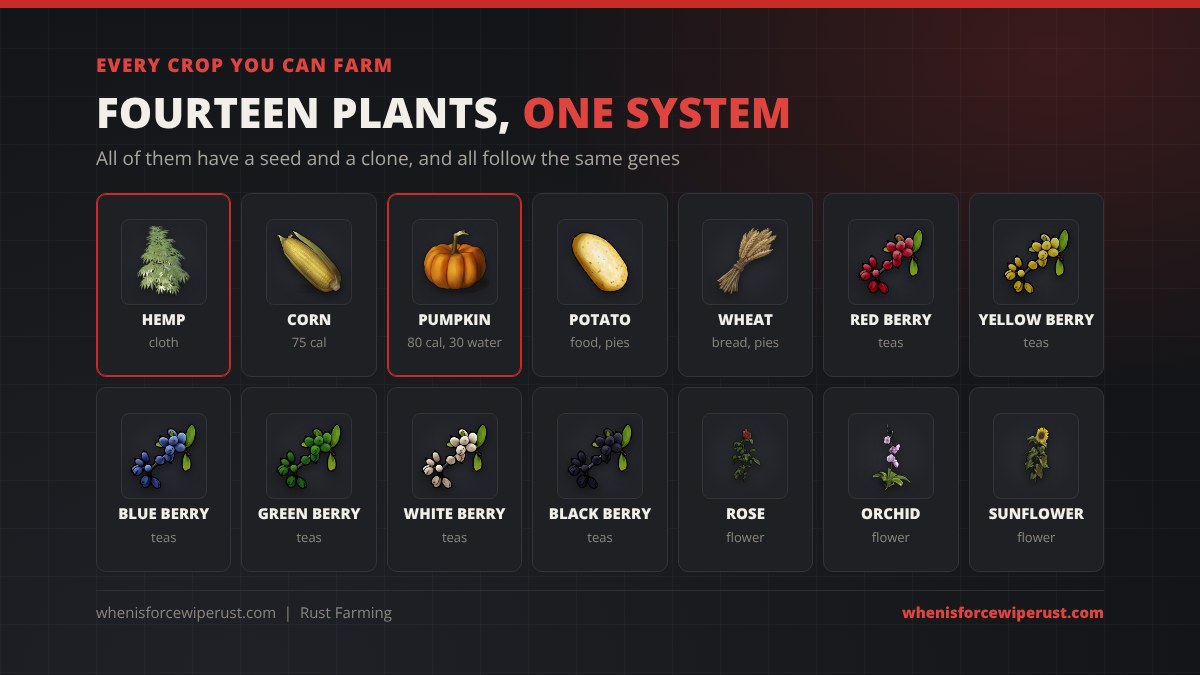
Rust has 14 plants that come with their own seed and clone items. You get your first seeds by picking the wild version of each plant. After that, your own harvests and clones keep the farm going.
| Crop | What you farm it for | Compost value | Spoils? |
|---|---|---|---|
| Hemp | Cloth for tarps, clothing, bags, bows and low grade fuel. See our hemp guide. | Plant fiber 0.05 | No |
| Corn | Food: 75 calories, 10 water. Chicken Pie filling. | 0.3 | Yes, 48 h |
| Pumpkin | Best wild food: 80 calories and 30 water. Pumpkin Pie. | 0.1 | Yes, 48 h |
| Potato | Food and pie filling. | 0.1 | Yes, 48 h |
| Wheat | Bread, Brioche and every pie at the Cooking Workbench. | 0.3 | No |
| Berries (red, yellow, blue, green, white, black) | Tea ingredients at the Mixing Table. | 0.01 | Yes, 48 h |
| Rose, Orchid, Sunflower | Flowers. Decoration, compost and scrap at the Ranch and Large Barn vendors, no food value. | 0.1 | No |
The compost and spoil numbers come straight from the current game files, the same data our Composter guide uses. Food values match our Rust food guide.
Which crop matters most depends on your group. Solo and duo players get the most out of hemp and pumpkins. Bigger groups add berries for Scrap Tea, Ore Tea and Max Health Tea, red berries for Healing Tea, and wheat for pies once the livestock side of the base is running.
What Plants Need: The Four Conditions
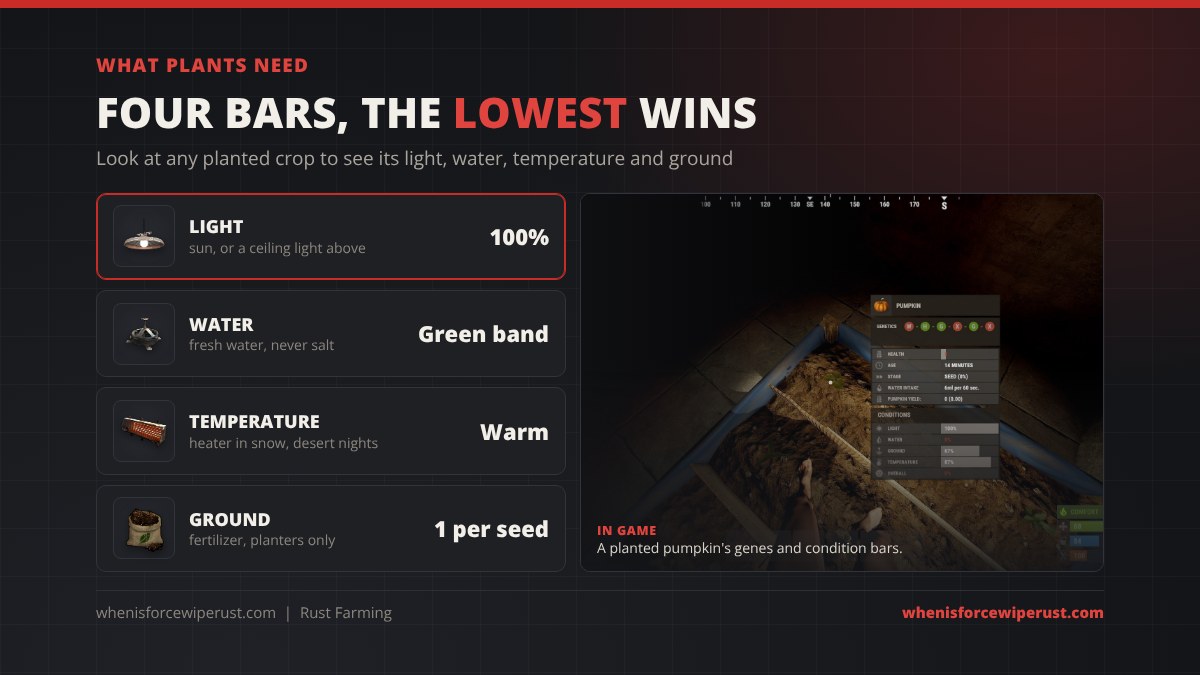
Look at any plant you planted and Rust shows its genes, age, stage, water intake, current yield and four condition bars. The plant’s overall condition is only as good as its worst bar, so a planter with perfect water still crawls in a dark room.
| Condition | What fills it | What kills it |
|---|---|---|
| Light | Open sky in daytime. At night or indoors, a ceiling light right above the planter. In Corrosion Hour’s tests no other lamp counted, search lights and lanterns included. | Night, roofs, and lights that are not over the box. |
| Water | Fresh water from a jug, bucket or sprinkler. The plant shows how many mL it drinks per minute. | An empty planter, a soaked one, or salt water. |
| Temperature | Grassland and forest stay warm. Deserts need heat at night, snow needs an Electric Heater all the time. | Cold biomes and desert nights. |
| Ground | Fertilizer in the planter. Each seed uses 1 when it is planted, or 1 when you add fertilizer later. | No fertilizer: a planter tops out around two thirds. Plants in the open ground cannot be fertilized at all. |
How to Set Up a Farm in Rust
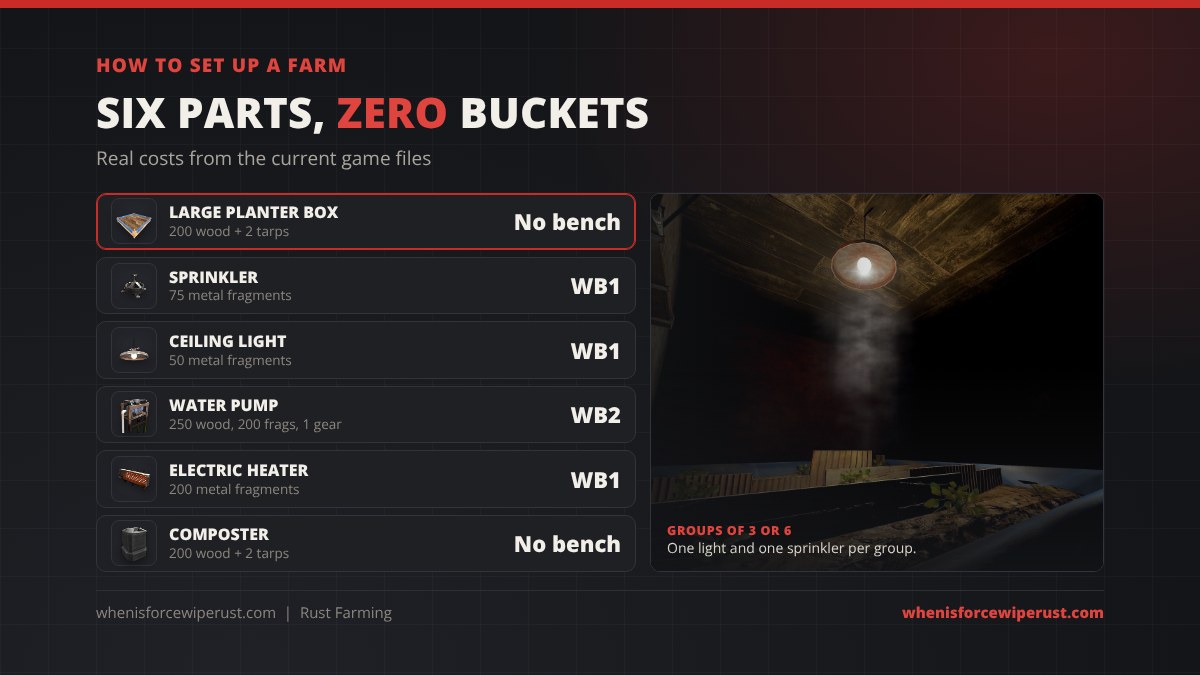
Here is everything a full indoor farm uses, with costs from the current game files:
| Part | Cost | Workbench | Research / tech tree | Job |
|---|---|---|---|---|
| Large Planter Box | 200 wood, 2 tarps | None | 15 / 30 scrap | 9 plant slots |
| Sprinkler | 75 metal fragments | Level 1 | 15 / 165 scrap | Waters the planters under it |
| Ceiling Light | 50 metal fragments | Level 1 | 15 / 135 scrap | Light at night and indoors (2 rW) |
| Water Pump | 250 wood, 200 metal fragments, 1 gear | Level 2 | 30 / 300 scrap | Pulls water from a river, lake or the sea |
| Electric Heater | 200 metal fragments | Level 1 | 30 / 165 scrap | Warmth in cold biomes |
| Composter | 200 wood, 2 tarps | None | Default blueprint | Turns waste into fertilizer |
| Water Barrel | 250 wood, 1 tarp | None | 15 / 150 scrap | Stores water for up to 6 sprinklers |
Our crafting calculator adds up the cost of a whole farm in one go. The build itself follows the layout Facepunch’s own farming guide recommends:
- Lay planters out in groups of 3 or 6. That is how far one sprinkler and one ceiling light reach. A sprinkler that can see more planters than that cannot keep any of them topped up. Groups of 3 fill faster; groups of 6 are easier to scale.
- Get water to it. On a river or fresh lake, power a pump and run its output straight into up to 4 sprinklers. Near the sea, run 2 pumps into a powered water purifier first, because salt water hurts plants. Far from water, fill water barrels; one barrel feeds up to 6 sprinklers.
- Light it. One ceiling light over each group keeps light at 100% all night. Power them with solar panels and a battery, or anything from our Rust electricity guide.
- Heat it if you need to. Snow bases need a heater pointed at the planters around the clock. Desert bases need one at night.
- Feed it. Keep fertilizer in every planter and a Composter next to the farm for the waste.
Growth Stages and How Long Crops Take
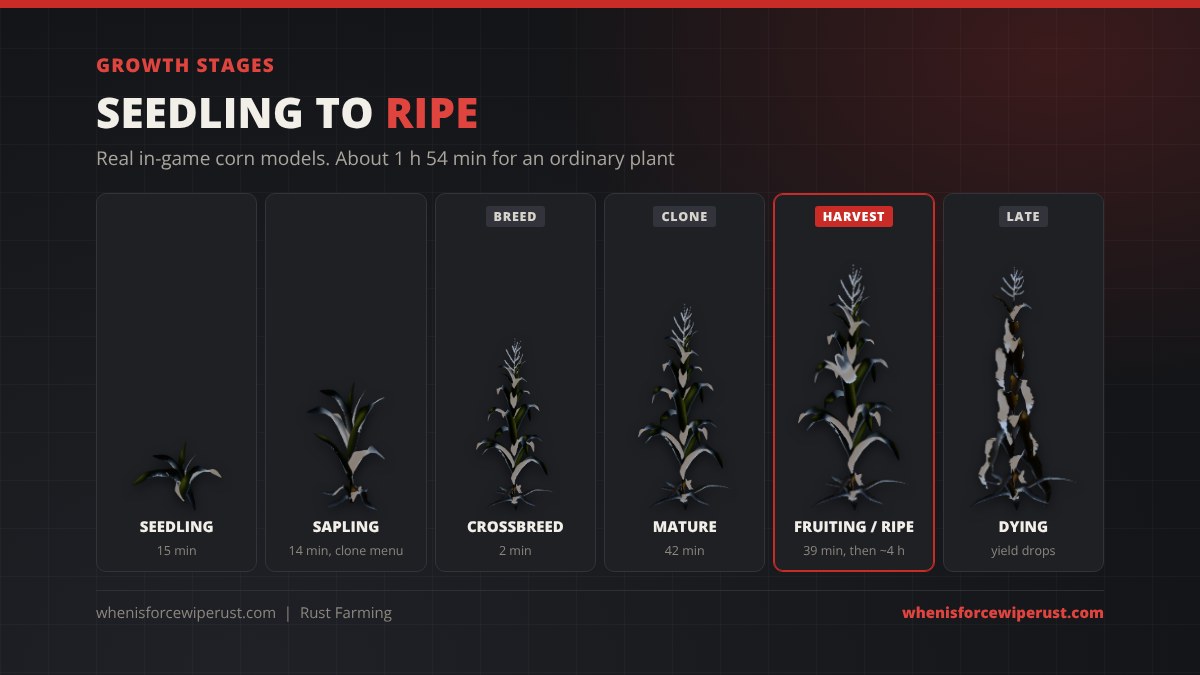
Every crop runs through the same eight stages. Look at a plant to see its stage and how far through it the plant is.
| Stage | Approx. length | What matters |
|---|---|---|
| Seed | 2 min | A seed rolls its six genes the moment you plant it. |
| Seedling | 15 min | Get water and light on it early. |
| Sapling | 14 min | The hold-E menu opens: eat, harvest or take clones. |
| Crossbreed | 2 min | The plant can take genes from the plants touching it. This is where breeding happens. |
| Mature | 42 min | Clone your best plants here, after their genes are settled. |
| Fruiting | 39 min | Yield climbs fast. |
| Ripe | About 4 hours | Yield is at its maximum. Harvest now. |
| Dying | Until it is gone | Yield falls, then the plant leaves Plant Fiber. |
The times above are Corrosion Hour’s stage timings, which put an ordinary plant at about 1 hour 54 minutes from seed to Ripe. Every G gene shortens each stage, and anything below 100% condition slows it down, so real farms land anywhere from under an hour to well over two. Well-bred hemp in a perfect room ripens in roughly 40 to 60 minutes. The long Ripe window is there so you can log off and still come back to a full harvest.
Rust Plant Genes Explained
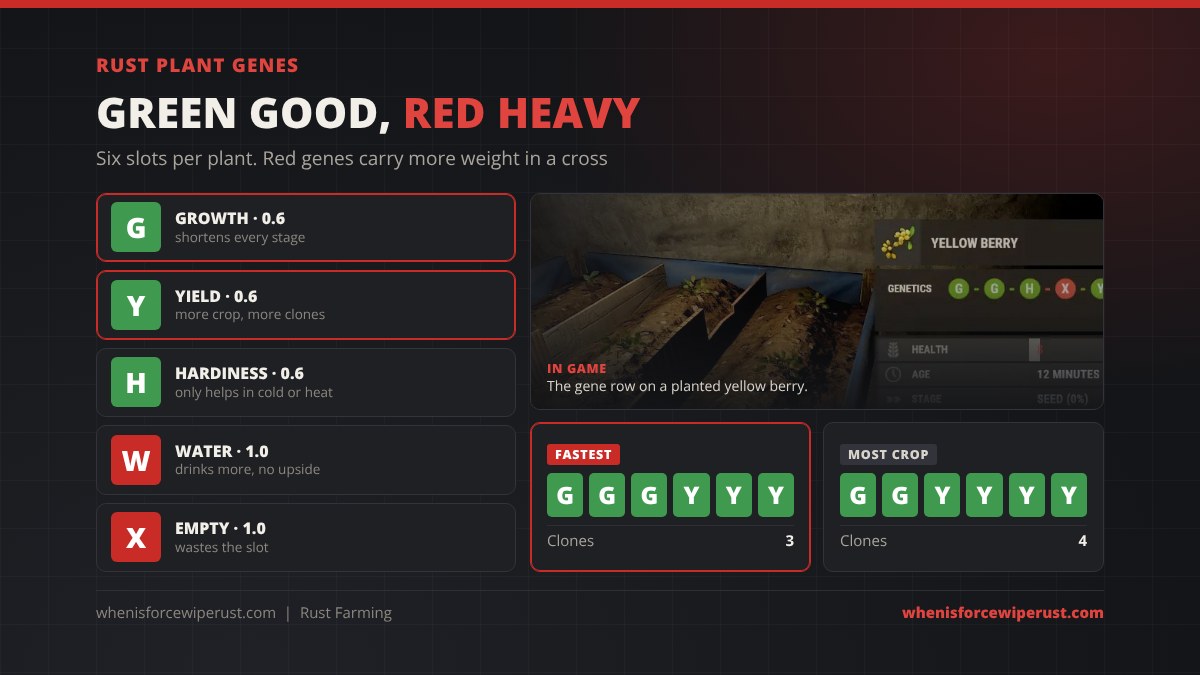
Every planted crop has exactly six gene slots, read left to right. Each slot holds one of five genes:
| Gene | Colour | Effect | Crossbreed weight |
|---|---|---|---|
| G Growth | Green | Shortens every growth stage | 0.6 |
| Y Yield | Green | More crop per harvest and more clones | 0.6 |
| H Hardiness | Green | Copes better with cold, heat and poor conditions | 0.6 |
| W Water | Red | Drinks more water, no upside | 1.0 |
| X Empty | Red | Does nothing, wastes a slot | 1.0 |
The two targets every farmer chases are GGGYYY (fastest, 3 clones) and GGYYYY (a little slower, more crop and 4 clones), both straight from Facepunch’s farming guide. Some groups also run GGGGYY for speed. In a warm, controlled room, H does nothing a heater cannot, so treat it as a wasted slot unless you farm in snow.
Seeds have no genes until you plant them, and the roll is random. Genes also never move: a G in slot 2 stays in slot 2 every time you clone that plant. The only way to change a gene is crossbreeding.
Crossbreeding in Rust: How It Works
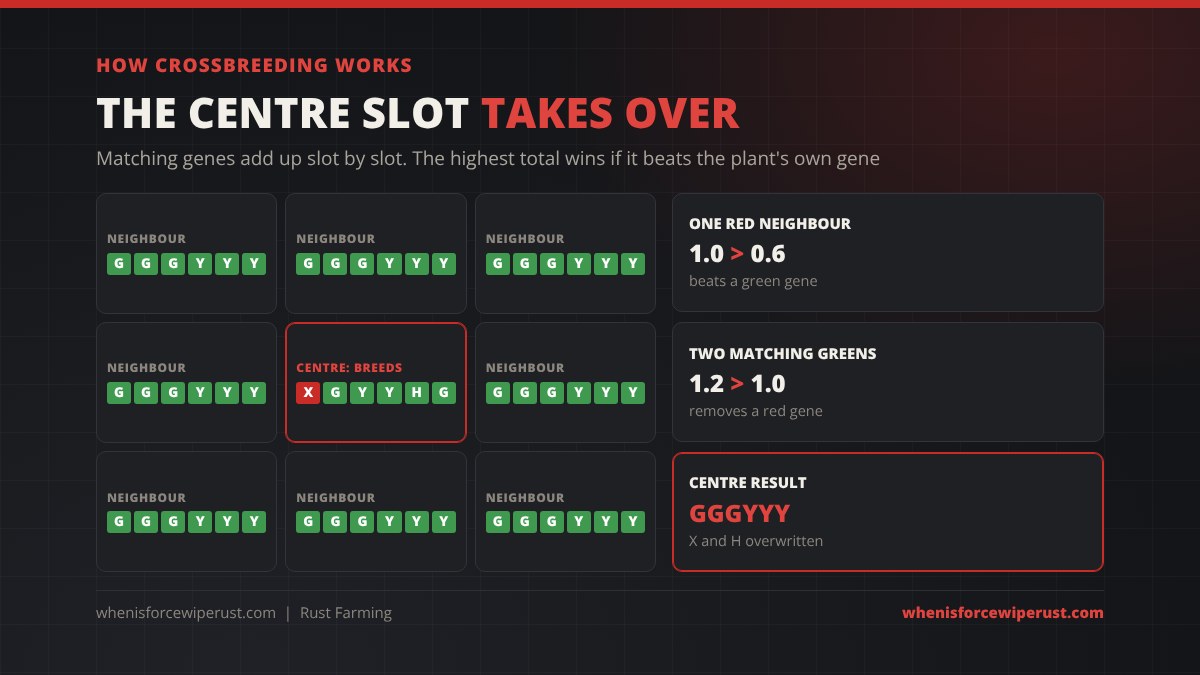
When a plant reaches the Crossbreed stage, it looks at the plants of the same crop touching it and runs a simple vote for each of its six slots:
- Add up the neighbours. For one slot, every neighbouring plant adds its gene’s weight. Only identical genes stack: two Y neighbours make Y = 1.2, but a G and a Y stay 0.6 each.
- Find the winner. The gene with the highest total wins that slot. If two genes tie, it is a coin flip.
- Beat the plant’s own gene. The winner only replaces the plant’s own gene if its total is higher. A green gene (0.6) falls to one red neighbour (1.0) or two matching green neighbours (1.2). A red gene (1.0) needs two matching greens to remove it.
That is why red genes spread so easily and why you never put junk plants next to your good ones. Hemp next to berries does nothing to either, since only the same crop crossbreeds.
The Centre-Slot Method
In a Large Planter Box the centre slot touches all eight others, the edges touch five and the corners only three. That makes the centre the place to build a new strain:
- Plant the plant you want to change in the centre first.
- About 15 minutes later, fill the eight slots around it with clones that carry the genes you want, making sure at least two neighbours share the good gene in every slot.
- The centre hits Crossbreed while the neighbours are still young, so it takes their genes before they change.
- Once the centre reaches Mature, check its genes and take clones if it came out right.
Example: plant an XGYYHG in the centre and surround it with GGGYYY clones. Every slot sees at least 1.2 of a good gene from the neighbours, so the X and H are overwritten and the centre comes out GGGYYY. If you cannot do the math in your head, community calculators like RustBreeder take your gene strings and show you the best layout.
Seeds vs Clones
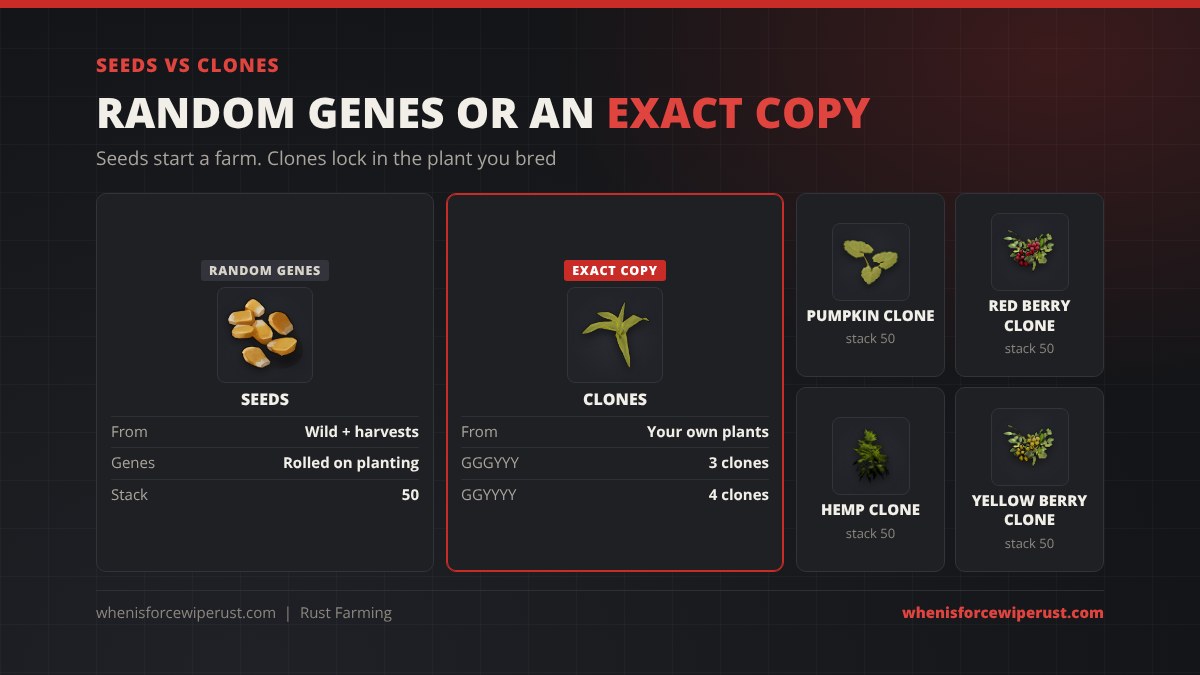
Seeds come from picking wild plants and from harvesting the ones you grew. They are free and plentiful, but every seed rolls brand new random genes when it goes in the ground.
Clones are cuttings. Look at a plant you planted, hold E and choose the clone option. The plant is used up and you get a stack of clones that carry exactly its six genes. Wild plants cannot be cloned.
- Yield genes add clones. Facepunch’s guide puts a GGGYYY plant at 3 clones and a GGYYYY plant at 4.
- Clone after Crossbreed. The menu opens at Sapling, but genes can still change at the Crossbreed stage, so clone at Mature to lock in the final genes.
- Seeds and clones stack to 50 and despawn 5 minutes after you drop them, so do not leave a god clone on the floor.
- Good clones are currency. Perfect clones sell for real scrap in vending machines, and buying a good starter clone at Bandit Camp or from a neighbour can skip hours of breeding.
Testing a layout on your own server? Admins can spawn seeds straight from the F1 console:
inventory.give seed.pumpkin 50Swap in seed.hemp, seed.corn, seed.potato, seed.wheat or seed.red.berry for other crops, or clone.hemp for clones. More commands are in our Rust admin commands list and every short name is in the Rust item IDs list.
Harvesting, Spoiling and Waste
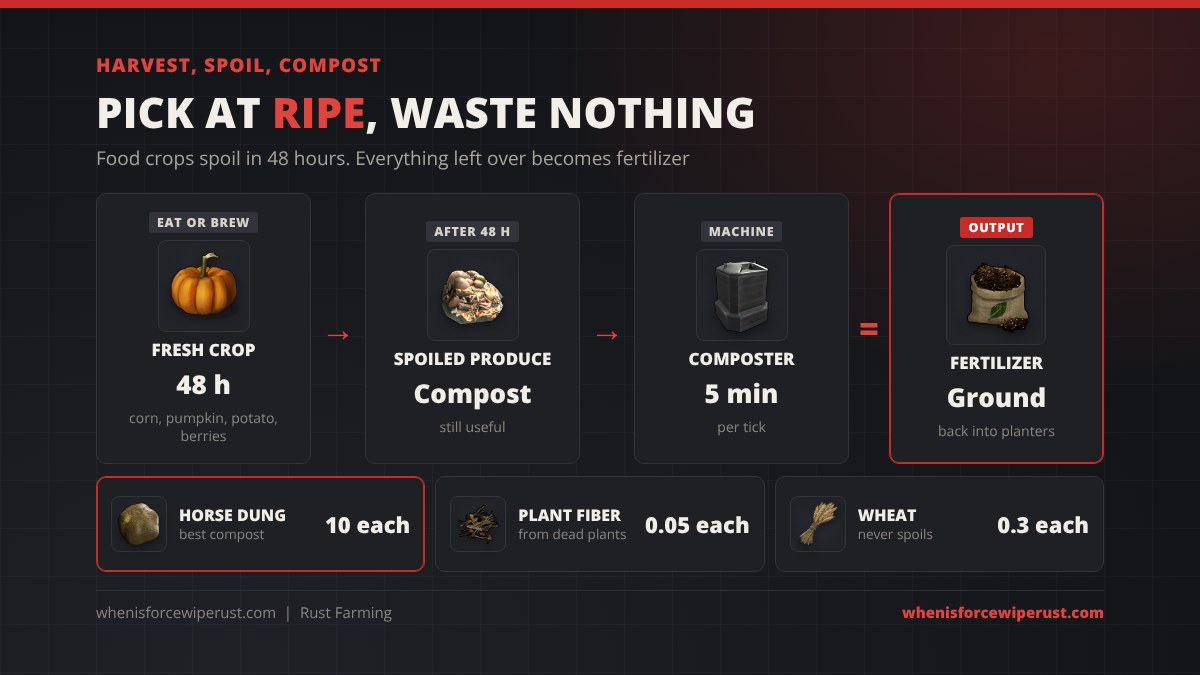
Look at a plant to see its yield right now, shown as a whole number and a decimal. It keeps climbing through Fruiting and stops at Ripe, so that is when to pick it. Picking early gives less, and a Dying plant loses yield until it is just a husk.
Harvested food does not last forever. In the current game files corn, pumpkins, potatoes, berries, mushrooms, apples and cactus flesh all turn into Spoiled Produce after 48 hours. Wheat and flowers do not spoil. Cook or brew big harvests, or sell the extra.
Waste goes back into the farm. Dead plants leave Plant Fiber (0.05 fertilizer each), and spoiled produce composts too. The best compost by far is horse dung at 10 fertilizer per piece, which is why so many farm bases keep a horse in a stable next to the Composter. Spare crops also run a Biofuel Generator.
Rust Farming Tips
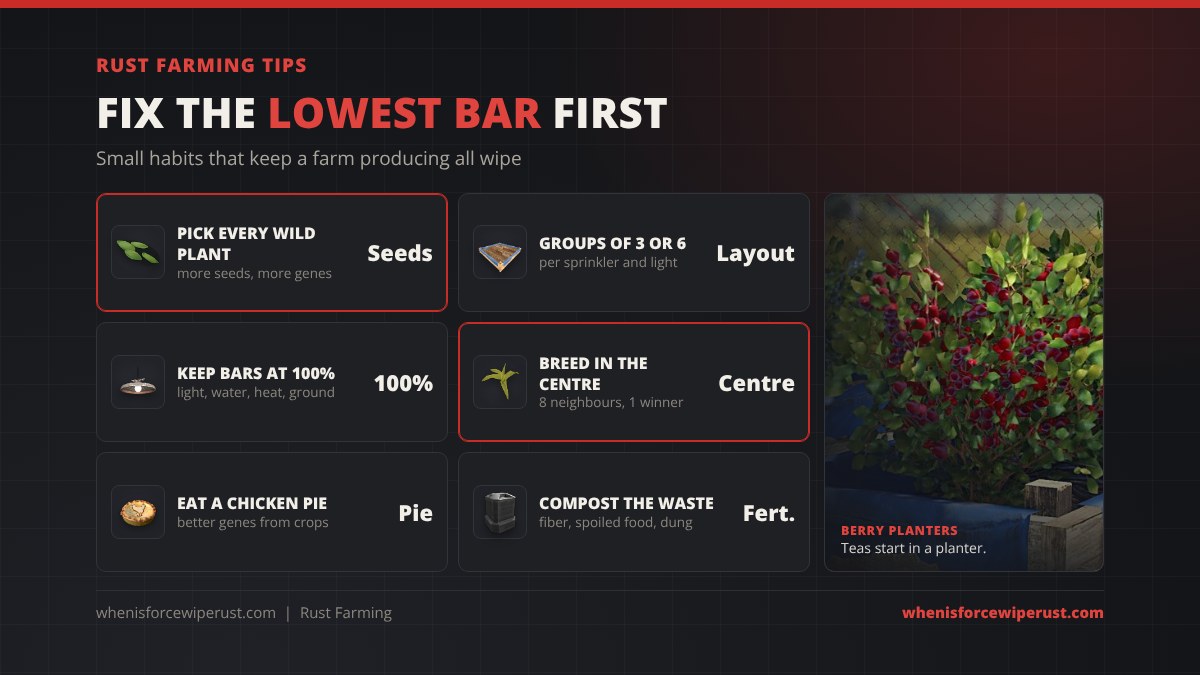
- Pick everything on wipe day. Every wild hemp, corn, pumpkin, potato and berry plant gives seeds. More seeds means more random genes to choose from. The force wipe countdown tells you when the next fresh start lands.
- Plant a full box of seeds, keep the best three. Look for plants with at least five green genes, clone them, and chop the rest with a hatchet.
- Never clone two plants with the same red gene in the same slot. You will need two good neighbours in every slot later, and a shared bad slot makes that impossible.
- Build the farm inside the base. Planters are wood and easy to break, and other players will steal ripe crops. The base designs guide has layouts with room for a grow room.
- Fix the lowest bar first. Do not chase genes while a planter sits at 60% light.
- Pair the farm with teas. A berry farm feeds Pure Wood Tea, Ore Tea and Scrap Tea, and a Bear Pie stretches them further.
- Grow cloth, not just food. A hemp farm is the steadiest cloth source in the game once it is running.
New to the game? Our Rust beginner’s guide covers the first hour before any of this matters.
Rust Farming FAQ
How do you start farming in Rust?
Pick wild hemp, corn, pumpkins, potatoes and berries to collect seeds, craft a Large Planter Box (200 wood and 2 tarps), plant the seeds, and keep light, water, temperature and ground condition high. Add a sprinkler, a ceiling light and fertilizer to grow at full speed.
What can you farm in Rust?
Fourteen crops: hemp, corn, pumpkin, potato, wheat, six berries (red, yellow, blue, green, white and black), and three flowers (rose, orchid and sunflower). Each one has its own seed and clone.
What are the best genes in Rust farming?
GGGYYY for the fastest growth with 3 clones, or GGYYYY for a little more crop and 4 clones. G (growth) and Y (yield) are the genes you want. Avoid W (water) and X (empty), and only keep H (hardiness) in cold biomes.
How does crossbreeding work in Rust?
At the Crossbreed stage a plant adds up the genes of the same crop touching it, slot by slot. Green genes weigh 0.6 and red genes weigh 1.0, and only identical genes stack. The highest total replaces the plant’s own gene if it is higher, so two matching green neighbours (1.2) beat one red gene (1.0).
How long do plants take to grow in Rust?
An ordinary plant takes about 1 hour 54 minutes from seed to Ripe. Growth genes and 100% conditions make it faster, and well-bred hemp in a perfect room ripens in roughly 40 to 60 minutes. Plants then stay Ripe for about 4 hours before they start dying.
What lights work for plants in Rust?
Sunlight and ceiling lights. Put one ceiling light directly above each group of planters to keep light at 100% at night or indoors. Other lamps, including search lights and lanterns, did not count in Corrosion Hour’s tests.
How many planters can one sprinkler water in Rust?
Keep planters in groups of 3 or 6 per sprinkler. A sprinkler that reaches more planters than that cannot keep them topped up. One water pump feeds up to 4 sprinklers and one water barrel up to 6.
Do crops spoil in Rust?
Yes. Corn, pumpkins, potatoes and berries turn into Spoiled Produce after 48 hours. Wheat and flowers do not spoil. Spoiled produce can still go in a Composter for fertilizer.
Can you use fertilizer on plants in the ground?
No. Fertilizer only works in planters, where it raises the ground condition. Without fertilizer a planter’s ground condition tops out around two thirds.