
Every Rust life starts the same way: a rock, a torch and a walk inland past tall green plants. Those plants are hemp, and they are the first thing that stands between a fresh spawn and a sleeping bag, a bow and a set of clothes.
This hemp Rust guide covers where wild hemp grows, exactly what one plant gives you, how hemp seeds and hemp clones work, every growth stage from seedling to dying, which genes to breed for, what Plant Fiber is, and how to turn a few planters into all the cloth your group will ever need.
- What It Is
- Wild Hemp
- Cloth Yield
- Seeds & Clones
- Stages
- Genes
- Hemp Farm
- Plant Fiber
- What Cloth Builds
- Tips
- FAQ
What Is Hemp in Rust?
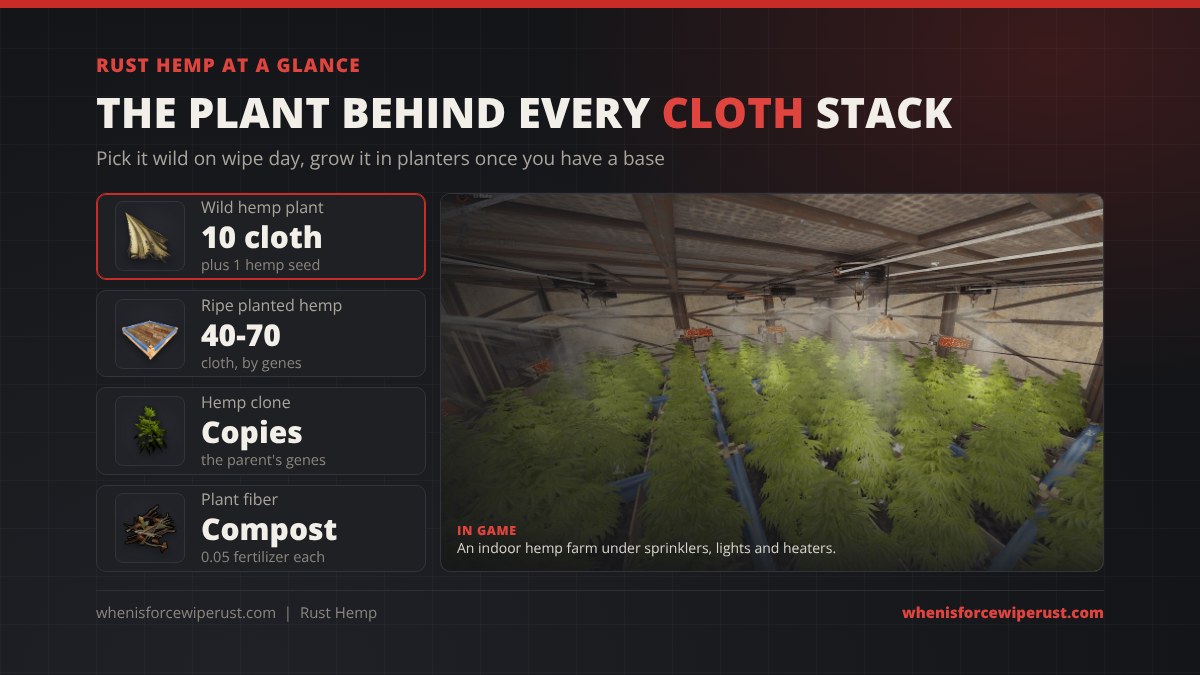
Hemp is a plant, not an inventory item. In the game files the wild version is the hemp-collectable and the farmed version is hemp.entity, and when you look at one the prompt says “Hemp Fibers”. That is why older guides and the Rust wiki still call it Hemp Fibers, but there is no Hemp Fibers item any more. Picking the plant drops Cloth straight into your inventory.
Four items come from hemp plants, and every one of them has a different job:
| Item | Short name / ID | Stack | What it does |
|---|---|---|---|
| Cloth | cloth / -858312878 | 1,000 | The resource you actually want. Clothing, sleeping bags, bows, low grade fuel and more. |
| Hemp Seed | seed.hemp / -237809779 | 50 | Plant it to grow a new hemp plant with random genes. |
| Hemp Clone | clone.hemp / -886280491 | 50 | A cutting from a grown plant. Plant it to get an exact copy of the parent’s genes. |
| Plant Fiber | plantfiber / -804769727 | 1,000 | “Fiber from dead plants.” Compost only, 0.05 fertilizer each. |
Seeds, clones and Plant Fiber all despawn 5 minutes after you drop them, and none of them can be crafted, recycled or researched. You can look up any other ID in our Rust item IDs list.
Where to Find Wild Hemp

Wild hemp spawns all over the map on its own, and it respawns through the wipe, so there is always some near the coast on a fresh spawn. Look for a tall, bright green plant with jagged, star-shaped leaves standing above the grass. You will find the most of it in:
- Temperate grassland. Open fields are the easiest place to spot it, since it stands taller than the grass around it.
- Forests and their edges. Single plants between the trees, often near rocks and fallen logs.
- Riverbanks and lakes. A walk along a river usually turns up a cluster or two.
- Drier areas. It also grows in arid parts of the map, though more spread out. Snow is the worst place to look.
To pick it, look at the plant and press E. No tool is needed and you do not have to hit it, which is why “punching hemp” is really just holding the use key. Picking wild plants can also drop a worm or a grub for fishing.
How Much Cloth Does Hemp Give?
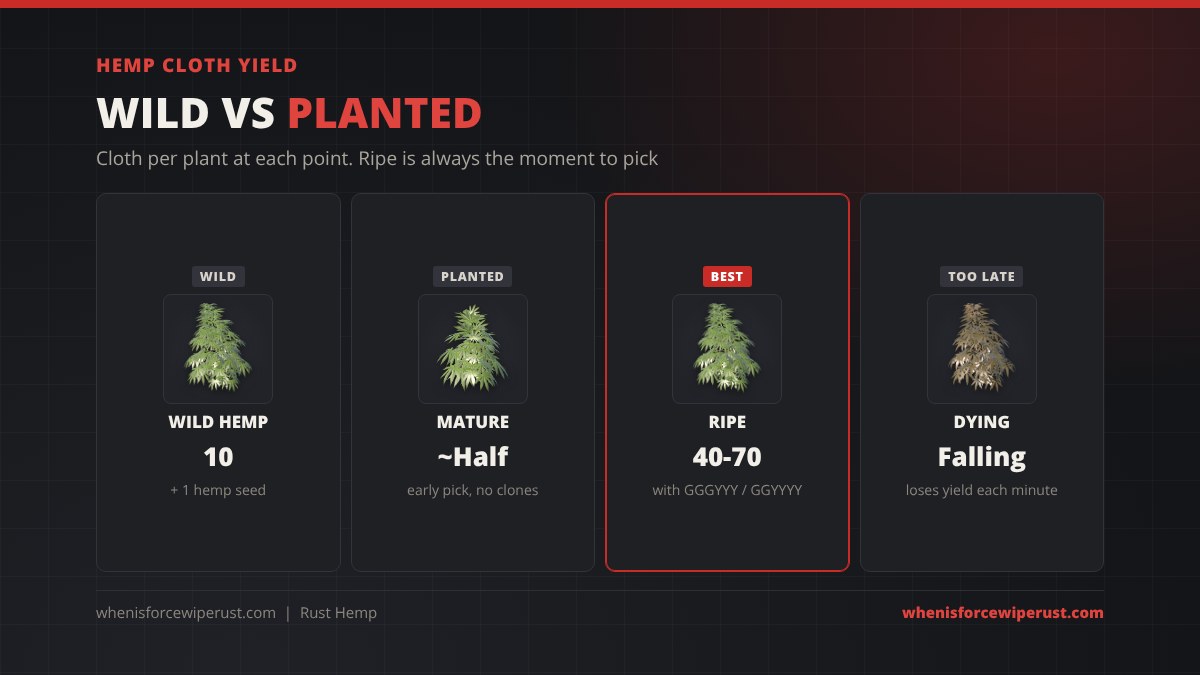
This is the number most players are actually searching for, and it depends on whether the plant is wild or one you grew:
| Hemp plant | Cloth | Extra | Notes |
|---|---|---|---|
| Wild hemp, fully grown | 10 | 1 Hemp Seed | Smaller wild plants give less |
| Planted hemp, picked at Mature or Fruiting | About half of its maximum | Seeds | Early harvest, no clones |
| Planted hemp, picked at Ripe, average genes | About 25 to 40 | Seeds | Wild seed, decent water and light |
| Planted hemp, picked at Ripe, GGGYYY or GGYYYY | About 40 to 70 | Seeds | More Y genes, more cloth |
| Planted hemp, left Dying | Drops every minute | Plant Fiber when it dies | Harvest before it turns brown |
Planted hemp shows its yield when you look at it, so you never have to guess. Yield climbs as the plant grows and stops rising when it hits Ripe, which is the moment to pick it. Cold rooms pull the number down, so a well-bred plant in a freezing biome can land at the low end of that range.
For comparison, a bear gives 50 cloth and a tiger 70, and recycling a tarp gives 60. Our Rust cloth guide compares every source side by side.
Hemp Seeds and Hemp Clones
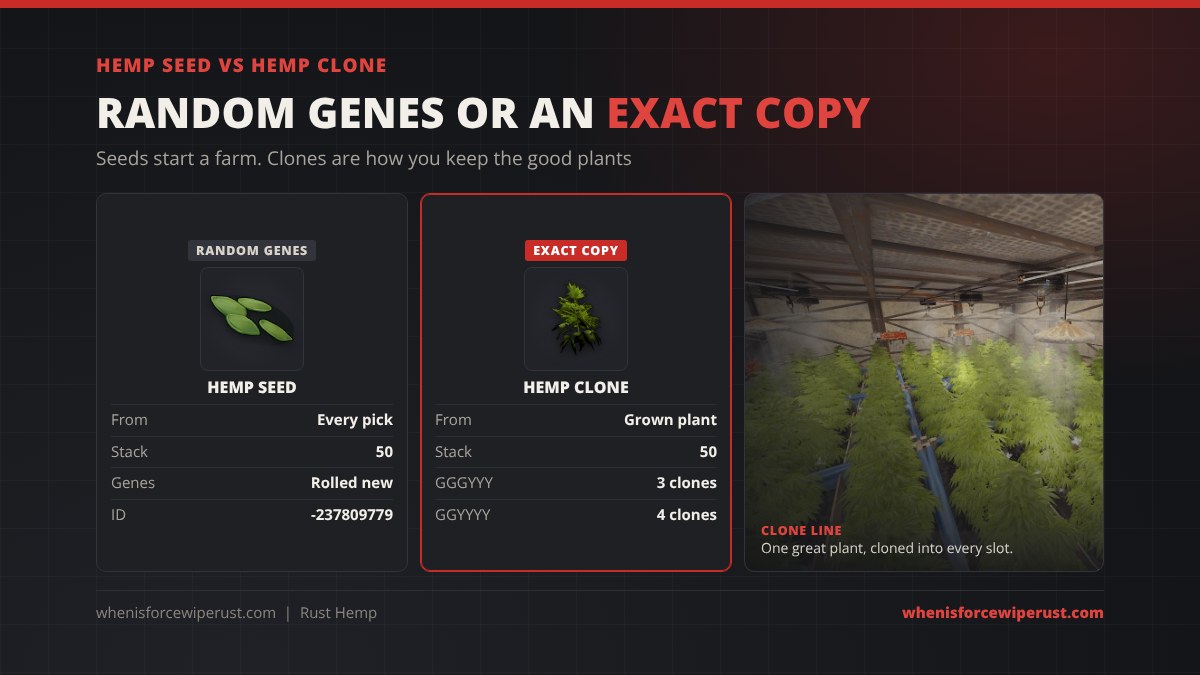
Hemp Seeds drop from every wild hemp plant you pick, one per plant, and from harvesting your own planted hemp. The in-game description says it plainly: seeds “can be planted in the ground and grown to collect additional cloth”, and planting them in a planter and giving them lots of water “yields significantly more cloth and faster growth”. Each new seed rolls six random genes when it is planted.
Hemp Clones are cuttings. Once a planted hemp plant is grown, look at it, hold E and choose the clone option. The plant is used up and you get a stack of clones that carry exactly the same genes as the parent. That is the whole trick to hemp farming: get one great plant, then clone it into every planter you own.
- How many clones? The Y genes decide it. Facepunch’s own farming guide notes that a GGGYYY plant gives 3 clones and a GGYYYY plant gives 4.
- Wild plants cannot be cloned. The clone option only appears on hemp you planted yourself.
- Clones work anywhere a seed does. Planters, plant pots or the ground.
Admins can give themselves seeds or clones straight from the F1 console, which is handy for testing a farm build on a private server:
inventory.give seed.hemp 50inventory.give clone.hemp 50Our Rust admin commands list has every other give command.
Hemp Growth Stages
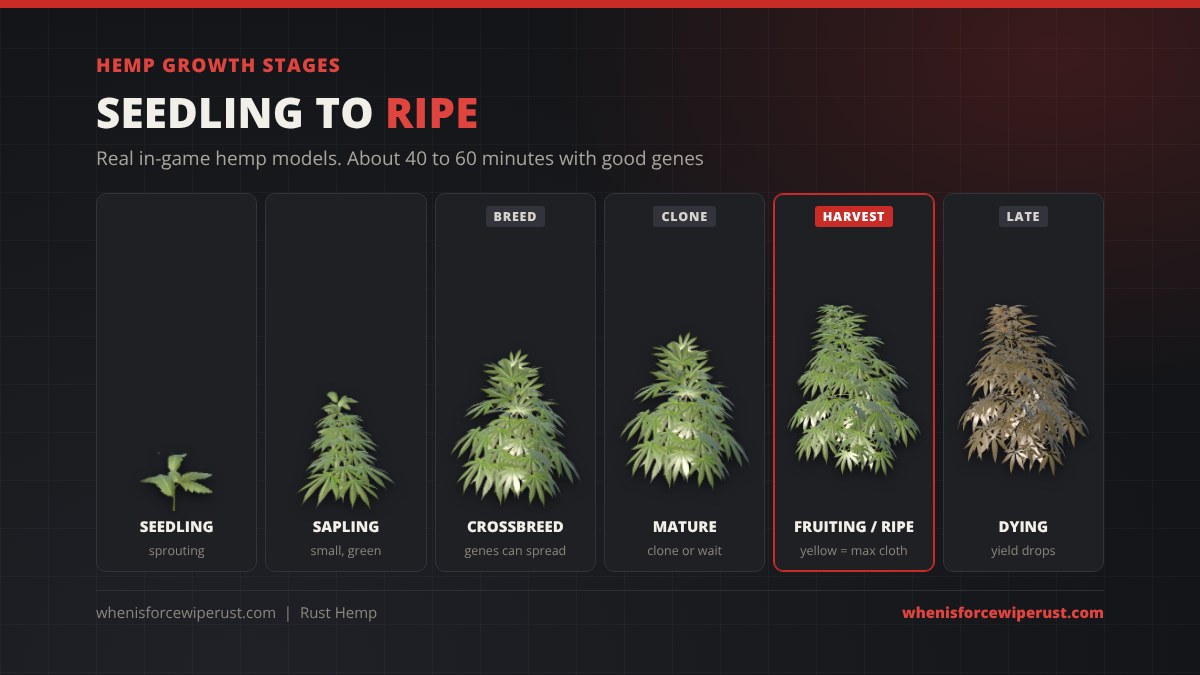
Every planted hemp plant runs through the same stages. You can see the current stage and its progress by looking at the plant.
| Stage | What happens | What you can do |
|---|---|---|
| Seed / Seedling | The plant sprouts | Nothing yet. Keep water and light on it. |
| Sapling | Small green plant | Wait |
| Crossbreed | Genes from neighbouring plants in the same planter can spread into it | This is where breeding happens |
| Mature | Full size, still green | Clone, or harvest early for reduced cloth |
| Fruiting | Yield keeps climbing | Clone, or wait |
| Ripe | Turns bright yellow, yield is at its maximum | Harvest now for the most cloth |
| Dying | Turns brown, yield falls every minute | Harvest fast, or clear it for Plant Fiber |
With good Growth genes, steady water and full light, hemp goes from seed to Ripe in roughly 40 to 60 minutes. Poor genes, a dry planter or weak light can easily double that.
Best Hemp Genes: GGGYYY vs GGYYYY

Every hemp plant has six gene slots, and each slot holds one letter:
| Gene | Name | Effect on hemp |
|---|---|---|
| G | Growth | Faster growth through every stage. Good. |
| Y | Yield | More cloth and more clones per plant. Good. |
| H | Hardiness | Copes better with cold and heat. Only useful in harsh biomes. |
| W | Water | Drinks more water for no benefit. Bad. |
| X | Empty | Does nothing and wastes a slot. Bad. |
The two targets almost every farmer chases are GGGYYY (fastest cycles) and GGYYYY (slightly slower, more cloth per plant and one more clone). Either one massively out-yields a wild seed. Community testing also shows only about four copies of G or Y actually count, so a six-Y plant is not worth hunting for.
Breeding works during the Crossbreed stage. Plants that share a planter can pass genes to each other, and each slot ends up with whichever gene has the most weight around it. Green genes (G, Y, H) carry less weight than red ones (W, X), so one bad neighbour (1.0) outweighs one good one (0.6), and it takes two matching good genes (1.2) to push a bad gene out. Keep W and X plants out of your breeding planters entirely. Our Rust farming guide shows the exact crossbreeding math and the centre-slot layout.
How to Build a Hemp Farm
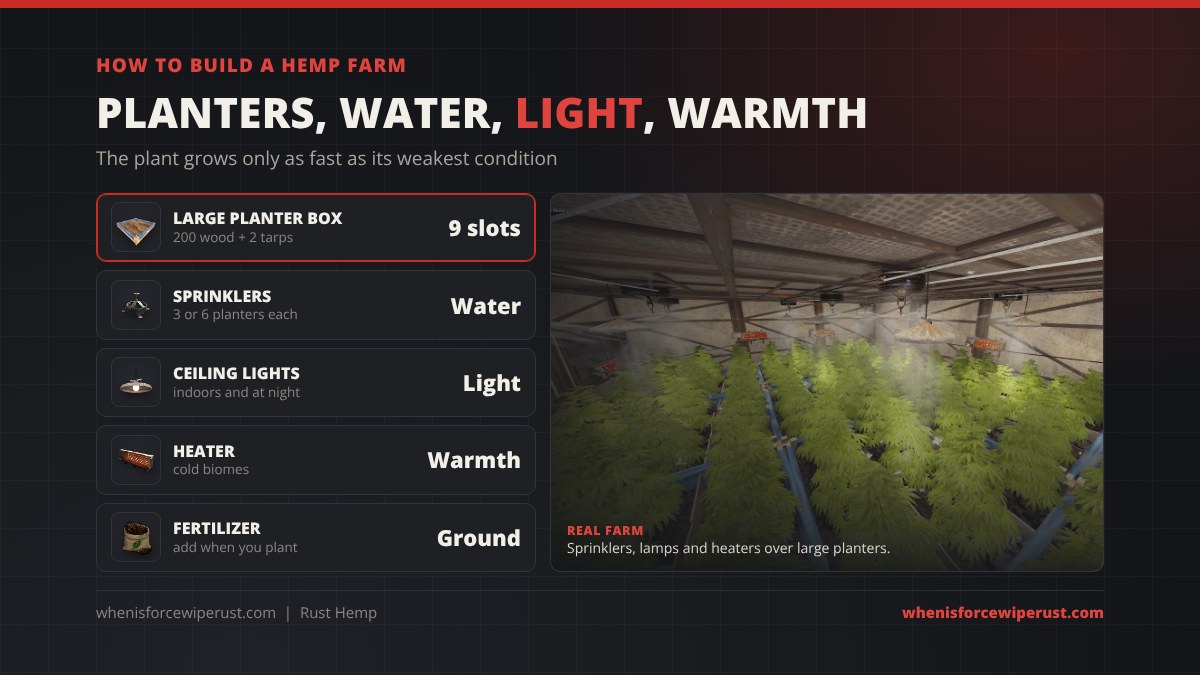
A hemp farm needs four things, and the plant only grows as fast as its weakest one:
- Planters. A Large Planter Box holds 9 plants for 200 wood and 2 tarps. Planters give far better ground than the bare earth, and seeds planted straight in the ground cannot be fertilized.
- Water. A Water Pump on fresh water feeding sprinklers is the standard setup. Keep groups of 3 or 6 planters per sprinkler so every box stays topped up. Overwatering does not hurt hemp.
- Light. Outdoors, the sun does the job by day. Indoors or at night you need Ceiling Lights, which takes power.
- Temperature. Cold biomes slow hemp and cut its yield. A heater beside the planters, or a base in a temperate area, fixes it.
Then top the planters up with fertilizer when you plant. A full setup of a few large planters running GGGYYY clones turns into thousands of cloth an hour, which is more than any group can use, so many players sell the spare at the Bandit Camp or turn it into low grade fuel.
What Is Plant Fiber in Rust?

Plant Fiber is a separate item that people often mix up with hemp. Its game description is “Fiber from dead plants. Can be composted.” You get it by clearing out dead crops, and the only thing it does is go in a Composter.
It is not worth much. In the current game files each Plant Fiber is worth 0.05 fertilizer, so it takes 20 Plant Fiber to make one fertilizer. A single piece of horse dung is worth 10. Drop your Plant Fiber in the Composter so it is not wasted, but do not let crops die on purpose to farm it.
What Hemp Cloth Builds
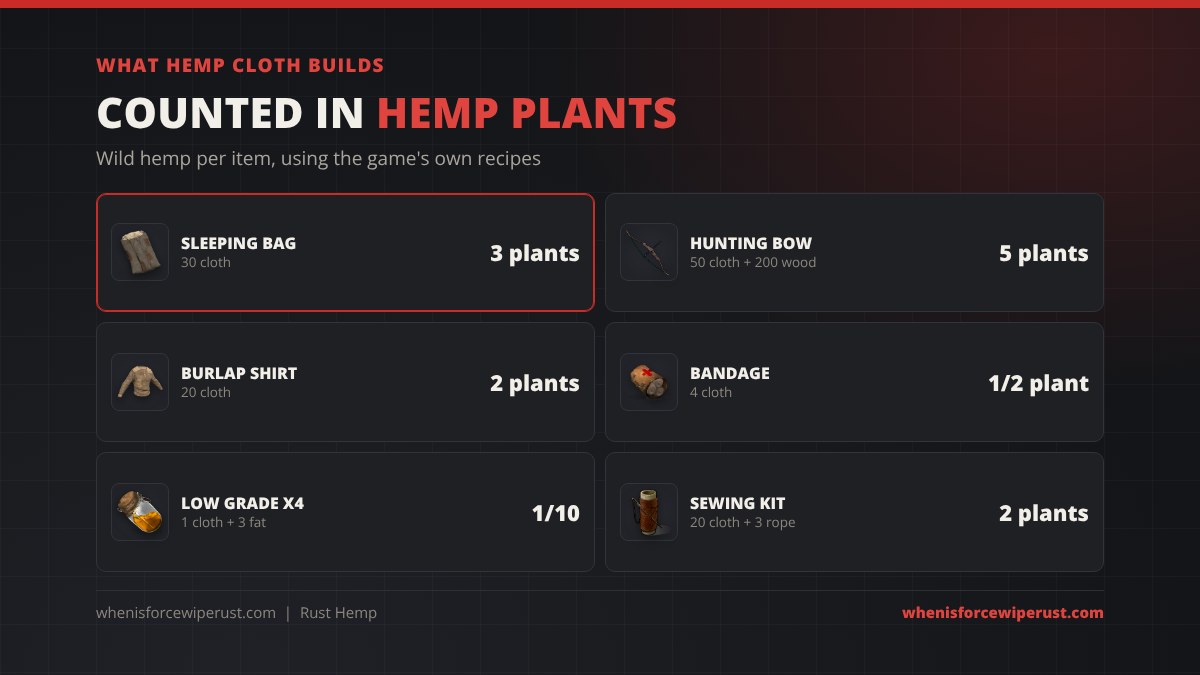
Cloth goes into more recipes than almost any other resource. Here is what the early-game staples cost in wild hemp plants, using the recipes from the game files:
| Item | Cloth | Wild hemp plants |
|---|---|---|
| Sleeping Bag | 30 | 3 |
| Hunting Bow (plus 200 wood) | 50 | 5 |
| Burlap Shirt / Burlap Trousers | 20 each | 2 each |
| Bandage | 4 | Half a plant |
| Low Grade Fuel (plus 3 animal fat, makes 4) | 1 | A tenth of a plant |
| Small Stash | 10 | 1 |
| Sewing Kit (plus 3 rope, Workbench 3) | 20 | 2 |
| Bed (plus 100 frags, 2 sewing kits) | 60 | 6 |
| Jacket (plus 2 sewing kits) | 50 | 5 |
Tarp cannot be crafted at all any more, so cloth does not turn into tarps. Our tarp guide explains where to loot them, and the Rust clothing guide lists every outfit you can sew from your hemp.
Hemp Tips
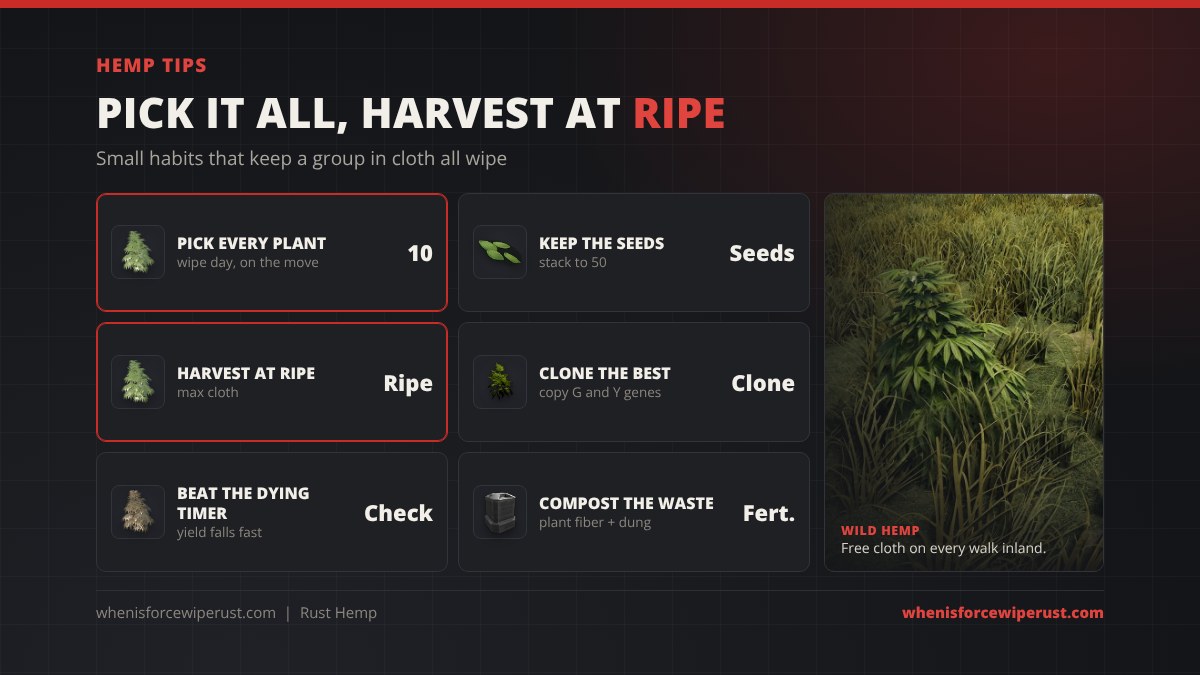
- Never walk past wild hemp early. Ten cloth for one key press is the best rate in the game on wipe day.
- Keep your seeds. They stack to 50, and a few planted seeds are your first chance at a good gene roll.
- Harvest at Ripe, not before. Picking at Mature leaves around half the cloth in the plant.
- Clone, do not replant seeds. Once you have a plant with three or more G and Y genes, clone it into every slot.
- Watch the Dying timer. Yield drops every minute once the plant browns, so set up a routine or a timer to check the farm.
- Compost the waste. Plant Fiber and spare crops go in the Composter, horse dung even more so.
- Plan around the wipe. A good clone line dies with the map. Check the next force wipe date before you sink hours into breeding.
Hemp Rust FAQ
How much cloth does a hemp plant give in Rust?
A fully grown wild hemp plant gives 10 cloth and 1 hemp seed. A hemp plant you grow in a planter gives about 40 to 70 cloth at the Ripe stage with good genes, and less if you pick it early or let it die.
Where do you find hemp in Rust?
Wild hemp grows across the map in grassland, forests, along rivers and in drier areas, and it respawns during the wipe. Look for a tall, bright green plant with star-shaped leaves and press E on it.
How do you get hemp seeds in Rust?
Every wild hemp plant you pick drops 1 hemp seed along with its cloth, and harvesting planted hemp gives seeds too. Hemp seeds stack to 50.
How do you clone hemp in Rust?
Look at a hemp plant you planted once it is grown, hold E and pick the clone option. The plant is used up and you get several hemp clones that copy its genes exactly. Wild hemp cannot be cloned.
What are the best hemp genes in Rust?
GGGYYY for the fastest growth, or GGYYYY for slightly more cloth and one more clone. Avoid W and X genes, and only add H if you farm in a cold biome.
How long does hemp take to grow in Rust?
About 40 to 60 minutes from planting to Ripe with good Growth genes, steady water and full light. Poor genes, a dry planter, darkness or cold can double that.
What is Plant Fiber used for in Rust?
Plant Fiber comes from dead plants and can only be composted. Each piece gives 0.05 fertilizer in a Composter, so 20 Plant Fiber make 1 fertilizer.
Is Hemp Fibers an item in Rust?
No. “Hemp Fibers” is the name that appears when you look at a wild hemp plant, but picking it gives you cloth and a hemp seed directly. There is no Hemp Fibers item to convert.
When should you harvest hemp in Rust?
At the Ripe stage, when the plant turns bright yellow. Its yield is at its maximum then. Mature and Fruiting plants give less, and Dying plants lose yield every minute.