
The Beancan Grenade is Rust’s first real raiding explosive. It is a tin can full of gun powder with a fuse sticking out of the top, it costs 120 sulfur, and you can craft it at a Workbench 1 on day one of a wipe. The game itself calls it an unreliable explosive, and it earns the name: the fuse is random and some cans never go off at all.
Used on the right targets it is one of the best value explosives in the game. Six cans open a wooden door for less sulfur than two satchels, four kill a tool cupboard, and four of them are what every satchel charge is made from. This beancan grenade Rust guide covers the craft cost, the stack size, how the fuse and duds work, a full raid chart, where to find them and when another explosive is the better buy.
- What It Is
- Stats
- Craft a Beancan
- Fuse and Duds
- Raid Chart
- Deployables and Vehicles
- Where to Find
- Beancan vs Others
- Satchels
- Tips
- FAQ
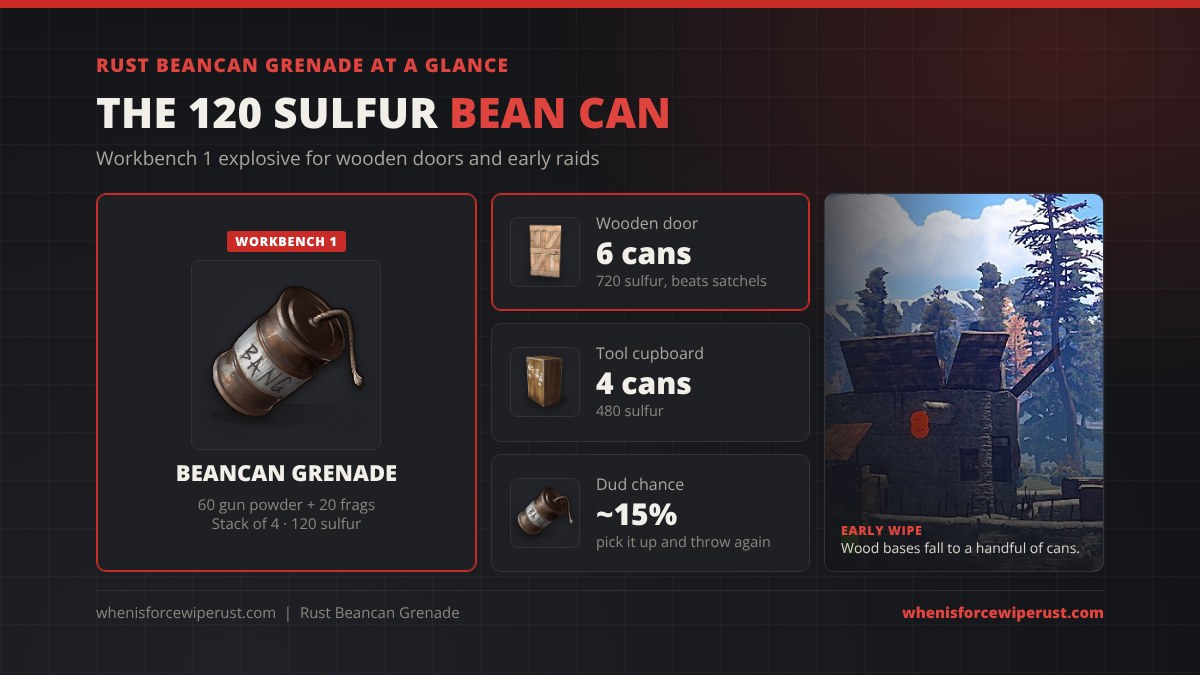
What Is the Beancan Grenade in Rust?
The beancan is a thrown explosive and the cheapest raiding tool you can make before a Workbench 2. It deals about 115 explosive damage in a radius of roughly 4.5 metres, falling off with distance. That is enough to hurt a player badly, but it is mainly used on bases, because explosive damage against doors and deployables is much higher than with the F1 Grenade, which is built for fights instead.
The trade off is reliability. Every can rolls a random fuse when you throw it, and a share of them fizzle out as duds. That randomness carries into the satchel charge, which is four beancans tied to a small stash, and it is why satchels are famous for duds too.
Beancans are also one of the explosives allowed on Primitive servers, so on those wipes they are the main way in through a door. See our Primitive mode guide for the full list.
Beancan Grenade Stats
| Stat | Beancan Grenade |
|---|---|
| Craft cost | 60 Gun Powder, 20 Metal Fragments |
| Raw cost | 120 Sulfur, 180 Charcoal, 20 Metal Fragments |
| Workbench | Workbench 1 |
| Craft time | 10 seconds |
| Research | 40 scrap at a Research Table, or the Workbench 1 tech tree |
| Fuse | Random, usually 3.5 to 4 seconds, sometimes much shorter or longer |
| Dud chance | About 15% (some wikis list up to 25%) |
| Damage | About 115 explosive, roughly 4.5 m radius |
| Stack size | 4 |
| Despawn time | 40 minutes on the ground |
| Recycles into | 36 Gun Powder, 12 Metal Fragments at a powered monument recycler (60%) |
| Shortname / Item ID | grenade.beancan / 1840822026 |
Recipe, stack size, despawn time and research cost come from the current game item files. The item ID is also in our Rust item IDs list for admin commands.
How to Craft a Beancan Grenade in Rust
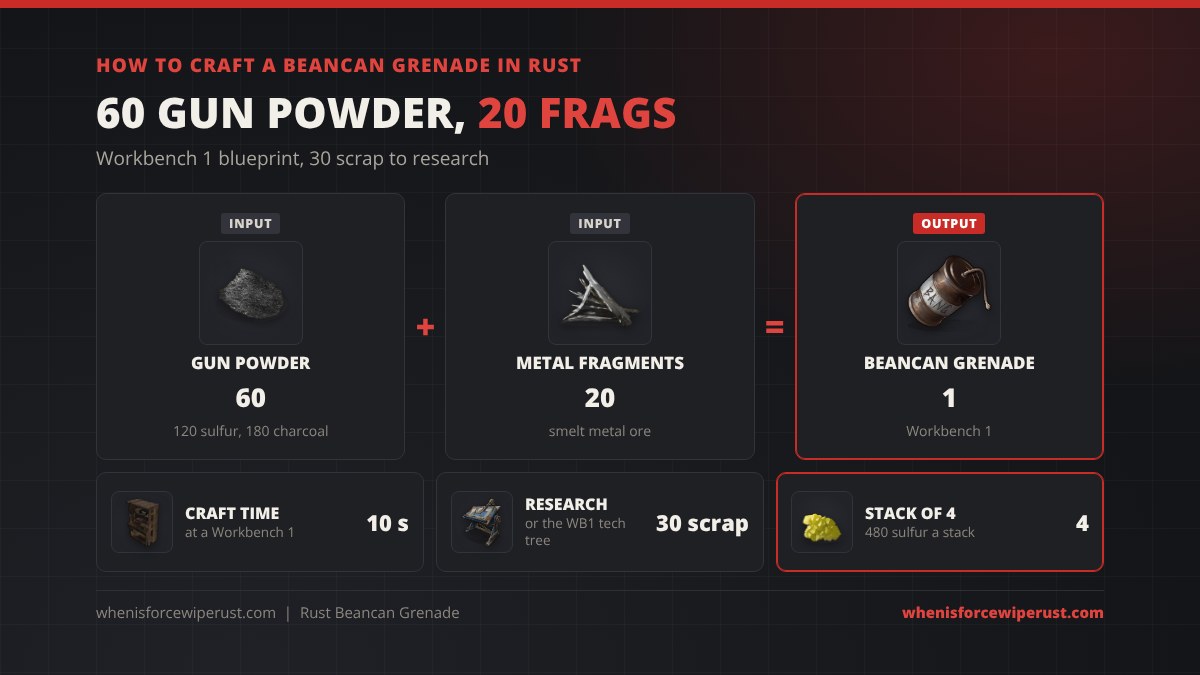
The beancan is not a default blueprint. Put one in a Research Table with 40 scrap, or unlock it on the Workbench 1 page of the tech tree. Then craft it at a Workbench 1 from:
- 60 Gun Powder, which is 120 sulfur and 180 charcoal (gun powder crafts in batches of 10 from 20 sulfur and 30 charcoal).
- 20 Metal Fragments.
Each can takes 10 seconds. A full stack of four is 480 sulfur, exactly the price of one satchel charge. To see how many beancans a whole raid takes, try the Rust eco raid calculator. If you want to plan a bigger batch, our Rust crafting calculator works out the sulfur and charcoal for you.
Stack size. Grenade stacks were cut and standardised on September 3, 2026, alongside the Breach and Clear update. F1, Bee Grenade, Molotov and Flashbang went from 5 to 3, and beancans sit at 4, so a full raid kit of beancans takes more inventory space than it used to.
Beancan Fuse and Duds
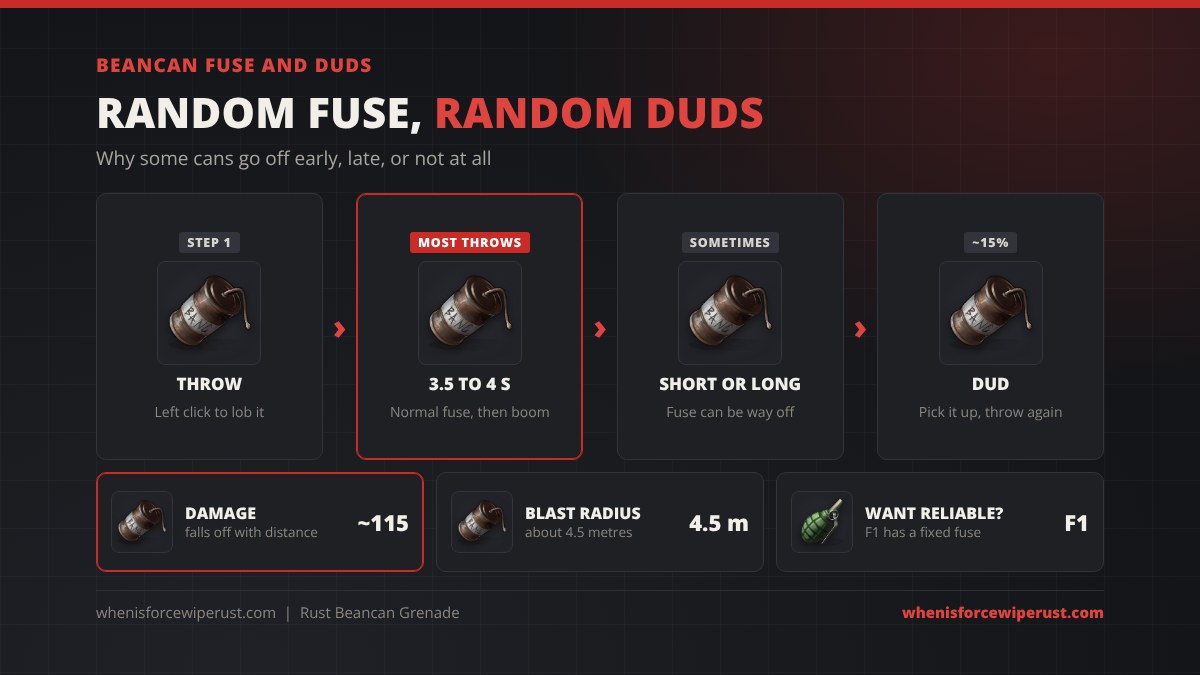
This is what makes the beancan different from every other explosive:
- Normal fuse. Most throws go off after about 3.5 to 4 seconds.
- Short or long fuse. A share of throws roll a fuse that is far shorter or longer. A short one can go off in your face if you stand close, and a long one can make you think it was a dud.
- Duds. About 15% of cans fizzle and do nothing. The can stays on the ground and you can pick it up and throw it again. Wait a few seconds before you grab it, because a long fuse looks exactly like a dud until it goes off.
To throw one, put it on your hotbar, select it and left click. It flies in an arc and rolls, so aim at the base of the door you want to hit. Back off right away, because the blast hurts you as much as the door. If you want a grenade that always goes off on time, the F1 has a fixed fuse of about 3 seconds.
How Many Beancans? Raid Chart
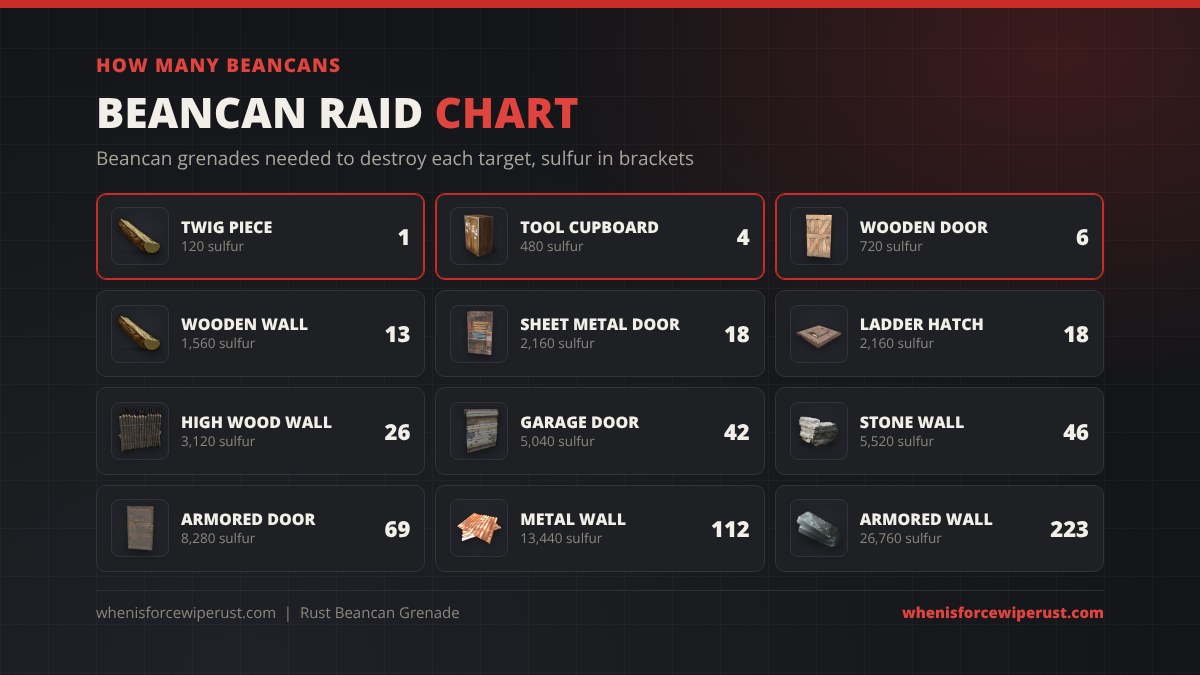
These are the number of cans that actually explode, so add a few spare for duds:
| Target | Beancans | Sulfur |
|---|---|---|
| Twig wall, floor or foundation | 1 | 120 |
| Tool Cupboard | 4 | 480 |
| Wooden Door, Wood Double Door | 6 | 720 |
| Wooden Wall or any wood building piece | 13 | 1,560 |
| Sheet Metal Door, Ladder Hatch | 18 | 2,160 |
| High External Wooden Wall or Gate | 26 | 3,120 |
| Garage Door | 42 | 5,040 |
| Stone Wall, High External Stone Wall | 46 | 5,520 |
| Armored Door | 69 | 8,280 |
| Sheet Metal Wall | 112 | 13,440 |
| Armored Wall | 223 | 26,760 |
The cut-off is the sheet metal door. Up to a wooden door, beancans are the cheapest sulfur option you can craft at a Workbench 1. From sheet metal up, satchels, explosive ammo and C4 all win. To price a full route through a base, use our Rust raid calculator.
For beancans next to every other explosive, grab our printable Rust raid chart (free PDF and HD image).
Beancans vs Deployables and Vehicles

| Target | Beancans | Sulfur |
|---|---|---|
| Stone Barricade | 2 | 240 |
| Sleeping Bag, Wooden Barricade | 4 | 480 |
| Large Wood Box, Bed | 5 | 600 |
| Furnace, Workbench 1 | 8 | 960 |
| Scrap Transport Helicopter | 13 | 1,560 |
| Auto Turret, SAM Site | 16 | 1,920 |
| Snowmobile, Motorbike | 23 | 2,760 |
| Minicopter | 25 | 3,000 |
| Attack Helicopter | 29 | 3,480 |
| Workbench 2 | 59 | 7,080 |
| Bradley APC | 191 | 22,920 |
For turrets and vehicles the F1 is the better grenade: 10 F1s kill a turret for 600 sulfur and 14 kill a minicopter for 840. Keep beancans for doors and the tool cupboard.
Where to Find Beancan Grenades
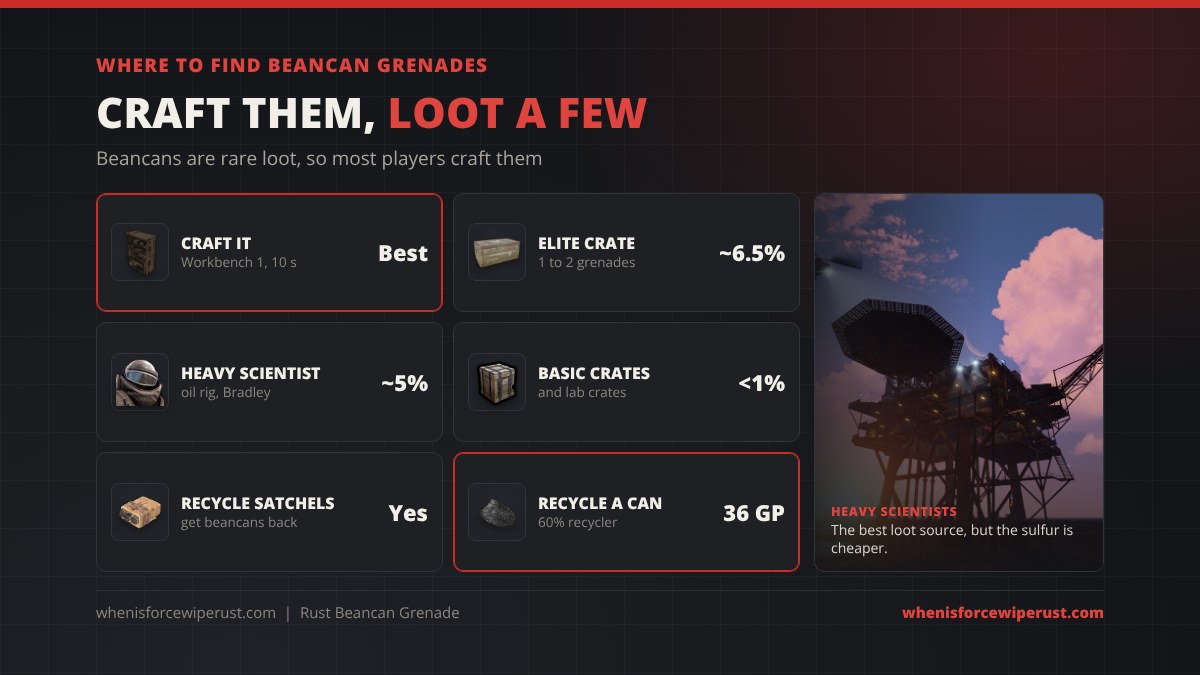
Beancans are not common loot, and most of what you throw in a wipe you will craft yourself. The sources that do drop them:
| Source | Chance | Amount |
|---|---|---|
| Elite Crate (incl. Underwater Labs) | About 6.5% | 1 to 2 |
| Heavy Scientists (Oil Rig, Bradley drops) | About 5% | 1 to 2 |
| Basic crates, underwater lab crates, scientists | Under 1% | 1 |
Drop chances vary between data sites and change with loot table updates, so treat them as rough. If you have sulfur, crafting is always faster than farming crates for them.
Recycling. A beancan recycles into 36 gun powder and 12 metal fragments at a powered monument recycler (60%), or 24 and 8 at a safe zone recycler (40%). A spare satchel charge recycles back into beancans, so leftover satchels after a cancelled raid are not a total loss.
Beancan Grenade vs Other Explosives
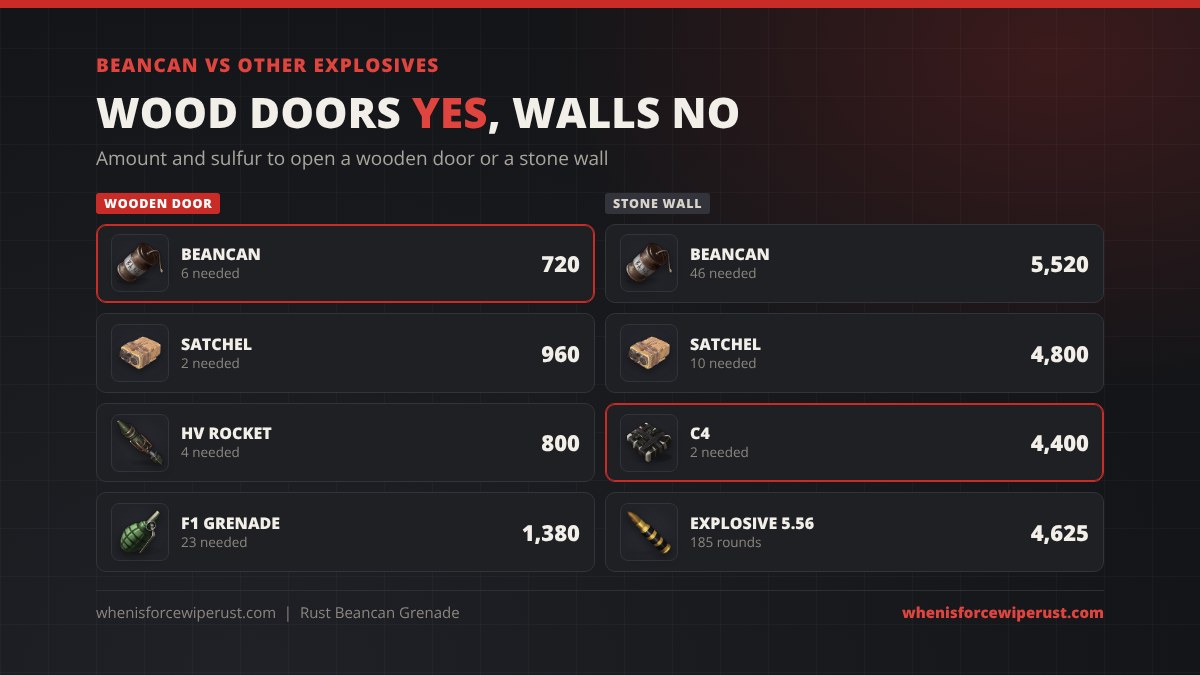
| Tool | Wooden Door | Sheet Metal Door | Stone Wall |
|---|---|---|---|
| Beancan Grenade | 6 (720) | 18 (2,160) | 46 (5,520) |
| Satchel Charge | 2 (960) | 4 (1,920) | 10 (4,800) |
| Explosive 5.56 | 19 (475) | 63 (1,575) | 185 (4,625) |
| High Velocity Rocket | 4 (800) | 11 (2,200) | Poor |
| F1 Grenade | 23 (1,380) | 50 (3,000) | 182 (10,920) |
| Timed Explosive Charge (C4) | 1 (2,200) | 1 (2,200) | 2 (4,400) |
| Molotov Cocktail | 2 (0) | Immune | Immune |
Numbers in brackets are sulfur. Explosive ammo is cheaper on doors but needs a Workbench 3 and an assault rifle, and molotovs only work on wood. For a Workbench 1 raid, beancans are the cheapest sulfur way through a wooden door. Our Rust explosives guide compares every option side by side.
Beancans Make Satchel Charges
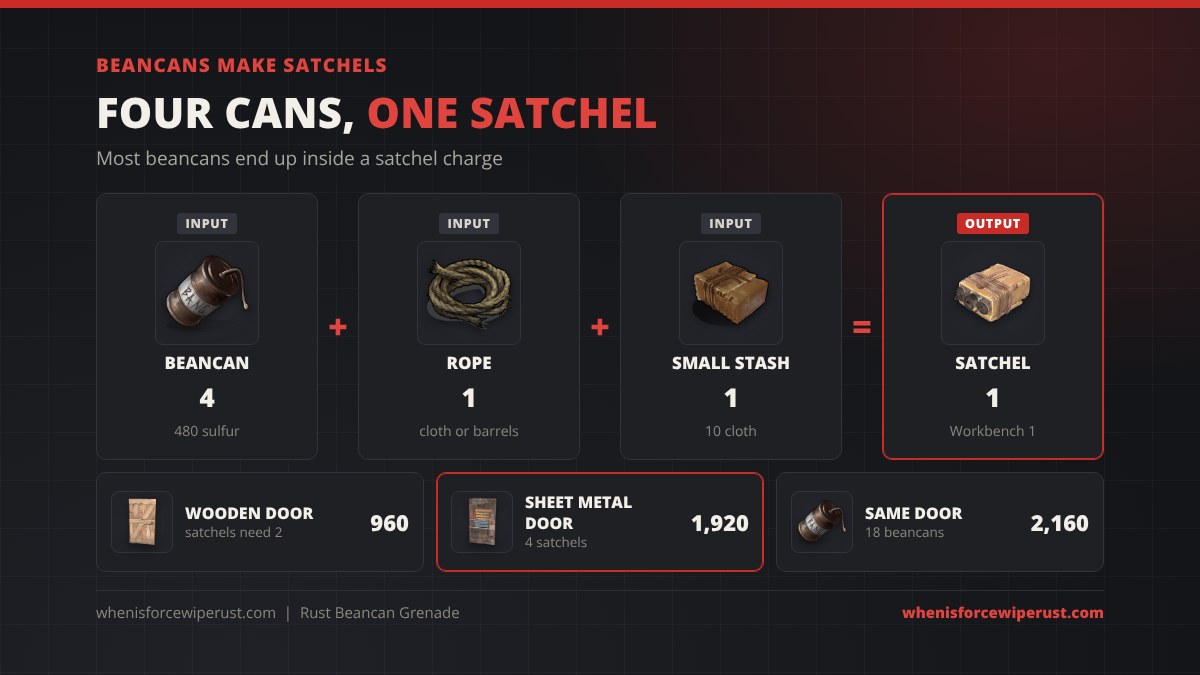
Most beancans end up inside a satchel. The satchel charge recipe is 4 Beancan Grenades, 1 Rope and 1 Small Stash at a Workbench 1, so it costs exactly the same 480 sulfur as four loose cans.
Which to use depends on the target. On a wooden door, six loose beancans (720 sulfur) beat two satchels (960). On a sheet metal door the satchel wins, 4 satchels for 1,920 sulfur against 18 beancans for 2,160, and satchels stick to the door instead of rolling away. Craft your beancans into satchels once the base you are hitting has metal doors.
Beancan Grenade Tips
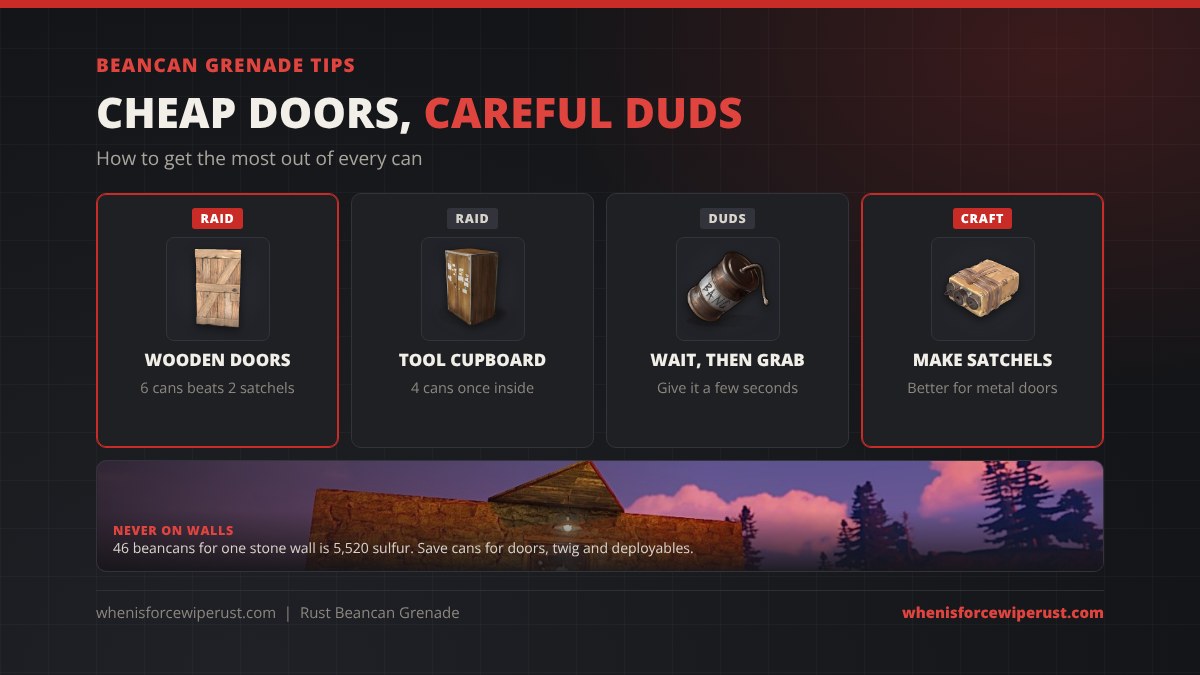
- Hit wooden doors, not walls. Six cans open a wooden door. One stone wall takes 46 cans and 5,520 sulfur.
- Kill the TC once you are in. Four beancans destroy a tool cupboard so you can take building privilege.
- Bring spares. Plan for roughly one dud in every seven cans, plus the odd can that rolls away from the door.
- Wait before you grab a dud. A long fuse looks just like a dud. Give it a few seconds, then pick it up and throw again.
- Do not stand close. A short fuse can go off right after it leaves your hand.
- Switch to satchels for sheet metal. Four satchels beat 18 beancans on a sheet metal door.
- Use F1s for turrets and helis. F1s are cheaper per kill on turrets, barricades and vehicles.
Beancan Grenade Rust FAQ
How do you craft a beancan grenade in Rust?
Craft it at a Workbench 1 from 60 gun powder and 20 metal fragments. It takes 10 seconds. You need the blueprint first, which costs 40 scrap at a Research Table or on the Workbench 1 tech tree.
How much sulfur is a beancan grenade?
120 sulfur. The 60 gun powder in the recipe is made from 120 sulfur and 180 charcoal, plus 20 metal fragments on top.
How many beancans for a wooden door in Rust?
6 beancan grenades, or 720 sulfur. That is cheaper than 2 satchel charges at 960 sulfur. Bring one or two spare for duds.
How many beancans for a sheet metal door?
18 beancan grenades, or 2,160 sulfur. Four satchel charges (1,920 sulfur) or 63 explosive 5.56 rounds (1,575 sulfur) are cheaper.
How many beancans for a stone wall?
46 beancan grenades, or 5,520 sulfur. Two C4 do the same job for 4,400 sulfur, so never use beancans on stone.
How many beancans to destroy a tool cupboard?
4 beancan grenades, or 480 sulfur.
What is the beancan grenade stack size?
Beancan grenades stack to 4. Grenade stacks were cut on September 3, 2026, when F1, Bee Grenade, Molotov and Flashbang went from 5 to 3.
Why did my beancan not explode?
It was a dud, which happens to roughly 15% of beancans, or it rolled a long fuse. Wait a few seconds, then walk up to it, pick it up and throw it again.
How many beancans make a satchel charge?
Four. A satchel charge is 4 beancan grenades, 1 rope and 1 small stash, crafted at a Workbench 1.