
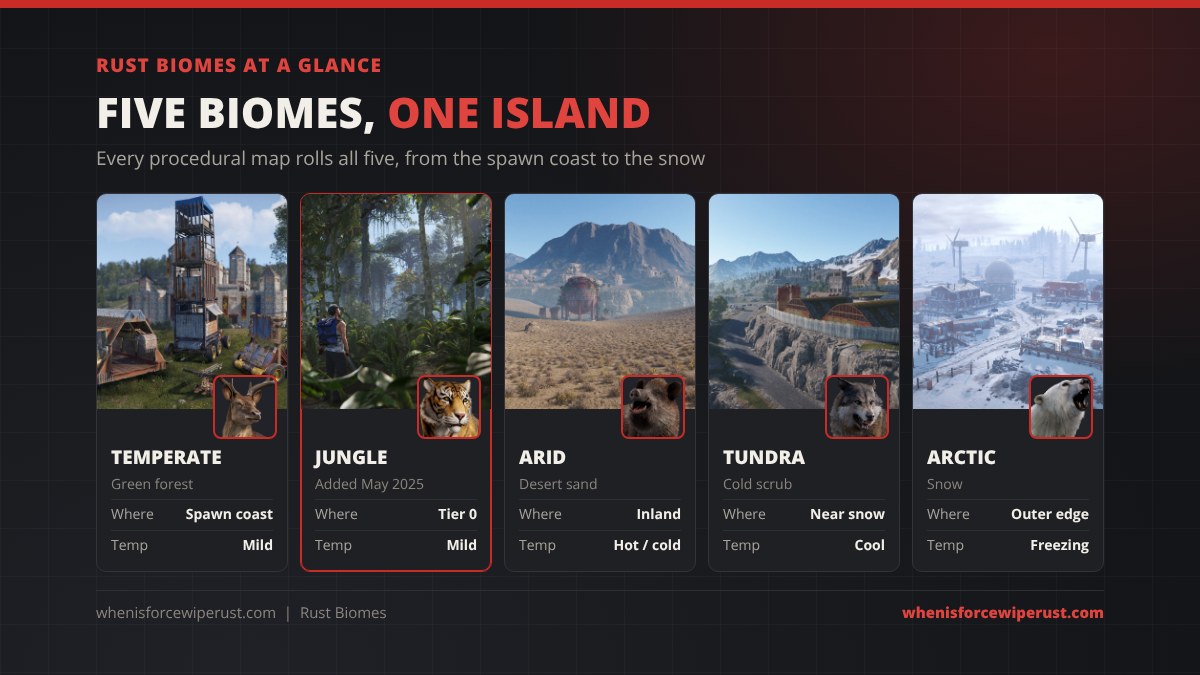
Where you wash up on the beach decides a lot about your first wipe in Rust. The ground under your feet sets how cold you get at night, which animals come for you, what ore is lying around and which monuments are a short run away. That ground is the biome, and every procedural Rust map is a patchwork of five of them.
This Rust biomes guide breaks down all five, temperate, jungle, arid, tundra and arctic, with what each one is good for, what lives there, what to wear, which monuments only spawn in one biome, and where you should actually build. If you want to know when the next fresh map drops, our Rust force wipe countdown has the date.
What Are Biomes in Rust?
A biome in Rust is a climate zone of the map. It sets the ground texture, the trees and plants, which animals spawn, how hot or cold the air is, and which biome-locked monuments can appear there. The world generator paints biomes onto the island when the server builds a procedural map from its seed and size, so the layout changes every wipe.
Biomes follow the map’s tier system. Tier 0, the spawn coast where fresh players wash up, is always temperate, and since the Jungle update part of it is jungle too. The harsher biomes are rolled further out, which is also where the better monuments sit. In short: the further you walk from the spawn beaches, the colder or hotter it gets and the better the loot.
You can tell biomes apart at a glance on the map (G): green is temperate, darker green is jungle, yellow sand is arid, dull olive and brown is tundra, and white is arctic. Larger worlds have more room for desert and snow, so check our Rust map sizes chart if you want a server with a big snow or desert area.
Temperate Biome (Forest)
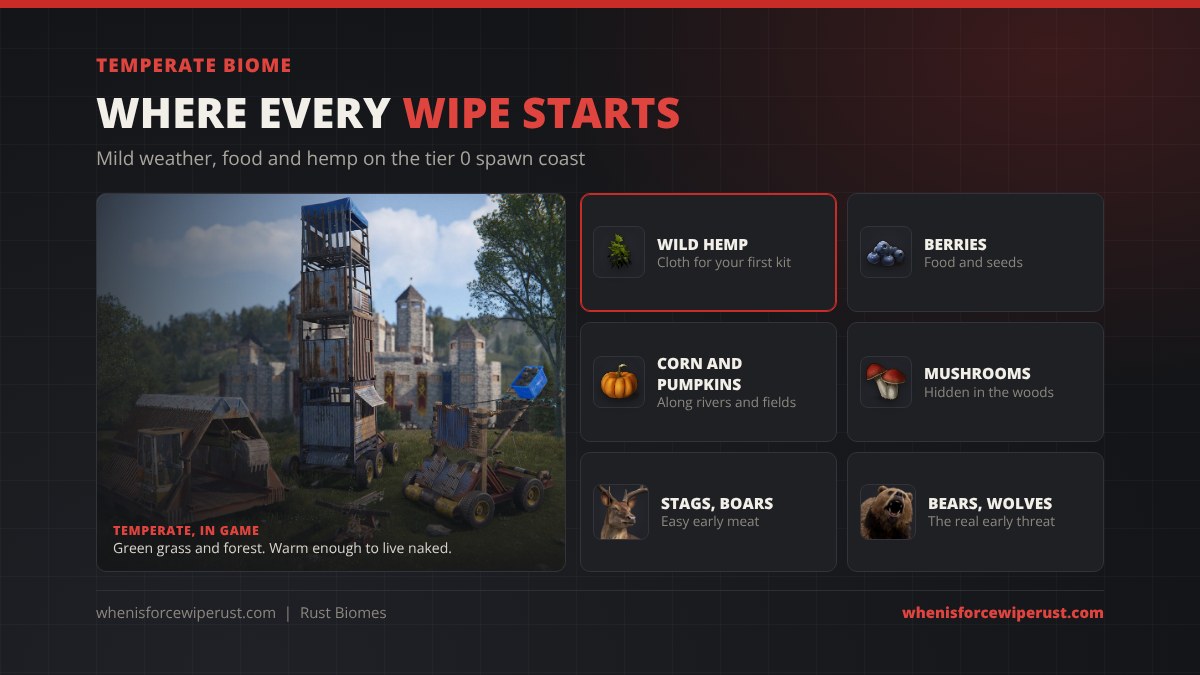
The temperate biome is the green grass and leafy forest that most players picture when they think of Rust. It is the starter biome: you always spawn on its beaches, and it has the mildest temperature in the game, so a naked spawn does not freeze or overheat.
- Resources: wild hemp for cloth, berries, mushrooms, wild roses and other flowers, and corn, pumpkins and potatoes along rivers and in fields. Stone, metal and sulfur nodes are around but thinner than in the mountains.
- Animals: chickens, boars, stags, wild horses, wolves and bears.
- Monuments: mostly starter tier 0 spots like supermarkets, gas stations, lighthouses and the Harbor.
- Best for: solos and new players, early farming of cloth and food, and anyone who wants a quiet first night.
The catch is traffic. Every fresh spawn passes through the temperate coast, so it is also where you meet the most nakeds and roamers on wipe day.
Jungle Biome
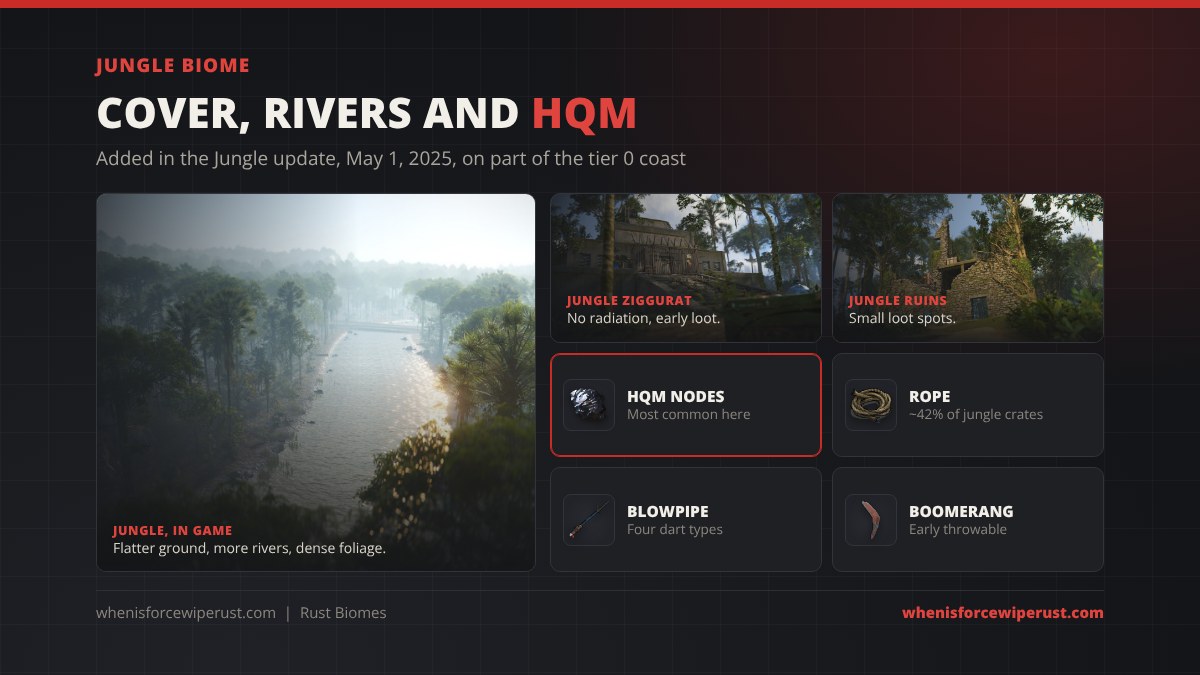
The jungle is the newest biome. Facepunch added it in the Jungle update on May 1, 2025, the first new biome since procedural maps were introduced. It covers part of the tier 0 temperate coast, so you can spawn right next to it. The ground is flatter, there are more rivers, and the foliage is so thick you often cannot see 20 metres. Full base building is allowed.
- Climbable trees and vines: vine-covered kapok trees can be climbed for a lookout, and swinging vines carry you from branch to branch without touching the ground. Vines also give a fast, quiet way back down.
- Monuments: the Jungle Ziggurat and several small Jungle Ruins. Both are early-game loot spots with no radiation, listed in our Rust monuments guide.
- Loot: basic jungle crates carry rope about 42% of the time, and the rare high quality metal nodes added in Breach and Clear are most common in the jungle.
- Weapons it introduced: the blowpipe (wood, scatter, incapacitate and radiation darts) and the boomerang.
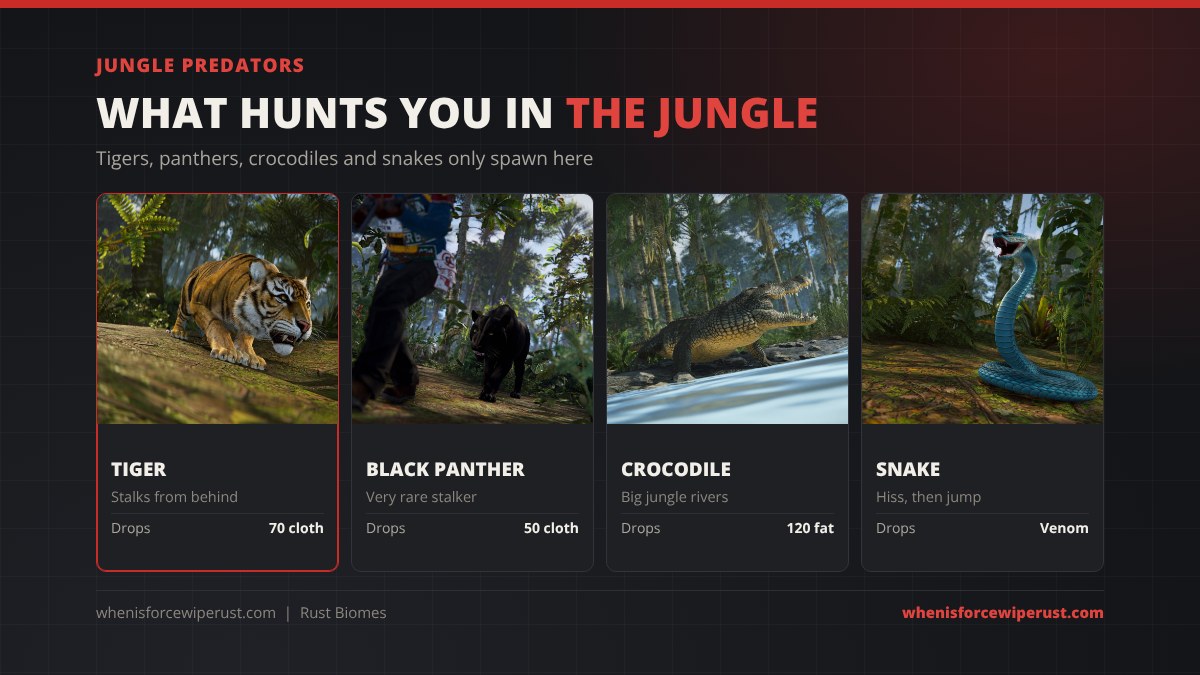
- Animals: tigers, rare black panthers, crocodiles in the wide rivers and snakes in the undergrowth, plus Outbreak Scientists.
How to survive the jungle animals
- Tiger: Facepunch calls it the deadliest animal in Rust. It creeps up slowly from behind and only pounces when it is sure of the kill. The game always gives you at least one warning cue that you are being stalked, so keep sound on and turn around often.
- Black panther: very rare, and hunts the same way as the tiger.
- Crocodile: lives in the wider, deeper jungle rivers and looks like a floating dead tree. Stay off the banks of big rivers with no gun. Its meat goes into the Crocodile Pie, which makes wolves, bears and boars keep their distance.
- Snake: hides in foliage and its bite poisons you, slowing your movement. It hisses before it strikes, and a quick jump after the hiss dodges the bite. Skin dead snakes for Snake Venom, which goes into incapacitate darts.
The Big Cat Pie gives Hunter Vision for 15 minutes, which shows animal scent trails, so it is the food to eat before a jungle hunt.
Arid Biome (Desert)
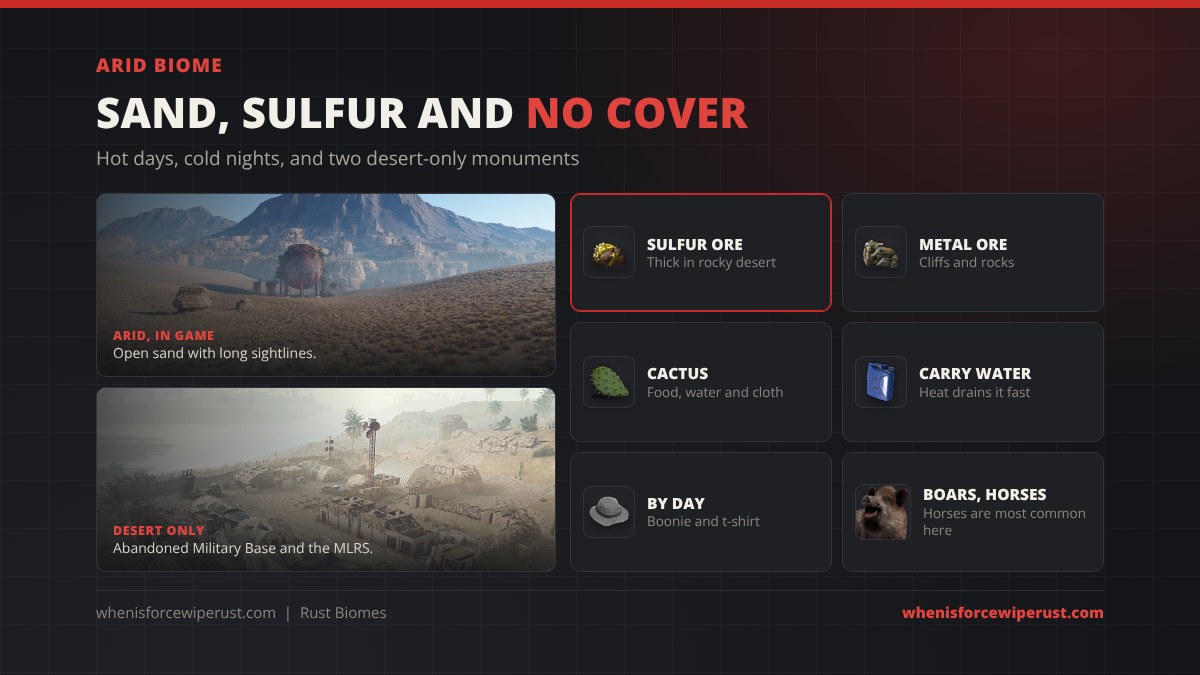
The arid biome is the yellow sand desert. It has the biggest temperature swing in Rust: hot enough during the day to drain your water, and cold enough at night to hurt a naked player. Light clothing like a boonie hat and t-shirt helps by day, but carry a jacket for the night.
- Resources: rocky ground full of stone, metal and sulfur nodes. Cacti give cactus flesh (food and a little water) plus cloth when you cut them. Corn and pumpkins grow along desert rivers.
- Animals: boars, wolves, chickens and lots of wild horses, which are most common in the desert.
- Monuments: the Abandoned Military Base (with the only MLRS on the map) and the Giant Excavator Pit both need a desert to spawn.
- Downside: almost no cover. A base on open sand can be seen from a long way off, and so can you.
Tundra and Arctic Biomes
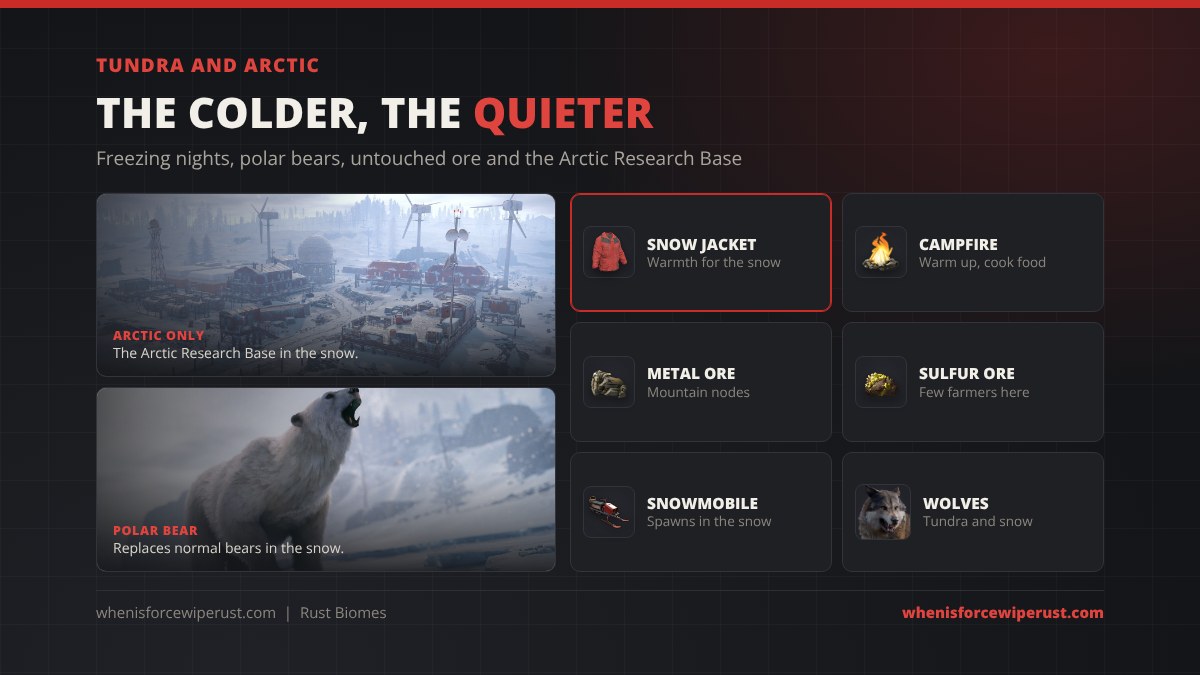
Tundra is the cold scrubland between the green and the snow: brown and olive ground, sparse pines and rock. It is chilly at night but not brutal, and it often sits next to mountains, which makes it a solid ore area with fewer players than the forest.
Arctic (the snow biome) is the harshest part of the map. It is below freezing day and night, being cold burns your calories faster, and wet clothes make it much worse. A Snow Jacket or warm layers, a campfire and a full belly keep you alive.
- Resources: mountains and cliffs packed with metal and sulfur nodes that are often untouched because few players live there. No wild hemp, so cloth is the bottleneck.
- Animals: wolves and polar bears. Since the February 2022 Arctic update, polar bears replace regular bears in the snow and are tougher, but drop more.
- Monuments and vehicles: the Arctic Research Base only spawns in the arctic, and snowmobiles spawn there too.
- Quirk: the metal detector finds nothing in snow.
Rust Biomes Compared
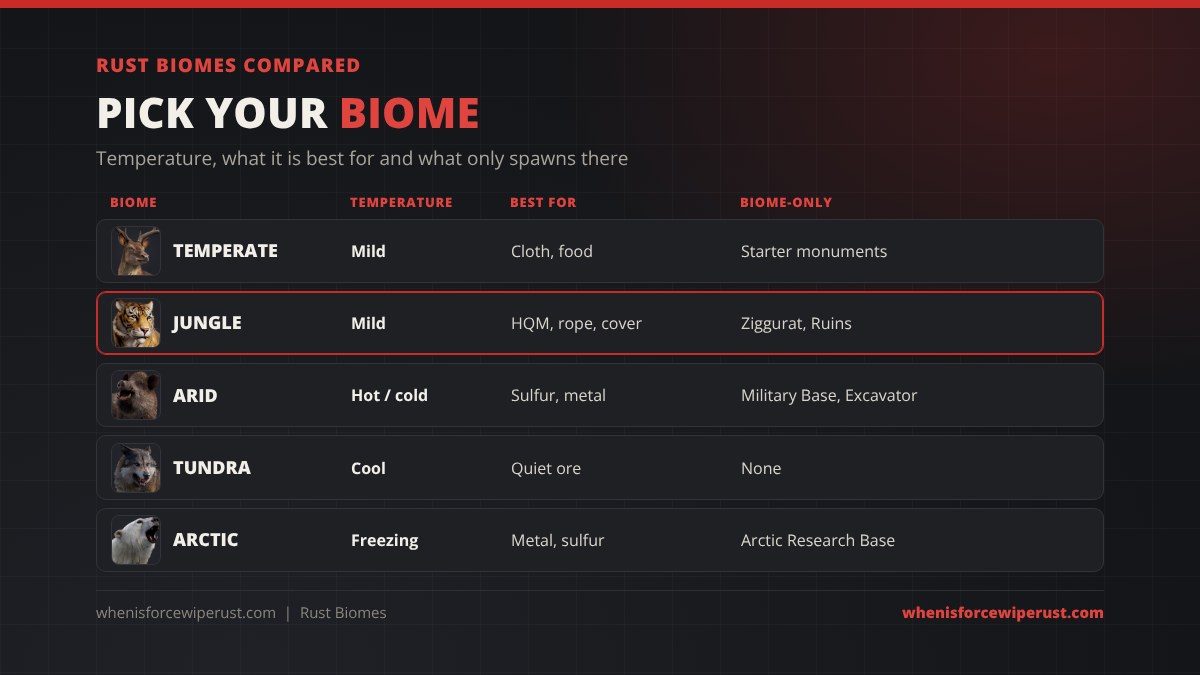
| Biome | Where | Temperature | Best for | Signature animals | Biome-only content |
|---|---|---|---|---|---|
| Temperate | Tier 0 spawn coast | Mild day and night | Cloth, food, safe start | Stag, boar, horse, bear | None (starter monuments) |
| Jungle | Part of tier 0 | Mild | HQM nodes, rope, cover | Tiger, panther, crocodile, snake | Jungle Ziggurat, Jungle Ruins |
| Arid | Further inland | Hot days, cold nights | Sulfur, metal, horses | Boar, wolf, horse | Abandoned Military Base, Giant Excavator |
| Tundra | Between green and snow | Cool, cold nights | Ore with less traffic | Wolf, bear, stag | None |
| Arctic | Outer edge, high ground | Freezing | Metal, sulfur, privacy | Polar bear, wolf | Arctic Research Base, snowmobiles |
Animals by Biome: What Each One Drops
These are the drop numbers we use across the site, taken from the current game data. They show why the jungle and the snow are worth the risk for hunters: a tiger is the best cloth animal in the game, and a polar bear or crocodile is the best animal fat.
| Animal | Biome | Cloth | Animal fat |
|---|---|---|---|
| Tiger | Jungle | 70 | 100 |
| Panther | Jungle (rare) | 50 | 100 |
| Crocodile | Jungle rivers | 30 | 120 |
| Snake | Jungle | – | 10 |
| Polar bear | Arctic | 50 | 120 |
| Bear | Temperate, tundra | 50 | 100 |
| Wolf | Most biomes | 35 | 10 |
| Stag | Temperate, tundra | 25 | 10 |
| Horse | Arid, temperate | 25 | 10 |
| Boar | Most biomes | 10 | 40 |
| Chicken | Temperate, arid | 6 | – |
Bear and polar bear meat is also the base for Bear Pie, and every animal’s meat value is in our Rust food guide.
Which Biome Should You Build In?
There is no single best biome. It depends on your group and what you want from the wipe.
- Solo or new player: temperate, a little inland from the beach. Warm, food everywhere, hemp for cloth, and recyclers at the starter monuments.
- Want cover and HQM: jungle. The thick foliage hides your base and your movements, but bring a weapon for the tigers.
- Sulfur farming duo or trio: the edge of the desert or tundra near mountains. Plenty of nodes and fewer neighbours, but your base is easy to spot on open sand.
- Large group: snow or tundra near the Arctic Research Base or Launch Site side of the map. Lots of untouched ore, less foot traffic, and room to spread out. Keep heaters and furnaces burning.
Whatever you pick, look at the map at the start of the wipe. Our Rust server browser shows each server’s map size and wipe, so you can pick a big map if you want room to choose your biome.
Rust Biome Tips
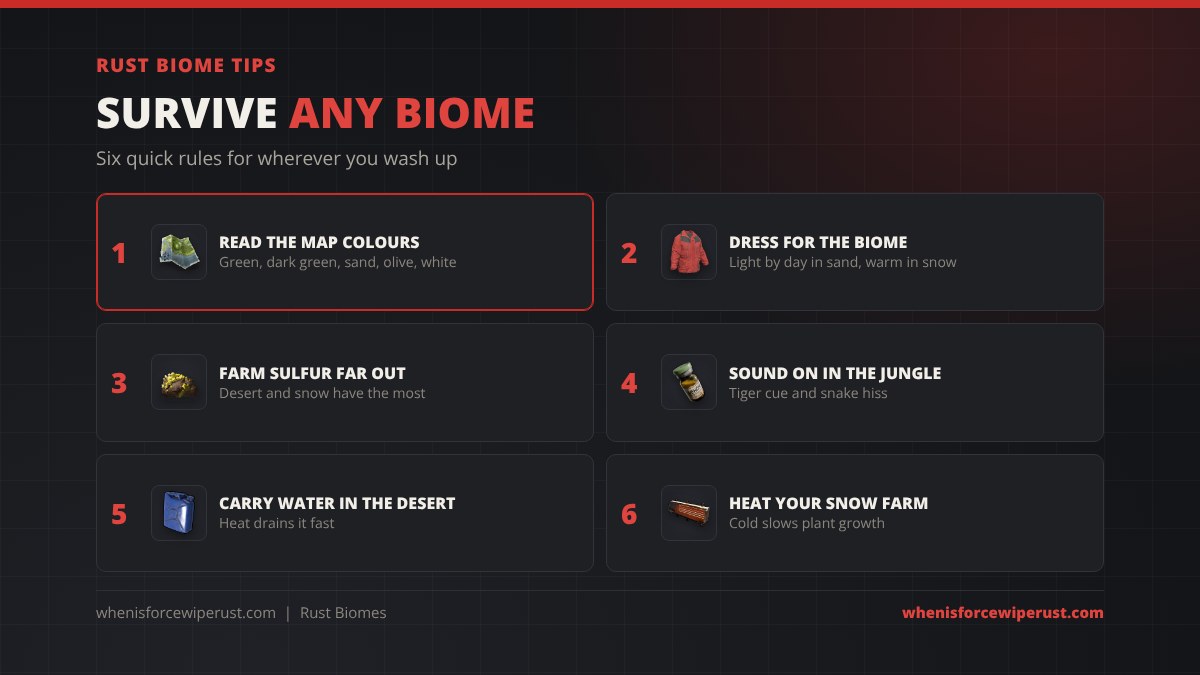
- Dress for the biome. Light clothes in the desert by day, a jacket at night, warm layers or a Snow Jacket in the snow. A Hazmat Suit is not a snow outfit. Our Rust clothing guide has every item’s cold rating.
- Farm the right place. Sulfur is thickest in the desert and snow, metal in mountains and snow, and stone nodes are everywhere.
- Mind the cold on farms. Plants grow slower in cold biomes, so a farm in the snow needs heaters.
- Listen in the jungle. The tiger’s cue and the snake’s hiss are both sounds. Play the jungle with sound on.
- Carry water in the desert. Heat drains water fast, and cactus flesh only helps a little.
- Custom maps play by their own rules. On a custom map the maker chooses the biome split, so classic Hapis Island, for example, is about 42% arctic and has no jungle.
New to the game? Start with our Rust beginner’s guide, and check the next force wipe date so you can start on a fresh map with the biome you want.
Rust Biomes FAQ
How many biomes are in Rust?
Five: temperate, jungle, arid (desert), tundra and arctic (snow). Every default procedural map has all five, while custom maps can use any mix.
When was the jungle biome added to Rust?
On May 1, 2025, in the Jungle update. It was the first new biome since procedural maps were introduced and brought tigers, panthers, crocodiles, snakes, climbable trees, the Jungle Ziggurat and Jungle Ruins.
Where is the jungle on a Rust map?
The jungle takes over part of the tier 0 temperate spawn coast, so it is usually close to the beaches where fresh players spawn. It shows as dark green on the map.
What is the best biome to live in Rust?
Temperate is best for solos and new players because it is warm and full of food and hemp. Groups that want sulfur and privacy often pick the desert edge, tundra or snow near mountains, and the jungle is best if you want cover and HQM nodes.
Which biome has the most sulfur in Rust?
The desert and the snow, especially around cliffs and mountains. Temperate has sulfur nodes too, but fewer, and they get farmed out fast by the crowds on the spawn coast.
Where do polar bears spawn in Rust?
Only in the arctic snow biome. Since the February 2022 Arctic update they replace normal bears there. They are tougher than normal bears and give 120 animal fat.
Where do tigers spawn in Rust?
Tigers, black panthers, crocodiles and snakes spawn in the jungle biome. A tiger drops 70 cloth, the most of any animal.
Which monuments only spawn in one biome?
The Abandoned Military Base and Giant Excavator Pit need the desert, the Arctic Research Base only spawns in the snow, and the Jungle Ziggurat and Jungle Ruins only spawn in the jungle. A map with too little of a biome can be missing its monument.
How do you stay warm in the snow biome in Rust?
Wear a Snow Jacket or warm layers, stay dry, stand near a campfire or heater and keep your calories up, because being cold burns food faster.